Critical Inter-Horizon Thermal Dynamics on the Lukewarm Reissner-Nordstr\"om-de Sitter Manifold
Pith reviewed 2026-06-30 22:17 UTC · model grok-4.3
The pith
Lukewarm Reissner-Nordström-de Sitter black holes mark the exact zero-dissipation point of an effective two-horizon thermal system.
A machine-rendered reading of the paper's core claim, the machinery that carries it, and where it could break.
Core claim
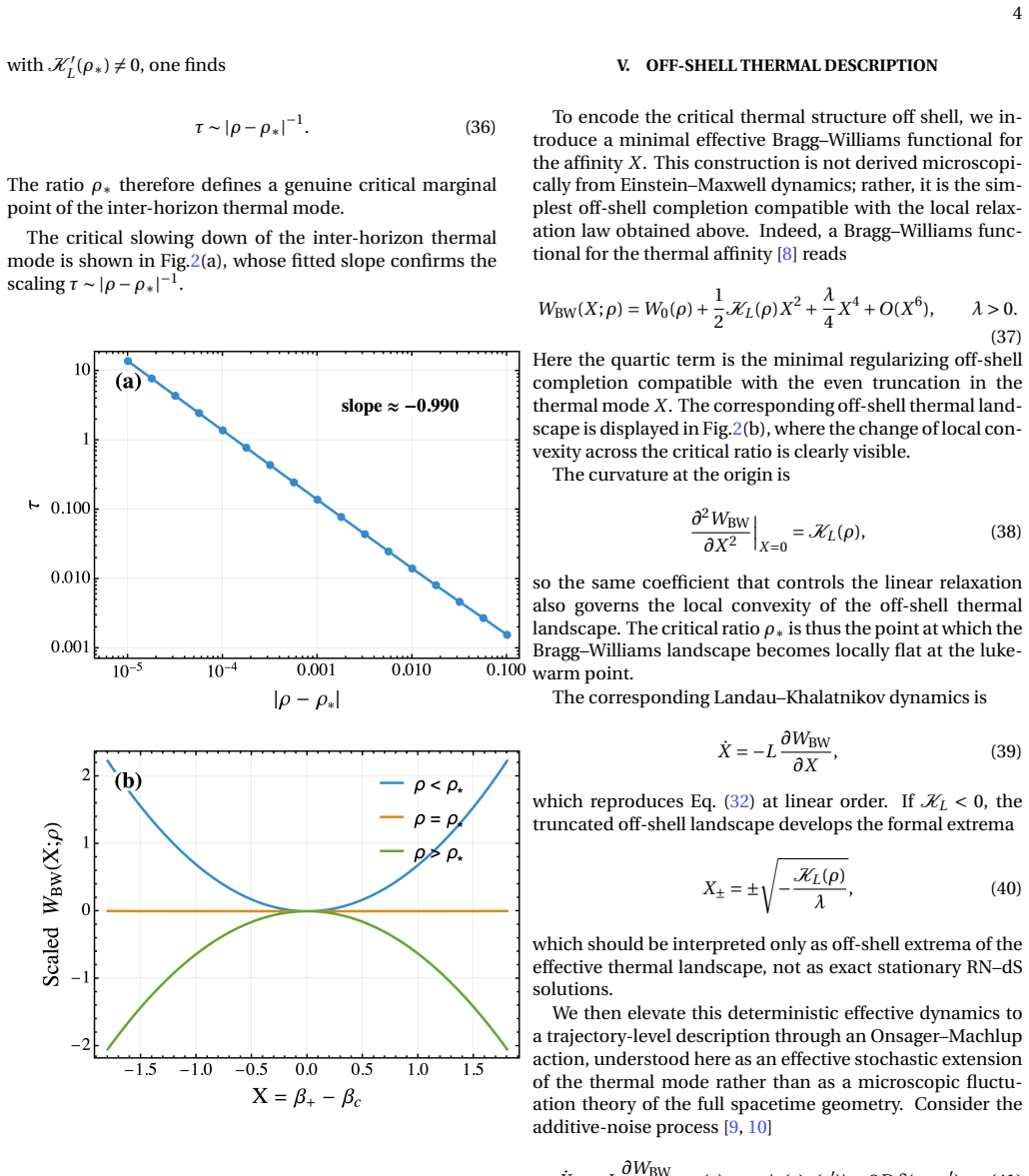
The lukewarm branch is promoted from a geometric equal-temperature locus to a critical inter-horizon thermal manifold in which the inter-horizon thermal affinity vanishes and the linearized thermal mode governed by K_L(ρ) changes stability at ρ* = (1 + √3 − √2 · 3^{1/4})/2 ≈ 0.4354, with relaxation time diverging as τ ∼ |ρ − ρ*|^{-1}.
What carries the argument
The inter-horizon thermal affinity, identified as the entropy-production rate of the effective two-horizon nonequilibrium system and expressed through the single scalar relaxation coefficient K_L(ρ) in the fixed-charge sector.
If this is right
- The thermal affinity vanishes exactly on the lukewarm branch.
- The linearized thermal mode changes stability at the critical ratio ρ* ≈ 0.4354.
- The relaxation time diverges as τ ∼ |ρ − ρ*|^{-1} at the critical point.
- The critical structure is encoded in a Bragg-Williams functional and an Onsager-Machlup action for the effective thermal trajectories.
Where Pith is reading between the lines
- The same construction could be tested on other multi-horizon geometries to check whether equal-temperature loci systematically coincide with vanishing affinity.
- The divergence of relaxation time suggests a dynamical slowing that might be observable in numerical simulations of horizon perturbations near the critical ratio.
- The Onsager-Machlup action provides a variational principle that could be used to derive higher-order corrections to the thermal mode dynamics.
Load-bearing premise
The inter-horizon thermal affinity can be identified with the entropy-production rate of an effective two-horizon nonequilibrium system whose dynamics are captured by a single scalar mode K_L(ρ) in the fixed-charge sector.
What would settle it
A direct computation showing that the inter-horizon affinity fails to vanish on the lukewarm branch, or that the relaxation time of the thermal mode does not diverge at the stated value of ρ*.
Figures

read the original abstract
We reinterpret the lukewarm sector of four-dimensional Reissner--Nordstr\"om--de Sitter black holes as the exact zero-dissipation thermal manifold of an effective two-horizon nonequilibrium system. In the fixed-charge sector, the inter-horizon thermal affinity controls the entropy production and vanishes precisely on the lukewarm branch. The corresponding linearized thermal mode is governed by an exact relaxation coefficient \(K_L(\rho)\), with \(\rho=r_+/r_c\), and changes stability at the critical ratio \[ \rho_*=\frac{1+\sqrt{3}-\sqrt{2}\,3^{1/4}}{2}\approx 0.4354, \] where the relaxation time diverges as \(\tau\sim |\rho-\rho_*|^{-1}\). We then encode this critical structure in a minimal Bragg--Williams functional and an Onsager--Machlup action for the effective trajectories of the thermal mode. In this way, the lukewarm branch is promoted from a geometric equal-temperature locus to a critical inter-horizon thermal manifold.
Editorial analysis
A structured set of objections, weighed in public.
Referee Report
Summary. The manuscript reinterprets the lukewarm sector of four-dimensional Reissner-Nordström-de Sitter black holes as the exact zero-dissipation thermal manifold of an effective two-horizon nonequilibrium system. In the fixed-charge sector, the inter-horizon thermal affinity is claimed to control entropy production and to vanish precisely on the lukewarm branch; the linearized thermal mode is governed by an exact relaxation coefficient K_L(ρ) (with ρ = r_+/r_c) that changes stability at the critical ratio ρ_* = (1 + √3 − √2 · 3^{1/4})/2 ≈ 0.4354, where the relaxation time diverges as τ ∼ |ρ − ρ_*|^{-1}. The critical structure is then encoded in a minimal Bragg-Williams functional and an Onsager-Machlup action.
Significance. If the effective single-mode nonequilibrium description is valid and free of additional constraints from the Einstein equations, the work would supply an exactly computable critical ratio together with a diverging relaxation time, furnishing a concrete link between black-hole thermodynamics and nonequilibrium statistical mechanics. The algebraic form of ρ_* would constitute a genuine strength if shown to be parameter-free.
major comments (2)
- [Abstract] Abstract, paragraph 2: the central claim rests on identifying the inter-horizon thermal affinity with the entropy-production rate of an effective two-horizon nonequilibrium system governed by the single scalar mode K_L(ρ). This identification is load-bearing for the reinterpretation yet its consistency with the full Einstein equations and the absence of other gravitational modes is not demonstrated.
- [Abstract] Abstract: the vanishing of the thermal affinity on the lukewarm branch is presented as a derived result, but the affinity appears to be constructed from the same surface gravities and horizon areas that already enforce the lukewarm condition (equal temperatures); the paper must show that the affinity is independently defined as an entropy-production rate rather than by construction.
minor comments (1)
- The abstract supplies both the exact algebraic expression and the decimal approximation for ρ_*; this is useful, but the explicit functional form of K_L(ρ) and the steps that produce the divergence τ ∼ |ρ − ρ_*|^{-1} should be stated already in the introduction.
Simulated Author's Rebuttal
We thank the referee for their careful reading of the manuscript and for the constructive comments. We address each of the major comments below.
read point-by-point responses
-
Referee: [Abstract] Abstract, paragraph 2: the central claim rests on identifying the inter-horizon thermal affinity with the entropy-production rate of an effective two-horizon nonequilibrium system governed by the single scalar mode K_L(ρ). This identification is load-bearing for the reinterpretation yet its consistency with the full Einstein equations and the absence of other gravitational modes is not demonstrated.
Authors: The present work develops an effective thermodynamic description of the inter-horizon dynamics, treating the two horizons as an effective nonequilibrium system with a single scalar mode. The identification follows from applying standard nonequilibrium relations to this reduced system. A demonstration of consistency with the complete set of Einstein equations and the decoupling from all other gravitational modes would require a separate, more extensive analysis of linear perturbations around the RNdS background, which is beyond the scope of this manuscript. We will revise the text to explicitly state the effective character of the model and note this limitation. revision: partial
-
Referee: [Abstract] Abstract: the vanishing of the thermal affinity on the lukewarm branch is presented as a derived result, but the affinity appears to be constructed from the same surface gravities and horizon areas that already enforce the lukewarm condition (equal temperatures); the paper must show that the affinity is independently defined as an entropy-production rate rather than by construction.
Authors: The thermal affinity is introduced as the thermodynamic force driving entropy production in the effective two-horizon system, defined via the standard relation \dot{S}_{prod} = A \cdot J where A is the affinity and J the flux. Its explicit form in terms of the surface gravities and areas is obtained by expressing the entropy production for the inter-horizon heat flow. The fact that this affinity vanishes when the temperatures are equal (the lukewarm condition) is a derived consequence of the thermodynamic structure, not an input. We will clarify this definition and derivation in the revised abstract and in the main text to avoid any impression of circularity. revision: yes
Circularity Check
Affinity vanishing on lukewarm branch reduces to tautology via geometric definition
specific steps
-
self definitional
[abstract]
"We reinterpret the lukewarm sector of four-dimensional Reissner--Nordström--de Sitter black holes as the exact zero-dissipation thermal manifold of an effective two-horizon nonequilibrium system. In the fixed-charge sector, the inter-horizon thermal affinity controls the entropy production and vanishes precisely on the lukewarm branch."
The lukewarm branch is the geometric locus where the two horizons have equal temperature (equal surface gravities). Defining the thermal affinity via the same geometric quantities (temperature difference or equivalent) makes its vanishing on that branch true by definition, rendering the statement that it 'vanishes precisely on the lukewarm branch' a tautology rather than a derived prediction from dynamics.
full rationale
The paper's core claim that inter-horizon thermal affinity vanishes on the lukewarm branch follows directly from the identification of affinity with the same surface gravities/areas that define equal-temperature loci in RNdS. This makes the vanishing true by construction rather than a dynamical result. The linearized mode K_L(ρ) and critical ρ_* are then built atop this redefinition, with the Bragg-Williams/Onsager-Machlup encoding adding no independent content from the Einstein equations. The derivation chain is therefore partially self-definitional at the load-bearing step, though the explicit algebraic form of ρ_* shows some non-tautological calculation once the identification is granted.
Axiom & Free-Parameter Ledger
axioms (1)
- domain assumption The inter-horizon thermal affinity controls entropy production in the fixed-charge sector
invented entities (2)
-
effective two-horizon nonequilibrium system
no independent evidence
-
linearized thermal mode K_L(ρ)
no independent evidence
Reference graph
Works this paper leans on
-
[1]
J. D. Bekenstein, Black holes and entropy, Phys. Rev. D7, 2333 (1973)
1973
-
[2]
S. W . Hawking, Particle creation by black holes, Commun. Math. Phys.43, 199 (1975)
1975
-
[3]
G. W . Gibbons and S. W . Hawking, Cosmological event hori- zons, thermodynamics, and particle creation, Phys. Rev. D15, 2738 (1977)
1977
-
[4]
L. J. Romans, Supersymmetric, cold and lukewarm black holes in cosmological einstein-maxwell theory, Nucl. Phys. B 383, 395 (1992), arXiv:hep-th/9203018
work page internal anchor Pith review Pith/arXiv arXiv 1992
-
[5]
M. Urano, A. Tomimatsu, and H. Saida, Mechanical first law of black hole spacetimes with cosmological constant and its ap- plication to schwarzschild-de sitter spacetime, Class. Quant. Grav.26, 105010 (2009), arXiv:0903.4230 [gr-qc]
work page internal anchor Pith review Pith/arXiv arXiv 2009
-
[6]
Thermodynamics of horizons: de Sitter black holes and reentrant phase transitions
D. Kubiz ˇ nák and F . Simovic, Thermodynamics of horizons: de sitter black holes and reentrant phase transitions, Class. Quant. Grav.33, 245001 (2016), arXiv:1507.08630 [gr-qc]
work page internal anchor Pith review Pith/arXiv arXiv 2016
-
[7]
Critical Phenomena of Born-Infeld-de Sitter Black Holes in Cavities
F . Simovic and R. B. Mann, Critical phenomena of born- infeld-de sitter black holes in cavities, JHEP05, 136, arXiv:1904.04871 [hep-th]
work page internal anchor Pith review Pith/arXiv arXiv 1904
-
[8]
A Note on Charged Black Holes in AdS space and the Dual Gauge Theories
S. Banerjee, A note on charged black holes in ads space and the dual gauge theories, Phys. Rev. D82, 106008 (2010), arXiv:1009.1780 [hep-th]
work page internal anchor Pith review Pith/arXiv arXiv 2010
-
[9]
Onsager and S
L. Onsager and S. Machlup, Fluctuations and irreversible pro- cesses, Phys. Rev.91, 1505 (1953)
1953
-
[10]
Machlup and L
S. Machlup and L. Onsager, Fluctuations and irreversible pro- cess. ii. systems with kinetic energy, Phys. Rev.91, 1512 (1953)
1953
-
[11]
S.-W . Wei and Y.-X. Liu, Topology of black hole thermodynam- ics, Phys. Rev. D105, 104003 (2022), arXiv:2112.01706 [gr-qc]
- [12]
discussion (0)
Sign in with ORCID, Apple, or X to comment. Anyone can read and Pith papers without signing in.