Particle Physics in Curved Spacetime and Dark Matter
Pith reviewed 2026-06-30 16:33 UTC · model grok-4.3
The pith
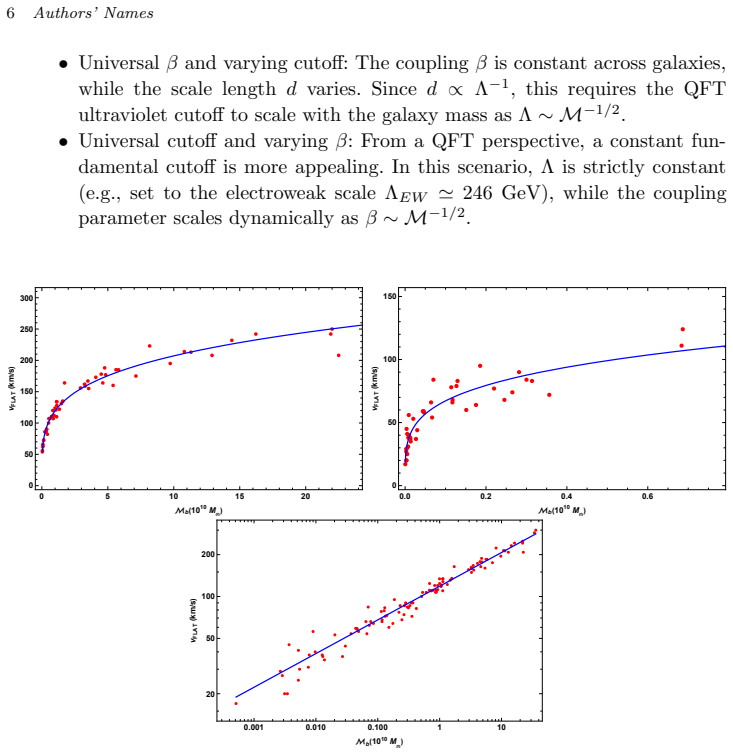
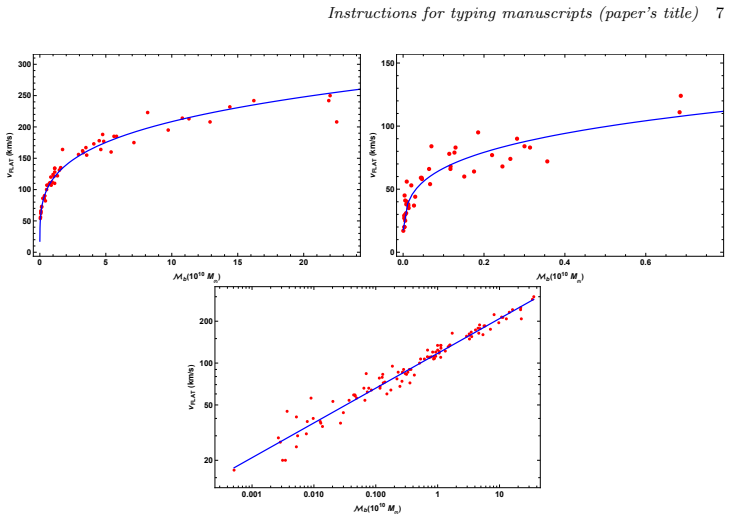
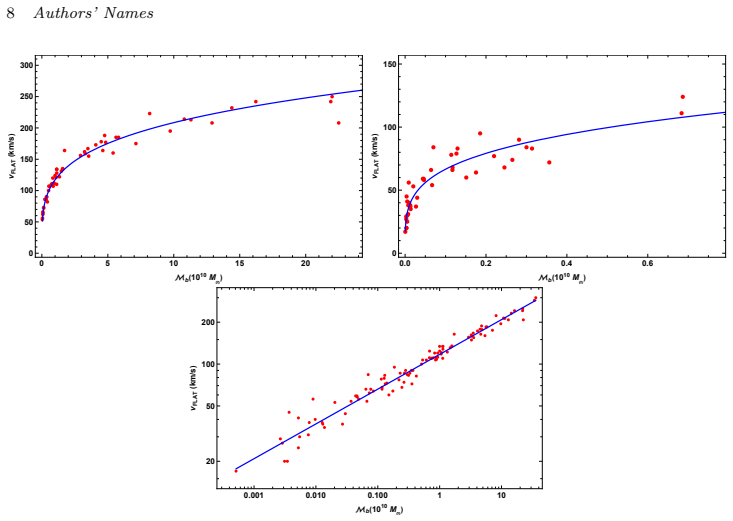
The semiclassical energy-momentum tensor of the neutrino flavor vacuum fulfills the equation of state of cold dark matter and contributes a Yukawa correction to the Newtonian potential that accounts for flat rotation curves.
A machine-rendered reading of the paper's core claim, the machinery that carries it, and where it could break.
Core claim
Within quantum field theory in curved spacetime, the semiclassical energy-momentum tensor of the neutrino flavor vacuum fulfills the equation of state of dust and cold dark matter. By considering spherically symmetric spacetimes in the weak field approximation, the flavor vacuum is shown to contribute as a Yukawa correction to the Newtonian potential. This modified potential provides a mechanism to account for the flat rotation curves of spiral galaxies, presenting neutrino mixing as a viable contributing factor to the dark matter content of the universe.
What carries the argument
The semiclassical energy-momentum tensor of the neutrino flavor vacuum, which satisfies a dust equation of state and induces Yukawa corrections to gravity in weak-field limits.
If this is right
- The flavor vacuum acts as a source of cold dark matter.
- It leads to modified gravity potentials that fit galaxy dynamics.
- Neutrino mixing effects become relevant for large-scale structure.
Where Pith is reading between the lines
- If valid, this links quantum mixing phenomena directly to gravitational observations at galactic scales.
- Future measurements of rotation curves could test the specific form of the Yukawa correction predicted.
- Extensions to other metrics or cosmological backgrounds might reveal additional effects from flavor vacua.
Load-bearing premise
The semiclassical approximation remains valid for the energy-momentum tensor of the flavor vacuum on the curved spacetimes considered, producing a dust-like equation of state.
What would settle it
A mismatch between the predicted Yukawa-modified rotation curves and high-precision observations of spiral galaxy velocities would falsify the claim that this mechanism accounts for the flat curves.
Figures
read the original abstract
We review recent results showing that, within the framework of quantum field theory in curved spacetime, the semiclassical energy-momentum tensor of the neutrino flavor vacuum fulfills the equation of state of dust and cold dark matter. By considering spherically symmetric spacetimes in the weak field approximation, the flavor vacuum is shown to contribute as a Yukawa correction to the Newtonian potential. We discuss how this modified potential provides a mechanism to account for the flat rotation curves of spiral galaxies. In this perspective, neutrino mixing is presented as a viable contributing factor to the dark matter content of the universe.
Editorial analysis
A structured set of objections, weighed in public.
Referee Report
Summary. The manuscript reviews results from quantum field theory in curved spacetime claiming that the semiclassical energy-momentum tensor of the neutrino flavor vacuum satisfies the dust equation of state (p=0, w=0) and, in the weak-field spherically symmetric limit, contributes a Yukawa correction to the Newtonian gravitational potential that can account for the flat rotation curves of spiral galaxies, positioning neutrino mixing as a contributing factor to dark matter.
Significance. If the underlying derivations hold, the work would establish a direct link between standard-model neutrino flavor mixing and cold dark matter phenomenology without new particles or free parameters, offering a falsifiable mechanism testable via rotation-curve data and weak-field limits. The review format usefully consolidates these results, but significance depends on the validity of the semiclassical approximation and the absence of higher-order curvature effects.
major comments (2)
- [Abstract / weak-field limit discussion] The central claim that <T_{\mu\nu}>_{flavor} yields a dust EOS (p=0) and a Yukawa term in the Newtonian potential requires explicit demonstration that the semiclassical approximation remains valid on the chosen curved backgrounds; the abstract and weak-field discussion do not specify the cutoff scale relative to neutrino mass or curvature radius, nor show that higher-order curvature corrections to the mode functions preserve w=0.
- [Weak-field spherically symmetric limit] No error estimates, convergence checks, or direct comparison to observational rotation-curve data are provided to substantiate that the Yukawa correction quantitatively accounts for flat curves; this is load-bearing for the dark-matter interpretation.
Simulated Author's Rebuttal
We thank the referee for the constructive comments on our review manuscript. We address each major point below, proposing targeted revisions to improve clarity on the semiclassical regime while noting the review's theoretical focus.
read point-by-point responses
-
Referee: [Abstract / weak-field limit discussion] The central claim that <T_{\mu\nu}>_{flavor} yields a dust EOS (p=0) and a Yukawa term in the Newtonian potential requires explicit demonstration that the semiclassical approximation remains valid on the chosen curved backgrounds; the abstract and weak-field discussion do not specify the cutoff scale relative to neutrino mass or curvature radius, nor show that higher-order curvature corrections to the mode functions preserve w=0.
Authors: The reviewed results employ the semiclassical approximation under the standard condition that the spacetime curvature radius greatly exceeds the neutrino Compton wavelength, allowing the use of the mode expansions from the cited QFT calculations. We will revise the abstract and weak-field section to state this cutoff explicitly and note that the leading-order flavor vacuum EMT yields w=0 by construction of the Bogoliubov transformations. A complete demonstration that all higher-order curvature corrections preserve w=0 exactly lies outside the original derivations and would require new analytic work; we will add a clarifying remark referencing the validity regime of the cited papers rather than claiming a full proof here. revision: partial
-
Referee: [Weak-field spherically symmetric limit] No error estimates, convergence checks, or direct comparison to observational rotation-curve data are provided to substantiate that the Yukawa correction quantitatively accounts for flat curves; this is load-bearing for the dark-matter interpretation.
Authors: The manuscript reviews the analytic derivation of the Yukawa correction in the weak-field spherically symmetric limit and its qualitative ability to modify rotation curves. Quantitative error estimates, convergence checks, and direct fits to observational data are not present because the scope is the theoretical mechanism linking neutrino flavor mixing to a dust-like source term, not a full phenomenological model. We will add a sentence acknowledging that detailed numerical validation against rotation-curve catalogs remains future work, but we do not agree that such comparisons are required to establish the mechanism as a contributing factor; the analytic result stands independently of specific data fits. revision: partial
Circularity Check
No circularity; derivation presented as review of external QFT results
full rationale
The abstract frames the work as a review of results showing the semiclassical EMT of the neutrino flavor vacuum yields dust EOS and Yukawa corrections. No equations, fitted parameters, or self-citations are quoted in the provided text that would reduce the central claim to a definition, input fit, or unverified self-reference chain. The derivation is treated as self-contained against standard QFT-in-curved-spacetime benchmarks, with no load-bearing steps matching the enumerated patterns.
Axiom & Free-Parameter Ledger
axioms (2)
- domain assumption Quantum field theory in curved spacetime correctly describes neutrino flavor mixing
- domain assumption The weak-field approximation is sufficient for spherically symmetric galactic potentials
Reference graph
Works this paper leans on
-
[1]
Capolupo, S
A. Capolupo, S. Capozziello, G. Pisacane and A. Quaranta, Phys. Dark Univ.,48, 101894 (2025)
2025
-
[2]
de Bernardis et al., Nature,404, 955 (2000)
P. de Bernardis et al., Nature,404, 955 (2000)
2000
-
[3]
Trimble, Annual Review of Astronomy and Astrophysics 25.1, pp
V. Trimble, Annual Review of Astronomy and Astrophysics 25.1, pp. 425–472 (1987)
1987
-
[4]
Corbelli and P
E. Corbelli and P. Salucci, Monthly Notices of the Royal Astronomical Society 311.2, pp. 441-447 (Jan. 2000)
2000
-
[5]
V. C. Rubin, Jr. Ford W. K., Astrophysical Journal 159, p. 379 (Feb. 1970)
1970
-
[6]
V. C. Rubin, Jr. Ford W. K. and N. Thonnard, Astrophysical Journal 238, pp. 471–487 (June 1980)
1980
-
[7]
Clowe et al., ApJ649, 2 (2006)
D. Clowe et al., ApJ649, 2 (2006)
2006
-
[8]
Aghanim et al., A & A641, A6 (2020)
N. Aghanim et al., A & A641, A6 (2020)
2020
-
[9]
Joyce et al., Phys
A. Joyce et al., Phys. Rep.568, pp. 1–98 (2015)
2015
-
[10]
Bertone, D
G. Bertone, D. Hooper, J. Silk, Phys. Rep.405, issues 5–6, pp. 279–390 (2005)
2005
-
[11]
P. F. de Salas and A. Widmark, Rep. Prog. Phys.84, 104901 (2021)
2021
-
[12]
History of dark matter
G. Bertone and D. Hooper, “History of dark matter”, Rev. Mod. Phys.90, 045002 (2018)
2018
-
[13]
Bergstr¨ om, Rep
L. Bergstr¨ om, Rep. Prog. Phys.63, 793 (2000)
2000
-
[14]
Roszkowski, E
L. Roszkowski, E. M. Sessolo and S. Trojanowski, Rep. Prog. Phys.81, 066201 (2018)
2018
-
[15]
Klasen, M
M. Klasen, M. Pohl and G. Sigl, Prog. Part. Nucl. Phys.85, pp. 1–32 (2015)
2015
-
[16]
Conrad and O
J. Conrad and O. Reimer, Nat. Phys.13, 224 (2017)
2017
-
[17]
Schumann, J
M. Schumann, J. Phys. G: Nucl. Part. Phys.46, 103003 (2019)
2019
-
[18]
Berlin, Phys
A. Berlin, Phys. Rev. Lett.117, 231801 (2016)
2016
-
[19]
Necib, M
L. Necib, M. Lisanti and V. Belokurov, Astrophys. J874, 3 (2019)
2019
-
[20]
Mayet et al., Phys
F. Mayet et al., Phys. Rep.627, 1 (2016)
2016
-
[21]
R. D. Peccei and H. R. Quinn, Phys. Rev. D16, pp. 1791-1797 (1977)
1977
-
[22]
Arvanitaki et al., Phys
A. Arvanitaki et al., Phys. Rev. D81(2010)
2010
-
[23]
Raffelt, Stars as Laboratories for Fundamental Physics, University of Chicago Press, Chicago, ill, USA, 1996
G. Raffelt, Stars as Laboratories for Fundamental Physics, University of Chicago Press, Chicago, ill, USA, 1996
1996
-
[24]
Astrophysical axion bounds
G. G. Raffelt, “Astrophysical axion bounds”, inAxions, Lecture Notes in Physics Vol. 741, pp. 51–71, Springer, Berlin, Germany, 2008
2008
-
[25]
Capolupo, G
A. Capolupo, G. Lambiase, A. Quaranta, S. M. Giampaolo, Phys. Lett. B804, 135407 (2020)
2020
-
[26]
De Martino, T
I. De Martino, T. Broadhurst, S. H. H. Tye, T. Chiueh, H.Y. Schive, R. Lazkoz, Phys. Rev. Lett.119(22), 221103 (2017)
2017
-
[27]
Capolupo, S
A. Capolupo, S. M. Giampaolo and A. Quaranta, Eur. Phys. J. C81, 1116 (2021)
2021
-
[28]
Capolupo, I
A. Capolupo, I. De Martino, G. Lambiase and An. Stabile, Phys. Lett. B790, pp. 427–435 (2019)
2019
-
[29]
De Martino, T
I. De Martino, T. Broadhurst, S. H. H. Tye, T. Chiueh, H. Y. Schive, R. Lazkoz, Galaxies6(1), 10 (2018)
2018
-
[30]
Aune et al., Phys
S. Aune et al., Phys. Rev. Lett.107, no. 26, article ID 261302 (2011)
2011
-
[31]
Capolupo, G
A. Capolupo, G. Lambiase, G. Vitiello, Adv. High En. Phys.,2015, 826051 (2015)
2015
-
[32]
T. D. Lee and C. N. Yang, Phys. Rev.104, 254 (1956)
1956
-
[33]
I. Y. Kobzarev, I.Y., L.B. Okun and I. Y. Pomeranchuk, Sov. J. Nucl. Phys.3, 6, 837-841 (1966). 10Authors’ Names
1966
-
[34]
Berezhiani, Int
Z. Berezhiani, Int. J. Mod. Phys. A19, 3775-3806 (2004)
2004
-
[35]
Capolupo, G
A. Capolupo, G. Pisacane, A. Quaranta and F. Romeo, Phys. Dark Univ.46, 101688 (2024)
2024
-
[36]
Capolupo, A
A. Capolupo, A. Quaranta, R. Serao, Phys. of Dark Univ.,47, 101748 (2025)
2025
-
[37]
Boyarsky, M
A. Boyarsky, M. Drewes, T. Lasserre, S. Mertens and O. Ruchayskiy, Prog. Nucl. Part. Phys.104, pp.1-45 (2019)
2019
-
[38]
Capozziello and M
S. Capozziello and M. De Laurentis, Phys. Rep.509, Issues 4-5, pp. 167-321 (2011)
2011
-
[39]
Y. F. Cai, S. Capozziello, M. De Laurentis and E. N. Saridakis, Rept. Prog. Phys.79 (2016) no.10, 106901
2016
-
[40]
Belfiglio, Y
A. Belfiglio, Y. Carloni and O. Luongo, Phys. Dark Univ.,44, 101458 (2024)
2024
-
[41]
Belfiglio, O
A. Belfiglio, O. Luongo and S. Mancini, Phys. Rev. D,109, 123520 (2024)
2024
-
[42]
Belfiglio, O
A. Belfiglio, O. Luongo and S. Mancini, Phys. Rev. D,105, 123523 (2022)
2022
-
[43]
Belfiglio, R
A. Belfiglio, R. Franzosi and O. Luongo, Phys. Lett. B,877, 140459 (2026)
2026
-
[44]
Belfiglio, O
A. Belfiglio, O. Luongo and S. Mancini, Phys. Rep.,1146, 1 (2025)
2025
-
[45]
Entanglement generation from gravitationally produced massless vector particles during inflation
A. Belfiglio, M. Dubbini and O. Luongo,Entanglement generation from gravitationally produced massless vector particles during inflation, arXiv:2604.03822 (2026)
work page internal anchor Pith review Pith/arXiv arXiv 2026
-
[46]
A. Belfiglio, R. Franzosi and O. Luongo,Geometric multipartite entanglement from gravitational particle production, arXiv:2508.01658 (2025)
-
[47]
Fukuda et al., Phys
(Super-Kamiokande Collaboration) Y. Fukuda et al., Phys. Rev. Lett.81, 1562 (1998)
1998
-
[48]
Abe et al., Phys
(Double Chooz Collaboration) Y. Abe et al., Phys. Rev. Lett.108, 131801 (2012)
2012
-
[49]
F. P. An et al., Phys. Rev. Lett.108, 171803 (2012)
2012
-
[50]
Abe et al., Phys
(T2K Collaboration) K. Abe et al., Phys. Rev. D88, 032002 (2013)
2013
-
[51]
S. M. Bilenky and B. Pontecorvo, Phys. Rep.41.4, pp. 225-261 (1978)
1978
-
[52]
S. M. Bilenky and S. T. Petcov, Rev. Mod. Phys.59, pp. 671-754 (1987)
1987
-
[53]
Alfinito, M.Blasone, A.Iorio, G.Vitiello, Phys
E. Alfinito, M.Blasone, A.Iorio, G.Vitiello, Phys. Lett. B362, 91 (1995)
1995
-
[54]
Blasone, A
M. Blasone, A. Capolupo and G. Vitiello, Phys. Rev. D66, 025033 (2002)
2002
-
[55]
Blasone, A
M. Blasone, A. Capolupo, S. Capozziello, S. Carloni, G. Vitiello, Phys. Lett. A323, pp. 182–189 (2004)
2004
-
[56]
Ji and Y
C.-R. Ji and Y. Mishchenko, Phys. Rev. D65, 096015 (2002)
2002
-
[57]
Capolupo, S
A. Capolupo, S. M. Giampaolo and A. Quaranta, Phys. Lett. B820, 136489 (2021)
2021
-
[58]
Capolupo and A
A. Capolupo and A. Quaranta, J. Phys. G50, 055003 (2023)
2023
-
[59]
Capolupo, S
A. Capolupo, S. M. Giampaolo, B. C. Hiesmayr, G. Lambiase and A. Quaranta, J. Phys G50, 025001 (2023)
2023
-
[60]
Capolupo, S
A. Capolupo, S. M. Giampaolo, G. Lambiase and A. Quaranta, Universe2020, 6(11), 207 (2020)
2020
-
[61]
Blasone and G
M. Blasone and G. Vitiello, Annals of Physics244(2), pp. 283-311 (1995)
1995
-
[62]
Buchm¨ uller,Neutrinos, Grand Unification and Leptogenesis, arXiv:hep- ph/0204288v2 (2002)
W. Buchm¨ uller,Neutrinos, Grand Unification and Leptogenesis, arXiv:hep- ph/0204288v2 (2002)
-
[63]
Tanabashi et al
M. Tanabashi et al. (Particle Data Group),Neutrinos in Cosmology,Phys. Rev. D 98, 030001 (2018)
2018
-
[64]
Betti et al
M.G. Betti et al. (PTOLEMY collaboration),JCAP07, 047 (2019)
2019
-
[65]
D. B. Kaplan, A. E. Nelson, N. Weiner,Phys. Rev. Lett.93, 091801 (2004)
2004
-
[66]
Fardon, A
R. Fardon, A. E. Nelson, N. Weiner,JCAP10, 005 (2004)
2004
-
[67]
H. P. Nilles, M. Peloso and L. Sorbo,JHEP042001(2001)
2001
-
[68]
Grossman and H
Y. Grossman and H. J. Lipkin,Phys. Rev. D55, 2760 (1997)
1997
-
[69]
Capolupo, G
A. Capolupo, G. De Maria, S. Monda, A. Quaranta and R. Serao, Universe2024, 10(4), 170 (2024)
2024
-
[70]
Piriz, M
D. Piriz, M. Roy and J. Wudka,Phys. Rev. D54, 1587 (1996)
1996
-
[71]
C. Y. Cardall and G. M. Fuller,Phys. Rev. D55, 7960 (1997)
1997
-
[72]
Buoninfante, G
L. Buoninfante, G. G. Luciano, L. Petruzziello and L. Smaldone, Phys. Rev. D101, Instructions for typing manuscripts (paper’s title)11 024016 (2020)
2020
-
[73]
Buoninfante, G
L. Buoninfante, G. G. Luciano, L. Petruzziello and L. Smaldone, Phys. Lett. B846, 138253 (2023)
2023
-
[74]
Capolupo, G
A. Capolupo, G. Lambiase and A. Quaranta, Phys. Rev. D101, 095022 (2020)
2020
-
[75]
Capolupo, S
A. Capolupo, S. Carloni and A. Quaranta, Phys. Rev. D105, 105013 (2022)
2022
-
[76]
Capolupo, A
A. Capolupo, A. Quaranta and R. Serao, Symmetry2023, 15(4), 807 (2023)
2023
-
[77]
Parker,Phys
L. Parker,Phys. Rev.183, 1057 (1969) andPhys. Rev. D3, 346 (1971)
1969
-
[78]
Capolupo, Adv
A. Capolupo, Adv. High En. Phys.2018, 9840351 (2018)
2018
-
[79]
Capolupo, S
A. Capolupo, S. Capozziello, G. Vitiello, Phys. Lett. A373, pp. 601–610 (2009)
2009
-
[80]
Quantum fields in curved space
N. D. Birrell and P. C. Davies, “Quantum fields in curved space”, Cambridge Univer- sity Press (1982)
1982
discussion (0)
Sign in with ORCID, Apple, or X to comment. Anyone can read and Pith papers without signing in.