Unitarity bounds and form-factor predictions for B-meson decays
Pith reviewed 2026-06-29 21:10 UTC · model grok-4.3
The pith
Standard BGL and DM unitarity constructions for B-meson form factors are rigorous only when no subthreshold cuts are present, a condition met solely by B to pi decays.
A machine-rendered reading of the paper's core claim, the machinery that carries it, and where it could break.
Core claim
The paper shows that the standard BGL and DM constructions encode unitarity information from dispersion relations in a way that remains rigorous only when subthreshold cuts are absent, a requirement satisfied solely by the B to pi form factors. To treat the general case the GG parametrization is fully developed and shown to extend the same unitarity logic, allowing equivalent DM-like constructions. Three combined fits are carried out that yield concrete form-factor predictions across the full semileptonic region together with posterior samples.
What carries the argument
The GG parametrization, which incorporates unitarity bounds while properly accounting for subthreshold cuts in the analytic structure of the form factors.
If this is right
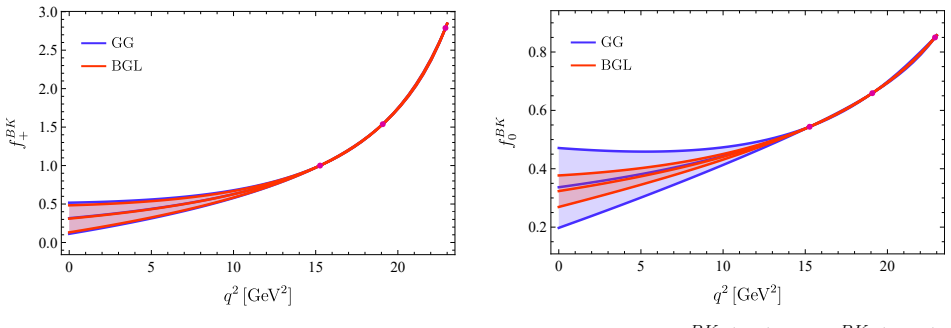
- Form-factor predictions over the full semileptonic region are obtained for B to pi and Bs to K(*).
- Form-factor predictions over the full semileptonic region are obtained for B to K(*) and Bs to phi.
- Form-factor predictions over the full semileptonic region are obtained for B to D(*) and Bs to Ds(*).
- All predictions come with posterior samples that can be used in further phenomenological studies.
Where Pith is reading between the lines
- Analyses that previously applied BGL or DM to channels with subthreshold cuts may need re-examination once the GG construction is adopted.
- The demonstrated equivalence of BGL and DM suggests that apparent differences between those methods in the literature arise from cut handling rather than from distinct unitarity content.
- The combined-fit approach could be repeated with updated lattice inputs to reduce uncertainties on extracted CKM matrix elements.
Load-bearing premise
The unitarity information encoded in the dispersion relations remains sufficient to constrain the form factors once subthreshold cuts are present and that the combined fits do not introduce uncontrolled systematic bias from the choice of parametrization or from the assumed analytic structure.
What would settle it
An independent lattice-QCD calculation of a form factor such as B to K at a point inside the semileptonic region that lies outside the uncertainty band obtained from the GG-based combined fit would directly test whether the extended bounds hold.
Figures






read the original abstract
This paper is organized around three main objectives. First, I review in a pedagogical way the unitarity bounds for form factors in $B$-meson decays, together with the parametrizations most commonly used in phenomenological analyses. These include BGL, BCL, CLN, and the Dispersive Matrix (DM) method. I also clarify the relation between BGL and DM, showing that they are two equivalent implementations of the same unitarity information. Second, I demonstrate that the standard BGL and DM constructions are strictly rigorous only when no subthreshold cuts are present. For $B$-meson decays, this requirement is fulfilled exclusively by the $B\to\pi$ FFs. To treat the generic case, I fully develop the GG parametrization introduced in previous work and show how the same logic extends to a DM-like construction. Third, I perform three combined analyses and obtain form-factor predictions over the full semileptonic region: one for $B\to\pi$ and $B_s\to K^{(*)}$, one for $B\to K^{(*)}$ and $B_s\to \phi$, and one for $B\to D^{(*)}$ and $B_s\to D_s^{(*)}$. All numerical results, posterior samples, analysis files, and plots are provided in the supplementary material (https://github.com/gubernari/suppl-unitb).
Editorial analysis
A structured set of objections, weighed in public.
Referee Report
Summary. The manuscript reviews unitarity bounds and parametrizations (BGL, BCL, CLN, DM) for B-meson form factors, demonstrates BGL-DM equivalence under the no-subthreshold-cut condition, shows that this condition holds only for B→π among common channels, develops the GG parametrization (and DM-like extension) for the generic case with cuts, and reports three combined analyses yielding form-factor predictions over the full semileptonic region for (B→π, Bs→K(*)), (B→K(*), Bs→φ), and (B→D(*), Bs→Ds(*)), with all posterior samples, analysis files, and plots released publicly.
Significance. If the central construction holds, the work supplies a systematically extendable unitarity framework that removes an unphysical restriction present in prior BGL/DM implementations, directly enabling controlled analyses of additional channels. The public release of all numerical results and analysis files constitutes a clear strength, permitting independent verification of the combined fits and reducing the risk of hidden parametrization bias.
minor comments (3)
- [§2] §2 (review of BGL/DM equivalence): the statement that the two methods are 'two equivalent implementations of the same unitarity information' would be strengthened by an explicit side-by-side comparison of the resulting coefficient constraints or by reference to a specific equation showing the mapping.
- [§4] The three combined analyses are described only at the level of the channels involved; a brief statement of the number of data points, the kinematic ranges, and the treatment of experimental correlations would improve clarity without altering the central claims.
- [Figures in §4] Figure captions for the form-factor plots should explicitly note whether the bands include only statistical or also systematic uncertainties from the dispersion-relation truncation.
Simulated Author's Rebuttal
We thank the referee for the positive and constructive report, which accurately summarizes the scope and contributions of the manuscript. We are pleased that the referee recognizes the systematic extension of the unitarity framework and the value of the public supplementary material.
Circularity Check
No significant circularity identified
full rationale
The derivation chain rests on external unitarity bounds and dispersion relations, with the paper internally demonstrating the BGL/DM equivalence and the no-subthreshold-cut restriction via its own analytic-structure analysis; the GG parametrization is extended here from prior introduction but is not load-bearing for the core claims. The three combined analyses are explicitly described as fits with public posteriors, so the resulting form-factor values are presented as constrained extrapolations rather than pure predictions that reduce to inputs by construction. No self-definitional loops, fitted quantities renamed as independent predictions, or unverified self-citation chains appear in the load-bearing steps.
Axiom & Free-Parameter Ledger
axioms (1)
- domain assumption Unitarity and analyticity of form factors imply dispersion relations that can be used to derive bounds.
Forward citations
Cited by 2 Pith papers
-
Decay constants of $B_c$-mesons with vector and tensor currents
QCD sum-rule computation of vector/axial-vector and tensor/axial-tensor decay constants for B_c, B_c*, B_c0*, B_c1 mesons, with refined power corrections and first tensor results.
-
$|V_{cb}|$ determinations from $\bar{B} \to D^{(*)} \ell \bar\nu$ decays within the SM and beyond
Fits to B to D(*) l nu form factors with BSZ, BGL and HQET yield |V_cb| matching PDG average for BGL but smaller for HQET, while data still allows non-zero new physics contributions.
Reference graph
Works this paper leans on
-
[1]
Unitarity bounds and form-factor predictions forB-meson decays
N. Gubernari,Supplementary material for the paper “Unitarity bounds and form-factor predictions forB-meson decays”, GitHub repository,github.com/gubernari/suppl-unitb, 2026
2026
-
[2]
C.G. Boyd, B. Grinstein and R.F. Lebed,Precision corrections to dispersive bounds on form-factors,Phys. Rev. D56(1997) 6895 [hep-ph/9705252]
work page internal anchor Pith review Pith/arXiv arXiv 1997
-
[3]
Model-independent description of $B\to \pi l\nu$ decays and a determination of $|V_{ub}|$
C. Bourrely, I. Caprini and L. Lellouch,Model-independent description ofB→πℓνdecays and a determination of|V ub|,Phys. Rev. D79(2009) 013008 [0807.2722]
work page internal anchor Pith review Pith/arXiv arXiv 2009
-
[4]
Dispersive Bounds on the Shape of B -> D^(*) l nu Form Factors
I. Caprini, L. Lellouch and M. Neubert,Dispersive bounds on the shape of ¯B→D (∗)ℓ¯ν form-factors,Nucl. Phys. B530(1998) 153 [hep-ph/9712417]
work page internal anchor Pith review Pith/arXiv arXiv 1998
-
[5]
Bourrely, B
C. Bourrely, B. Machet and E. de Rafael,Semileptonic Decays of Pseudoscalar Particles (M→M ′ℓνℓ) and Short Distance Behavior of Quantum Chromodynamics,Nucl. Phys. B 189(1981) 157
1981
-
[6]
Lattice-Constrained Unitarity Bounds for $\bar B^0 \to \pi^+ l^- \bar \nu_l$ Decays
L. Lellouch,Lattice constrained unitarity bounds for ¯B0 →π +ℓ¯νdecays,Nucl. Phys. B479 (1996) 353 [hep-ph/9509358]
work page internal anchor Pith review Pith/arXiv arXiv 1996
-
[7]
A. Gopal and N. Gubernari,Unitarity bounds with subthreshold and anomalous cuts for b-hadron decays,Phys. Rev. D111(2025) L031501 [2412.04388]
-
[8]
Charm-loop effect in $B \to K^{(*)} \ell^{+} \ell^{-}$ and $B\to K^*\gamma$
A. Khodjamirian, T. Mannel, A.A. Pivovarov and Y.M. Wang,Charm-loop effect in B→K (∗)ℓ+ℓ− andB→K ∗γ,JHEP09(2010) 089 [1006.4945]
work page internal anchor Pith review Pith/arXiv arXiv 2010
-
[9]
$B \to K \ell^{+}\ell^{-}$ decay at large hadronic recoil
A. Khodjamirian, T. Mannel and Y.M. Wang,B→Kℓ +ℓ− decay at large hadronic recoil, JHEP02(2013) 010 [1211.0234]
work page internal anchor Pith review Pith/arXiv arXiv 2013
-
[10]
N. Gubernari, D. van Dyk and J. Virto,Non-local matrix elements inB (s) → {K (∗), ϕ}ℓ+ℓ−, JHEP02(2021) 088 [2011.09813]. 63
-
[11]
T. Feldmann and N. Gubernari,Non-factorisable contributions of strong-penguin operators inΛ b →Λℓ +ℓ− decays,JHEP03(2024) 152 [2312.14146]
- [12]
-
[13]
B_{d,s}->rho, omega, K*, phi Decay Form Factors from Light-Cone Sum Rules Revisited
P. Ball and R. Zwicky,B d,s →ρ, ω, K ∗, ϕdecay form-factors from light-cone sum rules revisited,Phys. Rev. D71(2005) 014029 [hep-ph/0412079]
work page internal anchor Pith review Pith/arXiv arXiv 2005
-
[14]
(A)symmetries of weak decays at and near the kinematic endpoint
G. Hiller and R. Zwicky,(A)symmetries of weak decays at and near the kinematic endpoint, JHEP03(2014) 042 [1312.1923]
work page internal anchor Pith review Pith/arXiv arXiv 2014
-
[15]
Ahlfors,Complex Analysis, McGraw-Hill Book Company, 2 ed
L.V. Ahlfors,Complex Analysis, McGraw-Hill Book Company, 2 ed. (1966)
1966
-
[16]
I. Caprini,Functional Analysis and Optimization Methods in Hadron Physics, SpringerBriefs in Physics, Springer (2019), 10.1007/978-3-030-18948-8
-
[17]
Dispersion relations: foundations
B. Kubis,Dispersion relations: foundations, 10, 2025 [2510.01962]
work page internal anchor Pith review Pith/arXiv arXiv 2025
-
[18]
R. de L. Kronig,On the theory of dispersion of x-rays,Journal of the Optical Society of America12(1926) 547
1926
-
[19]
Kramers,La diffusion de la lumi` ere par les atomes, inAtti del Congresso Internazionale dei Fisici, vol
H.A. Kramers,La diffusion de la lumi` ere par les atomes, inAtti del Congresso Internazionale dei Fisici, vol. 2, (Como), p. 545, Zanichelli, 1927
1927
-
[20]
QCD Sum Rules, a Modern Perspective
P. Colangelo and A. Khodjamirian,QCD sum rules, a modern perspective,hep-ph/0010175
work page internal anchor Pith review Pith/arXiv arXiv
-
[21]
Dispersion representations and anomalous singularities of the triangle diagram
W. Lucha, D. Melikhov and S. Simula,Dispersion representations and anomalous singularities of the triangle diagram,Phys. Rev. D75(2007) 016001 [hep-ph/0610330]
work page internal anchor Pith review Pith/arXiv arXiv 2007
-
[22]
Dispersion relation for hadronic light-by-light scattering: theoretical foundations
G. Colangelo, M. Hoferichter, M. Procura and P. Stoffer,Dispersion relation for hadronic light-by-light scattering: theoretical foundations,JHEP09(2015) 074 [1506.01386]
work page internal anchor Pith review Pith/arXiv arXiv 2015
- [23]
-
[24]
Meiman,Analytic expressions for upper limits of coupling constants in quantum field theory,Sov
N.N. Meiman,Analytic expressions for upper limits of coupling constants in quantum field theory,Sov. Phys. JETP17(1963) 830
1963
-
[25]
Geshkenbein and B.L
B.V. Geshkenbein and B.L. Ioffe,Upper limits for coupling constants in quantum field theory,Phys. Rev. Lett.11(1963) 55
1963
-
[26]
Okubo,Exact bounds forK l3 decay parameters,Phys
S. Okubo,Exact bounds forK l3 decay parameters,Phys. Rev. D3(1971) 2807
1971
-
[27]
Okubo and I.-F
S. Okubo and I.-F. Shih,Exact inequality and test of chiralSW(3)theory inK l3 decay problem,Phys. Rev. D4(1971) 2020
1971
-
[28]
de Rafael and J
E. de Rafael and J. Taron,Constraints on heavy meson form-factors,Phys. Lett. B282 (1992) 215
1992
-
[29]
Analyticity Properties and Unitarity Constraints of Heavy Meson Form Factors
E. de Rafael and J. Taron,Analyticity properties and unitarity constraints of heavy meson form-factors,Phys. Rev. D50(1994) 373 [hep-ph/9306214]
work page internal anchor Pith review Pith/arXiv arXiv 1994
-
[30]
C.G. Boyd, B. Grinstein and R.F. Lebed,Constraints on form-factors for exclusive semileptonic heavy to light meson decays,Phys. Rev. Lett.74(1995) 4603 [hep-ph/9412324]
work page internal anchor Pith review Pith/arXiv arXiv 1995
-
[31]
C.G. Boyd, B. Grinstein and R.F. Lebed,Model independent extraction of|V cb|using dispersion relations,Phys. Lett. B353(1995) 306 [hep-ph/9504235]. 64
work page internal anchor Pith review Pith/arXiv arXiv 1995
-
[32]
Wilson,Nonlagrangian models of current algebra,Phys
K.G. Wilson,Nonlagrangian models of current algebra,Phys. Rev.179(1969) 1499
1969
-
[33]
Wilson,The Renormalization Group and Strong Interactions,Phys
K.G. Wilson,The Renormalization Group and Strong Interactions,Phys. Rev. D3(1971) 1818
1971
-
[34]
Wilson and J.B
K.G. Wilson and J.B. Kogut,The Renormalization group and the epsilon expansion,Phys. Rept.12(1974) 75
1974
-
[35]
Reinders, H
L.J. Reinders, H. Rubinstein and S. Yazaki,Hadron Properties from QCD Sum Rules,Phys. Rept.127(1985) 1
1985
-
[36]
Khodjamirian,Hadron Form Factors, CRC Press (4, 2020), 10.1201/9781315142005
A. Khodjamirian,Hadron Form Factors, CRC Press (4, 2020), 10.1201/9781315142005. [37]Flavour Lattice A veraging Group (FLAG)collaboration,FLAG Review 2021,Eur. Phys. J. C82(2022) 869 [2111.09849]
-
[37]
Condensates in Quantum Chromodynamics
B.L. Ioffe,Condensates in quantum chromodynamics,Phys. Atom. Nucl.66(2003) 30 [hep-ph/0207191]
work page internal anchor Pith review Pith/arXiv arXiv 2003
-
[38]
A. Bharucha, T. Feldmann and M. Wick,Theoretical and Phenomenological Constraints on Form Factors for Radiative and Semi-LeptonicB-Meson Decays,JHEP09(2010) 090 [1004.3249]
work page internal anchor Pith review Pith/arXiv arXiv 2010
-
[39]
Electroweak gauge bosons self--energies: complete QCD corrections
A. Djouadi and P. Gambino,Electroweak gauge bosons selfenergies: Complete QCD corrections,Phys. Rev. D49(1994) 3499 [hep-ph/9309298]
work page internal anchor Pith review Pith/arXiv arXiv 1994
-
[40]
T. Generet, N. Gubernari and E. Loisa,Correlator with tensor currents and two masses at two loops,Eur. Phys. J. C86(2026) 112 [2509.02776]
-
[41]
Moments of heavy quark correlators with two masses: exact mass dependence to three loops
J. Grigo, J. Hoff, P. Marquard and M. Steinhauser,Moments of heavy quark correlators with two masses: exact mass dependence to three loops,Nucl. Phys. B864(2012) 580 [1206.3418]
work page internal anchor Pith review Pith/arXiv arXiv 2012
-
[42]
G. Martinelli, S. Simula and L. Vittorio,Constraints for the semileptonic B→D(*) form factors from lattice QCD simulations of two-point correlation functions,Phys. Rev. D104 (2021) 094512 [2105.07851]
- [43]
-
[44]
Harrison, ¯bcsusceptibilities from fully relativistic lattice QCD,Phys
J. Harrison, ¯bcsusceptibilities from fully relativistic lattice QCD,Phys. Rev. D110(2024) 054506 [2405.01390]. [46]Particle Data Groupcollaboration,Review of particle physics,Phys. Rev. D110(2024) 030001. [47]ETMcollaboration,Masses and decay constants ofD ∗ (s) andB ∗ (s) mesons with Nf = 2 + 1 + 1twisted mass fermions,Phys. Rev. D96(2017) 034524 [1707.04529]
- [45]
- [46]
- [47]
-
[48]
Comment on the heavy-->light form factors
D. Becirevic and A.B. Kaidalov,Comment on the heavy→light form-factors,Phys. Lett. B 478(2000) 417 [hep-ph/9904490]. 65
work page internal anchor Pith review Pith/arXiv arXiv 2000
-
[49]
New Results on B->pi, K, eta Decay Formfactors from Light-Cone Sum Rules
P. Ball and R. Zwicky,New results onB→π, K, ηdecay formfactors from light-cone sum rules,Phys. Rev. D71(2005) 014015 [hep-ph/0406232]
work page internal anchor Pith review Pith/arXiv arXiv 2005
-
[50]
|V_ub| from UTangles and B->pi l nu
P. Ball,|V ub|from UTangles andB→πℓν,Phys. Lett. B644(2007) 38 [hep-ph/0611108]
work page internal anchor Pith review Pith/arXiv arXiv 2007
-
[51]
Extracting |V(ub)| from B->pi l nu Decays Using a Multiply-subtracted Omnes Dispersion Relation
J.M. Flynn and J. Nieves,Extracting|V ub|fromB→πℓνdecays using a multiply-subtracted Omnes dispersion relation,Phys. Rev. D75(2007) 013008 [hep-ph/0607258]
work page internal anchor Pith review Pith/arXiv arXiv 2007
-
[52]
Semileptonic $B\to \pi$ Decays from an Omn\`es Improved Nonrelativistic Constituent Quark Model
C. Albertus, J.M. Flynn, E. Hernandez, J. Nieves and J.M. Verde-Velasco,Semileptonic B→πdecays from an Omnes improved nonrelativistic constituent quark model,Phys. Rev. D72(2005) 033002 [hep-ph/0506048]
work page internal anchor Pith review Pith/arXiv arXiv 2005
-
[53]
The $V_{cb}$ puzzle: an update
P. Gambino, M. Jung and S. Schacht,TheV cb puzzle: An update,Phys. Lett. B795(2019) 386 [1905.08209]
work page internal anchor Pith review Pith/arXiv arXiv 2019
-
[54]
F.U. Bernlochner, Z. Ligeti and D.J. Robinson,N= 5,6,7,8: Nested hypothesis tests and truncation dependence of|V cb|,Phys. Rev. D100(2019) 013005 [1902.09553]
-
[55]
N. Gubernari, M. Reboud, D. van Dyk and J. Virto,Dispersive analysis ofB→K (∗) and Bs →ϕform factors,JHEP12(2023) 153 [2305.06301]
-
[56]
S. Simula and L. Vittorio,Multiple dispersive bounds. II. Subthreshold branch cuts,Phys. Rev. D113(2026) 074018 [2509.00412]
-
[57]
Bounds on the slope and the curvature of the scalar K\pi form factor at zero momentum transfer
C. Bourrely and I. Caprini,Bounds on the slope and the curvature of the scalarKπ form-factor at zero momentum transfer,Nucl. Phys. B722(2005) 149 [hep-ph/0504016]
work page internal anchor Pith review Pith/arXiv arXiv 2005
-
[58]
On B -> V l l at small dilepton invariant mass, power corrections, and new physics
S. J¨ ager and J. Martin Camalich,OnB→V ℓℓat small dilepton invariant mass, power corrections, and new physics,JHEP05(2013) 043 [1212.2263]
work page internal anchor Pith review Pith/arXiv arXiv 2013
-
[59]
$B\to K^* \ell^+ \ell^-$ decays at large recoil in the Standard Model: a theoretical reappraisal
M. Ciuchini, M. Fedele, E. Franco, S. Mishima, A. Paul, L. Silvestrini et al.,B→K ∗ℓ+ℓ− decays at large recoil in the Standard Model: a theoretical reappraisal,JHEP06(2016) 116 [1512.07157]
work page internal anchor Pith review Pith/arXiv arXiv 2016
-
[60]
$B\to V\ell^+\ell^-$ in the Standard Model from Light-Cone Sum Rules
A. Bharucha, D.M. Straub and R. Zwicky,B→V ℓ +ℓ− in the Standard Model from light-cone sum rules,JHEP08(2016) 098 [1503.05534]
work page internal anchor Pith review Pith/arXiv arXiv 2016
-
[61]
Model-Independent Extraction of $|V_{cb}|$ from $\bar{B}\rightarrow D^* \ell \overline{\nu}$
B. Grinstein and A. Kobach,Model-Independent Extraction of|V cb|from ¯B→D ∗ℓ¯ν,Phys. Lett. B771(2017) 359 [1703.08170]
work page internal anchor Pith review Pith/arXiv arXiv 2017
-
[62]
D. Bigi, P. Gambino and S. Schacht,A fresh look at the determination of|V cb|from B→D ∗ℓν,Phys. Lett. B769(2017) 441 [1703.06124]
work page internal anchor Pith review Pith/arXiv arXiv 2017
-
[63]
A. Biswas, S. Nandi and I. Ray,Extractions of|V ub|/|Vcb|from a combined study of the exclusiveb→u(c)ℓ −¯νℓ decays,JHEP07(2023) 024 [2212.02528]. [67]Bellecollaboration,Measurement of the CKM matrix element|V cb|fromB 0 →D ∗−ℓ+νℓ at Belle,Phys. Rev. D100(2019) 052007 [1809.03290]. [68]LHCbcollaboration,Measurement of|V cb|withB 0 s →D (∗)− s µ+νµ decays,P...
-
[64]
M. Di Carlo, G. Martinelli, M. Naviglio, F. Sanfilippo, S. Simula and L. Vittorio,Unitarity bounds for semileptonic decays in lattice QCD,Phys. Rev. D104(2021) 054502 [2105.02497]. 66
-
[65]
G. Martinelli, S. Simula and L. Vittorio,Exclusive determinations of|V cb|andR(D ∗) through unitarity,Eur. Phys. J. C82(2022) 1083 [2109.15248]
-
[66]
S. Simula and L. Vittorio,Dispersive analysis of the experimental data on the electromagnetic form factor of charged pions at spacelike momenta,Phys. Rev. D108(2023) 094013 [2309.02135]
- [67]
-
[68]
G. Martinelli, S. Simula and L. Vittorio,Updates on the determination of|V cb|, R(D∗)and |Vub|/|Vcb|,Eur. Phys. J. C84(2024) 400 [2310.03680]
-
[69]
A. Juettner and L. Vittorio,Differences and similarities in modellingb→cform factors, Contribution toBeyond the Flavour Anomalies 2025, agenda.infn.it/event/44057/contributions/257449, Apr., 2025. [76](HPQCD collaboration)§, HPQCDcollaboration,B→KandD→Kform factors from fully relativistic lattice QCD,Phys. Rev. D107(2023) 014510 [2207.12468]
-
[70]
M. Bordone, N. Gubernari, M. Jung and D. van Dyk,Challenging B(s) →D (∗) (s) form factors with the heavy quark expansion,JHEP11(2025) 051 [2507.03569]
-
[71]
S. Simula and L. Vittorio,Multiple dispersive bounds. I. Thezexpansion,Phys. Rev. D113 (2026) 074017 [2509.00411]
-
[72]
Lepage and S.J
G.P. Lepage and S.J. Brodsky,Exclusive Processes in Perturbative Quantum Chromodynamics,Phys. Rev. D22(1980) 2157
1980
-
[73]
Akhoury, G.F
R. Akhoury, G.F. Sterman and Y.P. Yao,Exclusive semileptonic decays of B mesons into light mesons,Phys. Rev. D50(1994) 358
1994
-
[74]
M. Bordone, M. Jung and D. van Dyk,Theory determination of ¯B→D (∗)ℓ−¯νform factors atO(1/m 2 c),Eur. Phys. J. C80(2020) 74 [1908.09398]
-
[75]
F.U. Bernlochner, Z. Ligeti, M. Papucci, M.T. Prim, D.J. Robinson and C. Xiong, Constrained second-order power corrections in HQET:R(D (∗)),|V cb|, and new physics, Phys. Rev. D106(2022) 096015 [2206.11281]
- [76]
-
[77]
M. Hoferichter, B. Kubis and S. Mutke,Reconciling hadronic and partonic analyticity in b→sℓℓtransitions,2604.01284
-
[78]
RunDec: a Mathematica package for running and decoupling of the strong coupling and quark masses
K.G. Chetyrkin, J.H. Kuhn and M. Steinhauser,RunDec: A Mathematica package for running and decoupling of the strong coupling and quark masses,Comput. Phys. Commun. 133(2000) 43 [hep-ph/0004189]
work page internal anchor Pith review Pith/arXiv arXiv 2000
-
[79]
Version 3 of {\tt RunDec} and {\tt CRunDec}
F. Herren and M. Steinhauser,Version 3 of RunDec and CRunDec,Comput. Phys. Commun.224(2018) 333 [1703.03751]. [87]HPQCDcollaboration,B-meson decay constants: a more complete picture from full lattice QCD,Phys. Rev. D91(2015) 114509 [1503.05762]
work page internal anchor Pith review Pith/arXiv arXiv 2018
-
[80]
B. Pullin and R. Zwicky,Radiative decays of heavy-light mesons and thef (T) H,H ∗,H1 decay constants,JHEP09(2021) 023 [2106.13617]. 67 [89]Flavour Lattice A veraging Group (FLAG)collaboration,FLAG review 2024,Phys. Rev. D113(2026) 014508 [2411.04268]
discussion (0)
Sign in with ORCID, Apple, or X to comment. Anyone can read and Pith papers without signing in.