Donutization Inside Neutron Stars: Shell-Localized Scalar Fields
Pith reviewed 2026-06-29 20:30 UTC · model grok-4.3
The pith
Neutron stars can scalarize via interior shell profiles of heavy scalar fields that stay hidden from the exterior.
A machine-rendered reading of the paper's core claim, the machinery that carries it, and where it could break.
Core claim
In scalar-tensor theories, neutron stars admit stable, non-trivial scalar field solutions that are localized in a shell inside the stellar interior when the scalar mass satisfies m_phi greater than or equal to 10^{-9} eV. These solutions are suppressed at the center and matched to the exterior vacuum, allowing scalarization to occur despite the field's short Compton wavelength and thereby modifying the stellar structure and global properties.
What carries the argument
Donutization: the shell-localized scalar field profile that peaks inside the neutron star while remaining zero at the center and exterior.
If this is right
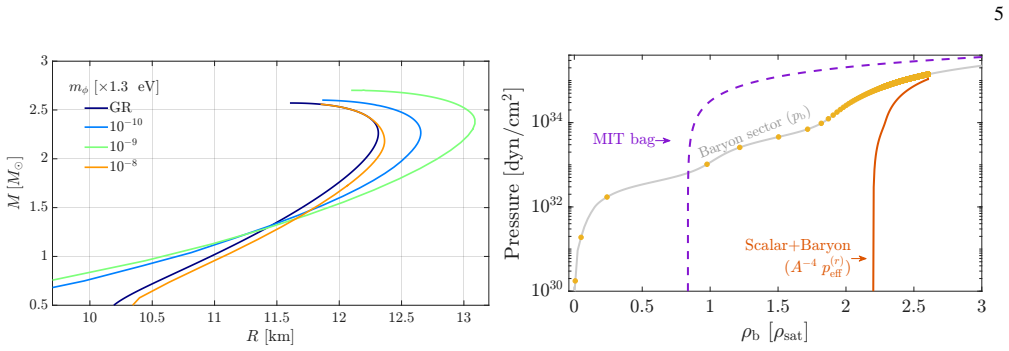
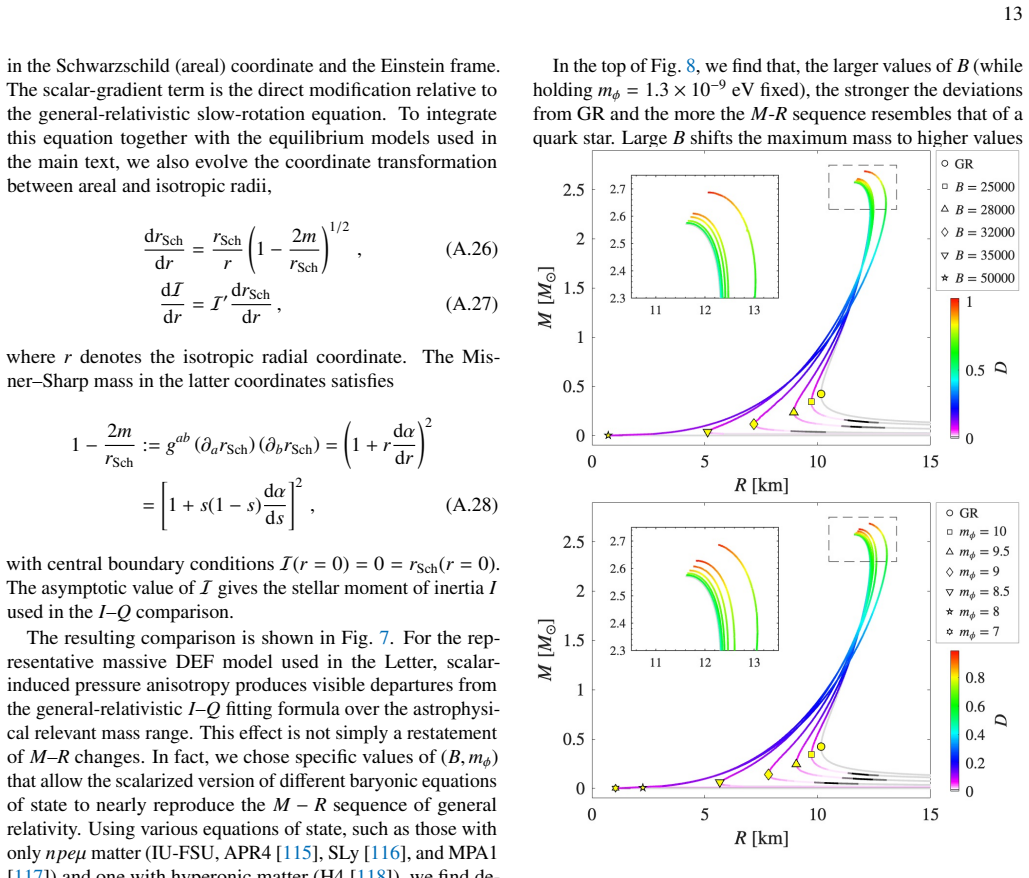
- Hadronic neutron stars can reproduce the mass-radius curves of quark stars.
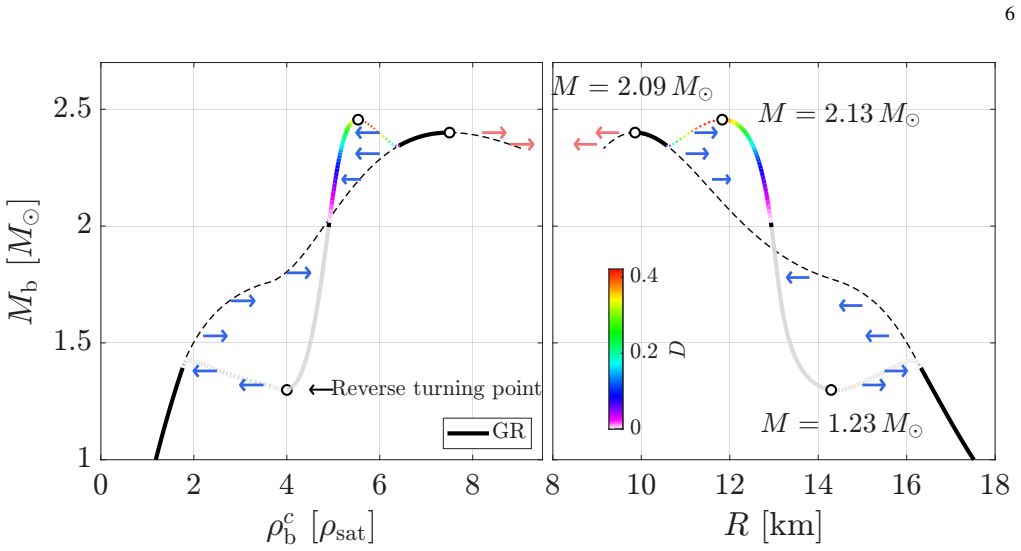
- The stellar models can develop split stable branches similar to hybrid stars.
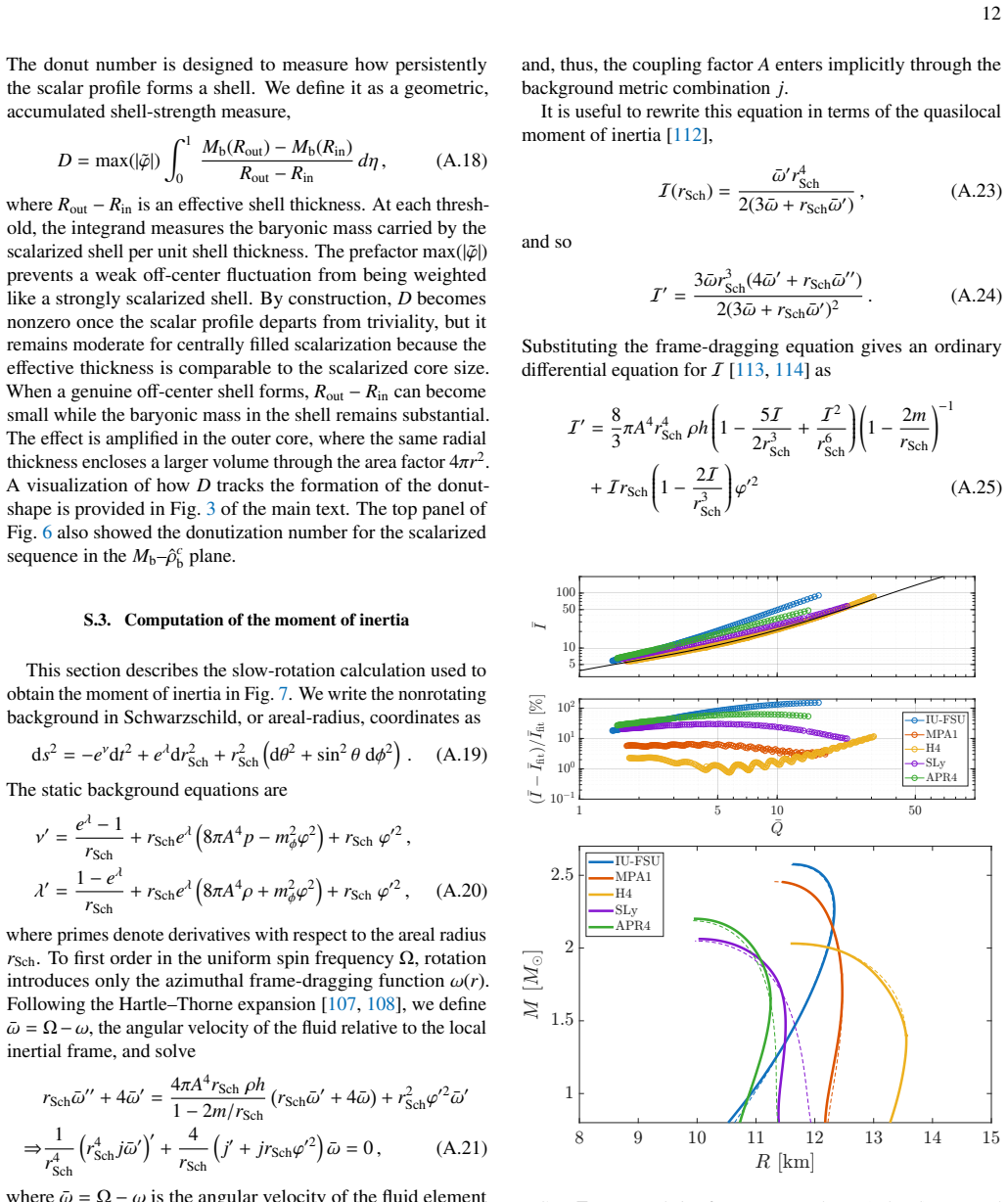
- The I-Q relation between moment of inertia and quadrupole moment is violated.
- All exterior observables relevant to binary pulsars remain unchanged.
Where Pith is reading between the lines
- Interior-only scalarization implies that current exterior matching criteria for scalarization may miss entire classes of solutions.
- Gravitational-wave signals from neutron-star mergers could carry imprints of the modified interior equation of state that are not captured by standard hadronic or quark equations of state.
- High-precision radius measurements combined with independent mass determinations could reveal populations whose properties fit neither pure hadronic nor pure quark models.
Load-bearing premise
The chosen scalar-tensor equations admit stable non-trivial shell solutions inside neutron-star matter for heavy scalars without violating energy conditions or exterior matching.
What would settle it
A numerical integration of the coupled Einstein-scalar equations on a realistic neutron-star density profile that yields no stable shell solution for any m_phi above 10^{-9} eV.
Figures


read the original abstract
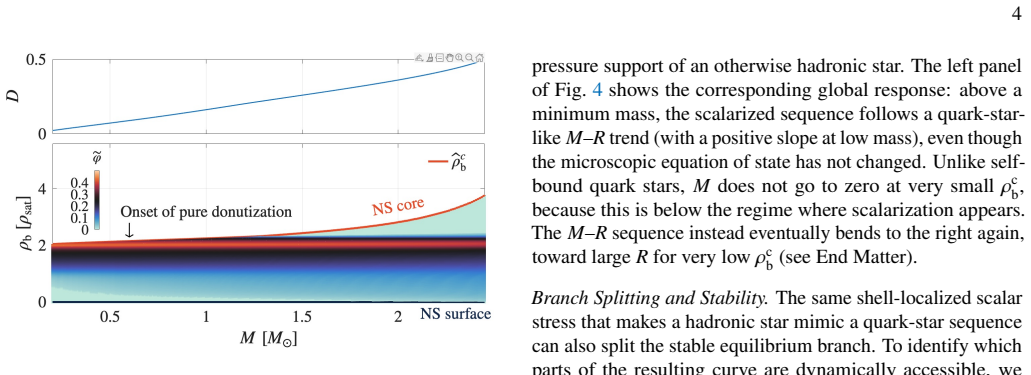
Heavy scalar fields ($m_\phi\gtrsim10^{-9}$ eV) in scalar-tensor gravity are expected to be hidden from neutron-star observations because their Compton wavelength is sub-stellar. We show that neutron stars can nevertheless scalarize by forming a shell-localized profile, suppressed at their center and exterior but peaked in their interior. This \emph{donutization} reshapes the effective equation of state, making hadronic stars mimic quark-star mass-radius behavior or hybrid-star behavior with split stable branches, and breaks the $I$--$Q$ relation, while remaining hidden from binary pulsar observations.
Editorial analysis
A structured set of objections, weighed in public.
Referee Report
Summary. The manuscript claims that in scalar-tensor gravity, scalar fields with masses m_φ ≳ 10^{-9} eV, normally expected to be hidden from neutron-star observations due to their short Compton wavelength, can nevertheless induce scalarization inside neutron stars via a novel 'donutization' mechanism. This produces stable, shell-localized scalar profiles that are suppressed both at the stellar center and in the exterior vacuum but peak in the interior; the resulting effective equation of state allows hadronic stars to mimic quark-star or hybrid-star mass-radius relations (including split stable branches) and breaks the I-Q universality relation, while remaining consistent with binary-pulsar constraints.
Significance. If the claimed shell solutions exist, are stable, and satisfy the field equations together with energy conditions and exterior matching, the result would be significant: it identifies a previously overlooked channel for scalarization with heavy fields, supplies a concrete mechanism that alters global neutron-star observables without violating existing pulsar bounds, and thereby enlarges the testable parameter space of scalar-tensor theories. The manuscript supports the claim with explicit numerical profiles and derived observational consequences.
minor comments (3)
- [§3.2] §3.2: the definition of the effective energy density after integrating out the scalar should be written explicitly (currently only stated in words) so that the mapping to the quark-star or hybrid-star EOS can be reproduced without ambiguity.
- [Figure 4] Figure 4: the caption does not state the central density or the value of m_φ used for the plotted I-Q curves; this information is needed to assess how far the relation deviates from the universal fit.
- [§4.1] The stability analysis in §4.1 is performed only for radial perturbations; a brief statement on non-radial or secular stability would strengthen the claim that the donutized configurations are astrophysically relevant.
Simulated Author's Rebuttal
We thank the referee for the positive assessment of our work on donutization in neutron stars and for recommending minor revision. No major comments were raised in the report, so we have no specific points to address point-by-point at this stage. We will incorporate any minor suggestions during revision.
Circularity Check
No significant circularity identified
full rationale
The abstract and available context present a theoretical claim about donutization via shell-localized scalar profiles without any visible derivation chain, equations, fitted parameters, or self-citations. No load-bearing steps reduce by construction to inputs, and the central result is framed as arising from solving the field equations in the chosen theory. With no explicit derivations or citations supplied for inspection, the paper is self-contained against external benchmarks in the provided material, yielding a normal non-finding of circularity.
Axiom & Free-Parameter Ledger
axioms (1)
- domain assumption Scalar-tensor gravity theories permit non-trivial scalar field configurations inside compact objects when coupled to matter.
invented entities (1)
-
donutization profile
no independent evidence
Reference graph
Works this paper leans on
-
[1]
Brans and R
C. Brans and R. H. Dicke, Mach’s principle and a relativistic theory of gravitation, Phys. Rev.124, 925 (1961)
1961
-
[2]
Damour and G
T. Damour and G. Esposito-Farese, Nonperturbative strong field effects in tensor - scalar theories of gravitation, Phys. Rev. Lett.70, 2220 (1993). 7
1993
-
[3]
Tensor-scalar gravity and binary-pulsar experiments
T. Damour and G. Esposito-Farese, Tensor - scalar gravity and binary pulsar experiments, Phys. Rev. D54, 1474 (1996), arXiv:gr-qc/9602056
work page internal anchor Pith review Pith/arXiv arXiv 1996
- [4]
-
[5]
D. Anderson, N. Yunes, and E. Barausse, Effect of cosmologi- cal evolution on Solar System constraints and on the scalariza- tion of neutron stars in massless scalar-tensor theories, Phys. Rev. D94, 104064 (2016), arXiv:1607.08888 [gr-qc]
work page internal anchor Pith review Pith/arXiv arXiv 2016
-
[6]
T. A. de Pirey Saint Alby and N. Yunes, Cosmological Evolu- tion and Solar System Consistency of Massive Scalar-Tensor Gravity, Phys. Rev. D96, 064040 (2017), arXiv:1703.06341 [gr-qc]
work page internal anchor Pith review Pith/arXiv arXiv 2017
- [7]
- [8]
-
[9]
A. Gupta, Ten years of extreme gravity tests of general theory of relativity with gravitational-wave observations, Class. Quant. Grav.43, 053001 (2026), arXiv:2511.15890 [gr-qc]
-
[10]
P. C. C. Freire, N. Wex, G. Esposito-Farese, J. P. W. Verbiest, M. Bailes, B. A. Jacoby, M. Kramer, I. H. Stairs, J. Anto- niadis, and G. H. Janssen, The relativistic pulsar-white dwarf binary PSR J1738+0333 II. The most stringent test of scalar- tensor gravity, Mon. Not. Roy. Astron. Soc.423, 3328 (2012), arXiv:1205.1450 [astro-ph.GA]
work page internal anchor Pith review Pith/arXiv arXiv 2012
-
[11]
A Massive Pulsar in a Compact Relativistic Binary
J. Antoniadiset al., A Massive Pulsar in a Compact Relativistic Binary, Science340, 6131 (2013), arXiv:1304.6875 [astro- ph.HE]
work page internal anchor Pith review Pith/arXiv arXiv 2013
-
[12]
L. Shao, N. Sennett, A. Buonanno, M. Kramer, and N. Wex, Constraining nonperturbative strong-field effects in scalar-tensor gravity by combining pulsar timing and laser- interferometer gravitational-wave detectors, Phys. Rev. X7, 041025 (2017), arXiv:1704.07561 [gr-qc]
work page internal anchor Pith review Pith/arXiv arXiv 2017
-
[13]
D. Anderson, P. Freire, and N. Yunes, Binary pulsar constraints on massless scalar–tensor theories using Bayesian statistics, Class. Quant. Grav.36, 225009 (2019), arXiv:1901.00938 [gr- qc]
- [14]
-
[15]
S. S. Yazadjiev, D. D. Doneva, and D. Popchev, Slowly rotating neutron stars in scalar-tensor theories with a massive scalar field, Phys. Rev. D93, 084038 (2016), arXiv:1602.04766 [gr- qc]
work page internal anchor Pith review Pith/arXiv arXiv 2016
-
[16]
K. V . Staykov, D. Popchev, D. D. Doneva, and S. S. Yazadjiev, Static and slowly rotating neutron stars in scalar–tensor theory with self-interacting massive scalar field, Eur. Phys. J. C78, 586 (2018), arXiv:1805.07818 [gr-qc]
work page internal anchor Pith review Pith/arXiv arXiv 2018
- [17]
- [18]
-
[19]
D. Popchev, K. V . Staykov, D. D. Doneva, and S. S. Yazadjiev, Moment of inertia–mass universal relations for neutron stars in scalar-tensor theory with self-interacting massive scalar field, Eur. Phys. J. C79, 178 (2019), arXiv:1812.00347 [gr-qc]
work page internal anchor Pith review Pith/arXiv arXiv 2019
- [20]
-
[21]
Spontaneous scalarization with an extremely massive field and heavy neutron stars
S. Morisaki and T. Suyama, Spontaneous scalarization with an extremely massive field and heavy neutron stars, Phys. Rev. D 96, 084026 (2017), arXiv:1707.02809 [gr-qc]
work page internal anchor Pith review Pith/arXiv arXiv 2017
-
[22]
R. Rosca-Mead, C. J. Moore, U. Sperhake, M. Agathos, and D. Gerosa, Structure of neutron stars in massive scalar-tensor gravity, Symmetry12, 1384 (2020), arXiv:2007.14429 [gr-qc]
- [23]
-
[24]
F. M. Ramazano˘glu and F. Pretorius, Spontaneous Scalariza- tion with Massive Fields, Phys. Rev. D93, 064005 (2016), arXiv:1601.07475 [gr-qc]
work page internal anchor Pith review Pith/arXiv arXiv 2016
-
[25]
Alcock, E
C. Alcock, E. Farhi, and A. Olinto, Strange stars, Astrophys. J. 310, 261 (1986)
1986
-
[26]
F. Rahimi and Z. Rezaei, Scalarized hybrid neutron stars in scalar tensor gravity, Eur. Phys. J. C84, 734 (2024), arXiv:2401.13557 [astro-ph.HE]
- [27]
-
[28]
U. H. Gerlach, Equation of State at Supranuclear Densities and the Existence of a Third Family of Superdense Stars, Phys. Rev. 172, 1325 (1968)
1968
- [29]
-
[30]
K. Schertler, C. Greiner, J. Schaffner-Bielich, and M. H. Thoma, Quark phases in neutron stars and a ’third family’ of compact stars as a signature for phase transitions, Nucl. Phys. A677, 463 (2000), arXiv:astro-ph/0001467
work page internal anchor Pith review Pith/arXiv arXiv 2000
-
[31]
M. G. Alford, S. Han, and M. Prakash, Generic conditions for stable hybrid stars, Phys. Rev. D88, 083013 (2013), arXiv:1302.4732 [astro-ph.SR]
work page internal anchor Pith review Pith/arXiv arXiv 2013
-
[32]
A new quark-hadron hybrid equation of state for astrophysics - I. High-mass twin compact stars
S. Benic, D. Blaschke, D. E. Alvarez-Castillo, T. Fischer, and S. Typel, A new quark-hadron hybrid equation of state for astro- physics - I. High-mass twin compact stars, Astron. Astrophys. 577, A40 (2015), arXiv:1411.2856 [astro-ph.HE]
work page internal anchor Pith review Pith/arXiv arXiv 2015
-
[33]
J.-E. Christian, A. Zacchi, and J. Schaffner-Bielich, Signals in the tidal deformability for phase transitions in compact stars with constraints from GW170817, Phys. Rev. D99, 023009 (2019), arXiv:1809.03333 [astro-ph.HE]
work page internal anchor Pith review Pith/arXiv arXiv 2019
- [34]
- [35]
-
[36]
Damour and G
T. Damour and G. Esposito-Farese, Tensor multiscalar theories of gravitation, Class. Quant. Grav.9, 2093 (1992)
2093
- [37]
-
[38]
K. Yagi and N. Yunes, I-Love-Q Relations in Neutron Stars 8 and their Applications to Astrophysics, Gravitational Waves and Fundamental Physics, Phys. Rev. D88, 023009 (2013), arXiv:1303.1528 [gr-qc]
work page internal anchor Pith review Pith/arXiv arXiv 2013
-
[39]
K. Yagi and N. Yunes, I-Love-Q, Science341, 365 (2013), arXiv:1302.4499 [gr-qc]
work page internal anchor Pith review Pith/arXiv arXiv 2013
-
[40]
I-Love-Q, Spontaneously: Slowly Rotating Neutron Stars in Scalar-Tensor Theories
P. Pani and E. Berti, Slowly rotating neutron stars in scalar-tensor theories, Phys. Rev. D90, 024025 (2014), arXiv:1405.4547 [gr-qc]
work page internal anchor Pith review Pith/arXiv arXiv 2014
-
[41]
Coalescence of binary neutron stars in a scalar-tensor theory of gravity
M. Shibata, K. Taniguchi, H. Okawa, and A. Buonanno, Coales- cence of binary neutron stars in a scalar-tensor theory of gravity, Phys. Rev. D89, 084005 (2014), arXiv:1310.0627 [gr-qc]
work page internal anchor Pith review Pith/arXiv arXiv 2014
-
[42]
Quasiequilibrium sequences of binary neutron stars undergoing dynamical scalarization
K. Taniguchi, M. Shibata, and A. Buonanno, Quasiequilibrium sequences of binary neutron stars undergoing dynamical scalar- ization, Phys. Rev. D91, 024033 (2015), arXiv:1410.0738 [gr-qc]
work page internal anchor Pith review Pith/arXiv arXiv 2015
-
[43]
T. Kuroda and M. Shibata, Spontaneous scalarization as a new core-collapse supernova mechanism and its multimessenger signals, Phys. Rev. D107, 103025 (2023), arXiv:2302.09853 [astro-ph.HE]
- [44]
- [45]
-
[46]
Komatsu, Y
H. Komatsu, Y . Eriguchi, and I. Hachisu, Rapidly rotating gen- eral relativistic stars. I - Numerical method and its application to uniformly rotating polytropes, Mon. Not. Roy. Astron. Soc. 237, 355 (1989)
1989
-
[47]
G. B. Cook, S. L. Shapiro, and S. A. Teukolsky, Spin-up of a Rapidly Rotating Star by Angular Momentum Loss: Effects of General Relativity, ApJ398, 203 (1992)
1992
-
[48]
D. D. Doneva, S. S. Yazadjiev, N. Stergioulas, and K. D. Kokko- tas, Rapidly rotating neutron stars in scalar-tensor theories of gravity, Phys. Rev. D88, 084060 (2013), arXiv:1309.0605 [gr-qc]
work page internal anchor Pith review Pith/arXiv arXiv 2013
-
[49]
D. D. Doneva and S. S. Yazadjiev, Rapidly rotating neutron stars with a massive scalar field—structure and universal rela- tions, JCAP11(2016), 019, arXiv:1607.03299 [gr-qc]
work page internal anchor Pith review Pith/arXiv arXiv 2016
-
[50]
D. D. Doneva, S. S. Yazadjiev, N. Stergioulas, and K. D. Kokko- tas, Differentially rotating neutron stars in scalar-tensor theories of gravity, Phys. Rev. D98, 104039 (2018), arXiv:1807.05449 [gr-qc]
work page internal anchor Pith review Pith/arXiv arXiv 2018
- [51]
-
[52]
J. C. O. M., D. D. Doneva, P. Cerdá-Durán, J. A. Font, and S. S. Yazadjiev, Rapidly Rotating Neutron Star Collapse in Massive Scalar-Tensor Theories, arXiv (2026), arXiv:2605.16506 [gr- qc]
work page internal anchor Pith review Pith/arXiv arXiv 2026
-
[53]
Bonazzola, E
S. Bonazzola, E. Gourgoulhon, M. Salgado, and J. A. Marck, Axisymmetric rotating relativistic bodies: A new numerical approach for ’exact’ solutions, Astron. Astrophys.278, 421 (1993)
1993
-
[54]
Shibata, Rotating black hole surrounded by self-gravitating torus in the puncture framework, Phys
M. Shibata, Rotating black hole surrounded by self-gravitating torus in the puncture framework, Phys. Rev. D76, 064035 (2007)
2007
-
[55]
V . Paschalidis and N. Stergioulas, Rotating Stars in Relativity, Living Rev. Rel.20, 7 (2017), arXiv:1612.03050 [astro-ph.HE]
work page internal anchor Pith review Pith/arXiv arXiv 2017
-
[56]
J. D. Jackson,Classical Electrodynamics(John Wiley & Sons, 1962)
1962
-
[57]
(2026), this Green’s function, equivalent toe−mϕ|r−r′|/(4π|r−r ′|), reduces to the one for Laplace equation in the mϕ → 0 limit, i.e., G(r,r ′)mϕ→0 =( rℓ/r′ℓ+1)[mϕ(2ℓ +1)] −1 for any finite r and r′
2026
-
[58]
G. B. Cook, S. L. Shapiro, and S. A. Teukolsky, Rapidly ro- tating polytropes in general relativity, Astrophys. J.422, 227 (1994)
1994
-
[59]
G. B. Cook, S. L. Shapiro, and S. A. Teukolsky, Rapidly rotat- ing neutron stars in general relativity: Realistic equations of state, Astrophys. J.424, 823 (1994)
1994
-
[60]
N. Stergioulas and J. L. Friedman, Comparing models of rapidly rotating relativistic stars constructed by two numer- ical methods, Astrophys. J.444, 306 (1995), arXiv:astro- ph/9411032
-
[61]
F. J. Fattoyev, C. J. Horowitz, J. Piekarewicz, and G. Shen, Relativistic effective interaction for nuclei, giant reso- nances, and neutron stars, Phys. Rev. C82, 055803 (2010), arXiv:1008.3030 [nucl-th]
work page internal anchor Pith review Pith/arXiv arXiv 2010
- [62]
- [63]
-
[64]
Quarkyonic Matter and Neutron Stars
L. McLerran and S. Reddy, Quarkyonic Matter and Neutron Stars, Phys. Rev. Lett.122, 122701 (2019), arXiv:1811.12503 [nucl-th]
work page internal anchor Pith review Pith/arXiv arXiv 2019
-
[65]
D. M. Podkowka, R. F. P. Mendes, and E. Poisson, Trace of the energy-momentum tensor and macroscopic properties of neu- tron stars, Phys. Rev. D98, 064057 (2018), arXiv:1807.01565 [gr-qc]
work page internal anchor Pith review Pith/arXiv arXiv 2018
-
[66]
Y . Fujimoto, K. Fukushima, L. D. McLerran, and M. Praszalow- icz, Trace Anomaly as Signature of Conformality in Neutron Stars, Phys. Rev. Lett.129, 252702 (2022), arXiv:2207.06753 [nucl-th]
-
[67]
M. Marczenko, L. McLerran, K. Redlich, and C. Sasaki, Reach- ing percolation and conformal limits in neutron stars, Phys. Rev. C107, 025802 (2023), arXiv:2207.13059 [nucl-th]
- [68]
- [69]
-
[70]
A. R. Bodmer, Collapsed nuclei, Phys. Rev. D4, 1601 (1971)
1971
-
[71]
Witten, Cosmic Separation of Phases, Phys
E. Witten, Cosmic Separation of Phases, Phys. Rev. D30, 272 (1984)
1984
-
[72]
Chodos, R
A. Chodos, R. L. Jaffe, K. Johnson, C. B. Thorn, and V . F. Weisskopf, A New Extended Model of Hadrons, Phys. Rev. D 9, 3471 (1974)
1974
-
[73]
Farhi and R
E. Farhi and R. L. Jaffe, Strange Matter, Phys. Rev. D30, 2379 (1984)
1984
-
[74]
Sorkin, A Criterion for the onset of instability at a turning point, Astrophys
R. Sorkin, A Criterion for the onset of instability at a turning point, Astrophys. J.249, 254 (1981)
1981
-
[75]
R. D. Sorkin, A Stability criterion for many parameter equilib- rium families, Astrophys. J.257, 847 (1982)
1982
-
[76]
J. L. Friedman, J. R. Ipser, and R. D. Sorkin, Turning point method for axisymmetric stability of rotating relativistic stars, Astrophys. J.325, 722 (1988)
1988
-
[77]
Harada, Neutron stars in scalar tensor theories of gravity and catastrophe theory, Phys
T. Harada, Neutron stars in scalar tensor theories of gravity and catastrophe theory, Phys. Rev. D57, 4802 (1998), arXiv:gr- 9 qc/9801049
- [78]
- [79]
- [80]
discussion (0)
Sign in with ORCID, Apple, or X to comment. Anyone can read and Pith papers without signing in.