CNN-Based Online Trigger for QGP Event Selection
Pith reviewed 2026-06-29 19:02 UTC · model grok-4.3
The pith
A convolutional neural network classifies quark-gluon plasma events from reconstructed particle histograms with 83.7 percent accuracy.
A machine-rendered reading of the paper's core claim, the machinery that carries it, and where it could break.
Core claim
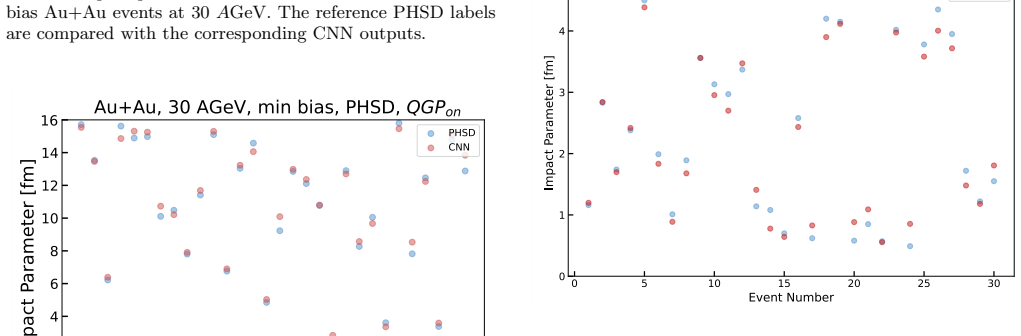
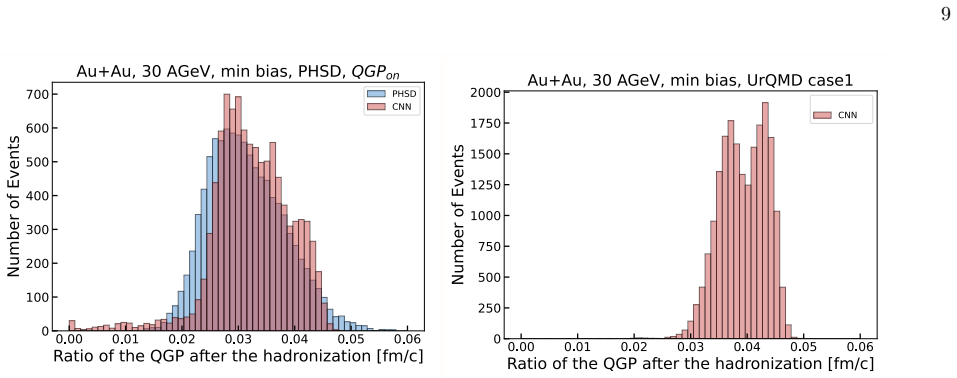
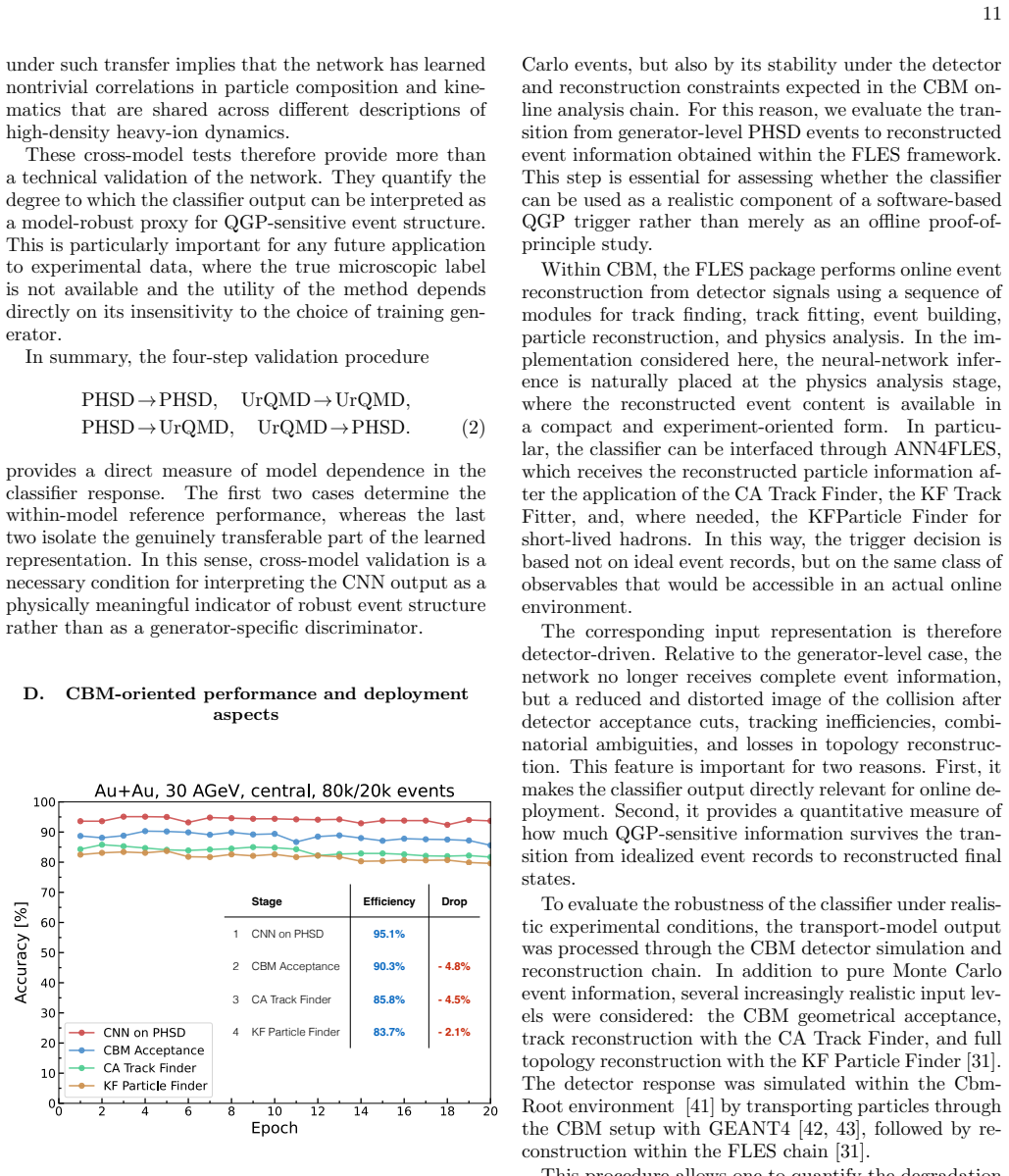
The authors demonstrate that a CNN operating on multidimensional histograms of reconstructed particles can distinguish events associated with QGP formation, achieving 83.7 percent classification accuracy after full reconstruction in Au+Au collisions at 30 AGeV while remaining stable when the same architecture and representation are applied to UrQMD simulations, and that SHAP analysis can identify the dominant particle-species contributions to the decisions.
What carries the argument
Multidimensional histograms of particle species, momentum magnitude, and angular information, processed by a convolutional neural network for binary classification of QGP-associated events.
If this is right
- The approach enables real-time filtering of rare QGP signatures under high data-throughput constraints in modern experiments.
- Performance remains practically useful after full reconstruction and topology analysis.
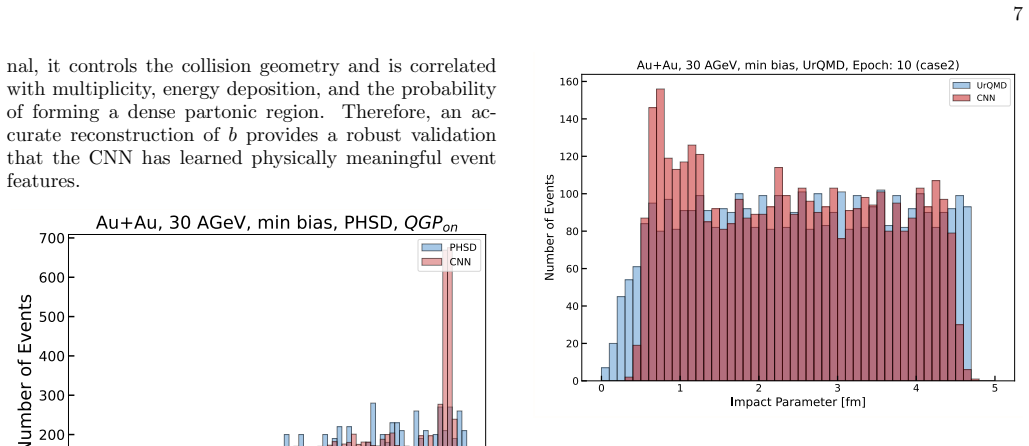
- The learned response is stable against generator-dependent effects when cross-checked between PHSD and UrQMD.
- A lightweight C++ inference package supports deployment directly at the physics-analysis stage.
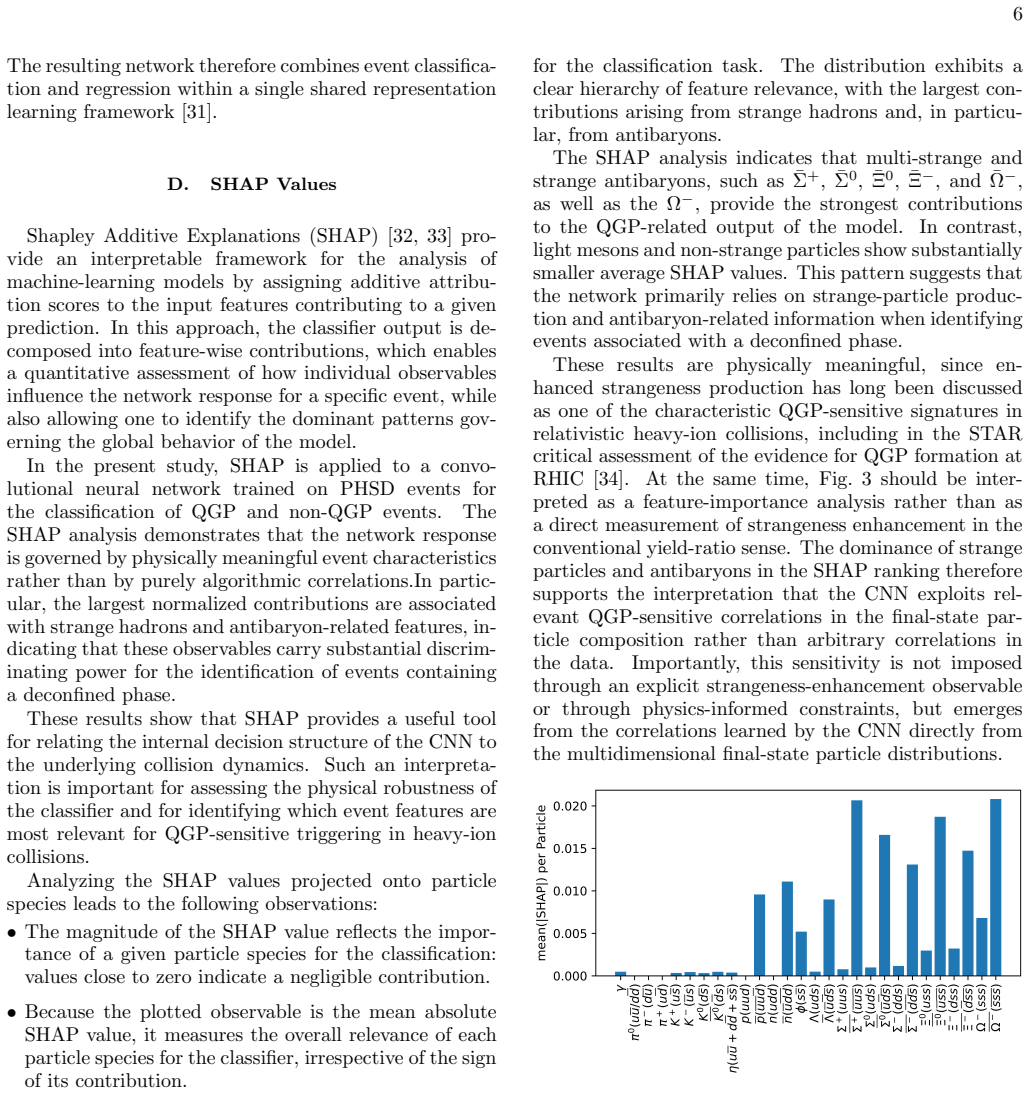
- SHAP-based analysis reveals which particle species most strongly influence the network decisions.
Where Pith is reading between the lines
- The method could reduce the volume of data that must be stored by discarding non-QGP events at the trigger level.
- Similar histogram encodings and CNN architectures might be adapted for selecting other rare processes in nuclear collisions.
- Direct comparison against actual detector output would be required to quantify any remaining simulation-to-reality gap.
- The same representation could be tested at different beam energies or in asymmetric collision systems to map the range of applicability.
Load-bearing premise
That microscopic QGP-related labels available inside the PHSD framework constitute reliable ground truth that transfers meaningfully to UrQMD dynamics and to events after detector reconstruction.
What would settle it
Classification accuracy dropping substantially below 80 percent when the trained network is applied to real experimental data from a heavy-ion detector or to events generated by a third independent model.
Figures
read the original abstract
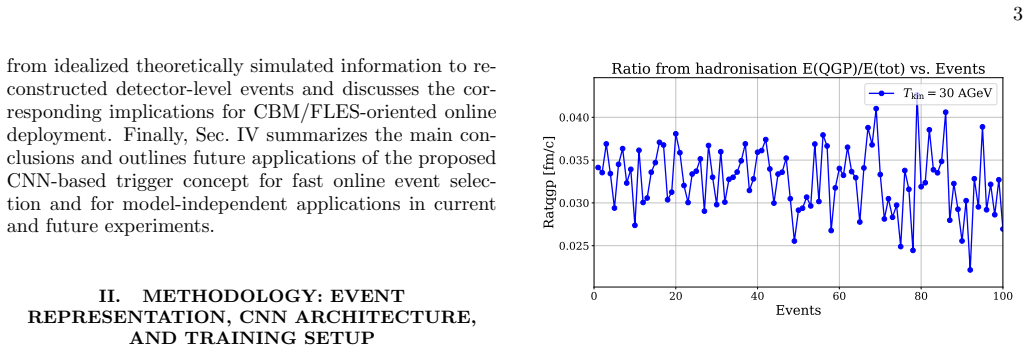
Modern high-rate experiments require rare physics signatures to be identified in real time from continuous streams of reconstructed events under stringent data-throughput and storage constraints. We present a convolutional-neural-network-based trigger concept for selecting events associated with quark-gluon plasma (QGP) formation. Events are encoded as compact multidimensional histograms of reconstructed particle content, including particle species, momentum magnitude, and angular information. The method is first evaluated within the Parton-Hadron-String Dynamics (PHSD) framework, where microscopic QGP-related labels are available. As an independent validation, the same event representation and network architecture are applied to Ultra-relativistic Quantum Molecular Dynamics (UrQMD) simulations, providing a distinct description of the collision dynamics. Cross-checks between PHSD and UrQMD are used to assess the stability of the learned response against generator-dependent effects and to quantify model-transfer robustness. For realistic deployment, a lightweight C++ inference package, ANN4FLES, is employed at the physics-analysis stage after tracking and topology reconstruction. For Au+Au collisions at 30 AGeV, the classification accuracy decreases from 95.1% on generator-level PHSD events to 83.7% after full reconstruction, while retaining practical separation power for online event selection. SHAP-based interpretability analysis is used to identify the dominant particle-species contributions to the network decision.
Editorial analysis
A structured set of objections, weighed in public.
Referee Report
Summary. The manuscript proposes a CNN-based online trigger for selecting QGP-associated events in high-rate heavy-ion collisions. Events are encoded as multidimensional histograms of reconstructed particle species, momenta, and angles. The network is trained on PHSD simulations using internal microscopic QGP labels, achieving 95.1% accuracy at generator level for Au+Au collisions at 30 AGeV; the same architecture yields 83.7% accuracy after full detector reconstruction. Cross-validation on UrQMD events and SHAP interpretability analysis are used to assess model-transfer robustness, with deployment via the lightweight ANN4FLES C++ package.
Significance. If the central performance claims hold under an observable definition of QGP, the work would address a practical need for real-time rare-event selection under data-throughput constraints at facilities such as FAIR or the LHC. The compact histogram representation, explicit post-reconstruction testing, cross-generator stability check, and provision of an inference package constitute concrete strengths that could facilitate experimental adoption.
major comments (2)
- [Abstract] Abstract: the reported accuracies (95.1% generator-level PHSD, 83.7% post-reconstruction) are defined exclusively with respect to PHSD-internal microscopic QGP labels. Because these labels are not directly observable and encode model-specific parton-hadron dynamics, the UrQMD cross-check only demonstrates inter-generator stability rather than providing an independent, falsifiable ground truth; this directly limits the strength of the 'practical separation power' claim for real data.
- [Abstract] Abstract: no statistical uncertainties, error bars, or dataset-size information accompany the accuracy figures, and no baseline comparison to simpler classifiers or conventional trigger algorithms is presented. These omissions make it impossible to judge whether the quoted performance exceeds what could be achieved with conventional observables.
minor comments (2)
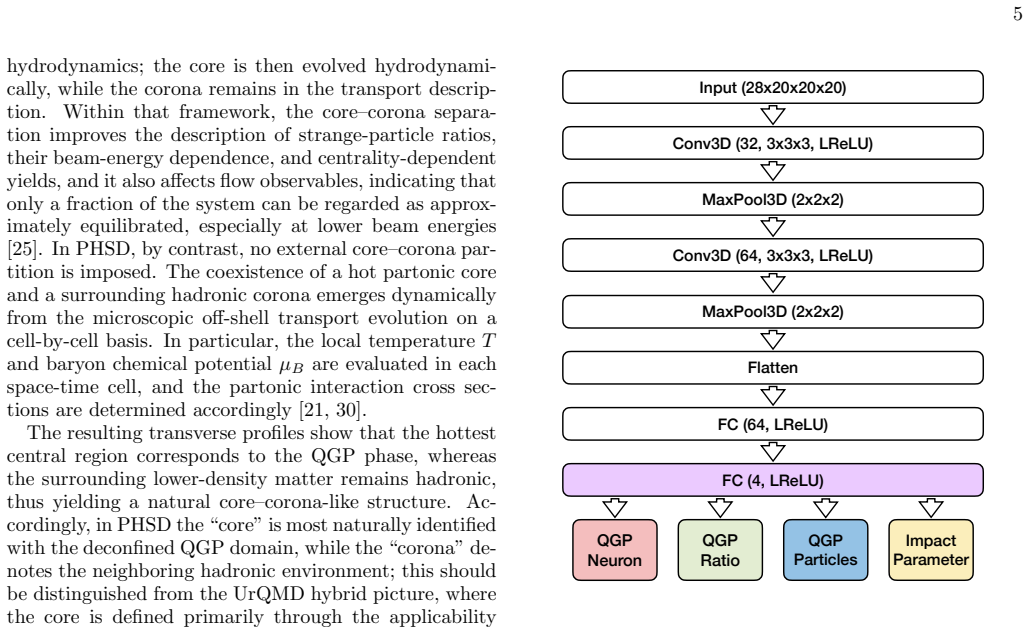
- The manuscript would benefit from an explicit diagram of the CNN architecture and input histogram binning scheme to allow reproduction.
- Training hyperparameters, optimizer choice, and regularization details are not stated, hindering assessment of potential overfitting to generator-specific features.
Simulated Author's Rebuttal
We thank the referee for the constructive comments on our manuscript. We address each major comment below and indicate the corresponding revisions.
read point-by-point responses
-
Referee: [Abstract] Abstract: the reported accuracies (95.1% generator-level PHSD, 83.7% post-reconstruction) are defined exclusively with respect to PHSD-internal microscopic QGP labels. Because these labels are not directly observable and encode model-specific parton-hadron dynamics, the UrQMD cross-check only demonstrates inter-generator stability rather than providing an independent, falsifiable ground truth; this directly limits the strength of the 'practical separation power' claim for real data.
Authors: We agree that the QGP labels are internal to the PHSD model and not directly observable. The UrQMD cross-validation tests robustness to differences in collision modeling between generators but does not supply an independent experimental ground truth. This does limit the strength of claims about separation power in real data. In the revised manuscript we will update the abstract to state explicitly that accuracies refer to model-specific labels and to moderate the phrasing of the 'practical separation power' claim. revision: yes
-
Referee: [Abstract] Abstract: no statistical uncertainties, error bars, or dataset-size information accompany the accuracy figures, and no baseline comparison to simpler classifiers or conventional trigger algorithms is presented. These omissions make it impossible to judge whether the quoted performance exceeds what could be achieved with conventional observables.
Authors: We acknowledge that statistical uncertainties and baseline comparisons are missing. In the revision we will add binomial or bootstrap error estimates to the accuracy numbers together with the sizes of the training and test samples. We will also include a comparison against a simple multiplicity-based trigger to provide context for the CNN performance. revision: yes
Circularity Check
No circularity: standard ML train/test on independent generators and reconstruction
full rationale
The paper reports CNN classification accuracies measured on held-out events from PHSD (training generator) and UrQMD (independent validation generator), plus after detector reconstruction. These are empirical performance metrics on separate data splits and models; no derivation chain, equations, or self-citations reduce the reported numbers to fitted parameters or prior results by construction. The use of internal PHSD labels for supervision is a modeling assumption, not a self-referential loop in any derivation.
Axiom & Free-Parameter Ledger
free parameters (1)
- CNN weights and biases
axioms (2)
- domain assumption Microscopic QGP-related labels inside PHSD constitute reliable supervised ground truth
- domain assumption Multidimensional histograms of particle species, momentum, and angle preserve the information needed to distinguish QGP events
Reference graph
Works this paper leans on
-
[1]
PHSD The Parton–Hadron–String Dynamics (PHSD) ap- proach provides a microscopic off-shell transport de- scription of relativistic heavy-ion collisions based on the Kadanoff–Baym equations in first-order gradient expan- sion [18–22]. It describes the full nonequilibrium evo- lution of the reaction, from the initial hard scatterings and string formation thr...
-
[2]
core” is most naturally identified with the deconfined QGP domain, while the “corona
URQMD To explore the robustness of the CNN approach beyond the PHSD description, we employed the Ultra-relativistic Quantum Molecular Dynamics (UrQMD) model [23–26] in two different variations. UrQMD provides a micro- scopic description of heavy-ion collisions in terms of hadronic and string degrees of freedom and is therefore well suited as an independen...
-
[3]
Friman, C
B. Friman, C. Hohne, J. Knoll, S. Leupold, J. Randrup, R. Rapp, and P. Senger, eds.,The CBM physics book: Compressed baryonic matter in laboratory experiments, Lect. Notes Phys., Vol. 814 (2011) pp. 1–980
2011
-
[4]
Sergeev, E
F. Sergeev, E. Bratkovskaya, I. Kisel, and I. Vassiliev, Int. J. Mod. Phys. A35, 2043002 (2020)
2020
-
[5]
Belousov, I
A. Belousov, I. Kisel, and R. Lakos, Algorithms16, 383 (2023)
2023
-
[6]
Kisel, R
I. Kisel, R. Lakos, and G. Zischka, Algorithms18, 229 (2025)
2025
-
[7]
Accardiet al., Eur
A. Accardiet al., Eur. Phys. J. A52, 268 (2016)
2016
-
[8]
Science Requirements and Detector Concepts for the Electron-Ion Collider: EIC Yellow Report
R. Abdul Khaleket al., Nucl. Phys. A1026, 122447 (2022), arXiv:2103.05419 [physics.ins-det]
work page internal anchor Pith review Pith/arXiv arXiv 2022
-
[9]
Pang, Nucl
L.-G. Pang, Nucl. Phys. A1005, 121972 (2021)
2021
-
[10]
Zheng and J
S. Zheng and J. Liu, Symmetry16, 1426 (2024)
2024
-
[11]
L.-G. Pang, K. Zhou, N. Su, H. Petersen, H. St¨ ocker, and X.-N. Wang, Nature Commun.9, 210 (2018)
2018
-
[12]
Y.-L. Du, K. Zhou, J. Steinheimer, L.-G. Pang, A. Mo- tornenko, H.-S. Zong, X.-N. Wang, and H. St¨ ocker, Eur. Phys. J. C80, 516 (2020)
2020
-
[13]
Kvasiuk, E
Y. Kvasiuk, E. Zabrodin, L. Bravina, I. Didur, and M. Frolov, JHEP07, 133
-
[14]
N. Mallick, S. Prasad, A. N. Mishra, R. Sahoo, and G. G. Barnaf¨ oldi, Phys. Rev. D105, 114022 (2022), arXiv:2203.01246 [hep-ph]
- [15]
- [16]
- [17]
-
[18]
Omana Kuttan, J
M. Omana Kuttan, J. Steinheimer, K. Zhou, A. Redel- bach, and H. Stoecker, Particles4, 47 (2021)
2021
-
[19]
Bleicher and E
M. Bleicher and E. Bratkovskaya, Prog. Part. Nucl. Phys. 122, 103920 (2022)
2022
-
[20]
Parton transport and hadronization from the dynamical quasiparticle point of view
W. Cassing and E. L. Bratkovskaya, Phys. Rev. C78, 034919 (2008), arXiv:0808.0022 [hep-ph]
work page internal anchor Pith review Pith/arXiv arXiv 2008
-
[21]
Cassing, Eur
W. Cassing, Eur. Phys. J. ST168, 3 (2009)
2009
-
[22]
E. L. Bratkovskaya, W. Cassing, V. P. Konchakovski, and O. Linnyk, Nucl. Phys. A856, 162 (2011)
2011
- [23]
- [24]
-
[25]
S. A. Basset al., Prog. Part. Nucl. Phys.41, 255 (1998), arXiv:nucl-th/9803035
work page internal anchor Pith review Pith/arXiv arXiv 1998
-
[26]
M. Bleicheret al., J. Phys. G25, 1859 (1999), arXiv:hep- 15 ph/9909407
-
[27]
Core-corona separation in the UrQMD hybrid model
J. Steinheimer and M. Bleicher, Phys. Rev. C84, 024905 (2011), arXiv:1104.3981 [hep-ph]
work page internal anchor Pith review Pith/arXiv arXiv 2011
-
[28]
M. Omana Kuttan, A. Motornenko, J. Steinheimer, H. Stoecker, Y. Nara, and M. Bleicher, Eur. Phys. J. C82, 427 (2022), arXiv:2201.01622 [nucl-th]
-
[29]
Linnyk, E
O. Linnyk, E. L. Bratkovskaya, and W. Cassing, Prog. Part. Nucl. Phys.87, 50 (2016)
2016
-
[30]
Soloveva, A
O. Soloveva, A. Palermo, and E. Bratkovskaya, Phys. Rev. C110, 034908 (2024)
2024
-
[31]
Y. Xu, P. Moreau, T. Song, M. Nahrgang, S. A. Bass, and E. Bratkovskaya, Phys. Rev. C96, 024902 (2017), arXiv:1703.09178 [nucl-th]
work page internal anchor Pith review Pith/arXiv arXiv 2017
-
[32]
O. Soloveva, P. Moreau, L. Oliva, V. Voronyuk, V. Kireyeu, T. Song, and E. Bratkovskaya, Particles3, 178 (2020), arXiv:2001.05395 [nucl-th]
-
[33]
Belousov,A QGP trigger based on convolutional neural network for the CBM experiment, Ph.D
A. Belousov,A QGP trigger based on convolutional neural network for the CBM experiment, Ph.D. thesis, Goethe U., Frankfurt (main) (2025)
2025
-
[34]
Noharaet al., inProceedings of the 10th ACM Inter- national Conference on Bioinformatics, Computational Biology and Health Informatics(2019)
Y. Noharaet al., inProceedings of the 10th ACM Inter- national Conference on Bioinformatics, Computational Biology and Health Informatics(2019)
2019
-
[35]
A. Shrikumar, P. Greenside, and A. Kundaje, Pro- ceedings of the 34th International Conference on Ma- chine Learning, PMLR 70:3145-3153, 2017 (2017), arXiv:1704.02685 [cs.LG]
-
[36]
J. Adamset al.(STAR), Nucl. Phys. A757, 102 (2005), arXiv:nucl-ex/0501009
work page internal anchor Pith review Pith/arXiv arXiv 2005
-
[37]
S. A. Bass, A. Bischoff, C. Hartnack, J. A. Maruhn, J. Reinhardt, H. Stoecker, and W. Greiner, J. Phys. G 20, L21 (1994)
1994
-
[38]
David, M
C. David, M. Freslier, and J. Aichelin, Phys. Rev. C51, 1453 (1995)
1995
- [39]
-
[40]
M. Omana Kuttan, J. Steinheimer, K. Zhou, A. Redel- bach, and H. Stoecker, Phys. Lett. B811, 135872 (2020), arXiv:2009.01584 [hep-ph]
- [41]
-
[42]
F. Li, Y. Wang, Z. Gao, P. Li, H. L¨ u, Q. Li, C. Y. Tsang, and M. B. Tsang, Phys. Rev. C104, 034608 (2021)
2021
-
[43]
Al-Turany and D
M. Al-Turany and D. Bertini, inComputing in High En- ergy and Nuclear Physics (CHEP 2006), MACMILLAN Advanced Research Series, Vol. 1 (2006) pp. 170–171
2006
-
[44]
Agostinelliet al.(GEANT4), Nucl
S. Agostinelliet al.(GEANT4), Nucl. Instrum. Meth. A 506, 250 (2003)
2003
-
[45]
Allisonet al., IEEE Trans
J. Allisonet al., IEEE Trans. Nucl. Sci.53, 270 (2006)
2006
-
[46]
Senger, Particles3, 320 (2020), arXiv:2004.11214 [nucl-ex]
P. Senger, Particles3, 320 (2020), arXiv:2004.11214 [nucl-ex]
discussion (0)
Sign in with ORCID, Apple, or X to comment. Anyone can read and Pith papers without signing in.