Probing Spacetime Topology and Superposition with Accelerated Detectors
Pith reviewed 2026-06-29 16:20 UTC · model grok-4.3
The pith
Spacetime superposition introduces interference that enlarges the parameter region where accelerated detectors harvest entanglement, with compactification further boosting concurrence at high accelerations.
A machine-rendered reading of the paper's core claim, the machinery that carries it, and where it could break.
Core claim
Compactification of one spatial direction enhances the vacuum two-point function, producing higher concurrence and an extended harvesting window at large accelerations. When the background is instead placed in superposition, the resulting interference enlarges the viable region in parameter space still further, most noticeably where accelerations are high. The directional effects—suppression for perpendicular separation and higher yield for antiparallel acceleration—remain intact under both modifications.
What carries the argument
The vacuum two-point correlation function evaluated in compactified or superposed Minkowski space, inserted into the standard entanglement-harvesting protocol for two Unruh-DeWitt detectors on Rindler trajectories.
If this is right
- Compactification raises concurrence and extends the range of accelerations permitting entanglement harvesting.
- Spacetime superposition adds interference that enlarges the harvesting region in parameter space, especially at high accelerations.
- Detector separation perpendicular to acceleration uniformly suppresses harvested entanglement due to increased spacelike separation.
- The advantage of antiparallel over parallel acceleration persists in both compactified and superposed settings.
Where Pith is reading between the lines
- The same protocol could be applied to other topologies or to superpositions involving curved geometries to test whether interference signatures remain detectable.
- If the enhancement scales with the compactification radius, the method might constrain the size of extra dimensions through entanglement measurements.
- The persistence of directional effects suggests that acceleration orientation could be used as an independent control knob when probing spacetime features.
Load-bearing premise
The standard entanglement harvesting protocol and its associated vacuum two-point function remain valid without further corrections when the background is compactified or superposed.
What would settle it
A calculation or measurement showing that concurrence fails to rise with compactification or that superposition fails to enlarge the high-acceleration harvesting region would falsify the central claims.
Figures
read the original abstract
We study entanglement harvested by Unruh DeWitt detectors following Rindler trajectories in compactified and superposed Minkowski spacetime. We consider different directions of acceleration (both parallel and antiparallel), separation between detectors and direction of spatial compactification mutually perpendicular to each other. Using the standard entanglement harvesting protocol, we analyze how these features influence the extracted correlations. When detector separation is perpendicular to the direction of acceleration, the harvested entanglement is uniformly suppressed due to increased spacelike separation. Compactification enhances field correlations leading to an increased concurrence and an extended harvesting range at higher accelerations. Additionally, we show that spacetime superposition introduces interference effects that further enlarge the entanglement harvesting region in parameter space, particularly in the high acceleration regime. We also find that the effect of antiparallel acceleration yielding significantly higher entanglement than parallel acceleration prevails in compactified and superposed spacetime.
Editorial analysis
A structured set of objections, weighed in public.
Referee Report
Summary. The manuscript examines entanglement harvesting by Unruh-DeWitt detectors on Rindler trajectories in Minkowski spacetime that is either spatially compactified or placed in a quantum superposition. It considers parallel and antiparallel accelerations, detector separations perpendicular to acceleration, and compactification directions, using the standard harvesting protocol to compute concurrence. Key findings are that perpendicular separation suppresses entanglement, compactification increases concurrence and extends the harvesting range at high accelerations, spacetime superposition introduces interference that further enlarges the harvesting region (especially at high acceleration), and the antiparallel-acceleration advantage persists in both modified backgrounds.
Significance. If the results hold under a properly derived superposed correlator, the work would provide concrete, falsifiable predictions for how topology and metric superposition modify extractable entanglement, extending the standard Unruh-DeWitt protocol to novel backgrounds. The persistence of the antiparallel advantage and the high-acceleration enhancement constitute clear, testable signatures that could be checked with existing numerical methods for compactified cases.
major comments (2)
- [Superposition modeling (abstract and main text)] The central claim that superposition enlarges the harvesting region via interference rests on an ad-hoc modification of the Wightman function. No derivation is supplied for the vacuum two-point function on a superposition of metrics (e.g., via consistent quantization, path-integral averaging, or an effective model), nor is a reference given to a controlled treatment that justifies inserting interference by hand. If additional decoherence or state-dependent terms appear in a proper superposed correlator, the reported enlargement disappears. This is load-bearing for the headline result.
- [Methods and results sections] The abstract states clear trends but the provided description supplies neither explicit expressions for the modified two-point function, error estimates on the concurrence, nor a description of the numerical quadrature or cutoff procedure used to evaluate the response functions. Without these, it is impossible to assess whether post-hoc parameter choices affect the reported high-acceleration enhancement.
minor comments (2)
- Notation for the compactification radius and the superposition parameter should be introduced once with a clear definition rather than appearing first in figures.
- Figure captions should explicitly state the values of all fixed parameters (e.g., detector energy gap, switching function width) used to generate each panel.
Simulated Author's Rebuttal
We thank the referee for their thorough review and valuable comments on our manuscript. We address each major comment below and will incorporate revisions to improve the clarity and rigor of the presentation.
read point-by-point responses
-
Referee: [Superposition modeling (abstract and main text)] The central claim that superposition enlarges the harvesting region via interference rests on an ad-hoc modification of the Wightman function. No derivation is supplied for the vacuum two-point function on a superposition of metrics (e.g., via consistent quantization, path-integral averaging, or an effective model), nor is a reference given to a controlled treatment that justifies inserting interference by hand. If additional decoherence or state-dependent terms appear in a proper superposed correlator, the reported enlargement disappears. This is load-bearing for the headline result.
Authors: We recognize that our treatment of spacetime superposition employs an effective model in which the Wightman function is constructed as a coherent superposition of the correlators corresponding to each metric component to capture the interference effects. This approach is inspired by analogous effective descriptions in the literature on quantum superpositions of spacetimes. While a complete derivation from a fundamental theory of quantum gravity is outside the scope of the present work, we will revise the manuscript to explicitly present the form of the modified two-point function, discuss the assumptions underlying the model, and cite relevant references where similar effective treatments have been used. We agree that this is a key aspect and will strengthen the justification in the revised version. revision: partial
-
Referee: [Methods and results sections] The abstract states clear trends but the provided description supplies neither explicit expressions for the modified two-point function, error estimates on the concurrence, nor a description of the numerical quadrature or cutoff procedure used to evaluate the response functions. Without these, it is impossible to assess whether post-hoc parameter choices affect the reported high-acceleration enhancement.
Authors: We agree with the referee that more detailed information on the computational methods is required. In the revised manuscript, we will add the explicit expressions for the two-point functions used in the compactified and superposed cases. Additionally, we will include error estimates for the computed concurrence values and provide a description of the numerical methods, including the quadrature techniques and any regularization or cutoff procedures applied to the integrals. revision: yes
Circularity Check
No circularity; standard protocol applied to modified geometries
full rationale
The paper applies the standard Unruh-DeWitt entanglement harvesting protocol using the usual response functions and a modified Wightman function that incorporates compactification via image sums or mode expansions and superposition via interference terms. No equations reduce by construction to fitted parameters from the authors' prior work, no load-bearing self-citations justify uniqueness or ansatzes, and no predictions are statistically forced by input fits. The concurrence and harvesting region results are computed outputs from the modified correlators rather than self-definitions or renamings of known results. The derivation chain remains self-contained against external benchmarks.
Axiom & Free-Parameter Ledger
axioms (2)
- domain assumption The quantum field is prepared in the Minkowski vacuum state.
- domain assumption The Unruh-DeWitt detector couples linearly to the field via the standard monopole interaction.
Reference graph
Works this paper leans on
-
[1]
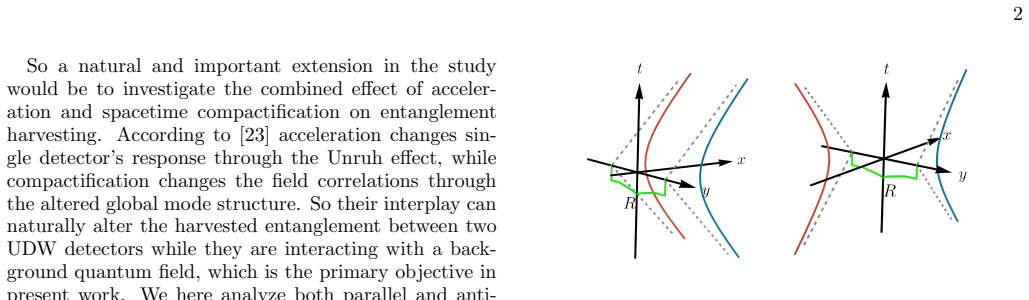
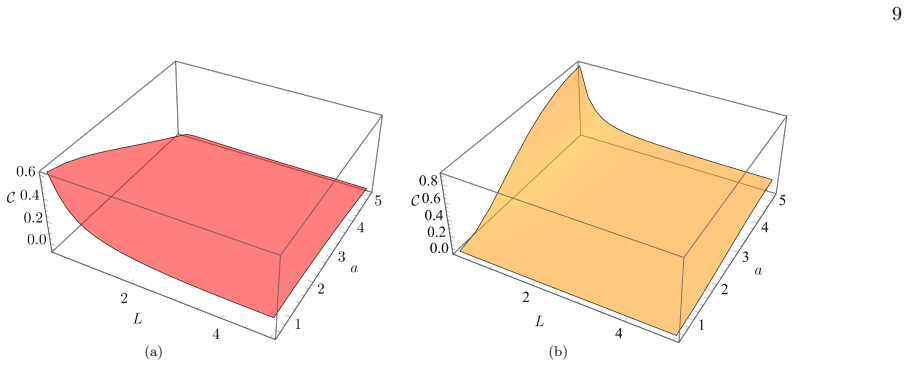
an universal suppression in harvested entanglement due to the chosen initial separation between two detectors which isperpendicularto the direction of acceleration
-
[2]
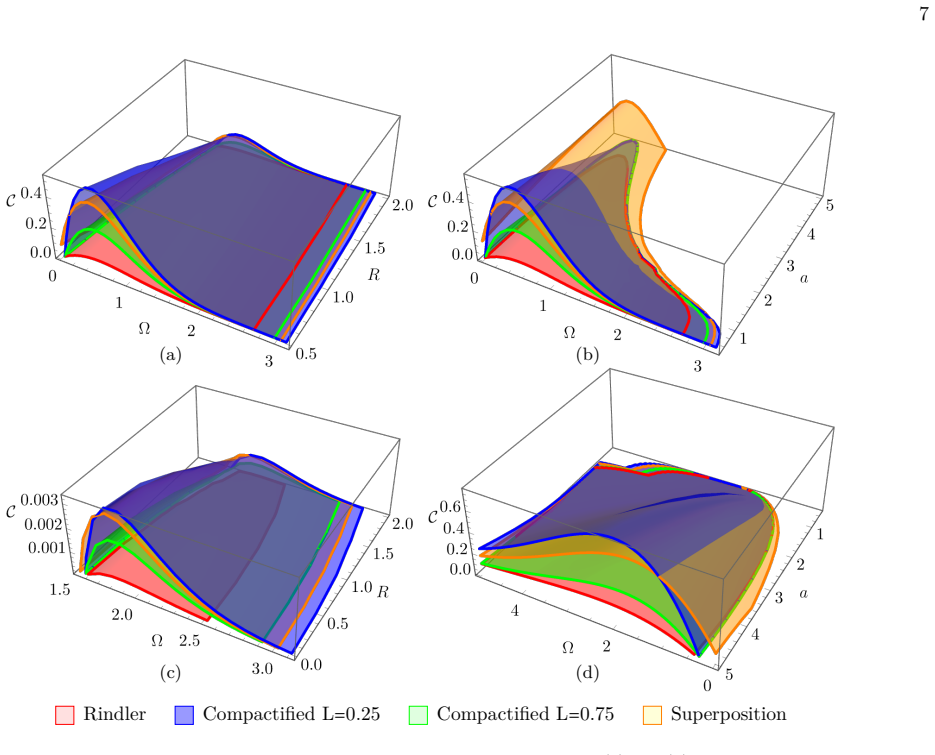
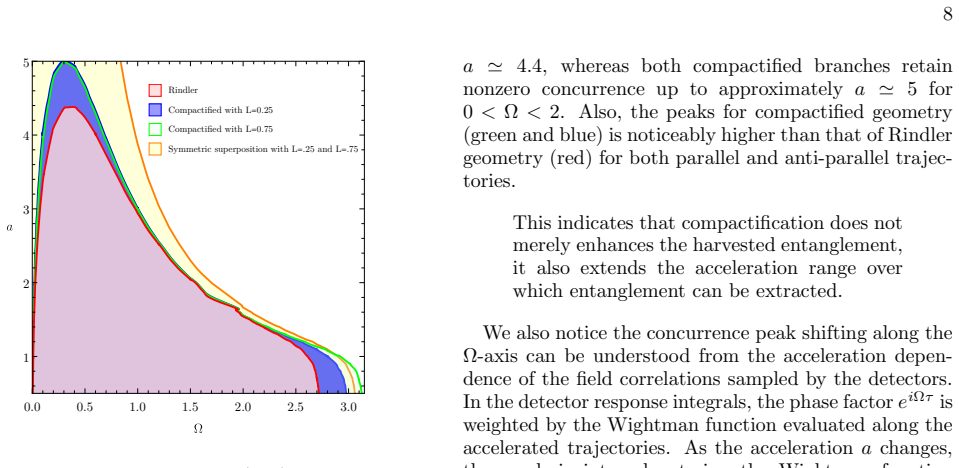
a systematic enhancement and expanded harvest- ing region due to compactification of spacetime
-
[3]
2 In a previous study [9] we already established that the effect of superposed spacetime is most pronounced whenθ=ϕ
superposed geometry enlarges the entanglement harvesting region, particularly in the high accel- eration regime. 2 In a previous study [9] we already established that the effect of superposed spacetime is most pronounced whenθ=ϕ. We have chosenθ=ϕ= π 4 for our analysis. 7 Rindler Compactified L =0.25 Compactified L =0.75 Superposition (a) (b) (c) (d) FIG. 2...
-
[4]
N. D. Birrell and P. C. W. Davies,Quantum Fields in Curved Space, Cambridge Monographs on Mathematical Physics (Cambridge University Press, Cambridge, UK, 1982)
1982
-
[5]
R. B. Mann and T. C. Ralph, Classical and Quantum Gravity29, 220301 (2012)
2012
- [6]
-
[7]
Mart´ ın-Mart´ ınez and N
E. Mart´ ın-Mart´ ınez and N. C. Menicucci, Classical and Quantum Gravity29, 224003 (2012)
2012
-
[8]
G. V. Steeg and N. C. Menicucci, Phys. Rev. D79, 044027 (2009)
2009
-
[9]
Pozas-Kerstjens and E
A. Pozas-Kerstjens and E. Martin-Martinez, Phys. Rev. D92, 064042 (2015)
2015
-
[10]
Martin-Martinez, A
E. Martin-Martinez, A. R. Smith, and D. R. Terno, Phys. Rev. D93, 044001 (2016)
2016
- [11]
-
[12]
Chakraborty, L
A. Chakraborty, L. Hackl, and M. Zych, Phys. Rev. D 111, 104052 (2025)
2025
-
[13]
Nambu, Entropy15, 1847 (2013)
Y. Nambu, Entropy15, 1847 (2013)
2013
-
[14]
J. Foo, R. B. Mann, and M. Zych, Phys. Rev. D103, 065013 (2021)
2021
-
[15]
Z. Liu, J. Zhang, R. B. Mann, and H. Yu, Phys. Rev. D 105, 085012 (2022)
2022
-
[16]
X. Liu, W. Liu, and S.-M. Wu, Eur. Phys. J. C85, 1209 (2025)
2025
-
[17]
Chiou, Phys
D.-W. Chiou, Phys. Rev. D97, 124028 (2018)
2018
-
[18]
H. Sun, K. Zhang, and H. Cai, Classical and Quantum Gravity38(2021)
2021
-
[19]
Salton, R
G. Salton, R. B. Mann, and N. C. Menicucci, New Jour- nal of Physics17, 035001 (2015)
2015
-
[20]
L. J. Henderson and N. C. Menicucci, Phys. Rev. D102, 125026 (2020)
2020
-
[21]
I. Fuentes-Schuller and R. B. Mann, Physical Review Let- ters95, 10.1103/physrevlett.95.120404 (2005)
- [23]
-
[24]
W. G. Unruh, Phys. Rev. D14, 870 (1976)
1976
-
[25]
Z. Liu, J. Zhang, and H. Yu, Phys. Rev. D107, 045010 (2023)
2023
-
[26]
L. Goel, E. A. Patterson, M. R. Preciado-Rivas, M. Tora- bian, R. B. Mann, and N. Afshordi, Phys. Rev. D111, 025015 (2025)
2025
-
[27]
Langlois, Annals Phys.321, 2027 (2006), arXiv:gr- qc/0510049
P. Langlois, Annals Phys.321, 2027 (2006), arXiv:gr- qc/0510049
-
[28]
J. Foo, C. S. Arabaci, M. Zych, and R. B. Mann, Phys. Rev. D107, 045014 (2023)
2023
- [29]
-
[30]
C. Suryaatmadja, C. S. Arabaci, M. P. G. Robbins, J. Foo, M. Zych, and R. B. Mann, Signatures of ro- tating black holes in quantum superposition (2023), arXiv:2310.10864 [gr-qc]
- [31]
-
[32]
J. Foo, R. B. Mann, and M. Zych, Physical Review D 103, 10.1103/physrevd.103.065013 (2021)
-
[33]
Y. Tang, W. Liu, Z. Liu, and J. Wang, Journal of High Energy Physics2026, 45 (2026)
2026
-
[34]
Particle detector in a position-superposed black hole spacetime
L. Walleghem and C. Cepollaro, Particle detector in a position-superposed black hole spacetime (2026), arXiv:2604.11897 [quant-ph]
work page internal anchor Pith review Pith/arXiv arXiv 2026
-
[35]
Banach and J
R. Banach and J. S. Dowker, J. Phys. A12, 2545 (1979)
1979
-
[36]
Banach, J
R. Banach, J. Phys. A13, 2179 (1980)
1980
- [37]
-
[38]
J. Foo, S. Onoe, R. B. Mann, and M. Zych, Phys. Rev. Res.3, 043056 (2021)
2021
-
[39]
Peres, Phys
A. Peres, Phys. Rev. Lett.77, 1413 (1996)
1996
-
[40]
Z. Liu, T. Haug, Q. Ye, Z.-W. Liu, and I. Roth, (2026), arXiv:2512.16777 [quant-ph]
work page internal anchor Pith review Pith/arXiv arXiv 2026
-
[41]
G. Vidal and R. F. Werner, Physical Review A65, 10.1103/physreva.65.032314 (2002)
-
[42]
W. K. Wootters, Phys. Rev. Lett.80, 2245 (1998), arXiv:quant-ph/9709029
work page internal anchor Pith review Pith/arXiv arXiv 1998
-
[43]
P. Rungta, V. Buˇ zek, C. M. Caves, M. Hillery, and G. J. Milburn, Physical Review A64, 10.1103/phys- reva.64.042315 (2001)
discussion (0)
Sign in with ORCID, Apple, or X to comment. Anyone can read and Pith papers without signing in.