Local Surrogates for Harmonic Vibrational Entropy in Multilattices
Pith reviewed 2026-06-29 15:04 UTC · model grok-4.3
The pith
Finite-range models let harmonic entropy be calculated from local sublattice surrogates with bounded error.
A machine-rendered reading of the paper's core claim, the machinery that carries it, and where it could break.
Core claim
For finite-range or screened atomistic models, sublattice-resolved locality and cutoff-error estimates justify replacing the global entropy calculation by a local, symmetry-respecting regression problem with controlled truncation error.
What carries the argument
Sublattice-resolved locality proofs and local regression surrogates that respect species and internal shift symmetries.
If this is right
- Harmonic entropy can be evaluated at linear cost in system size for fixed cutoff radius.
- Surrogates transfer across different supercell sizes in multispecies crystals.
- Explicit controls on truncation and regression error are available for stability checks.
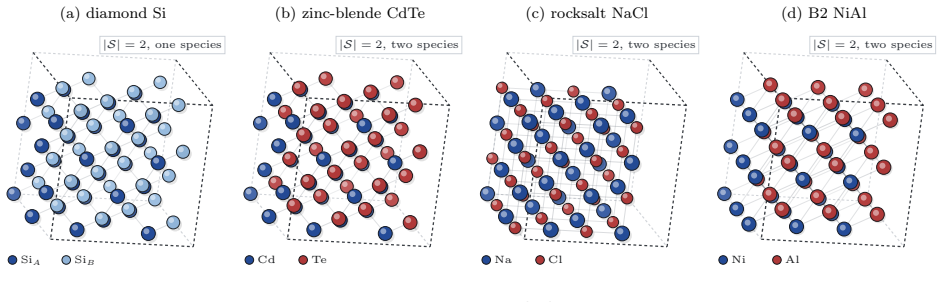
- Method applies to semiconductors, ordered alloys, and crystals with multi-atom bases.
Where Pith is reading between the lines
- Such surrogates could enable high-throughput screening of defect formation energies including vibrational contributions.
- Extension to anharmonic effects might require similar locality arguments for higher-order force constants.
Load-bearing premise
The atomistic models have finite interaction range or are screened.
What would settle it
Observation of significant entropy contributions from atoms beyond the cutoff distance in a model with strictly finite-range interactions.
Figures
read the original abstract
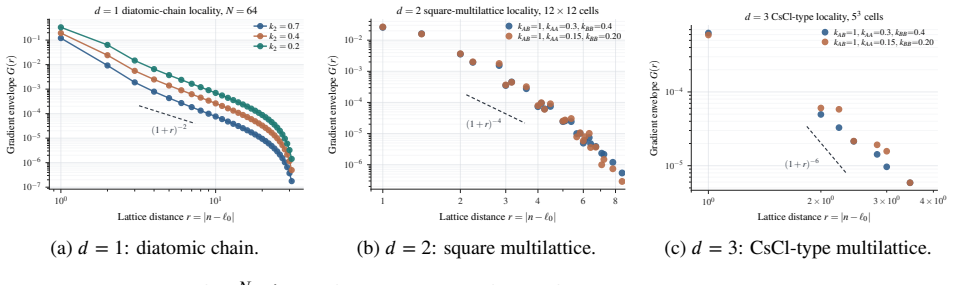
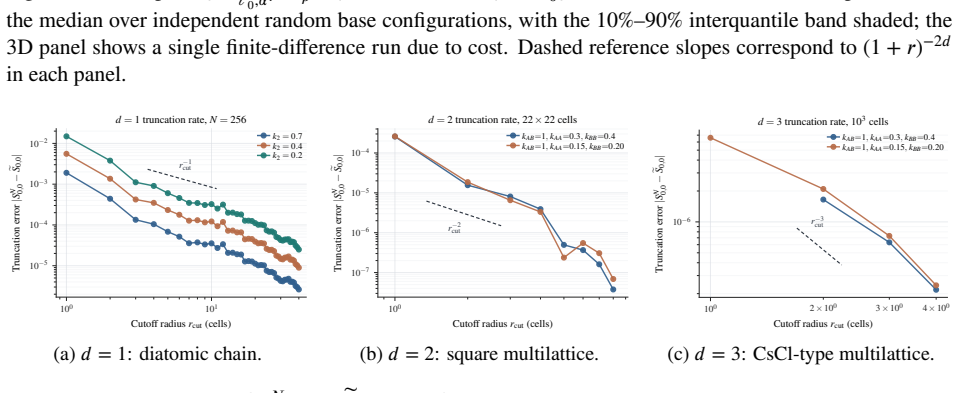
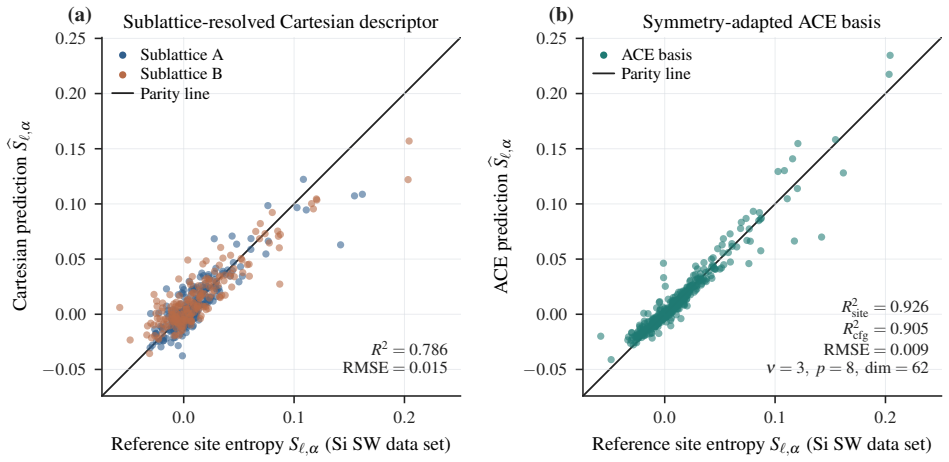
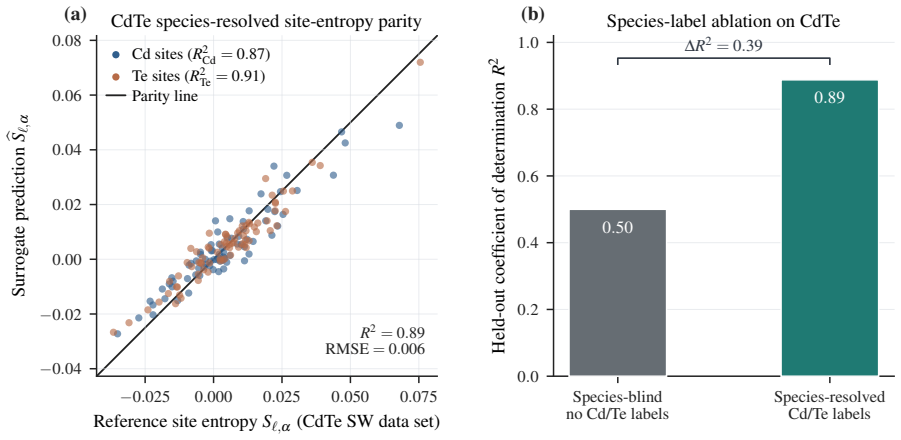
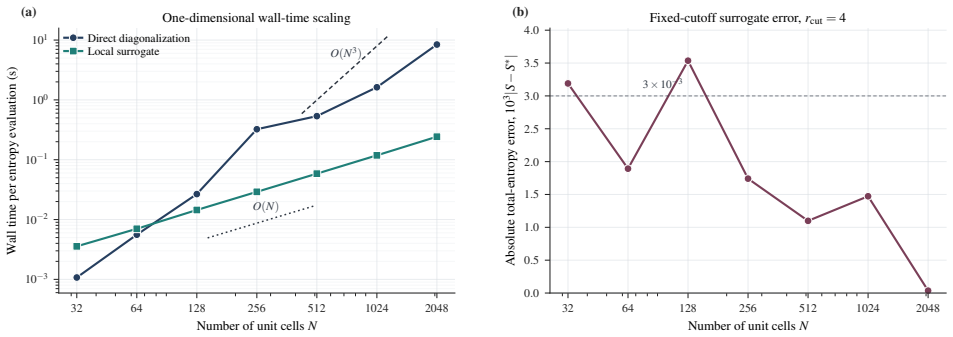
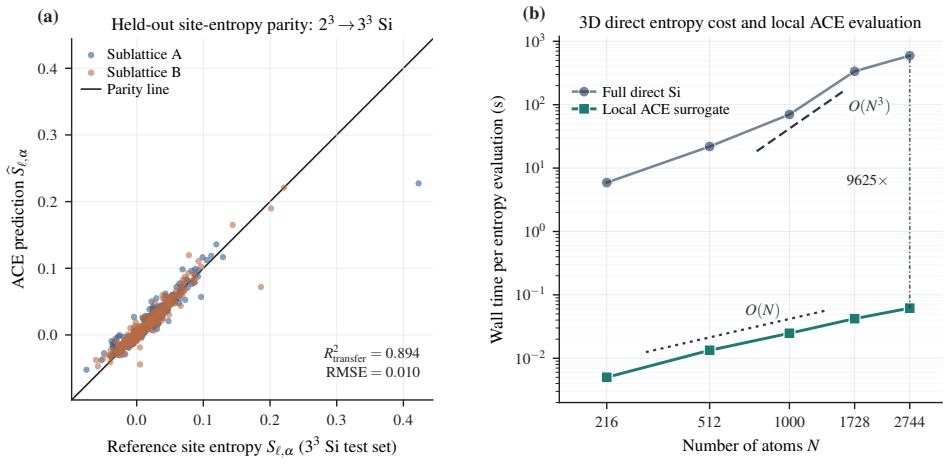
Harmonic vibrational entropy is a key finite-temperature contribution to defect thermodynamics, but direct evaluation by dense Hessian diagonalization scales cubically with atom count and is too costly for supercell convergence, migration-path sampling, and high-throughput defect studies. We develop local surrogate models for harmonic entropy in multilattices, including semiconductors, ordered alloys, and multispecies crystals with multi-atom bases and internal degrees of freedom. Unlike Bravais lattices, multilattices contain internal-shift degrees of freedom and optical phonon modes coupled to acoustic strain; entropy models must therefore resolve sublattice and species labels. For finite-range or screened atomistic models, we prove sublattice-resolved locality and cutoff-error estimates that justify replacing the global entropy calculation by a local, symmetry-respecting regression problem with controlled truncation error. This turns vibrational entropy from a global spectral calculation into a reusable local site model with linear evaluation cost at fixed cutoff. Numerical tests confirm the predicted locality behavior and show that sublattice/species-resolved surrogates achieve accurate regression, transfer across supercell sizes, and linear-scaling evaluation on Stillinger--Weber Si and CdTe benchmarks. The resulting method enables repeated harmonic-entropy evaluations in multispecies defect calculations while retaining explicit stability, truncation, and surrogate-error controls.
Editorial analysis
A structured set of objections, weighed in public.
Referee Report
Summary. The manuscript develops local surrogate models for harmonic vibrational entropy in multilattices (semiconductors, ordered alloys, multispecies crystals). For finite-range or screened atomistic models it proves sublattice-resolved locality together with cutoff-error estimates; these justify replacing global Hessian diagonalization by a local, symmetry-respecting regression problem whose evaluation cost is linear at fixed cutoff. Numerical benchmarks on Stillinger-Weber Si and CdTe are reported to confirm the predicted locality scaling, regression accuracy, and transfer across supercell sizes.
Significance. If the conditional proofs and error bounds hold, the work supplies an explicit, reusable site model with controlled truncation and surrogate error for a quantity that is otherwise cubic-cost. This directly enables repeated harmonic-entropy evaluations inside defect thermodynamics, migration-path sampling, and high-throughput studies of multilattices. Credit is due for (i) stating the finite-range/screened assumption up front, (ii) deriving sublattice/species-resolved locality rather than assuming it, and (iii) validating on two independent short-range benchmarks rather than a single toy system.
major comments (2)
- [Theoretical development / locality proof] The central claim rests on the proof of sublattice-resolved locality and the cutoff-error estimates. The abstract states that these hold precisely when the underlying model is finite-range or screened; the manuscript must therefore contain an explicit derivation (presumably in the theoretical section) showing how the finite-range assumption produces the stated truncation bound. Without that derivation the error-control guarantee cannot be verified.
- [Numerical results / benchmarks] Table or figure reporting regression accuracy (R², MAE, or similar) on the Stillinger-Weber Si and CdTe benchmarks should be accompanied by the exact regression procedure, feature set, and how the predicted scaling with cutoff is quantified. The current high-level description leaves open whether the numerical confirmation actually matches the analytic cutoff-error estimate.
minor comments (2)
- Notation for sublattice and species labels in the surrogate model equations should be introduced once and used consistently; a small table summarizing the symbols would improve readability.
- The abstract mentions 'explicit stability, truncation, and surrogate-error controls'; a short dedicated paragraph or subsection listing the three controls and where each appears in the manuscript would help readers locate them.
Simulated Author's Rebuttal
We thank the referee for the positive assessment of the work's significance and for the constructive major comments. We address each point below and will revise the manuscript to strengthen the presentation of the theoretical derivation and the numerical procedures.
read point-by-point responses
-
Referee: [Theoretical development / locality proof] The central claim rests on the proof of sublattice-resolved locality and the cutoff-error estimates. The abstract states that these hold precisely when the underlying model is finite-range or screened; the manuscript must therefore contain an explicit derivation (presumably in the theoretical section) showing how the finite-range assumption produces the stated truncation bound. Without that derivation the error-control guarantee cannot be verified.
Authors: We agree that an explicit, self-contained derivation is required to allow verification of the error-control guarantee. The current manuscript states the finite-range/screened assumption and asserts the resulting locality and truncation bounds, but the step-by-step derivation from the assumption to the sublattice-resolved bounds is not presented with sufficient detail. In the revised version we will add a dedicated subsection (or appendix) that derives the locality result and the cutoff-error estimate directly from the finite-range hypothesis, including the relevant matrix-element decay arguments and the symmetry-respecting truncation. revision: yes
-
Referee: [Numerical results / benchmarks] Table or figure reporting regression accuracy (R², MAE, or similar) on the Stillinger-Weber Si and CdTe benchmarks should be accompanied by the exact regression procedure, feature set, and how the predicted scaling with cutoff is quantified. The current high-level description leaves open whether the numerical confirmation actually matches the analytic cutoff-error estimate.
Authors: We will expand the numerical section to include (i) the precise regression algorithm and hyperparameters, (ii) the explicit feature construction (local atomic neighborhoods with species and sublattice labels up to the chosen cutoff), and (iii) a direct quantitative comparison between the observed regression errors and the analytic cutoff-error bounds derived in the theory section. A new table or supplementary figure will report R², MAE, and scaling of the error with cutoff radius for both benchmarks, confirming consistency with the theoretical predictions. revision: yes
Circularity Check
No significant circularity; derivation is conditional on stated model assumptions
full rationale
The central claim is a conditional proof of sublattice-resolved locality and cutoff-error estimates that hold precisely when the atomistic model is finite-range or screened; this assumption is stated explicitly and required for the result. No load-bearing self-citation, self-definitional step, or fitted input renamed as prediction appears. Numerical benchmarks on independent short-range models (Stillinger-Weber Si, CdTe) provide external validation of the predicted scaling. The derivation chain is therefore self-contained against external benchmarks.
Axiom & Free-Parameter Ledger
axioms (1)
- domain assumption Finite-range or screened atomistic models exhibit sublattice-resolved locality for vibrational entropy contributions.
Reference graph
Works this paper leans on
-
[1]
Atomic cluster expansion: Completeness, efficiency and stability
Bachmayr, M., Csanyi, G., Dusson, G., Drautz, R., Etter, S., van der Oord, C., Ortner, C., 2022. Atomic cluster expansion: Completeness, efficiency and stability. Journal of Computational Physics 454, 110946. doi:10.1016/j.jcp.2022.110946
-
[2]
Polynomial approximation of symmetric functions
Bachmayr, M., Dusson, G., Ortner, C., Drautz, R., 2024. Polynomial approximation of symmetric functions. Mathematics of Computation 93, 811–839. doi:10.1090/mcom/3868
-
[3]
Boundsforthetraceoftheinverseandthedeterminantofsymmetricpositive definite matrices
Bai,Z.,Golub,G.H.,1996. Boundsforthetraceoftheinverseandthedeterminantofsymmetricpositive definite matrices. Annals of Numerical Mathematics 4, 29–38
1996
-
[4]
On representing chemical environments
Bartók, A.P., Kondor, R., Csányi, G., 2013. On representing chemical environments. Physical Review B 87, 184115. doi:10.1103/PhysRevB.87.184115
work page internal anchor Pith review doi:10.1103/physrevb.87.184115 2013
-
[5]
Gaussian approximation potentials: The accuracy of quantum mechanics, without the electrons
Bartók, A.P., Payne, M.C., Kondor, R., Csányi, G., 2010. Gaussian approximation potentials: The accuracy of quantum mechanics, without the electrons. Physical Review Letters 104, 136403. doi:10. 1103/PhysRevLett.104.136403
2010
-
[6]
Higher-order far-field boundary conditions for crys- talline defects
Braun, J., Ortner, C., Wang, Y., Zhang, L., 2025. Higher-order far-field boundary conditions for crys- talline defects. SIAM Journal on Numerical Analysis 63, 520–541. doi:10.1137/24M165836X
-
[7]
Computer modelling of defects in solids
Catlow, C.R.A., 1986. Computer modelling of defects in solids. Annual Review of Materials Science 16, 517–548. doi:10.1146/annurev.ms.16.080186.002505
-
[8]
QM/MMmethodsforcrystallinedefects.part3: Machine-learned MM models
Chen,H.,Ortner,C.,Wang,Y.,2022. QM/MMmethodsforcrystallinedefects.part3: Machine-learned MM models. Multiscale Modeling & Simulation 20, 1490–1518. doi:10.1137/21M1441122
-
[9]
On the mathematical foundations of learning
Cucker, F., Smale, S., 2002. On the mathematical foundations of learning. Bulletin of the American Mathematical Society 39, 1–49. doi:10.1090/S0273-0979-01-00923-5
-
[10]
Embedded-atom method: Derivation and application to impurities, surfaces, andotherdefectsinmetals
Daw, M.S., Baskes, M.I., 1984. Embedded-atom method: Derivation and application to impurities, surfaces, andotherdefectsinmetals. PhysicalReviewB29, 6443–6453. doi:10.1103/PhysRevB.29. 6443
-
[11]
Atomicclusterexpansionforaccurateandtransferableinteratomicpotentials
Drautz,R.,2019. Atomicclusterexpansionforaccurateandtransferableinteratomicpotentials. Physical Review B 99, 014104. doi:10.1103/PhysRevB.99.014104
-
[12]
Uniform accuracy of the quasicontinuum method
E, W., Lu, J., Yang, J.Z., 2006. Uniform accuracy of the quasicontinuum method. Physical Review B 74, 214115. doi:10.1103/PhysRevB.74.214115
-
[13]
Anharmonic free energies and phonon dispersions from the stochastic self-consistent harmonic approximation
Errea, I., Calandra, M., Mauri, F., 2014. Anharmonic free energies and phonon dispersions from the stochastic self-consistent harmonic approximation. Physical Review B 89, 064302. doi:10.1103/ PhysRevB.89.064302
2014
-
[14]
Method to extract anharmonic force constants from first principles calculations
Esfarjani, K., Stokes, H.T., 2008. Method to extract anharmonic force constants from first principles calculations. Physical Review B 77, 144112. doi:10.1103/PhysRevB.77.144112
-
[15]
Evaluation of harmonic methods for calculating the free energy of defects in solids
Foiles, S.M., 1994. Evaluation of harmonic methods for calculating the free energy of defects in solids. Physical Review B 49, 14930–14938. doi:10.1103/PhysRevB.49.14930
-
[16]
New Monte Carlo method to compute the free energy of arbitrary solids
Frenkel, D., Ladd, A.J.C., 1984. New Monte Carlo method to compute the free energy of arbitrary solids. application to the fcc and hcp phases of hard spheres. Journal of Chemical Physics 81, 3188–
1984
-
[17]
doi:10.1063/1.448024
-
[18]
Calculation of the vacancy formation energy in aluminium
Gillan, M.J., 1989. Calculation of the vacancy formation energy in aluminium. Journal of Physics: Condensed Matter 1, 689–711. doi:10.1088/0953-8984/1/4/005. 31
-
[19]
Glensk, A., Grabowski, B., Hickel, T., Neugebauer, J., 2014. Breakdown of the Arrhenius law in de- scribing vacancy formation energies: The importance of local anharmonicity revealed byab initiother- modynamics. Physical Review X 4, 011018. doi:10.1103/PhysRevX.4.011018
-
[20]
Goryaeva, A.M., Maréchal, C., Marinica, M.C., 2020. Reinforcing materials modelling by encoding the structures of defects in crystalline solids into distortion scores. Nature Communications 11, 4691. doi:10.1038/s41467-020-18282-2
-
[21]
Grabowski, B., Ismer, L., Hickel, T., Neugebauer, J., 2009.Ab initioup to the melting point: Anhar- monicity and vacancies in aluminum. Physical Review B 79, 134106. doi:10.1103/PhysRevB.79. 134106
-
[22]
Grigorev, P., Goryaeva, A.M., Marinica, M.C., Kermode, J.R., Swinburne, T.D., 2023. Calculation of dislocation binding to helium-vacancy defects in tungsten using hybrid ab initio-machine learning methods. Acta Materialia 247, 118734. doi:10.1016/j.actamat.2023.118734
-
[23]
Approximating spectral sums of large-scale matrices usingstochasticChebyshevapproximations
Han, I., Malioutov, D., Avron, H., Shin, J., 2017. Approximating spectral sums of large-scale matrices usingstochasticChebyshevapproximations. SIAMJournalonScientificComputing39,A1558–A1585. doi:10.1137/16M1078148
-
[24]
Approximation properties of ACE basis func- tions
Hashemi, M., Wittwer, S., Suldér, B., Drautz, R., 2023. Approximation properties of ACE basis func- tions. Multiscale Modeling & Simulation 21, 978–1010. doi:10.1137/22M1535040
-
[25]
Temperaturedependenteffectivepotential method for accurate free energy calculations of solids
Hellman,O.,Steneteg,P.,Abrikosov,I.A.,Simak,S.I.,2013. Temperaturedependenteffectivepotential method for accurate free energy calculations of solids. Physical Review B 87, 104111. doi:10.1103/ PhysRevB.87.104111
2013
-
[26]
Improved tangent estimate in the nudged elastic band method for findingminimumenergypathsandsaddlepoints
Henkelman, G., Jónsson, H., 2000. Improved tangent estimate in the nudged elastic band method for findingminimumenergypathsandsaddlepoints. JournalofChemicalPhysics113,9978–9985. doi:10. 1063/1.1323224
2000
-
[27]
Higham,N.J.,2008.FunctionsofMatrices: TheoryandComputation.SocietyforIndustrialandApplied Mathematics, Philadelphia. doi:10.1137/1.9780898717778
-
[28]
In operando active learning of interatomic interaction during large- scale simulations
Hodapp, M., Shapeev, A., 2020. In operando active learning of interatomic interaction during large- scale simulations. Machine Learning: Science and Technology 1, 045005. doi:10.1088/2632-2153/ aba373
-
[29]
Machine-learning potentials enable predictive and tractable high- throughput screening of random alloys
Hodapp, M., Shapeev, A., 2021. Machine-learning potentials enable predictive and tractable high- throughput screening of random alloys. Physical Review Materials 5, 113802. doi:10.1103/ PhysRevMaterials.5.113802
2021
-
[30]
Analysisofstablescrewdislocationconfigurationsinanantiplanelattice model
Hudson,T.,Ortner,C.,2014a. Analysisofstablescrewdislocationconfigurationsinanantiplanelattice model. SIAM Journal on Mathematical Analysis 46, 291–320. doi:10.1137/130941318
-
[31]
Existence and stability of a screw dislocation under anti-plane deforma- tion
Hudson, T., Ortner, C., 2014b. Existence and stability of a screw dislocation under anti-plane deforma- tion. ArchiveforRationalMechanicsandAnalysis213,887–929. doi:10.1007/s00205-014-0746-9
-
[32]
A stochastic estimator of the trace of the influence matrix for Lapla- cian smoothing splines
Hutchinson, M.F., 1990. A stochastic estimator of the trace of the influence matrix for Lapla- cian smoothing splines. Communications in Statistics — Simulation and Computation 19, 433–450. doi:10.1080/03610919008812866
-
[33]
Statisticalmechanicsoffluidmixtures
Kirkwood,J.G.,1935. Statisticalmechanicsoffluidmixtures. JournalofChemicalPhysics3,300–313. doi:10.1063/1.1749657
-
[34]
Crack propagation in b.c.c
Kohlhoff, S., Gumbsch, P., Fischmeister, H.F., 1991. Crack propagation in b.c.c. crystals studied with a combined finite-element and atomistic model. Philosophical Magazine A 64, 851–878. doi:10.1080/ 01418619108213953. 32
1991
-
[35]
Lapointe, C., Swinburne, T.D., Proville, L., Becquart, C.S., Mousseau, N., Marinica, M.C., 2022. Ma- chine learning surrogate models for strain-dependent vibrational properties and migration rates of point defects. Physical Review Materials 6, 113803. doi:10.1103/PhysRevMaterials.6.113803
-
[36]
Machine learning surrogate models for prediction of point defect vibrational entropy
Lapointe,C.,Swinburne,T.D., Thiry,L.,Mallat,S.,Proville,L.,Becquart, C.S.,Marinica,M.C.,2020. Machine learning surrogate models for prediction of point defect vibrational entropy. Physical Review Materials 4, 063802. doi:10.1103/PhysRevMaterials.4.063802
-
[37]
Theatomicsimulationenvironment—aPythonlibraryfor working with atoms
Larsen,A.H.,Mortensen,J.J.r.,Blomqvist,J.,Castelli,I.E.,Christensen,R.,Dułak,M.,Friis,J.,Groves, M.N.,Hammer,B.r.,Hargus,C.,etal.,2017. Theatomicsimulationenvironment—aPythonlibraryfor working with atoms. Journal of Physics: Condensed Matter 29, 273002. doi:10.1088/1361-648X/ aa680e
-
[38]
Fine-tuning universal machine-learned interatomicpotentials: Atutorialonmethodsandapplications
Liu, X., Zeng, K., Luo, Z., Wang, Y., Zhao, T., Xu, Z., 2026. Fine-tuning universal machine-learned interatomicpotentials: Atutorialonmethodsandapplications. JournalofAppliedPhysics139,041101. doi:10.1063/5.0299305
-
[39]
Atomistic-to-continuum coupling
Luskin, M., Ortner, C., 2013. Atomistic-to-continuum coupling. Acta Numerica 22, 397–508. doi:10. 1017/S0962492913000068
2013
-
[40]
Lysogorskiy,Y.,vanderOord,C.,Bochkarev,A.,Menon,S.,Rinaldi,M.,Hammerschmidt,T.,Mrovec, M., Thompson, A., Csányi, G., Ortner, C., Drautz, R., 2021. Performant implementation of the atomic cluster expansion (PACE) and application to copper and silicon. npj Computational Materials 7, 97. doi:10.1038/s41524-021-00559-9
-
[41]
Theory of Lattice Dynamics in the Harmonic Approximation
Maradudin, A.A., Montroll, E.W., Weiss, G.H., Ipatova, I.P., 1971. Theory of Lattice Dynamics in the Harmonic Approximation. 2nd ed., Academic Press, New York
1971
-
[42]
Marinica, M.C., Becquart, C.S., Domain, C., 2013. The role of the activation barriers and the diffusion path on the rate constants for vacancy diffusion in bcc Fe. Journal of Nuclear Materials 433, 491–497. doi:10.1016/j.jnucmat.2012.04.024
-
[43]
Elastic far-field decay from dislocations in multilat- tices
Olson, E., Ortner, C., Wang, Y., Zhang, L., 2023. Elastic far-field decay from dislocations in multilat- tices. Multiscale Modeling & Simulation 21, 1379–1409. doi:10.1137/22M1502021
-
[44]
Moment tensor potentials: A class of systematically improvable interatomic po- tentials
Shapeev, A.V., 2016. Moment tensor potentials: A class of systematically improvable interatomic po- tentials. Multiscale Modeling & Simulation 14, 1153–1173. doi:10.1137/15M1054183
-
[45]
Computer simulation of local order in condensed phases of silicon
Stillinger, F.H., Weber, T.A., 1985. Computer simulation of local order in condensed phases of silicon. Physical Review B 31, 5262–5271. doi:10.1103/PhysRevB.31.5262
-
[46]
Unsupervised calculation of free energy barriers in large crys- talline systems
Swinburne, T.D., Marinica, M.C., 2018. Unsupervised calculation of free energy barriers in large crys- talline systems. Physical Review Letters 120, 135503. doi:10.1103/PhysRevLett.120.135503
-
[47]
Modeling solid-state chemistry: Interatomic potentials for multicomponent systems
Tersoff, J., 1989. Modeling solid-state chemistry: Interatomic potentials for multicomponent systems. Physical Review B 39, 5566–5568. doi:10.1103/PhysRevB.39.5566
-
[48]
Thompson, A.P., Aktulga, H.M., Berger, R., Bolintineanu, D.S., Brown, W.M., Crozier, P.S., in ’t Veld, P.J., Kohlmeyer, A., Moore, S.G., Nguyen, T.D., et al., 2022. LAMMPS – a flexible simulation tool for particle-based materials modeling at the atomic, meso, and continuum scales. Computer Physics Communications 271, 108171. doi:10.1016/j.cpc.2021.108171
-
[49]
Surrogate models for vibrational entropy based on a spatial decomposition
Torabi, T., Wang, Y., Ortner, C., 2025. Surrogate models for vibrational entropy based on a spatial decomposition. Multiscale Modeling & Simulation 23, 514–544. doi:10.1137/24M165168X
-
[50]
Trinkle, D.R., 2008. Latticegreenfunctionforextendeddefectcalculations: Computationanderrores- timationwithlong-rangeforces. PhysicalReviewB78, 014110. doi:10.1103/PhysRevB.78.014110. 33
-
[51]
Fastestimationoftr(𝑓(𝑎))viastochasticLanczosquadrature
Ubaru,S.,Chen,J.,Saad,Y.,2017. Fastestimationoftr(𝑓(𝑎))viastochasticLanczosquadrature. SIAM Journal on Matrix Analysis and Applications 38, 1075–1099. doi:10.1137/16M1104974
-
[52]
Frequency factors and isotope effects in solid state rate processes
Vineyard, G.H., 1957. Frequency factors and isotope effects in solid state rate processes. Journal of Physics and Chemistry of Solids 3, 121–127. doi:10.1016/0022-3697(57)90059-8
-
[53]
Thermodynamics of Crystals
Wallace, D.C., 1972. Thermodynamics of Crystals. Wiley, New York
1972
-
[54]
A posteriori error estimate and adaptivity for QM/MMmodelsofcrystallinedefects
Wang, Y., Kermode, J.R., Ortner, C., Zhang, L., 2024. A posteriori error estimate and adaptivity for QM/MMmodelsofcrystallinedefects. ComputerMethodsinAppliedMechanicsandEngineering428, 117097. doi:10.1016/j.cma.2024.117097
-
[55]
Scattered Data Approximation
Wendland, H., 2004. Scattered Data Approximation. Cambridge University Press, Cambridge
2004
-
[56]
ACEpotentials.jl: A Julia implementationoftheatomicclusterexpansion
Witt, W.C., van der Oord, C., Gelzinyte, E., Jarvinen, T., Ross, A., Darby, J.P., Ho, C.H., Baldwin, W.J., Sachs, M., Kermode, J., Bernstein, N., Csanyi, G., Ortner, C., 2023. ACEpotentials.jl: A Julia implementationoftheatomicclusterexpansion. TheJournalofChemicalPhysics159,164101. doi:10. 1063/5.0158783
2023
-
[57]
Directcalculationofthelatticegreenfunctionwitharbitraryinteractions for general crystals
Yasi,J.A.,Trinkle,D.R.,2012. Directcalculationofthelatticegreenfunctionwitharbitraryinteractions for general crystals. Physical Review E 85, 066706. doi:10.1103/PhysRevE.85.066706. 34
discussion (0)
Sign in with ORCID, Apple, or X to comment. Anyone can read and Pith papers without signing in.