Evolution of Hypoequilibrium States in Steepest Entropy Ascent Models for Nonequilibrium Quantum Thermodynamics
Pith reviewed 2026-06-29 17:18 UTC · model grok-4.3
The pith
The M-th order hypoequilibrium family forms an invariant manifold under the SEAQT equation of motion.
A machine-rendered reading of the paper's core claim, the machinery that carries it, and where it could break.
Core claim
Using a general decomposition of the Hilbert space, hypoequilibrium states are defined in operator language. For the regime where dissipative dynamics commutes with the Hamiltonian, the reduced evolution of intensive parameters is derived. It is proved that the M-th order HE family constitutes an invariant manifold under the SEAQT equation of motion, ensuring that states initially representing a mixture of canonicals maintain this structure throughout their evolution. A formal connection is established between the HE ansatz and the RCCE method, identifying HE variables as constraint potentials, and the model is extended to non-Hamiltonian SEAQT interactions.
What carries the argument
The M-th order hypoequilibrium family (defined by spectral-sector decomposition of the Hilbert space), which functions as an invariant manifold under the SEAQT equation of motion.
If this is right
- Initial mixtures of canonical ensembles preserve their hypoequilibrium structure for all later times.
- Reduced dynamics for the intensive parameters follow directly once the commuting regime is assumed.
- HE variables serve as the constraint potentials that connect the approach to the RCCE method.
- The framework extends consistently to non-Hamiltonian SEAQT interactions describing energy and entropy exchange with heat baths.
Where Pith is reading between the lines
- The invariance property could reduce the computational cost of simulating far-from-equilibrium quantum relaxation by confining trajectories to a lower-dimensional manifold.
- The same manifold structure might appear in other quantum master equations that share the steepest-entropy-ascent property.
- Because HE variables map to RCCE constraint potentials, the result offers a route to embed SEAQT dynamics inside existing chemical kinetics codes.
Load-bearing premise
The reduced evolution of intensive parameters is derived only in the regime where dissipative dynamics commutes with the Hamiltonian.
What would settle it
A direct numerical integration of the SEAQT equation starting from an M-th order hypoequilibrium state that produces a density operator outside the hypoequilibrium family at later times would falsify the invariance claim.
Figures
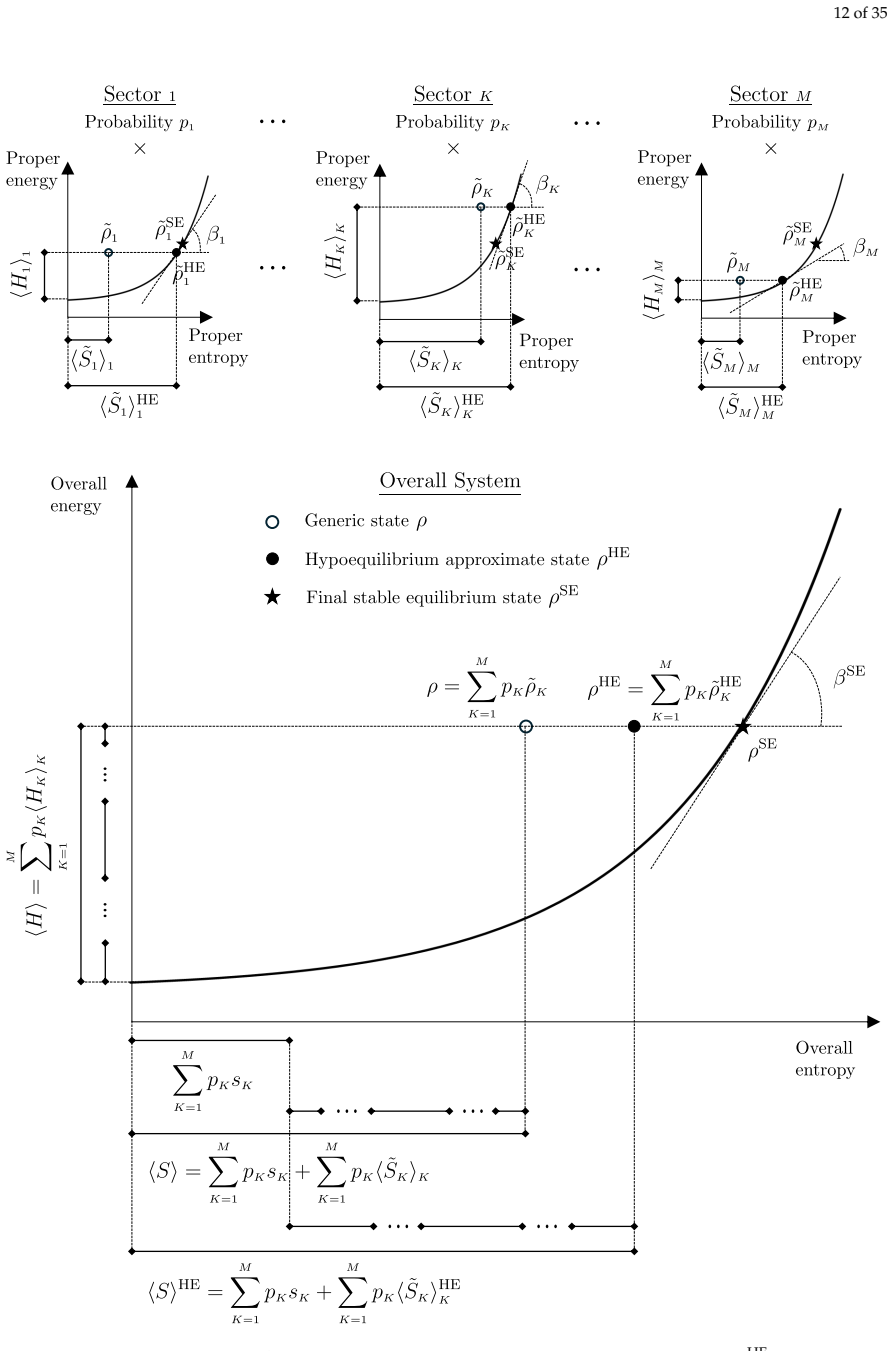
read the original abstract
A formal development of the hypoequilibrium (HE) state concept within the Steepest-Entropy-Ascent Quantum Thermodynamics (SEAQT) framework is presented, emphasizing its rigorous mathematical formulation. Using a general decomposition of the Hilbert space, HE states are defined in operator language and the reduced evolution of the associated intensive parameters for the regime where the dissipative dynamics commutes with the Hamiltonian is derived. It is proved that the $M$-th order HE family (where $M$ is the number of spectral sectors) constitutes an invariant manifold under the SEAQT equation of motion, ensuring that states initially representing a ``mixture of canonicals'' maintain this structure throughout their evolution. Furthermore, a formal connection is established between the HE ansatz and the rate-controlled constrained equilibrium (RCCE) method, identifying HE variables as constraint potentials. Finally, the model is extended to non-Hamiltonian SEAQT (NH-SEAQT) interactions to describe thermodynamically consistent energy and entropy exchanges between subsystems and heat baths. This work provides the formal foundation for reduced-order modeling of far-from-equilibrium relaxation and transport processes, and supports a methodology previously applied across various physical and chemical systems.
Editorial analysis
A structured set of objections, weighed in public.
Referee Report
Summary. The paper formally develops the hypoequilibrium (HE) state concept within the SEAQT framework. Using a general Hilbert-space decomposition, it defines HE states in operator language, derives the reduced evolution of the associated intensive parameters in the regime where dissipative dynamics commutes with the Hamiltonian, proves that the M-th order HE family (M = number of spectral sectors) forms an invariant manifold under the SEAQT equation of motion, establishes a connection to the RCCE method by identifying HE variables as constraint potentials, and extends the framework to non-Hamiltonian SEAQT interactions for consistent energy and entropy exchanges.
Significance. If the proofs hold, this provides a rigorous mathematical foundation for reduced-order modeling of far-from-equilibrium processes in quantum thermodynamics and supports prior applications across physical and chemical systems. The formal proofs of manifold invariance and the explicit link to RCCE (via constraint potentials) are strengths that enhance the work's utility for thermodynamically consistent modeling.
major comments (1)
- [Abstract] Abstract (paragraph on reduced evolution): The derivation of the reduced evolution of intensive parameters and the subsequent proof that the M-th order HE family constitutes an invariant manifold explicitly invokes the regime in which dissipative dynamics commutes with the Hamiltonian after the general Hilbert-space decomposition into spectral sectors. This commutation is load-bearing for closure of the projected dynamics within the HE ansatz; without it, the invariance need not hold, so the central claim is scoped to this regime and the manuscript should clarify whether additional conditions or extensions are required beyond the stated assumption.
Simulated Author's Rebuttal
We thank the referee for their careful reading and constructive feedback. The single major comment concerns the scoping of the commutation assumption in the abstract and proofs. We agree this requires clearer emphasis and will revise accordingly.
read point-by-point responses
-
Referee: [Abstract] Abstract (paragraph on reduced evolution): The derivation of the reduced evolution of intensive parameters and the subsequent proof that the M-th order HE family constitutes an invariant manifold explicitly invokes the regime in which dissipative dynamics commutes with the Hamiltonian after the general Hilbert-space decomposition into spectral sectors. This commutation is load-bearing for closure of the projected dynamics within the HE ansatz; without it, the invariance need not hold, so the central claim is scoped to this regime and the manuscript should clarify whether additional conditions or extensions are required beyond the stated assumption.
Authors: We agree that the commutation condition is essential for the reduced dynamics to close within the hypoequilibrium ansatz and for the invariance proof to hold. The manuscript already restricts the derivation and proof to this regime, as stated in the abstract. To make the scoping explicit, we will revise the abstract to state that the reduced evolution and manifold invariance are established under the assumption that dissipative dynamics commutes with the Hamiltonian. We will also add a brief clarifying sentence in Section 3 or the conclusions noting that this condition is necessary for the reported results and that the paper does not claim invariance or closure without it; extensions to non-commuting cases are outside the present scope. No further conditions beyond those already stated in the paper are required. revision: yes
Circularity Check
No significant circularity; central invariance proof is self-contained
full rationale
The paper defines HE states via Hilbert-space decomposition into spectral sectors, derives reduced dynamics of intensive parameters explicitly under the stated commuting regime, and proves invariance of the M-th order HE manifold under the SEAQT equation. These steps are presented as direct mathematical consequences of the operator definitions and the SEAQT dynamics; no reduction to fitted parameters, self-referential definitions, or load-bearing self-citations is exhibited in the abstract or described derivation chain. The commuting assumption is openly declared as the regime of interest rather than hidden. The connection to RCCE is presented as an identification of variables, not a renaming that substitutes for proof. The work therefore remains within the normal range of non-circular formal development.
Axiom & Free-Parameter Ledger
axioms (1)
- domain assumption General decomposition of the Hilbert space into spectral sectors
Reference graph
Works this paper leans on
-
[1]
CSHE state
HE Assumptions for a Structured Composite of Subsystems When dealing with a composite system with overall density operator ρ on the system’s Hilbert space H= NM J=1 HJ, the composite–system hypoequilibrium (CSHE) approximation results when the following assumptions hold: (CSHE1):The subsystems are noninteracting, i.e., H= M ∑ J=1 HJ ⊗I J , (50) and in an ...
-
[2]
constraint potentials
Consistency of the HE approximation with the RCCE approach In this section, the HE approximation is shown to fit precisely within the framework of the RCCE method for model reduction. This method was introduced and applied by Keck and coworkers [42, 43,48,49,67] as a thermodynamically consistent method for obtaining accurate results in combustion 11 of 35...
-
[3]
leverage
HE–SEAQT for an Unstructured and Isolated System Appendix A provides a review of the foundational assumptions of the original SEAQT formalism for a general system with internal structure, while Appendix B merges these assumptions with the HE assumptions discussed in Section 4 and completes them with two additional assumptions to obtain the HE–SEAQT formul...
-
[4]
entropic coupling
NH-HE–SEAQT: Model of Non-Hamiltonian Heat Interaction Between Unstructured Systems Building on the sectoral decomposition developed for an isolated system in Section 6, the model is now extended to describe heat interactions between two or more systems. The suggestions in [36,41] for a heuristic extension of the SEA and HE mathematical frameworks are fol...
-
[5]
NH-SEAQT Model of Heat Interaction Between Two Systems in Local but not Mutual Equilibrium To illustrate the applications allowed by the NH-SEAQT framework just outlined in Section 7, the simplest case of a composite of only two subsystems A and B each with a single HE sector is 20 of 35 considered (hence the subscript 1, used below for notational consist...
-
[6]
21 of 35
(Section 12.3) and [69] (Section 40)—as well as with the linear Fourier-like law with coefficient vAvB/(vA +v B)≈c AcBTAB Q /(τAcA +τ BcB). 21 of 35
-
[7]
NH-HE–SEAQT Model of SEA-Driven Energy and Entropy Exchange between a System and Two Other Systems in Local but not Mutual Equilibrium As a further illustration, consider the case of a composite of three subsystems A, B, and J, where A and B are each assumed to have a single HE sector (hence the subscript 1) (and could represent heat baths if their heat c...
-
[8]
mixture of canonicals
Conclusions In this work, a rigorous mathematical foundation for the HES concept within the framework of SEAQT is established. Using a general Hilbert space decomposition, a precise operator-level definition of HES’s is provided, and the reduced dynamical equations for their associated intensive parameters derived. A central result of this work is the pro...
-
[9]
A Unified Quantum Theory of Mechanics and Thermodynamics
Hatsopoulos, G.N.; Gyftopoulos, E.P . A Unified Quantum Theory of Mechanics and Thermodynamics. Part I. Postulates.Foundations of Physics1976,6, 15–31. https://doi.org/10.1007/BF00708660
-
[10]
A Unified Quantum Theory of Mechanics and Thermodynamics
Hatsopoulos, G.N.; Gyftopoulos, E.P . A Unified Quantum Theory of Mechanics and Thermodynamics. Part IIa. Available Energy.Foundations of Physics1976,6, 127–141. https://doi.org/10.1007/BF00708955
-
[11]
A Unified Quantum Theory of Mechanics and Thermodynamics
Hatsopoulos, G.N.; Gyftopoulos, E.P . A Unified Quantum Theory of Mechanics and Thermodynamics. Part IIb. Stable Equilibrium States.Foundations of Physics1976,6, 439–455. https://doi.org/10.1007/BF00715033
-
[12]
A Unified Quantum Theory of Mechanics and Thermodynamics
Hatsopoulos, G.N.; Gyftopoulos, E.P . A Unified Quantum Theory of Mechanics and Thermodynamics. Part III. Irreducible Quantal Dispersions.Foundations of Physics1976,6, 561–570. https://doi.org/10.1007/BF007 15108
-
[13]
Beretta, G.P . On the General Equation of Motion of Quantum Thermodynamics and the Distinction between Quantal and Nonquantal Uncertainties; ScD thesis, Massachusetts Institute of Technology, 1981.arXiv: quant-ph/05091162005. https://doi.org/10.48550/arXiv.quant-ph/0509116
work page internal anchor Pith review Pith/arXiv arXiv doi:10.48550/arxiv.quant-ph/0509116 1981
-
[14]
Quantum Thermodynamics
Beretta, G.P .; Gyftopoulos, E.P .; Park, J.L.; Hatsopoulos, G.N. Quantum Thermodynamics. A New Equation of Motion for a Single Constituent of Matter.Il Nuovo Cimento B1984,82, 169–191. https://doi.org/10.1007/ BF02732871
-
[15]
Beretta, G.P .; Gyftopoulos, E.P .; Park, J.L. Quantum Thermodynamics. A New equation of Motion for a General Quantum System.Il Nuovo Cimento B Series 111985,87, 77–97. https://doi.org/10.1007/BF02729244
-
[16]
Beretta, G.P . Nonlinear Quantum Evolution Equations to Model Irreversible Adiabatic Relaxation with Maximal Entropy Production and Other Nonunitary Processes.Reports on Mathematical Physics2009, 64, 139–168. https://doi.org/10.1016/S0034-4877(09)90024-6
-
[17]
Beretta, G.P . Steepest Entropy Ascent Model for Far-Nonequilibrium Thermodynamics: Unified Im- plementation of the Maximum Entropy Production Principle.Physical Review E2014,90, 042113. https://doi.org/10.1103/PhysRevE.90.042113
-
[18]
Beretta, G.P . The Fourth Law of Thermodynamics: Steepest Entropy Ascent.Philosophical T ransactions of the Royal Society A2020,378, 20190168. https://doi.org/10.1098/rsta.2019.0168. 32 of 35
-
[19]
Ray, R.K.; Beretta, G.P . No-Signaling in Steepest Entropy Ascent: A Nonlinear, Non-Local, Non-Equilibrium Quantum Dynamics of Composite Systems Strongly Compatible with the Second Law.Entropy2025,27. https://doi.org/10.3390/e27101018
-
[20]
(eds.): Dynamic Thinking: A Primer on Dynamic Field Theory
Breuer, H.P .; Petruccione, F.The Theory of Open Quantum Systems, 1 ed.; Oxford University PressOxford, 2007. https://doi.org/10.1093/acprof:oso/9780199213900.001.0001
work page doi:10.1093/acprof:oso/9780199213900.001.0001 2007
-
[21]
https://doi.org/10.2307/j.ctt1wq8zhp
von Neumann, J.Mathematical Foundations of Quantum Mechanics; Princeton University Press, translated from the original 1932 German edition, 1955. https://doi.org/10.2307/j.ctt1wq8zhp
-
[22]
Beretta, G.P . Time–Energy and Time–Entropy Uncertainty Relations in Nonequilibrium Quantum Ther- modynamics under Steepest-Entropy-Ascent Nonlinear Master Equations.Entropy2019,21. https: //doi.org/10.3390/e21070679
-
[23]
Dissipative Quantum Dynamics, Entropy Production and Irreversible Evolution Towards Equilibrium.Journal of Physics A: Mathematical and General1987,20, 3787
Korsch, H.J.; Steffen, H. Dissipative Quantum Dynamics, Entropy Production and Irreversible Evolution Towards Equilibrium.Journal of Physics A: Mathematical and General1987,20, 3787. https://doi.org/10.1088/ 0305-4470/20/12/028
-
[24]
Hensel, M.; Korsch, H.J. Dissipative Quantum Dynamics: Solution of the Generalized von Neumann Equation for the Damped Harmonic Oscillator.Journal of Physics A: Mathematical and General1992,25, 2043. https://doi.org/10.1088/0305-4470/25/7/040
-
[25]
Nonlinear Quantum Evolution with Maximal Entropy Production.Phys
Gheorghiu-Svirschevski, S. Nonlinear Quantum Evolution with Maximal Entropy Production.Phys. Rev. A 2001,63, 022105. https://doi.org/10.1103/PhysRevA.63.022105
-
[26]
Nonlinear Quantum Evolution with Maximal Entropy Produc- tion
Gheorghiu-Svirschevski, S. Addendum to “Nonlinear Quantum Evolution with Maximal Entropy Produc- tion”.Phys. Rev. A2001,63, 054102. https://doi.org/10.1103/PhysRevA.63.054102
-
[27]
Model Dynamics for Quantum Computing.Annals of Physics2017,383, 33–78
Tabakin, F. Model Dynamics for Quantum Computing.Annals of Physics2017,383, 33–78. https://doi.org/ 10.1016/j.aop.2017.04.013
-
[28]
Local Model Dynamics for Two Qubits.Annals of Physics2023,457, 169408
Tabakin, F. Local Model Dynamics for Two Qubits.Annals of Physics2023,457, 169408. https://doi.org/10.1 016/j.aop.2023.169408
-
[29]
Lindblad, G. On the Generators of Quantum Dynamical Semigroups.Communications in Mathematical Physics 1976,48, 119–130. https://doi.org/10.1007/BF01608499
-
[30]
Journal of Mathematical Physics17(5), 821–825 (1976) https://doi.org/10.1063/1.522979
Gorini, V .; Kossakowski, A.; Sudarshan, E.C.G. Completely Positive Dynamical Semigroups of N-Level Systems.Journal of Mathematical Physics1976,17, 821–825. https://doi.org/10.1063/1.522979
-
[31]
Quantum Thermodynamics and Open-Systems Modeling.The Journal of Chemical Physics2019, 150, 204105
Kosloff, R. Quantum Thermodynamics and Open-Systems Modeling.The Journal of Chemical Physics2019, 150, 204105. https://doi.org/10.1063/1.5096173
-
[32]
A Short Introduction to the Lindblad Master Equation.AIP Advances2020,10, 025106
Manzano, D. A Short Introduction to the Lindblad Master Equation.AIP Advances2020,10, 025106. https://doi.org/10.1063/1.5115323
-
[33]
On Necessary and Sufficient Conditions for a Generator of a Quantum Dynamical Semi- Group.Bull
Kossakowski, A. On Necessary and Sufficient Conditions for a Generator of a Quantum Dynamical Semi- Group.Bull. Acad. Sci. Math.1972,20, 1021–1025
1972
-
[34]
Ingarden, R.S.; Kossakowski, A. On the Connection of Nonequilibrium Information Thermodynamics with Non-Hamiltonian Quantum Mechanics of Open Systems.Annals of Physics1975,89, 451–485. https: //doi.org/10.1016/0003-4916(75)90190-6
-
[35]
Kraus, K.States, Effects, and Operations: Fundamental Notions of Quantum Theory; Vol. 190,Lecture Notes in Physics (Lectures in Mathematical Physics at the University of T exas at Austin, Eds. A. Böhm, J.D. Dollard, and W.H. Wootters), Springer-Verlag: Berlin, Heidelberg, 1983. https://doi.org/10.1007/3-540-12732-1
-
[36]
printing ed.; Cambridge Univ
Nielsen, M.A.; Chuang, I.L.Quantum Computation and Quantum Information, 10. printing ed.; Cambridge Univ. Press: Cambridge, 2009
2009
-
[37]
Choi, M.D. Completely Positive Linear Maps on Complex Matrices.Linear Algebra and its Applications1975, 10, 285–290. https://doi.org/10.1016/0024-3795(75)90075-0
-
[38]
General State Changes in Quantum Theory.Annals of Physics1971,64, 311–335
Kraus, K. General State Changes in Quantum Theory.Annals of Physics1971,64, 311–335. https://doi.org/ 10.1016/0003-4916(71)90108-4
-
[39]
Positive Functions on C∗-Algebras.Proceedings of the American Mathematical Society1955, 6, 211–216
Stinespring, W.F. Positive Functions on C∗-Algebras.Proceedings of the American Mathematical Society1955, 6, 211–216. https://doi.org/10.2307/2032342
-
[40]
Approach to Equilibrium for Completely Positive Dynamical Semigroups of N-Level Systems
Spohn, H. Approach to Equilibrium for Completely Positive Dynamical Semigroups of N-Level Systems. Reports on Mathematical Physics1976,10, 189–194. https://doi.org/10.1016/0034-4877(76)90040-9
-
[41]
Irreversible Thermodynamics for Quantum Systems Weakly Coupled to Thermal Reservoirs
Spohn, H.; Lebowitz, J.L. Irreversible Thermodynamics for Quantum Systems Weakly Coupled to Thermal Reservoirs. InFrom the Microscopic to the Macroscopic; World Scientific, 2025; pp. 73–106. https://doi.org/10 .1142/9789819819560_0010
2025
-
[42]
A Mini-Introduction to Information Theory.La Rivista del Nuovo Cimento2020,43, 187–227
Witten, E. A Mini-Introduction to Information Theory.La Rivista del Nuovo Cimento2020,43, 187–227. https://doi.org/10.1007/s40766-020-00004-5. 33 of 35
-
[43]
von Spakovsky, M.R.; Reynolds, Jr., W.T.; Damián Ascencio, C.E.Quantum thermodynamics: SEAQT Formalism, 1st edition ed.; Springer-Nature: New York, 2026
2026
-
[44]
Li, G.; von Spakovsky, M.R. Steepest-Entropy-Ascent Quantum Thermodynamic Modeling of the Relaxation Process of Isolated Chemically Reactive Systems using Density of States and the Concept of Hypoequilibrium State.Physical Review E2016,93, 012137. https://doi.org/10.1103/PhysRevE.93.012137
-
[45]
Li, G.; von Spakovsky, M.R. Generalized Thermodynamic Relations for a System Experiencing Heat and Mass Diffusion in the Far-from-Equilibrium Realm Based on Steepest Entropy Ascent.Physical Review E 2016,94, 032117. https://doi.org/10.1103/PhysRevE.94.032117
-
[46]
Li, G.; von Spakovsky, M.R. Modeling the Nonequilibrium Effects in a Nonquasiequilibrium Thermodynamic Cycle Based on Steepest Entropy Ascent and an Isothermal-Isobaric Ensemble.Energy2016,115, 498–512. https://doi.org/10.1016/j.energy.2016.09.010
-
[47]
Li, G.; von Spakovsky, M.R. Study on Nonequilibrium Size and Concentration Effects on the Heat and Mass Diffusion of Indistinguishable Particles Using Steepest-Entropy-Ascent Quantum Thermodynamics.Journal of Heat T ransfer2017,139, 122003. https://doi.org/10.1115/1.4036735
-
[48]
Li, G.; von Spakovsky, M.R. Steepest-Entropy-Ascent Model of Mesoscopic Quantum Systems Far from Equilibrium Along with Generalized Thermodynamic Definitions of Measurement and Reservoir.Physical Review E2018,98, 042113. https://doi.org/10.1103/physreve.98.042113
-
[49]
Li, G.; von Spakovsky, M.R.; Hin, C. Steepest Entropy Ascent Quantum Thermodynamic Model of Electron and Phonon Transport.Physical Review B2018,97, 024308. https://doi.org/10.1103/PhysRevB.97.024308
-
[50]
Rate-Controlled Partial-Equilibrium Method for Treating Reacting Gas Mixtures
Keck, J.C.; Gillespie, D. Rate-Controlled Partial-Equilibrium Method for Treating Reacting Gas Mixtures. Combustion and Flame1971,17, 237–241. https://doi.org/10.1016/S0010-2180(71)80166-9
-
[51]
The Rate-Controlled Constrained-Equilibrium Approach to Far-from-Local-Equilibrium Thermodynamics.Entropy2012,14, 92–130
Beretta, G.P .; Keck, J.C.; Janbozorgi, M.; Metghalchi, H. The Rate-Controlled Constrained-Equilibrium Approach to Far-from-Local-Equilibrium Thermodynamics.Entropy2012,14, 92–130. https://doi.org/10.3 390/e14020092
-
[52]
Hadi, F.; H. Sheikhi, M.R. A Comparison of Constraint and Constraint Potential Forms of the Rate- Controlled Constraint-Equilibrium Method.Journal of Energy Resources T echnology2015,138, 022202. https: //doi.org/10.1115/1.4031614
-
[53]
Gorban, A.N.; Karlin, I.V . Quasi-Equilibrium Closure Hierarchies for the Boltzmann Equation.Physica A: Statistical Mechanics and its Applications2006,360, 325–364. https://doi.org/10.1016/j.physa.2005.07.016
-
[55]
Snowden, T.J.; van der Graaf, P .H.; Tindall, M.J. Methods of Model Reduction for Large-Scale Biological Systems: A Survey of Current Methods and Trends.Bulletin of Mathematical Biology2017,79, 1449–1486. https://doi.org/10.1007/s11538-017-0277-2
-
[56]
Rate-Controlled Constrained Cquilibrium Method for Treating Reactions in Complex Systems
Keck, J.C. Rate-Controlled Constrained Cquilibrium Method for Treating Reactions in Complex Systems. InThe Maximum Entropy Formalism; Levine, R.D.; Tribus, M., Eds.; MIT Press: Cambridge, MA, 1979; pp. 219–245. Available online via the James C. Keck Memorial Collection
1979
-
[57]
Rate-Controlled Constrained-Equilibrium Theory of Chemical Reactions in Complex Systems
Keck, J.C. Rate-Controlled Constrained-Equilibrium Theory of Chemical Reactions in Complex Systems. Progress in Energy and Combustion Science1990,16, 125–154. https://doi.org/10.1016/0360-1285(90)90046-6
-
[58]
Statistical Mechanics of Coarse-Graining
Español, P . Statistical Mechanics of Coarse-Graining. InNovel Methods in Soft Matter Simulations; Karttunen, M.; Lukkarinen, A.; Vattulainen, I., Eds.; Springer Berlin Heidelberg: Berlin, Heidelberg, 2004; pp. 69–115. https://doi.org/10.1007/978-3-540-39895-0_3
-
[59]
Ren, Z.; Pope, S.B.; Vladimirsky, A.; Guckenheimer, J.M. The Invariant Constrained Equilibrium Edge Preimage Curve Method for the Dimension Reduction of Chemical Kinetics.The Journal of Chemical Physics 2006,124, 114111. https://doi.org/10.1063/1.2177243
-
[60]
Contact Geometry of Mesoscopic Thermodynamics and Dynamics.Entropy2014,16, 1652–1686
Grmela, M. Contact Geometry of Mesoscopic Thermodynamics and Dynamics.Entropy2014,16, 1652–1686. https://doi.org/10.3390/e16031652
-
[61]
Grmela, M.; Klika, V .; Pavelka, M. Gradient and GENERIC Time Evolution Towards Reduced Dynam- ics.Philosophical T ransactions of the Royal Society A: Mathematical, Physical and Engineering Sciences2020, 378, 20190472. https://doi.org/10.1098/rsta.2019.0472
-
[62]
Barbaresco, F. Symplectic Foliation Structures of Non-Equilibrium Thermodynamics as Dissipation Model: Application to Metriplectic Nonlinear Lindblad Quantum Master Equation.Entropy2022,24. https: //doi.org/10.3390/e24111626. 34 of 35
-
[63]
Inclusive Curvaturelike Framework for Describing Dissipation: Metriplectic 4-Bracket Dynamics.Phys
Morrison, P .J.; Updike, M.H. Inclusive Curvaturelike Framework for Describing Dissipation: Metriplectic 4-Bracket Dynamics.Phys. Rev. E2024,109, 045202. https://doi.org/10.1103/PhysRevE.109.045202
-
[64]
Jean-Marie Souriau’s Symplectic Foliation Model of Sadi Carnot’s Thermodynamics.Entropy 2025,27
Barbaresco, F. Jean-Marie Souriau’s Symplectic Foliation Model of Sadi Carnot’s Thermodynamics.Entropy 2025,27. https://doi.org/10.3390/e27050509
-
[65]
Approximation of Slow and Fast Dynamics in Multiscale Dynamical Systems by the Linearized Relaxation Redistribution Method.Journal of Computational Physics2012,231, 1751–1765
Chiavazzo, E. Approximation of Slow and Fast Dynamics in Multiscale Dynamical Systems by the Linearized Relaxation Redistribution Method.Journal of Computational Physics2012,231, 1751–1765. https://doi.org/10 .1016/j.jcp.2011.11.007
2011
-
[66]
Beretta, G.P .; Janbozorgi, M.; Metghalchi, H. Degree of Disequilibrium Analysis for Automatic Selection of Kinetic Constraints in the Rate-Controlled Constrained-Equilibrium Method.Combustion and Flame2016, 168, 342–364. https://doi.org/10.1016/j.combustflame.2016.02.005
-
[67]
Rivadossi, L.; Beretta, G.P . Validation of the ASVDADD Constraint Selection Algorithm for Effective RCCE Modeling of Natural Gas Ignition in Air.ASME Journal of Energy Resources T echnology2018,140, 052201. https://doi.org/10.1115/1.4038376
-
[68]
Bloom, Yossi Paltiel, Ron Naaman, and David H
Jin, J.; Pak, A.J.; Durumeric, A.E.P .; Loose, T.D.; Voth, G.A. Bottom-Up Coarse-Graining: Principles and Perspectives.Journal of Chemical Theory and Computation2022,18, 5759–5791. https://doi.org/10.1021/acs. jctc.2c00643
-
[69]
Modeling the effects of dissipation in a quantum algorithm on an NMR quantum computer
Holladay, R.T. Modeling the effects of dissipation in a quantum algorithm on an NMR quantum computer. PhD thesis, Virginia Tech, Blacksburg, VA, 2019
2019
-
[70]
Morishita, T.; Kobayashi, K.; Ishikawa, A. Relaxation Dynamics of Nonresonant Excitation Transfer Processes Assisted by Coherent Phonon Environment.Japanese Journal of Applied Physics2023,62, 102005. https: //doi.org/10.35848/1347-4065/acfcfa
-
[71]
Morishita, T.; Kobayashi, K.; Ishikawa, A. Quantum Nano-system Dynamics Based on the Steepest- Entropy-Ascent Quantum Thermodynamics.Journal of the Physical Society of Japan2023,92, 024001. https: //doi.org/10.7566/JPSJ.92.024001
-
[72]
Enrique Rocha-Soto, L.; Eduardo Damian-Ascencio, C.; Saldaña-Robles, A.; Cano-Andrade, S. Prediction of the Relaxation Time of a Transmon Qubit with the Steepest-Entropy-Ascent Quantum Thermodynamics Framework.Journal of Physics A: Mathematical and Theoretical2025,58, 365301. https://doi.org/10.1088/1751 -8121/adffcd
-
[73]
The Hagedorn Temperature as a Nonequilibrium Dynamical Bottleneck in String Thermodynamics
Damian, C.; Loaiza-Brito, O. The Hagedorn Temperature as a Nonequilibrium Dynamical Bottleneck in String Thermodynamics.arXiv: hep-th/2605.064972026. https://doi.org/10.48550/arXiv.2605.06497
work page internal anchor Pith review Pith/arXiv arXiv doi:10.48550/arxiv.2605.06497
-
[74]
Rocha-Soto, L.E.; Damian-Ascencio, C.E.; Saldaña-Robles, A.; Cano-Andrade, S. A Description of the Quantum Mpemba Effect using the Steepest-Entropy-Ascent Quantum Thermodynamics Framework.arXiv: quant-ph/2603.245222026. https://doi.org/10.48550/arXiv.2603.24522
work page internal anchor Pith review Pith/arXiv arXiv doi:10.48550/arxiv.2603.24522
-
[75]
The Constrained-Equilibrium Approach to Nonequilibrium Dynamics
Beretta, G.P .; Keck, J.C. The Constrained-Equilibrium Approach to Nonequilibrium Dynamics. InSecond Law Analysis and Modeling; Gaggioli, R.A., Ed.; ASME: New York, 1986; Vol. 3, pp. 135–139. ASME Book H0341C-AES, available online via the James C. Keck Memorial Collection
1986
-
[76]
Reprint of 1991 Macmillan edition
Gyftopoulos, E.P .; Beretta, G.P .Thermodynamics: Foundations and Applications; Dover Publications: Mineola, NY, 2005. Reprint of 1991 Macmillan edition
2005
-
[77]
Beretta, G.P . Universal Foundations of Thermodynamics: Entropy and Energy Beyond Equilibrium and Without Extensivity.Entropy2026,28. https://doi.org/10.3390/e28040371
-
[78]
What is a chemical equilibrium state?ASME Journal of Energy Resources T echnology2015,137, 021008
Beretta, G.P .; Gyftopoulos, E.P . What is a chemical equilibrium state?ASME Journal of Energy Resources T echnology2015,137, 021008. https://doi.org/10.1115/1.4026384
-
[79]
Beretta, G.P . A Theorem on Lyapunov Stability for Dynamical Systems and a Conjecture on a Property of Entropy.Journal of Mathematical Physics1986,27, 305–308. https://doi.org/10.1063/1.527390
-
[80]
Callen, H.B.Thermodynamics and an Introduction to Thermostatistics, 2nd ed.; John Wiley & Sons: New York, 1985
1985
-
[81]
Steepest Entropy Ascent for Two-State Systems with Slowly Varying Hamiltonians.Phys
Militello, B. Steepest Entropy Ascent for Two-State Systems with Slowly Varying Hamiltonians.Phys. Rev. E 2018,97, 052113. https://doi.org/10.1103/PhysRevE.97.052113
discussion (0)
Sign in with ORCID, Apple, or X to comment. Anyone can read and Pith papers without signing in.