Nonlinear Breit-Wheeler Process Driven by Intense Squeezed Light
Pith reviewed 2026-06-29 16:19 UTC · model grok-4.3
The pith
Statistical fluctuations in squeezed coherent light reshape nonlinear Breit-Wheeler pair production observables even at fixed mean field amplitude.
A machine-rendered reading of the paper's core claim, the machinery that carries it, and where it could break.
Core claim
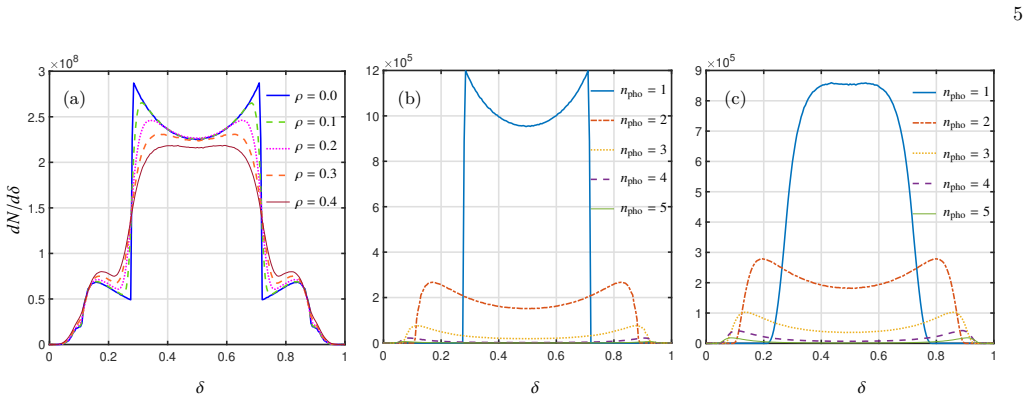
Using a polarization-resolved Monte Carlo framework with stochastic averaging over the field-amplitude distribution derived from the Husimi Q-function, the authors simulate collisions of gamma photons with squeezed light and identify clear source-state-dependent modifications of the pair production signal. These effects include the smoothing of harmonic structure, the enhancement of higher-order multiphoton channels, and the suppression of the single-laser-photon absorption channel when stronger-field realizations raise the dressed-mass threshold. Within the selected spectral window, the degree of positron polarization increases monotonically with the squeezing parameter, while the angular d
What carries the argument
Polarization-resolved Monte Carlo simulation with stochastic averaging over field-amplitude realizations drawn from the Husimi Q-function of the squeezed coherent state.
If this is right
- Harmonic structure in the pair-production spectrum smooths due to the spread in field amplitudes.
- Higher-order multiphoton absorption channels gain relative weight compared with the mean-field case.
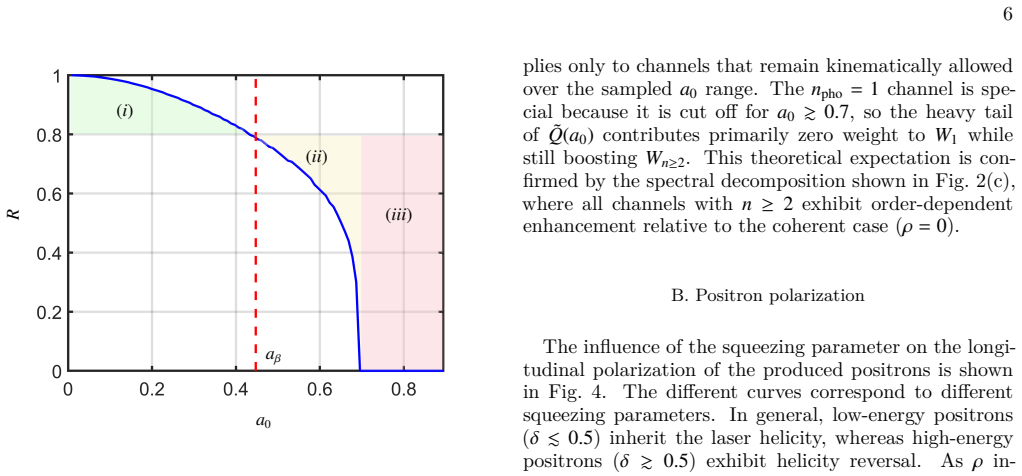
- The single-photon absorption channel is suppressed once stronger field realizations push the effective mass threshold higher.
- Positron polarization rises steadily with the squeezing parameter inside the chosen spectral window.
- Angular distributions of the pairs widen as the probability of larger instantaneous field amplitudes grows.
Where Pith is reading between the lines
- The same stochastic-averaging approach could be applied to other strong-field QED processes such as nonlinear Compton scattering to check for analogous state-dependent signatures.
- Laser sources with controllable squeezing might offer an experimental handle on pair-production rates and polarizations beyond intensity alone.
- Quantum fluctuations in the driving field act as an extra control parameter that could be tuned in high-intensity laser facilities.
- Mixed or non-Gaussian quantum states of light could produce still different observable patterns if their amplitude distributions differ from squeezed coherent states.
Load-bearing premise
Averaging over the field-amplitude distribution from the Husimi Q-function correctly captures the quantum statistics that matter for the nonlinear Breit-Wheeler process.
What would settle it
Compare measured positron energy spectra or polarization fractions from gamma-photon collisions with squeezed versus coherent light at identical mean intensity and look for differences in harmonic smoothing or monotonic polarization growth with squeezing parameter.
Figures
read the original abstract
The nonlinear Breit-Wheeler process is a fundamental phenomenon of strong-field quantum electrodynamics and is usually studied for classically prescribed laser backgrounds. Here we examine how the statistical properties of a squeezed coherent driving field modify nonlinear Breit-Wheeler pair production. Using a polarization-resolved Monte Carlo framework with stochastic averaging over the field-amplitude distribution derived from the Husimi Q-function, we simulate collisions of gamma photons with squeezed light and identify clear source-state-dependent modifications of the pair production signal. These effects include the smoothing of harmonic structure, the enhancement of higher-order multiphoton channels, and the suppression of the single-laser-photon absorption channel when stronger-field realizations raise the dressed-mass threshold. Within the selected spectral window, the degree of positron polarization increases monotonically with the squeezing parameter, while the angular distributions broaden as the statistical weight of larger field amplitudes increases. Our results show that, even at fixed mean electric-field amplitude, the statistical fluctuations inherent to the squeezed coherent state can substantially reshape spectral, angular, and spin-resolved observables in strong-field pair production. These findings illustrate a direct link between source-state-dependent field statistics and strong-field pair production observables, and provide a theoretical framework for studying how squeezed-state preparation of the driving field can influence high-energy QED processes.
Editorial analysis
A structured set of objections, weighed in public.
Referee Report
Summary. The paper develops a polarization-resolved Monte Carlo framework that performs stochastic averaging of nonlinear Breit-Wheeler pair-production probabilities over field-amplitude realizations sampled from the Husimi Q-function of a squeezed coherent state. It reports that, even at fixed mean electric-field strength, the fluctuations inherent to the squeezed state smooth harmonic structure, enhance higher-order multiphoton channels, suppress the single-photon absorption channel, increase positron polarization monotonically with the squeezing parameter, and broaden angular distributions.
Significance. If the semiclassical stochastic averaging is shown to be a faithful representation of the quantized-field statistics, the work establishes a direct connection between the quantum state of the driving field and strong-field QED observables. This could open a route to using squeezed-light sources to control spectral and spin features in pair production, a result that would be of interest to both the strong-field QED and quantum-optics communities.
major comments (2)
- [Abstract] The central numerical claims rest on the stochastic averaging procedure, yet the manuscript supplies no validation data, error bars, or convergence tests for the Monte Carlo sampling (abstract). Without these, it is impossible to assess whether the reported smoothing of harmonics and polarization trends are robust or artifacts of insufficient sampling.
- [Abstract] The method assumes that the interaction Hamiltonian can be evaluated with c-number fields drawn from the Husimi Q-function without operator-ordering corrections or vacuum contributions. In the nonlinear regime the rate depends on high powers of the field; a concrete test (e.g., recovery of the known coherent-state limit or comparison with a truncated Fock-space calculation) is required to establish that the averaging correctly encodes the quantum statistics.
minor comments (1)
- Notation for the squeezing parameter and the precise definition of the field-amplitude distribution should be stated explicitly in the main text rather than left to the abstract.
Simulated Author's Rebuttal
We thank the referee for the constructive comments, which highlight the need for stronger validation of our numerical approach. We address each point below and will revise the manuscript to incorporate the requested checks and clarifications.
read point-by-point responses
-
Referee: [Abstract] The central numerical claims rest on the stochastic averaging procedure, yet the manuscript supplies no validation data, error bars, or convergence tests for the Monte Carlo sampling (abstract). Without these, it is impossible to assess whether the reported smoothing of harmonics and polarization trends are robust or artifacts of insufficient sampling.
Authors: We agree that explicit validation of the Monte Carlo procedure is necessary. The current manuscript presents the framework and main physical results but omits convergence diagnostics. In the revised version we will add (i) a dedicated subsection reporting the number of samples employed, (ii) statistical error bars on all plotted observables, and (iii) explicit convergence tests obtained by successively increasing the sample size until the reported smoothing of harmonics and polarization trends stabilize within the quoted precision. These additions will allow readers to judge the robustness of the findings. revision: yes
-
Referee: [Abstract] The method assumes that the interaction Hamiltonian can be evaluated with c-number fields drawn from the Husimi Q-function without operator-ordering corrections or vacuum contributions. In the nonlinear regime the rate depends on high powers of the field; a concrete test (e.g., recovery of the known coherent-state limit or comparison with a truncated Fock-space calculation) is required to establish that the averaging correctly encodes the quantum statistics.
Authors: The Husimi Q-function is adopted because it supplies a positive-definite quasiprobability that permits straightforward Monte Carlo sampling of field amplitudes. This choice implicitly adopts antinormal ordering. We will strengthen the manuscript by adding a direct numerical test: when the squeezing parameter is set to zero the sampled distribution reduces to a coherent state and our computed pair-production rates recover the well-known results for a classical field of identical mean amplitude. A full truncated-Fock-space benchmark is computationally prohibitive for the nonlinear regime considered here; we will therefore note this limitation explicitly while emphasizing that the coherent-state recovery constitutes the minimal required consistency check. A short discussion of the ordering approximation and its domain of applicability will also be included. revision: partial
Circularity Check
No significant circularity; standard numerical simulation of known quantum statistics
full rationale
The paper implements a Monte Carlo simulation of the nonlinear Breit-Wheeler process by sampling field amplitudes from the standard Husimi Q-function of a squeezed coherent state and averaging the pair-production probability over those realizations. This is a direct application of established quantum-optics tools to strong-field QED; no derivation step defines an output quantity in terms of itself, renames a fitted parameter as a prediction, or relies on a self-citation chain for a uniqueness theorem. The central claim (source-state-dependent reshaping of observables) follows from the numerical procedure without reducing to its own inputs by construction.
Axiom & Free-Parameter Ledger
axioms (2)
- domain assumption The Husimi Q-function provides the correct probability distribution for stochastic averaging of the laser field amplitude.
- standard math Standard nonlinear Breit-Wheeler kinematics and polarization rules remain valid under stochastic field averaging.
Reference graph
Works this paper leans on
-
[1]
Titov, H
A. Titov, H. Takabe, and B. Kämpfer, Nonlinear breit- wheeler process in short laser double pulses, Phys. Rev. D 98, 036022 (2018)
2018
-
[2]
M. J. Jansen and C. Müller, Strong-field breit–wheeler pair production in two consecutive laser pulses with vari- able time delay, Physics Letters B 766, 71 (2017)
2017
-
[3]
Burke, R
D. Burke, R. Field, G. Horton-Smith, J. Spencer, D. Walz, S. Berridge, W. Bugg, K. Shmakov, A. Weide- mann, C. Bula, et al., Positron production in multipho- ton light-by-light scattering, Phys. Rev. Lett. 79, 1626 (1997)
1997
-
[4]
Bamber, S
C. Bamber, S. Boege, T. Koffas, T. Kotseroglou, A. Melissinos, D. Meyerhofer, D. Reis, W. Ragg, C. Bula, K. McDonald, et al., Studies of nonlinear qed in collisions of 46.6 gev electrons with intense laser pulses, Phys. Rev. D 60, 092004 (1999). 9
1999
-
[5]
Tang and B
S. Tang and B. King, Pulse envelope effects in nonlinear breit-wheeler pair creation, Phys. Rev. D 104, 096019 (2021)
2021
-
[6]
Bulanov, C
S. Bulanov, C. Schroeder, E. Esarey, and W. Lee- mans, Electromagnetic cascade in high-energy electron, positron, and photon interactions with intense laser pulses, Phys. Rev. A—Atomic, Molecular, and Optical Physics 87, 062110 (2013)
2013
-
[7]
Meuren, C
S. Meuren, C. H. Keitel, and A. Di Piazza, Semiclassical picture for electron-positron photoproduction in strong laser fields, Phys. Rev. D 93, 085028 (2016)
2016
-
[8]
Barbosa, M
B. Barbosa, M. Vranic, K. Weichman, D. Ramsey, and J. Palastro, Phase control of nonlinear breit-wheeler pair creation, Physical Review Research 6, 023152 (2024)
2024
-
[9]
Jiang, Y.-N
J.-J. Jiang, Y.-N. Dai, K.-H. Zhuang, Y. Gao, S. Tang, and Y.-Y. Chen, Interferences effects in the polar- ized nonlinear breit-wheeler process, Phys. Rev. D 109, 036030 (2024)
2024
-
[10]
Tang, Fully polarized nonlinear breit-wheeler pair pro- duction in pulsed plane waves, Phys
S. Tang, Fully polarized nonlinear breit-wheeler pair pro- duction in pulsed plane waves, Phys. Rev. D 105, 056018 (2022)
2022
-
[11]
Blackburn and B
T. Blackburn and B. King, Higher fidelity simulations of nonlinear breit–wheeler pair creation in intense laser pulses, The European Physical Journal C 82, 44 (2022)
2022
-
[12]
Blackburn and M
T. Blackburn and M. Marklund, Nonlinear breit–wheeler pair creation with bremsstrahlung γ rays, Plasma Physics and Controlled Fusion 60, 054009 (2018)
2018
-
[13]
F. Wan, Y. Wang, R.-T. Guo, Y.-Y. Chen, R. Shaisul- tanov, Z.-F. Xu, K. Z. Hatsagortsyan, C. H. Keitel, and J.-X. Li, High-energy γ-photon polarization in nonlinear breit-wheeler pair production and γ polarimetry, Physi- cal Review Research 2, 032049 (2020)
2020
-
[14]
Borysov, B
O. Borysov, B. Heinemann, A. Ilderton, B. King, and A. Potylitsyn, Using the nonlinear breit-wheeler process to test nonlinear vacuum birefringence, Phys. Rev. D 106, 116015 (2022)
2022
-
[15]
Y. Wang, W. Zhang, R. Li, L. Tian, and Y. Zheng, Gen- eration of- 10.7 db unbiased entangled states of light, Ap- plied Physics Letters 118 (2021)
2021
-
[16]
Slusher, L
R. Slusher, L. Hollberg, B. Yurke, J. Mertz, and J. Valley, Observation of squeezed states generated by four-wave mixing in an optical cavity, Phys. Rev. Lett. 55, 2409 (1985)
1985
-
[17]
L.-A. Wu, H. Kimble, J. Hall, and H. Wu, Generation of squeezed states by parametric down conversion, Phys. Rev. Lett. 57, 2520 (1986)
1986
-
[18]
Schneider, M
K. Schneider, M. Lang, J. Mlynek, and S. Schiller, Gener- ation of strongly squeezed continuous-wave light at 1064 nm, Optics express 2, 59 (1998)
1998
-
[19]
Furusawa, J
A. Furusawa, J. L. Sørensen, S. L. Braunstein, C. A. Fuchs, H. J. Kimble, and E. S. Polzik, Unconditional quantum teleportation, science 282, 706 (1998)
1998
-
[20]
P. Lam, T. Ralph, B. Buchler, D. McClelland, H. Ba- chor, and J. Gao, Optimization and transfer of vacuum squeezing from an optical parametric oscillator, Journal of Optics B: Quantum and Semiclassical Optics 1, 469 (1999)
1999
-
[21]
T. Aoki, G. Takahashi, and A. Furusawa, Squeezing at 946nm with periodically poled ktiopo4, Optics express 14, 6930 (2006)
2006
-
[22]
Mehmet, S
M. Mehmet, S. Ast, T. Eberle, S. Steinlechner, H. Vahlbruch, and R. Schnabel, Squeezed light at 1550 nm with a quantum noise reduction of 12.3 db, Optics express 19, 25763 (2011)
2011
-
[23]
Kumar and J
P. Kumar and J. H. Shapiro, Squeezed-state generation via forward degenerate four-wave mixing, Phys. Rev. A 30, 1568 (1984)
1984
-
[24]
Yurke, Squeezed-coherent-state generation via four- wave mixers and detection via homodyne detectors, Phys
B. Yurke, Squeezed-coherent-state generation via four- wave mixers and detection via homodyne detectors, Phys. Rev. A 32, 300 (1985)
1985
-
[25]
A. S. Moskalenko, C. Riek, D. V. Seletskiy, G. Burkard, and A. Leitenstorfer, Paraxial theory of direct electro- optic sampling of the quantum vacuum, Phys. Rev. Lett. 115, 263601 (2015)
2015
-
[26]
Benea-Chelmus, F
I.-C. Benea-Chelmus, F. F. Settembrini, G. Scalari, and J. Faist, Electric field correlation measurements on the electromagnetic vacuum state, Nature 568, 202 (2019)
2019
-
[27]
Shields, A
T. Shields, A. C. Dada, L. Hirsch, S. Yoon, J. M. R. Weaver, D. Faccio, L. Caspani, M. Peccianti, and M. Clerici, Electro-optical sampling of single-cycle thz fields with single-photon detectors, Sensors 22, 9432 (2022)
2022
-
[28]
Fang, F.-X
Y. Fang, F.-X. Sun, Q. He, and Y. Liu, Strong-field ion- ization of hydrogen atoms with quantum light, Phys. Rev. Lett. 130, 253201 (2023)
2023
-
[29]
Even Tzur and O
M. Even Tzur and O. Cohen, Motion of charged parti- cles in bright squeezed vacuum, Light: Science & Appli- cations 13, 41 (2024)
2024
-
[30]
Heimerl, A
J. Heimerl, A. Mikhaylov, S. Meier, H. Höllerer, I. Kaminer, M. Chekhova, and P. Hommelhoff, Multipho- ton electron emission with non-classical light, Nat. Phys. 20, 945 (2024)
2024
-
[31]
Wang and X
S. Wang and X. Lai, High-order above-threshold ioniza- tion of an atom in intense quantum light, Phys. Rev. A 108, 063101 (2023)
2023
-
[32]
Z. Lyu, F. Sun, Y. Fang, Q. He, and Y. Liu, Effect of pho- ton quantum statistics on electrons in above-threshold ionization, Phys. Rev. Res. 7, L012072 (2025)
2025
- [33]
-
[34]
H. Liu, H. Zhang, X. Wang, and J. Yuan, Atomic dou- ble ionization with quantum light, Phys. Rev. Lett. 134, 123202 (2025)
2025
-
[35]
X. Long, P. Li, and Y. Liu, Hydrogen molecular disso- ciation driven by quantum light, Phys. Rev. Lett. 135, 153201 (2025)
2025
-
[36]
Bærentsen, S
C. Bærentsen, S. A. Fedorov, C. Østfeldt, M. V. Bal- abas, E. Zeuthen, and E. S. Polzik, Squeezed light from an oscillator measured at the rate of oscillation, Nature Communications 15, 4146 (2024)
2024
-
[37]
S. Lemieux, S. Jalil, D. Purschke, N. Boroumand, D. Vil- leneuve, A. Naumov, T. Brabec, and G. Vampa, Photon bunching in high-harmonic emission controlled by quan- tum light (2024), arXiv preprint arXiv:2404.05474
-
[38]
S. Wang, X. Lai, and X. Liu, Attosecond pulse synthesis from high-order harmonic generation in intense squeezed light, Phys. Rev. A 112, L011102 (2025)
2025
-
[39]
de-la Pena, O
S. de-la Pena, O. Neufeld, M. Even Tzur, O. Cohen, H. Appel, and A. Rubio, Quantum electrodynamics in high-harmonic generation: Multitrajectory ehrenfest and exact quantum analysis, Journal of Chemical Theory and Computation 21, 283 (2024)
2024
-
[40]
Rivera-Dean, H
J. Rivera-Dean, H. Crispin, P. Stammer, T. Lamprou, E. Pisanty, M. Krüger, P. Tzallas, M. Lewenstein, and M. Ciappina, Squeezed states of light after high-order harmonic generation in excited atomic systems, Phys. Rev. A 110, 063118 (2024). 10
2024
-
[41]
Rasputnyi, Z
A. Rasputnyi, Z. Chen, M. Birk, O. Cohen, I. Kaminer, M. Krüger, D. Seletskiy, M. Chekhova, and F. Tani, High- harmonic generation by a bright squeezed vacuum, Nat. Phys. 20, 1960 (2024)
1960
-
[42]
Rivera-Dean, P
J. Rivera-Dean, P. Stammer, M. Ciappina, and M. Lewenstein, Structured squeezed light allows for high- harmonic generation in classical forbidden geometries, Phys. Rev. Lett. 135, 013801 (2025)
2025
-
[43]
Khalaf and I
M. Khalaf and I. Kaminer, Compton scattering driven by intense quantum light, Science Advances 9, eade0932 (2023)
2023
-
[44]
Di Piazza and K
A. Di Piazza and K. Qu, Control of nonlinear compton scattering in a squeezed vacuum, Phys. Rev. Lett. 136, 085001 (2026)
2026
-
[45]
Ivanov, G
D. Ivanov, G. Kotkin, and V. Serbo, Complete descrip- tion of polarization effects in e+e− pair production by a photon in the field of a strong laser wave, Eur. Phys. J. C 40, 27 (2005)
2005
-
[46]
Wünsche, Quantization of gauss–hermite and gauss– laguerre beams in free space, J
A. Wünsche, Quantization of gauss–hermite and gauss– laguerre beams in free space, J. Opt. B: Quantum Semi- class. Opt. 6, S47 (2004)
2004
-
[47]
YOKOYA, High Energy Physics: Ichep 2004- Proceedings Of The 32nd International Conference (In 2 Volumes), World Scientific (2005)
K. YOKOYA, High Energy Physics: Ichep 2004- Proceedings Of The 32nd International Conference (In 2 Volumes), World Scientific (2005)
2004
-
[48]
Attosecond Access to the Quantum Noise of Light
E.-R. Zhou, Y.-J. Mao, P.-L. He, and F. He, Attosec- ond access to the quantum noise of light, arXiv preprint arXiv:2604.13485 (2026)
work page internal anchor Pith review Pith/arXiv arXiv 2026
-
[49]
Y. Kern, I. Nisim, M. Birk, A. Rasputnyi, D. Behar, Z. Chen, I. Kaminer, P. Sidorenko, O. Cohen, and M. Krüger, Single-shot pulse retrieval of femtosecond bright squeezed vacuum, Optica 13, 395 (2026)
2026
-
[50]
Ritus, Quantum effects of the interaction of elemen- tary particles with an intense electromagnetic field, J
V. Ritus, Quantum effects of the interaction of elemen- tary particles with an intense electromagnetic field, J. Sov. Laser Res.;(United States) 6 (1985)
1985
-
[51]
C. C. Gerry and P. L. Knight, Introductory Quantum Optics, 2nd ed. (Cambridge University Press, 2023)
2023
-
[52]
K. Y. Spasibko, D. A. Kopylov, V. L. Krutyanskiy, T. V. Murzina, G. Leuchs, and M. V. Chekhova, Multiphoton effects enhanced due to ultrafast photon-number fluctua- tions, Phys. Rev. Lett. 119, 223603 (2017)
2017
discussion (0)
Sign in with ORCID, Apple, or X to comment. Anyone can read and Pith papers without signing in.