APEX: Amplitude Anchors and Phase Priors for Target-Scarce Higher-Frequency Wave Prediction
Pith reviewed 2026-06-29 18:54 UTC · model grok-4.3
The pith
Higher-frequency wave prediction succeeds by anchoring on stable low-frequency amplitudes and guiding phase recovery separately.
A machine-rendered reading of the paper's core claim, the machinery that carries it, and where it could break.
Core claim
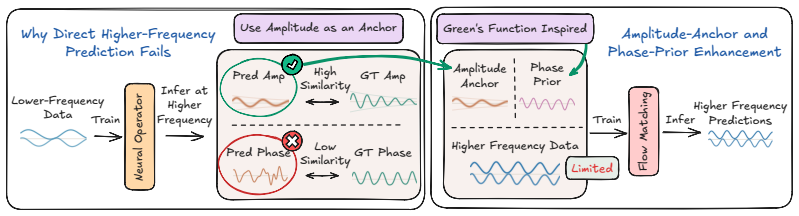
APEX obtains a coarse prediction in the target-frequency regime from a lower-frequency neural operator, retains only the amplitude as a transferable structural anchor, and reconstructs the full higher-frequency field via a conditional flow-matching enhancer under the guidance of a Green's-function-inspired phase prior. This exploits the inherent asymmetry that coarse amplitude structure remains relatively stable across frequencies whereas phase-sensitive oscillatory structure deteriorates much more rapidly, yielding consistent gains over direct lower-to-higher extrapolation and other baselines when target-frequency supervision is limited.
What carries the argument
The amplitude-anchored and phase-prior-guided enhancement step that decouples transferable coarse amplitude from recoverable oscillatory phase detail.
If this is right
- Direct end-to-end transfer of the full complex field is outperformed by explicit reuse of coarse amplitude structure plus separate phase recovery.
- Performance gains hold across SimpleWave, Helmholtz, and Maxwell benchmarks under limited target-frequency data.
- The approach reduces reliance on expensive high-frequency simulations or measurements.
- Conditional flow matching becomes effective once supplied with an amplitude anchor and phase prior.
Where Pith is reading between the lines
- The same amplitude-phase split could be tested in other oscillatory simulation domains such as acoustics or structural vibrations.
- Replacing the Green's-function phase prior with data-driven alternatives might further reduce the need for analytic assumptions.
- Running the method on measured rather than simulated wave data would check whether the frequency asymmetry persists outside controlled benchmarks.
Load-bearing premise
Coarse amplitude patterns remain relatively stable when frequency increases while phase details do not.
What would settle it
A controlled test in which amplitude maps extracted from low-frequency predictions match high-frequency ground truth no better than full complex fields would falsify the claimed advantage.
Figures

read the original abstract
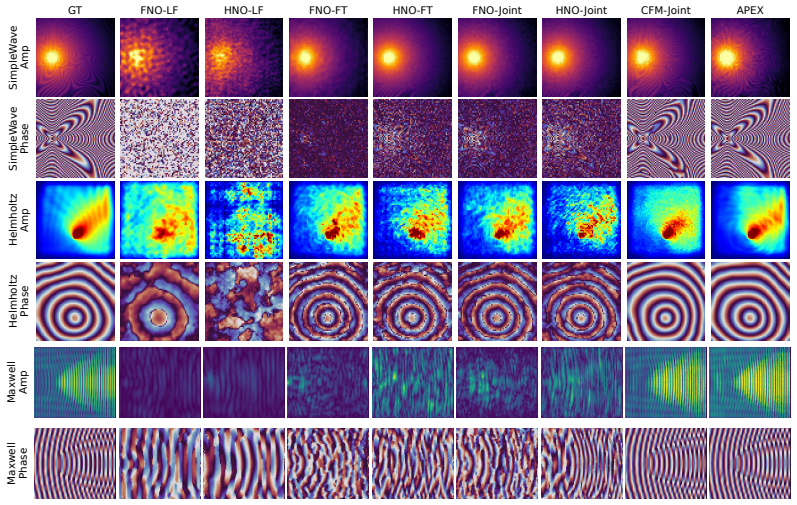
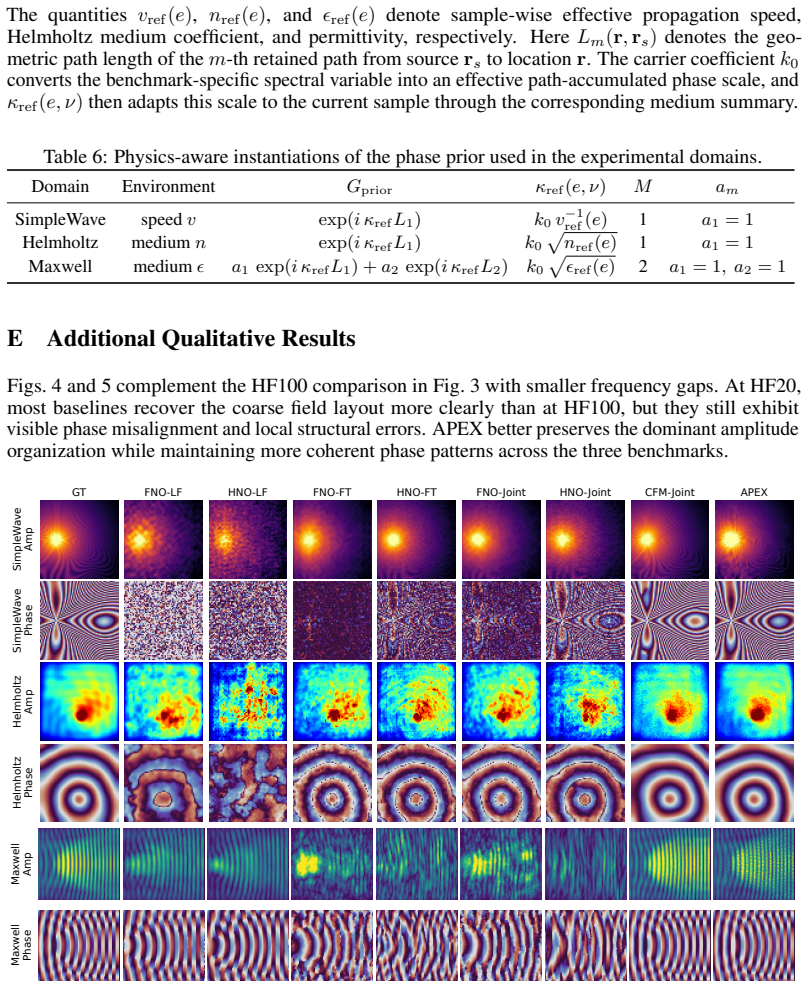
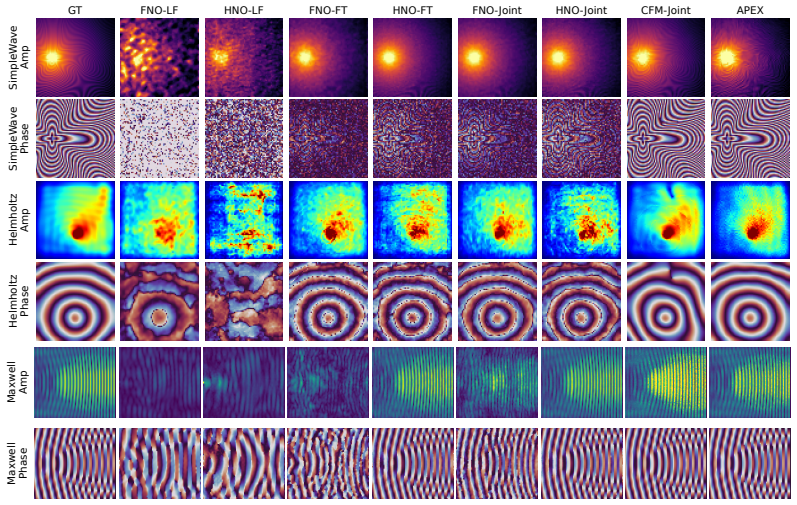
Learning-based surrogates have become increasingly effective for wave-field prediction, and neural operators in particular have shown strong performance within observed frequency regimes. However, higher-frequency prediction under scarce target supervision remains comparatively underexplored, especially in wave problems where higher-frequency data are substantially more expensive to simulate or measure than lower-frequency data. A central difficulty is that cross-frequency transfer is inherently asymmetric: coarse amplitude structure remains relatively stable across frequencies, whereas phase-sensitive oscillatory structure deteriorates much more rapidly as frequency increases. Motivated by this asymmetry, we propose APEX, Amplitude-anchored and Phase-prior-guided Enhancement from eXtrapolated coarse predictions, a framework for target-scarce higher-frequency wave-field prediction. A lower-frequency neural operator first provides a coarse prediction in the target-frequency regime, from which we retain only the amplitude as a transferable structural anchor. A conditional flow-matching enhancer then reconstructs the target higher-frequency field under the guidance of a Green's-function-inspired phase prior. Experiments on SimpleWave, Helmholtz, and Maxwell benchmarks show that APEX consistently outperforms direct lower-to-higher extrapolation, target-adapted operator, and joint generative baselines under limited target-frequency supervision. Our results suggest that reliable higher-frequency prediction of oscillatory wave fields should not rely on direct end-to-end transfer of the full complex field, but instead on explicitly reusing transferable coarse structure while separately recovering the missing oscillatory detail.
Editorial analysis
A structured set of objections, weighed in public.
Referee Report
Summary. The paper introduces APEX, a two-stage framework for higher-frequency oscillatory wave prediction under scarce target-frequency supervision. A low-frequency neural operator generates a coarse prediction whose amplitude is retained as a structural anchor; a conditional flow-matching model then reconstructs the target field guided by a Green's-function-inspired phase prior. Experiments on SimpleWave, Helmholtz, and Maxwell benchmarks report consistent gains over direct extrapolation, target-adapted operators, and joint generative baselines.
Significance. If the reported gains are robust, the work offers a practical route to amortize expensive high-frequency simulations by exploiting differential transferability of amplitude versus phase structure. The explicit separation of anchors and priors is a clear methodological contribution that could be adopted in other frequency-extrapolation settings in scientific machine learning.
major comments (2)
- [Abstract and §3] Abstract and §3 (method description): the claim that amplitude structure is 'relatively stable across frequencies' while phase deteriorates is presented as an inherent property motivating the amplitude-anchor design, yet no diagnostic (amplitude spectra, pointwise |u_low| vs |u_high| correlation, or wavenumber scaling argument) is supplied to quantify the stability. Because this asymmetry is load-bearing for attributing performance gains to the proposed decomposition rather than to the flow-matching stage alone, the absence of such verification weakens the central claim.
- [§4] §4 (experiments): the reported outperformance on Helmholtz and Maxwell is shown only under the full APEX pipeline; no ablation that replaces the retained amplitude anchor with the full complex coarse field (or with a phase-retained variant) is presented. Without this control, it remains unclear whether the gains derive from the amplitude-only conditioning or from other modeling choices.
minor comments (2)
- [§3] Notation for the phase prior (Green's function form) should be stated explicitly with the relevant equation number so readers can verify consistency with the flow-matching conditioning.
- [§4] Figure captions for the benchmark results should include the exact number of target-frequency samples used in each limited-supervision regime.
Simulated Author's Rebuttal
We thank the referee for the constructive comments on our manuscript. We address each major point below and will incorporate the suggested additions in the revised version.
read point-by-point responses
-
Referee: [Abstract and §3] Abstract and §3 (method description): the claim that amplitude structure is 'relatively stable across frequencies' while phase deteriorates is presented as an inherent property motivating the amplitude-anchor design, yet no diagnostic (amplitude spectra, pointwise |u_low| vs |u_high| correlation, or wavenumber scaling argument) is supplied to quantify the stability. Because this asymmetry is load-bearing for attributing performance gains to the proposed decomposition rather than to the flow-matching stage alone, the absence of such verification weakens the central claim.
Authors: We agree that a quantitative diagnostic would strengthen the central motivation. In the revision we will add, in §3 and the experimental section, an analysis of amplitude-field correlation (pointwise |u_low| vs |u_high|) and amplitude spectra across frequencies on all three benchmarks, together with a direct comparison to phase deterioration. This will make the asymmetry explicit and support attribution of gains to the amplitude-anchor design. revision: yes
-
Referee: [§4] §4 (experiments): the reported outperformance on Helmholtz and Maxwell is shown only under the full APEX pipeline; no ablation that replaces the retained amplitude anchor with the full complex coarse field (or with a phase-retained variant) is presented. Without this control, it remains unclear whether the gains derive from the amplitude-only conditioning or from other modeling choices.
Authors: We acknowledge the value of this control. The current direct-extrapolation baseline already uses the full complex coarse field, yet underperforms APEX; however, to isolate the conditioning choice we will add an explicit ablation in the revised §4 in which the flow-matching stage is conditioned on the full complex coarse prediction (and on a phase-retained variant) instead of the amplitude anchor alone. This will quantify the contribution of the amplitude-only design. revision: yes
Circularity Check
No significant circularity detected
full rationale
The paper states the cross-frequency asymmetry as an inherent property motivating the APEX design (retaining coarse amplitude while recovering phase via flow-matching and Green's prior), but this premise is not derived from or reduced to the method's own equations, fitted parameters, or self-citations. No load-bearing step equates a claimed prediction to its input by construction, renames a known result, or imports uniqueness via author-overlapping citation. The framework is presented as a design choice with benchmark experiments; the derivation chain is self-contained against external validation and does not collapse into its inputs.
Axiom & Free-Parameter Ledger
axioms (1)
- domain assumption cross-frequency transfer is inherently asymmetric with amplitude more stable than phase
Reference graph
Works this paper leans on
-
[1]
Phase coherence—a time-localized approach to studying interactions.Chaos: An Interdisciplinary Journal of Nonlinear Science, 34(7), 2024
Samuel JK Barnes, J Bjerkan, PT Clemson, J Newman, and A Stefanovska. Phase coherence—a time-localized approach to studying interactions.Chaos: An Interdisciplinary Journal of Nonlinear Science, 34(7), 2024
2024
-
[2]
Physics-informed diffusion models
Jan-Hendrik Bastek, WaiChing Sun, and Dennis Kochmann. Physics-informed diffusion models. InInternational Conference on Learning Representations, volume 2025, pages 3360–3385, 2025
2025
-
[3]
Out-of-distributional risk bounds for neural operators with applications to the helmholtz equation.Journal of Computational Physics, 513:113168, 2024
Jose Antonio Lara Benitez, Takashi Furuya, Florian Faucher, Anastasis Kratsios, Xavier Tric- oche, and Maarten V de Hoop. Out-of-distributional risk bounds for neural operators with applications to the helmholtz equation.Journal of Computational Physics, 513:113168, 2024
2024
-
[4]
Laplace neural operator for solving differential equations.Nature Machine Intelligence, 6(6):631–640, 2024
Qianying Cao, Somdatta Goswami, and George Em Karniadakis. Laplace neural operator for solving differential equations.Nature Machine Intelligence, 6(6):631–640, 2024
2024
-
[5]
Choose a transformer: Fourier or galerkin.Advances in neural information processing systems, 34:24924–24940, 2021
Shuhao Cao. Choose a transformer: Fourier or galerkin.Advances in neural information processing systems, 34:24924–24940, 2021
2021
-
[6]
Exercise enhances hippocampal-cortical ripple interactions in the human brain.Brain Communications, 8(2):fcag041, 2026
Araceli R Cardenas, Juan F Ramirez-Villegas, Christopher K Kovach, Phillip E Gander, Rachel C Cole, Andrew J Grossbach, Hiroto Kawasaki, Jeremy DW Greenlee, Matthew A Howard, Kirill V Nourski, et al. Exercise enhances hippocampal-cortical ripple interactions in the human brain.Brain Communications, 8(2):fcag041, 2026
2026
-
[7]
Generating full-field evolution of physical dynamics from irregular sparse observations
Panqi Chen, Yifan Sun, Lei Cheng, Yang Yang, Weichang Li, Yang Liu, Weiqing Liu, Jiang Bian, and Shikai Fang. Generating full-field evolution of physical dynamics from irregular sparse observations. InThe Thirty-ninth Annual Conference on Neural Information Processing Systems, 2025
2025
-
[8]
Springer, 3 edition, 2013
David Colton and Rainer Kress.Inverse Acoustic and Electromagnetic Scattering Theory. Springer, 3 edition, 2013
2013
-
[9]
Neurolight: A physics-agnostic neural operator enabling parametric photonic device simulation.Advances in Neural Information Processing Systems, 35:14623–14636, 2022
Jiaqi Gu, Zhengqi Gao, Chenghao Feng, Hanqing Zhu, Ray Chen, Duane Boning, and David Pan. Neurolight: A physics-agnostic neural operator enabling parametric photonic device simulation.Advances in Neural Information Processing Systems, 35:14623–14636, 2022
2022
-
[10]
Gnot: A general neural operator transformer for operator learning
Zhongkai Hao, Zhengyi Wang, Hang Su, Chengyang Ying, Yinpeng Dong, Songming Liu, Ze Cheng, Jian Song, and Jun Zhu. Gnot: A general neural operator transformer for operator learning. InInternational conference on machine learning, pages 12556–12569. PMLR, 2023
2023
-
[11]
Denoising diffusion probabilistic models.Advances in neural information processing systems, 33:6840–6851, 2020
Jonathan Ho, Ajay Jain, and Pieter Abbeel. Denoising diffusion probabilistic models.Advances in neural information processing systems, 33:6840–6851, 2020
2020
-
[12]
Diffusionpde: Generative pde-solving under partial observation.Advances in Neural Information Processing Systems, 37: 130291–130323, 2024
Jiahe Huang, Guandao Yang, Zichen Wang, and Jeong Joon Park. Diffusionpde: Generative pde-solving under partial observation.Advances in Neural Information Processing Systems, 37: 130291–130323, 2024
2024
-
[13]
Ihlenburg and I
F. Ihlenburg and I. Babuška. Finite element solution of the helmholtz equation with high wave number part i: The h-version of the fem.Computers & Mathematics with Applications, 30(9): 9–37, 1995. ISSN 0898-1221
1995
-
[14]
Joseph B. Keller. Geometrical theory of diffraction.J. Opt. Soc. Am., 52(2):116–130, Feb 1962
1962
-
[15]
Neural operator: Learning maps between function spaces with applications to pdes.Journal of Machine Learning Research, 24(89):1–97, 2023
Nikola Kovachki, Zongyi Li, Burigede Liu, Kamyar Azizzadenesheli, Kaushik Bhattacharya, Andrew Stuart, and Anima Anandkumar. Neural operator: Learning maps between function spaces with applications to pdes.Journal of Machine Learning Research, 24(89):1–97, 2023
2023
-
[16]
Physics-aligned field reconstruction with diffusion bridge
Zeyu Li, Hongkun Dou, Shen Fang, Wang Han, Yue Deng, and Lijun Yang. Physics-aligned field reconstruction with diffusion bridge. InThe Thirteenth International Conference on Learning Representations, 2025
2025
-
[17]
Fourier neural operator for parametric partial differential equations
Zongyi Li, Nikola Borislavov Kovachki, Kamyar Azizzadenesheli, Kaushik Bhattacharya, Andrew Stuart, Anima Anandkumar, et al. Fourier neural operator for parametric partial differential equations. InInternational Conference on Learning Representations, 2021. 10
2021
-
[18]
Geometry-informed neural operator for large-scale 3d pdes.Advances in Neural Information Processing Systems, 36:35836–35854, 2023
Zongyi Li, Nikola Kovachki, Chris Choy, Boyi Li, Jean Kossaifi, Shourya Otta, Moham- mad Amin Nabian, Maximilian Stadler, Christian Hundt, Kamyar Azizzadenesheli, et al. Geometry-informed neural operator for large-scale 3d pdes.Advances in Neural Information Processing Systems, 36:35836–35854, 2023
2023
-
[19]
Yaron Lipman, Ricky T. Q. Chen, Heli Ben-Hamu, Maximilian Nickel, and Matthew Le. Flow matching for generative modeling. InThe Eleventh International Conference on Learning Representations, 2023
2023
-
[20]
Pde- refiner: Achieving accurate long rollouts with neural pde solvers.Advances in Neural Informa- tion Processing Systems, 36:67398–67433, 2023
Phillip Lippe, Bas Veeling, Paris Perdikaris, Richard Turner, and Johannes Brandstetter. Pde- refiner: Achieving accurate long rollouts with neural pde solvers.Advances in Neural Informa- tion Processing Systems, 36:67398–67433, 2023
2023
-
[21]
Learning nonlinear operators via deeponet based on the universal approximation theorem of operators
Lu Lu, Pengzhan Jin, Guofei Pang, Zhongqiang Zhang, and George Em Karniadakis. Learning nonlinear operators via deeponet based on the universal approximation theorem of operators. Nature machine intelligence, 3(3):218–229, 2021
2021
-
[22]
Film: Visual reasoning with a general conditioning layer
Ethan Perez, Florian Strub, Harm De Vries, Vincent Dumoulin, and Aaron Courville. Film: Visual reasoning with a general conditioning layer. InProceedings of the AAAI conference on artificial intelligence, volume 32, 2018
2018
-
[23]
Derivative-enhanced deep operator network.Ad- vances in Neural Information Processing Systems, 37:20945–20981, 2024
Yuan Qiu, Nolan Bridges, and Peng Chen. Derivative-enhanced deep operator network.Ad- vances in Neural Information Processing Systems, 37:20945–20981, 2024
2024
-
[24]
U-NO: U-shaped neural operators.Transactions on Machine Learning Research, 2023
Md Ashiqur Rahman, Zachary E Ross, and Kamyar Azizzadenesheli. U-NO: U-shaped neural operators.Transactions on Machine Learning Research, 2023. ISSN 2835-8856
2023
-
[25]
U-net: Convolutional networks for biomedical image segmentation
Olaf Ronneberger, Philipp Fischer, and Thomas Brox. U-net: Convolutional networks for biomedical image segmentation. InInternational Conference on Medical image computing and computer-assisted intervention, pages 234–241. Springer, 2015
2015
-
[26]
Dyffusion: A dynamics-informed diffusion model for spatiotemporal forecasting.Advances in neural information processing systems, 36:45259–45287, 2023
Salva Rühling Cachay, Bo Zhao, Hailey Joren, and Rose Yu. Dyffusion: A dynamics-informed diffusion model for spatiotemporal forecasting.Advances in neural information processing systems, 36:45259–45287, 2023
2023
-
[27]
Wave interpolation neural operator: Interpolated prediction of electric fields across untrained wavelengths
Joonhyuk Seo, Chanik Kang, Dongjin Seo, and Haejun Chung. Wave interpolation neural operator: Interpolated prediction of electric fields across untrained wavelengths. InNeurIPS 2024 Workshop on Data-driven and Differentiable Simulations, Surrogates, and Solvers, 2024
2024
-
[28]
A fast marching level set method for monotonically advancing fronts.Proceedings of the National Academy of Sciences, 93(4):1591–1595, 1996
J A Sethian. A fast marching level set method for monotonically advancing fronts.Proceedings of the National Academy of Sciences, 93(4):1591–1595, 1996
1996
-
[29]
High-frequency wavefield extrapolation using the fourier neural operator.Journal of Geophysics and Engineering, 19(2):269–282, 2022
Chao Song and Yanghua Wang. High-frequency wavefield extrapolation using the fourier neural operator.Journal of Geophysics and Engineering, 19(2):269–282, 2022
2022
-
[30]
Score-based generative modeling through stochastic differential equations
Yang Song, Jascha Sohl-Dickstein, Diederik P Kingma, Abhishek Kumar, Stefano Ermon, and Ben Poole. Score-based generative modeling through stochastic differential equations. In International Conference on Learning Representations, 2021
2021
-
[31]
Holst.Green’s functions and boundary value problems
Ivar Stakgold and Michael J. Holst.Green’s functions and boundary value problems. Wiley, 3 edition, 2011
2011
-
[32]
Hankel-fno: Fast underwater acoustic charting via physics-encoded fourier neural operator.The Journal of the Acoustical Society of America, 158(6):5075–5089, 2025
Yifan Sun, Lei Cheng, Jianlong Li, and Peter Gerstoft. Hankel-fno: Fast underwater acoustic charting via physics-encoded fourier neural operator.The Journal of the Acoustical Society of America, 158(6):5075–5089, 2025
2025
-
[33]
Improving and generalizing flow-based genera- tive models with minibatch optimal transport.Transactions on Machine Learning Research,
Alexander Tong, Kilian FATRAS, Nikolay Malkin, Guillaume Huguet, Yanlei Zhang, Jarrid Rector-Brooks, Guy Wolf, and Yoshua Bengio. Improving and generalizing flow-based genera- tive models with minibatch optimal transport.Transactions on Machine Learning Research,
-
[34]
Transfer learning fourier neural operator for solving parametric frequency-domain wave equations.IEEE Transactions on Geoscience and Remote Sensing, 62:1–11, 2024
Yufeng Wang, Heng Zhang, Chensen Lai, and Xiangyun Hu. Transfer learning fourier neural operator for solving parametric frequency-domain wave equations.IEEE Transactions on Geoscience and Remote Sensing, 62:1–11, 2024. 11
2024
-
[35]
Deep neural helmholtz operators for 3-d elastic wave propagation and inversion.Geophysical Journal International, 239(3):1469–1484, 2024
Caifeng Zou, Kamyar Azizzadenesheli, Zachary E Ross, and Robert W Clayton. Deep neural helmholtz operators for 3-d elastic wave propagation and inversion.Geophysical Journal International, 239(3):1469–1484, 2024
2024
-
[36]
Yicheng Zou, Samuel Lanthaler, and Hossein Salahshoor. A probabilistic framework for solving high-frequency helmholtz equations via diffusion models.arXiv preprint arXiv:2602.04082, 2026. 12 A Proofs for the Amplitude–Phase Error Decomposition This appendix provides the proofs of the analytical results stated in Sec. 2.3. We first derive an exact pointwis...
discussion (0)
Sign in with ORCID, Apple, or X to comment. Anyone can read and Pith papers without signing in.