Long-range deformations in Gaussian States
Pith reviewed 2026-07-01 16:16 UTC · model grok-4.3
The pith
The exponent of power-law couplings in imaginary-time deformations of the Kitaev chain controls three distinct long-distance regimes without finite-strength transitions.
A machine-rendered reading of the paper's core claim, the machinery that carries it, and where it could break.
Core claim
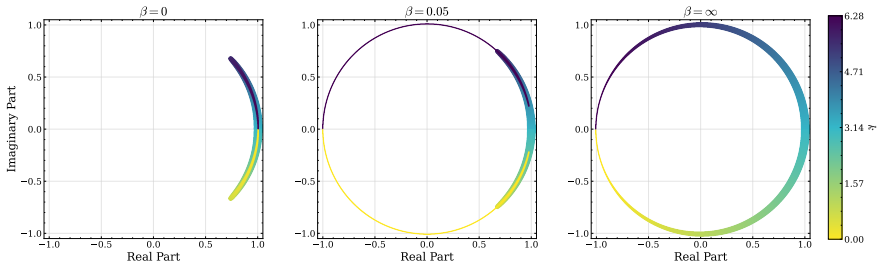
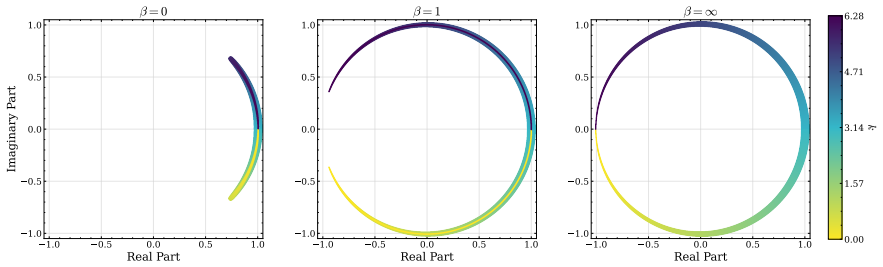
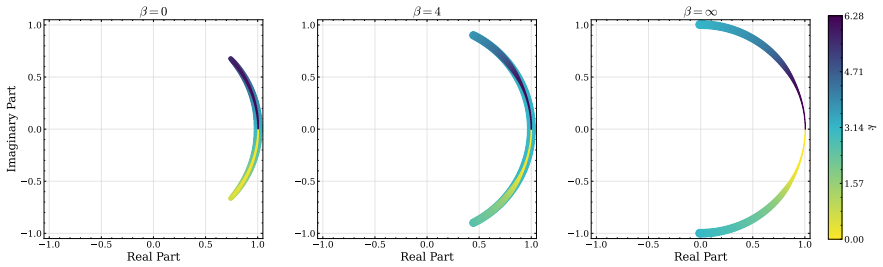
Starting from the Kitaev chain ground state, imaginary-time evolution under a quadratic Hamiltonian with power-law couplings of the form 1/r^α produces deformed Gaussian states whose long-distance properties fall into three regimes governed by α. For α > 1 the topological regime appears only as the deformation strength tends to infinity, with finite strength yielding smooth crossovers. At α = 1 an infinitesimal deformation drives the system topological, and in special cases an emergent Kramers-Wannier symmetry produces Ising scaling. For α < 1 the state exhibits critical-like behavior at all nonzero deformation strengths. Even arbitrarily long-range interactions yield no sharp phase transiti
What carries the argument
The power-law exponent α in the couplings of the imaginary-time evolution Hamiltonian, which dictates the infrared regime of the deformed Gaussian state.
If this is right
- For α greater than 1, only asymptotic infinite deformation reaches the topological regime with finite strength producing smooth crossovers.
- At α equal to 1, an infinitesimal deformation drives the system to the topological regime, sometimes with emergent Kramers-Wannier symmetry and Ising scaling.
- For α less than 1, the state shows critical-like behavior for all nonzero deformation strength.
- Arbitrarily long-range interactions still produce no sharp phase transition at nonzero finite deformation strength.
Where Pith is reading between the lines
- One could test these regimes by preparing such deformed states in cold-atom or superconducting qubit arrays with tunable long-range couplings.
- The results suggest that the no-go theorem for local imaginary-time evolution inducing transitions in 1D can be circumvented by long-range terms in a controlled, exponent-dependent way.
- Future work might examine whether these three regimes persist when the deformation Hamiltonian is non-quadratic.
Load-bearing premise
The imaginary-time evolution generated by the quadratic power-law Hamiltonian preserves the Gaussian nature of the initial state.
What would settle it
Computing or measuring the two-point correlation functions or entanglement spectrum for a fixed α=1 and small deformation strength to verify if topological signatures appear immediately rather than at a finite threshold.
Figures






read the original abstract
Imaginary-time evolution by a local Hamiltonian cannot induce a phase transition in one dimension, but longer-range interactions may subvert such constraints. Starting from the ground state of the Kitaev Majorana chain, we modify the wave function by an imaginary-time evolution generated by a quadratic Hamiltonian with power-law couplings that enhance pairing correlations, typically of the form $1/r^{\alpha}$, where $r$ is the distance between two sites. As the state remains Gaussian, entanglement and correlation functions can be computed analytically. We find that the decay exponent $\alpha$ controls three distinct infrared regimes: for $\alpha>1$, the deformation produces only smooth crossovers at finite deformation strength, while the topological regime is reached only asymptotically as the deformation strength tends to infinity. At $\alpha=1$, the deformation induces an immediate flow to the topological phase: an infinitesimal deformation strength drives the system to a topological regime, and in a particular case, an emergent Kramers-Wannier symmetry enforces Ising-like scaling at long distances. For $\alpha<1$, the deformed state shows the same critical-like behavior for all non-zero deformation strength. We observe that even with arbitrarily long-range interactions, these models do not display a sharp phase transition at non-zero deformation strength.
Editorial analysis
A structured set of objections, weighed in public.
Referee Report
Summary. The manuscript examines imaginary-time evolution of the Kitaev Majorana chain ground state under a quadratic Hamiltonian with power-law couplings decaying as 1/r^α. Because the evolution preserves Gaussianity, the covariance matrix admits an exact closed-form transformation, from which entanglement and correlation functions are computed analytically. The decay exponent α is shown to partition the infrared behavior into three regimes: for α>1 only smooth crossovers occur at finite deformation strength, with the topological phase reached only as strength → ∞; at α=1 an infinitesimal deformation drives the system into the topological regime, and a special case exhibits emergent Kramers-Wannier symmetry with Ising scaling; for α<1 the state remains critical-like for any nonzero strength. The work concludes that arbitrarily long-range interactions still produce no sharp phase transition at finite deformation.
Significance. If the analytic expressions for the covariance matrix hold, the paper supplies an exact, parameter-free classification of long-range deformations in one-dimensional Gaussian topological states. The explicit link between the singularity structure of the Fourier-transformed power-law kernel and the three infrared regimes constitutes a concrete, falsifiable prediction that can be checked numerically or experimentally. The absence of any hidden fitting parameters or self-referential definitions strengthens the result.
minor comments (2)
- [Abstract] The abstract refers to “a particular case” in which emergent Kramers-Wannier symmetry appears; the main text should state explicitly which value of α or which form of the deformation Hamiltonian realizes this case (e.g., §3 or Eq. (12)).
- Figure captions should indicate the system size and the precise definition of the deformation strength used in each panel so that the claimed crossovers and scaling can be reproduced directly from the plotted data.
Simulated Author's Rebuttal
We thank the referee for their careful reading of the manuscript and for the positive assessment. We are pleased that the referee recognizes the exact solvability via the covariance matrix and the concrete classification of the three infrared regimes controlled by α.
Circularity Check
No significant circularity detected
full rationale
The paper's central claims follow from direct analytic computation of the covariance matrix under imaginary-time evolution generated by a quadratic power-law Hamiltonian. Gaussianity is preserved by the quadratic form of H (standard property, not a fitted or self-defined assumption), and the three infrared regimes are read off from the small-k singularity of the Fourier transform of the 1/r^α kernel, which changes character at α=1. No parameters are fitted to data and then relabeled as predictions, no self-citations bear the load of the uniqueness or derivation steps, and no ansatz is smuggled in. The derivation is self-contained against the explicit equations for the deformed state.
Axiom & Free-Parameter Ledger
axioms (1)
- domain assumption The deformed wave function remains Gaussian
Reference graph
Works this paper leans on
-
[1]
Topological order and conformal quantum critical points.Annals of Physics, 310(2):493–551, 2004
Eddy Ardonne, Paul Fendley, and Eduardo Fradkin. Topological order and conformal quantum critical points.Annals of Physics, 310(2):493–551, 2004. doi:10.1016/j.aop.2004.01.004. 20
-
[2]
Claudio Castelnovo, Claudio Chamon, Christopher Mudry, and Pierre Pujol. From quan- tum mechanics to classical statistical physics: Generalized Rokhsar–Kivelson Hamiltoni- ans and the “Stochastic Matrix Form” decomposition.Annals of Physics, 318(2):316–344, August 2005. ISSN 0003-4916. URLhttp://dx.doi.org/10.1016/j.aop.2005.01.006
-
[3]
A quantum topological phase transition at the microscopic level.Physical Review B, 77:054433, 2008
Claudio Castelnovo and Claudio Chamon. A quantum topological phase transition at the microscopic level.Physical Review B, 77:054433, 2008. doi:10.1103/PhysRevB.77.054433
-
[4]
Daniel S. Rokhsar and Steven A. Kivelson. Superconductivity and the Quantum Hard- Core Dimer Gas.Phys. Rev. Lett., 61(20):2376–2379, November 1988. ISSN 0031-9007. URLhttp://dx.doi.org/10.1103/PhysRevLett.61.2376
-
[5]
C L Henley. From classical to quantum dynamics at Rokhsar–Kivelson points.Journal of Physics: Condensed Matter, 16(11):S891–S898, March 2004. ISSN 1361-648X. URL http://dx.doi.org/10.1088/0953-8984/16/11/045
-
[6]
Topological order and quantum criticality
Claudio Castelnovo, Simon Trebst, and Matthias Troyer. Topological order and quantum criticality. pages 169–194, 2010. doi:10.1201/b10273-10
-
[7]
S. V. Isakov, P. Fendley, A. W. W. Ludwig, S. Trebst, and M. Troyer. Dynam- ics at and near conformal quantum critical points.Phys. Rev. B, 83:125114, Mar
-
[8]
URLhttps://link.aps.org/doi/10.1103/ PhysRevB.83.125114
doi:10.1103/PhysRevB.83.125114. URLhttps://link.aps.org/doi/10.1103/ PhysRevB.83.125114
-
[9]
Unpaired Majorana fermions in quantum wires.Physics-Uspekhi, 44 (10S):131–136, October 2001
A Yu Kitaev. Unpaired Majorana fermions in quantum wires.Physics-Uspekhi, 44 (10S):131–136, October 2001. ISSN 1468-4780. URLhttp://dx.doi.org/10.1070/ 1063-7869/44/10S/S29
2001
-
[10]
New directions in the pursuit of Majorana fermions in solid state systems
Jason Alicea. New directions in the pursuit of Majorana fermions in solid state systems. Reports on Progress in Physics, 75(7):076501, June 2012. ISSN 1361-6633. URLhttp: //dx.doi.org/10.1088/0034-4885/75/7/076501
-
[11]
Long-range interacting quantum systems.Rev
Nicolò Defenu, Tobias Donner, Tommaso Macrì, Guido Pagano, Stefano Ruffo, and An- drea Trombettoni. Long-range interacting quantum systems.Rev. Mod. Phys., 95:035002, Aug 2023. doi:10.1103/RevModPhys.95.035002. URLhttps://link.aps.org/doi/10. 1103/RevModPhys.95.035002
-
[12]
Nicolò Defenu, Alessio Lerose, and Silvia Pappalardi. Out-of-equilibrium dynamics of quantum many-body systems with long-range interactions.Physics Reports, 1074:1– 92, 2024. ISSN 0370-1573. doi:https://doi.org/10.1016/j.physrep.2024.04.005. URL https://www.sciencedirect.com/science/article/pii/S0370157324001406. Out- of-equilibrium dynamics of quantum ma...
-
[13]
Gorshkov, and Guido Pupillo
Davide Vodola, Luca Lepori, Elisa Ercolessi, Alexey V. Gorshkov, and Guido Pupillo. Kitaev chains with long-range pairing.Phys. Rev. Lett., 113:156402, Oct
-
[14]
URLhttps://link.aps.org/doi/10
doi:10.1103/PhysRevLett.113.156402. URLhttps://link.aps.org/doi/10. 1103/PhysRevLett.113.156402
-
[15]
Long-range Ising and Kitaev models: phases, correlations and edge modes.New J
Davide Vodola, Luca Lepori, Elisa Ercolessi, and Guido Pupillo. Long-range Ising and Kitaev models: phases, correlations and edge modes.New J. Phys., 18(1): 015001, December 2015. ISSN 1367-2630. doi:10.1088/1367-2630/18/1/015001. URL https://doi.org/10.1088/1367-2630/18/1/015001
-
[16]
Z.-X. Gong, M. F. Maghrebi, A. Hu, M. L. Wall, M. Foss-Feig, and A. V. Gorshkov. Topological phases with long-range interactions.Phys. Rev. B, 93(4):041102, January
-
[17]
URLhttp://dx.doi.org/10.1103/PhysRevB.93.041102
ISSN 2469-9969. URLhttp://dx.doi.org/10.1103/PhysRevB.93.041102. 21
-
[18]
Fate of Measurement-Induced Phase Transition in Long-Range Interactions.Phys
Takaaki Minato, Koudai Sugimoto, Tomotaka Kuwahara, and Keiji Saito. Fate of Measurement-Induced Phase Transition in Long-Range Interactions.Phys. Rev. Lett., 128(1):010603, January 2022. ISSN 1079-7114. URLhttp://dx.doi.org/10.1103/ PhysRevLett.128.010603
2022
-
[19]
Maxwell Block, Yimu Bao, Soonwon Choi, Ehud Altman, and Norman Y. Yao. Measurement-Induced Transition in Long-Range Interacting Quantum Circuits.Phys. Rev. Lett., 128(1):010604, January 2022. ISSN 1079-7114. URLhttp://dx.doi.org/ 10.1103/PhysRevLett.128.010604
-
[20]
T. Müller, S. Diehl, and M. Buchhold. Measurement-Induced Dark State Phase Transi- tions in Long-Ranged Fermion Systems.Phys. Rev. Lett., 128(1):010605, January 2022. ISSN 1079-7114. URLhttp://dx.doi.org/10.1103/PhysRevLett.128.010605
-
[21]
Extended kitaev chain with longer-range hopping and pairing.Phys
Antonio Alecce and Luca Dell’Anna. Extended kitaev chain with longer-range hopping and pairing.Phys. Rev. B, 95:195160, May 2017. doi:10.1103/PhysRevB.95.195160. URL https://link.aps.org/doi/10.1103/PhysRevB.95.195160
-
[22]
Esteve, Fernando Falceto, and Amilcar R
Filiberto Ares, José G. Esteve, Fernando Falceto, and Amilcar R. de Queiroz. En- tanglement entropy in the long-range kitaev chain.Phys. Rev. A, 97:062301, Jun
-
[23]
URLhttps://link.aps.org/doi/10.1103/ PhysRevA.97.062301
doi:10.1103/PhysRevA.97.062301. URLhttps://link.aps.org/doi/10.1103/ PhysRevA.97.062301
-
[24]
Esteve, Fernando Falceto, and Amilcar R
Filiberto Ares, Jose G. Esteve, Fernando Falceto, and Amilcar R. de Queiroz. Entangle- ment in fermionic chains with finite range coupling and broken symmetries.Phys. Rev. A, 92(4):042334, 2015. doi:10.1103/PhysRevA.92.042334
-
[25]
Domenico Giuliano, Simone Paganelli, and Luca Lepori. Current transport properties and phase diagram of a kitaev chain with long-range pairing.Physical Review B, 97(15): 155113, 2018. doi:10.1103/PhysRevB.97.155113
-
[26]
Jäger, Luca Dell’Anna, and Giovanna Morigi
Simon B. Jäger, Luca Dell’Anna, and Giovanna Morigi. Edge states of the long- range kitaev chain: An analytical study.Physical Review B, 102(3):035152, 2020. doi:10.1103/PhysRevB.102.035152
-
[27]
Xiaoming Cai. Disordered kitaev chains with long-range pairing.Journal of Physics: Condensed Matter, 29(11):115401, 2017. doi:10.1088/1361-648X/aa5a39. URLhttps: //doi.org/10.1088/1361-648X/aa5a39
-
[28]
Andrea Solfanelli, Stefano Ruffo, Sauro Succi, and Nicolò Defenu. Logarithmic, fractal and volume-law entanglement in a kitaev chain with long-range hopping and pairing. Journal of High Energy Physics, 2023(5):66, 2023. doi:10.1007/JHEP05(2023)066
-
[29]
Quantum heat engine with long-range advantages.New J
Andrea Solfanelli, Guido Giachetti, Michele Campisi, Stefano Ruffo, and Nicolò Defenu. Quantum heat engine with long-range advantages.New J. Phys., 25(3):033030, March
-
[30]
ISSN 1367-2630. doi:10.1088/1367-2630/acc04e. URLhttps://doi.org/10.1088/ 1367-2630/acc04e
-
[31]
Cinnirella, Andrea Nava, Gabriele Campagnano, and Domenico Giuliano
Emmanuele G. Cinnirella, Andrea Nava, Gabriele Campagnano, and Domenico Giuliano. Phase diagram of the disordered kitaev chain with long-range pairing connected to ex- ternal baths.Phys. Rev. B, 111:155149, Apr 2025. doi:10.1103/PhysRevB.111.155149. URLhttps://link.aps.org/doi/10.1103/PhysRevB.111.155149. 22
-
[32]
R. Baghran, R. Jafari, and A. Langari. Competition of long-range interactions and noise atarampedquenchdynamicalquantumphasetransition: Thecaseofthelong-rangepair- ingkitaevchain.Phys. Rev. B,110:064302, Aug2024. doi:10.1103/PhysRevB.110.064302. URLhttps://link.aps.org/doi/10.1103/PhysRevB.110.064302
-
[33]
Kaustubh S. Agarwal and Yogesh N. Joglekar. Pt-symmetry breaking in a kitaev chain with one pair of gain-loss potentials.Physical Review A, 104(2):022218, 2021. doi:10.1103/PhysRevA.104.022218
-
[34]
Joana Fraxanet, Utso Bhattacharya, Tobias Grass, Maciej Lewenstein, and Alexandre Dauphin. Localization and multifractal properties of the long-range kitaev chain in the presence of an aubry-andré-harper modulation.Physical Review B, 106(2):024204, 2022. doi:10.1103/PhysRevB.106.024204
-
[35]
Gianluca Francica and Luca Dell’Anna. Correlations, long-range entanglement, and dynamics in long-range kitaev chains.Physical Review B, 106(15):155126, 2022. doi:10.1103/PhysRevB.106.155126
-
[36]
Utkarsh Mishra, R Jafari, and Alireza Akbari. Disordered Kitaev chain with long-range pairing: Loschmidt echo revivals and dynamical phase transitions.J. Phys. A: Math. Theor., 53(37):375301, August 2020. ISSN 1751-8121. doi:10.1088/1751-8121/ab97de. URLhttps://doi.org/10.1088/1751-8121/ab97de
-
[37]
Ignacio Cirac, and Antonio Acín
Senaida Hernández-Santana, Christian Gogolin, J. Ignacio Cirac, and Antonio Acín. Correlation Decay in Fermionic Lattice Systems with Power-Law Inter- actions at Nonzero Temperature.Phys. Rev. Lett., 119(11):110601, September
-
[38]
URLhttps://link.aps.org/doi/10
doi:10.1103/PhysRevLett.119.110601. URLhttps://link.aps.org/doi/10. 1103/PhysRevLett.119.110601
-
[39]
Multipartite En- tanglement in Topological Quantum Phases.Phys
Luca Pezzè, Marco Gabbrielli, Luca Lepori, and Augusto Smerzi. Multipartite En- tanglement in Topological Quantum Phases.Phys. Rev. Lett., 119(25):250401, Decem- ber 2017. doi:10.1103/PhysRevLett.119.250401. URLhttps://link.aps.org/doi/10. 1103/PhysRevLett.119.250401
-
[40]
Maghrebi, Zhe-Xuan Gong, Michael Foss-Feig, and Alexey V
Mohammad F. Maghrebi, Zhe-Xuan Gong, Michael Foss-Feig, and Alexey V. Gorshkov. Causality and quantum criticality in long-range lattice models.Phys. Rev. B, 93(12): 125128, March 2016. doi:10.1103/PhysRevB.93.125128. URLhttps://link.aps.org/ doi/10.1103/PhysRevB.93.125128
-
[41]
Universal dynam- ical scaling of long-range topological superconductors.Phys
Nicolò Defenu, Giovanna Morigi, Luca Dell’Anna, and Tilman Enss. Universal dynam- ical scaling of long-range topological superconductors.Phys. Rev. B, 100(18):184306, November 2019. doi:10.1103/PhysRevB.100.184306. URLhttps://link.aps.org/doi/ 10.1103/PhysRevB.100.184306
-
[42]
PhilippUhrich, Nicolò Defenu, RouhollahJafari, andJad C. Halimeh. Out-of-equilibrium phase diagram of long-range superconductors.Phys. Rev. B, 101(24):245148, June
-
[43]
URLhttps://link.aps.org/doi/10.1103/ PhysRevB.101.245148
doi:10.1103/PhysRevB.101.245148. URLhttps://link.aps.org/doi/10.1103/ PhysRevB.101.245148
-
[44]
Information propagation and equilibration in long-range Kitaev chains.Phys
Mathias Van Regemortel, Dries Sels, and Michiel Wouters. Information propagation and equilibration in long-range Kitaev chains.Phys. Rev. A, 93(3):032311, March
-
[45]
URLhttps://link.aps.org/doi/10.1103/ PhysRevA.93.032311
doi:10.1103/PhysRevA.93.032311. URLhttps://link.aps.org/doi/10.1103/ PhysRevA.93.032311. 23
-
[46]
CriticalphenomenaandKibble–Zurekscalinginthelong-rangequantumIsingchain.New J
Daniel Jaschke, Kenji Maeda, Joseph D Whalen, Michael L Wall, and Lincoln D Carr. CriticalphenomenaandKibble–Zurekscalinginthelong-rangequantumIsingchain.New J. Phys., 19(3):033032, March 2017. ISSN 1367-2630. doi:10.1088/1367-2630/aa65bc. URLhttps://doi.org/10.1088/1367-2630/aa65bc
-
[47]
Singular dynamics and emergence of nonlocality in long-range quantum models.J
L Lepori, A Trombettoni, and D Vodola. Singular dynamics and emergence of nonlocality in long-range quantum models.J. Stat. Mech., 2017(3):033102, March 2017. ISSN 1742-
2017
-
[48]
URLhttps://doi.org/10.1088/1742-5468/ aa569d
doi:10.1088/1742-5468/aa569d. URLhttps://doi.org/10.1088/1742-5468/ aa569d
-
[49]
Entanglementinthexyspinchain.Journal of Physics A: Mathematical and General, 38(13):2975, mar 2005
ARIts, B-QJin, andVEKorepin. Entanglementinthexyspinchain.Journal of Physics A: Mathematical and General, 38(13):2975, mar 2005. doi:10.1088/0305-4470/38/13/011. URLhttps://doi.org/10.1088/0305-4470/38/13/011
-
[50]
Percy Deift, Alexander Its, and Igor Krasovsky. Toeplitz matrices and toeplitz de- terminants under the impetus of the ising model: Some history and some recent results.Communications on Pure and Applied Mathematics, 66(9):1360–1438, 2013. doi:10.1002/cpa.21467
-
[51]
Reduced density matrices and entanglement entropy in free lattice models.Journal of Physics A: Mathematical and Theoretical, 42(50):504003,
Ingo Peschel and Viktor Eisler. Reduced density matrices and entanglement entropy in free lattice models.Journal of Physics A: Mathematical and Theoretical, 42(50):504003,
-
[52]
doi:10.1088/1751-8113/42/50/504003
-
[53]
Calculation of reduced density matrices from correlation functions.J
Ingo Peschel. Calculation of reduced density matrices from correlation functions.J. Phys. A, 36(14):L205, 2003. doi:10.1088/0305-4470/36/14/101
-
[54]
Pasquale Calabrese and John L. Cardy. Entanglement entropy and quantum field theory. J. Stat. Mech., 0406:P06002, 2004. doi:10.1088/1742-5468/2004/06/P06002
-
[55]
Biao-Qing Jin and Vladimir E. Korepin. Quantum spin chain, toeplitz determinants and the fisher-hartwig conjecture.Journal of Statistical Physics, 116(1-4):79–95, 2004. doi:10.1023/B:JOSS.0000037230.37166.42
-
[56]
Toeplitz determinants with singular generating functions.Advances in Chemical Physics, 15:333–353, 1968
Michael E Fisher and R E Hartwig. Toeplitz determinants with singular generating functions.Advances in Chemical Physics, 15:333–353, 1968
1968
-
[57]
R. E. Hartwig and M. E. Fisher. Asymptotic behavior of toeplitz matrices and determi- nants.Archive for Rational Mechanics and Analysis, 32(3):190–225, 1969
1969
-
[58]
Aspects of toeplitz determinants
Igor Krasovsky. Aspects of toeplitz determinants. In D. Lenz, F. Sobieczky, and W. Woess, editors,Random Walks, Boundaries and Spectra, pages 305–324. Springer, Basel, 2011
2011
-
[59]
Filiberto Ares, M. A. Rajabpour, and Jacopo Viti. Exact full counting statistics for the staggered magnetization and the domain walls in the xy spin chain.Phys. Rev. E, 103(4): 042107, 2021. doi:10.1103/PhysRevE.103.042107. URLhttps://arxiv.org/abs/2012. 14012
-
[60]
Percy Deift, Alexander Its, and Igor Krasovsky. Asymptotics of toeplitz, hankel, and toeplitz+hankel determinants with fisher-hartwig singularities.Annals of Mathematics, 174(2):1243–1299, 2011. doi:10.4007/annals.2011.174.2.12
-
[61]
Nathan Seiberg and Shu-Heng Shao. Majorana chain and ising model – (non-invertible) translations, anomalies, and emanant symmetries.SciPost Physics, 16:064, 2024. doi:10.21468/SciPostPhys.16.3.064. 24
-
[62]
Entanglementspectrumoftopologicalinsulatorsandsuperconductors
LukaszFidkowski. Entanglementspectrumoftopologicalinsulatorsandsuperconductors. Physical Review Letters, 104(13):130502, 2010. doi:10.1103/PhysRevLett.104.130502
-
[63]
HuiLiandF.D.M.Haldane. Entanglementspectrumasageneralizationofentanglement entropy: Identification of topological order in non-abelian fractional quantum hall effect states.Physical Review Letters, 101:010504, 2008. doi:10.1103/PhysRevLett.101.010504
-
[64]
Frank Pollmann, Erez Berg, Ari M. Turner, and Masaki Oshikawa. Entanglement spec- trum of a topological phase in one dimension.Physical Review B, 81:064439, 2010. doi:10.1103/PhysRevB.81.064439
-
[65]
Entanglement hamiltonians in two-dimensional conformal field theory.Journal of Statistical Mechanics: Theory and Experiment, 2016(12):123103,
John Cardy and Erik Tonni. Entanglement hamiltonians in two-dimensional conformal field theory.Journal of Statistical Mechanics: Theory and Experiment, 2016(12):123103,
2016
-
[66]
doi:10.1088/1742-5468/2016/12/123103
-
[67]
Ananda Roy, Frank Pollmann, and Hubert Saleur. Entanglement hamiltonian of the 1+1-dimensional free compact boson.Journal of Statistical Mechanics: Theory and Ex- periment, 2020(12):123103, 2020. doi:10.1088/1742-5468/aba498. URLhttps://doi. org/10.1088/1742-5468/aba498
-
[68]
Work in preparation
Yue Liu, Nandagopal Manoj, and Jason Alicea. Work in preparation
-
[69]
Potter, and Norman Y
Michael Foss-Feig, Guido Pagano, Andrew C. Potter, and Norman Y. Yao. Progress in Trapped-Ion Quantum Simulation.Ann. Rev. Condensed Matter Phys., 16(1):145–172,
-
[70]
doi:10.1146/annurev-conmatphys-032822-045619
-
[71]
Sara Murciano, Pablo Sala, Yue Liu, Roger S. K. Mong, and Jason Alicea. Measurement-altered ising quantum criticality.Phys. Rev. X, 13:041042, Dec
-
[72]
URLhttps://link.aps.org/doi/10.1103/ PhysRevX.13.041042
doi:10.1103/PhysRevX.13.041042. URLhttps://link.aps.org/doi/10.1103/ PhysRevX.13.041042
-
[73]
Lin Lin. Dissipative Preparation of Many-Body Quantum States: Towards Practical Quantum Advantage.Physics, 1:010901, 2025. doi:10.1063/5.0283315. A Emergent Kramers-Wannier Symmetry UnderaKramers-Wannier(KW)transformation, theMajoranafermionssimplygettranslated by one Majorana site in real space. In momentum space, this corresponds toγk,e 7→γ k,o and γk,o...
-
[74]
(63) The critical value ofβis β∗ = 2√ 4 +π 2 arctanh √ 4 +π 2 2 +π ! ≈0.492.(64) 26 If we compute Eq
Using (60), u0±(β) = cosh 1 2 p 4 +π 2β − 2 sinh 1 2 √ 4 +π 2β √ 4 +π 2 , v 0±(β) =± πsinh 1 2 √ 4 +π 2β √ 4 +π 2 . (63) The critical value ofβis β∗ = 2√ 4 +π 2 arctanh √ 4 +π 2 2 +π ! ≈0.492.(64) 26 If we compute Eq. (59) and we plot them for an arbitrary value ofh,β∗(h)as a function ofk, we observe that they are not equal ton(k, β)andg(k, β), respective...
discussion (0)
Sign in with ORCID, Apple, or X to comment. Anyone can read and Pith papers without signing in.