w₀-probe: A new diagnostic of dark energy based on Om
Pith reviewed 2026-06-29 15:38 UTC · model grok-4.3
The pith
The w0-probe derived from Om(z) determines the current dark energy equation of state directly from h(z) without differentiation and excludes LambdaCDM at 95% C.L.
A machine-rendered reading of the paper's core claim, the machinery that carries it, and where it could break.
Core claim
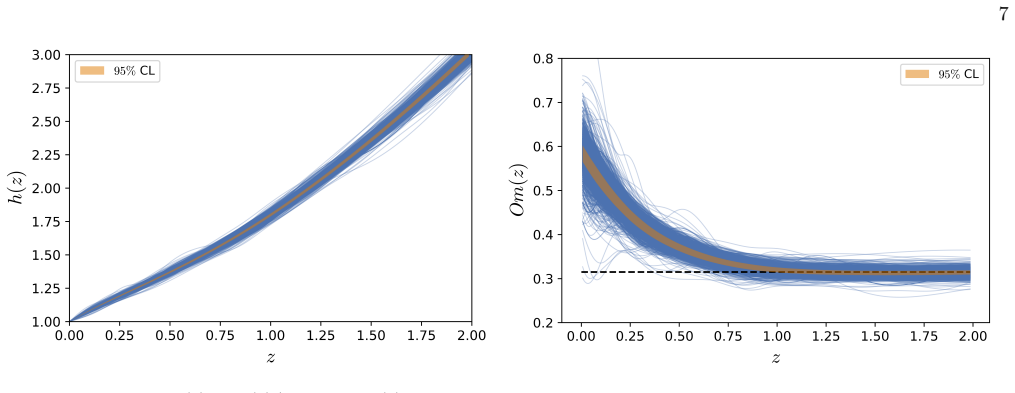
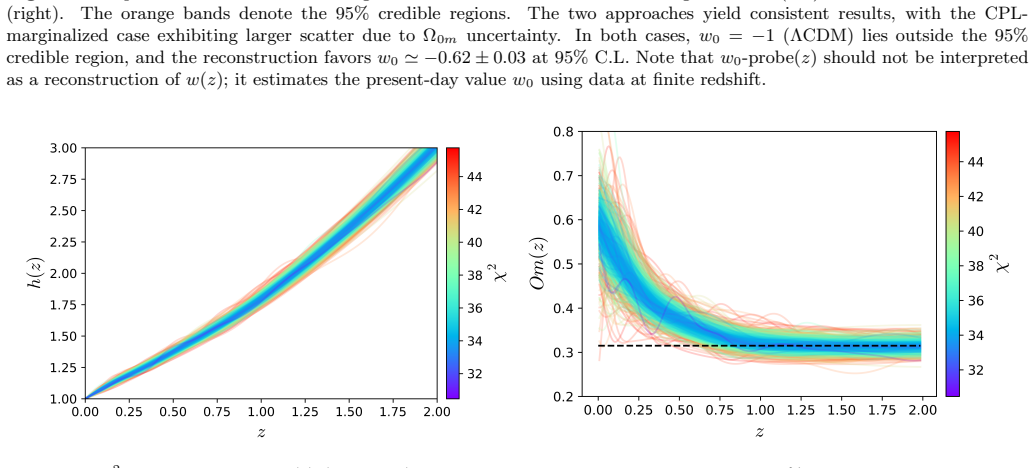
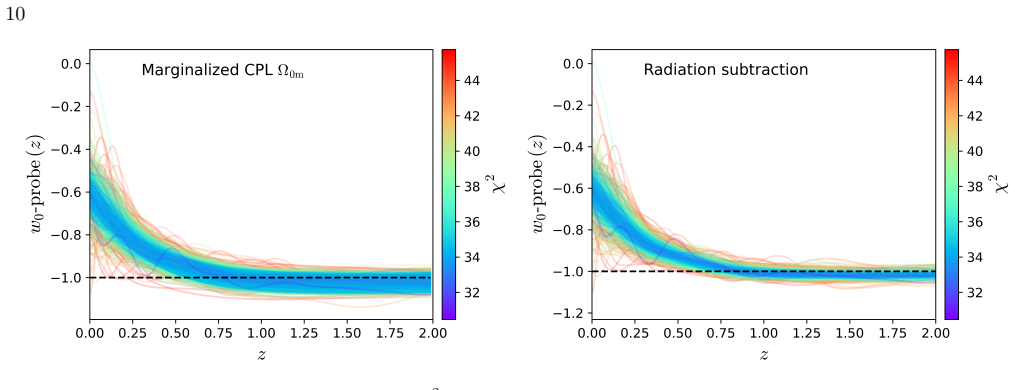
The w0-probe is constructed from Om(z) to enable direct determination of the current EoS from h(z) without additional differentiation. Reconstructions using current SNe Ia+BAO+CMB data via Gaussian processes show that both Om(z) and the w0-probe exclude LambdaCDM at the 95% C.L., with the w0-probe favoring w0 ≃ -0.62 ± 0.03 at 95% C.L. Analysis of chi-squared-limited high-likelihood samples confirms the exclusion of LambdaCDM and yields w0 in (-0.8, -0.5) at z approaching 0.
What carries the argument
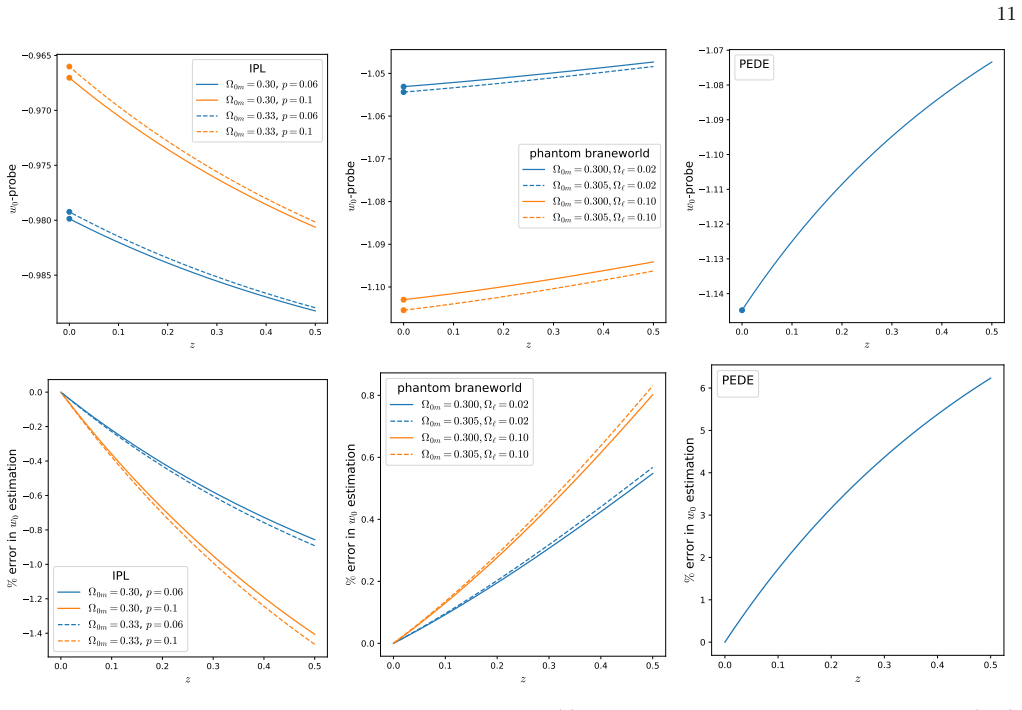
The w0-probe, a quantity derived from Om(z) that directly yields the present dark energy equation of state w0 from the normalized Hubble parameter h(z). It performs the work of providing a model-independent estimate while serving as a null test for LambdaCDM.
If this is right
- The w0-probe reconstruction remains robust for any smooth underlying w(z).
- Both Om(z) and the w0-probe exclude LambdaCDM at 95% C.L. from the data.
- The w0-probe favors w0 ≃ -0.62 ± 0.03 at 95% C.L.
- High-likelihood chi-squared-limited samples give w0 in (-0.8,-0.5) at z approaching 0.
- It offers a simple model-independent diagnostic of the current EoS.
Where Pith is reading between the lines
- If the w0-probe result holds, it implies that dark energy is evolving, which could require new theoretical models beyond a cosmological constant.
- Future high-precision measurements of h(z) could use this probe to confirm or refute the deviation from w0 = -1.
- The method's avoidance of differentiation may make it useful for other cosmological parameters where noise amplification is an issue.
- Combining the w0-probe with other diagnostics like Om(z) provides stronger constraints on dark energy evolution.
Load-bearing premise
The assumption that the underlying dark energy equation of state w(z) is smooth enough for the probe to remain robust.
What would settle it
An independent reconstruction of h(z) from future data that produces a w0 value consistent with -1 within 95% confidence limits would falsify the exclusion of LambdaCDM.
Figures



read the original abstract
Recent DESI data suggest that dark energy may be evolving and motivate the use of model-independent diagnostics such as $Om(z)$ and probes of the equation of state (EoS) of dark energy, $w(z)$. Traditional reconstructions of $w(z)$ rely on differentiating the expansion history, $h(z)=H(z)/H_0$, which amplifies noise and systematic uncertainties. In this work, we introduce a new diagnostic, the $w_0$-probe, which is constructed from $Om(z)$, and which enables a direct determination of the current EoS from $h(z)$ without any additional differentiation. While retaining the null-test capability of $Om(z)$ for $\Lambda$CDM, the $w_0$-probe also provides a direct estimate of $w_0$ -- the current EoS of dark energy. We demonstrate that this reconstruction of $w_0$ is robust for any smooth underlying $w(z)$. We apply this method to Gaussian-process (GP) reconstructions of $h(z)$ using current SNe Ia+BAO+CMB data. Both $Om(z)$ and the $w_0$-probe exclude $\Lambda$CDM at the $95\%$ confidence level (C.L.), with the latter favouring $w_0\simeq-0.62 \pm 0.03$ at $95\%$ C.L. To mitigate potential over-constraining from GP priors, we additionally analyze $\chi^2$-limited reconstructions with likelihoods exceeding the $95\%$ CPL threshold. The $w_0$-probe obtained from these high-likelihood samples again predominantly excludes $\Lambda$CDM and yields $w_0\in(-0.8,-0.5)$ at $z\to 0$, demonstrating the robustness of our results. The $w_0$-probe therefore provides a simple, model-independent, and robust diagnostic of the current EoS of dark energy.
Editorial analysis
A structured set of objections, weighed in public.
Referee Report
Summary. The paper introduces the w0-probe, a diagnostic algebraically constructed from Om(z) that extracts the present-day dark energy equation-of-state value w0 directly from the expansion history h(z) without further differentiation. It retains Om(z)'s null-test property for ΛCDM while providing a direct w0 estimate, claims this reconstruction is robust for any smooth underlying w(z), and applies the probe to Gaussian-process reconstructions of h(z) from SNe Ia+BAO+CMB data. Both Om(z) and the w0-probe exclude ΛCDM at 95% CL, with the probe favoring w0 ≃ −0.62 ± 0.03; χ²-limited high-likelihood samples yield w0 ∈ (−0.8, −0.5) at z→0.
Significance. If the asserted robustness to arbitrary smooth w(z) holds and the reconstructions are reliable, the w0-probe supplies a simple, differentiation-free, model-independent route to w0 that complements Om(z) and conventional w(z) reconstructions. A 95% CL exclusion of ΛCDM together with a concrete w0 interval would be noteworthy for the field, particularly given the use of external data-driven methods rather than parametric fits.
major comments (3)
- [Abstract / diagnostic introduction] Abstract and the section introducing the diagnostic: the central claim that 'this reconstruction of w0 is robust for any smooth underlying w(z)' is load-bearing for the numerical result w0 ≃ −0.62; the χ²-limited check mitigates GP priors but does not constitute a direct test that the algebraic rearrangement remains exact when higher derivatives of w(z) are non-zero.
- [Results section on GP reconstructions] Application to GP reconstructions: the 95% CL exclusion and quoted uncertainty on w0 rest on the accuracy of the h(z) reconstruction; the paper flags potential over-constraining from GP priors, yet the quantitative impact of that prior on the w0-probe limit is not shown explicitly (e.g., via a prior-variation test).
- [χ²-limited reconstructions paragraph] χ²-limited sample analysis: while the high-likelihood subset yields w0 ∈ (−0.8, −0.5), it is unclear whether these samples still satisfy the smoothness assumption required for the w0-probe derivation or whether they introduce selection bias that affects the reported interval.
minor comments (2)
- [Data and methods] The abstract states 'current SNe Ia+BAO+CMB data' without naming the specific compilations; these should be listed explicitly in the data section for reproducibility.
- [Diagnostic definition] Notation for the w0-probe should be defined with an equation number at first use to allow precise cross-reference in the robustness discussion.
Simulated Author's Rebuttal
We thank the referee for the constructive report. We address each major comment below, providing clarifications on the algebraic basis of the w0-probe and indicating where revisions will strengthen the presentation.
read point-by-point responses
-
Referee: [Abstract / diagnostic introduction] Abstract and the section introducing the diagnostic: the central claim that 'this reconstruction of w0 is robust for any smooth underlying w(z)' is load-bearing for the numerical result w0 ≃ −0.62; the χ²-limited check mitigates GP priors but does not constitute a direct test that the algebraic rearrangement remains exact when higher derivatives of w(z) are non-zero.
Authors: The w0-probe follows from an exact algebraic rearrangement of the Om(z) definition evaluated at z=0, which depends only on the value of h(z) and its first derivative at the present epoch. This rearrangement holds for any differentiable w(z) at z=0; higher derivatives of w(z) affect the global shape of h(z) but cancel in the local extraction of w0. Smoothness is required only to ensure Om(z) is well-defined. The χ²-limited check addresses GP reconstruction fidelity rather than the identity itself. We will add an appendix with the explicit derivation confirming independence from higher derivatives. revision: yes
-
Referee: [Results section on GP reconstructions] Application to GP reconstructions: the 95% CL exclusion and quoted uncertainty on w0 rest on the accuracy of the h(z) reconstruction; the paper flags potential over-constraining from GP priors, yet the quantitative impact of that prior on the w0-probe limit is not shown explicitly (e.g., via a prior-variation test).
Authors: We agree that an explicit prior-variation test would be useful. The χ²-limited samples already provide a data-driven robustness check, but to quantify prior sensitivity we will add a supplementary analysis varying the GP length-scale and variance hyperparameters and report the resulting range on the w0-probe. revision: yes
-
Referee: [χ²-limited reconstructions paragraph] χ²-limited sample analysis: while the high-likelihood subset yields w0 ∈ (−0.8, −0.5), it is unclear whether these samples still satisfy the smoothness assumption required for the w0-probe derivation or whether they introduce selection bias that affects the reported interval.
Authors: All χ²-limited samples are drawn from the same GP ensemble and therefore inherit the smoothness enforced by the kernel. The selection criterion is purely data likelihood and does not alter the differentiability properties. The reported interval is presented as a consistency range rather than a statistical interval to avoid over-interpretation. We will add a clarifying sentence on these points in the revised text. revision: partial
Circularity Check
No significant circularity; w0-probe is algebraic derivation from Om(z) applied to independent reconstructions
full rationale
The paper derives the w0-probe directly from the standard Om(z) expression using h(z) to obtain w0 at z=0 without further differentiation. This is an algebraic rearrangement, not a self-definitional loop or a fitted parameter renamed as a prediction. The robustness claim for arbitrary smooth w(z) is presented as a demonstrated property of the construction rather than an assumption that reduces the result to the input data by construction. Application to GP reconstructions of h(z) from SNe+BAO+CMB uses external datasets and does not involve the paper fitting parameters to the target w0 value itself. No self-citation load-bearing steps, uniqueness theorems, or ansatz smuggling appear in the derivation chain. The central numerical result (w0 ≈ -0.62) emerges from data-driven h(z) input rather than being forced by the diagnostic's definition.
Axiom & Free-Parameter Ledger
axioms (2)
- domain assumption h(z) can be reconstructed from SNe Ia+BAO+CMB data via Gaussian processes or chi2-limited sampling.
- domain assumption The underlying w(z) is smooth.
Reference graph
Works this paper leans on
-
[1]
Abdul Karim, M., Aguilar, J., Ahlen, S., et al. 2025, Phys. Rev., 112, 083515, doi: 10.1103/tr6y-kpc6 Alam, U., Bag, S., & Sahni, V. 2017, Phys. Rev. D, 95, 023524, doi: 10.1103/PhysRevD.95.023524 Bag, S., Mishra, S. S., & Sahni, V. 2018, JCAP, 08, 009, doi: 10.1088/1475-7516/2018/08/009 Bag, S., Sahni, V., Shafieloo, A., & Shtanov, Y. 2021, Astrophys. J....
-
[2]
The Pantheon+ Analysis: Cosmological Constraints
https://arxiv.org/abs/2202.04077 Calderon, R., Lodha, K., Shafieloo, A., et al. 2024, JCAP, 2024, 048, doi: 10.1088/1475-7516/2024/10/048 Chevallier, M., & Polarski, D. 2001, Int. J. Mod. Phys. D, 10, 213, doi: 10.1142/S0218271801000822 DESI Collaboration, Abdul Karim, M., Adame, A. G., et al. 2026, Astron. J., 171, 285, doi: 10.3847/1538-3881/ae4c43 13 D...
work page internal anchor Pith review Pith/arXiv arXiv doi:10.1088/1475-7516/2024/10/048 2024
discussion (0)
Sign in with ORCID, Apple, or X to comment. Anyone can read and Pith papers without signing in.