Atomically precise mechanosynthesis of carbon structures on hydrogenated Si(100) by inverted-mode STM
Pith reviewed 2026-06-29 16:38 UTC · model grok-4.3
The pith
Inverted-mode STM donates C2 units from molecules to reactive sites on hydrogen-passivated silicon to assemble carbon structures with atomic precision.
A machine-rendered reading of the paper's core claim, the machinery that carries it, and where it could break.
Core claim
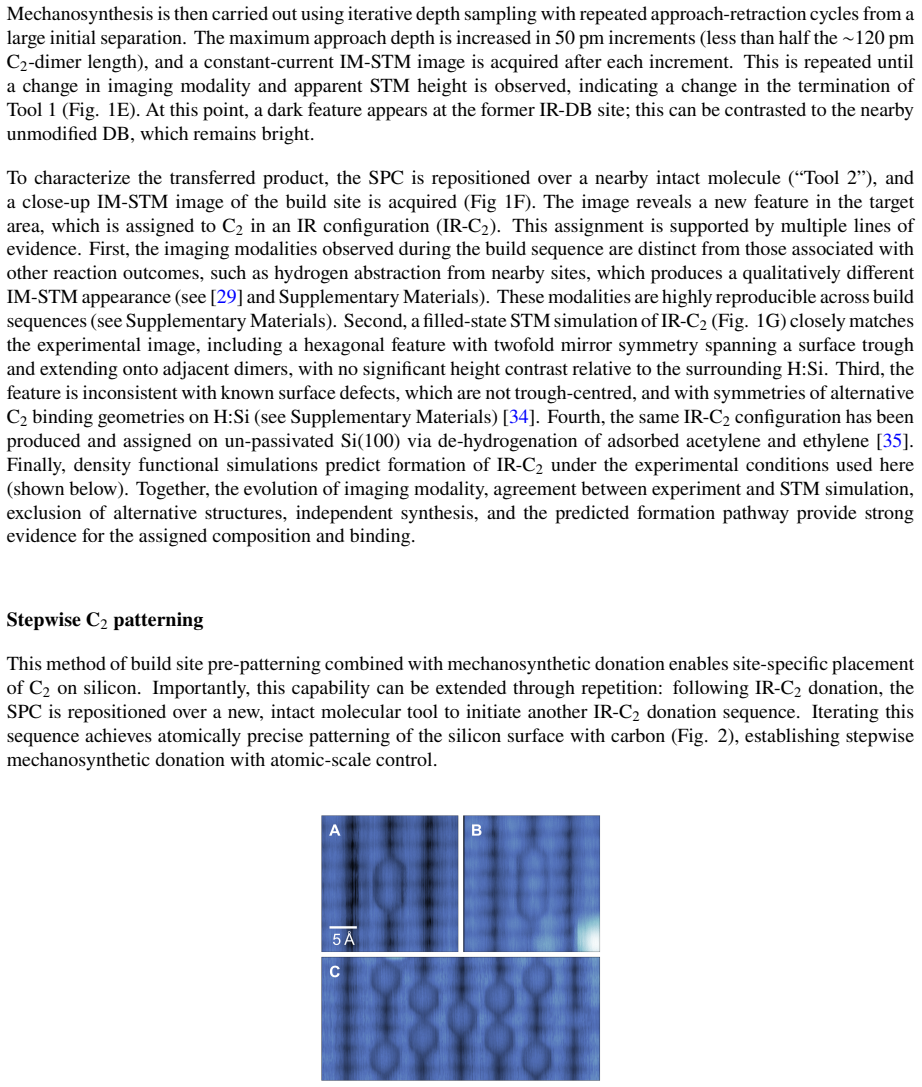
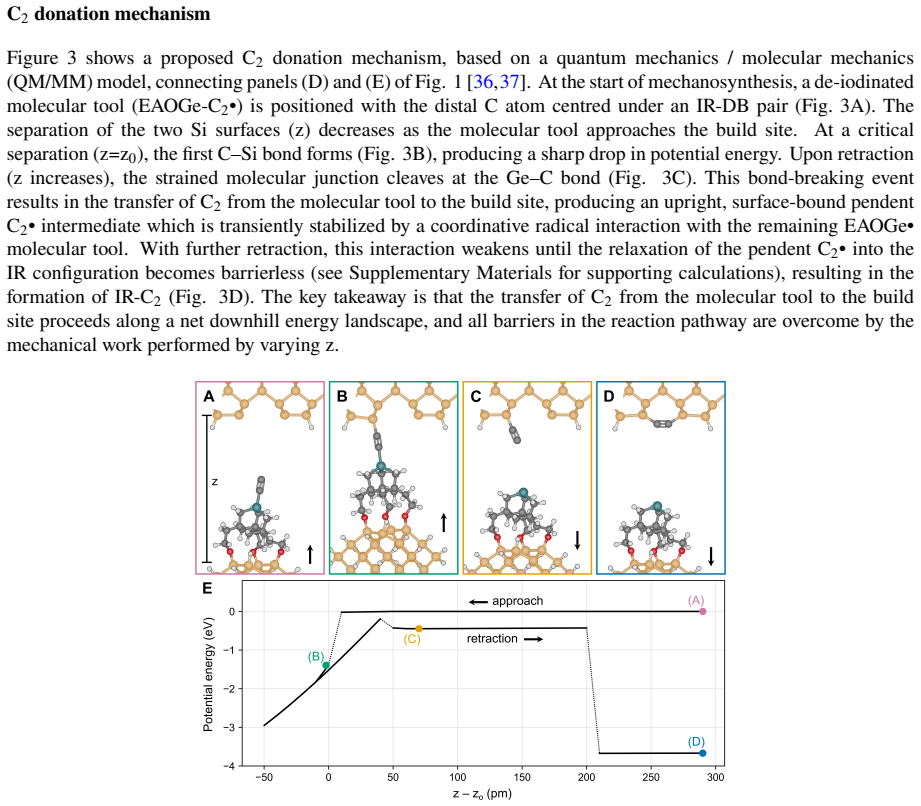
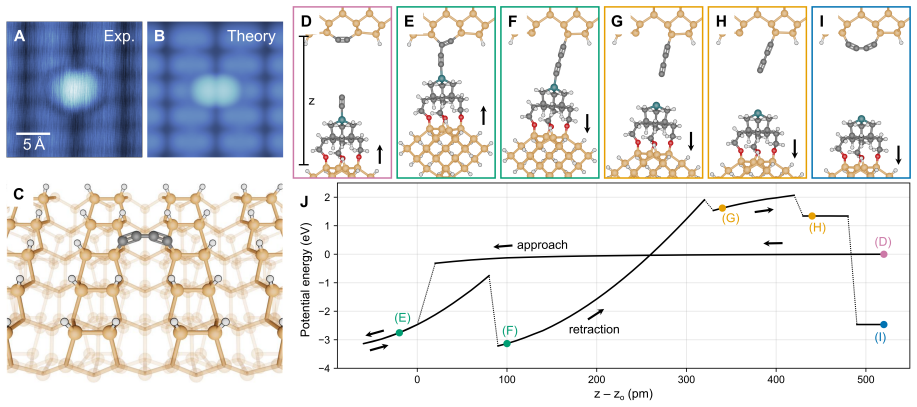
Using inverted-mode STM, C2 units are donated from surface-deposited molecules to pre-patterned reactive sites on a hydrogen-passivated Si(100) surface. We demonstrate single-site C2 donation, spatially patterned multi-site C2 donation, and the stepwise assembly of polyyne structures through successive C-C bond formation.
What carries the argument
Inverted-mode STM mechanosynthesis that transfers C2 units from deposited molecules to selected dangling-bond sites on the passivated silicon surface.
If this is right
- Single-site and multi-site C2 placement can be performed with independent spatial and chemical control.
- Repeated donations enable linear polyyne chains to form site by site on the surface.
- The technique supplies a foundational step for building larger carbon-based atomically precise structures on silicon.
Where Pith is reading between the lines
- The same donation protocol could be tested with other small carbon-containing molecules to access different bonding motifs.
- If the formed structures remain stable at room temperature, the method might support fabrication of molecular wires or junctions.
- Extending the patterning to larger areas would require checking whether successive operations interfere with prior sites.
Load-bearing premise
Changes seen in STM images after tip manipulation represent C2 donation and new C-C bonds rather than desorption, molecular rearrangement, or imaging artifacts.
What would settle it
Spectroscopic or high-resolution imaging data showing no net addition of carbon atoms or mismatched bond lengths at the manipulated sites would falsify the C2 donation interpretation.
Figures


read the original abstract
The ability to build atomically precise structures on surfaces with complete control over both atomic placement and chemical bonding remains a central challenge in nanoscale fabrication. Here, we demonstrate simultaneous spatial and chemical control over the mechanosynthetic fabrication of carbon structures. Using inverted-mode STM, C$_2$ units are donated from surface-deposited molecules to pre-patterned reactive sites on a hydrogen-passivated Si(100) surface. We demonstrate single-site C$_2$ donation, spatially patterned multi-site C$_2$ donation, and the stepwise assembly of polyyne structures through successive C-C bond formation. Together, these results establish controlled mechanosynthetic donation as a foundational capability for programmable atomically precise fabrication.
Editorial analysis
A structured set of objections, weighed in public.
Referee Report
Summary. The manuscript claims to demonstrate atomically precise mechanosynthesis on hydrogen-passivated Si(100) via inverted-mode STM, in which C2 units are donated from surface-deposited molecules to pre-patterned reactive sites. It reports single-site C2 donation, spatially patterned multi-site donation, and stepwise assembly of polyyne chains through successive C-C bond formation, establishing controlled mechanosynthetic donation as a capability for programmable atomically precise fabrication.
Significance. If the experimental interpretations are validated, the work would establish a new experimental route for placing and bonding carbon units with spatial and chemical control on a silicon surface. This could serve as a foundational technique for building carbon-based nanostructures in an atomically precise manner, extending existing STM manipulation methods to donation chemistry.
major comments (2)
- [Results (STM images after tip manipulation)] The central claim that post-manipulation STM contrast changes correspond to C2 donation and C-C bond formation (rather than H desorption, molecular rearrangement, or imaging artifacts) is load-bearing but rests solely on topographic imaging. No dI/dV spectra, bond-length statistics across multiple images, or DFT-simulated STM images are presented to distinguish the proposed chemistry from alternatives.
- [Methods (inverted-mode STM operation)] The description of inverted-mode STM does not include explicit control experiments showing that the mode enforces C2 donation over other tip-induced processes. Without such controls, the specificity claimed for single-site and patterned multi-site donation cannot be assessed.
minor comments (2)
- [Figure captions] Figure captions should explicitly state the tunneling parameters (bias, current) and tip state before/after each manipulation step to allow readers to evaluate possible artifacts.
- [Abstract] The abstract would benefit from a single sentence noting the corroborative techniques (if any) used to assign the observed features to C2 attachment.
Simulated Author's Rebuttal
We thank the referee for their constructive comments, which help clarify the presentation of our results on mechanosynthetic C2 donation. We address each major comment below and indicate the revisions planned for the next version of the manuscript.
read point-by-point responses
-
Referee: [Results (STM images after tip manipulation)] The central claim that post-manipulation STM contrast changes correspond to C2 donation and C-C bond formation (rather than H desorption, molecular rearrangement, or imaging artifacts) is load-bearing but rests solely on topographic imaging. No dI/dV spectra, bond-length statistics across multiple images, or DFT-simulated STM images are presented to distinguish the proposed chemistry from alternatives.
Authors: We agree that topographic STM imaging is the primary evidence and that additional quantitative support would strengthen the interpretation. The contrast changes are observed only at the pre-patterned dangling-bond sites, with spatial registry and reproducibility that align with expected C2 addition rather than random H desorption or rearrangement. In the revised manuscript we will add bond-length statistics compiled from multiple independent images to quantify the apparent C-C distances and compare them to literature values for polyyne segments. We will also expand the discussion to explicitly rule out common imaging artifacts based on bias-dependent imaging and tip-condition controls already performed. dI/dV spectra and DFT-simulated images were outside the scope of the present study; we will note this limitation and indicate it as a direction for follow-up work. revision: partial
-
Referee: [Methods (inverted-mode STM operation)] The description of inverted-mode STM does not include explicit control experiments showing that the mode enforces C2 donation over other tip-induced processes. Without such controls, the specificity claimed for single-site and patterned multi-site donation cannot be assessed.
Authors: The inverted-mode operation is defined by a combination of tip preparation, bias polarity, and setpoint parameters that favor mechanosynthetic transfer. The experimental outcomes themselves—selective donation only at chosen sites, successful multi-site patterning, and sequential chain growth—provide evidence of specificity, as non-specific tip-induced processes would not permit such positional control. In the revised methods section we will add a dedicated paragraph describing control experiments performed with conventional (non-inverted) STM parameters on the same surfaces, which produced only random desorption or no reaction rather than the controlled, site-specific donation reported. These controls will be presented to quantify the mode’s selectivity. revision: yes
Circularity Check
No circularity: experimental demonstration with no derivation chain
full rationale
The paper is an experimental report on STM-based mechanosynthesis. It contains no equations, fitted parameters, predictions derived from subsets of data, or mathematical derivations. Claims rest on interpretation of STM images as C2 donation and bond formation, but this is not a derivation that reduces to its inputs by construction. No self-citation load-bearing steps, ansatzes, or uniqueness theorems are invoked in a way that creates circularity. The work is self-contained as an empirical demonstration against external benchmarks of surface science imaging.
Axiom & Free-Parameter Ledger
axioms (1)
- domain assumption STM tip manipulation can induce specific chemical bond formation between deposited molecules and surface sites
Reference graph
Works this paper leans on
-
[1]
R. P. Feynman. There’s plenty of room at the bottom.Engineering and Science, 23:22–36, 1960
1960
-
[2]
A. A. Khajetoorians, D. Wegner, A. F. Otte, and I. Swart. Creating designer quantum states of matter atom-by-atom.Nature Reviews Physics, 1(12):703–715, 2019. doi: 10.1038/s42254-019-0108-5
-
[3]
A. Chatterjee, P. Stevenson, S. De Franceschi, A. Morello, N. P. de Leon, and F. Kuemmeth. Semiconductor qubits in practice.Nature Reviews Physics, 3(3):157–177, 2021. doi: 10.1038/s42254-021-00283-9
-
[4]
S. R. Schofield, A. J Fisher, E. Ginossar, J. W. Lyding, R. Silver, F. Fei, P. Namboodiri, J. Wyrick, M. G. Masteghin, D. C. Cox, B. N. Murdin, S. K. Clowes, J. G Keizer, M. Y Simmons, H. G. Stemp, A. Morello, B. Voisin, S. Rogge, R. A Wolkow, L. Livadaru, J. Pitters, T. J Z Stock, N. J Curson, R. E. Butera, T. V Pavlova, A. M. Jakob, D. Spemann, P. R˜A¤c...
-
[5]
D. M. Eigler and E. K. Schweizer. Positioning single atoms with a scanning tunnelling microscope.Nature, 344(6266):524–526, 1990. doi: 10.1038/344524a0
-
[6]
M. F. Crommie, C. P. Lutz, and D. M. Eigler. Confinement of electrons to quantum corrals on a metal surface. Science, 262(5131):218–220, 1993. doi: 10.1126/science.262.5131.218
-
[7]
P. H. Beton, A. W. Dunn, and P. Moriarty. Manipulation of C60 molecules on a Si surface.Applied Physics Letters, 67(8):1075–1077, 1995. doi: 10.1063/1.114469
-
[8]
J. W. Lyding, T. Shen, G. C. Abeln, C. Wang, and J. R. Tucker. Nanoscale patterning and selective chemistry of silicon surfaces by ultrahigh-vacuum scanning tunneling microscopy.Nanotechnology, 7(2):128–133, 1996. doi: 10.1088/0957-4484/7/2/006
-
[9]
T. A. Jung, R. R. Schlittler, J. K. Gimzewski, H. Tang, and C. Joachim. Controlled room-temperature positioning of individual molecules: Molecular flexure and motion.Science, 271(5246):181–184, 1996. doi: 10.1126/science.271.5246.181. 8
-
[10]
N. Oyabu, Y. Sugimoto, M. Abe, O. Custance, and S. Morita. Lateral manipulation of single atoms at semiconductor surfaces using atomic force microscopy.Nanotechnology, 16(3):S112–S117, 2005. doi: 10.1088/0957-4484/16/3/021
-
[11]
S. Hla, L. Bartels, G. Meyer, and K. Rieder. Inducing all steps of a chemical reaction with the scanning tunneling microscope tip: Towards single molecule engineering.Physical Review Letters, 85(13):2777–2780,
-
[12]
doi: 10.1103/physrevlett.85.2777
-
[13]
Y. Okawa, M. Akai-Kasaya, Y. Kuwahara, S. K. Mandal, and M. Aono. Controlled chain polymerisation and chemical soldering for single-molecule electronics.Nanoscale, 4(10):3013, 2012. doi: 10.1039/c2nr30245d
-
[14]
Pavli ˇcek, P
N. Pavli ˇcek, P. Gawel, D. R. Kohn, Z. Majzik, Y. Xiong, G. Meyer, H. L. Anderson, and L. Gross. Polyyne formation via skeletal rearrangement induced by atomic manipulation.Nature Chemistry, 10(8):853–858,
-
[15]
doi: 10.1038/s41557-018-0067-y
-
[16]
K. Kaiser, L. M. Scriven, F. Schulz, P. Gawel, L. Gross, and H. L. Anderson. An sp-hybridized molecular carbon allotrope, cyclo[18]carbon.Science, 365(6459):1299–1301, 2019. doi: 10.1126/science.aay1914
-
[17]
S. Kawai, O. Krej ˇc´ı, T. Nishiuchi, K. Sahara, T. Kodama, R. Pawlak, E. Meyer, T. Kubo, and A. S. Foster. Three-dimensional graphene nanoribbons as a framework for molecular assembly and local probe chemistry. Science Advances, 6(9), 2020. doi: 10.1126/sciadv.aay8913
-
[18]
Q. Zhong, A. Ihle, S. Ahles, H. A. Wegner, A. Schirmeisen, and D. Ebeling. Constructing covalent organic nanoarchitectures molecule by molecule via scanning probe manipulation.Nature Chemistry, 13(11):1133–1139, 2021. doi: 10.1038/s41557-021-00773-4
-
[19]
F. Albrecht, S. Fatayer, I. Pozo, Ivano Tavernelli, Jascha Repp, Diego Pe ˜na, and Leo Gross. Selectivity in single-molecule reactions by tip-induced redox chemistry.Science, 377(6603):298–301, 2022. doi: 10.1126/science.abo6471
-
[20]
L. Bartels, G. Meyer, and K.-H. Rieder. Controlled vertical manipulation of single co molecules with the scanning tunneling microscope: A route to chemical contrast.Applied Physics Letters, 71(2):213–215, 1997. doi: 10.1063/1.119503
-
[21]
G. Dujardin, A. Mayne, O. Robert, F. Rose, C. Joachim, and H. Tang. Vertical manipulation of individual atoms by a direct STM tip-surface contact on Ge(111).Physical Review Letters, 80(14):3085–3088, 1998. doi: 10.1103/physrevlett.80.3085
-
[22]
N. Oyabu, O. Custance, I. Yi, Y. Sugawara, and S. Morita. Mechanical vertical manipulation of selected single atoms by soft nanoindentation using near contact atomic force microscopy.Physical Review Letters, 90(17), 2003. doi: 10.1103/physrevlett.90.176102
-
[23]
F. Pump, R. Temirov, O. Neucheva, S. Soubatch, S. Tautz, M. Rohlfing, and G. Cuniberti. Quantum transport through STM-lifted single PTCDA molecules.Applied Physics A, 93(2):335–343, 2008. doi: 10.1007/s00339- 008-4837-z
-
[24]
L. Gross, F. Mohn, N. Moll, P. Liljeroth, and G. Meyer. The chemical structure of a molecule resolved by atomic force microscopy.Science, 325(5944):1110–1114, 2009. doi: 10.1126/science.1176210
-
[25]
Y. Sugimoto, P. Pou, O. Custance, P. Jelinek, M. Abe, R. Perez, and S. Morita. Complex patterning by vertical interchange atom manipulation using atomic force microscopy.Science, 322(5900):413–417, 2008. doi: 10.1126/science.1160601
-
[26]
T. R. Huff, H. Labidi, M. Rashidi, M. Koleini, R. Achal, M. H. Salomons, and R. A. Wolkow. Atomic white-out: Enabling atomic circuitry through mechanically induced bonding of single hydrogen atoms to a silicon surface.ACS Nano, 11(9):8636–8642, 2017. doi: 10.1021/acsnano.7b04238
-
[27]
D. Cai, G. Yu, X. Shi, Y. Xia, Y. Liu, Y. Gu, S. Huo, and S. Qin. Controlled formation of artificial superstructures in C60 arrays via vertical STM manipulation.Journal of Applied Physics, 138(16), 2025. doi: 10.1063/5.0296568
-
[28]
K. E. Drexler.Nanosystems: Molecular Machinery, Manufacturing, and Computation. Wiley, New York, 1992
1992
-
[29]
Freitas Jr.Diamondoid Mechanosynthesis for Tip-Based Nanofabrication, page 387–400
R. Freitas Jr.Diamondoid Mechanosynthesis for Tip-Based Nanofabrication, page 387–400. Springer New York, 2011. 9
2011
-
[30]
Bothra, A
P. Bothra, A. Z. Stieg, J. K. Gimzewski, and P. Sautet. Controlled vertical transfer of individual au atoms using a surface supported carbon radical for atomically precise manufacturing.Precision Chemistry, 1(2):119–126, March 2023
2023
-
[31]
E. Barrera, B. Thanabalasingam, R. Addou, D. Allis, A. Asani, J. Barton, T. Bernots, B. Blue, A. Bottomley, D. Cheng, B. Choi, M. Cowie, C. Deimert, M. Drew, M. Durand, T. Enright, R. Freitas Jr., A. Godfrey, R. Groome, S. Y. Guo, S. Haird, A. Hill, T. Huff, C. Imperiale, A. Inayeh, J. Jeyachandra, M. Jobes, M. Kennedy, R. J. Kirby, M. Krykunov, S. Lilak,...
-
[32]
B. Blue, M. Morin, A. Inayeh, C. J. Mackie, M. Savoie, A. Bottomley, C. J. Imperiale, Z. Ahmed, R. Cranston, R. Addou, A. Asani, E. Barrera-Ramirez, J. Barton, D. Cheng, M. Cowie, C. Deimert, T. Enright, J. Z. Fan, R. Freitas Jr., A. T. K. Godfrey, R. Groome, S. Y. Guo, K. A. Harrison, A. Hill, T. Huff, M. Jobes, R. J. Kirby, S. Lilak, H. Ma, A. C. Maahs,...
2026
-
[33]
T. McCallum, S. Rohe, M. Morin, H. Y. Su, S. W. J. Shields, K. Tanveer, M. Mamone, N. Zindy, A. J. Hill, and M. Drew. (hetero)adamantane synthesis: A triple alkylation reaction.arXiv, 2026. doi: 10.26434/chem- rxiv.15002728/v1
-
[34]
R. J. Kirby, N. M. ´Culum, H. Rodriguez, T. McCallum, B. Scheffel, S. Lilak, S. Shields, A. T. K. Godfrey, S. Rohe, C. J. Mackie, R. Plumadore, R. Addou, A. J. Hill, M. Drew, T. Huff, T. Enright, and M. Morin. XPS study of sp and sp3 carbon radicals in UHV by iodine capture. Manuscript in preparation, 2026
2026
-
[35]
T.-C. Shen and P. Avouris. Electron stimulated desorption induced by the scanning tunneling microscope. Surface Science, 390(1-3):35–44, 1997. doi: 10.1016/s0039-6028(97)00506-2
-
[36]
J. Croshaw, T. Dienel, T. Huff, and R. Wolkow. Atomic defect classification of the H-Si(100) surface through multi-mode scanning probe microscopy.Beilstein Journal of Nanotechnology, 11:1346–1360, 2020. doi: 10.3762/bjnano.11.119
-
[37]
MacLean, M
O. MacLean, M. Savoie, D. Allis, R. Addou, R. Groome, S. Y. Guo, A. J. Hill, A. Inayeh, H. Ma, C. J. Mackie, S. Ou, M. Taucer, D. A. B. Therien, and F. Van Barr. Electron-induced formation of C 2 on Si(100) from acetylene and ethylene. Manuscript in preparation, 2026
2026
-
[38]
H. M. Senn and W. Thiel. QM/MM methods for biomolecular systems.Angewandte Chemie International Edition, 48(7):1198–1229, 2009. doi: 10.1002/anie.200802019
-
[39]
M. Svensson, S. Humbel, R. D. J. Froese, T. Matsubara, S. Sieber, and K. Morokuma. ONIOM: A multilayered integrated MO + MM method for geometry optimizations and single-point energy predictions. A test for diels– alder reactions and Pt(P(t-Bu)3)2 + H2 oxidative addition.The Journal of Physical Chemistry, 100(50):19357– 19363, 1996. doi: 10.1021/jp962071j
-
[40]
J. Pitters, J. Croshaw, R. Achal, L. Livadaru, S. Ng, R. Lupoiu, T. Chutora, T. Huff, K. Walus, and R. A. Wolkow. Atomically precise manufacturing of silicon electronics.ACS Nano, 18(9):6766–6816, 2024. doi: 10.1021/acsnano.3c10412
-
[41]
J. Tersoff and D. R. Hamann. Theory of the scanning tunneling microscope.Physical Review B, 31(2):805– 813, January 1985. doi: 10.1103/physrevb.31.805
-
[42]
I. S. Ufimtsev and T. J. Martinez. Quantum chemistry on graphical processing units. 3. Analytical energy gradients, geometry optimization, and first principles molecular dynamics.Journal of Chemical Theory and Computation, 5(10):2619–2628, 2009. doi: 10.1021/ct9003004
-
[43]
A. V. Titov, I. S. Ufimtsev, N. Luehr, and T. J. Martinez. Generating efficient quantum chemistry codes for novel architectures.Journal of Chemical Theory and Computation, 9(1):213–221, 2012. doi: 10.1021/ct300321a
-
[44]
C. Song, L-P. Wang, and T. J. Mart ´ınez. Automated code engine for graphical processing units: Applica- tion to the effective core potential integrals and gradients.Journal of Chemical Theory and Computation, 12(1):92–106, 2015. doi: 10.1021/acs.jctc.5b00790. 10
-
[45]
A. D. Becke. Density-functional thermochemistry. III. The role of exact exchange.The Journal of Chemical Physics, 98(7):5648–5652, 1993. doi: 10.1063/1.464913
-
[46]
J-D. Chai and M. Head-Gordon. Long-range corrected hybrid density functionals with damped atom-atom dispersion corrections.Physical Chemistry Chemical Physics, 10(44):6615, 2008. doi: 10.1039/b810189b
-
[47]
W. J. Hehre, R. Ditchfield, and J. A. Pople. Self-consistent molecular orbital methods. XII. Further extensions of Gaussian-type basis sets for use in molecular orbital studies of organic molecules.The Journal of Chemical Physics, 56(5):2257–2261, 1972. doi: 10.1063/1.1677527
-
[48]
W. R. Wadt and P. J. Hay. Ab initio effective core potentials for molecular calculations. Potentials for main group elements Na to Bi.The Journal of Chemical Physics, 82(1):284–298, 1985. doi: 10.1063/1.448800
-
[49]
Y. Lin, G. Li, S. Mao, and J. Chai. Long-range corrected hybrid density functionals with improved dispersion corrections.Journal of Chemical Theory and Computation, 9(1):263–272, 2012. doi: 10.1021/ct300715s
-
[50]
F. Weigend. Accurate coulomb-fitting basis sets for H to Rn.Physical Chemistry Chemical Physics, 8(9):1057,
-
[51]
doi: 10.1039/b515623h
-
[52]
M. J. Frisch, G. W. Trucks, H. B. Schlegel, G. E. Scuseria, M. A. Robb, J. R. Cheeseman, G. Scalmani, V. Barone, G. A. Petersson, H. Nakatsuji, X. Li, M. Caricato, A. V. Marenich, J. Bloino, B. G. Janesko, R. Gomperts, B. Mennucci, H. P. Hratchian, J. V. Ortiz, A. F. Izmaylov, J. L. Sonnenberg, D. Williams- Young, F. Ding, F. Lipparini, F. Egidi, J. Going...
2013
-
[53]
A. Hjorth Larsen, J. Jørgen Mortensen, J. Blomqvist, I. E. Castelli, R. Christensen, M. Du lak, J. Friis, M. N. Groves, B. Hammer, C. Hargus, E. D. Hermes, P. C. Jennings, P. Bjerre Jensen, J. Kermode, J. R. Kitchin, E. Leonhard Kolsbjerg, J. Kubal, K. Kaasbjerg, S. Lysgaard, J. Bergmann Maronsson, T. Maxson, T. Olsen, L. Pastewka, A. Peterson, C. Rostgaa...
-
[54]
G. Wentzel. Eine verallgemeinerung der quantenbedingungen f¨ ur die zwecke der wellenmechanik.Zeitschrift f¨ur Physik, 38(6-7):518–529, 1926. doi: 10.1007/bf01397171
-
[55]
H. A. Kramers. Wellenmechanik und halbzahlige quantisierung.Zeitschrift f ¨ur Physik, 39(10-11):828–840,
-
[56]
doi: 10.1007/bf01451751
-
[57]
Brillouin
L. Brillouin. La m ´ecanique ondulatoire de Schr¨odinger: Une m´ethode g´en´erale de r´esolution par approxima- tions successives.Comptes Rendus de l’Acad´emie des Sciences de Paris, 183:24–26, 1926
1926
-
[58]
G. Henkelman, B. P. Uberuaga, and H. J ´onsson. A climbing image nudged elastic band method for finding saddle points and minimum energy paths.The Journal of Chemical Physics, 113(22):9901–9904, 2000. doi: 10.1063/1.1329672
-
[59]
A. Biedermann, E. Knoesel, Z. Hu, and T. F. Heinz. Dissociative adsorption of H 2 on Si(100) induced by atomic H.Physical Review Letters, 83(9):1810–1813, 1999. doi: 10.1103/physrevlett.83.1810
-
[60]
M. Lastapis, M. Martin, D. Riedel, L. Hellner, G. Comtet, and G. Dujardin. Picometer-scale electronic control of molecular dynamics inside a single molecule.Science, 308(5724):1000–1003, 2005. doi: 10.1126/sci- ence.1108048
-
[61]
A. Bellec, D. Riedel, G. Dujardin, O. Boudrioua, L. Chaput, L. Stauffer, and Ph. Sonnet. Nonlocal activation of a bistable atom through a surface state charge-transfer process on Si(100)-2x1:H.Physical Review Letters, 105(4), 2010. doi: 10.1103/physrevlett.105.048302
-
[62]
[29] [31] [33,38] [29] [39] [40–42] [43] [44] [45] [46] [47] [48] [49] [50] [44] [40–42] [51–53] [54] [50] [55–57] 11
discussion (0)
Sign in with ORCID, Apple, or X to comment. Anyone can read and Pith papers without signing in.