Autonomous oscillations in quantum electromechanics: tensor network treatment
Pith reviewed 2026-06-29 17:21 UTC · model grok-4.3
The pith
A tensor-network framework using binary vibrational encoding and mesoscopic reservoir embeddings computes self-oscillatory steady states without real-time propagation.
A machine-rendered reading of the paper's core claim, the machinery that carries it, and where it could break.
Core claim
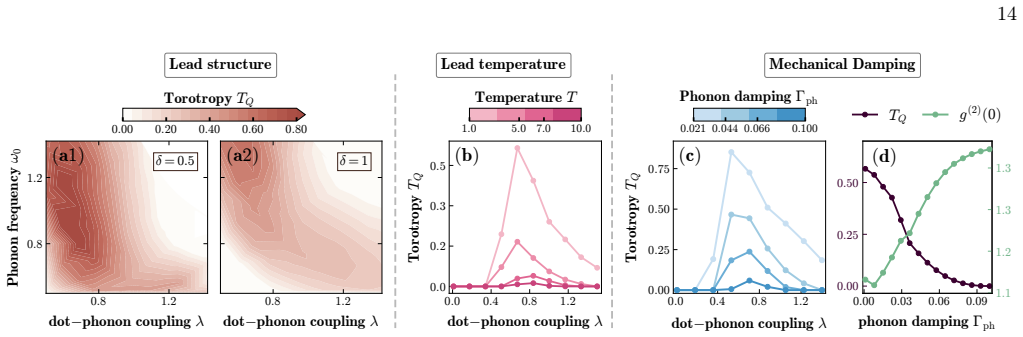
We formulate a tensor-network framework that combines a binary representation of the vibrational mode with mesoscopic reservoir embeddings that enable controlled access to the self-oscillatory steady states and relevant transport observables without explicit real-time propagation. We demonstrate the emergence of mechanical self-oscillations across a broad set of operating conditions, in which strong electromechanical backaction, nonadiabatic oscillator dynamics, and energy-dependent electronic tunneling processes compete. Furthermore, we observe that for both slow and fast vibrating mechanical modes, suppressed vibrational occupation fluctuations in the self-oscillation window along the elec
What carries the argument
Tensor-network framework that combines binary representation of the vibrational mode with mesoscopic reservoir embeddings to reach steady states directly.
If this is right
- Self-oscillations appear when backaction, nonadiabatic dynamics, and energy-dependent tunneling compete.
- A peak in occupation fluctuations precedes their suppression inside the oscillation window for both slow and fast modes.
- Oscillation behavior is governed by both intrinsic device properties and environmental parameters.
- The same framework applies to more complicated or experimentally relevant electromechanical setups.
Where Pith is reading between the lines
- The method could be used to map how additional mechanical or electronic degrees of freedom shift the location of the fluctuation peak.
- It offers a route to compute current noise or heat transport signatures tied to the self-oscillation window.
- Similar binary-plus-embedding constructions might apply to other open quantum systems with one large bosonic mode coupled to structured baths.
Load-bearing premise
The binary representation of the vibrational mode together with the mesoscopic reservoir embeddings accurately capture the essential physics of strong electromechanical backaction and energy-dependent tunneling without introducing uncontrolled truncation errors.
What would settle it
Direct comparison of the predicted peak in vibrational fluctuations before suppression against exact real-time evolution in a truncated small-system regime where both methods apply; disagreement would show the representation fails to capture the backaction regime.
Figures






read the original abstract
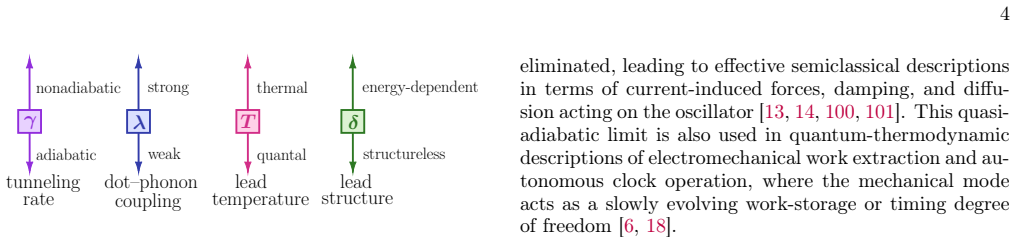
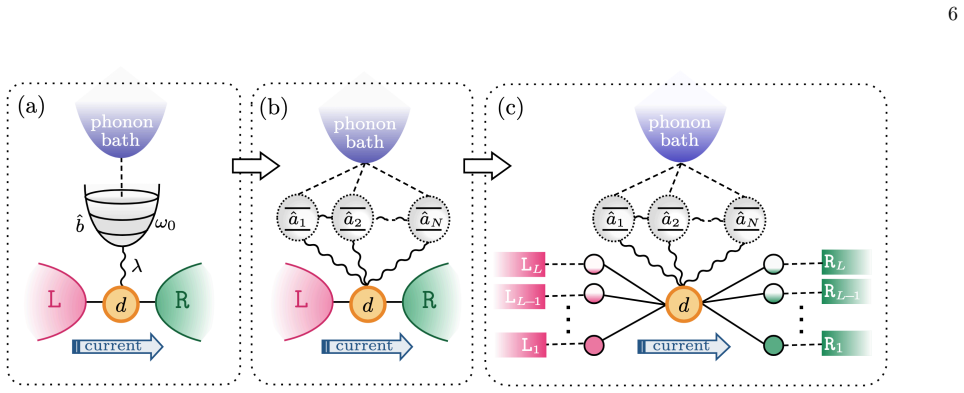
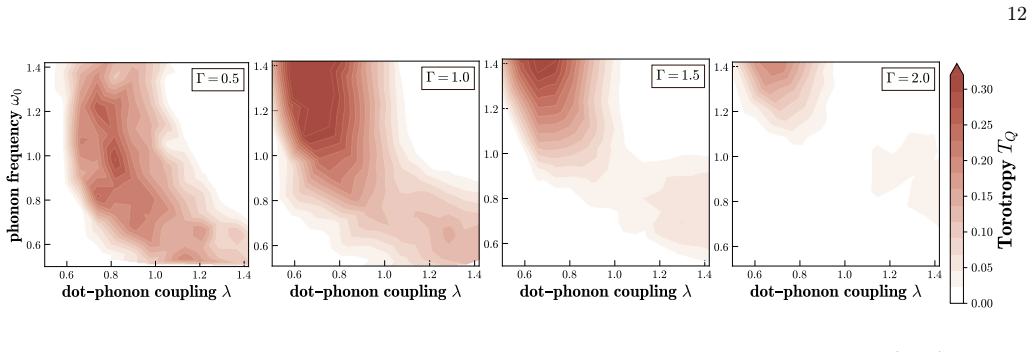
Transport-induced self-sustained oscillations in electromechanical systems convert a static electrochemical bias into robust, autonomous oscillatory motion in the absence of any external periodic drive. However, an exact description of such self-oscillations remains challenging in nanoscale electromechanical devices featuring a simultaneously large bosonic Hilbert space, strong interactions, and structured fermionic leads. We formulate a tensor-network framework that combines a binary representation of the vibrational mode with mesoscopic reservoir embeddings that enable controlled access to the self-oscillatory steady states and relevant transport observables without explicit real-time propagation. We demonstrate the emergence of mechanical self-oscillations across a broad set of operating conditions, in which strong electromechanical backaction, nonadiabatic oscillator dynamics, and energy-dependent electronic tunneling processes compete. Furthermore, we observe that for both slow and fast vibrating mechanical modes, suppressed vibrational occupation fluctuations in the self-oscillation window along the electromechanical coupling strength sweep is preceded by a peak in the occupation fluctuations. Collectively, we explore how both intrinsic system properties and environmental parameters govern such autonomous oscillations over a broad range of operating conditions. The generality of our framework will enable the method to be employed straightforwardly to more complicated or experimentally relevant scenarios.
Editorial analysis
A structured set of objections, weighed in public.
Referee Report
Summary. The manuscript formulates a tensor-network framework combining a binary (two-level) representation of the vibrational mode with mesoscopic reservoir embeddings to compute self-oscillatory steady states and transport observables in quantum electromechanical systems without explicit real-time propagation. It reports the emergence of autonomous mechanical oscillations across parameter regimes where strong backaction, nonadiabatic dynamics, and energy-dependent tunneling compete, along with a peak in vibrational occupation fluctuations preceding their suppression as electromechanical coupling is swept.
Significance. If the central approximations hold with controlled errors, the method would supply a useful numerical route to steady-state properties in systems combining large bosonic spaces with structured fermionic leads, where exact diagonalization or real-time methods become intractable. The avoidance of explicit time propagation and the tensor-network construction are concrete strengths for accessing long-time behavior.
major comments (2)
- [§III] §III (tensor-network framework): The central claim that the binary representation plus mesoscopic embeddings 'enable controlled access' to self-oscillatory states rests on the assumption that two-level truncation of the vibrational mode introduces no uncontrolled errors. No convergence tests against three- or higher-level bosonic truncations are reported, which is load-bearing because self-oscillations routinely populate higher phonon states under strong backaction.
- [Results] Results section (fluctuation sweeps): The reported peak in occupation fluctuations preceding suppression is presented as a qualitative observation, yet the abstract and results supply no quantitative error bars, comparison to known analytic limits (weak-coupling or adiabatic regimes), or cross-checks with alternative solvers. This undermines assessment of whether the framework reproduces established physics before exploring new regimes.
minor comments (1)
- [Abstract] Abstract: the term 'binary representation' is used without immediate clarification that it denotes a strict two-level truncation; an explicit parenthetical definition would improve accessibility.
Simulated Author's Rebuttal
We thank the referee for their careful reading of the manuscript and for highlighting these important points regarding validation of the tensor-network framework. We address each major comment below and indicate the revisions planned for the next version.
read point-by-point responses
-
Referee: [§III] §III (tensor-network framework): The central claim that the binary representation plus mesoscopic embeddings 'enable controlled access' to self-oscillatory states rests on the assumption that two-level truncation of the vibrational mode introduces no uncontrolled errors. No convergence tests against three- or higher-level bosonic truncations are reported, which is load-bearing because self-oscillations routinely populate higher phonon states under strong backaction.
Authors: We agree that the absence of explicit convergence tests with higher bosonic truncations leaves the error control of the two-level approximation insufficiently demonstrated. Although the binary representation is chosen to capture the essential physics in the regimes of interest, the referee is correct that this requires direct numerical support. In the revised manuscript we will add a dedicated subsection (or appendix) presenting comparisons of key observables (vibrational occupation, current, and fluctuation spectra) between the two-level and three-level truncations for representative parameter points across the self-oscillation window. These tests will quantify the truncation error and thereby strengthen the claim of controlled access. revision: yes
-
Referee: [Results] Results section (fluctuation sweeps): The reported peak in occupation fluctuations preceding suppression is presented as a qualitative observation, yet the abstract and results supply no quantitative error bars, comparison to known analytic limits (weak-coupling or adiabatic regimes), or cross-checks with alternative solvers. This undermines assessment of whether the framework reproduces established physics before exploring new regimes.
Authors: We acknowledge that the presentation of the fluctuation peak would benefit from quantitative benchmarks. Error bars arising from the tensor-network contraction tolerance and sampling will be added to the relevant figures. Where feasible, we will also include a comparison to the weak-coupling analytic limit (derived from a perturbative master equation) in an appendix, showing consistency in the appropriate regime. Direct cross-checks against alternative numerical solvers are, however, limited by the intractability of exact diagonalization or real-time methods for the system sizes and parameter ranges considered; we will explicitly discuss this limitation rather than claim such benchmarks exist. revision: partial
Circularity Check
No circularity: tensor-network framework is an independent numerical construction
full rationale
The paper presents a new tensor-network method that combines a binary vibrational-mode representation with mesoscopic reservoir embeddings to access self-oscillatory steady states. No load-bearing step reduces a claimed result to a fitted parameter, self-citation chain, or ansatz smuggled from prior author work; the demonstrations are direct numerical outputs of the formulated framework rather than tautological re-expressions of its inputs. The derivation chain is therefore self-contained against external benchmarks.
Axiom & Free-Parameter Ledger
axioms (2)
- domain assumption The vibrational mode admits an accurate binary representation within the tensor network without loss of essential nonadiabatic or backaction physics.
- domain assumption Mesoscopic reservoir embeddings provide controlled access to structured fermionic leads and steady-state observables.
Reference graph
Works this paper leans on
-
[1]
Geometry of the MPS The numerical efficiency of an MPS representation strongly depends on the particular ordering of its degrees of freedom [86, 87, 110, 111, 130]. This is especially im- portant for impurity and transport problems, where cor- relations are generated near the interacting region and then rapidly spread into bath or auxiliary modes, thereby...
-
[2]
Initialization and warm start The initial MPS provides a stable starting point for the variational search. We use a short low-bond-dimension warmup [78, 79, 132] to reduce the initial variational energy before entering the full homotopy and adaptive DMRG procedure described in the next Sec. A3. The Liouville-space MPS contains physical and auxil- iary cop...
-
[3]
The optimization is initialized at a nearby parameter point that is easier to converge and is then continued toward the target param- eters
Homotopy continuation and adaptive DMRG sweeps To improve the stability of the variational search using DMRG, we use a homotopy strategy. The optimization is initialized at a nearby parameter point that is easier to converge and is then continued toward the target param- eters. For example, the phonon-bath coupling is ramped geometrically, with an analogo...
-
[4]
Convergence diagnostics and phonon cutoff checks Since the Liouvillian is represented as a compressed MPO and the MPS has a finite bond dimension, conver- gence is also checked through physical consistency con- ditions. A primary transport diagnostic is the current balance, IL ≃J,(A3) whereI L istheparticlecurrentinjectedbytheMarkovian relaxation of the l...
1965
-
[5]
Ginoux and C
J.-M. Ginoux and C. Letellier, Chaos22, 023120 (2012)
2012
-
[6]
Jenkins, Phys
A. Jenkins, Phys. Rep.525, 167 (2013)
2013
-
[7]
Antonio Marín Guzmán, P
J. Antonio Marín Guzmán, P. Erker, S. Gasparinetti, M. Huber, and N. Yunger Halpern, Reports on Progress in Physics87, 122001 (2024)
2024
-
[8]
Erker, M
P. Erker, M. T. Mitchison, R. Silva, M. P. Woods, N. Brunner, and M. Huber, Phys. Rev. X7, 031022 (2017). 21
2017
-
[9]
Sevitz, F
S. Sevitz, F. Cerisola, K. V. Hovhannisyan, and J. An- ders, Quantum Science and Technology11, 015059 (2026)
2026
-
[10]
Culhane, M
O. Culhane, M. T. Mitchison, and J. Goold, Phys. Rev. E106, L032104 (2022)
2022
-
[11]
Van der Pol, Philos
B. Van der Pol, Philos. Mag.2, 978 (1926)
1926
-
[12]
Haken, Z
H. Haken, Z. Phys.181, 96 (1964)
1964
-
[13]
Ben Arosh, M
L. Ben Arosh, M. C. Cross, and R. Lifshitz, Phys. Rev. Res.3, 013130 (2021)
2021
-
[14]
I. R. Epstein and K. Showalter, J. Phys. Chem.100, 13132 (1996)
1996
-
[15]
Bell-Pedersen, V
D. Bell-Pedersen, V. M. Cassone, D. J. Earnest, S. S. Golden, P. E. Hardin, T. L. Thomas, and M. J. Zoran, Nat. Rev. Genet.6, 544 (2005)
2005
-
[16]
Patke, M
A. Patke, M. W. Young, and S. Axelrod, Nat. Rev. Mol. Cell Biol.21, 67 (2020)
2020
-
[17]
Y. M. Blanter, O. Usmani, and Y. V. Nazarov, Phys. Rev. Lett.93, 136802 (2004)
2004
-
[18]
A Clerk and S
A. A Clerk and S. Bennett, New J. Phys.7, 238 (2005)
2005
-
[19]
Aspelmeyer, T
M. Aspelmeyer, T. J. Kippenberg, and F. Marquardt, Rev. Mod. Phys.86, 1391 (2014)
2014
-
[20]
Urgell, W
C. Urgell, W. Yang, S. L. de Bonis, C. Samanta, M. J. Esplandiu, Q.Dong, Y.Jin,andA.Bachtold,Nat.Phys. 16, 32 (2020)
2020
-
[21]
Y. Wen, N. Ares, F. J. Schupp, T. Pei, G. A. D. Briggs, and E. A. Laird, Nat. Phys.16, 75 (2020)
2020
-
[22]
Culhane, M
O. Culhane, M. J. Kewming, A. Silva, J. Goold, and M. T. Mitchison, New Journal of Physics26, 023047 (2024)
2024
-
[23]
Poot and H
M. Poot and H. S. J. van der Zant, Phys. Rep.511, 273 (2012)
2012
-
[24]
A. D. O’Connell, M. Hofheinz, M. Ansmann, R. C. Bial- czak, M. Lenander, E. Lucero, M. Neeley, D. Sank, H. Wang, M. Weides, J. Wenner, J. M. Martinis, and A. N. Cleland, Nature464, 697 (2010)
2010
-
[25]
J. D. Teufel, T. Donner, D. Li, J. W. Harlow, M. S. Allman, K. Cicak, A. J. Sirois, J. D. Whittaker, K. W. Lehnert, and R. W. Simmonds, Nature475, 359 (2011)
2011
-
[26]
Arrangoiz-Arriola, E
P. Arrangoiz-Arriola, E. A. Wollack, Z. Wang, M. Pechal, W. Jiang, T. P. McKenna, J. D. Witmer, R. Van Laer, and A. H. Safavi-Naeini, Nature571, 537 (2019)
2019
-
[27]
Rossi, D
M. Rossi, D. Mason, J. Chen, Y. Tsaturyan, and A. Schliesser, Nature563, 53 (2018)
2018
-
[28]
Kolkowitz, A
S. Kolkowitz, A. C. Bleszynski Jayich, Q. P. Unterrei- thmeier, S. D. Bennett, P. Rabl, J. G. E. Harris, and M. D. Lukin, Science335, 1603 (2012)
2012
-
[29]
Piovano, F
G. Piovano, F. Cavaliere, E. Paladino, and M. Sassetti, Phys. Rev. B83, 245311 (2011)
2011
-
[30]
H. Park, J. Park, A. K. L. Lim, E. H. Anderson, A. P. Alivisatos, and P. L. McEuen, Nature407, 57 (2000)
2000
-
[31]
Koch and F
J. Koch and F. von Oppen, Phys. Rev. Lett.94, 206804 (2005)
2005
-
[32]
J. Koch, M. E. Raikh, and F. von Oppen, Phys. Rev. Lett.96, 056803 (2006)
2006
-
[33]
Mitra, I
A. Mitra, I. Aleiner, and A. J. Millis, Phys. Rev. B69, 245302 (2004)
2004
-
[34]
Avriller, Journal of Physics: Condensed Matter23, 105301 (2011)
R. Avriller, Journal of Physics: Condensed Matter23, 105301 (2011)
2011
-
[35]
Schinabeck and M
C. Schinabeck and M. Thoss, Phys. Rev. B101, 075422 (2020)
2020
-
[36]
Willick and J
K. Willick and J. Baugh, Phys. Rev. Res.2, 033040 (2020)
2020
-
[37]
Vigneau, J
F. Vigneau, J. Monsel, J. Tabanera, K. Aggarwal, L. Bresque, F. Fedele, F. Cerisola, G. A. D. Briggs, J. Anders, J. M. R. Parrondo, A. Auffèves, and N. Ares, Phys. Rev. Res.4, 043168 (2022)
2022
-
[38]
Bresque, F
J.Tabanera-Bravo, F.Vigneau, J.Monsel, K.Aggarwal, L. Bresque, F. Fedele, F. Cerisola, G. A. D. Briggs, J. Anders, A. Auffèves, J. M. R. Parrondo, and N. Ares, Phys. Rev. Res.6, 013291 (2024)
2024
-
[39]
Fedorets, L
D. Fedorets, L. Y. Gorelik, R. I. Shekhter, and M. Jon- son, Phys. Rev. Lett.92, 166801 (2004)
2004
-
[40]
Novotný, A
T. Novotný, A. Donarini, and A.-P. Jauho, Phys. Rev. Lett.90, 256801 (2003)
2003
-
[41]
L. Y. Gorelik, A. Isacsson, M. V. Voinova, B. Kasemo, R. I. Shekhter, and M. Jonson, Phys. Rev. Lett.80, 4526 (1998)
1998
-
[42]
D. W. Utami, H.-S. Goan, C. A. Holmes, and G. J. Milburn, Phys. Rev. B74, 014303 (2006)
2006
-
[43]
L. M. Jonsson, F. Santandrea, L. Y. Gorelik, R. I. Shekhter, and M. Jonson, Physical review letters100, 186802 (2008)
2008
-
[44]
M. P. Blencowe, J. Imbers, and A. D. Armour, New J. Phys.7, 236 (2005)
2005
-
[45]
Pistolesi, Phys
F. Pistolesi, Phys. Rev. B69, 245409 (2004)
2004
-
[46]
T. Song, M. N. Kiselev, K. Kikoin, R. I. Shekhter, and L. Y. Gorelik, New Journal of Physics16, 033043 (2014)
2014
-
[47]
G. A. Skorobagatko, I. V. Krive, and R. I. Shekhter, Low Temp. Phys.35, 949 (2009)
2009
-
[48]
D. R. Koenig and E. M. Weig, Appl. Phys. Lett.101, 213111 (2012)
2012
-
[49]
C. W. Wächtler, P. Strasberg, S. H. L. Klapp, G. Schaller, and C. Jarzynski, New J. Phys.21, 073009 (2019)
2019
-
[50]
Karwat, D
P. Karwat, D. E. Reiter, T. Kuhn, and O. Hess, Phys. Rev. A98, 053855 (2018)
2018
-
[51]
Campbell, I
S. Campbell, I. d’Amico, M. A. Ciampini, J. Anders, N. Ares, S. Artini, A. Auffèves, L. Bassman Oftelie, L. P. Bettmann, M. V. Bonança,et al., Quantum Sci. Technol.11, 012501 (2026)
2026
-
[52]
Mahadeviya, S
K. Mahadeviya, S. V. Moreira, S. P. Mandal, M. Pandit, J. Prior, and M. Mitchison, New J. Phys.28, 044511 (2026)
2026
-
[53]
S. Sevitz, F. Cerisola, and J. Anders, arXiv preprint 10.48550/arXiv.2506.20593 (2025)
-
[54]
de Vega and D
I. de Vega and D. Alonso, Rev. Mod. Phys.89, 015001 (2017)
2017
-
[55]
Tamascelli, A
D. Tamascelli, A. Smirne, S. F. Huelga, and M. B. Ple- nio, Phys. Rev. Lett.120, 030402 (2018)
2018
-
[56]
Strathearn, P
A. Strathearn, P. Kirton, D. Kilda, J. Keeling, and B. W. Lovett, Nat. Commun.9, 3322 (2018)
2018
-
[57]
P. W. Anderson, Phys. Rev.124, 41 (1961)
1961
-
[58]
Holstein, Ann
T. Holstein, Ann. Phys.8, 325 (1959)
1959
-
[59]
Hewson and D
A. Hewson and D. Meyer, Journal of Physics: Con- densed Matter14, 427 (2002)
2002
-
[60]
Hübener and T
H. Hübener and T. Brandes, Phys. Rev. Lett.99, 247206 (2007)
2007
-
[61]
De and B
B. De and B. Muralidharan, J. Phys.: Condens. Matter 32, 035305 (2020)
2020
-
[62]
T. L. Schmidt, P. Werner, L. Mühlbacher, and A. Kom- nik, Phys. Rev. B78, 235110 (2008)
2008
-
[63]
K. F. Albrecht, A. Martin-Rodero, R. C. Monreal, L. Mühlbacher, and A. Levy Yeyati, Phys. Rev. B87, 085127 (2013)
2013
-
[64]
Flindt, T
C. Flindt, T. Novotný, A. Braggio, and A.-P. Jauho, Phys. Rev. B82, 155407 (2010). 22
2010
-
[65]
Flindt, T
C. Flindt, T. Novotný, and A.-P. Jauho, Physica E: Low-dimensional Systems and Nanostructures29, 411 (2005)
2005
-
[66]
K. H. Thomas and C. Flindt, Phys. Rev. B87, 121405(R) (2013)
2013
-
[67]
S. D. Bennett, J. Maassen, and A. A. Clerk, Physical Review Letters105, 217206 (2010)
2010
-
[68]
Jovchev and F
A. Jovchev and F. B. Anders, Phys. Rev. B87, 195112 (2013)
2013
-
[69]
Haug and A.-P
H. Haug and A.-P. Jauho,Quantum Kinetics in Trans- port and Optics of Semiconductors, 2nd ed., Springer SeriesinSolid-StateSciences, Vol.123(Springer,Berlin, Heidelberg, 2008)
2008
-
[70]
Kamenev,Field Theory of Non-Equilibrium Systems (Cambridge University Press, Cambridge, 2011)
A. Kamenev,Field Theory of Non-Equilibrium Systems (Cambridge University Press, Cambridge, 2011)
2011
-
[71]
Härtle, C
R. Härtle, C. Benesch, and M. Thoss, Physical Review Letters102, 146801 (2009)
2009
-
[72]
Härtle and M
R. Härtle and M. Thoss, Phys. Rev. B83, 115414 (2011)
2011
-
[73]
H.-T.Chen, G.Cohen, A.J.Millis,andD.R.Reichman, Physical Review B93, 174309 (2016)
2016
-
[74]
Schinabeck, A
C. Schinabeck, A. Erpenbeck, R. Härtle, and M. Thoss, Phys. Rev. B94, 201407(R) (2016)
2016
-
[75]
Schinabeck, R
C. Schinabeck, R. Härtle, and M. Thoss, Phys. Rev. B 97, 235429 (2018)
2018
-
[76]
Jeckelmann and S
E. Jeckelmann and S. R. White, Phys. Rev. B57, 6376 (1998)
1998
-
[77]
Brenes, J
M. Brenes, J. J. Mendoza-Arenas, A. Purkayastha, M. T. Mitchison, S. R. Clark, and J. Goold, Phys. Rev. X10, 031040 (2020)
2020
-
[78]
A. M. Lacerda, M. J. Kewming, M. Brenes, C. Jackson, S. R. Clark, M. T. Mitchison, and J. Goold, Phys. Rev. E110, 014125 (2024)
2024
-
[79]
Arrigoni, M
E. Arrigoni, M. Knap, and W. von der Linden, Phys. Rev. Lett.110, 086403 (2013)
2013
-
[80]
Dorda, M
A. Dorda, M. Nuss, W. von der Linden, and E. Arrigoni, Phys. Rev. B89, 165105 (2014)
2014
discussion (0)
Sign in with ORCID, Apple, or X to comment. Anyone can read and Pith papers without signing in.