On the Validity of the Effective Theory of (Multi-)Field Inflation
Pith reviewed 2026-06-29 15:37 UTC · model grok-4.3
The pith
The low-energy effective theory of multi-field inflation allows computation of quantum perturbation amplitudes without the sub-horizon limit.
A machine-rendered reading of the paper's core claim, the machinery that carries it, and where it could break.
Core claim
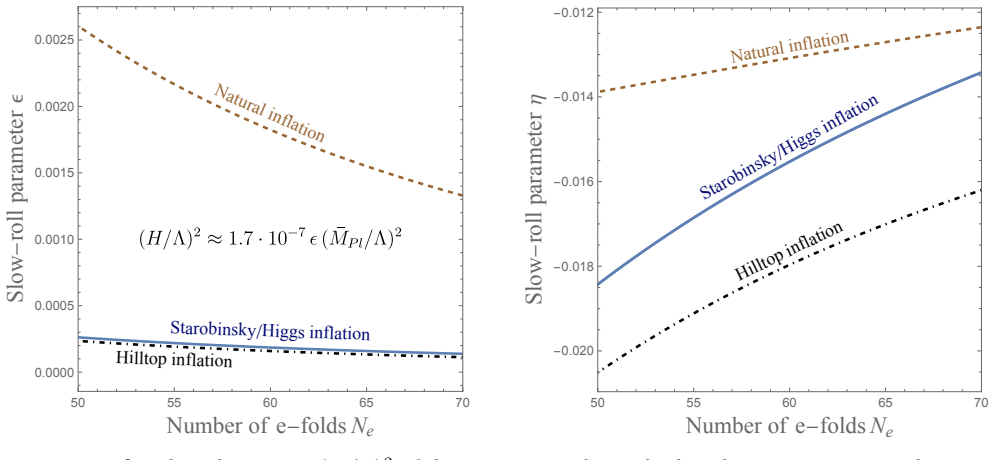
In the general low-energy effective theory of (multi-)field inflation, the Hilbert space and amplitudes of quantum perturbations are determined without relying on the sub-horizon limit. The scalar sector, featuring field mixings and second-class constraints, is treated using Dirac brackets. This enables estimation of the magnitude of higher-derivative corrections, which in slow-roll inflation can be expressed in terms of the first slow-roll parameter ε for a given cutoff Λ. The method is applied to several models with finite Λ such as Higgs inflation and the Starobinsky model.
What carries the argument
The Dirac bracket procedure for handling second-class constraints in the scalar sector with field mixings.
If this is right
- Higher-derivative corrections can be estimated in terms of the slow-roll parameter ε and cutoff Λ in slow-roll cases.
- The effective theory remains usable for quantizing perturbations in multi-field models without invoking the sub-horizon limit.
- Amplitudes in the scalar sector can be computed while properly accounting for field mixings and constraints.
- The validity of the low-energy description can be checked for specific models with finite cutoff such as natural inflation and hilltop inflation.
Where Pith is reading between the lines
- Similar constraint-handling techniques might connect to quantization issues in other cosmological settings where approximations break down.
- The method could be tested by including the estimated corrections in predictions for the primordial power spectrum and comparing to precision data.
- Extensions to non-slow-roll regimes might reveal whether the ε dependence generalizes or requires additional parameters.
Load-bearing premise
The low-energy effective Lagrangian remains a valid starting point for quantizing perturbations even when the sub-horizon approximation is dropped, and the Dirac-bracket procedure correctly captures all second-class constraints without introducing new inconsistencies at the cutoff scale.
What would settle it
A direct computation in one of the studied models, such as slow-roll Higgs inflation, showing that the estimated size of higher-derivative corrections exceeds order ε for the chosen cutoff Λ would falsify the estimate.
Figures

read the original abstract
Motivated by trans-Planckian issues in inflation, we determine the Hilbert space and amplitudes of quantum perturbations in the general low-energy effective theory of (multi-)field inflation without relying on the sub-horizon limit. The scalar sector is the most intricate, featuring field mixings and second-class constraints, which we handle using Dirac brackets. These results enable us to estimate the magnitude of higher-derivative corrections. In the specific case of slow-roll inflation, such estimate can be expressed in terms of the first slow-roll parameter $\epsilon$ for a given cutoff $\Lambda$. We apply our results to several inflationary models with finite $\Lambda$: Higgs inflation, the Starobinsky model, natural inflation and hilltop inflation.
Editorial analysis
A structured set of objections, weighed in public.
Referee Report
Summary. The manuscript constructs the Hilbert space and amplitudes of quantum perturbations in the general low-energy effective theory of (multi-)field inflation without invoking the sub-horizon limit. The scalar sector, which includes field mixings and second-class constraints, is quantized using Dirac brackets. This framework is used to estimate the size of higher-derivative corrections; in the slow-roll limit the estimate reduces to a dependence on the first slow-roll parameter ε at a given cutoff Λ. The results are applied to Higgs inflation, the Starobinsky model, natural inflation, and hilltop inflation.
Significance. If the central construction holds, the work supplies a technically consistent route to quantizing perturbations beyond the usual sub-horizon approximation and yields an explicit ε-dependent bound on higher-derivative effects in slow-roll. The explicit verification that the constraint algebra closes and that the commutation relations recover the standard Bunch-Davies form in the appropriate limit constitutes a clear strength. The approach is internally consistent within the stated regime and directly addresses trans-Planckian concerns without introducing new inconsistencies at the cutoff scale.
minor comments (2)
- [Abstract] Abstract: the functional dependence of the higher-derivative correction on ε is stated only qualitatively; an explicit expression (even schematic) would allow immediate assessment of the result's magnitude.
- The manuscript would benefit from a short table or paragraph summarizing the numerical size of the estimated correction for each of the four example models at a common reference value of Λ.
Simulated Author's Rebuttal
We thank the referee for the positive assessment of our work and the recommendation for minor revision. The report highlights the internal consistency of the constraint algebra closure and the recovery of the Bunch-Davies vacuum, which aligns with our goals. Since no specific major comments are raised in the report, we have no points requiring point-by-point rebuttal at this stage.
Circularity Check
No significant circularity
full rationale
The paper derives the Hilbert space and perturbation amplitudes directly from the general low-energy effective Lagrangian of multi-field inflation by applying the Dirac-bracket procedure to handle second-class constraints and field mixings. This construction is presented as self-contained within the effective theory, with the resulting commutation relations reducing to standard forms in appropriate limits and the O(ε) estimate for higher-derivative corrections at cutoff Λ following from the mode functions and cutoff scale in the slow-roll case. No equations or steps in the provided abstract or skeptic analysis reduce a claimed prediction to a fitted input, self-definition, or load-bearing self-citation chain; the central results are obtained from the starting Lagrangian without circular reduction to its own outputs. The derivation is therefore internally consistent and independent of the target quantities.
Axiom & Free-Parameter Ledger
Reference graph
Works this paper leans on
-
[1]
Planck 2015 results. XX. Constraints on inflation
P. A. R. Adeet al.[Planck Collaboration], “Planck 2015 results. XX. Constraints on inflation,” Astron. Astrophys.594(2016) A20 doi:10.1051/0004-6361/201525898 [arXiv:1502.02114]. Y. Akramiet al.[Planck Col- laboration], “Planck 2018 results. X. Constraints on inflation,” Astron. Astrophys.641(2020), A10 doi:10.1051/0004-6361/201833887 [arXiv:1807.06211]
work page internal anchor Pith review Pith/arXiv arXiv doi:10.1051/0004-6361/201525898 2015
-
[2]
The Atacama Cosmology Telescope: DR6 Power Spectra, Likelihoods and $\Lambda$CDM Parameters
T. Louiset al.[ACT], “The Atacama Cos- mology Telescope: DR6 Power Spectra, Likeli- hoods andΛCDM Parameters,” JCAP11, 062 (2025) doi:10.1088/1475-7516/2025/11/062 [arXiv:2503.14452]
work page internal anchor Pith review Pith/arXiv arXiv doi:10.1088/1475-7516/2025/11/062 2025
-
[3]
The Atacama Cosmology Telescope: DR6 Constraints on Extended Cosmological Models
E. Calabreseet al.[ACT], “The Atacama Cosmology Telescope: DR6 Constraints on Ex- tended Cosmological Models,” JCAP11, 063 (2025) doi:10.1088/1475-7516/2025/11/063 [arXiv:2503.14454]
work page internal anchor Pith review Pith/arXiv arXiv doi:10.1088/1475-7516/2025/11/063 2025
-
[4]
General relativity as an effective field theory: The leading quantum 25 corrections,
J. F. Donoghue, “General relativity as an effective field theory: The leading quantum 25 corrections,” Phys. Rev. D50(1994), 3874- 3888 doi:10.1103/PhysRevD.50.3874 [arXiv:gr- qc/9405057]
-
[5]
Quantum gravity as a low energy effective field theory ,
J. Donoghue, “Quantum gravity as a low energy effective field theory ,” Scholarpedia12(2017) no.4, 32997 doi:10.4249/scholarpedia.32997
-
[6]
Effective Field Theory for Inflation
S. Weinberg, “Effective Field Theory for Inflation,” Phys. Rev. D77(2008), 123541 doi:10.1103/PhysRevD.77.123541 [arXiv:0804.4291]
work page internal anchor Pith review Pith/arXiv arXiv doi:10.1103/physrevd.77.123541 2008
-
[7]
Effective Field Theory of Multi-Field Inflation a la Weinberg
N. Khosravi, “Effective Field Theory of Multi- Field Inflation a la Weinberg,” JCAP05(2012), 018 doi:10.1088/1475-7516/2012/05/018 [arXiv:1203.2266]
work page internal anchor Pith review Pith/arXiv arXiv doi:10.1088/1475-7516/2012/05/018 2012
-
[8]
The Trans-Planckian Problem of Inflationary Cosmology
J. Martin and R. H. Brandenberger, “The TransPlanckian problem of inflation- ary cosmology ,” Phys. Rev. D63(2001), 123501 doi:10.1103/PhysRevD.63.123501 [[arXiv:]arXiv:hep-th/0005209]
work page internal anchor Pith review Pith/arXiv arXiv doi:10.1103/physrevd.63.123501 2001
-
[9]
The Robustness of Inflation to Changes in Super-Planck-Scale Physics
R. H. Brandenberger and J. Martin, “The Robustness of inflation to changes in superPlanck scale physics,” Mod. Phys. Lett. A16(2001), 999-1006 doi:10.1142/S0217732301004170 [arXiv:astro-ph/0005432]
work page internal anchor Pith review Pith/arXiv arXiv doi:10.1142/s0217732301004170 2001
-
[10]
Unitarity problems for an effective field theory description of early universe cosmology ,
R. Brandenberger and V. Kamali, “Unitarity problems for an effective field theory description of early universe cosmology ,” Eur. Phys. J. C82 (2022) no.9, 818 doi:10.1140/epjc/s10052-022- 10783-2 [arXiv:2203.11548]
-
[11]
Assessing the scientific status of infla- tion after Planck,
D. Chowdhury , J. Martin, C. Ringeval and V. Vennin, “Assessing the scientific status of infla- tion after Planck,” Phys. Rev. D100(2019) no.8, 083537 doi:10.1103/PhysRevD.100.083537 [arXiv:1902.03951]
-
[12]
Cosmological Trans-Planckian Conjec- tures are not Effective,
C. P. Burgess, S. P. de Alwis and F. Quevedo, “Cosmological Trans-Planckian Conjec- tures are not Effective,” JCAP05(2021), 037 doi:10.1088/1475-7516/2021/05/037 [arXiv:2011.03069]
-
[14]
Cosmology ,
S. Weinberg, “Cosmology ,” Oxford University Press, Oxford, 2008
2008
-
[15]
The Standard Model Higgs boson as the inflaton
F. L. Bezrukov and M. Shaposhnikov, “The Standard Model Higgs boson as the inflaton,” Phys. Lett. B659(2008), 703- 706 doi:10.1016/j.physletb.2007.11.072 [arXiv:0710.3755]
work page internal anchor Pith review Pith/arXiv arXiv doi:10.1016/j.physletb.2007.11.072 2008
-
[16]
Multicomponent de Sitter (Inflationary) Stages and the Generation of Per- turbations,
A. A. Starobinsky , “Multicomponent de Sitter (Inflationary) Stages and the Generation of Per- turbations,” JETP Lett.42(1985), 152-155
1985
-
[17]
M. Sasaki and E. D. Stewart, “A General analytic formula for the spectral index of the density perturbations produced during inflation,” Prog. Theor. Phys.95(1996), 71-78 doi:10.1143/PTP.95.71 [arXiv:astro- ph/9507001]
-
[18]
T. T. Nakamura and E. D. Stewart, “The Spectrum of cosmological perturbations pro- duced by a multicomponent inflaton to second order in the slow roll approximation,” Phys. Lett. B381(1996), 413-419 doi:10.1016/0370- 2693(96)00594-1 [arXiv:astro-ph/9604103]
work page internal anchor Pith review Pith/arXiv arXiv doi:10.1016/0370- 1996
-
[19]
Adiabatic and entropy perturbations from inflation
C. Gordon, D. Wands, B. A. Bassett and R. Maartens, “Adiabatic and entropy perturba- tions from inflation,” Phys. Rev. D63(2000), 023506 doi:10.1103/PhysRevD.63.023506 [arXiv:astro-ph/0009131]
work page internal anchor Pith review Pith/arXiv arXiv doi:10.1103/physrevd.63.023506 2000
-
[20]
Multi-brid inflation and non-Gaussianity
M. Sasaki, “Multi-brid inflation and non-Gaussianity ,” Prog. Theor. Phys.120 (2008), 159-174 doi:10.1143/PTP.120.159 [arXiv:0805.0974]
work page internal anchor Pith review Pith/arXiv arXiv doi:10.1143/ptp.120.159 2008
-
[22]
Curvature perturbation in multi-field inflation with non-minimal coupling
J. White, M. Minamitsuji and M. Sasaki, “Curvature perturbation in multi-field inflation with non-minimal coupling,” JCAP07(2012), 039 doi:10.1088/1475-7516/2012/07/039 [arXiv:1205.0656]
work page internal anchor Pith review Pith/arXiv arXiv doi:10.1088/1475-7516/2012/07/039 2012
-
[23]
Primordial Bispectrum from Multifield Inflation with Nonminimal Couplings
D. I. Kaiser, E. A. Mazenc and E. I. Sfakianakis, “Primordial Bispectrum 26 from Multifield Inflation with Nonmini- mal Couplings,” Phys. Rev. D87(2013), 064004 doi:10.1103/PhysRevD.87.064004 [arXiv:1210.7487]
work page internal anchor Pith review Pith/arXiv arXiv doi:10.1103/physrevd.87.064004 2013
-
[24]
Multifield Inflation after Planck: The Case for Nonminimal Couplings
D. I. Kaiser and E. I. Sfakianakis, “Multifield Inflation after Planck: The Case for Nonminimal Couplings,” Phys. Rev. Lett.112(2014) no.1, 011302 doi:10.1103/PhysRevLett.112.011302 [arXiv:1304.0363]
work page internal anchor Pith review Pith/arXiv arXiv doi:10.1103/physrevlett.112.011302 2014
-
[26]
Theory of cosmological pertur- bations,
V. F. Mukhanov, H. A. Feldman and R. H. Bran- denberger, “Theory of cosmological pertur- bations,” Phys. Rept.215(1992), 203-333 doi:10.1016/0370-1573(92)90044-Z
-
[27]
Inflation with a Weyl term, or ghosts at work
N. Deruelle, M. Sasaki, Y. Sendouda and A. Youssef, “Inflation with a Weyl term, or ghosts at work,” JCAP03(2011), 040 doi:10.1088/1475-7516/2011/03/040 [arXiv:1012.5202]
work page internal anchor Pith review Pith/arXiv arXiv doi:10.1088/1475-7516/2011/03/040 2011
-
[28]
T. Maskawa and H. Nakajima, Prog. Theor. Phys. 56, 1295 (1976) doi:10.1143/PTP.56.1295
-
[29]
Hamiltonian formalism and gauge invariance for linear perturbations in in- flation,
D. Langlois, “Hamiltonian formalism and gauge invariance for linear perturbations in in- flation,” Class. Quant. Grav.11(1994), 389-407 doi:10.1088/0264-9381/11/2/011
-
[31]
Hamiltonian formalism and gauge-fixing conditions for cosmological pertur- bation theory ,
P. Małkiewicz, “Hamiltonian formalism and gauge-fixing conditions for cosmological pertur- bation theory ,” Class. Quant. Grav.36(2019) no.21, 215003 doi:10.1088/1361-6382/ab45aa [arXiv:1810.11621]
-
[32]
J. M. Lee,Introduction to Smooth Mani- folds, 2nd edition, (Springer, New York, 2013), doi:10.1007/978-1-4419-9982-5
-
[33]
L. Buoninfante, B. Knorr, K. S. Kumar, A. Pla- tania, D. Anselmi, I. Basile, N. E. J. Bjerrum- Bohr, R. Brandenberger, M. Carrillo Gonz ´alez and A. C. Davis,et al.“Visions in quantum gravity ,” doi:10.21468/SciPostPhysCommRep.11 [arXiv:2412.08696]
-
[34]
Softened Gravity and the Extension of the Standard Model up to Infinite Energy
G. F. Giudice, G. Isidori, A. Salvio and A. Stru- mia, “Softened Gravity and the Extension of the Standard Model up to Infinite Energy ,” JHEP 02(2015), 137 doi:10.1007/JHEP02(2015)137 [arXiv:1412.2769]
work page internal anchor Pith review Pith/arXiv arXiv doi:10.1007/jhep02(2015)137 2015
-
[35]
Solving the Standard Model Problems in Softened Gravity
A. Salvio, “Solving the Standard Model Prob- lems in Softened Gravity ,” Phys. Rev. D94(2016) no.9, 096007 doi:10.1103/PhysRevD.94.096007 [arXiv:1608.01194]
work page internal anchor Pith review Pith/arXiv arXiv doi:10.1103/physrevd.94.096007 2016
-
[36]
Low scale inflation and the curvaton mechanism
K. Dimopoulos, D. H. Lyth and Y. Rodriguez, “Low scale inflation and the curvaton mecha- nism,” JHEP02(2005), 055 doi:10.1088/1126- 6708/2005/02/055 [arXiv:hep-ph/0411119]
work page internal anchor Pith review Pith/arXiv arXiv doi:10.1088/1126- 2005
-
[38]
Measuring the duration of inflation with the curvaton
J. Torrado, C. T. Byrnes, R. J. Hard- wick, V. Vennin and D. Wands, “Mea- suring the duration of inflation with the curvaton,” Phys. Rev. D98(2018) no.6, 063525 doi:10.1103/PhysRevD.98.063525 [arXiv:1712.05364]
work page internal anchor Pith review Pith/arXiv arXiv doi:10.1103/physrevd.98.063525 2018
-
[39]
Curvaton in light of ACT results,
C. T. Byrnes, M. Cort ˆes and A. R. Liddle, “Curvaton in light of ACT results,” Phys. Rev. D113(2026) no.6, 063568 doi:10.1103/x43p- zm85 [arXiv:2505.09682]
-
[40]
A Possible new dimension at a few TeV,
I. Antoniadis, “A Possible new dimension at a few TeV,” Phys. Lett. B246(1990), 377-384 doi:10.1016/0370-2693(90)90617-F
-
[41]
A. Salvio and A. Strumia, “Agravity ,” JHEP 06(2014), 080 doi:10.1007/JHEP06(2014)080 [arXiv:1403.4226]
work page internal anchor Pith review Pith/arXiv arXiv doi:10.1007/jhep06(2014)080 2014
-
[42]
Agravity up to infinite energy
A. Salvio and A. Strumia, “Agravity up to infinite energy ,” Eur. Phys. J. C78(2018) no.2, 124 doi:10.1140/epjc/s10052-018-5588-4 [arXiv:1705.03896]
work page internal anchor Pith review Pith/arXiv arXiv doi:10.1140/epjc/s10052-018-5588-4 2018
-
[43]
Dimensional Transmuta- tion in Gravity and Cosmology ,
A. Salvio, “Dimensional Transmuta- tion in Gravity and Cosmology ,” Int. J. Mod. Phys. A36(2021) no.08n09, 2130006 doi:10.1142/S0217751X21300064 [arXiv:2012.11608]. 27
-
[44]
A non-perturbative and background-independent formulation of quadratic gravity ,
A. Salvio, “A non-perturbative and background-independent formulation of quadratic gravity ,” JCAP07(2024), 092 doi:10.1088/1475-7516/2024/07/092 [arXiv:2404.08034]
-
[45]
Weinberg, in Understanding the Funda- mental Constituents of Matter, ed
S. Weinberg, in Understanding the Funda- mental Constituents of Matter, ed. A. Zichichi (Plenum Press, New York, 1977). S. Weinberg, in General Relativity: An Einstein Centenary Sur- vey , edited by S. W. Hawking and W. Israel (Cam- bridge University Press, 1980) pp. 790-831
1977
-
[46]
An asymptotically safe guide to quantum gravity and matter,
A. Eichhorn, “An asymptotically safe guide to quantum gravity and matter,” Front. Astron. Space Sci.5 (2019), 47 doi:10.3389/fspas.2018.00047 [arXiv:1810.07615]
-
[47]
Asymptotic safety in higher-derivative gravity
D. Benedetti, P. F. Machado and F. Sauer- essig, “Asymptotic safety in higher-derivative gravity ,” Mod. Phys. Lett. A24, 2233-2241 (2009) doi:10.1142/S0217732309031521 [arXiv:0901.2984]
work page internal anchor Pith review Pith/arXiv arXiv doi:10.1142/s0217732309031521 2009
-
[48]
K. Falls, N. Ohta and R. Percacci, “To- wards the determination of the dimension of the critical surface in asymptotically safe gravity ,” Phys. Lett. B810, 135773 (2020) doi:10.1016/j.physletb.2020.135773 [arXiv:2004.04126]
-
[49]
E. D. Stewart and D. H. Lyth, “A More ac- curate analytic calculation of the spectrum of cosmological perturbations produced during in- flation,” Phys. Lett. B302(1993), 171-175 doi:10.1016/0370-2693(93)90379-V [arXiv:gr- qc/9302019]
-
[50]
A New Type of Isotropic Cosmological Models Without Singularity ,
A. A. Starobinsky , “A New Type of Isotropic Cosmological Models Without Singularity ,” Phys. Lett.91B(1980) 99
1980
-
[51]
A. Salvio, “Quadratic Gravity ,” Front. in Phys.6(2018), 77 doi:10.3389/fphy .2018.00077 [arXiv:1804.09944]
-
[52]
Power-counting and the Validity of the Classical Approximation During Inflation
C. P. Burgess, H. M. Lee and M. Trott, “Power- counting and the Validity of the Classical Approx- imation During Inflation,” JHEP0909(2009) 103 doi:10.1088/1126-6708/2009/09/103 [arXiv:0902.4465]. J. L. F. Barbon and J. R. Espinosa, “On the Naturalness of Higgs Inflation,” Phys. Rev. D79(2009) 081302 doi:10.1103/PhysRevD.79.081302 [arXiv:0903.0355]. M. P....
work page internal anchor Pith review Pith/arXiv arXiv doi:10.1088/1126-6708/2009/09/103 2009
-
[53]
Comment on Higgs Inflation and Naturalness
C. P. Burgess, H. M. Lee and M. Trott, “Comment on Higgs Inflation and Naturalness,” JHEP1007(2010) 007 doi:10.1007/JHEP07(2010)007 [arXiv:1002.2730]
work page internal anchor Pith review Pith/arXiv arXiv doi:10.1007/jhep07(2010)007 2010
-
[54]
Higgs inflation: consistency and generalisations
F. Bezrukov, A. Magnin, M. Shaposh- nikov and S. Sibiryakov, “Higgs inflation: consistency and generalisations,” JHEP01 (2011), 016 doi:10.1007/JHEP01(2011)016 [arXiv:1008.5157]
work page internal anchor Pith review Pith/arXiv arXiv doi:10.1007/jhep01(2011)016 2011
-
[55]
Higgs boson mass and new physics
F. Bezrukov, M. Y. Kalmykov, B. A. Kniehl and M. Shaposhnikov, “Higgs Boson Mass and New Physics,” JHEP10(2012), 140 doi:10.1007/JHEP10(2012)140 [arXiv:1205.2893]
work page internal anchor Pith review Pith/arXiv arXiv doi:10.1007/jhep10(2012)140 2012
-
[56]
Higgs inflation from Standard Model criticality
Y. Hamada, H. Kawai, K. y . Oda and S. C. Park, “Higgs inflation from Standard Model criticality ,” Phys. Rev. D91(2015), 053008 doi:10.1103/PhysRevD.91.053008 [arXiv:1408.4864]
work page internal anchor Pith review Pith/arXiv arXiv doi:10.1103/physrevd.91.053008 2015
-
[57]
Y. Hamada, H. Kawai, K. y . Oda and S. C. Park, “Higgs Inflation is Still Alive after the Results from BICEP2,” Phys. Rev. Lett.112(2014) no.24, 241301 doi:10.1103/PhysRevLett.112.241301 [arXiv:1403.5043]
work page internal anchor Pith review Pith/arXiv arXiv doi:10.1103/physrevlett.112.241301 2014
-
[58]
Higgs inflation at the critical point
F. Bezrukov and M. Shaposh- nikov, “Higgs inflation at the critical point,” Phys. Lett. B734(2014), 249- 254 doi:10.1016/j.physletb.2014.05.074 [arXiv:1403.6078]
work page internal anchor Pith review Pith/arXiv arXiv doi:10.1016/j.physletb.2014.05.074 2014
-
[59]
Classical and Quantum Initial Conditions for Higgs Inflation
A. Salvio and A. Mazumdar, “Classical and Quantum Initial Conditions for Higgs Inflation,” Phys. Lett. B750(2015), 194- 200 doi:10.1016/j.physletb.2015.09.020 [arXiv:1506.07520]
work page internal anchor Pith review Pith/arXiv arXiv doi:10.1016/j.physletb.2015.09.020 2015
-
[60]
Initial Conditions for Critical Higgs Inflation
A. Salvio, “Initial Conditions for Critical Higgs Inflation,” Phys. Lett. B780(2018), 111-117 doi:10.1016/j.physletb.2018.03.009 [arXiv:1712.04477]. 28
work page internal anchor Pith review Pith/arXiv arXiv doi:10.1016/j.physletb.2018.03.009 2018
-
[61]
Scalaron the healer: removing the strong-coupling in the Higgs- and Higgs-dilaton inflations
D. Gorbunov and A. Tokareva, “Scalaron the healer: removing the strong-coupling in the Higgs- and Higgs-dilaton infla- tions,” Phys. Lett. B788(2019), 37- 41 doi:10.1016/j.physletb.2018.11.015 [arXiv:1807.02392]
work page internal anchor Pith review Pith/arXiv arXiv doi:10.1016/j.physletb.2018.11.015 2019
-
[62]
Nat- ural Inflation with Pseudo - Nambu-Goldstone Bosons,
K. Freese, J. A. Frieman and A. V. Olinto, “Nat- ural Inflation with Pseudo - Nambu-Goldstone Bosons,” Phys. Rev. Lett.65(1990), 3233-3236 doi:10.1103/PhysRevLett.65.3233
-
[63]
F. C. Adams, J. R. Bond, K. Freese, J. A. Frieman and A. V. Olinto, “Natural infla- tion: Particle physics models, power law spec- tra for large scale structure, and constraints from COBE,” Phys. Rev. D47(1993), 426- 455 doi:10.1103/PhysRevD.47.426 [arXiv:hep- ph/9207245]
-
[66]
Scalar-tensor extension of Natural Inflation,
G. Simeon, “Scalar-tensor extension of Natural Inflation,” JCAP07(2020), 028 doi:10.1088/1475-7516/2020/07/028 [arXiv:2002.07625]
-
[68]
Quasi-Conformal Models and the Early Universe,
A. Salvio, “Quasi-Conformal Models and the Early Universe,” Eur. Phys. J. C79(2019) no.9, 750 doi:10.1140/epjc/s10052-019-7267-5 [arXiv:1907.00983]
-
[69]
BICEP/Keck data and quadratic gravity ,
A. Salvio, “BICEP/Keck data and quadratic gravity ,” JCAP09(2022), 027 doi:10.1088/1475-7516/2022/09/027 [arXiv:2202.00684]
-
[70]
Natural metric-affine inflation,
A. Racioppi and A. Salvio, “Natural metric-affine inflation,” JCAP06(2024), 033 doi:10.1088/1475-7516/2024/06/033 [arXiv:2403.18004]
-
[71]
Natural Metric- Affine Inflation,
A. Racioppi and A. Salvio, “Natural Metric- Affine Inflation,” doi:10.22323/1.474.0007
-
[72]
Natural Metric-Affine Inflation: Reloaded
D. Kraiko and A. Racioppi, “Natural Metric- Affine Inflation: Reloaded,” [arXiv:2605.23827]
work page internal anchor Pith review Pith/arXiv arXiv
-
[73]
P. A. R. Adeet al.[BICEP and Keck], “Im- proved Constraints on Primordial Gravitational Waves using Planck, WMAP, and BICEP/Keck Observations through the 2018 Observing Season,” Phys. Rev. Lett.127(2021) no.15, 151301 doi:10.1103/PhysRevLett.127.151301 [arXiv:2110.00483]
-
[78]
Minimal Theoretical Uncertainties in Inflationary Predictions
D. J. H. Chung, A. Notari and A. Ri- otto, “Minimal theoretical uncertainties in inflationary predictions,” JCAP10(2003), 012 doi:10.1088/1475-7516/2003/10/012 [arXiv:hep-ph/0305074]
work page internal anchor Pith review Pith/arXiv arXiv doi:10.1088/1475-7516/2003/10/012 2003
-
[79]
Choice of Quantum Vacuum for Inflation Observables
M. Wood-Saanaoui, R. O. Ramos and A. Berera, “Choice of Quantum Vacuum for Inflation Observables,” Symmetry18 (2026) no.3, 399 doi:10.3390/sym18030399 [arXiv:2602.22116]
work page internal anchor Pith review Pith/arXiv arXiv doi:10.3390/sym18030399 2026
-
[80]
Vacuum Choices and the Predictions of Inflation
C. Armendariz-Picon and E. A. Lim, “Vac- uum choices and the predictions of infla- tion,” JCAP12(2003), 006 doi:10.1088/1475- 7516/2003/12/006 [arXiv:hep-th/0303103]
work page internal anchor Pith review Pith/arXiv arXiv doi:10.1088/1475- 2003
-
[81]
Temperature of the inflaton and duration of inflation from WMAP 29 data,
K. Bhattacharya, S. Mohanty and R. Ran- garajan, “Temperature of the inflaton and duration of inflation from WMAP 29 data,” Phys. Rev. Lett.96(2006), 121302 doi:10.1103/PhysRevLett.96.121302 [arXiv:hep- ph/0508070]
-
[82]
A. Berera, “Warm inflation,” Phys. Rev. Lett.75(1995), 3218-3221 doi:10.1103/PhysRevLett.75.3218 [arXiv:astro- ph/9509049]
-
[83]
ACT-Planck data and phase transitions from a viable no-scale Standard Model completion,
F. Cutrona, F. Rescigno and A. Salvio, “ACT-Planck data and phase transitions from a viable no-scale Standard Model completion,” [arXiv:2603.24664]
-
[84]
Quantum Contributions to Cosmological Correlations
S. Weinberg, “Quantum contributions to cos- mological correlations,” Phys. Rev. D72(2005), 043514 doi:10.1103/PhysRevD.72.043514 [arXiv:hep-th/0506236]
work page internal anchor Pith review Pith/arXiv arXiv doi:10.1103/physrevd.72.043514 2005
-
[85]
Where does Cosmological Perturbation Theory Break Down?
C. Armendariz-Picon, M. Fontanini, R. Penco and M. Trodden, “Where does Cosmological Per- turbation Theory Break Down?,” Class. Quant. Grav.26(2009), 185002 doi:10.1088/0264- 9381/26/18/185002 [arXiv:0805.0114]
work page internal anchor Pith review Pith/arXiv arXiv doi:10.1088/0264- 2009
-
[86]
General Covariance Constraints on Cosmological Correlators
C. Armendariz-Picon, J. T. Neelakanta and R. Penco, “General Covariance Constraints on Cosmological Correlators,” JCAP01(2015), 035 doi:10.1088/1475-7516/2015/01/035 [arXiv:1411.0036]
work page internal anchor Pith review Pith/arXiv arXiv doi:10.1088/1475-7516/2015/01/035 2015
-
[87]
S. Weinberg, “The Cosmological Constant Problem,” Rev. Mod. Phys.61(1989), 1-23 doi:10.1103/RevModPhys.61.1
-
[88]
Dynamics of the generalized unimodular gravity the- ory ,
A. O. Barvinsky , N. Kolganov, A. Kurov and D. Nesterov, “Dynamics of the generalized unimodular gravity the- ory ,” Phys. Rev. D100(2019) no.2, 023542 doi:10.1103/PhysRevD.100.023542 [arXiv:1903.09897]
-
[89]
In- flation in generalized unimodular grav- ity ,
A. O. Barvinsky and N. Kolganov, “In- flation in generalized unimodular grav- ity ,” Phys. Rev. D100(2019) no.12, 123510 doi:10.1103/PhysRevD.100.123510 [arXiv:1908.05697]
-
[90]
Unimodular quadratic gravity and the cosmological constant,
A. Salvio, “Unimodular quadratic gravity and the cosmological constant,” Phys. Lett. B856(2024), 138920 doi:10.1016/j.physletb.2024.138920 [arXiv:2406.12958]. 30
discussion (0)
Sign in with ORCID, Apple, or X to comment. Anyone can read and Pith papers without signing in.