Compact Experimental Negative TriAngUlarity Reactor (CENTAUR): A design study for a compact, affordable breakeven tokamak
Pith reviewed 2026-06-29 15:00 UTC · model grok-4.3
The pith
A compact negative-triangularity tokamak design reaches 40 MW fusion power and scientific breakeven at $1.6 billion overnight cost.
A machine-rendered reading of the paper's core claim, the machinery that carries it, and where it could break.
Core claim
The CENTAUR design achieves a predicted total fusion power of 40MW and scientific energy gain of 1.3, with ballooning stability in the first regime, 13.5% radiated power fraction, heat loads below limits, magnet survival over design lifetime, and overnight cost of $1.6B±0.2B using a custom costing model.
What carries the argument
Negative triangularity geometry in the divertor region, which enables high radiated power fraction and first-regime ballooning stability while supporting compact high-field operation with REBCO coils.
If this is right
- Ballooning stability in the first regime supports expected ELM-free operation of negative-triangularity plasmas.
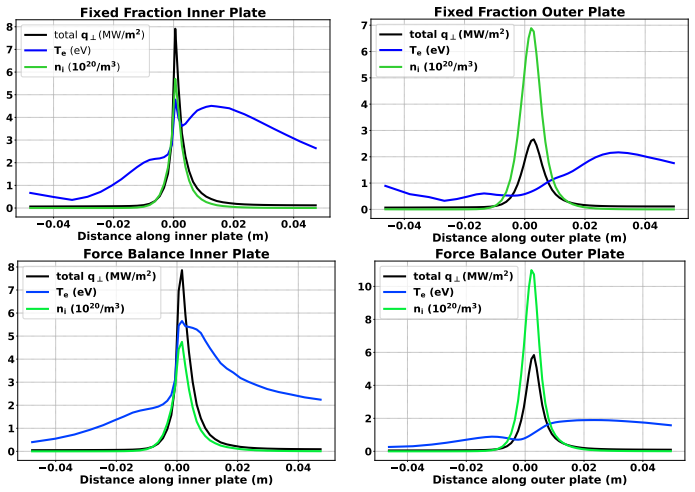
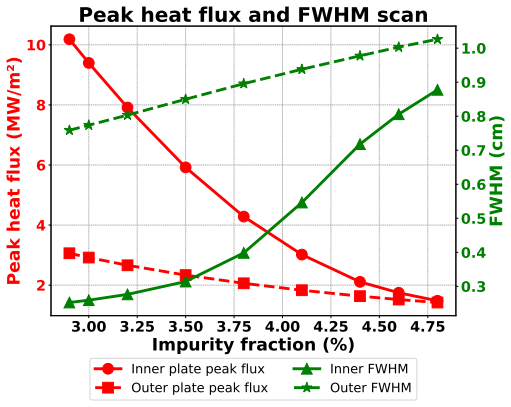
- The 13.5% radiated power fraction between separatrix and walls keeps heat loads on plasma-facing components below material limits.
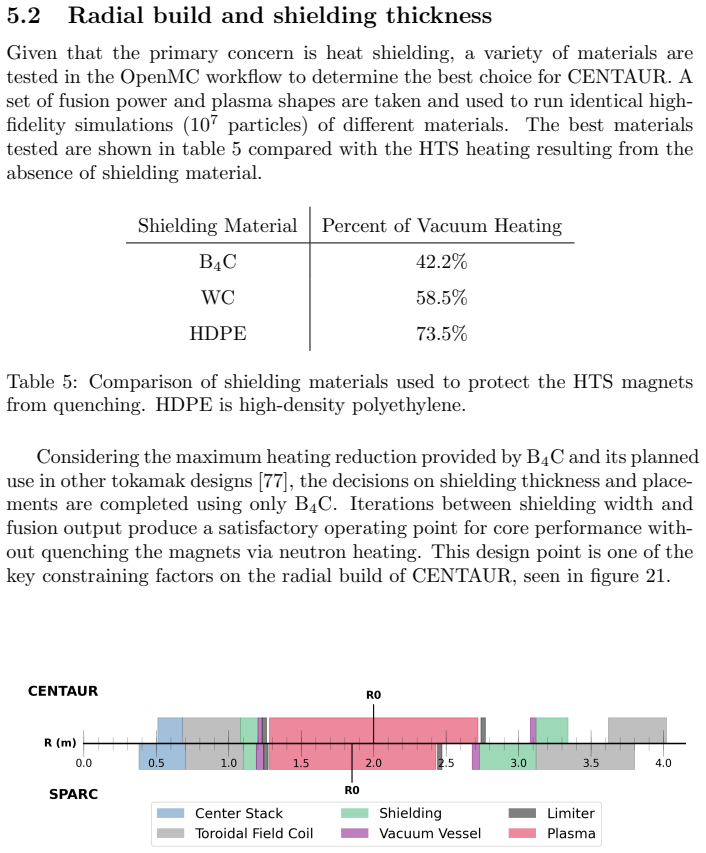
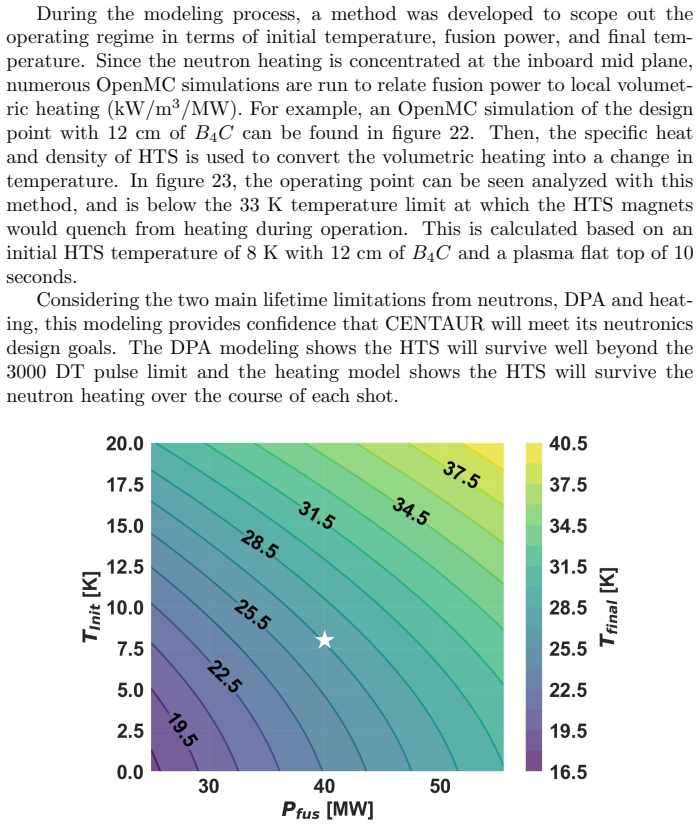
- The 12 cm B4C shield keeps superconducting magnet heating below the 33 K quench limit and allows survival more than ten times the 3000-pulse design lifetime.
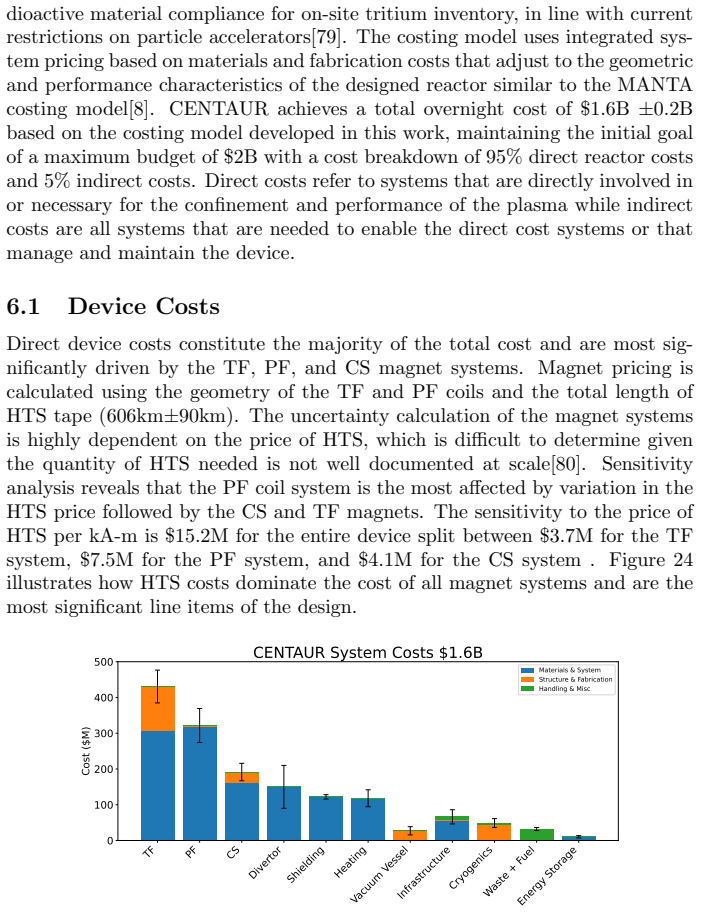
- The custom costing model iterated with the technical design yields an overnight cost of $1.6B ±0.2B that meets the $2B goal.
Where Pith is reading between the lines
- If the modeled negative-triangularity radiation and stability hold at scale, the same geometry could be used to shrink the size of higher-power devices.
- Early coupling of costing models to plasma and engineering choices may allow other tokamak concepts to stay within similar budget envelopes.
- Experimental tests of the NT divertor radiation fraction on existing machines would provide direct data to refine the heat-load predictions.
- Success at the modeled parameters would demonstrate that high-field REBCO magnets plus negative triangularity can lower the capital threshold for breakeven experiments.
Load-bearing premise
The ballooning stability calculations, edge heat transport simulations, neutronics analysis for the 12 cm B4C shield, and custom economic costing model accurately represent real-device behavior for this negative-triangularity geometry without unmodeled losses or cost overruns.
What would settle it
Construction and 10-second 40 MW DT operation of the device to measure whether actual fusion power reaches 40 MW with energy gain 1.3, heat loads stay below limits, magnets avoid quench, and total overnight costs remain within the modeled $1.6B ±0.2B range.
Figures
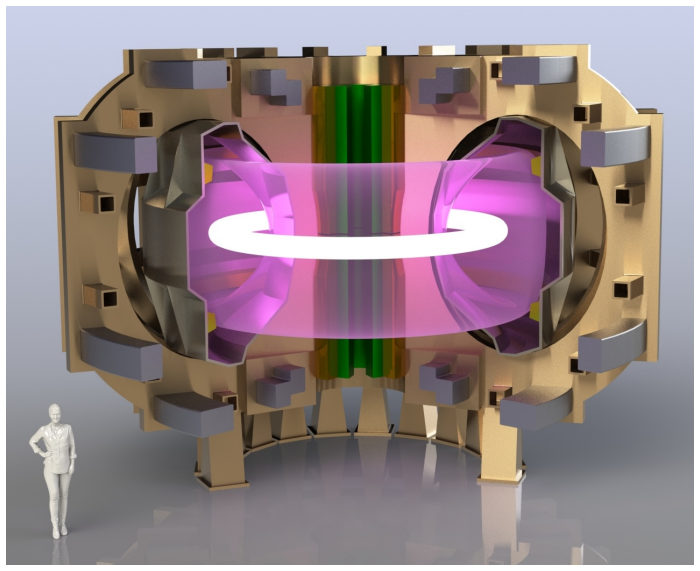
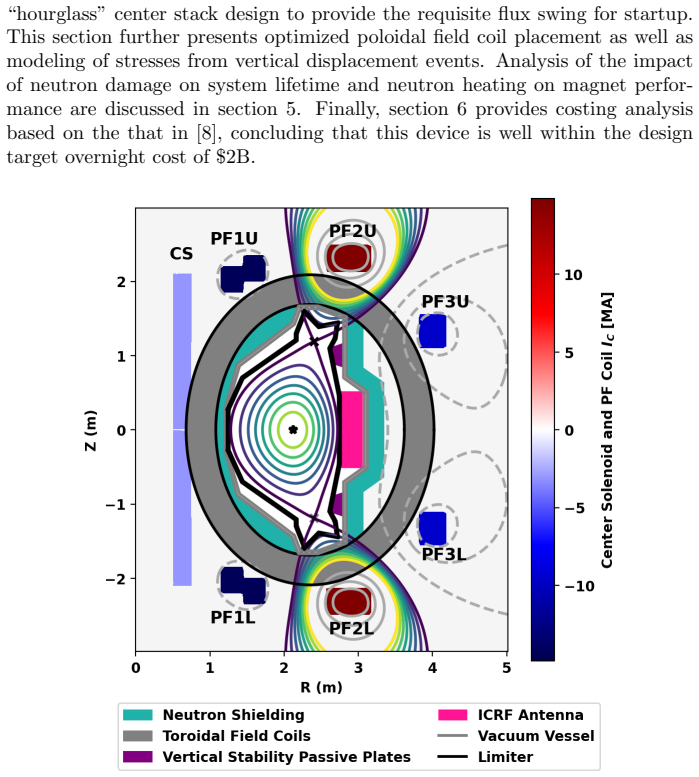
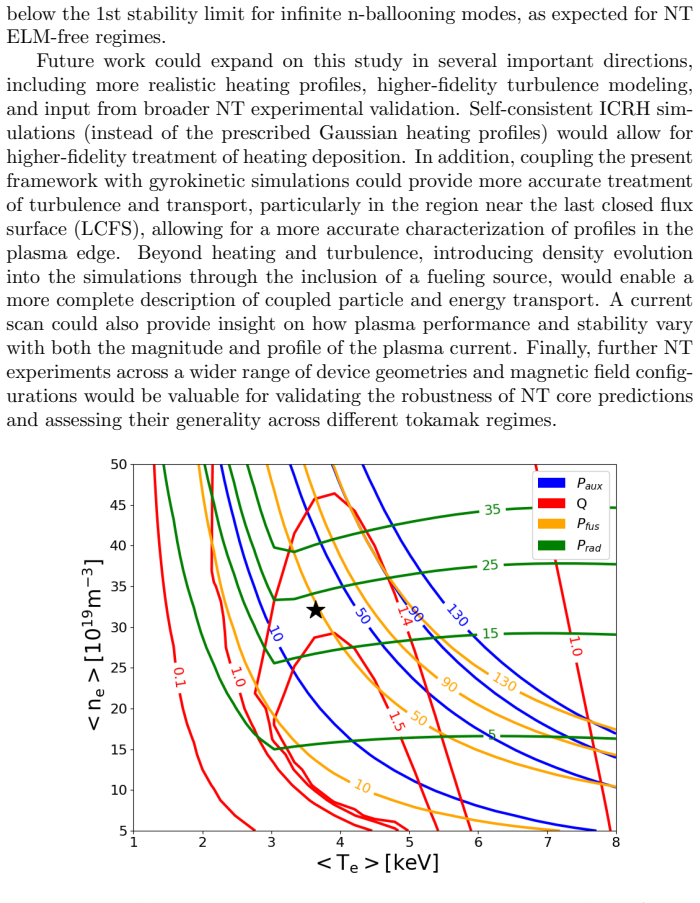
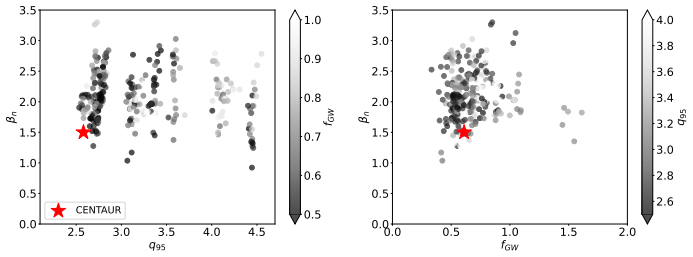


read the original abstract
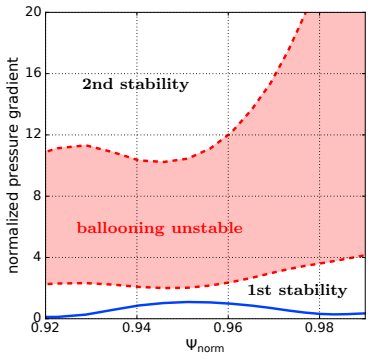
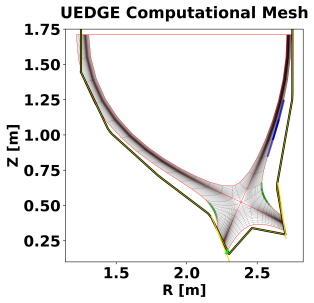
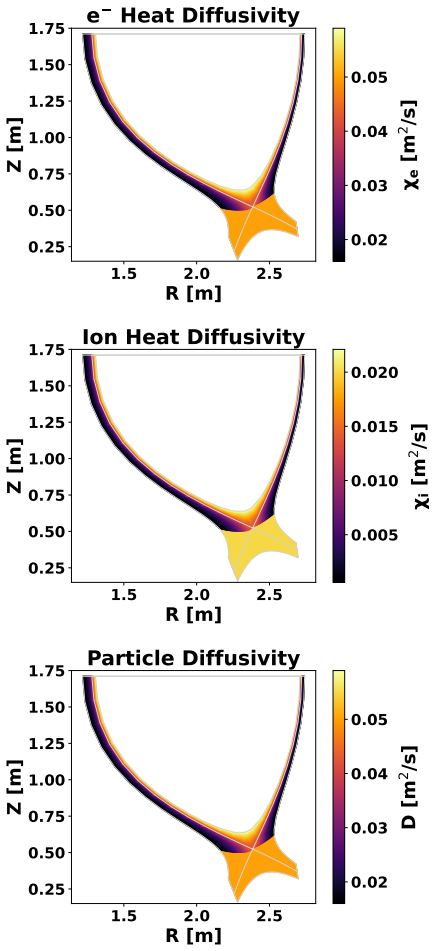
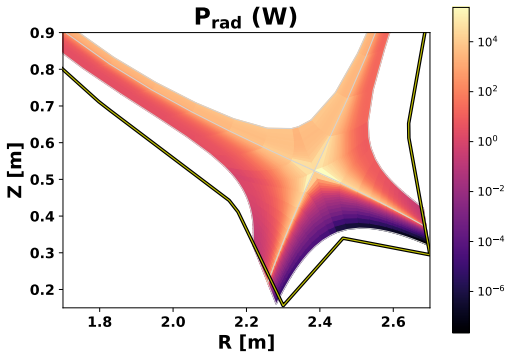
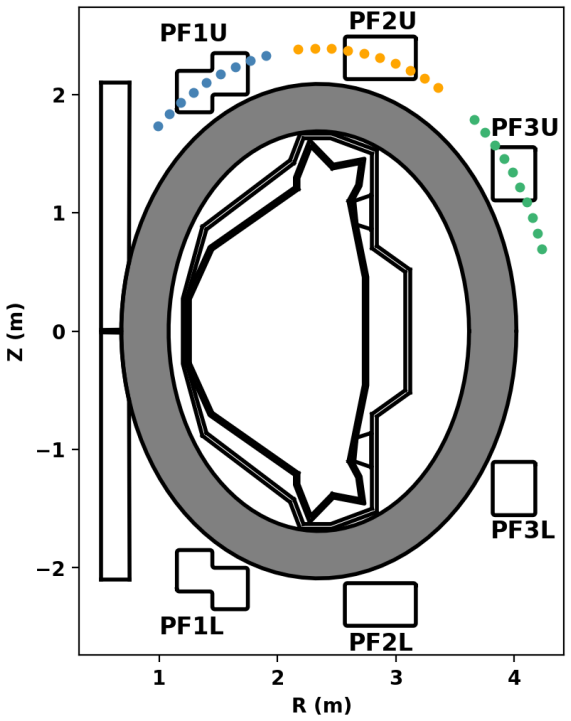
This work presents the compact experimental negative triangularity reactor (CENTAUR), a low overnight cost, high-field tokamak, breakeven reactor design, achieving a predicted total fusion power of 40MW and scientific energy gain of 1.3. Ballooning stability calculations confirm that the device's pedestal is within the first stability regime, which is consistent with the expected ELM-free operation associated with negative triangularity (NT) plasmas. The geometry of the NT divertor allows for high fraction of radiated power (13.5$\%$) between the separatrix and plasma facing components. Heat transport modeling based on simulations of the edge region show heat loads into plasma facing components well below material limits. The magnet system employs rare-earth barium copper oxide (REBCO) high-temperature superconductors in 18 toroidal field coils, an hourglass-shaped central solenoid, and six poloidal field coils to support high-field ($B_0=10.9$ T) plasma confinement, shaping, and current drive. Neutronics analysis shows that a 12 cm $B_4C$ shield keeps superconducting magnet heating below the 33~K quench limit during 10 s, 40 MW DT pulses. With this shielding, the modeled fluence indicates HTS components can survive more than ten times the 3000-pulse design lifetime. Iteration of economic analysis in tandem with the technical design process allows CENTAUR to achieve its overnight cost goal of $\$$2B determined using a custom costing model that predicts a total overnight cost of $1.6$B$\pm0.2$B.
Editorial analysis
A structured set of objections, weighed in public.
Referee Report
Summary. The manuscript presents a design study for the CENTAUR compact high-field negative-triangularity tokamak, claiming 40 MW total fusion power and scientific Q=1.3 at B0=10.9 T using REBCO magnets. It reports first-regime ballooning stability consistent with ELM-free NT operation, 13.5% radiated power fraction, edge heat loads below material limits from transport simulations, magnet survival over >10x the 3000-pulse lifetime with a 12 cm B4C shield, and an overnight cost of $1.6B±0.2B obtained via a custom economic model iterated with the technical design to meet a $2B target.
Significance. If the simulation chain and costing model prove accurate for this NT geometry, the work would demonstrate a viable low-cost pathway to breakeven using high-field HTS and NT for ELM-free operation, advancing compact reactor concepts. The integration of stability, transport, neutronics, and economic modeling is a positive feature of the study.
major comments (2)
- [Abstract] Abstract: the reported overnight cost of $1.6B±0.2B is obtained by iterating the custom costing model in tandem with the technical design to achieve the $2B goal; this process makes the cost prediction dependent on the model's internal parameters and iteration choices rather than an independent forecast anchored to external device benchmarks or scaling laws for NT at B0=10.9 T.
- [Stability/Transport/Neutronics sections] Ballooning stability, edge transport, and neutronics sections: the central performance claims (first-regime stability, 13.5% radiation, heat loads, and shield performance for 10 s 40 MW pulses) rest on a chain of simulations whose validation details, sensitivity to free parameters (B0, shield thickness), and applicability to this specific NT geometry at high field are not shown; without these, the predictions remain untested against real-device behavior.
minor comments (1)
- [Title] The stylized acronym 'TriAngUlarity' in the title is unconventional; consider standardizing to 'triangularity' for clarity.
Simulated Author's Rebuttal
We thank the referee for the detailed and constructive review. The comments highlight important aspects of how the cost model and simulation chain are presented. We address each major comment below and have revised the manuscript to improve clarity and transparency without altering the core technical claims.
read point-by-point responses
-
Referee: [Abstract] Abstract: the reported overnight cost of $1.6B±0.2B is obtained by iterating the custom costing model in tandem with the technical design to achieve the $2B goal; this process makes the cost prediction dependent on the model's internal parameters and iteration choices rather than an independent forecast anchored to external device benchmarks or scaling laws for NT at B0=10.9 T.
Authors: We agree that the reported cost results from an iterative process in which the technical parameters were adjusted in tandem with the economic model to meet the $2B target. This is standard practice in conceptual reactor design studies. The underlying costing model draws on component-level estimates and scaling relations from the literature, but the final figure is indeed goal-constrained. We have revised the abstract and the economic analysis section to state explicitly that the $1.6B±0.2B value is the outcome of a target-driven iteration rather than an unconstrained prediction. revision: yes
-
Referee: [Stability/Transport/Neutronics sections] Ballooning stability, edge transport, and neutronics sections: the central performance claims (first-regime stability, 13.5% radiation, heat loads, and shield performance for 10 s 40 MW pulses) rest on a chain of simulations whose validation details, sensitivity to free parameters (B0, shield thickness), and applicability to this specific NT geometry at high field are not shown; without these, the predictions remain untested against real-device behavior.
Authors: The stability, transport, and neutronics results were obtained with established codes whose validation on conventional tokamaks is documented in the literature. The first-regime ballooning stability for NT is consistent with published experimental observations on devices such as TCV. Nevertheless, the manuscript does not include explicit sensitivity scans with respect to B0 or shield thickness, nor a dedicated discussion of code applicability limits for high-field NT. We have added a new subsection summarizing the validation basis for each code, reporting sensitivity to the key free parameters, and noting the extrapolation uncertainties for the CENTAUR parameter regime. revision: yes
Circularity Check
Cost 'prediction' obtained by iterating custom model to meet $2B target; physics chain uses unanchored NT-specific simulations
specific steps
-
fitted input called prediction
[Abstract]
"Iteration of economic analysis in tandem with the technical design process allows CENTAUR to achieve its overnight cost goal of $2B determined using a custom costing model that predicts a total overnight cost of $1.6B±0.2B."
The model and design parameters are adjusted together until the $2B target is met; the reported $1.6B figure is therefore the output of that fitting loop rather than an independent forecast from external benchmarks or first-principles costing.
full rationale
The sole load-bearing circular step is the economic costing model, which is explicitly iterated in tandem with the design to achieve the $2B goal and then presented as predicting $1.6B. This matches the fitted-input-called-prediction pattern. Ballooning stability, edge transport, and neutronics results are simulation outputs rather than reductions to their own inputs by construction; no self-citation chains or ansatzes imported from prior author work are quoted in the provided text. The derivation is therefore partially circular but not fully forced by definition.
Axiom & Free-Parameter Ledger
free parameters (3)
- B0 on-axis field =
10.9 T
- Custom costing model parameters
- Shield thickness =
12 cm
axioms (2)
- domain assumption Ballooning stability calculations confirm first-regime operation consistent with ELM-free NT plasmas
- domain assumption Edge heat transport simulations accurately predict heat loads to PFCs
Forward citations
Cited by 1 Pith paper
-
The Negative Triangularity Tokamak Path for Fusion Pilot Plants: Experimental Progress and Future Prospects
Review of experimental progress indicating negative triangularity tokamaks achieve ELM-free high confinement with advantages in divertor wetted area, detachment compatibility, and operational robustness compared to po...
Reference graph
Works this paper leans on
-
[2]
A. O. Nelson et al. “Robust Avoidance of Edge-Localized Modes alongside Gradient Formation in the Negative Triangularity Tokamak Edge”. en. In:Physical Review Letters131.19 (Nov. 2023), p. 195101.issn: 0031- 9007, 1079-7114.doi:10.1103/PhysRevLett.131.195101.url:https: //link.aps.org/doi/10.1103/PhysRevLett.131.195101(visited on 05/02/2026)
work page doi:10.1103/physrevlett.131.195101.url:https: 2023
-
[3]
Diverted Negative Triangularity Plasmas on DIII- D: The Benefit of High Confinement without the Liability of an Edge Pedestal
M. E. Austin et al. “Diverted Negative Triangularity Plasmas on DIII- D: The Benefit of High Confinement without the Liability of an Edge Pedestal”. In:Nuclear Fusion61.11 (2021), p. 116016.doi:10 . 1088 / 1741 - 4326 / ac1f90.url:https : / / doi . org / 10 . 1088 / 1741 - 4326 / ac1f90
2021
-
[4]
Divertor heat flux challenge and mitigation in SPARC
A. Q. Kuang et al. “Divertor heat flux challenge and mitigation in SPARC”. en. In:Journal of Plasma Physics86.5 (Oct. 2020), p. 865860505.issn: 0022-3778, 1469-7807.doi:10.1017/S0022377820001117.url:https: //www.cambridge.org/core/journals/journal-of-plasma-physics/ article / divertor - heat - flux - challenge - and - mitigation - in - sparc/A25A8CFADBBA3...
-
[6]
T. Slendebroek et al. “Exploring the fusion power plant design space: com- parative analysis of positive and negative triangularity tokamaks through optimization”. In:Nuclear Fusion66.2 (2026).doi:10.1088/1741-4326/ ae27e6.url:https://doi.org/10.1088/1741-4326/ae27e6
-
[8]
MANTA: a negative-triangularity NASEM- compliant fusion pilot plant
The MANTA Collaboration et al. “MANTA: a negative-triangularity NASEM- compliant fusion pilot plant”. en. In:Plasma Physics and Controlled Fu- sion66.10 (Oct. 2024), p. 105006.issn: 0741-3335, 1361-6587.doi:10. 1088/1361-6587/ad6708.url:https://iopscience.iop.org/article/ 10.1088/1361-6587/ad6708(visited on 01/14/2026). 39
-
[9]
B.N. Sorbom et al. “ARC: A Compact, High-Field, Fusion Nuclear Sci- ence Facility and Demonstration Power Plant with Demountable Mag- nets”. In:Fusion Engineering and Design100 (Nov. 2015), pp. 378–405. issn: 09203796.doi:10.1016/j.fusengdes.2015.07.008. (Visited on 02/18/2024)
-
[10]
First access to ELM-free negative triangularity at low aspect ratio
A.O. Nelson et al. “First access to ELM-free negative triangularity at low aspect ratio”. en. In:Nuclear Fusion64.12 (Oct. 2024), p. 124004.issn: 0029-5515.doi:10.1088/1741-4326/ad89db.url:https://doi.org/ 10.1088/1741-4326/ad89db(visited on 02/10/2026)
work page doi:10.1088/1741-4326/ad89db.url:https://doi.org/ 2024
- [11]
-
[12]
C. Hansen et al. “TokaMaker: An open-source time-dependent Grad-Shafranov tool for the design and modeling of axisymmetric fusion devices”. In:Com- puter Physics Communications298 (May 2024), p. 109111.issn: 0010- 4655.doi:10.1016/j.cpc.2024.109111.url:http://dx.doi.org/10. 1016/j.cpc.2024.109111
work page doi:10.1016/j.cpc.2024.109111.url:http://dx.doi.org/10 2024
-
[13]
H-Mode Grade Confinement in L-mode Edge Plasmas at Negative Triangularity on DIII-D
A. Marinoni et al. “H-Mode Grade Confinement in L-mode Edge Plasmas at Negative Triangularity on DIII-D”. In:Physics of Plasmas26.4 (Apr. 2019), p. 042515.issn: 1070-664X.doi:10 . 1063 / 1 . 5091802. eprint: https : / / pubs . aip . org / aip / pop / article - pdf / doi / 10 . 1063 / 1 . 5091802/19778787/042515_1_online.pdf.url:https://doi.org/10. 1063/1.5091802
2019
-
[14]
Observationofanarrowpentaquarkstate𝑃 𝑐 (4312) +andoftwo-peakstructure of the𝑃 𝑐 (4450) +.Phys
M. E. Austin et al. “Achievement of Reactor-Relevant Performance in Negative Triangularity Shape in the DIII-D Tokamak”. In:Phys. Rev. Lett.122 (11 Mar. 2019), p. 115001.doi:10.1103/PhysRevLett.122. 115001.url:https://link.aps.org/doi/10.1103/PhysRevLett.122. 115001
-
[15]
Tom Body et al.cfs-energy/cfspopcon: v7.0.2. 2024
2024
-
[16]
Contour Analysis of Fusion Reactor Plasma Performance
W.A. Houlberg, S.E. Attenberger, and L.M. Hively. “Contour Analysis of Fusion Reactor Plasma Performance”. In:Nuclear Fusion22.7 (July 1982), p. 935.doi:10.1088/0029-5515/22/7/006.url:https://doi. org/10.1088/0029-5515/22/7/006
work page doi:10.1088/0029-5515/22/7/006.url:https://doi 1982
-
[17]
Automated System for TRansport Analysis in a tokamak
Gregorij V Pereverzev and e PN Yushmanov.ASTRA. Automated System for TRansport Analysis in a tokamak. 2002
2002
-
[18]
Gyro-Landau Fluid Equa- tions for Trapped and Passing Particles
G. M. Staebler, J. E. Kinsey, and R. E. Waltz. “Gyro-Landau Fluid Equa- tions for Trapped and Passing Particles”. In:Physics of Plasmas12.10 (Oct. 2005), p. 102508.issn: 1070-664X.doi:10.1063/1.2044587. eprint: https : / / pubs . aip . org / aip / pop / article - pdf / doi / 10 . 1063 / 1 . 2044587/14688354/102508_1_online.pdf.url:https://doi.org/10. 1063...
-
[19]
TokaMaker: An Open-Source Time-Dependent Grad- Shafranov Tool for the Design and Modeling of Axisymmetric Fusion De- vices
C. Hansen et al. “TokaMaker: An Open-Source Time-Dependent Grad- Shafranov Tool for the Design and Modeling of Axisymmetric Fusion De- vices”. In:Computer Physics Communications298 (2024), p. 109111.issn: 0010-4655.doi:10 . 1016 / j . cpc . 2024 . 109111.url:https : / / www . sciencedirect.com/science/article/pii/S0010465524000341
2024
-
[20]
A Fully Implicit, Time Dependent 2-D Fluid Code for Modeling Tokamak Edge Plasmas
T. D. Rognlien et al. “A Fully Implicit, Time Dependent 2-D Fluid Code for Modeling Tokamak Edge Plasmas”. In:Journal of Nuclear Materials. Plasma-Surface Interactions in Controlled Fusion Devices 196–198 (Dec. 1992), pp. 347–351.issn: 0022-3115.doi:10 . 1016 / S0022 - 3115(06 ) 80058- 9.url:https://www.sciencedirect.com/science/article/ pii/S002231150680...
1992
-
[21]
Stable Equilibria for Bootstrap-Current-Driven Low Aspect Ratio Tokamaks
R. L. Miller et al. “Stable Equilibria for Bootstrap-Current-Driven Low Aspect Ratio Tokamaks”. In:Physics of Plasmas4.4 (Apr. 1997), pp. 1062– 1068.issn: 1070-664X.doi:10.1063/1.872193. eprint:https://pubs. aip.org/aip/pop/article-pdf/4/4/1062/19079719/1062_1_online. pdf.url:https://doi.org/10.1063/1.872193
-
[22]
Overview of Results from the 2023 DIII-D Negative Triangularity Campaign
K E Thome et al. “Overview of Results from the 2023 DIII-D Negative Triangularity Campaign”. In:Plasma Physics and Controlled Fusion66.10 (Sept. 2024), p. 105018.doi:10.1088/1361-6587/ad6f40.url:https: //doi.org/10.1088/1361-6587/ad6f40
-
[24]
C. Paz-Soldan et al. “Simultaneous access to high normalized density, current, pressure, and confinement in strongly-shaped diverted negative triangularity plasmas”. en. In:Nuclear Fusion64.9 (Aug. 2024), p. 094002. issn: 0029-5515.doi:10.1088/1741-4326/ad69a4.url:https://doi. org/10.1088/1741-4326/ad69a4(visited on 04/03/2026)
-
[25]
ASTRA Automated System for TRansport Analysis in a Tokamak
G. Pereverzev and P. N. Yushmanov. “ASTRA Automated System for TRansport Analysis in a Tokamak”. In:Max Planck Institute for Plasma Physics, Garching, Germany(2002).url:https://pure.mpg.de/rest/ items/item_2138238/component/file_2138237/content
2002
-
[26]
E. Fable et al. “Novel free-boundary equilibrium and transport solver with theory-based models and its validation against ASDEX Upgrade current ramp scenarios”. In:Plasma Phys. Control. Fusion55.12 (2013), p. 124028.doi:10.1088/0741-3335/55/12/124028.url:https://dx. doi.org/10.1088/0741-3335/55/12/124028
work page doi:10.1088/0741-3335/55/12/124028.url:https://dx 2013
-
[27]
A theory-based transport model with comprehensive physicsa)
G. M. Staebler, J. E. Kinsey, and R. E. Waltz. “A theory-based transport model with comprehensive physicsa)”. In:Physics of Plasmas14.5 (2007), p. 055909.issn: 1070-664X.doi:10 . 1063 / 1 . 2436852.url:https : //doi.org/10.1063/1.2436852. 41
-
[28]
Examining transport and integrated modeling predictive capabilities for negative-triangularity scenarios
J McClenaghan et al. “Examining transport and integrated modeling predictive capabilities for negative-triangularity scenarios”. In:Plasma Physics and Controlled Fusion66.11 (2024), p. 115008
2024
-
[31]
First-Principle Based Predictions of the Effects of Neg- ative Triangularity on DTT Scenarios
A. Mariani et al. “First-Principle Based Predictions of the Effects of Neg- ative Triangularity on DTT Scenarios”. In:Nuclear Fusion64.4 (Feb. 2024), p. 046018.doi:10.1088/1741-4326/ad2abc.url:https://doi. org/10.1088/1741-4326/ad2abc
-
[33]
Guizzo et al.Assessment of vertical stability for negative triangularity pilot plants
S. Guizzo et al.Assessment of vertical stability for negative triangularity pilot plants. en. arXiv:2401.15217 [physics]. Jan. 2024.doi:10 . 48550 / arXiv.2401.15217.url:http://arxiv.org/abs/2401.15217(visited on 03/23/2026)
-
[34]
A.O. Nelson et al. “Implications of vertical stability control on the SPARC tokamak”. en. In:Nuclear Fusion64.8 (June 2024), p. 086040.issn: 0029- 5515.doi:10.1088/1741- 4326/ad58f6.url:https://doi.org/10. 1088/1741-4326/ad58f6(visited on 04/01/2026)
-
[35]
Charlie Sanabria et al. “Development of a high current density, high temperature superconducting cable for pulsed magnets”. en. In:Super- conductor Science and Technology37.11 (Nov. 2024), p. 115010.issn: 0953-2048, 1361-6668.doi:10.1088/1361- 6668/ad7efc.url:https: //iopscience.iop.org/article/10.1088/1361-6668/ad7efc(visited on 01/14/2026)
-
[36]
K. Krieger et al. “Scrape-off layer and divertor physics: Chapter 5 of the special issue: on the path to tokamak burning plasma operation”. In:Nuclear Fusion65.4 (Mar. 2025), p. 043001.doi:10 . 1088 / 1741 - 4326/adaf42.url:https://doi.org/10.1088/1741-4326/adaf42
-
[37]
Department of Energy.Report on Science Challenges and Research Opportunities in Plasma Materials Interactions
U.S. Department of Energy.Report on Science Challenges and Research Opportunities in Plasma Materials Interactions. Technical Report. Wash- ington, DC, USA: U.S. Department of Energy, 2015. 42
2015
-
[38]
P. C. Stangeby.The Plasma Boundary of Magnetic Fusion Devices. Insti- tute of Physics Publishing, 2000
2000
-
[39]
Plasma Detachment in JET Mark I Divertor Exper- iments
A. Loarte et al. “Plasma Detachment in JET Mark I Divertor Exper- iments”. In:Nuclear Fusion38.3 (Mar. 1998), p. 331.issn: 0029-5515. doi:10.1088/0029-5515/38/3/303. (Visited on 04/03/2026)
-
[40]
Plasma detachment in divertor tokamaks
A. W. Leonard. “Plasma detachment in divertor tokamaks”. In:Plasma Physics and Controlled Fusion(2018).doi:10.1088/1361-6587/aaa7a9
-
[41]
Physics of ultimate detachment of a tokamak di- vertor plasma
S. I. Krasheninnikov. “Physics of ultimate detachment of a tokamak di- vertor plasma”. In:Journal of Plasma Physics(2017)
2017
-
[42]
Recent progress of plasma exhaust con- cepts and divertor designs for tokamak DEMO reactors
N. Asakura, K. Hoshino, et al. “Recent progress of plasma exhaust con- cepts and divertor designs for tokamak DEMO reactors”. In:Nuclear Ma- terials and Energy(2023).doi:10.1016/j.nme.2023.101446
-
[43]
Plasma–material interactions in current toka- maks and their implications for next step devices
G. Federici and C. Skinner. “Plasma–material interactions in current toka- maks and their implications for next step devices”. In:Journal of Nuclear Materials(2001). Review of underlying physical processes and experimen- tal database
2001
-
[44]
Chapter 5: Physics of the ITER divertor
R. A. Pitts et al. “Chapter 5: Physics of the ITER divertor”. In:Nuclear Fusion47.6 (2007), S143–S194.doi:10 . 1088 / 0029 - 5515 / 47 / 6 / S05. url:https://doi.org/10.1088/0029-5515/47/6/S05
-
[45]
Scaling of the tokamak near the scrape-off layer H-mode power width and implications for ITER
T. Eich et al. “Scaling of the tokamak near the scrape-off layer H-mode power width and implications for ITER”. In:Nuclear Fusion53.9 (2013), p. 093031.doi:10.1088/0029-5515/53/9/093031.url:https://doi. org/10.1088/0029-5515/53/9/093031
work page doi:10.1088/0029-5515/53/9/093031.url:https://doi 2013
-
[46]
Scaling of the tokamak scrape-off layer power fall-off length in L-mode plasmas
A. Scarabosio et al. “Scaling of the tokamak scrape-off layer power fall-off length in L-mode plasmas”. In:Nuclear Fusion53.11 (2013), p. 113002. doi:10.1088/0029-5515/53/11/113002.url:https://doi.org/10. 1088/0029-5515/53/11/113002
work page doi:10.1088/0029-5515/53/11/113002.url:https://doi.org/10 2013
-
[47]
T. D. Rognlien and M. E. Rensink.Users manual for the UEDGE edge- plasma transport code. LLNL Report, 2023.url:https://github.com/ llnl/UEDGE/releases/tag/v8.1.1-patch.0
2023
-
[48]
C. Hansen et al. “TokaMaker: An open-source time-dependent Grad-Shafranov tool for the design and modeling of axisymmetric fusion devices”. en. In:Computer Physics Communications298 (May 2024), p. 109111.issn: 00104655.doi:10.1016/j.cpc.2024.109111.url:https://linkinghub. elsevier.com/retrieve/pii/S0010465524000341(visited on 01/16/2026)
work page doi:10.1016/j.cpc.2024.109111.url:https://linkinghub 2024
-
[49]
Impurity Transport at Arbitrary Densities in the Divertor Plasma
Yu. L. Igitkhanov. “Impurity Transport at Arbitrary Densities in the Divertor Plasma”. In:Contributions to Plasma Physics28.4-5 (1988), pp. 477–482.doi:https : / / doi . org / 10 . 1002 / ctpp . 2150280435. eprint:https://onlinelibrary.wiley.com/doi/pdf/10.1002/ctpp. 2150280435.url:https://onlinelibrary.wiley.com/doi/abs/10. 1002/ctpp.2150280435. 43
-
[50]
Divertor characterization and access to dissipative diver- tor conditions in negative triangularity discharges in DIII-D
F Scotti et al. “Divertor characterization and access to dissipative diver- tor conditions in negative triangularity discharges in DIII-D”. In:Plasma Physics and Controlled Fusion67.9 (2025), p. 095030.doi:10 . 1088 / 1361 - 6587 / adf881.url:https : / / doi . org / 10 . 1088 / 1361 - 6587 / adf881
2025
-
[51]
Sputtering of beryllium, tungsten, tungsten oxide and mixed W–C layers by deuterium ions in the near-threshold energy range
M.I Guseva et al. “Sputtering of beryllium, tungsten, tungsten oxide and mixed W–C layers by deuterium ions in the near-threshold energy range”. In:Journal of Nuclear Materials266-269 (1999), pp. 222–227.issn: 0022- 3115.doi:https : / / doi . org / 10 . 1016 / S0022 - 3115(98 ) 00819 - 8. url:https : / / www . sciencedirect . com / science / article / pii...
1999
-
[52]
Deuterium retention in single-crystal tungsten irradi- ated with 10–500 eV/D+
J.P. Roszell et al. “Deuterium retention in single-crystal tungsten irradi- ated with 10–500 eV/D+”. In:Journal of Nuclear Materials438 (2013). Proceedings of the 20th International Conference on Plasma-Surface Inter- actions in Controlled Fusion Devices, S1084–S1087.issn: 0022-3115.doi: https://doi.org/10.1016/j.jnucmat.2013.01.238.url:https:// www.scien...
work page doi:10.1016/j.jnucmat.2013.01.238.url:https:// 2013
-
[53]
Scalar field vacuum expectation value in- duced by gravitational wave background
Q. Zhang et al. “Spectroscopic investigation of the tungsten deuteride sputtering in the EAST divertor”. In:Nuclear Materials and Energy33 (2022), p. 101265.issn: 2352-1791.doi:https://doi.org/10.1016/j. nme.2022.101265.url:https://www.sciencedirect.com/science/ article/pii/S2352179122001466
work page doi:10.1016/j 2022
-
[54]
A Review of Radiative Detachment Studies in Toka- mak Advanced Magnetic Divertor Configurations
V A Soukhanovskii. “A Review of Radiative Detachment Studies in Toka- mak Advanced Magnetic Divertor Configurations”. In:Plasma Physics and Controlled Fusion59.6 (Apr. 2017), p. 064005.issn: 0741-3335.doi: 10.1088/1361-6587/aa6959. (Visited on 04/08/2026)
-
[55]
Stangeby.The Plasma Boundary of Magnetic Fusion Devices
Peter C. Stangeby.The Plasma Boundary of Magnetic Fusion Devices. Plasma Physics Series. Bristol [ u.a. ]: Institute of Physics Publ, 2000. isbn: 978-0-7503-0559-4
2000
-
[56]
M. Faitsch et al. “Broadening of the Power Fall-off Length in a High Den- sity, High Confinement H-mode Regime in ASDEX Upgrade”. In:Nuclear Materials and Energy26 (Mar. 2021), p. 100890.issn: 2352-1791.doi: 10.1016/j.nme.2020.100890. (Visited on 04/08/2026)
-
[57]
J. Ren et al. “Experimental Observation of Heat Flux Mitigation during Divertor Detachment in the DIII-D Small Angle Slot Divertor”. In:Nu- clear Materials and Energy26 (Mar. 2021), p. 100887.issn: 2352-1791. doi:10.1016/j.nme.2020.100887. (Visited on 04/08/2026)
-
[58]
Divertor Heat Flux Reduction and Detachment in NSTX
V A Soukhanovskii et al. “Divertor Heat Flux Reduction and Detachment in NSTX”. In: ()
-
[59]
Integration of Full Divertor Detachment with Improved Core Confinement for Tokamak Fusion Plasmas
L. Wang et al. “Integration of Full Divertor Detachment with Improved Core Confinement for Tokamak Fusion Plasmas”. In:Nature Communica- tions12.1 (Mar. 2021), p. 1365.issn: 2041-1723.doi:10.1038/s41467- 021-21645-y. (Visited on 04/08/2026). 44
-
[60]
Physics basis for the first ITER tungsten divertor
R.A. Pitts et al. “Physics basis for the first ITER tungsten divertor”. en. In:Nuclear Materials and Energy20 (Aug. 2019), p. 100696.issn: 23521791.doi:10.1016/j.nme.2019.100696.url:https://linkinghub. elsevier.com/retrieve/pii/S2352179119300237(visited on 03/05/2026)
work page doi:10.1016/j.nme.2019.100696.url:https://linkinghub 2019
-
[61]
Recrystallization and grain growth induced by ELMs- like transient heat loads in deformed tungsten samples
A. Suslova et al. “Recrystallization and grain growth induced by ELMs- like transient heat loads in deformed tungsten samples”. en. In:Scien- tific Reports4.1 (Nov. 2014), p. 6845.issn: 2045-2322.doi:10 . 1038 / srep06845.url:https://www.nature.com/articles/srep06845(vis- ited on 02/16/2026)
2014
-
[62]
The SPARC Toroidal Field Model Coil Pro- gram
Zachary S. Hartwig et al. “The SPARC Toroidal Field Model Coil Pro- gram”. In:IEEE Transactions on Applied Superconductivity34.2 (Mar. 2024), pp. 1–16.issn: 1558-2515.doi:10 . 1109 / TASC . 2023 . 3332613. url:https://ieeexplore.ieee.org/document/10316582/(visited on 01/14/2026)
-
[63]
Experimental Assessment and Model Validation of the SPARC Toroidal Field Model Coil
D G Whyte et al. “Experimental Assessment and Model Validation of the SPARC Toroidal Field Model Coil”. en. In:IEEE TRANSACTIONS ON APPLIED SUPERCONDUCTIVITY34.2 (2024)
2024
-
[64]
Development and large volume production of extremely high current density YBa2Cu3O7 superconducting wires for fusion
A. Molodyk et al. “Development and large volume production of extremely high current density YBa2Cu3O7 superconducting wires for fusion”. en. In:Scientific Reports11.1 (Jan. 2021), p. 2084.issn: 2045-2322.doi:10. 1038/s41598-021-81559-z.url:https://www.nature.com/articles/ s41598-021-81559-z(visited on 01/14/2026)
2021
-
[65]
Critical Current Densities of 482 A/mm 2 in HTS CrossConductors at 4.2 K and 12 T
Michael J. Wolf et al. “Critical Current Densities of 482 A/mm 2 in HTS CrossConductors at 4.2 K and 12 T”. en. In:IEEE Transactions on Ap- plied Superconductivity28.4 (June 2018), pp. 1–4.issn: 1051-8223, 1558- 2515.doi:10.1109/TASC.2018.2815767.url:https://ieeexplore. ieee.org/document/8316945/(visited on 02/12/2026)
work page doi:10.1109/tasc.2018.2815767.url:https://ieeexplore 2018
-
[66]
Large Superconducting Magnet Designs for Fusion Reactors
J. File, R. G. Mills, and G. V. Sheffield. “Large Superconducting Magnet Designs for Fusion Reactors”. In:IEEE Transactions on Nuclear Science 18.4 (Aug. 1971), pp. 277–282.issn: 1558-1578.doi:10.1109/TNS.1971. 4326354.url:https : / / ieeexplore . ieee . org / document / 4326354 (visited on 01/14/2026)
-
[67]
Plasma Design Considerations of Near Term Tokamak Fusion Experimental Reactor
Masayoshi SUGIHARA et al. “Plasma Design Considerations of Near Term Tokamak Fusion Experimental Reactor”. In:Journal of Nuclear Sci- ence and Technology19.8 (Aug. 1982). eprint: https://doi.org/10.1080/18811248.1982.9734193, pp. 628–637.issn: 0022-3131.doi:10.1080/18811248.1982.9734193. url:https://doi.org/10.1080/18811248.1982.9734193(visited on 01/14/2026)
-
[68]
Pri- vate communication
Jim Leuer.Ramp-Up Flux Consumption of +- Triangularity Plasmas. Pri- vate communication. May 2020. 45
2020
-
[69]
Electro- mechanical properties of REBCO coated conductors from various indus- trial manufacturers at 77 K, self-field and 4.2 K, 19 T
Christian Barth, Giorgio Mondonico, and Carmine Senatore. “Electro- mechanical properties of REBCO coated conductors from various indus- trial manufacturers at 77 K, self-field and 4.2 K, 19 T”. In:Superconductor Science and Technology28.4 (2015), p. 045011.doi:10 . 1088 / 0953 - 2048/28/4/045011
2015
-
[70]
N.W. Eidietis et al. “The ITPA disruption database”. en. In:Nuclear Fusion55.6 (May 2015), p. 063030.issn: 0029-5515.doi:10.1088/0029- 5515/55/6/063030.url:https://doi.org/10.1088/0029-5515/55/6/ 063030(visited on 01/16/2026)
-
[71]
Fatigue behavior of Austenitic Type 316L Stain- less Steel
K A Mohammad et al. “Fatigue behavior of Austenitic Type 316L Stain- less Steel”. en. In:IOP Conference Series: Materials Science and Engi- neering36 (Sept. 2012), p. 012012.issn: 1757-899X.doi:10.1088/1757- 899X/36/1/012012.url:https://iopscience.iop.org/article/10. 1088/1757-899X/36/1/012012(visited on 03/22/2026)
-
[72]
Christopher Hansen et al. “ThinCurr: An open-source 3D thin-wall eddy current modeling code for the analysis of large-scale systems of conducting structures”. In:Computer Physics Communications315 (2025), p. 109713. issn: 0010-4655.doi:https://doi.org/10.1016/j.cpc.2025.109713. url:https : / / www . sciencedirect . com / science / article / pii / S0010465...
-
[73]
OpenMC: A state-of-the-art Monte Carlo code for research and development
Paul K. Romano et al. “OpenMC: A state-of-the-art Monte Carlo code for research and development”. In:Annals of Nuclear Energy82 (2015), pp. 90–97.doi:10.1016/j.anucene.2014.07.048.url:https://doi. org/10.1016/j.anucene.2014.07.048
work page doi:10.1016/j.anucene.2014.07.048.url:https://doi 2015
-
[74]
D. X. Fischer et al. “The effect of fast neutron irradiation on the su- perconducting properties of REBCO coated conductors with and without artificial pinning centers”. In:Superconductor Science and Technology31.4 (2018), p. 044006.doi:10.1088/1361-6668/aaadf2
-
[75]
ARC: A compact, high-field, fusion nuclear science facility and demonstration power plant with demountable magnets
B. N. Sorbom et al. “ARC: A compact, high-field, fusion nuclear science facility and demonstration power plant with demountable magnets”. In: Fusion Engineering and Design100 (2015), pp. 378–405.doi:10.1016/ j.fusengdes.2015.07.008
2015
-
[76]
A. J. Creely et al. “Overview of the SPARC tokamak”. In:Journal of Plasma Physics86.5 (2020), p. 865860502.doi:10.1017/S0022377820001257
-
[77]
An OpenMC model of the SPARC tokamak for the di- agnostic scoping studies
X. Wang et al. “An OpenMC model of the SPARC tokamak for the di- agnostic scoping studies”. In:Fusion Engineering and Design221 (2025), p. 115390.issn: 0920-3796.doi:https://doi.org/10.1016/j.fusengdes. 2025.115390.url:https://www.sciencedirect.com/science/article/ pii/S0920379625005861. 46
-
[78]
Overview of the SPARC Physics Basis towards the Exploration of Burning-Plasma Regimes in High-Field, Com- pact Tokamaks
P. Rodriguez-Fernandez et al. “Overview of the SPARC Physics Basis towards the Exploration of Burning-Plasma Regimes in High-Field, Com- pact Tokamaks”. In:Nuclear Fusion62.4 (Sept. 2022), p. 042003.issn: 0029-5515, 1741-4326.doi:10 . 1088 / 1741 - 4326 / ac1654. (Visited on 10/21/2024)
2022
-
[79]
United States Congress.Energy Policy Act of 2005. H.R. 6, 109th Cong. (Aug. 8, 2005), became Public Law 109-58. U.S. Government Printing Office, 2005.url:https://www.congress.gov/bill/109th-congress/ house-bill/6
2005
-
[80]
Grant and Thomas P
Paul M. Grant and Thomas P. Sheahen.Cost Projections for High Tem- perature Superconductors. Tech. rep. EPRI, Palo Alto, CA 94304; SAIC, Gaithersburg, MD 20878. Palo Alto, CA and Gaithersburg, MD: Electric Power Research Institute (EPRI) and Science Applications International Corporation (SAIC), 2002
2002
-
[81]
Westinghouse Wins$180 Million Contract For Assembly Of ITER Vacuum Vessel
David Dalton. “Westinghouse Wins$180 Million Contract For Assembly Of ITER Vacuum Vessel”. In:NucNet(July 2025). Accessed: 2026-02-10. url:https://www.nucnet.org/news/westinghouse- wins- usd180- million - contract - for - assembly - of - iter - vacuum - vessel - 7 - 3 - 2025
2025
-
[82]
Modeling and analysis of the tritium fuel cycle for ARC- and STEP-class D-T fusion power plants
R´ emi Delaporte-Mathurin Samuele Meschini Sara E. Ferry and Dennis G. Whyte. “Modeling and analysis of the tritium fuel cycle for ARC- and STEP-class D-T fusion power plants”. In:Nuclear Fusion(2023)
2023
-
[83]
L. M. Waganer.ARIES Cost Account Documentation. Tech. rep. Univer- sity of California, San Diego, 2013
2013
-
[84]
Cost Assessment of a Generic Magnetic Fusion Reac- tor
J. Sheffield et al. “Cost Assessment of a Generic Magnetic Fusion Reac- tor”. In:Fusion Technology9.2 (1986), pp. 199–249.doi:10.13182/FST9- 2-199.url:https://doi.org/10.13182/FST9-2-199. 47
discussion (0)
Sign in with ORCID, Apple, or X to comment. Anyone can read and Pith papers without signing in.