Stationary generalizations for the vacuum ring wormhole
Pith reviewed 2026-06-29 15:20 UTC · model grok-4.3
The pith
Stationary ring wormholes satisfy M ~ J² for slow rotation and J = M² for fast rotation while approaching extremal Kerr when the ring shrinks to zero.
A machine-rendered reading of the paper's core claim, the machinery that carries it, and where it could break.
Core claim
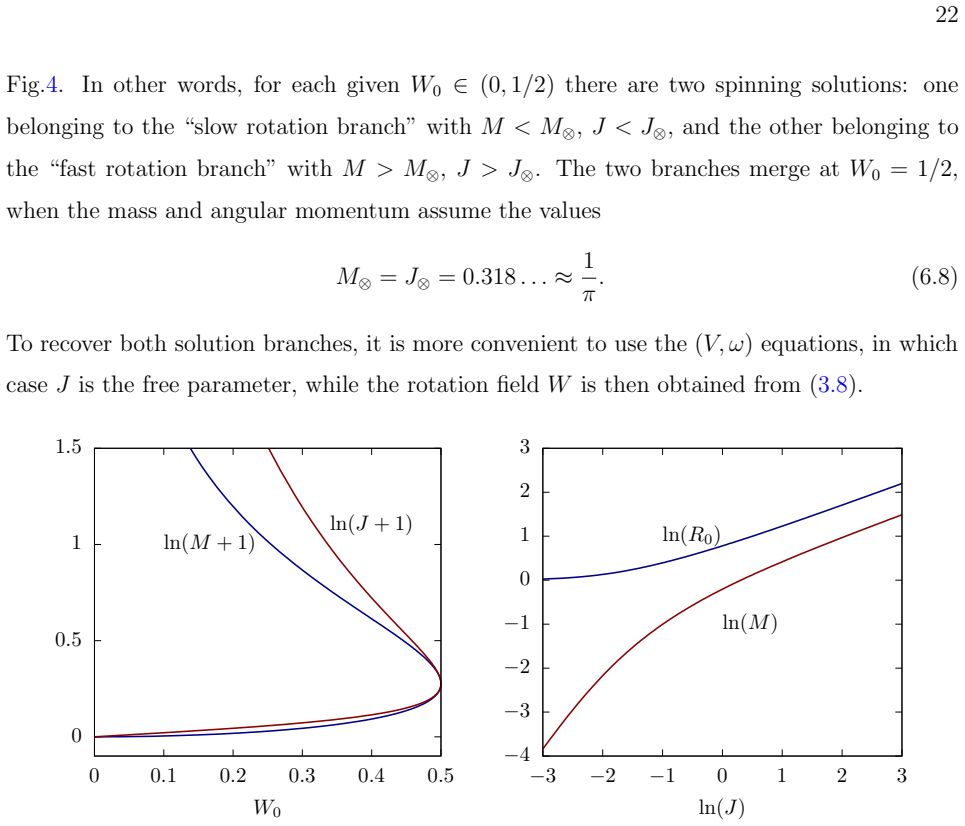
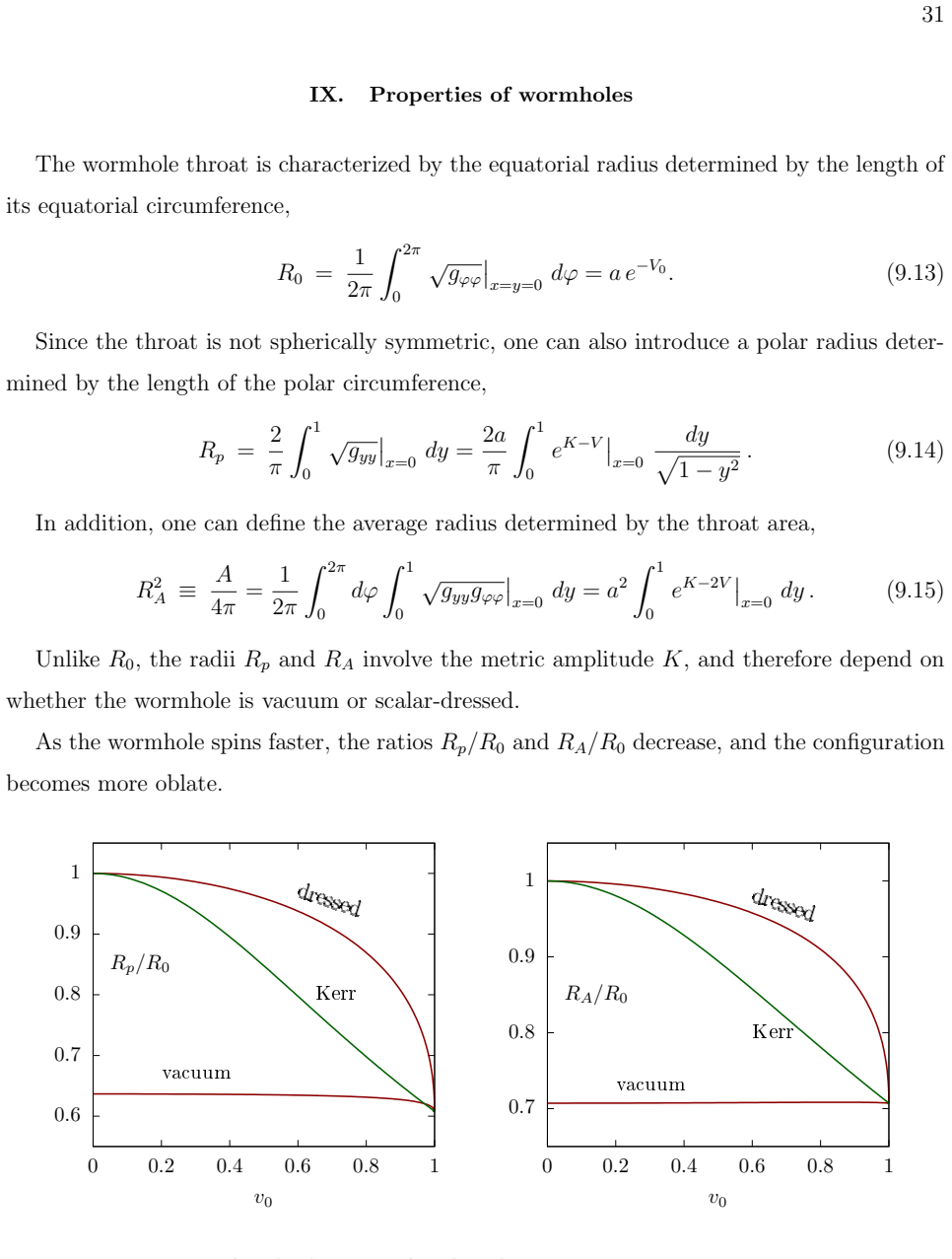
The non-perturbative numerical solutions exhibit the non-relativistic relation M ~ J² for slow rotation, which transforms into the Regge relation J = M² in the fast-rotation regime; if the ring size is sent to zero simultaneously then M and J remain bounded as the throat linear velocity approaches unity and the geometry approaches the extremal Kerr solution.
What carries the argument
Numerical solutions to the vacuum Ernst equations subject to reflection symmetry across the wormhole throat.
If this is right
- Slow rotation produces the non-relativistic scaling M ~ J² between mass and angular momentum.
- Fast rotation produces the Regge relation J = M² while the ring stretches without bound due to centrifugal force.
- Sending the static ring size to zero together with increasing rotation keeps M and J bounded as throat velocity approaches the speed of light.
- The geometry approaches the extremal Kerr solution in that simultaneous limit.
- The ring singularity can be removed by promoting the solutions to regular configurations with a phantom scalar field.
Where Pith is reading between the lines
- The imposed reflection symmetry distinguishes these wormholes from the Kerr family while still allowing them to approach Kerr in a controlled limit.
- The bounded M and J in the shrinking-ring limit suggest these geometries could serve as singularity-free proxies for studying extremal Kerr properties.
- Scalarization may open a route to fully regular, traversable wormholes whose asymptotic behavior matches that of extremal black holes.
Load-bearing premise
The numerical solutions satisfy the vacuum Einstein equations everywhere outside the ring singularity and respect the imposed reflection symmetry across the throat for all values of the rotation parameter.
What would settle it
A computation demonstrating that the numerical solutions violate the vacuum Einstein equations or the reflection symmetry condition for some value of the rotation parameter would falsify the central claim.
Figures



read the original abstract
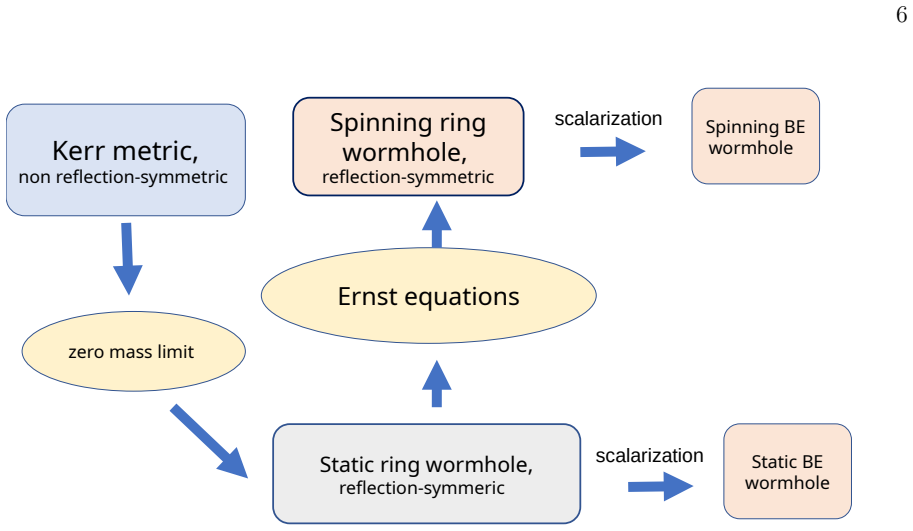
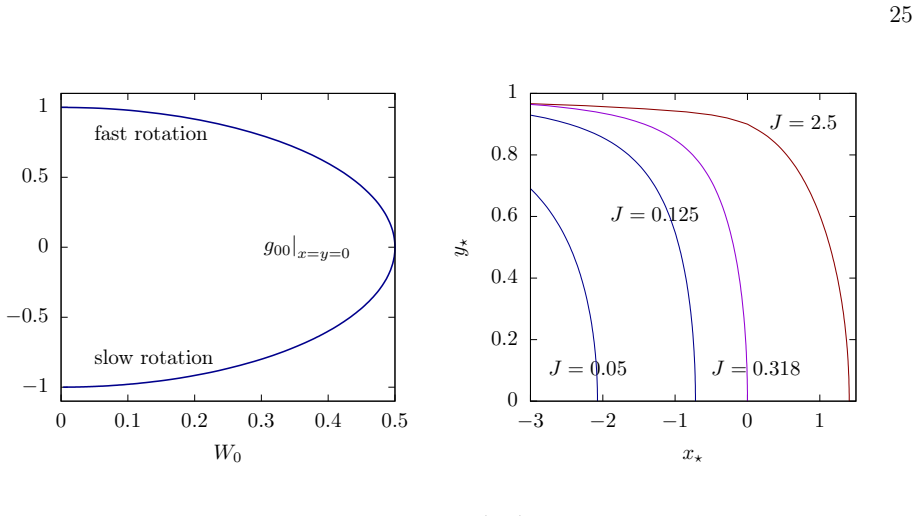
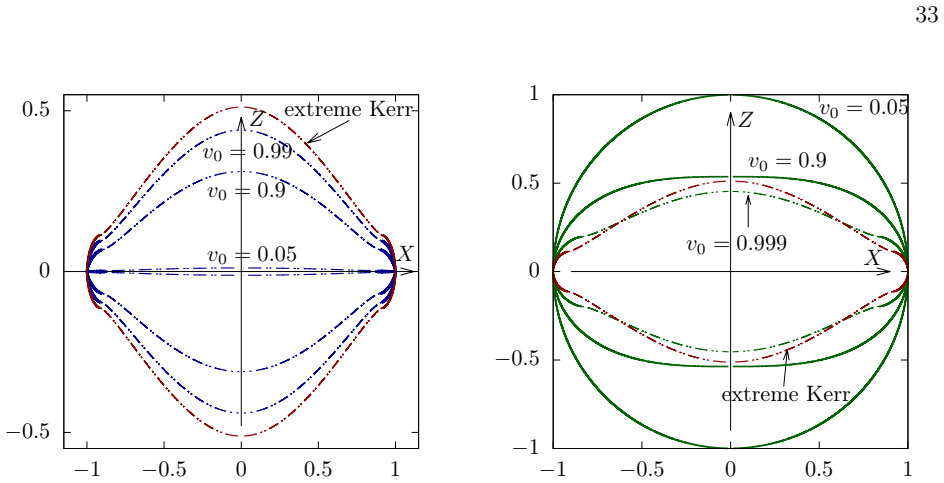
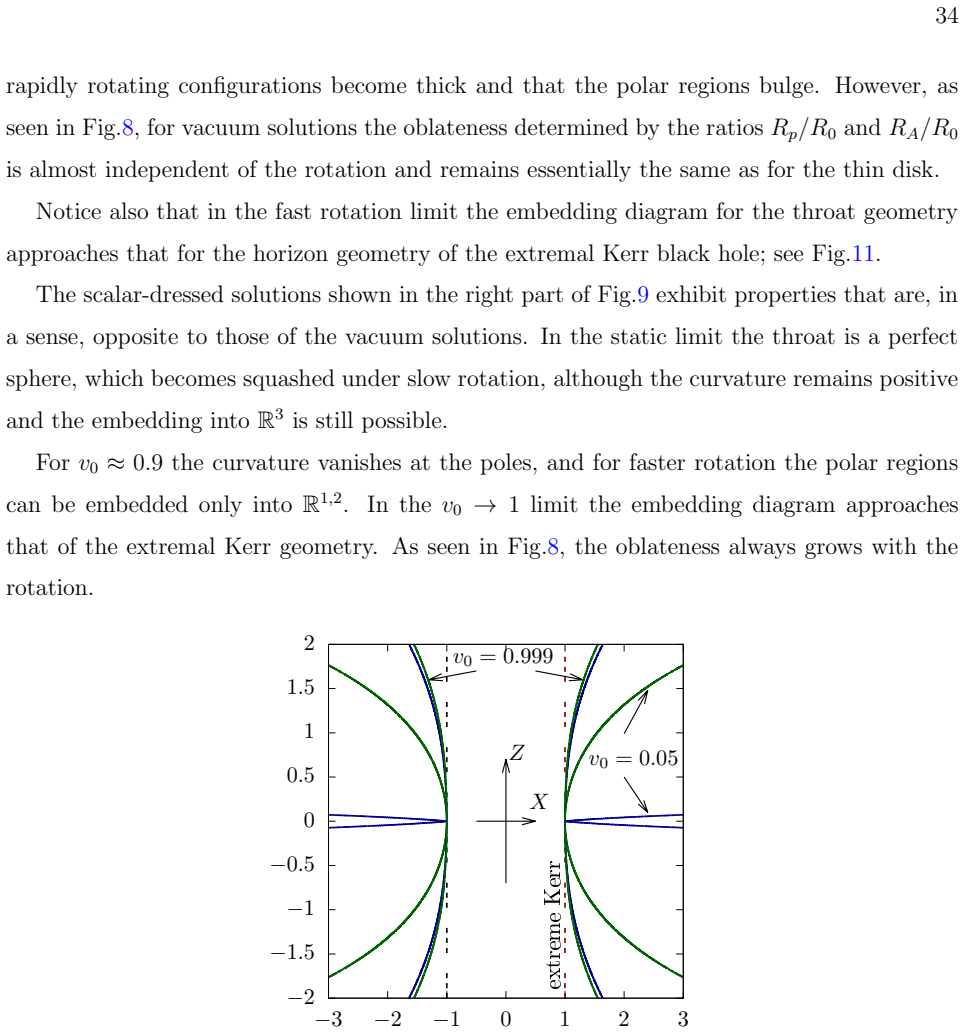
The ring wormhole is the zero-mass limit of the Kerr metric. Its geometry is locally flat, but the topology is nontrivial, with a throat connecting two asymptotic regions and a distributional curvature singularity on the ring encircling the throat. We construct stationary generalizations of this static wormhole that are different from Kerr and invariant under reflections across the wormhole throat. The problem reduces to solving the vacuum Ernst equations subject to the corresponding symmetry conditions. The slowly rotating perturbative solutions were constructed previously, while we now present a detailed analysis of non-perturbative solutions obtained within a numerical framework. For slow rotation, they exhibit the non-relativistic relation $M\sim J^2$ between the mass and angular momentum, which transforms into the Regge relation $J=M^2$ in the fast-rotation regime, when $J\to\infty$ and the ring is stretched without bound by the centrifugal force. However, if the ring size in the static limit is sent to zero at the same time, then $M$ and $J$ remain bounded as the throat linear velocity approaches unity. The wormhole geometry then approaches the extremal Kerr solution, thus ``mimicking'' it. The wormholes carry a curvature singularity at the ring, but this can be removed by via simple ``scalarization'' procedure that promotes the vacuum solutions to regular wormholes with a phantom scalar field.
Editorial analysis
A structured set of objections, weighed in public.
Referee Report
Summary. The paper constructs stationary, reflection-symmetric generalizations of the vacuum ring wormhole (zero-mass limit of Kerr) by numerically solving the vacuum Ernst equations. It reports that the resulting non-perturbative solutions obey M ∼ J² for slow rotation, transition to the Regge relation J = M² for fast rotation (with the ring stretched by centrifugal effects), and, when the static ring radius is simultaneously sent to zero, yield bounded M and J with the throat velocity approaching unity and the geometry approaching extremal Kerr. The ring singularity can be removed by a scalarization procedure introducing a phantom scalar field.
Significance. If the numerical solutions are confirmed to satisfy the Ernst equations to controlled accuracy, the work supplies explicit non-perturbative examples of rotating wormhole geometries that are distinct from Kerr yet can mimic its extremal properties in a controlled limit. This would be a concrete illustration of how nontrivial topology can produce stationary vacuum solutions whose asymptotic charges track those of black holes, complementing the earlier perturbative analysis.
major comments (1)
- [Numerical framework and boundary conditions] Numerical framework and boundary conditions: the central claims (M ∼ J² to J = M² transition, bounded M,J in the simultaneous zero-ring-size limit, and approach to extremal Kerr) rest on the assertion that the numerical solutions satisfy the vacuum Ernst equations everywhere outside the ring and respect the imposed reflection symmetry for all rotation parameters. However, the manuscript provides no quantitative validation—maximum residual norms, grid-refinement convergence studies, or direct comparison of the slow-rotation numerics against the known perturbative expansion. Without these, discretization artifacts cannot be ruled out as the source of the reported relations.
minor comments (1)
- The scalarization procedure that removes the ring singularity is mentioned only briefly; a short explicit description of the phantom scalar ansatz and the resulting regular metric would improve readability.
Simulated Author's Rebuttal
We thank the referee for the careful review and for recognizing the potential interest of the non-perturbative rotating ring wormhole solutions. We agree that quantitative numerical validation is necessary to support the central claims and will incorporate the requested checks in the revised manuscript.
read point-by-point responses
-
Referee: Numerical framework and boundary conditions: the central claims (M ∼ J² to J = M² transition, bounded M,J in the simultaneous zero-ring-size limit, and approach to extremal Kerr) rest on the assertion that the numerical solutions satisfy the vacuum Ernst equations everywhere outside the ring and respect the imposed reflection symmetry for all rotation parameters. However, the manuscript provides no quantitative validation—maximum residual norms, grid-refinement convergence studies, or direct comparison of the slow-rotation numerics against the known perturbative expansion. Without these, discretization artifacts cannot be ruled out as the source of the reported relations.
Authors: We acknowledge that the present manuscript does not contain explicit quantitative validation metrics. In the revision we will add: (i) the maximum residual norm of the Ernst equations evaluated on the computational domain for representative solutions across the rotation range; (ii) results of grid-refinement studies demonstrating that the extracted asymptotic charges M and J converge under successive doubling of the grid resolution; and (iii) a direct side-by-side comparison, in the slow-rotation regime, between the numerical values of M and J and the analytic perturbative expressions obtained in our earlier work. These additions will confirm that the reported M ∼ J² and J = M² relations are not discretization artifacts. The boundary conditions are imposed to enforce exact reflection symmetry across the throat (by construction of the computational domain) together with the required asymptotic flatness and regularity at the axis, consistent with the vacuum Ernst formulation. revision: yes
Circularity Check
Numerical integration of Ernst equations yields independent M-J relations
full rationale
The derivation reduces the problem to solving the vacuum Ernst equations under reflection symmetry across the throat, then obtains non-perturbative numerical solutions whose M ~ J^2 (slow) and J = M^2 (fast) behaviors, plus the controlled limit to extremal Kerr, are direct outputs of that integration. No step renames a fitted parameter as a prediction, imports a uniqueness theorem from the same authors, or reduces the central claims to self-citation by construction. The prior perturbative work is cited only for context and is not load-bearing for the non-perturbative results. The derivation chain is therefore self-contained against the Einstein equations.
Axiom & Free-Parameter Ledger
free parameters (1)
- static ring size
axioms (2)
- standard math Vacuum Einstein equations reduce to the Ernst system for stationary axisymmetric metrics
- domain assumption Reflection symmetry across the wormhole throat
Reference graph
Works this paper leans on
-
[1]
Event horizon The black hole horizon is located wherex 2 +ν= 0 andg xx → ∞, hence at xh = √ −ν= p 1−q 2 p = √ M 2 −a 2.(B.10) The equatorial horizon radius is R0 = √gφφ x=xh,y=0 = 2 p = 2M ,(B.11) while the horizon angular velocity and the linear velocity are W0 =W| x=xh = pq 2(1 + p 1−q 2) , v 0 =R 0W0 = q 1 + p 1−q 2 .(B.12) 41 The polar horizon radius ...
-
[2]
Extremal Kerr solution and its near horizon limit Settingq= 1,a=M, andν= 0 in (B.3)–(B.5) yields the extremal Kerr geometry, ds2 =−e 2V dt2 + [(x+M) 2 +M 2y2] dx2 x2 + dy2 1−y 2 +x 2(1−y 2)e−2V (dφ−W dt) 2 ,(B.15) where e2V = p2x2 [(px+ 1) 2 +y 2] Q , W= 2p(px+ 1) Q , Q= 4 +px[8 +px(7 +px(px+ 4) +y 2)], p= 1 M .(B.16) Let us pass to the rotating frame by ...
-
[3]
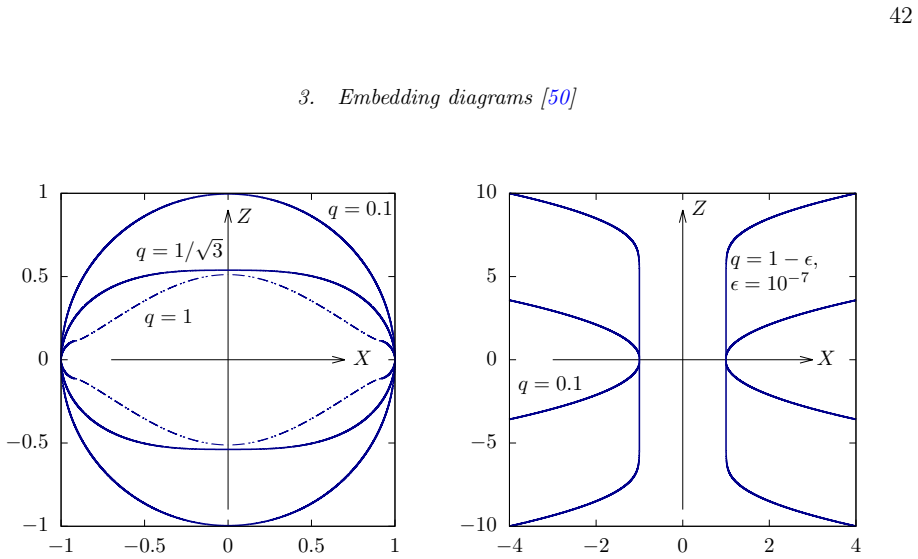
Embedding diagrams [50] −1 −0.5 0 0.5 1 −1 −0.5 0 0 .5 1 X Z q = 0.1 q = 1/ √ 3 q = 1 −10 −5 0 5 10 −4 −2 0 2 4 X Z q = 1 −ϵ, ϵ= 10 −7 q = 0.1 FIG. 11. The isometric realization of slices of theR 0 = 1 Kerr geometry on surfaces obtained by rotating theX, Zcurves around theZ-axis. Left: embeddings of the event horizon, with the dashed curve corresponding t...
-
[4]
The particle problem in the general theory of relativity
A. Einstein and N. Rosen,The particle problem in the General Theory of Relativity,Phys.Rev. 48(1935) 73–77, [doi:10.1103/PhysRev.48.73]
-
[5]
Can quantum-mechanical description of physical reality be considered complete?
A. Einstein, B. Podolsky, and N. Rosen,Can quantum mechanical description of physical reality be considered complete?,Phys.Rev.47(1935) 777–780, [doi:10.1103/PhysRev.47.777]
-
[6]
Cool horizons for entangled black holes
J. Maldacena and L. Susskind,Cool horizons for entangled black holes,Fortsch.Phys.61 (2013) 781–811, [arXiv:1306.0533], [doi:10.1002/prop.201300020]
work page internal anchor Pith review Pith/arXiv arXiv doi:10.1002/prop.201300020 2013
-
[7]
Testing ER = EPR with Hydrogen
I. Javed and E. Wilson-Ewing,Testing Wormhole-Mediated Entanglement with Hydrogen, Phys. Rev. Lett.136(2026), no. 12 121501, [arXiv:2512.02156], [doi:10.1103/78f4-2gxv]
work page internal anchor Pith review Pith/arXiv arXiv doi:10.1103/78f4-2gxv 2026
-
[8]
C. W. Misner and J. A. Wheeler,Classical physics as geometry: Gravitation, electromagnetism, unquantized charge, and mass as properties of curved empty space,Annals Phys.2(1957) 525–603, [doi:10.1016/0003-4916(57)90049-0]
-
[9]
C. W. Misner,Wormhole Initial Conditions,Phys.Rev.118(1960) 1110–1111, [doi:10.1103/PhysRev.118.1110]
-
[10]
M. Cvetic, G. W. Gibbons, and C. N. Pope,Super-Geometrodynamics,JHEP03(2015) 029, [arXiv:1411.1084], [doi:10.1007/JHEP03(2015)029]. [8]LIGO Scientific, VirgoCollaboration, B. Abbottet al.,Observation of Gravitational Waves from a Binary Black Hole Merger,Phys. Rev. Lett.116(2016), no. 6 061102, [arXiv:1602.03837], [doi:10.1103/PhysRevLett.116.061102]
work page internal anchor Pith review Pith/arXiv arXiv doi:10.1007/jhep03(2015)029 2015
-
[11]
M. Morris, K. Thorne, and U. Yurtsever,Wormholes, time machines, and the weak energy condition,Phys.Rev.Lett.61(1988) 1446–1449, [doi:10.1103/PhysRevLett.61.1446]
-
[12]
Visser,Lorentzian wormholes: From Einstein to Hawking
M. Visser,Lorentzian wormholes: From Einstein to Hawking. AIP, 1996
1996
-
[13]
J. L. Friedman, K. Schleich, and D. M. Witt,Topological censorship,Phys.Rev.Lett.71(1993) 48 1486–1489, [arXiv:gr-qc/9305017], [doi:10.1103/PhysRevLett.71.1486]. [Erratum: Phys. Rev. Lett.75,1872(1995)]
work page internal anchor Pith review Pith/arXiv arXiv doi:10.1103/physrevlett.71.1486 1993
-
[14]
The null energy condition in dynamic wormholes
D. Hochberg and M. Visser,The null energy condition in dynamic wormholes,Phys.Rev.Lett. 81(1998) 746–749, [arXiv:gr-qc/9802048], [doi:10.1103/PhysRevLett.81.746]
work page internal anchor Pith review Pith/arXiv arXiv doi:10.1103/physrevlett.81.746 1998
-
[15]
Bronnikov,Scalar-tensor theory and scalar charge,Acta Phys.Polon.B4(1973) 251–266
K. Bronnikov,Scalar-tensor theory and scalar charge,Acta Phys.Polon.B4(1973) 251–266
1973
-
[16]
H. G. Ellis,Ether flow through a drainhole - a particle model in general relativity, J.Math.Phys.14(1973) 104–118, [doi:10.1063/1.1666161]
-
[17]
Riesset al.,Observational evidence from supernovae for an accelerating universe and a cosmological constant,Astron.Journ.116(1998), no
A. Riesset al.,Observational evidence from supernovae for an accelerating universe and a cosmological constant,Astron.Journ.116(1998), no. 3 1009
1998
-
[18]
Perlmutteret al.,Measurements ofωandλfrom 42 high-redshift supernovae, Astrophys.Journ.517(1999), no
S. Perlmutteret al.,Measurements ofωandλfrom 42 high-redshift supernovae, Astrophys.Journ.517(1999), no. 2 565
1999
-
[19]
Static and symmetric wormholes respecting energy conditions in Einstein-Gauss-Bonnet gravity
H. Maeda and M. Nozawa,Static and symmetric wormholes respecting energy conditions in Einstein-Gauss-Bonnet gravity,Phys.Rev.D78(2008) 024005, [arXiv:0803.1704], [doi:10.1103/PhysRevD.78.024005]
work page internal anchor Pith review Pith/arXiv arXiv doi:10.1103/physrevd.78.024005 2008
-
[20]
Wormholes in Dilatonic Einstein-Gauss-Bonnet Theory
P. Kanti, B. Kleihaus, and J. Kunz,Wormholes in Dilatonic Einstein-Gauss-Bonnet Theory, Phys.Rev.Lett.107(2011) 271101, [arXiv:1108.3003], [doi:10.1103/PhysRevLett.107.271101]
work page internal anchor Pith review Pith/arXiv arXiv doi:10.1103/physrevlett.107.271101 2011
-
[21]
M. A. Cuyubamba, R. A. Konoplya, and A. Zhidenko,No stable wormholes in Einstein-dilaton-Gauss-Bonnet theory,Phys. Rev. D98(2018), no. 4 044040, [arXiv:1804.11170], [doi:10.1103/PhysRevD.98.044040]
work page internal anchor Pith review Pith/arXiv arXiv doi:10.1103/physrevd.98.044040 2018
-
[22]
Possible wormholes in a brane world
K. Bronnikov and S.-W. Kim,Possible wormholes in a brane world,Phys.Rev.D67(2003) 064027, [arXiv:gr-qc/0212112], [doi:10.1103/PhysRevD.67.064027]
work page internal anchor Pith review Pith/arXiv arXiv doi:10.1103/physrevd.67.064027 2003
-
[23]
S. V. Sushkov and R. Korolev,Scalar wormholes with nonminimal derivative coupling, Class.Quant.Grav.29(2012) 085008, [arXiv:1111.3415], [doi:10.1088/0264-9381/29/8/085008]
work page internal anchor Pith review Pith/arXiv arXiv doi:10.1088/0264-9381/29/8/085008 2012
-
[24]
S. V. Sushkov and M. S. Volkov,Giant wormholes in ghost-free bigravity theory,JCAP1506 (2015), no. 06 017, [arXiv:1502.03712], [doi:10.1088/1475-7516/2015/06/017]
work page internal anchor Pith review Pith/arXiv arXiv doi:10.1088/1475-7516/2015/06/017 2015
-
[25]
J. L. Bl´ azquez-Salcedo, C. Knoll, and E. Radu,Traversable wormholes in Einstein-Dirac-Maxwell theory,Phys. Rev. Lett.126(2021), no. 10 101102, [arXiv:2010.07317], [doi:10.1103/PhysRevLett.126.101102]
-
[26]
R. A. Konoplya and A. Zhidenko,Traversable Wormholes in General Relativity,Phys. Rev. Lett.128(2022), no. 9 091104, [arXiv:2106.05034], [doi:10.1103/PhysRevLett.128.091104]
-
[27]
Rotating wormholes in Einstein-Dirac-Maxwell theory
V. Dzhunushaliev and V. Folomeev,Rotating wormholes in Einstein-Dirac-Maxwell theory, Gen. Rel. Grav.58(2026), no. 4 39, [arXiv:2511.02431], [doi:10.1007/s10714-026-03550-1]
work page internal anchor Pith review Pith/arXiv arXiv doi:10.1007/s10714-026-03550-1 2026
-
[28]
Zipoy,Topology of some spheroidal metrics,J.Math.Phys.7(1966) 1137–1143, 49 [doi:10.1063/1.1705005]
D. Zipoy,Topology of some spheroidal metrics,J.Math.Phys.7(1966) 1137–1143, 49 [doi:10.1063/1.1705005]
-
[29]
K. A. Bronnikov and J. C. Fabris,Weyl space-times and wormholes in D-dimensional Einstein and dilaton gravity,Class. Quant. Grav.14(1997) 831–842, [arXiv:gr-qc/9603037], [doi:10.1088/0264-9381/14/4/003]
work page internal anchor Pith review Pith/arXiv arXiv doi:10.1088/0264-9381/14/4/003 1997
-
[30]
G. Cl´ ement, D. Gal’tsov, and M. Guenouche,NUT wormholes,Phys.Rev.D93(2016), no. 2 024048, [arXiv:1509.07854], [doi:10.1103/PhysRevD.93.024048]. [Phys. Rev.D93,024048(2016)]
work page internal anchor Pith review Pith/arXiv arXiv doi:10.1103/physrevd.93.024048 2016
-
[31]
G. W. Gibbons and M. S. Volkov,Weyl metrics and wormholes,JCAP1705(2017), no. 05 039, [arXiv:1701.05533], [doi:10.1088/1475-7516/2017/05/039]
work page internal anchor Pith review Pith/arXiv arXiv doi:10.1088/1475-7516/2017/05/039 2017
-
[32]
G. Cl´ ement and D. Gal’tsov,Rotating traversable wormholes in Einstein-Maxwell theory,Phys. Lett. B838(2023) 137677, [arXiv:2210.08913], [doi:10.1016/j.physletb.2023.137677]
-
[33]
Carter,Global structure of the Kerr family of gravitational fields,Phys
B. Carter,Global structure of the Kerr family of gravitational fields,Phys. Rev.174(1968) 1559–1571, [doi:10.1103/PhysRev.174.1559]
-
[34]
G. W. Gibbons and M. S. Volkov,Zero mass limit of Kerr spacetime is a wormhole,Phys. Rev. D96(2017), no. 2 024053, [arXiv:1705.07787], [doi:10.1103/PhysRevD.96.024053]
work page internal anchor Pith review Pith/arXiv arXiv doi:10.1103/physrevd.96.024053 2017
-
[35]
B. H. Voorhees,Static axially symmetric gravitational fields,Phys.Rev.D2(1970) 2119–2122, [doi:10.1103/PhysRevD.2.2119]
-
[36]
G. W. Gibbons and M. S. Volkov,Ring wormholes via duality rotations,Phys.Lett.B760 (2016) 324–328, [arXiv:1606.04879], [doi:10.1016/j.physletb.2016.07.012]
work page internal anchor Pith review Pith/arXiv arXiv doi:10.1016/j.physletb.2016.07.012 2016
-
[37]
V. P. Frolov, P. Krtous, and A. Zelnikov,Ring wormholes and time machines,Phys. Rev. D 108(2023), no. 2 024034, [arXiv:2305.03887], [doi:10.1103/PhysRevD.108.024034]
-
[38]
Stephani, D
H. Stephani, D. Kramer, M. A. H. MacCallum, C. Hoenselaers, and E. Herlt,Exact solutions of Einstein’s field equations. Cambridge Monographs on Mathematical Physics. Cambridge Univ. Press, Cambridge, 2003
2003
-
[39]
Belinski and E
V. Belinski and E. Verdaguer,Gravitational solitons. Cambridge Monographs on Mathematical Physics. Cambridge University Press, 2005
2005
-
[40]
A. Eris and M. Gurses,Stationary axially-symmetric solutions of Einstein-Maxwell massless scalar field equations,Journ.Math.Phys.18(1977) 1303–1304, [doi:10.1063/1.523419]
-
[41]
P. E. Kashargin and S. V. Sushkov,Slowly rotating wormholes: The First order approximation, Grav. Cosmol.14(2008) 80–85, [arXiv:0710.5656], [doi:10.1134/S0202289308010106]
work page internal anchor Pith review Pith/arXiv arXiv doi:10.1134/s0202289308010106 2008
-
[42]
P. E. Kashargin and S. V. Sushkov,Slowly rotating scalar field wormholes: The Second order approximation,Phys. Rev. D78(2008) 064071, [arXiv:0809.1923], [doi:10.1103/PhysRevD.78.064071]
work page internal anchor Pith review Pith/arXiv arXiv doi:10.1103/physrevd.78.064071 2008
-
[43]
Rotating Ellis Wormholes in Four Dimensions
B. Kleihaus and J. Kunz,Rotating Ellis Wormholes in Four Dimensions,Phys. Rev. D90 50 (2014) 121503, [arXiv:1409.1503], [doi:10.1103/PhysRevD.90.121503]
work page internal anchor Pith review Pith/arXiv arXiv doi:10.1103/physrevd.90.121503 2014
-
[44]
X. Y. Chew, B. Kleihaus, and J. Kunz,Geometry of Spinning Ellis Wormholes,Phys. Rev. D 94(2016), no. 10 104031, [arXiv:1608.05253], [doi:10.1103/PhysRevD.94.104031]
work page internal anchor Pith review Pith/arXiv arXiv doi:10.1103/physrevd.94.104031 2016
-
[45]
M. S. Volkov,Stationary generalizations for the Bronnikov-Ellis wormhole and for the vacuum ring wormhole,Phys. Rev. D104(2021), no. 12 124064, [arXiv:2109.14496], [doi:10.1103/PhysRevD.104.124064]
-
[46]
Fate of the first traversible wormhole: black-hole collapse or inflationary expansion
H.-a. Shinkai and S. A. Hayward,Fate of the first traversible wormhole: Black hole collapse or inflationary expansion,Phys. Rev. D66(2002) 044005, [arXiv:gr-qc/0205041], [doi:10.1103/PhysRevD.66.044005]
work page internal anchor Pith review Pith/arXiv arXiv doi:10.1103/physrevd.66.044005 2002
-
[47]
B. Azad, J. L. Blazquez-Salcedo, F. S. Khoo, and J. Kunz,Are slowly rotating Ellis-Bronnikov wormholes stable?,Phys. Lett. B848(2024) 138349, [arXiv:2301.05243], [doi:10.1016/j.physletb.2023.138349]
-
[48]
B. Azad, J. L. Bl´ azquez-Salcedo, F. S. Khoo, and J. Kunz,Radial perturbations of Ellis-Bronnikov wormholes in slow rotation up to second order,Phys. Rev. D109(2024), no. 12 124051, [arXiv:2403.08387], [doi:10.1103/PhysRevD.109.124051]
-
[49]
F. J. Ernst,New formulation of the axially symmetric gravitational potential,Phys.Rev.167 (1968) 1175–1167, [doi:10.1103/PhysRev.167.1175]
-
[50]
Smarr,Mass formula for Kerr black holes,Phys
L. Smarr,Mass formula for Kerr black holes,Phys. Rev. Lett.30(1973) 71–73, [doi:10.1103/PhysRevLett.30.71]. [Erratum: Phys.Rev.Lett. 30, 521–521 (1973)]
-
[51]
Hecht,New development in freefem++,J
F. Hecht,New development in freefem++,J. Numer. Math.20(2012), no. 3-4 251–265
2012
-
[52]
Smarr,Surface Geometry of Charged Rotating Black Holes,Phys
L. Smarr,Surface Geometry of Charged Rotating Black Holes,Phys. Rev. D7(1973) 289–295, [doi:10.1103/PhysRevD.7.289]
-
[53]
Self--gravitating cosmic rings
G. Clement,Selfgravitating cosmic rings,Phys.Lett.B449(1999) 12–16, [arXiv:gr-qc/9808082], [doi:10.1016/S0370-2693(99)00079-9]
work page internal anchor Pith review Pith/arXiv arXiv doi:10.1016/s0370-2693(99)00079-9 1999
-
[54]
C. Hoenselaers, W. Kinnersley, and B. C. Xanthopoulos,Symmetries of the stationary Einstein-Maxwell equations. 6. Transformations which generate asymptotically flat space-times, J. Math. Phys.20(1979) 2530–2536, [doi:10.1063/1.524058]
-
[55]
J. M. Bardeen and G. T. Horowitz,The Extreme Kerr throat geometry: A Vacuum analog of AdS(2) x S**2,Phys. Rev. D60(1999) 104030, [arXiv:hep-th/9905099], [doi:10.1103/PhysRevD.60.104030]
work page internal anchor Pith review Pith/arXiv arXiv doi:10.1103/physrevd.60.104030 1999
-
[56]
R. P. Geroch,Multipole moments. II. Curved space,J. Math. Phys.11(1970) 2580–2588, [doi:10.1063/1.1665427]
-
[57]
Hansen,Multipole moments of stationary spacetimes,J
R. Hansen,Multipole moments of stationary spacetimes,J. Math. Phys.15(1974) 46–52, 51 [doi:10.1063/1.1666501]
-
[58]
Landau and E
L. Landau and E. Lifshitz,The Classical Theory of Fields. Course of theoretical physics. Butterworth-Heinemann, 1975
1975
-
[59]
G. Fodor, C. Hoenselaers, and Z. Perjes,Multipole moments of axisymmetric systems in relativity,J. Math. Phys.30(1989) 2252–2257, [doi:10.1063/1.528551]
-
[60]
G. Fodor, E. d. S. C. Filho, and B. Hartmann,Calculation of multipole moments of axistationary electrovacuum spacetimes,Phys. Rev. D104(2021), no. 6 064012, [arXiv:2012.05548], [doi:10.1103/PhysRevD.104.064012]
-
[61]
T. P. Sotiriou and T. A. Apostolatos,Corrected multipole moments of axisymmetric electrovacuum spacetimes,Class. Quant. Grav.21(2004) 5727–5733, [arXiv:gr-qc/0407064], [doi:10.1088/0264-9381/21/24/003]
work page internal anchor Pith review Pith/arXiv arXiv doi:10.1088/0264-9381/21/24/003 2004
-
[62]
T. Damour and S. N. Solodukhin,Wormholes as black hole foils,Phys. Rev. D76(2007) 024016, [arXiv:0704.2667], [doi:10.1103/PhysRevD.76.024016]
work page internal anchor Pith review Pith/arXiv arXiv doi:10.1103/physrevd.76.024016 2007
discussion (0)
Sign in with ORCID, Apple, or X to comment. Anyone can read and Pith papers without signing in.