Light nuclear scattering from neural quantum states
Pith reviewed 2026-06-29 09:59 UTC · model grok-4.3
The pith
Neural quantum states compute few-body nuclear scattering cross sections and partial-wave amplitudes with conservative uncertainties without time evolution.
A machine-rendered reading of the paper's core claim, the machinery that carries it, and where it could break.
Core claim
A method is presented for studying few-body nuclear scattering by means of neural quantum states, without requiring time-evolution. A recently developed family of stable minimum principles for Schrödinger's equation provides conservative uncertainties on cross sections and partial wave amplitudes computed in this way. The method is used to study both elastic and inelastic neutron-deuteron scattering with realistic nuclear two-body forces.
What carries the argument
Neural quantum states optimized variationally together with stable minimum principles for the Schrödinger equation to bound scattering observables.
If this is right
- Cross sections for neutron-deuteron scattering become available with conservative error estimates from a single variational optimization.
- Both elastic and inelastic channels can be treated within the same framework.
- Realistic two-body forces enter the calculation directly without additional approximations.
- Partial-wave amplitudes are obtained alongside the cross sections under identical uncertainty bounds.
Where Pith is reading between the lines
- The method might extend to other few-body scattering systems once optimization accuracy improves.
- Direct comparison of the conservative bounds against high-precision n-d data would quantify how tight the uncertainties become in practice.
- Absence of time evolution could allow integration with certain quantum-simulation or machine-learning architectures for larger nuclei.
- Similar minimum-principle bounds might be explored for scattering problems in atomic or molecular physics.
Load-bearing premise
Neural quantum states can be variationally optimized to sufficient accuracy that the stable minimum principles actually deliver usefully tight conservative bounds on the scattering observables for realistic nuclear Hamiltonians.
What would settle it
A computed neutron-deuteron cross section whose conservative uncertainty interval does not contain the corresponding experimental value at the same energy would falsify the claim of practical utility.
Figures

read the original abstract
We present a method of studying few-body nuclear scattering by means of neural quantum states, without requiring time-evolution. A recently developed family of stable minimum principles for Schrodinger's equation provides conservative uncertainties on cross sections and partial wave amplitudes computed in this way. We use this method to study both elastic and inelastic neutron-deuteron scattering with realistic nuclear two-body forces.
Editorial analysis
A structured set of objections, weighed in public.
Referee Report
Summary. The manuscript presents a method for computing few-body nuclear scattering observables using neural quantum states (NQS) to represent the wave functions, without time evolution. It combines this ansatz with a family of stable minimum principles for the Schrödinger equation to obtain conservative uncertainties on cross sections and partial-wave amplitudes, and applies the approach to elastic and inelastic neutron-deuteron scattering using realistic two-body nuclear forces.
Significance. If the central claim holds, the work would offer a variational route to scattering calculations in light nuclei that supplies built-in conservative error bars and avoids explicit time propagation. The application to realistic forces and to both elastic and inelastic channels for an A=3 system is a positive step; however, the practical value hinges on whether the NQS representation plus the minimum principles can produce informative (non-vacuous) bounds.
major comments (2)
- [Abstract] Abstract: the assertion that the stable minimum principles 'provide conservative uncertainties' is stated without any supporting equations, numerical demonstrations, or verification that the optimized NQS satisfy the required scattering boundary conditions (including correct asymptotic channel structure and inelastic thresholds).
- [Method / Results] The central claim that the method yields useful conservative bounds on partial-wave amplitudes and cross sections for realistic Hamiltonians rests on the unverified assumption that the NQS variational minimum lies sufficiently close to the true scattering solution; no evidence is supplied that the resulting uncertainty intervals are tight enough to be informative rather than vacuous for A=3 systems.
Simulated Author's Rebuttal
We thank the referee for their careful reading of the manuscript and for the constructive comments. We address each major comment below and indicate where revisions will be made to improve clarity and presentation.
read point-by-point responses
-
Referee: [Abstract] Abstract: the assertion that the stable minimum principles 'provide conservative uncertainties' is stated without any supporting equations, numerical demonstrations, or verification that the optimized NQS satisfy the required scattering boundary conditions (including correct asymptotic channel structure and inelastic thresholds).
Authors: The abstract provides a concise summary of the central result. The supporting derivation of the stable minimum principles, including the proof that they furnish conservative bounds when the trial function satisfies the appropriate boundary conditions, appears in Section II. The NQS ansatz is constructed to incorporate the correct elastic and inelastic channel asymptotics (including thresholds) by design, as specified in Section III; the optimization procedure enforces these conditions. Numerical demonstrations of the resulting uncertainties are given for the A=3 system in Section IV. We will revise the abstract to include a short clause directing readers to these sections for the supporting details. revision: partial
-
Referee: [Method / Results] The central claim that the method yields useful conservative bounds on partial-wave amplitudes and cross sections for realistic Hamiltonians rests on the unverified assumption that the NQS variational minimum lies sufficiently close to the true scattering solution; no evidence is supplied that the resulting uncertainty intervals are tight enough to be informative rather than vacuous for A=3 systems.
Authors: The manuscript applies the combined NQS + minimum-principle approach to realistic two-body forces and reports explicit numerical values for both elastic and inelastic n-d observables together with the associated conservative uncertainty intervals (Section IV). These intervals are obtained directly from the variational minimum and are finite; the paper compares the central values and intervals against independent calculations and experimental data to illustrate that the bounds are non-vacuous. The variational character of the method guarantees that the trial function is the closest possible within the chosen NQS manifold, and the results section supplies concrete evidence that the intervals permit meaningful statements about the observables. We disagree that no evidence is supplied, but we will add a short paragraph in the discussion explicitly quantifying the relative size of the uncertainties for the A=3 case. revision: partial
Circularity Check
No circularity: method applies independent minimum principles to NQS wave functions
full rationale
The paper presents a computational method that optimizes neural quantum states variationally and then applies a family of stable minimum principles (cited as recently developed external work) to obtain conservative bounds on scattering observables. No equation or claim reduces a reported cross section or amplitude to a fitted parameter by construction, nor does any load-bearing step rely on a self-citation whose content is itself unverified or defined circularly. The derivation chain remains self-contained against external benchmarks because the minimum principles are invoked as an independent mathematical tool whose validity does not presuppose the NQS results.
Axiom & Free-Parameter Ledger
Reference graph
Works this paper leans on
-
[1]
We find that the cross section for (−1,+ 1
and (−1, 1 2)—are not shown. We find that the cross section for (−1,+ 1
-
[2]
is statistically in- distinguishable, whereas the cross section for (0,+ 1
-
[3]
composes
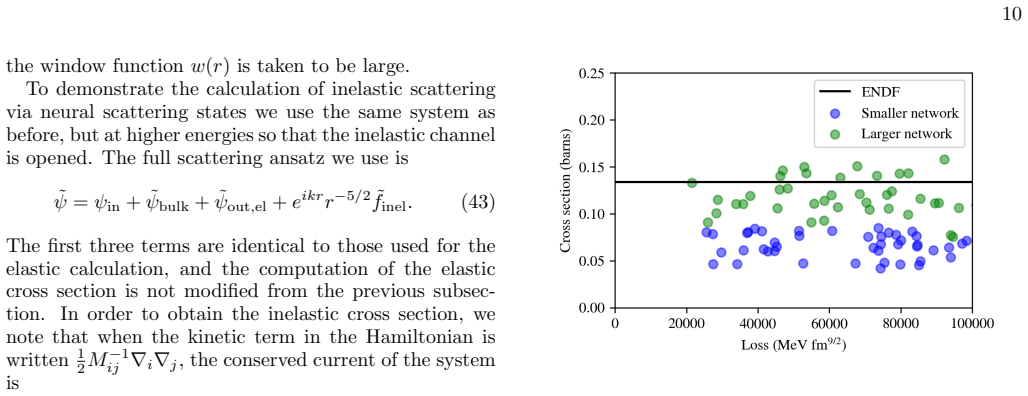
is smaller by a factor of two. This poor performance is reflected in part in the large value of the loss. Comparing to Figure 3, the best loss achieved in the inelastic calculation is a factor of five larger than the best loss achieved in the elastic calcula- tion. V. DISCUSSION We have presented a machine-learning method, based on neural quantum states, ...
-
[4]
To com- pute ˜ψout, we construct a neural network which is defined only on the unit sphere
Hard-sphere scattering Here we describe the architecture used to perform the hard-sphere scattering calculation of Section II. To com- pute ˜ψout, we construct a neural network which is defined only on the unit sphere. This takes as input the three co- ordinatesx i/|x|. This network is a fully-connected multi- layer perceptron (MLP). For the results of Se...
-
[5]
First, we parameterize the outgoing behavior ˜ψout ex- plicitly in terms of partial waves
Neutron-proton scattering In Section III a similar ansatz is used as in the calcula- tion of hard-sphere scattering, with only a few changes. First, we parameterize the outgoing behavior ˜ψout ex- plicitly in terms of partial waves. This allows us to ef- ficiently compute subleading behavior inr −1 without fi- nite differencing or automatic differentiatio...
-
[6]
The bulk behavior is parameterized with a multi-layer perceptron with three inputs (the three relative coordi- nates), a width of 40, and 4 hidden layers
The Laplacian is efficiently computed according to Appendix C. The bulk behavior is parameterized with a multi-layer perceptron with three inputs (the three relative coordi- nates), a width of 40, and 4 hidden layers. We do not enable a nonlinear final activation; intermediate activa- tions are the “swish” function as before. In terms of this network the ...
-
[7]
window function
Neutron-deuteron scattering As described in the main text, in order to keep the ansatz architecture relatively simple, some modifica- tions were performed to the loss function in the case of neutron-deuteron scattering, both above and below the deuteron breakup threshold. In the case of elastic scattering (the calculations be- hind Figure 3), onlys-wave s...
-
[8]
Stable minimum principles for scattering states
S. Lawrence and Y. Yamauchi, Stable minimum princi- ples for scattering states (2026), arXiv:2605.17139
work page internal anchor Pith review Pith/arXiv arXiv 2026
- [9]
- [10]
- [11]
-
[12]
R. Somasundaram, J. E. Lynn, L. Huth, A. Schwenk, and I. Tews, Maximally local two-nucleon interactions at N3LO in ∆-less chiral effective field theory, Phys. Rev. C109, 034005 (2024), arXiv:2306.13579
-
[13]
V. Cirigliano, M. Dawid, W. Dekens, and S. Reddy, New Class of Three-Nucleon Forces and Their Implications, Phys. Rev. Lett.135, 022501 (2025), arXiv:2411.00097
- [14]
- [15]
-
[16]
Ground-State Properties of $^{4}$He and $^{16}$O Extrapolated from Lattice QCD with Pionless EFT
L. Contessi, A. Lovato, F. Pederiva, A. Roggero, J. Kirscher, and U. van Kolck, Ground-state properties of 4He and 16O extrapolated from lattice QCD with pionless EFT, Phys. Lett. B772, 839 (2017), arXiv:1701.06516
work page internal anchor Pith review Pith/arXiv arXiv 2017
- [17]
- [18]
-
[19]
R. Somasundaram, I. Svensson, S. De, A. E. Deneris, Y. Dietz, P. Landry, A. Schwenk, and I. Tews, Inferring three-nucleon couplings from multi-messenger neutron- star observations, Nature Commun.16, 9819 (2025), arXiv:2410.00247
-
[20]
S. P. Jordan, K. S. M. Lee, and J. Preskill, Quantum Computation of Scattering in Scalar Quantum Field The- ories (2014), arXiv:1112.4833
work page internal anchor Pith review Pith/arXiv arXiv 2014
-
[21]
S. P. Jordan, K. S. M. Lee, and J. Preskill, Quan- tum Algorithms for Quantum Field Theories (2012), arXiv:1111.3633
work page internal anchor Pith review Pith/arXiv arXiv 2012
-
[22]
S. P. Jordan, K. S. M. Lee, and J. Preskill, Quantum Al- gorithms for Fermionic Quantum Field Theories (2014), arXiv:1404.7115
work page internal anchor Pith review Pith/arXiv arXiv 2014
- [23]
-
[24]
Stetcu, Quantum computing for nuclear reactions, EPJ Web Conf.322, 03002 (2025)
I. Stetcu, Quantum computing for nuclear reactions, EPJ Web Conf.322, 03002 (2025)
2025
-
[25]
E. Rule and I. Stetcu, A time-dependent wave-packet approach to reactions for quantum computation (2026), arXiv:2603.26881
-
[26]
Monte Carlo study of real time dynamics
A. Alexandru, G. Basar, P. F. Bedaque, S. Vartak, and N. C. Warrington, Monte Carlo Study of Real Time Dy- namics on the Lattice, Phys. Rev. Lett.117, 081602 (2016), arXiv:1605.08040
work page internal anchor Pith review Pith/arXiv arXiv 2016
-
[27]
Schwinger-Keldysh on the lattice: a faster algorithm and its application to field theory
A. Alexandru, G. Basar, P. F. Bedaque, and G. W. Ridgway, Schwinger-Keldysh formalism on the lattice: A faster algorithm and its application to field theory, Phys. Rev. D95, 114501 (2017), arXiv:1704.06404
work page internal anchor Pith review Pith/arXiv arXiv 2017
-
[28]
Carleo and M
G. Carleo and M. Troyer, Solving the quantum many- body problem with artificial neural networks, Science 355, 602 (2017)
2017
-
[29]
S. Lawrence, A. Shelby, and Y. Yamauchi, Quantum states from normalizing flows (2024), arXiv:2406.02451
-
[30]
S. Lawrence, B. McPeak, and D. Neill, Bootstrap- ping time-evolution in quantum mechanics (2024), arXiv:2412.08721
-
[31]
S. Lawrence and Y. Yamauchi, Normalizing Flows and the Real-Time Sign Problem, Phys. Rev. D103, 114509 (2021), arXiv:2101.05755
- [32]
- [33]
- [34]
-
[35]
X. Zhang and R. J. Furnstahl, Fast emulation of quantum three-body scattering, Phys. Rev. C105, 064004 (2022), arXiv:2110.04269
-
[36]
L. D. Faddeev and S. P. Merkuriev,Quantum scatter- ing theory for several particle systems, Vol. 11 (Springer Science & Business Media, 2013)
2013
-
[37]
A. C. Phillips, Application of the Faddeev Equations to the Three-Nucleon Problem, Phys. Rev.142, 984 (1966)
1966
-
[38]
J. J. Benayoun, J. Chauvin, C. Gignoux, and A. Laverne, Exact calculation ofn−dscattering at 14.1 mev with a 16 local realistic interaction: Elastic-channel results, Phys. Rev. Lett.36, 1438 (1976)
1976
-
[39]
V. M. Suslov, I. Filikhin, B. Vlahovic, M. A. Braun, and I. Slaus, Faddeev calculation for breakup neutron- deuteron scattering at 14.1 MeV lab energy (2013), arXiv:1304.1212
work page internal anchor Pith review Pith/arXiv arXiv 2013
-
[40]
O. A. Yakubovsky, On the Integral equations in the the- ory of N particle scattering, Sov. J. Nucl. Phys.5, 937 (1967)
1967
-
[41]
R. Lazauskas and J. Carbonell, The Fad- deev–Yakubovsky Symphony, Few Body Syst.60, 62 (2019), arXiv:1908.04861
-
[42]
Lazauskas, Application of the complex-scaling method to four-nucleon scattering above break-up threshold, Phys
R. Lazauskas, Application of the complex-scaling method to four-nucleon scattering above break-up threshold, Phys. Rev. C86, 044002 (2012)
2012
-
[43]
Lazauskas, Solution of then− 4 He elastic scattering problem using the faddeev-yakubovsky equations, Phys
R. Lazauskas, Solution of then− 4 He elastic scattering problem using the faddeev-yakubovsky equations, Phys. Rev. C97, 044002 (2018)
2018
-
[44]
Carlson, V
J. Carlson, V. Pandharipande, and R. Wiringa, Vari- ational calculations of resonant states in 4he, Nuclear Physics A424, 47 (1984)
1984
-
[45]
Carlson, K
J. Carlson, K. E. Schmidt, and M. H. Kalos, Microscopic calculations of 5He with realistic interactions, Phys. Rev. C36, 27 (1987)
1987
-
[46]
K. M. Nollett, S. C. Pieper, R. B. Wiringa, J. Carlson, and G. M. Hale, Quantum monte carlo calculations of neutron-αscattering, Phys. Rev. Lett.99, 022502 (2007)
2007
-
[47]
J. E. Lynn, I. Tews, J. Carlson, S. Gandolfi, A. Gezerlis, K. E. Schmidt, and A. Schwenk, Chiral three-nucleon in- teractions in light nuclei, neutron-αscattering, and neu- tron matter, Phys. Rev. Lett.116, 062501 (2016)
2016
-
[48]
A. R. Flores and K. M. Nollett, Variational monte carlo calculations ofn+ 3 H scattering, Phys. Rev. C108, 034001 (2023)
2023
- [49]
-
[50]
Description of the proton and neutron radiative capture reactions in the Gamow shell model
K. Fossez, N. Michel, M. P loszajczak, Y. Jaganathen, and R. M. Id Betan, Description of the proton and neutron radiative capture reactions in the Gamow shell model, Phys. Rev. C91, 034609 (2015), arXiv:1502.01631
work page internal anchor Pith review Pith/arXiv arXiv 2015
-
[51]
Ab initio many-body calculations of nucleon scattering on 4He, 7Li, 7Be, 12C and 16O
P. Navratil, R. Roth, and S. Quaglioni, Ab ini- tio many-body calculations of nucleon scattering on 4He, 7 Li,7 Be,12 Cand 16O, Phys. Rev. C82, 034609 (2010), arXiv:1007.0525
work page internal anchor Pith review Pith/arXiv arXiv 2010
-
[52]
M. Vorabbi, M. Gennari, P. Finelli, C. Giusti, and P. Navr´ atil, Inelastic nucleon-nucleus scattering from a microscopic point of view (2026), arXiv:2603.26265
- [53]
-
[54]
Kievsky, S
A. Kievsky, S. Rosati, M. Viviani, L. E. Marcucci, and L. Girlanda, A high-precision variational approach to three- and four-nucleon bound and zero-energy scatter- ing states, Journal of Physics G: Nuclear and Particle Physics35, 063101 (2008)
2008
-
[55]
Viviani, L
M. Viviani, L. Girlanda, A. Kievsky, and L. E. Marcucci, n+ 3 H, p+ 3 He, p+ 3 H,andn+ 3 He scattering with the hyperspherical harmonic method, Phys. Rev. C102, 034007 (2020)
2020
-
[56]
DeepMind and I. e. a. Babuschkin, The DeepMind JAX Ecosystem (2020)
2020
-
[57]
Kidger and C
P. Kidger and C. Garcia, Equinox: neural networks in JAX via callable PyTrees and filtered transformations, Differentiable Programming workshop at Neural Infor- mation Processing Systems 2021 (2021)
2021
-
[58]
Lawrence and Y
S. Lawrence and Y. Yamauchi, MLQM (2026)
2026
-
[59]
D. P. Kingma and J. Ba, Adam: A method for stochastic optimization (2014), arXiv:1412.6980
work page internal anchor Pith review Pith/arXiv arXiv 2014
-
[60]
R. B. Wiringa and S. C. Pieper, Evolution of nuclear spectra with nuclear forces, Phys. Rev. Lett.89, 182501 (2002), arXiv:nucl-th/0207050
work page internal anchor Pith review Pith/arXiv arXiv 2002
-
[61]
R. L. Gluckstern and H. A. Bethe, Neutron-deuteron scattering at high energy, Phys. Rev.81, 761 (1951)
1951
-
[62]
Kloet and J
W. Kloet and J. A. Tjon, Elastic neutron-deuteron scat- tering with local potentials, Annals of Physics79, 407 (1973)
1973
-
[63]
W. O. Amrein and K. B. Sinha, On three-body scattering cross sections, Journal of Physics A: Mathematical and General15, 1567 (1982)
1982
-
[64]
Wita la, D
H. Wita la, D. H¨ uber, and W. Gl¨ ockle, Analyzing power puzzle in low energy elastic nd scattering, Phys. Rev. C 49, R14 (1994)
1994
-
[65]
H¨ uber, J
D. H¨ uber, J. Golak, H. Wita la, W. G. Gl¨ ockle, and H. Kamada, Phase shifts and mixing parameters for elas- tic neutron-deuteron scattering above breakup threshold, Few-Body Systems19, 175 (1995)
1995
-
[66]
G. L. Payne, W. Gloeckle, and J. L. Friar, Boundary con- ditions for three-body scattering in configuration space, Phys. Rev. C61, 024005 (2000), arXiv:nucl-th/9908059
work page internal anchor Pith review Pith/arXiv arXiv 2000
-
[67]
S. Ishikawa, M. Tanifuji, and Y. Iseri, A Complete set of total cross-sections for imaginary parts of n d forward scattering amplitudes and three nucleon force effects, Phys. Rev. C64, 024001 (2001), arXiv:nucl-th/0011030
work page internal anchor Pith review Pith/arXiv arXiv 2001
- [68]
-
[69]
Modern nuclear force predictions for the neutron-deuteron scattering lengths
H. Witala, A. Nogga, H. Kamada, W. Gloeckle, J. Go- lak, and R. Skibinski, Modern nuclear force predic- tions for the neutron deuteron scattering lengths (2003), arXiv:nucl-th/0305028
work page internal anchor Pith review Pith/arXiv arXiv 2003
-
[70]
National Nuclear Data Center, Sigma: Web retrieval in- terface for nuclear reaction data, accessed: 2026-05-10
2026
-
[71]
Glockle and G
W. Glockle and G. L. Payne, Boundary conditions for three-body scattering in configuration space, Phys. Rev. C45, 974 (1992)
1992
-
[72]
Sitzmann, J
V. Sitzmann, J. Martel, A. Bergman, D. Lindell, and G. Wetzstein, Implicit neural representations with peri- odic activation functions, Advances in neural information processing systems33, 7462 (2020)
2020
discussion (0)
Sign in with ORCID, Apple, or X to comment. Anyone can read and Pith papers without signing in.