Coherent Dark State Formation of a Lead-Vacancy Spin Qubit in Diamond
Pith reviewed 2026-06-29 12:28 UTC · model grok-4.3
The pith
Lead-vacancy centers in diamond form a coherent dark state with 12 ms spin lifetime at 7.5 K
A machine-rendered reading of the paper's core claim, the machinery that carries it, and where it could break.
Core claim
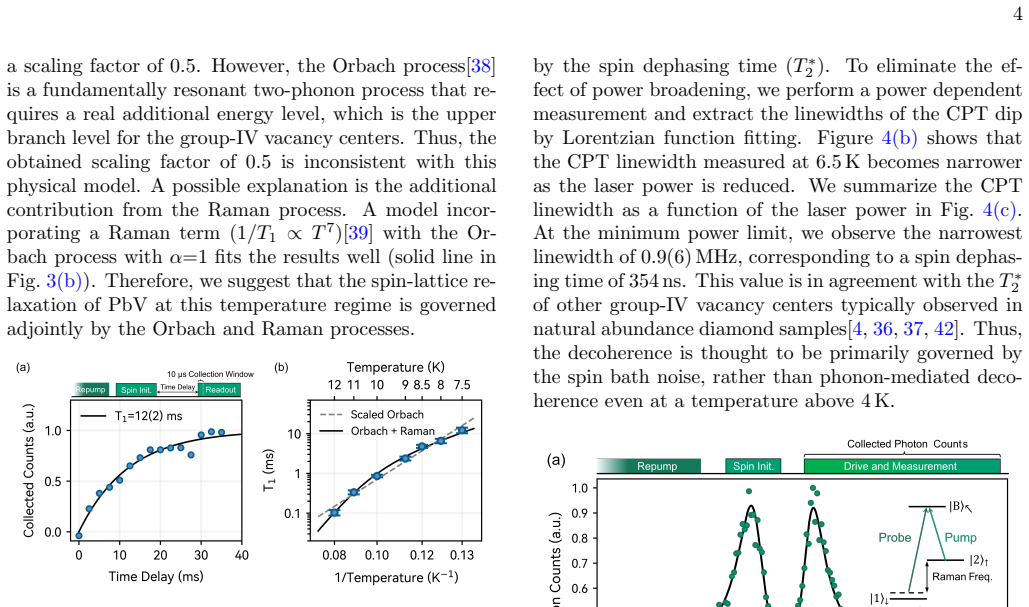
A lead-vacancy center in diamond exhibits coherent emission above liquid helium temperature. Under a large off-axis magnetic field the spin lifetime reaches 12 ms at 7.5 K. Coherent population trapping creates a coherent dark state whose dephasing time is 177 ns at 6.5 K. The results show that the PbV spin qubit retains useful coherence at temperatures above 4 K, unlike other group-IV centers.
What carries the argument
Coherent population trapping that produces a coherent dark state in the PbV spin system under off-axis magnetic field
If this is right
- PbV centers can be operated at temperatures above 4 K while preserving spin coherence suitable for quantum networks.
- The observed dark state provides a means to store quantum information without rapid dephasing at 6.5 K.
- Reduced cooling requirements follow directly from the demonstrated thermal robustness compared with other group-IV centers.
Where Pith is reading between the lines
- Simpler cryogenic systems could suffice for PbV-based nodes in a quantum network.
- The same dark-state technique might be tested in other group-IV centers to isolate which structural feature grants the extra temperature range.
Load-bearing premise
The recorded lifetimes and dark-state signals come from lead-vacancy centers rather than other defects or measurement artifacts.
What would settle it
Repeating the magneto-optical and coherent-population-trapping measurements on a diamond sample confirmed to contain no PbV centers and finding the same 12 ms lifetime or 177 ns dephasing time.
Figures


read the original abstract
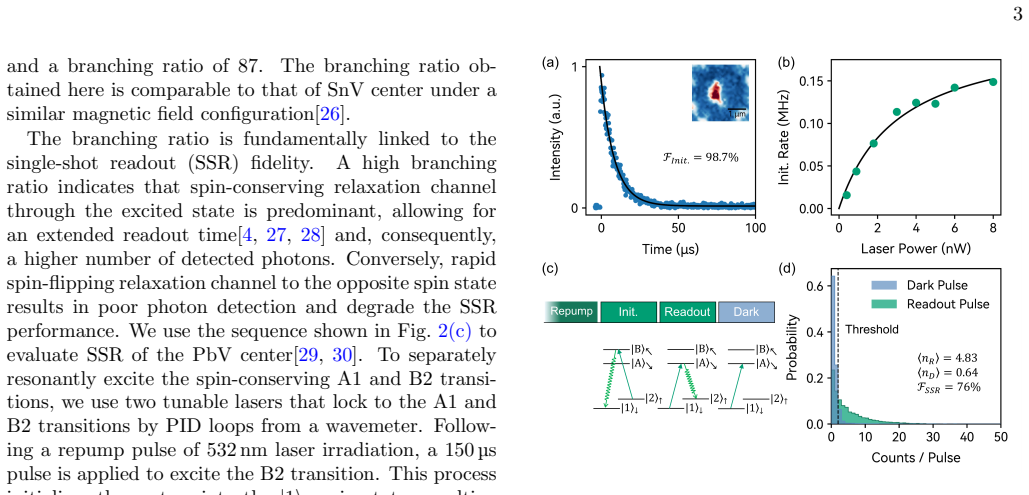
A lead-vacancy (PbV) center in diamond exhibits coherent emission above the liquid helium temperature, making it highly attractive for quantum network applications. Here, we report the magneto-optical and spin properties of PbV centers in diamond. We record a spin lifetime of 12 ms at 7.5 K under large off-axis magnetic field. Furthermore, we observe formation of the coherent dark state by coherent population trapping and estimate a spin dephasing time of 177 ns at 6.5 K. This work demonstrates the outstanding thermal robustness of the PbV spin compared to other group-IV centers above 4 K.
Editorial analysis
A structured set of objections, weighed in public.
Referee Report
Summary. The manuscript reports experimental magneto-optical and spin properties of lead-vacancy (PbV) centers in diamond. It measures a spin lifetime of 12 ms at 7.5 K under large off-axis magnetic field, observes coherent dark state formation via coherent population trapping (CPT), and estimates a spin dephasing time of 177 ns at 6.5 K, concluding that PbV exhibits outstanding thermal robustness relative to other group-IV centers above 4 K.
Significance. If the signals are unambiguously attributed to PbV centers, the results would indicate that PbV spins maintain long T1 and observable CPT at temperatures significantly above 4 K, which could reduce cryogenic demands for diamond-based quantum network nodes. The combination of lifetime, dephasing, and dark-state data would strengthen the case for PbV as a viable alternative to SiV or SnV centers.
major comments (2)
- [Center identification section] Center identification section: the manuscript must supply quantitative spectral (ZPL position, linewidth, temperature shift) and magnetic-field dependence data that match only the established PbV parameters while placing explicit upper bounds on possible contributions from NV, SiV, or unknown defects to the lifetime and CPT traces. Without this, attribution of the 12 ms T1 and 177 ns T2* remains the load-bearing uncertainty for the thermal-robustness claim.
- [Spin lifetime and CPT results] Spin lifetime and CPT results: the reported values of 12 ms (7.5 K) and 177 ns (6.5 K) appear without error bars, raw decay traces, fitting procedures, or temperature-calibration details, preventing independent verification of the headline numbers that underpin the comparison to other group-IV centers.
minor comments (1)
- [Abstract] Abstract: numerical results should include uncertainty estimates to allow readers to gauge precision immediately.
Simulated Author's Rebuttal
We thank the referee for the constructive feedback on our manuscript. We address the two major comments point-by-point below and will revise the manuscript to incorporate additional data and details as outlined.
read point-by-point responses
-
Referee: [Center identification section] Center identification section: the manuscript must supply quantitative spectral (ZPL position, linewidth, temperature shift) and magnetic-field dependence data that match only the established PbV parameters while placing explicit upper bounds on possible contributions from NV, SiV, or unknown defects to the lifetime and CPT traces. Without this, attribution of the 12 ms T1 and 177 ns T2* remains the load-bearing uncertainty for the thermal-robustness claim.
Authors: We agree that unambiguous attribution is critical. The manuscript and its supplementary information already contain ZPL spectra, linewidth measurements, and temperature-dependent shifts consistent with established PbV parameters, along with magnetic-field dependence data. In the revision we will move the key quantitative comparisons (ZPL position, linewidth, temperature shift) into the main text, add explicit magnetic-field sweep figures, and include a dedicated paragraph that places upper bounds on NV, SiV, and unknown-defect contributions by comparing observed intensities, lifetimes, and CPT contrast against control measurements on known defects. This will directly address the attribution uncertainty. revision: yes
-
Referee: [Spin lifetime and CPT results] Spin lifetime and CPT results: the reported values of 12 ms (7.5 K) and 177 ns (6.5 K) appear without error bars, raw decay traces, fitting procedures, or temperature-calibration details, preventing independent verification of the headline numbers that underpin the comparison to other group-IV centers.
Authors: We acknowledge that the main-text presentation of the 12 ms T1 and 177 ns T2* values is insufficiently detailed. The raw decay traces, exponential fitting procedures, and temperature-calibration protocol are already contained in the supplementary information. In the revised manuscript we will add the raw traces as a main-text figure or extended-data panel, report statistical error bars derived from repeated measurements, explicitly describe the fitting model and temperature sensor calibration, and reference the SI for full datasets. This will enable independent verification while preserving the headline comparison. revision: yes
Circularity Check
No circularity: purely experimental measurements with no derivations or fitted predictions
full rationale
The paper reports direct experimental observations of spin lifetime (12 ms at 7.5 K), coherent population trapping for dark-state formation, and dephasing time (177 ns at 6.5 K) in PbV centers. No equations, derivations, or parameter fits are present that reduce to self-defined inputs, self-citations, or renamed known results. Identification of centers relies on spectral/magnetic signatures rather than any circular modeling step. The work is self-contained experimental reporting against external benchmarks (temperature, field dependence), with no load-bearing self-citation chains or ansatz smuggling.
Axiom & Free-Parameter Ledger
axioms (1)
- standard math Standard quantum mechanics governs spin dynamics and coherent population trapping in the PbV center.
Reference graph
Works this paper leans on
-
[1]
H. J. Kimble, The quantum internet, Nature453, 1023 (2008)
2008
-
[2]
D. D. Awschalom, R. Hanson, J. Wrachtrup, and B. B. Zhou, Quantum technologies with optically interfaced solid-state spins, Nature Photonics12, 516 (2018)
2018
-
[3]
Ten-Second Electron-Spin Coherence in Isotopically Engineered Diamond
T. Yamamoto, H. B. van Ommen, K.-N. Schymik, B. de Zoeten, S. Onoda, S. Saiki, T. Ohshima, H. Arjmandi-Tash, R. Vollmer, and T. H. Taminiau, Ten- second electron-spin coherence in isotopically engineered diamond (2026), arXiv:2604.07439
work page internal anchor Pith review Pith/arXiv arXiv 2026
-
[4]
Sukachev, A
D. Sukachev, A. Sipahigil, C. Nguyen, M. Bhaskar, R. Evans, F. Jelezko, and M. Lukin, Silicon-vacancy spin qubit in diamond: A quantum memory exceeding 10 ms with single-shot state readout, Phys. Rev. Lett.119, 223602 (2017)
2017
-
[5]
Senkalla, G
K. Senkalla, G. Genov, M. H. Metsch, P. Siyushev, and F. Jelezko, Germanium vacancy in diamond quantum memory exceeding 20 ms, Phys. Rev. Lett.132, 026901 (2024)
2024
-
[6]
X. Guo, A. M. Stramma, Z. Li, W. G. Roth, B. Huang, Y. Jin, R. A. Parker, J. A. Mart´ ınez, N. Shofer, C. P. Michaels, C. P. Purser, M. H. Appel, E. M. Alexeev, T. Liu, A. C. Ferrari, D. D. Awschalom, N. Delegan, B. Pingault, G. Galli, F. J. Heremans, M. Atat¨ ure, and A. A. High, Microwave-based quantum control and co- herence protection of tin-vacancy s...
2023
-
[7]
Karapatzakis, J
I. Karapatzakis, J. Resch, M. Schrodin, P. Fuchs, M. Ki- eschnick, J. Heupel, L. Kussi, C. S¨ urgers, C. Popov, J. Meijer, C. Becher, W. Wernsdorfer, and D. Hunger, Microwave control of the tin-vacancy spin qubit in dia- mond with a superconducting waveguide, Phys. Rev. X 14, 031036 (2024)
2024
-
[8]
R. E. Evans, M. K. Bhaskar, D. D. Sukachev, C. T. Nguyen, A. Sipahigil, M. J. Burek, B. Machielse, G. H. Zhang, A. S. Zibrov, E. Bielejec, H. Park, M. Lonˇ car, and M. D. Lukin, Photon-mediated interactions between quantum emitters in a diamond nanocavity, Science362, 662 (2018)
2018
-
[9]
N. Codreanu, T. Turan, D. B. Rodriguez, M. Pasini, L. de Santis, M. Ruf, C. F. Primavera, L. G. C. Wien- hoven, C. E. Smulders, S. Gr¨ oblacher, and R. Han- son, Above-unity coherent cooperativity of tin-vacancy centers in diamond photonic crystal cavities (2025), arXiv:2511.13375
work page internal anchor Pith review arXiv 2025
-
[10]
Pompili, S
M. Pompili, S. L. N. Hermans, S. Baier, H. K. C. Beukers, P. C. Humphreys, R. N. Schouten, R. F. L. Vermeulen, M. J. Tiggelman, L. dos Santos Martins, B. Dirkse, S. Wehner, and R. Hanson, Realization of a multinode quantum network of remote solid-state qubits, Science 372, 259 (2021)
2021
-
[11]
C. Hepp, T. M¨ uller, V. Waselowski, J. N. Becker, B. Pin- gault, H. Sternschulte, D. Steinm¨ uller-Nethl, A. Gali, J. R. Maze, M. Atat¨ ure, and C. Becher, Electronic struc- ture of the silicon vacancy color center in diamond, Phys. Rev. Lett.112, 036405 (2014)
2014
-
[12]
Iwasaki, F
T. Iwasaki, F. Ishibashi, Y. Miyamoto, Y. Doi, S. Kobayashi, T. Miyazaki, K. Tahara, K. D. Jahnke, L. J. Rogers, B. Naydenov, F. Jelezko, S. Yamasaki, S. Nagamachi, T. Inubushi, N. Mizuochi, and M. Hatano, Germanium-vacancy single color centers in diamond, Sci- entific Reports5, 12882 (2015)
2015
-
[13]
Iwasaki, Y
T. Iwasaki, Y. Miyamoto, T. Taniguchi, P. Siyushev, M. H. Metsch, F. Jelezko, and M. Hatano, Tin-vacancy quantum emitters in diamond, Phys. Rev. Lett.119, 253601 (2017)
2017
-
[14]
P. Wang, T. Taniguchi, Y. Miyamoto, M. Hatano, and T. Iwasaki, Low-temperature spectroscopic investigation of lead-vacancy centers in diamond fabricated by high- pressure and high-temperature treatment, ACS Photon- ics8, 2947 (2021)
2021
-
[15]
C. M. Knaut, A. Suleymanzade, Y.-C. Wei, D. R. As- sumpcao, P.-J. Stas, Y. Q. Huan, B. Machielse, E. N. Knall, M. Sutula, G. Baranes, N. Sinclair, C. De- Eknamkul, D. S. Levonian, M. K. Bhaskar, H. Park, M. Lonˇ car, and M. D. Lukin, Entanglement of nanopho- 6 tonic quantum memory nodes in a telecom network, Na- ture629, 573 (2024)
2024
-
[16]
Wei, P.-J
Y.-C. Wei, P.-J. Stas, A. Suleymanzade, G. Baranes, F. Machado, Y. Q. Huan, C. M. Knaut, S. W. Ding, M. Merz, E. N. Knall, U. Yazlar, M. Sirotin, I. W. Wang, B. Machielse, S. F. Yelin, J. Borregaard, H. Park, M. Lonˇ car, and M. D. Lukin, Universal distributed blind quantum computing with solid-state qubits, Science388, 509 (2025)
2025
-
[17]
Stas, Y.-C
P.-J. Stas, Y.-C. Wei, M. Sirotin, Y. Q. Huan, U. Ya- zlar, F. A. Arias, E. Knyazev, G. Baranes, B. Machielse, S. Grandi, D. Riedel, J. Borregaard, H. Park, M. Lonˇ car, A. Suleymanzade, and M. D. Lukin, Entanglement- assisted non-local optical interferometry in a quantum network, Nature651, 326 (2026)
2026
-
[18]
P. Wang, L. Kazak, K. Senkalla, P. Siyushev, R. Abe, T. Taniguchi, S. Onoda, H. Kato, T. Makino, M. Hatano, F. Jelezko, and T. Iwasaki, Transform-limited photon emission from a lead-vacancy center in diamond above 10 K, Phys. Rev. Lett.132, 073601 (2024)
2024
-
[19]
R. Abe, Y. Chen, P. Wang, T. Taniguchi, M. Miyakawa, S. Onoda, M. Hatano, and T. Iwasaki, Narrow inho- mogeneous distribution and charge state stabilization of lead-vacancy centers in diamond, Adv. Funct. Mater.36, e12412 (2026)
2026
-
[20]
L. D. Santis, M. E. Trusheim, K. C. Chen, and D. R. En- glund, Investigation of the stark effect on a centrosym- metric quantum emitter in diamond, Phys. Rev. Lett. 127, 147402 (2021)
2021
-
[21]
Aghaeimeibodi, D
S. Aghaeimeibodi, D. Riedel, A. E. Rugar, C. Dory, and J. Vuˇ ckovi´ c, Electrical tuning of tin-vacancy centers in diamond, Phys. Rev. Appl.15, 064010 (2021)
2021
-
[22]
M. Ruf, N. H. Wan, H. Choi, D. Englund, and R. Hanson, Quantum networks based on color centers in diamond, J. Appl. Phys.130, 070901 (2021)
2021
-
[23]
Thiering and A
G. Thiering and A. Gali,Ab Initiomagneto-optical spec- trum of Group-IV vacancy color centers in Diamond, Phys. Rev. X8, 021063 (2018)
2018
-
[24]
Hirai, E
K. Hirai, E. Ota, Y. Chen, R. Kato, P. Wang, T. Makino, T. Taniguchi, M. Miyakawa, S. Onoda, M. Hatano, and T. Iwasaki, in preparation
-
[25]
Y. Chen, Y. Miyamoto, E. Ota, R. Abe, T. Taniguchi, S. Onoda, M. Hatano, and T. Iwasaki, Optical charge state manipulation of lead-vacancy centers in diamond, Nano Lett.25, 16697 (2025)
2025
-
[26]
Debroux, C
R. Debroux, C. P. Michaels, C. M. Purser, N. Wan, M. E. Trusheim, J. A. Mart´ ınez, R. A. Parker, A. M. Stramma, K. C. Chen, L. de Santis, E. M. Alexeev, A. C. Ferrari, D. Englund, D. A. Gangloff, and M. Atat¨ ure, Quantum control of the tin-vacancy spin qubit in diamond, Phys. Rev. X11, 041041 (2021)
2021
-
[27]
D. Chen, J. E. Fr¨ och, S. Ru, H. Cai, N. Wang, G. Adamo, J. Scott, F. Li, N. Zheludev, I. Aharonovich, and W. Gao, Quantum interference of resonance fluorescence from germanium-vacancy color centers in diamond, Nano Lett. 22, 6306 (2022)
2022
-
[28]
E. I. Rosenthal, S. Biswas, G. Scuri, H. Lee, A. J. Stein, H. C. Kleidermacher, J. Grzesik, A. E. Rugar, S. Aghaeimeibodi, D. Riedel, M. Titze, E. S. Bielejec, J. Choi, C. P. Anderson, and J. Vuˇ ckovi´ c, Single-shot readout and weak measurement of a tin-vacancy qubit in diamond, Phys. Rev. X14, 041008 (2024)
2024
-
[29]
G¨ orlitz, D
J. G¨ orlitz, D. Herrmann, P. Fuchs, T. Iwasaki, T. Taniguchi, D. Rogalla, D. Hardeman, P. O. Colard, M. Markham, M. Hatano, and C. Becher, Coherence of a charge stabilised tin-vacancy spin in diamond, npj Quan- tum Inf.8, 45 (2022)
2022
-
[30]
P. Gundlapalli, P. J. Vetter, G. Genov, M. Olney-Fraser, P. Wang, M. M. M¨ uller, K. Senkalla, and F. Jelezko, High-fidelity single-shot readout and selective nuclear spin control for a spin-1/2 quantum register in diamond (2025), arXiv:2510.09164
-
[31]
A. H. Myerson, D. J. Szwer, S. C. Webster, D. T. C. Allcock, M. J. Curtis, G. Imreh, J. A. Sherman, D. N. Stacey, A. M. Steane, and D. M. Lucas, High-fidelity readout of trapped-ion qubits, Phys. Rev. Lett.100, 200502 (2008)
2008
-
[32]
L. J. Rogers, K. D. Jahnke, M. H. Metsch, A. Sipahigil, J. M. Binder, T. Teraji, H. Sumiya, J. Isoya, M. D. Lukin, P. Hemmer, and F. Jelezko, All-optical initializa- tion, readout, and coherent preparation of single silicon- vacancy spins in diamond, Phys. Rev. Lett.113, 263602 (2014)
2014
-
[33]
J. N. Becker, B. Pingault, D. Groß, M. G¨ undoˇ gan, N. Kukharchyk, M. Markham, A. Edmonds, M. Atat¨ ure, P. Bushev, and C. Becher, All-optical control of the silicon-vacancy spin in diamond at millikelvin temper- atures, Phys. Rev. Lett.120, 053603 (2018)
2018
-
[34]
Pingault, D.-D
B. Pingault, D.-D. Jarausch, C. Hepp, L. Klintberg, J. N. Becker, M. Markham, C. Becher, and M. Atat¨ ure, Coher- ent control of the silicon-vacancy spin in diamond, Nat. Commun.8, 15579 (2017)
2017
-
[35]
Siyushev, M
P. Siyushev, M. H. Metsch, A. Ijaz, J. M. Binder, M. K. Bhaskar, D. D. Sukachev, A. Sipahigil, R. E. Evans, C. T. Nguyen, M. D. Lukin, P. R. Hemmer, Y. N. Palyanov, I. N. Kupriyanov, Y. M. Borzdov, L. J. Rogers, and F. Jelezko, Optical and microwave control of germanium- vacancy center spins in diamond, Phys. Rev. B96, 081201 (2017)
2017
-
[36]
M. E. Trusheim, B. Pingault, N. H. Wan, M. G¨ undo˘ gan, L. D. Santis, R. Debroux, D. Gangloff, C. Purser, K. C. Chen, M. Walsh, J. J. Rose, J. N. Becker, B. Lienhard, E. Bersin, I. Paradeisanos, G. Wang, D. Lyzwa, A. R.- P. Montblanch, G. Malladi, H. Bakhru, A. C. Ferrari, I. A. Walmsley, M. Atat¨ ure, and D. Englund, Transform- limited photons from a co...
2020
-
[37]
E. I. Rosenthal, C. P. Anderson, H. C. Kleidermacher, A. J. Stein, H. Lee, J. Grzesik, G. Scuri, A. E. Rugar, D. Riedel, S. Aghaeimeibodi, G. H. Ahn, K. V. Gasse, and J. Vuˇ ckovi´ c, Microwave spin control of a tin-vacancy qubit in diamond, Phys. Rev. X13, 031022 (2023)
2023
-
[38]
K. D. Jahnke, A. Sipahigil, J. M. Binder, M. W. Doherty, M. Metsch, L. J. Rogers, N. B. Manson, M. D. Lukin, and F. Jelezko, Electron–phonon processes of the silicon- vacancy centre in diamond, New J. Phys.17, 043011 (2015)
2015
-
[39]
Wolfowicz, F
G. Wolfowicz, F. J. Heremans, C. P. Anderson, S. Kanai, H. Seo, A. Gali, G. Galli, and D. D. Awschalom, Quan- tum guidelines for solid-state spin defects, Nat. Rev. Mater.6, 906 (2021)
2021
-
[40]
Pingault, J
B. Pingault, J. N. Becker, C. H. Schulte, C. Arend, C. Hepp, T. Godde, A. I. Tartakovskii, M. Markham, C. Becher, and M. Atat¨ ure, All-optical formation of co- herent dark states of silicon-vacancy spins in diamond, Phys. Rev. Lett.113, 263601 (2014)
2014
-
[41]
Lindblad, On the generators of quantum dynamical semigroups, Commun
G. Lindblad, On the generators of quantum dynamical semigroups, Commun. Math. Phys.48, 119 (1976). 7
1976
-
[42]
Y.-I. Sohn, S. Meesala, B. Pingault, H. A. Atikian, J. Holzgrafe, M. G¨ undo˘ gan, C. Stavrakas, M. J. Stan- ley, A. Sipahigil, J. Choi, M. Zhang, J. L. Pacheco, J. Abraham, E. Bielejec, M. D. Lukin, M. Atat¨ ure, and M. Lonˇ car, Controlling the coherence of a diamond spin qubit through its strain environment, Nat. Commun.9, 2012 (2018)
2012
-
[43]
Balasubramanian, P
G. Balasubramanian, P. Neumann, D. Twitchen, M. Markham, R. Kolesov, N. Mizuochi, J. Isoya, J. Achard, J. Beck, J. Tissler, V. Jacques, P. R. Hemmer, F. Jelezko, and J. Wrachtrup, Ultralong spin coherence time in isotopically engineered diamond, Nat. Mater.8, 383 (2009)
2009
discussion (0)
Sign in with ORCID, Apple, or X to comment. Anyone can read and Pith papers without signing in.