Low-cost quantum error mitigation via auxiliary qubit return validation
Pith reviewed 2026-06-29 11:58 UTC · model grok-4.3
The pith
Post-selection on auxiliary qubit returns provides low-overhead quantum error mitigation by discarding high-likelihood corrupted shots.
A machine-rendered reading of the paper's core claim, the machinery that carries it, and where it could break.
Core claim
The method exploits the property that auxiliary qubits return to the zero state in error-free computations. By measuring them at chosen points and rejecting outcomes whose implied corruption likelihood exceeds a threshold, where the likelihood is informed by the backward light cone, erroneous shots are filtered out to improve fidelity with minimal overhead.
What carries the argument
Auxiliary qubit return validation post-selection using backward light cone corruption likelihood estimation and a tunable rejection threshold.
If this is right
- The technique improves result fidelity in quantum algorithms with only minor additional measurements.
- Users can tune the threshold to suit the required balance between accuracy and number of retained shots for their application.
- Error rates can be lowered without the high resource cost of full error correction.
- It works on existing hardware by leveraging auxiliary qubits already present in many circuits.
Where Pith is reading between the lines
- This validation could be integrated with other mitigation methods to compound their benefits.
- The light cone analysis might be generalized to other types of validation qubits or check measurements.
- Real-device implementations could test the method's effectiveness beyond simulations.
- Scaling to deeper circuits may require careful choice of measurement points to maintain the return-to-zero property.
Load-bearing premise
That in an error-free computation the auxiliary qubits return to the zero state and that the backward light cone analysis gives an accurate estimate of the corruption likelihood from the measurement.
What would settle it
Apply the method to a circuit with independently verifiable correct output and measure whether the post-selection actually reduces the observed error rate by the simulated amount without excessive shot rejection.
Figures

read the original abstract
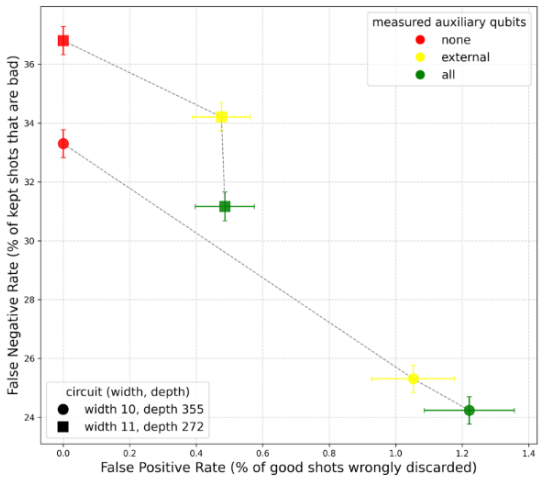
We introduce a low-overhead technique for quantum error mitigation based on post-selection using auxiliary qubit measurements. The method exploits the structural property that, in an error-free computation, auxiliary qubits are often expected to return to the zero state after use. By selectively measuring these qubits at carefully chosen points in the circuit, erroneous shots can be identified and discarded, improving result fidelity with minimal hardware overhead. To account for circuit noise, including measurement errors, we analyze the likelihood that a measurement outcome indicates a corrupted shot. This analysis is informed by the measurement's backward light cone, namely the set of circuit operations that could affect the outcome. Shots whose auxiliary measurement outcomes imply a corruption likelihood above a tunable threshold are rejected. Simulations show that the method reduces the false-negative rate by approximately 10% while discarding only approximately 1% of valid shots. The threshold controls the bias-variance tradeoff inherent to post-selection, allowing the method to be adapted to the fidelity and sampling requirements of different applications.
Editorial analysis
A structured set of objections, weighed in public.
Referee Report
Summary. The manuscript introduces a low-overhead quantum error mitigation technique based on post-selection of auxiliary qubit measurements. It exploits the property that auxiliary qubits return to |0⟩ in error-free circuits, analyzes the backward light cone of each measurement to estimate the likelihood that an outcome indicates a corrupted shot (including measurement errors), and rejects shots whose likelihood exceeds a tunable threshold. Simulations are reported to show an approximate 10% reduction in false-negative rate while discarding only ~1% of valid shots, with the threshold controlling the bias-variance tradeoff.
Significance. If the reported performance holds under realistic conditions, the method provides a resource-efficient error mitigation approach that requires no additional qubits beyond those already present in many algorithms and only selective mid-circuit measurements. The structural use of return-to-zero properties and the explicit handling of measurement errors in the likelihood calculation are positive features. The tunable threshold is a practical element for adapting to different sampling budgets.
major comments (2)
- [Abstract and simulation results] Abstract and simulation section: the central performance claims (∼10% false-negative reduction at ∼1% valid-shot discard) rest on simulations whose circuit models, noise assumptions (independent Pauli errors vs. spatially correlated or state-dependent readout errors), and benchmark circuits are not specified. Without these details it is impossible to verify whether the reported figures are reproducible or general.
- [Method description (likelihood analysis)] Likelihood estimation via backward light cone: the method computes per-shot corruption probability by assuming error probabilities factorize over the light-cone operations and that measurement error is independent of prior gates. On hardware exhibiting crosstalk or non-local correlations this factorization fails, so the estimated likelihood deviates from the true posterior and the claimed bias-variance tradeoff no longer holds.
minor comments (1)
- [Abstract] The abstract would benefit from a single sentence stating the noise model and circuit family used for the quoted 10% / 1% figures.
Simulated Author's Rebuttal
We thank the referee for the constructive feedback and positive assessment of the method's resource efficiency and practical features. We address each major comment below.
read point-by-point responses
-
Referee: [Abstract and simulation results] Abstract and simulation section: the central performance claims (∼10% false-negative reduction at ∼1% valid-shot discard) rest on simulations whose circuit models, noise assumptions (independent Pauli errors vs. spatially correlated or state-dependent readout errors), and benchmark circuits are not specified. Without these details it is impossible to verify whether the reported figures are reproducible or general.
Authors: We agree that explicit specification of simulation details is required for reproducibility. The full manuscript contains a dedicated simulation section, but to address this we will revise the abstract and insert a new subsection (or table) that specifies the circuit models, the noise assumptions (independent Pauli errors on gates together with independent measurement errors), and the benchmark circuits. The reported ~10% false-negative reduction at ~1% valid-shot discard is obtained under these conditions; the revision will make this fully verifiable. revision: yes
-
Referee: [Method description (likelihood analysis)] Likelihood estimation via backward light cone: the method computes per-shot corruption probability by assuming error probabilities factorize over the light-cone operations and that measurement error is independent of prior gates. On hardware exhibiting crosstalk or non-local correlations this factorization fails, so the estimated likelihood deviates from the true posterior and the claimed bias-variance tradeoff no longer holds.
Authors: The likelihood calculation does rely on factorization of error probabilities across the backward light cone and independence of measurement errors; this is an explicit modeling choice. We will add a limitations paragraph noting that strong crosstalk or non-local correlations can cause the estimated likelihood to deviate from the true posterior, thereby affecting the realized bias-variance tradeoff. At the same time the tunable threshold remains a practical control knob that can be calibrated on hardware, and the reported tradeoff is demonstrated under the independent-error model used in the simulations. revision: partial
Circularity Check
No circularity; claims rest on circuit structure and external simulations
full rationale
The paper grounds its method in the independent structural property that auxiliary qubits return to |0> in error-free circuits, then applies backward light-cone analysis to compute per-shot corruption likelihood (including measurement error) before applying a tunable threshold. The reported performance numbers (≈10% false-negative reduction, ≈1% valid-shot discard) are obtained from simulations, not from any equation or fit that reduces to the target metric by construction. No self-citations, self-definitional steps, or fitted-input-called-prediction patterns appear in the provided text. The threshold is presented as an explicit tunable parameter controlling bias-variance, not as a derived quantity forced by the data it evaluates.
Axiom & Free-Parameter Ledger
free parameters (1)
- threshold
axioms (2)
- domain assumption In an error-free computation, auxiliary qubits are expected to return to the zero state after use.
- domain assumption Backward light cone analysis can estimate the likelihood that a measurement outcome indicates a corrupted shot, accounting for circuit noise and measurement errors.
Reference graph
Works this paper leans on
-
[1]
Low-cost error mitigation by symmetry veri- fication.Physical Review A, 98(6):062339, 2018
Xavier Bonet-Monroig et al. Low-cost error mitigation by symmetry veri- fication.Physical Review A, 98(6):062339, 2018
2018
-
[2]
Quantum error mitigation.Nature Reviews Physics, 4:660–677, 2022
Zi-Hao Cai et al. Quantum error mitigation.Nature Reviews Physics, 4:660–677, 2022
2022
-
[3]
Automatically synthesized arithmetic cir- cuit with auxiliary reuse.https://platform.classiq.io/circuit/ 34v0Tbr2JJp5pXBhuIhgL0x7kfl
Classiq Technologies. Automatically synthesized arithmetic cir- cuit with auxiliary reuse.https://platform.classiq.io/circuit/ 34v0Tbr2JJp5pXBhuIhgL0x7kfl. Accessed 2026
2026
-
[4]
Error mitigation with clifford data regression.npj Quantum Information, 7(1):1–8, 2021
Piotr Czarnik et al. Error mitigation with clifford data regression.npj Quantum Information, 7(1):1–8, 2021
2021
-
[5]
Practical quantum error mitigation for near-future applications.Physical Review X, 8(3):031027, 2018
Suguru Endo, Simon C Benjamin, and Ying Li. Practical quantum error mitigation for near-future applications.Physical Review X, 8(3):031027, 2018. 8
2018
-
[6]
Tomer Goldfriend, Israel Reichental, Amir Naveh, Lior Gazit, Nadav Yoran, Ravid Alon, Shmuel Ur, Shahak Lahav, Eyal Cornfeld, Avi Elazari, Peleg Emanuel, Dor Harpaz, Tal Michaeli, Nati Erez, Lior Preminger, Ro- man Shapira, Erik Michael Garcell, Or Samimi, Sara Kisch, Gil Hallel, Gilad Kishony, Vincent van Wingerden, Nathaniel A. Rosenbloom, Ori Opher, Ma...
-
[7]
Virtual distillation for quantum error mitigation
William J Huggins et al. Virtual distillation for quantum error mitigation. PRX Quantum, 2(2):020318, 2021
2021
-
[8]
Efficient variational quantum simulator incorporating active error minimization.Physical Review X, 7(2):021050, 2017
Ying Li and Simon C Benjamin. Efficient variational quantum simulator incorporating active error minimization.Physical Review X, 7(2):021050, 2017
2017
-
[9]
Error mitigation using symmetry verification and sub- space expansion.npj Quantum Information, 5:75, 2019
Sam McArdle et al. Error mitigation using symmetry verification and sub- space expansion.npj Quantum Information, 5:75, 2019
2019
-
[10]
Quantum computing in the nisq era and beyond.Quantum, 2:79, 2018
John Preskill. Quantum computing in the nisq era and beyond.Quantum, 2:79, 2018
2018
-
[11]
Error mitigation for short-depth quantum circuits.Physical Review Letters, 119(18):180509, 2017
Kristan Temme, Sergey Bravyi, and Jay M Gambetta. Error mitigation for short-depth quantum circuits.Physical Review Letters, 119(18):180509, 2017. 9
2017
discussion (0)
Sign in with ORCID, Apple, or X to comment. Anyone can read and Pith papers without signing in.