A Lightweight Method for Multiple Signal Direction Estimation with Adaptive Notch Filters
Pith reviewed 2026-06-29 10:34 UTC · model grok-4.3
The pith
Cascaded adaptive notch filters isolate narrowband signals so Capon can estimate their directions with only two antennas.
A machine-rendered reading of the paper's core claim, the machinery that carries it, and where it could break.
Core claim
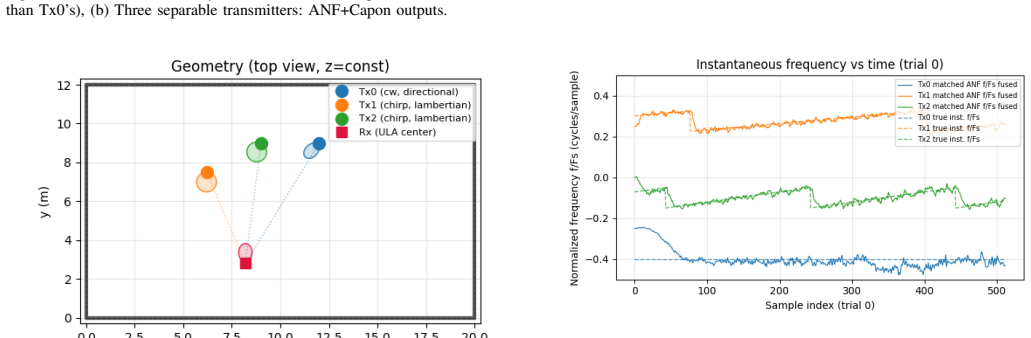
The paper claims that cascaded stages of adaptive notch filters form isolated channels for each narrowband signal, allowing Capon direction-of-arrival estimation to be applied to each channel separately. This enables simultaneous DoA estimation for two or more signals with only two antennas and very low computational cost. In simulations with signals separable in time, frequency, and angle, the performance approaches that of an oracle possessing prior knowledge of the signals. The method is implemented experimentally on a low-cost software-defined radio platform.
What carries the argument
Cascaded adaptive notch filter stages that create isolated channels per signal for subsequent per-channel Capon beamforming.
If this is right
- Only two antennas are needed regardless of the number of signals.
- Computational complexity remains low even as the number of signals increases.
- Performance nears that of methods with full prior signal knowledge under separability conditions.
- The technique is suitable for implementation on resource-constrained hardware like software-defined radios.
Where Pith is reading between the lines
- The isolation property of ANFs could extend to other array processing tasks beyond DoA.
- Combining this with other lightweight estimators might further reduce hardware requirements.
- Experimental validation on low-cost platforms suggests feasibility for real-world deployments where antenna count is limited.
Load-bearing premise
Signals must be narrowband and sufficiently separable in time, frequency, and angle for the notch filters to create isolated channels without interference.
What would settle it
Experiments with two signals at closely spaced frequencies would show failure to resolve directions accurately, confirming the stated limitation.
Figures

read the original abstract
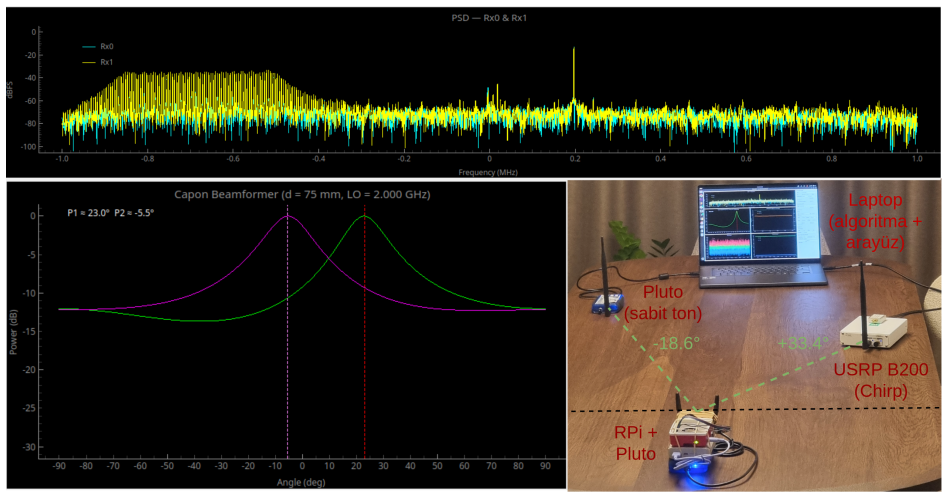
For multi-signal detection and direction-of-arrival (DoA) estimation, conventional Capon beamforming degrades when there are more transmitters than receive antennas minus one. This paper proposes a lightweight method using adaptive notch filters (ANFs) with only two receive antennas for simultaneous DoA of two or more narrowband signals. Cascaded ANF stages form isolated channels per signal, and Capon estimates direction on each. The method has very low computational cost, and in simulation, for transmitters separable in time, frequency, and angle, performance approaches that of an oracle with prior signal knowledge. As with ANFs themselves, multiple components at closely spaced frequencies are poorly resolved, forming the main limitation of the proposed method. Simulations are complemented by an experimental implementation on a low-cost software-defined radio (ADALM-Pluto).
Editorial analysis
A structured set of objections, weighed in public.
Referee Report
Summary. The paper proposes a lightweight DoA estimation technique for multiple narrowband signals that uses only two receive antennas. Cascaded adaptive notch filter (ANF) stages are claimed to produce isolated per-signal channels on which independent Capon beamformers then operate; the approach is asserted to have very low computational cost and, in simulations with signals separable in time/frequency/angle, to approach oracle performance. An experimental validation on an ADALM-Pluto SDR is also presented. The principal limitation stated is poor resolution of closely spaced frequencies.
Significance. If the isolation property holds without distorting the spatial covariance and the performance claims are reproducible, the method would provide a practical, low-complexity route to multi-signal DoA estimation on minimal hardware, extending Capon applicability beyond the classical M-1 limit. The combination of simulation and SDR experiment strengthens the practical relevance.
major comments (2)
- [Method description / simulation setup] The central claim that cascaded ANFs produce truly isolated channels for independent Capon processing requires explicit verification that the notch filters preserve the relative phase and amplitude information across the two antennas; any differential filtering effect would invalidate the subsequent spatial covariance estimate. This point is load-bearing for the entire method and should be addressed with either analytic derivation or controlled numerical checks in the method or results section.
- [Simulation results] The simulation results assert performance 'approaches that of an oracle'; however, the separability conditions (minimum frequency separation, time overlap, angular separation) under which this holds are not quantified with error bars or failure cases, making it difficult to judge the robustness of the claim relative to the stated limitation on closely spaced frequencies.
minor comments (3)
- [Notation / method] Notation for the ANF coefficients and the per-channel Capon weight vector should be introduced consistently and early; current usage mixes time-domain and frequency-domain symbols without clear definition.
- [Experimental results] The experimental section would benefit from a table comparing measured DoA error and runtime against a conventional multi-antenna Capon baseline on the same hardware.
- [Figures] Figure captions should explicitly state the number of signals, SNR, and frequency separations used in each panel.
Simulated Author's Rebuttal
We thank the referee for the constructive comments and the recommendation of minor revision. We address each major comment below and will update the manuscript accordingly.
read point-by-point responses
-
Referee: The central claim that cascaded ANFs produce truly isolated channels for independent Capon processing requires explicit verification that the notch filters preserve the relative phase and amplitude information across the two antennas; any differential filtering effect would invalidate the subsequent spatial covariance estimate. This point is load-bearing for the entire method and should be addressed with either analytic derivation or controlled numerical checks in the method or results section.
Authors: We agree this verification is essential. In the proposed architecture the ANF coefficients are computed once (from a combined or reference channel) and applied identically to both antenna signals; because the transfer function is therefore common to both channels, relative phase and amplitude are preserved and the spatial covariance matrix is undistorted. We will add a short analytic derivation of this property together with a controlled numerical check (pre- versus post-ANF covariance comparison) in the method section of the revised manuscript. revision: yes
-
Referee: The simulation results assert performance 'approaches that of an oracle'; however, the separability conditions (minimum frequency separation, time overlap, angular separation) under which this holds are not quantified with error bars or failure cases, making it difficult to judge the robustness of the claim relative to the stated limitation on closely spaced frequencies.
Authors: We accept that explicit quantification would improve clarity. The revised manuscript will include additional simulation results that report mean and standard-deviation DoA error versus minimum frequency separation, time-overlap fraction, and angular separation, with error bars and selected failure cases near the separability boundary. These results will be placed alongside the existing discussion of the method’s limitation for closely spaced frequencies. revision: yes
Circularity Check
No significant circularity
full rationale
The paper's core claim is that cascaded ANF stages isolate narrowband signals (under explicit separability in time/frequency/angle) so that per-channel Capon can be applied; this is presented as a lightweight engineering method with stated limitations on close frequencies. No derivation step reduces to a fitted parameter renamed as prediction, self-definition of outputs from inputs, or load-bearing self-citation chain. The method is conditioned on observable assumptions and validated in simulation plus hardware, making the chain self-contained against external benchmarks.
Axiom & Free-Parameter Ledger
Reference graph
Works this paper leans on
-
[1]
2)Üç verici:aynı deneyin üç verici ile tekrarı, ve ayrıklı˘gın azalmasının negatif etkisinin gözlemi
˙Iki verici:zaman-frekans-açı düzlemlerinde yeterince ayrık iki kaynak için sonuçlar, ve kahin yöntem ile kar¸ sıla¸ stırma. 2)Üç verici:aynı deneyin üç verici ile tekrarı, ve ayrıklı˘gın azalmasının negatif etkisinin gözlemi. 3)Sınır analizi:önerilen yöntemin limitlerini belirleyen, iki vericinin birbirine yakla¸ smasıyla ANF izlerinin birbirine karı¸ sm...
-
[2]
H. L. Van Trees,Detection, Estimation, and Modulation Theory, Part IV: Optimum Array Processing. New York, NY , USA: Wiley, 2002
2002
-
[3]
High-resolution frequency-wavenumber spectrum analysis,
J. Capon, “High-resolution frequency-wavenumber spectrum analysis,” Proc. IEEE, vol. 57, no. 8, pp. 1408–1418, Aug. 1969
1969
-
[4]
Multiple emitter location and signal parameter estima- tion,
R. O. Schmidt, “Multiple emitter location and signal parameter estima- tion,”IEEE Trans. Antennas Propag., vol. 34, no. 3, pp. 276–280, Mar. 1986
1986
-
[5]
X. Wang, Z. Huang, and Y . Zhou, “Underdetermined DOA estimation and blind separation of non-disjoint sources in time-frequency domain based on sparse representation method,”J. Syst. Eng. Electron., vol. 25, no. 1, pp. 17–25, Feb. 2014, doi: 10.1109/JSEE.2014.00003
-
[6]
W.-K. Ma, T.-H. Hsieh, and C.-Y . Chi, “DOA estimation of quasi- stationary signals with less sensors than sources and unknown spatial noise covariance: A Khatri–Rao subspace approach,”IEEE Trans. Signal Process., vol. 58, no. 4, pp. 2168–2180, Apr. 2010, doi: 10.1109/TSP.2009.2034935
-
[7]
A minimal parameter adaptive notch filter with constra- ined poles and zeros,
A. Nehorai, “A minimal parameter adaptive notch filter with constra- ined poles and zeros,”IEEE Trans. Acoust., Speech, Signal Process., vol. ASSP-33, no. 4, pp. 983–996, Aug. 1985
1985
-
[8]
Analysis of the one-pole notch filter for interference mitiga- tion: Wiener solution and loss estimations,
D. Borio, “Analysis of the one-pole notch filter for interference mitiga- tion: Wiener solution and loss estimations,” inProc. ION GNSS, Fort Worth, TX, USA, Sep. 2006
2006
-
[9]
FPGA imp- lementation issues of a two-pole adaptive notch filter for GPS/Galileo receivers,
M. Troglia Gamba, E. Falletti, D. Rovelli, and A. Tuozzi, “FPGA imp- lementation issues of a two-pole adaptive notch filter for GPS/Galileo receivers,” inProc. ION GNSS, Nashville, TN, USA, Sep. 2012, pp. 3549–3557
2012
-
[10]
Haykin,Adaptive Filter Theory, 5th ed
S. Haykin,Adaptive Filter Theory, 5th ed. Upper Saddle River, NJ, USA: Pearson, 2013
2013
-
[11]
A. M. Molaei, B. Zakeri, S. M. Hosseini Andargoli, M. A. B. Abbasi, V . Fusco, and O. Yurduseven, “A comprehensive review of direction-of-arrival estimation and localization approaches in mixed- field sources scenario,”IEEE Access, vol. 12, pp. 65883–65918, 2024, doi: 10.1109/ACCESS.2024.3398351
discussion (0)
Sign in with ORCID, Apple, or X to comment. Anyone can read and Pith papers without signing in.