On the existence of fully inseparable biseparable Gaussian states
Pith reviewed 2026-06-29 11:45 UTC · model grok-4.3
The pith
All fully inseparable Gaussian states turn out to be genuinely multipartite entangled.
A machine-rendered reading of the paper's core claim, the machinery that carries it, and where it could break.
Core claim
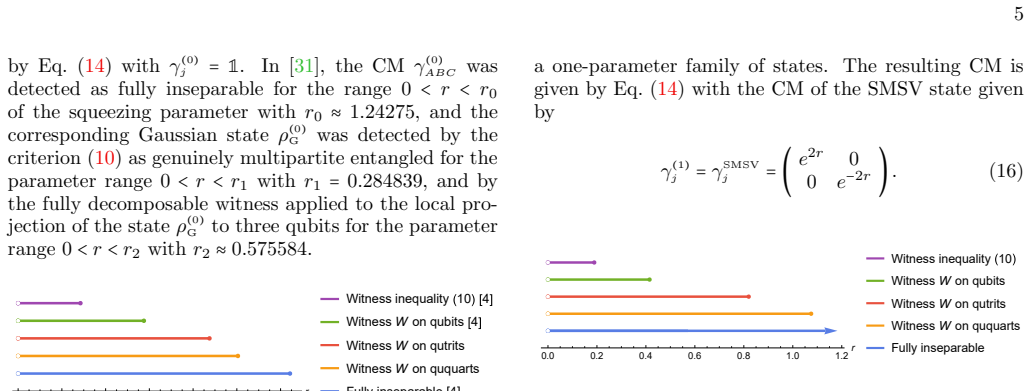
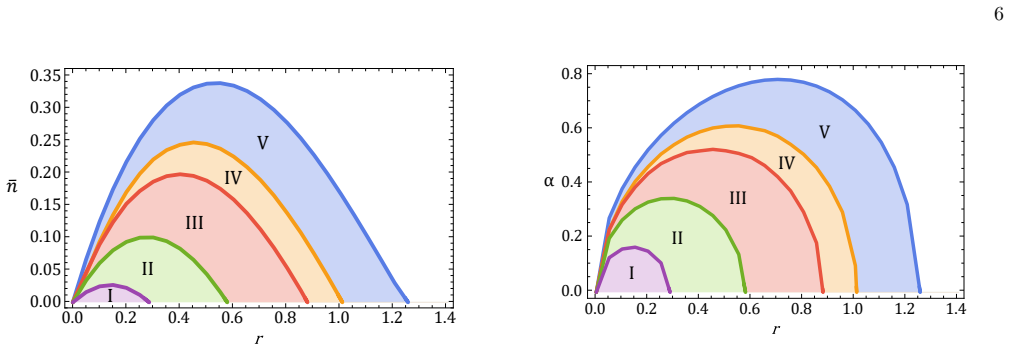
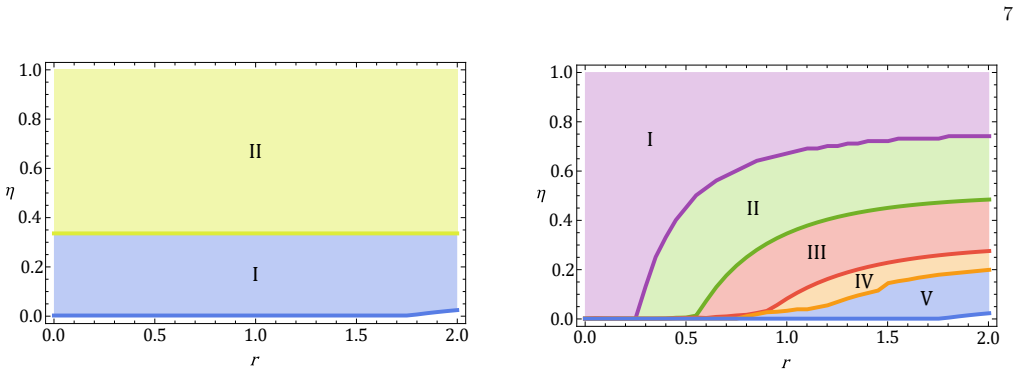
The authors show for archetypical families of multimode Gaussian states that regions of candidate fully inseparable biseparable states shrink under projections to finite-dimensional subspaces of increasing dimension when tested with fully decomposable witnesses, and they therefore conjecture that every fully inseparable Gaussian state is genuinely multipartite entangled.
What carries the argument
Finite-dimensional subspace projections combined with fully decomposable witnesses that detect the shrinking of candidate regions for fully inseparable biseparable states.
If this is right
- Full inseparability becomes equivalent to genuine multipartite entanglement for all Gaussian states.
- No Gaussian state can be prepared as a convex mixture of biseparable states across different partitions while still being fully inseparable.
- Entanglement classification for continuous-variable systems simplifies because one expected intermediate class is ruled out.
- Witness-based detection methods for Gaussian states gain a stronger guarantee that detected full inseparability implies genuine multipartite entanglement.
Where Pith is reading between the lines
- If the conjecture holds, numerical searches for Gaussian entanglement resources can safely treat full inseparability and genuine multipartite entanglement as interchangeable labels.
- The same projection technique might be applied to other continuous-variable state families to test whether the equivalence extends beyond Gaussians.
- Experimental preparation of multimode Gaussian light could focus on verifying genuine multipartite entanglement once full inseparability is confirmed, without separate checks for biseparability.
Load-bearing premise
That continued shrinking of the candidate regions as the projection dimension grows implies the complete absence of fully inseparable biseparable states for the original infinite-dimensional Gaussian states.
What would settle it
An explicit multimode Gaussian covariance matrix whose entanglement properties remain fully inseparable and biseparable after the limit of increasing projection dimension is taken.
Figures
read the original abstract
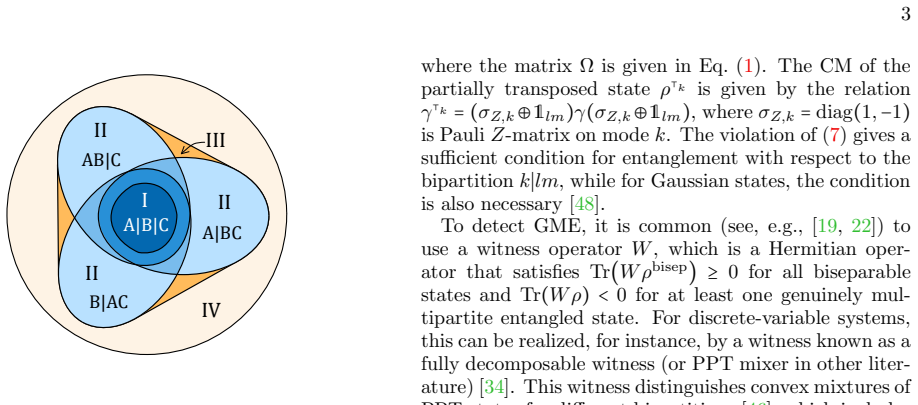
Genuine multipartite entanglement and full inseparability are two inequivalent quantum resources. Even though all genuinely multipartite entangled states are also fully inseparable, not all fully inseparable states are genuinely multipartite entangled. There exist fully inseparable states that can be prepared as convex mixtures of states separable with respect to different bipartite splits. Here, we are interested in examples of Gaussian states that possess this type of entanglement, so-called fully inseparable biseparable states. We show for several archetypical families of multimode Gaussian states that fully inseparable biseparable candidate states are actually genuinely multipartite entangled. Using projections to finite-dimensional subspaces and fully decomposable witnesses, we observe a shrinking of the regions of potentially fully inseparable biseparable Gaussian states with growing dimension of the projection subspaces. We therefore conjecture that all fully inseparable Gaussian states are genuinely multipartite entangled.
Editorial analysis
A structured set of objections, weighed in public.
Referee Report
Summary. The paper investigates whether fully inseparable biseparable Gaussian states exist among multimode continuous-variable systems. For several archetypical families, the authors apply projections to finite-dimensional subspaces combined with fully decomposable witnesses and report that candidate regions for fully inseparable biseparable states shrink as the projection dimension increases. On this basis they conjecture that all fully inseparable Gaussian states are genuinely multipartite entangled.
Significance. If the conjecture is correct, it would show that the two entanglement notions coincide for Gaussian states, in contrast to the general case where fully inseparable biseparable states are known to exist. The numerical evidence obtained from independent witnesses and systematic projection is suggestive for the families examined and constitutes a concrete step toward resolving the question in the Gaussian setting.
major comments (2)
- [abstract] Abstract (final paragraph): the conjecture that shrinking of candidate regions under finite-dimensional projections implies the non-existence of fully inseparable biseparable states in the infinite-dimensional Gaussian limit is not supported by a rigorous limit argument. The possibility remains that a state could be biseparable with respect to varying partitions only when the full infinite-dimensional space is considered, with the entanglement signature appearing outside every finite subspace.
- [abstract] Abstract: the numerical analysis is performed only on several archetypical families, yet the conjecture is formulated for the entire class of multimode Gaussian states. This extrapolation is load-bearing for the central claim and requires either additional analytic support or explicit qualification of the conjecture's scope.
minor comments (1)
- The description of the projection procedure and the precise range of subspace dimensions employed could be stated more explicitly to allow readers to assess the rate of shrinkage.
Simulated Author's Rebuttal
We thank the referee for the careful reading and constructive feedback on our manuscript. We address the major comments point by point below, proposing revisions to qualify the conjecture appropriately.
read point-by-point responses
-
Referee: [abstract] Abstract (final paragraph): the conjecture that shrinking of candidate regions under finite-dimensional projections implies the non-existence of fully inseparable biseparable states in the infinite-dimensional Gaussian limit is not supported by a rigorous limit argument. The possibility remains that a state could be biseparable with respect to varying partitions only when the full infinite-dimensional space is considered, with the entanglement signature appearing outside every finite subspace.
Authors: We agree that the observed shrinking of candidate regions under increasing projection dimension provides only numerical support and does not constitute a rigorous limit argument establishing non-existence in the infinite-dimensional case. The conjecture is presented as such, and the possibility noted by the referee cannot be excluded on the basis of our analysis. We will revise the abstract to explicitly describe the claim as a numerically motivated conjecture without a rigorous proof of the infinite-dimensional implication. revision: partial
-
Referee: [abstract] Abstract: the numerical analysis is performed only on several archetypical families, yet the conjecture is formulated for the entire class of multimode Gaussian states. This extrapolation is load-bearing for the central claim and requires either additional analytic support or explicit qualification of the conjecture's scope.
Authors: The numerical evidence is restricted to the archetypical families described in the manuscript. We accept that formulating the conjecture for all multimode Gaussian states requires qualification. We will revise the abstract to limit the stated conjecture to the families examined, while retaining the broader motivation for the Gaussian setting. revision: partial
Circularity Check
No circularity; numerical observations and conjecture are independent of fitted inputs or self-citations
full rationale
The paper's central steps consist of applying known fully decomposable witnesses and finite-dimensional projections drawn from prior independent literature to several families of multimode Gaussian states, observing contraction of candidate regions, and extrapolating to a conjecture. No equation reduces a claimed prediction to a fitted parameter by construction, no load-bearing premise rests on a self-citation chain, and the conjecture is explicitly presented as an observational extrapolation rather than a definitional identity. The analysis is therefore self-contained against external benchmarks.
Axiom & Free-Parameter Ledger
axioms (2)
- domain assumption Gaussian states are completely characterized by their first and second moments (covariance matrix)
- domain assumption Fully decomposable witnesses can certify genuine multipartite entanglement when applied to projected states
Reference graph
Works this paper leans on
-
[1]
Stefan B¨ auml and Koji Azuma,Fundamental limitation on quantum broadcast networks,Quantum Sci. Technol. 2, 024004 (2017), arXiv:1609.03994
work page internal anchor Pith review Pith/arXiv arXiv 2017
-
[2]
Multi-partite entanglement speeds up quantum key distribution in networks
Michael Epping, Hermann Kampermann, Chiara Mac- chiavello, and Dagmar Bruß,Multi-partite entanglement can speed up quantum key distribution in networks,New J. Phys.19, 093012 (2017), arXiv:1612.05585
work page internal anchor Pith review Pith/arXiv arXiv 2017
-
[3]
Matej Pivoluska, Marcus Huber, and Mehul Malik,Lay- ered quantum key distribution,Phys. Rev. A97, 032312 (2018), arXiv:1709.00377
work page internal anchor Pith review Pith/arXiv arXiv 2018
- [4]
- [5]
-
[6]
Dagmar Bruß and Chiara Macchiavello,Multipartite en- tanglement in quantum algorithms,Phys. Rev. A83, 052313 (2011), arXiv:1007.4179. 10
work page internal anchor Pith review Pith/arXiv arXiv 2011
-
[7]
Andrew J. Scott,Multipartite entanglement, quantum- error-correcting codes, and entangling power of quantum evolutions,Phys. Rev. A69, 052330 (2004), arXiv:quant- ph/0310137
-
[8]
Quantum computing via measurements only
Robert Raussendorf and Hans J. Briegel,A One-Way Quantum Computer,Phys. Rev. Lett.86, 5188 (2001), arXiv:quant-ph/0010033
work page internal anchor Pith review Pith/arXiv arXiv 2001
-
[9]
Persistent entanglement in arrays of interacting particles
Hans J. Briegel and Robert Raussendorf,Persistent En- tanglement in Arrays of Interacting Particles,Phys. Rev. Lett.86, 910 (2001), arXiv:quant-ph/0004051
work page internal anchor Pith review Pith/arXiv arXiv 2001
-
[10]
The structure of multidimensional entanglement in multipartite systems
Marcus Huber and Julio I. de Vicente,Structure of multi- dimensional entanglement in multipartite systems,Phys. Rev. Lett.110, 030501 (2013), arXiv:1210.6876
work page internal anchor Pith review Pith/arXiv arXiv 2013
-
[11]
The maximally entangled set of multipartite quantum states
Julio I. de Vicente, Cornelia Spee, and Barbara Kraus,Maximally Entangled Set of Multipartite Quan- tum States,Phys. Rev. Lett.111, 110502 (2013), arXiv:1305.7398
work page internal anchor Pith review Pith/arXiv arXiv 2013
-
[12]
Entanglement manipulation of multipartite pure states with finite rounds of classical communication
Julio I. de Vicente, Cornelia Spee, David Sauerwein, and Barbara Kraus,Entanglement manipulation of multipar- tite pure states with finite rounds of classical communica- tion,Phys. Rev. A95, 012323 (2017), arXiv:1607.05145
work page internal anchor Pith review Pith/arXiv arXiv 2017
- [13]
-
[14]
Cornelia Spee, Julio I. de Vicente, David Sauerwein, and Barbara Kraus,Entangled Pure State Transformations via Local Operations Assisted by Finitely Many Rounds of Classical Communication,Phys. Rev. Lett.118, 040503 (2017), arXiv:1606.04418
work page internal anchor Pith review Pith/arXiv arXiv 2017
- [15]
- [16]
-
[17]
Nicky Kai Hong Li, Cornelia Spee, Martin Hebenstreit, Julio I. de Vicente, and Barbara Kraus,Identifying families of multipartite states with non-trivial local en- tanglement transformations,Quantum8, 1270 (2024), arXiv:2302.03139
- [18]
-
[19]
Otfried G¨ uhne and G´ eza T´ oth,Entanglement detection, Phys. Rep.474, 1 (2009), arXiv:0811.2803
work page internal anchor Pith review Pith/arXiv arXiv 2009
-
[20]
Criterion for k-separability in mixed multipartite systems
Andreas Gabriel, Beatrix C. Hiesmayr, and Marcus Huber,Criterion for k-separability in mixed multipar- tite systems,Quantum Inf. Comput.10, 0829 (2010), arXiv:1002.2953
work page internal anchor Pith review Pith/arXiv arXiv 2010
-
[21]
Observation of Entangled States of a Fully Controlled 20-Qubit System
Nicolai Friis, Oliver Marty, Christine Maier, Cornelius Hempel, Milan Holz¨ apfel, Petar Jurcevic, Martin B. Ple- nio, Marcus Huber, Christian Roos, Rainer Blatt, and Ben Lanyon,Observation of Entangled States of a Fully Controlled 20-Qubit System,Phys. Rev. X8, 021012 (2018), arXiv:1711.11092
work page internal anchor Pith review Pith/arXiv arXiv 2018
-
[22]
Nicolai Friis, Giuseppe Vitagliano, Mehul Malik, and Marcus Huber,Entanglement Certification From The- ory to Experiment,Nat. Rev. Phys.1, 72 (2019), arXiv:1906.10929
work page internal anchor Pith review Pith/arXiv arXiv 2019
-
[23]
Nicky Kai Hong Li, Xi Dai, Manuel H. Mu˜ noz-Arias, Kevin Reuer, Marcus Huber, and Nicolai Friis,Detecting genuine multipartite entanglement in multi-qubit devices with restricted measurements,Nat. Commun.17, 1707 (2026), arXiv:2504.21076
-
[24]
Quantum information with continuous variables
Samuel L. Braunstein and Peter van Loock,Quantum information with continuous variables,Rev. Mod. Phys. 77, 513 (2005), arXiv:quant-ph/0410100
work page internal anchor Pith review Pith/arXiv arXiv 2005
-
[25]
Christian Weedbrook, Stefano Pirandola, Ra´ ul Garc´ ıa- Patr´ on, Nicolas J. Cerf, Timothy C. Ralph, Jeffrey H. Shapiro, and Seth Lloyd,Gaussian quantum informa- tion,Rev. Mod. Phys.84, 621 (2012), arXiv:1110.3234
work page internal anchor Pith review Pith/arXiv arXiv 2012
-
[26]
Continuous variable quantum information: Gaussian states and beyond
Gerardo Adesso, Sammy Ragy, and Antony R. Lee,Con- tinuous Variable Quantum Information: Gaussian States and Beyond,Open Syst. Inf. Dyn.21, 1440001 (2014), arXiv:1401.4679
work page internal anchor Pith review Pith/arXiv arXiv 2014
-
[27]
Geza Giedke, Barbara Kraus, Maciej Lewenstein, and Juan Ignacio Cirac,Separability properties of three- mode Gaussian states,Phys. Rev. A64, 052303 (2001), arXiv:quant-ph/0103137
work page internal anchor Pith review Pith/arXiv arXiv 2001
-
[28]
Gerardo Adesso, Alessio Serafini, and Fabrizio Illu- minati,Multipartite entanglement in three-mode Gaus- sian states of continuous variable systems: Quantifica- tion, sharing structure and decoherence,Phys. Rev. A 73, 032345 (2006), arXiv:quant-ph/0512124
work page internal anchor Pith review Pith/arXiv arXiv 2006
-
[29]
Tohya Hiroshima, Gerardo Adesso, and Fabrizio Il- luminati,Monogamy Inequality for Distributed Gaus- sian Entanglement,Phys. Rev. Lett.98, 050503 (2007), arXiv:quant-ph/0605021
work page internal anchor Pith review Pith/arXiv arXiv 2007
-
[30]
Criteria for genuine N-partite continuous variable entanglement and Einstein-Podolsky_Rosen steering
Run Yan Teh and Margaret D. Reid,Criteria for genuine n-partite continuous-variable entanglement and einstein- podolsky-rosen steering,Phys. Rev. A90, 062337 (2014), arXiv:1310.2690
work page internal anchor Pith review Pith/arXiv arXiv 2014
- [31]
-
[32]
Philipp Hyllus and Jens Eisert,Optimal entanglement witnesses for continuous-variable systems,New J. Phys. 8, 51 (2006), arXiv:quant-ph/0510077
work page internal anchor Pith review Pith/arXiv arXiv 2006
-
[33]
Multipartite entanglement for continuous variables: A quantum teleportation network
Peter van Loock and Samuel L. Braunstein,Multipar- tite Entanglement for Continuous Variables: A Quantum Teleportation Network,Phys. Rev. Lett.84, 3482 (2000), arXiv:quant-ph/9906021
work page internal anchor Pith review Pith/arXiv arXiv 2000
-
[34]
Bastian Jungnitsch, Tobias Moroder, and Otfried G¨ uhne,Taming Multiparticle Entanglement,Phys. Rev. Lett.106, 190502 (2011), arXiv:1010.6049
work page internal anchor Pith review Pith/arXiv arXiv 2011
- [35]
-
[36]
Carlos Palazuelos and Julio I. de Vicente,Gen- uine multipartite entanglement of quantum states in the multiple-copy scenario,Quantum6, 735 (2022), arXiv:2201.08694
-
[37]
Robert St´ arek, Tim Gollerthan, Olga Leskovjanov´ a, Michael Meth, Peter Tirler, Nicolai Friis, Martin Ring- bauer, and Ladislav Miˇ sta Jr.,Experimental Verifi- cation of Multicopy Activation of Genuine Multipartite Entanglement,Phys. Rev. Lett.136, 160201 (2026), arXiv:2510.12457
work page internal anchor Pith review Pith/arXiv arXiv 2026
- [38]
-
[39]
Wigner,On the Quantum Correction For Thermodynamic Equilibrium,Phys
Eugene P. Wigner,On the Quantum Correction For Thermodynamic Equilibrium,Phys. Rev.40, 749 (1932)
1932
-
[40]
Simon, N
R. Simon, N. Mukunda, and Biswadeb Dutta,Quantum- noise matrix for multimode systems: U(n) invariance, squeezing, and normal forms,Phys. Rev. A49, 1567 (1994)
1994
-
[41]
Rajiah Simon,Peres-Horodecki Separability Criterion for Continuous Variable Systems,Phys. Rev. Lett.84, 2726 (2000), arXiv:quant-ph/9909044
work page internal anchor Pith review Pith/arXiv arXiv 2000
-
[42]
Werner,Quantum states with Einstein- Podolsky-Rosen correlations admitting a hidden-variable model,Phys
Reinhard F. Werner,Quantum states with Einstein- Podolsky-Rosen correlations admitting a hidden-variable model,Phys. Rev. A40, 4277 (1989)
1989
-
[43]
Ryszard Horodecki, Pawe l Horodecki, Micha l Horodecki, and Karol Horodecki,Quantum entanglement,Rev. Mod. Phys.81, 865 (2009), arXiv:quant-ph/0702225
work page internal anchor Pith review Pith/arXiv arXiv 2009
-
[44]
Jean-Daniel Bancal, Nicolas Gisin, Yeong-Cherng Liang, and Stefano Pironio,Device-Independent Witnesses of Genuine Multipartite Entanglement,Phys. Rev. Lett. 106, 250404 (2011), arXiv:1102.0197
work page internal anchor Pith review Pith/arXiv arXiv 2011
-
[45]
Bertlmann and Nicolai Friis,Modern Quan- tum Theory – From Quantum Mechanics to Entan- glement and Quantum Information(Oxford University Press, Oxford, U.K., 2023)
Reinhold A. Bertlmann and Nicolai Friis,Modern Quan- tum Theory – From Quantum Mechanics to Entan- glement and Quantum Information(Oxford University Press, Oxford, U.K., 2023)
2023
-
[46]
Micha l Horodecki, Pawe l Horodecki, and Ryszard Horodecki,Separability of mixed states: necessary and sufficient conditions,Phys. Lett. A223, 25 (1996), arXiv:quant-ph/9605038
work page internal anchor Pith review Pith/arXiv arXiv 1996
- [47]
-
[48]
Bound entangled Gaussian states
Reinhard F. Werner and Michael M. Wolf,Bound Entan- gled Gaussian States,Phys. Rev. Lett.86, 3658 (2001), arXiv:quant-ph/0009118
work page internal anchor Pith review Pith/arXiv arXiv 2001
-
[49]
Nicolai Friis, Marcus Huber, Ivette Fuentes, and David Edward Bruschi,Quantum gates and multi- partite entanglement resonances realized by nonuni- form cavity motion,Phys. Rev. D86, 105003 (2012), arXiv:1207.1827
work page internal anchor Pith review Pith/arXiv arXiv 2012
-
[50]
G´ eza T´ oth and Otfried G¨ uhne,Entanglement detection in the stabilizer formalism,Phys. Rev. A72, 022340 (2005), arXiv:quant-ph/0501020
work page internal anchor Pith review Pith/arXiv arXiv 2005
-
[51]
Koenraad M. R. Audenaert and Martin B. Plenio,En- tanglement on mixed stabilizer states: normal forms and reduction procedures,New J. Phys.7, 170 (2005), arXiv:quant-ph/0505036
work page internal anchor Pith review Pith/arXiv arXiv 2005
-
[52]
Graeme Smith and Debbie Leung,Typical entanglement of stabilizer states,Phys. Rev. A74, 062314 (2006), arXiv:quant-ph/0510232
work page internal anchor Pith review Pith/arXiv arXiv 2006
-
[53]
Marc Hein, Wolfgang D¨ ur, Jens Eisert, Robert Raussendorf, Maarten Van den Nest, and Hans J. Briegel,Entanglement in graph states and its appli- cations,Proceedings of the International School of Physics ”Enrico Fermi”162, 115 (2005), arXiv:quant- ph/0602096
-
[54]
Bastian Jungnitsch, Tobias Moroder, and Otfried G¨ uhne,Entanglement witnesses for graph states: Gen- eral theory and examples,Phys. Rev. A84, 032310 (2011), arXiv:1106.1114
work page internal anchor Pith review Pith/arXiv arXiv 2011
- [55]
-
[56]
Otfried G¨ uhne and Michael Seevinck,Separability crite- ria for genuine multiparticle entanglement,New J. Phys. 12, 053002 (2010), arXiv:0905.1349
work page internal anchor Pith review Pith/arXiv arXiv 2010
-
[57]
Detection of high-dimensional genuine multi-partite entanglement of mixed states
Marcus Huber, Florian Mintert, Andreas Gabriel, and Beatrix C. Hiesmayr,Detection of High-Dimensional Genuine Multipartite Entanglement of Mixed States, Phys. Rev. Lett.104, 210501 (2010), arXiv:0912.1870
work page internal anchor Pith review Pith/arXiv arXiv 2010
-
[58]
Marcel Bergmann and Otfried G¨ uhne,Entanglement cri- teria for Dicke states,J. Phys. A: Math. Theor.46, 385304 (2013), arXiv:1305.2818
work page internal anchor Pith review Pith/arXiv arXiv 2013
-
[59]
G´ eza T´ oth and Otfried G¨ uhne,Entanglement and Per- mutational Symmetry,Phys. Rev. Lett.102, 170503 (2009), arXiv:0812.4453
work page internal anchor Pith review Pith/arXiv arXiv 2009
-
[60]
Marius Paraschiv, Nikolai Miklin, Tobias Moroder, and Otfried G¨ uhne,Proving genuine multiparticle entangle- ment from separable nearest-neighbor marginals,Phys. Rev. A98, 062102 (2018), arXiv:1705.02696
work page internal anchor Pith review Pith/arXiv arXiv 2018
-
[61]
Marco Canteri, James Bate, Ida Mishra, Nicolai Friis, Victor Krutyanskiy, and Benjamin P. Lanyon,Gen- eration of multipartite photonic entanglement using a trapped-ion quantum processing node,arXiv:2510.15693 (2025)
-
[62]
Marcus Huber, Mart´ ı Perarnau-Llobet, and Julio I. de Vicente,The entropy vector formalism and the structure of multidimensional entanglement in multi- partite systems,Phys. Rev. A88, 042328 (2013), arXiv:1307.3541
work page internal anchor Pith review Pith/arXiv arXiv 2013
- [63]
-
[64]
Jan Provazn´ ık,witnessmess,https://github.com/ jan-provaznik/witnessmess
-
[65]
Evgeny Shchukin and Peter van Loock,General- ized conditions for genuine multipartite continuous- variable entanglement,Phys. Rev. A92, 042328 (2015), arXiv:1503.05001
work page internal anchor Pith review Pith/arXiv arXiv 2015
-
[66]
Systematic Construction of Genuine Multipartite Entanglement Criteria using Uncertainty Relations
Fabricio Toscano, A. Saboia, Ardiley T. Avelar, and Stephen Patrick Walborn,Systematic construc- tion of genuine-multipartite-entanglement criteria in continuous-variable systems using uncertainty relations, Phys. Rev. A92, 052316 (2015), arXiv:1407.7248
work page internal anchor Pith review Pith/arXiv arXiv 2015
-
[67]
Evgeny Shchukin and Peter van Loock,Tripartite separa- bility conditions exponentially violated by gaussian states, Phys. Rev. A90, 012334 (2014), arXiv:1402.1701
work page internal anchor Pith review Pith/arXiv arXiv 2014
- [68]
-
[69]
Henning Vahlbruch, Moritz Mehmet, Karsten Danz- mann, and Roman Schnabel,Detection of 15 db squeezed states of light and their application for the absolute cal- ibration of photoelectric quantum efficiency,Phys. Rev. Lett.117, 110801 (2016)
2016
-
[70]
Henry Teicher,On the Mixture of Distributions,Ann. Math. Statist.31, 55–73 (1960)
1960
-
[71]
Henry Teicher,Identifiability of Finite Mixtures,Ann. Math. Statist.34, 1265–1269 (1963)
1963
-
[72]
Ultra-Large-Scale Continuous-Variable Cluster States Multiplexed in the Time Domain
Shota Yokoyama, Ryuji Ukai, Seiji C. Armstrong, Chanond Sornphiphatphong, Toshiyuki Kaji, Shigenari Suzuki, Jun-ichi Yoshikawa, Hidehiro Yonezawa, Nico- las C. Menicucci, and Akira Furusawa,Ultra-large-scale continuous-variable cluster states multiplexed in the time 12 domain,Nat. Photonics7, 982 (2013), arXiv:1306.3366
work page internal anchor Pith review Pith/arXiv arXiv 2013
-
[73]
Moran Chen, Nicolas C. Menicucci, and Olivier Pfister, Experimental Realization of Multipartite Entanglement of 60 Modes of a Quantum Optical Frequency Comb, Phys. Rev. Lett.112, 120505 (2014), arXiv:1311.2957
work page internal anchor Pith review Pith/arXiv arXiv 2014
-
[74]
Stefan Gerke, Jan Sperling, Werner Vogel, Yin Cai, Jonathan Roslund, Nicolas Treps, and Claude Fabre,Full Multipartite Entanglement of Frequency- Comb Gaussian States,Phys. Rev. Lett.114, 050501 (2015), arXiv:1409.5692
work page internal anchor Pith review Pith/arXiv arXiv 2015
-
[75]
Jun-ichi Yoshikawa, Shota Yokoyama, Toshiyuki Kaji, Chanond Sornphiphatphong, Yu Shiozawa, Kenzo Makino, and Akira Furusawa,Invited article: Gen- eration of one-million-mode continuous-variable cluster state by unlimited time-domain multiplexing,APL Pho- tonics1(2016), arXiv:1606.06688
work page internal anchor Pith review Pith/arXiv arXiv 2016
-
[76]
MOSEK ApS,MOSEK Optimizer API for Python 11.2.0 (2026)
2026
-
[77]
Harris, K
Charles R. Harris, K. Jarrod Millman, St´ efan J. van der Walt, Ralf Gommers, Pauli Virtanen, David Cour- napeau, Eric Wieser, Julian Taylor, Sebastian Berg, Nathaniel J. Smith, Robert Kern, Matti Picus, Stephan Hoyer, Marten H. van Kerkwijk, Matthew Brett, Al- lan Haldane, Jaime Fern´ andez del R´ ıo, Mark Wiebe, Pearu Peterson, Pierre G´ erard-Marchant,...
2020
-
[78]
Oliphant, Matt Haberland, Tyler Reddy, David Cournapeau, Evgeni Burovski, Pearu Peterson, Warren Weckesser, Jonathan Bright, St´ efan J
Pauli Virtanen, Ralf Gommers, Travis E. Oliphant, Matt Haberland, Tyler Reddy, David Cournapeau, Evgeni Burovski, Pearu Peterson, Warren Weckesser, Jonathan Bright, St´ efan J. van der Walt, Matthew Brett, Joshua Wilson, K. Jarrod Millman, Nikolay Mayorov, Andrew R. J. Nelson, Eric Jones, Robert Kern, Eric Larson, C J Carey, ˙Ilhan Polat, Yu Feng, Eric W....
2020
-
[79]
Fang,mpi4py: Sta- tus update after 12 years of development,Computing in Science & Engineering23, 47 (2021)
Lisandro Dalcin and Yao-Lung L. Fang,mpi4py: Sta- tus update after 12 years of development,Computing in Science & Engineering23, 47 (2021)
2021
-
[80]
Guillaume Sagnol and Maximilian Stahlberg,PICOS: A Python interface to conic optimization solvers,Journal of Open Source Software7, 3915 (2022)
2022
discussion (0)
Sign in with ORCID, Apple, or X to comment. Anyone can read and Pith papers without signing in.