Radiative Correction to the Casimir Energy for Massive Scalar Field in The Network
Pith reviewed 2026-06-29 11:17 UTC · model grok-4.3
The pith
Casimir energies for a massive Lorentz-violating scalar field on a network remain negative at both leading and first order.
A machine-rendered reading of the paper's core claim, the machinery that carries it, and where it could break.
Core claim
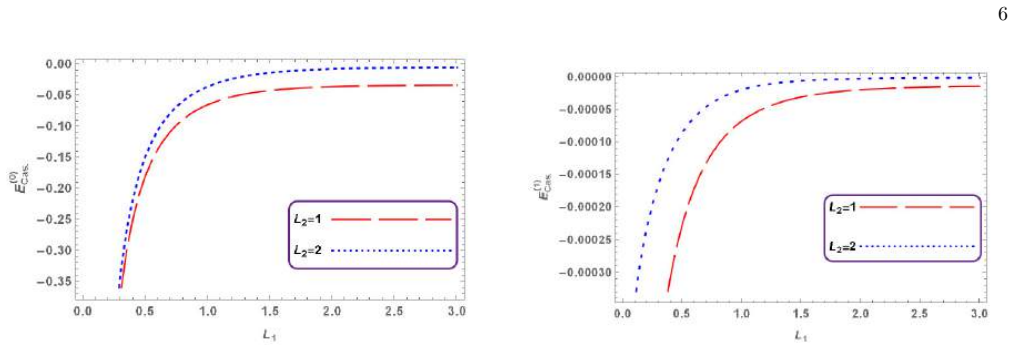
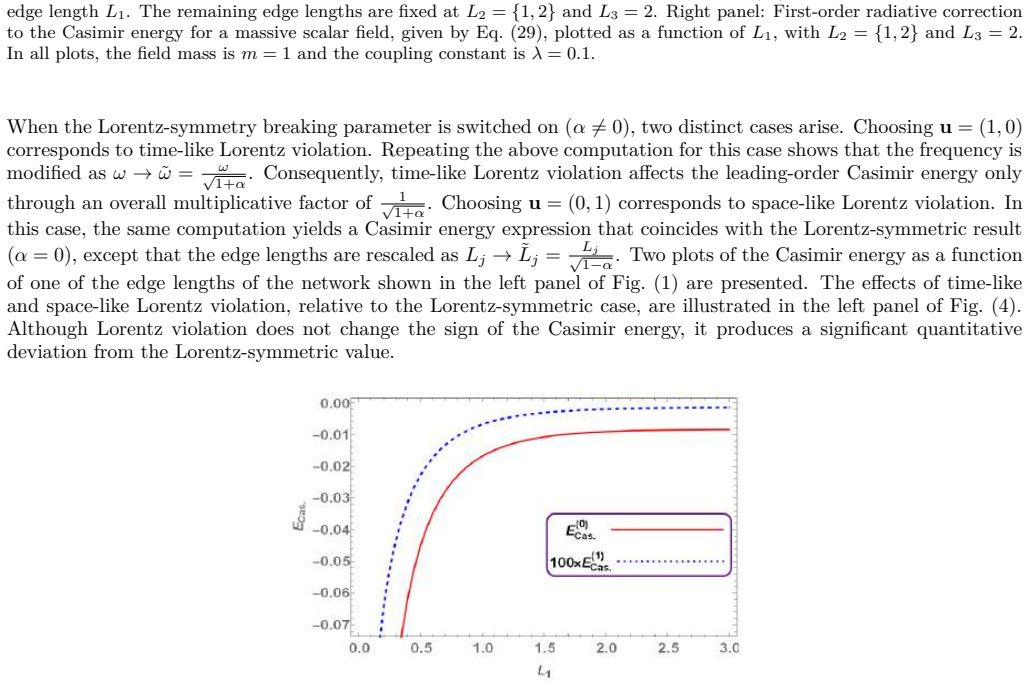
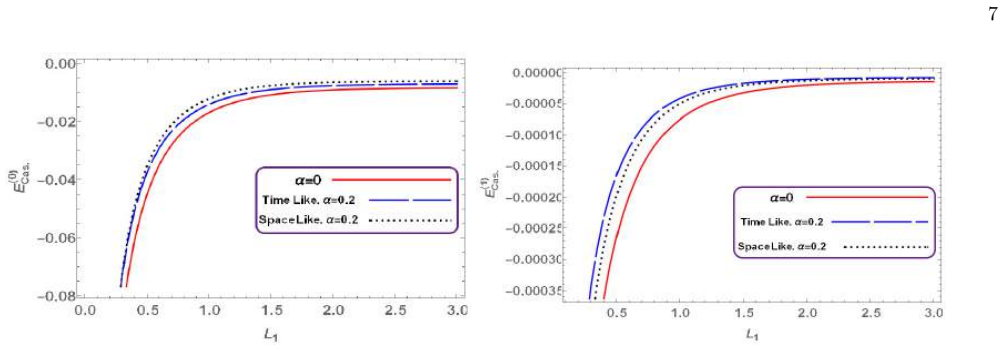
Both the leading-order and first-order Casimir energies are negative, regardless of the presence or absence of Lorentz-violating effects, and are in agreement with general physical expectations.
What carries the argument
Position-dependent counterterms arising from a renormalization program that consistently incorporates boundary conditions.
If this is right
- The Casimir force on the network is attractive at both orders.
- The sign of the energy does not change when the Lorentz-violating parameter is turned on.
- The position-dependent counterterm method successfully removes divergences while respecting the network geometry.
Where Pith is reading between the lines
- The same renormalization technique could be applied to networks with more junctions or to fields in higher dimensions.
- Numerical checks of the energy for different values of the mass and the Lorentz-violating parameter would test the analytic expressions.
Load-bearing premise
The renormalization program consistently incorporates the effects of boundary conditions into the renormalization procedure via position-dependent counterterms.
What would settle it
An explicit calculation that yields a positive value for either the leading or the first-order Casimir energy on the same network would contradict the result.
Figures

read the original abstract
In this paper, we compute the leading-order and first-order radiative corrections to the Casimir energy of a massive Lorentz-violating scalar field governed by a $\phi^4$ interaction on a network. For simplicity, the network is chosen to consist of three edges connected at a single central junction, with the scalar field defined in 1+1 dimensions on each edge. Dirichlet boundary conditions are imposed at the outer ends of the edges, thereby confining the field on the network. Beyond addressing the massive case of a Lorentz-violating scalar field, a key novelty of this work lies in the calculation of the radiative corrections to the Casimir energy using position-dependent counterterms. These counterterms emerge from a systematic renormalization program that consistently incorporates the effects of boundary conditions into the renormalization procedure. To eliminate divergences arising from vacuum energy contributions, we employ the box subtraction scheme in conjunction with cutoff regularization. Our results show that both the leading-order and first-order Casimir energies are negative, regardless of the presence or absence of Lorentz-violating effects, and are in agreement with general physical expectations.
Editorial analysis
A structured set of objections, weighed in public.
Referee Report
Summary. The paper claims to compute the leading-order and first-order radiative corrections to the Casimir energy of a massive Lorentz-violating scalar field with a φ^4 interaction on a three-edge network in 1+1 dimensions. Dirichlet boundary conditions are imposed at the outer ends. The renormalization uses position-dependent counterterms to incorporate boundary effects, and box subtraction with cutoff regularization is employed to remove divergences. The results indicate that both the leading-order and first-order Casimir energies are negative, regardless of Lorentz-violating effects.
Significance. If the result holds, this work offers a calculation of radiative corrections to the Casimir energy in a network setting for a massive field, highlighting a renormalization scheme that includes boundary conditions through position-dependent counterterms. This may be relevant for studies of vacuum energy in low-dimensional systems with interactions.
major comments (1)
- The abstract reports negative energies consistent with expectations, but provides no derivation steps, error estimates, or checks against alternative regularizations; the central claim cannot be verified from the available text.
minor comments (1)
- The title 'in The Network' has unusual capitalization; consider revising to 'on a Network' or similar for standard academic style.
Simulated Author's Rebuttal
We thank the referee for their review. We address the major comment below, noting that the abstract is a concise summary while the full derivations appear in the manuscript body.
read point-by-point responses
-
Referee: The abstract reports negative energies consistent with expectations, but provides no derivation steps, error estimates, or checks against alternative regularizations; the central claim cannot be verified from the available text.
Authors: Abstracts are not intended to contain derivation steps or error estimates; these are presented in Sections 3 and 4 of the manuscript. The leading-order Casimir energy follows from mode summation on the three-edge network with Dirichlet conditions at the outer ends, using cutoff regularization and box subtraction to isolate the finite part. The first-order correction is obtained by inserting the position-dependent counterterms (derived from the renormalization conditions that incorporate the boundaries) into the one-loop diagram and performing the same regularization. Explicit integral expressions and numerical results for several values of the mass and Lorentz-violating parameter are given, all yielding negative energies. We did not perform comparisons with other regularization schemes (e.g., zeta-function), which could be added if requested. revision: no
Circularity Check
No significant circularity detected
full rationale
The derivation relies on standard cutoff regularization, box subtraction, and position-dependent counterterms for renormalization of the Casimir energy on the network. The abstract and description present explicit computations of leading-order and O(λ) energies without any quoted reduction of a 'prediction' to a fitted input, self-definitional loop, or load-bearing self-citation chain. Results are stated to agree with physical expectations after these procedures, but the method is described as systematic and independent of the target sign outcome. No equations or steps in the provided material exhibit the enumerated circular patterns.
Axiom & Free-Parameter Ledger
Reference graph
Works this paper leans on
-
[1]
H. B. G. Casimir,On the attraction between two perfectly conducting plates, Proc. Kon. Nederl. Akad. Wet.51, 793 (1948)
1948
-
[2]
Martinez, X
J.C. Martinez, X. Chen, and M.B.A. Jalil,Casimir effect and graphene: Tunability, scalability, Casimir rotor, AIP. Ad- vances 8, 015330 (2018)
2018
-
[3]
G. L. Klimchitskaya and V. M. Mostepanenko,Experiment and theory in the Casimir effect, Contemporary Physics 47, 131 (2006)
2006
-
[4]
A. A. Saharian, Topological casimir effect in nanotubes and nanoloops, inQuantum Field Theory Under the Influence of External Conditions (QFEXT09), pp. 470–474
-
[5]
Pawlowski and P
P. Pawlowski and P. Zielenkiewicz,The Quantum Casimir Effect May Be a Universal Force Organizing the Bilayer structure of the Cell Membrane, J. Membr. Biol.246, 383 (2013)
2013
-
[6]
Gambassi,The Casimir Effect: From quantum to critical fluctuations, J
A. Gambassi,The Casimir Effect: From quantum to critical fluctuations, J. Phys: Conf. Ser.161, 012037 (2009)
2009
-
[7]
B. B. Machta, S. L. Veatch and J. P. Sethna,Critical Casimir Forces in Cellular Membranes, Phys. Rev. Lett.109, 138101 (2012). 10
2012
-
[8]
Szydłowski and W
M. Szydłowski and W. Godłowski,Acceleration of the Universe Driven by the Casimir Force, Int. J. Mod. Phys. D17, 343 (2008)
2008
-
[9]
Shweta and Sharma, Umesh Kumar and Mishra, Ambuj Kumar,Yukawa–Casimir wormhole model in F(R,T) framework, Int. J. Geo. Meth. Mod. Phys.20, 2350223 (2023)
2023
-
[10]
Asorey and J
M. Asorey and J. M. Muñoz-castañeda,Boundary Effects In Quantum Physics, Int. J. Geo. Meth. Mod. Phys.09, 1260017 (2012)
2012
-
[11]
V. K. Oikonomou,Casimir Force Of Fermions Coupled To Monopoles In Six-Dimensional Spacetime, Int. J. Geo. Meth. Mod. Phys. 11, 1450011 (2014)
2014
-
[12]
V. K. Oikonomou, and N. D. Tracas,Slab Bag Fermionic Casimir Effect, Chiral Boundaries and Vector Boson-Majorana Fermion Pistons, Int. J. Mod. Phys. A25, 5935 (2010)
2010
-
[13]
V. A. Kostelecky and S. Samuel,Spontaneous breaking of Lorentz symmetry in string theory, Phys. Rev. D39, 683 (1989)
1989
-
[14]
V. K. Oikonomou,Shape of Compact Toroidal DimensionsTd θand Casimir Effect onMD×Td θSpacetime, Commu. Theo. Phys. 55, 101 (2011)
2011
-
[15]
V. K. Oikonomou,Singularities of the Casimir Energy for Quantum Field Theories with Lifshitz Dimensions, Phys. Lett. B 721, 312 (2013)
2013
-
[16]
M. A. Valuyan and S. S. Gousheh,Dirichlet Casimir Energy For a Scalar Field In a Sphere: An Alternative Method, Int. J. Mod. Phys. A25, 1165 (2010)
2010
-
[17]
Bordag, D
M. Bordag, D. Robaschik and E. Wieczorek,Quantum field theoretic treatment of the Casimir effect, Ann. Phys.165, 192 (1985)
1985
-
[18]
Bordag and K
M. Bordag and K. Scharnhorst,O(α) radiative correction to the Casimir energy for penetrable mirrors, Phys. Rev. Lett. 81, 3815 (1998)
1998
-
[19]
Bordag and J
M. Bordag and J. Lindig,Radiative correction to the Casimir force on a sphere, Phys. Rev. D58, 045003 (1998)
1998
-
[20]
M. A. Valuyan,The Casimir energy for scalar field with mixed boundary condition, Int. J. Geo. Meth. Mod. Phys.15, 1850172 (2018)
2018
-
[21]
L. C. de Albuquerque,Casimir pressure at two loops and soft boundaries at finite temperature, Phys. Rev. D 55, 7754 (1997)
1997
-
[22]
M. A. Valuyan,Casimir energy calculation for massive scalar field on spherical surfaces: an alternative approach, Can. J. Phys. 96, 1004 (2018)
2018
-
[23]
M. P. E. Lock and I. Fuentes,Dynamical Casimir effect in curved spacetime, New J. Phys.19, 073005 (2017)
2017
-
[24]
Moazzemi, A
R. Moazzemi, A. Mohammadi, and S. S. Gousheh,A renormalized perturbation theory for problems with non-trivial bound- ary conditions or backgrounds in two space–time dimensions, Eur. Phys. J. C56, 585 (2008)
2008
-
[25]
Bordag, U
M. Bordag, U. Mohideen, and V. Mostepanenko,New developments in the Casimir effect, Phys. Rep.353, 1 (2001)
2001
-
[26]
C. D. Fosco and N. F. Svaiter, J. Math. Phys.42, 5185 (2001)
2001
-
[27]
Graham, R
N. Graham, R. L. Jaffe, V. Khemani, M. Quandt, O. Schroeder, and H. Weigel, Nucl. Phys. B677, 379 (2004)
2004
-
[28]
Moazzemi,The Dirichlet Casimir effect forϕ4 theory in (3 + 1) dimensions: a new renormalization approach, JHEP 09
R. Moazzemi,The Dirichlet Casimir effect forϕ4 theory in (3 + 1) dimensions: a new renormalization approach, JHEP 09
- [29]
-
[30]
Fulling,Vacuum Energy as Spectral Geometry, Symmetry, Integrability and Geometry: Methods and Applica- tions (SIGMA) 3, 094 (2007)
Stephen A. Fulling,Vacuum Energy as Spectral Geometry, Symmetry, Integrability and Geometry: Methods and Applica- tions (SIGMA) 3, 094 (2007)
2007
-
[31]
Kirsten and S
K. Kirsten and S. A. Fulling, Kaluza-klein models as pistons, Phys. Rev. D79, 065019 (2009)
2009
-
[32]
Exner and O
P. Exner and O. Post, Convergence of spectra of graph-like thin manifolds, Journal of Geometry and Physics54, 77 (2005)
2005
-
[33]
Sven Gnutzmann and Uzy Smilansky,Quantum graphs: Applications to quantum chaos and universal spectral statistics, Advances in Physics55, 527 (2006)
2006
-
[34]
Tian-Ming Zhao, Rong-Xin Miao, Casimir Effect for Quantum Field theory in Networks , Eur. Phys. J. C 85, https://doi.org/10.1140/epjc/s10052-025-14781-y (2025)
-
[35]
T. H. Boyer,Quantum Electromagnetic Zero-Point Energy of a Conducting Spherical Shell and the Casimir Model for a Charged Particle, Phys. Rev.174, 1764 (1968)
1968
discussion (0)
Sign in with ORCID, Apple, or X to comment. Anyone can read and Pith papers without signing in.