Development and Characterization of a Time Projection Chamber Prototype for Neutron Oscillation Searches at the European Spallation Source
Pith reviewed 2026-06-29 09:18 UTC · model grok-4.3
The pith
A time projection chamber prototype reaches 0.55 mm yz resolution and 16% dE/dx width for pion tracking in neutron-antineutron searches.
A machine-rendered reading of the paper's core claim, the machinery that carries it, and where it could break.
Core claim
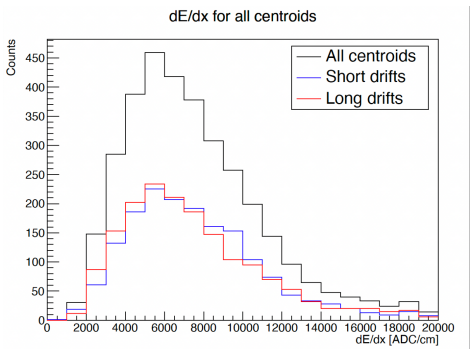
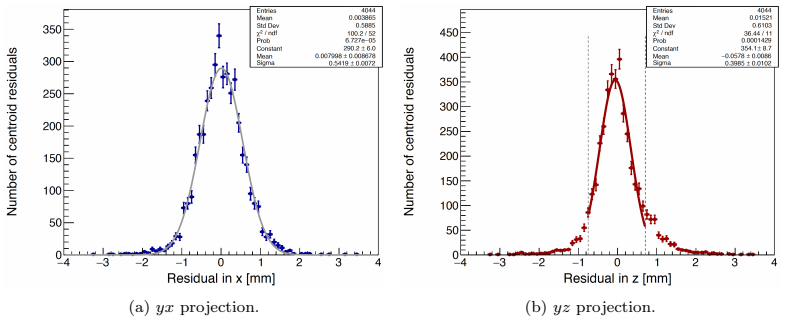
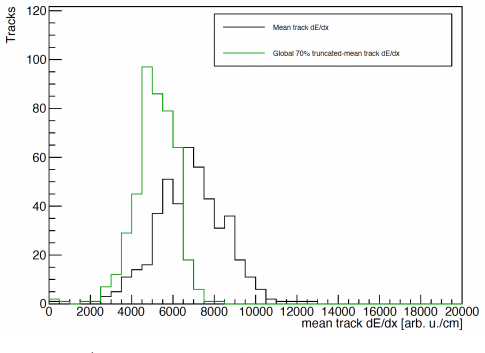
The central claim is that the TPC prototype with zigzag readout, combined with the developed tracking algorithm, delivers sub-millimetre residual widths and robust charge sharing in cosmic data, produces a truncated-mean track-level dE/dx distribution that is approximately Gaussian with 16% relative width, and supports the sub-centroid refit technique that reduces yz residual width from 1.30 mm to 0.55 mm, thereby validating initial tracking performance for the charged-pion final states expected in antineutron annihilation.
What carries the argument
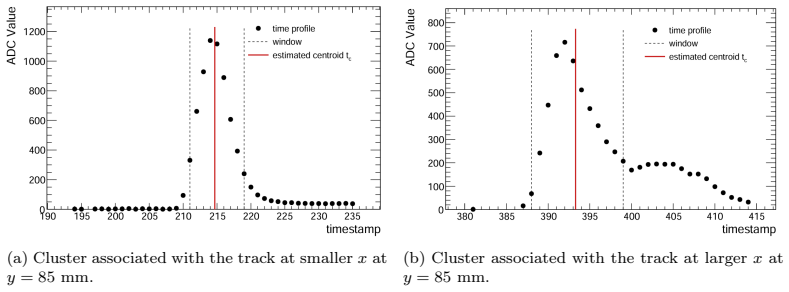
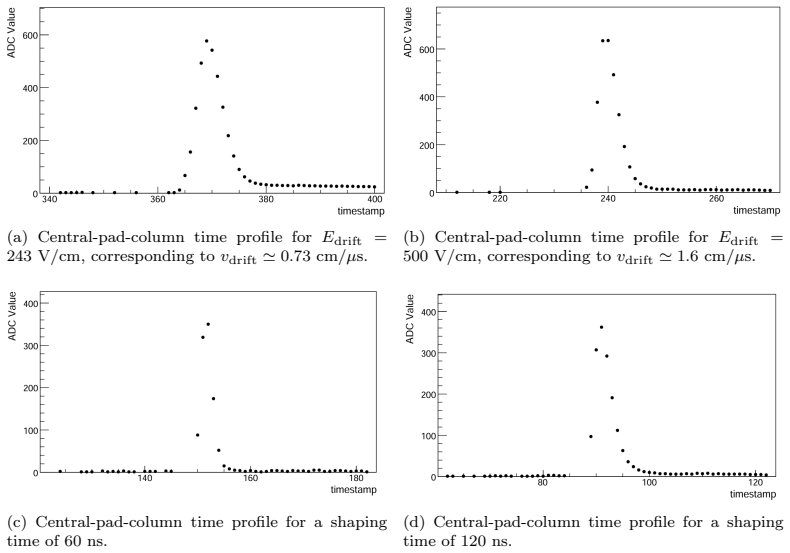
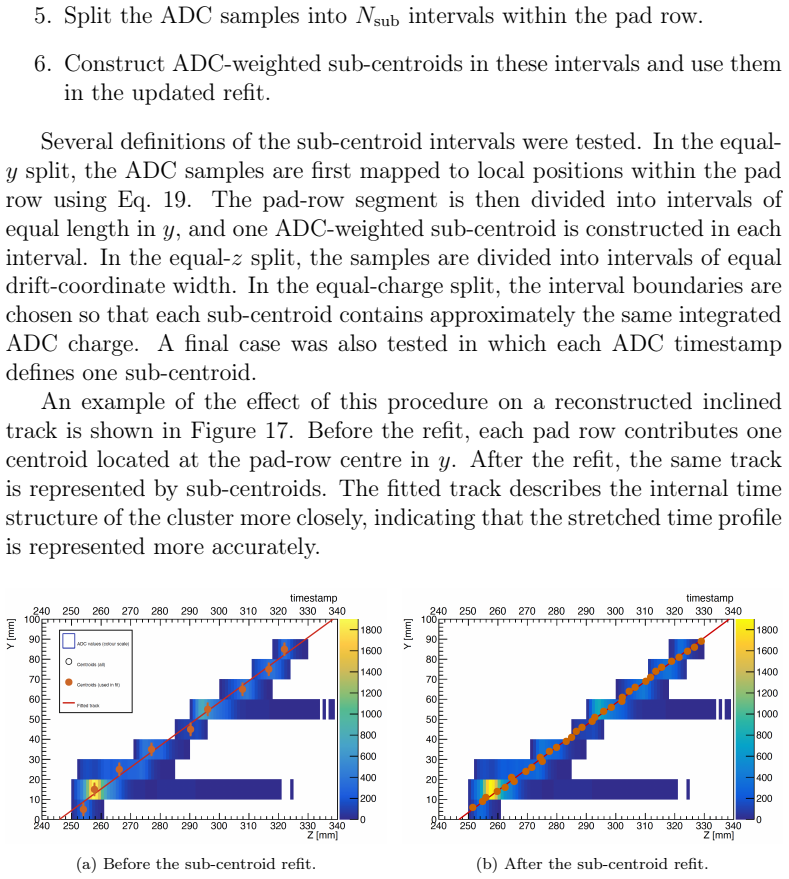
The sub-centroid refit technique, which divides each pad-row signal into four equal-y sub-centroids using the internal ADC time profile rather than a single charge-weighted centroid.
If this is right
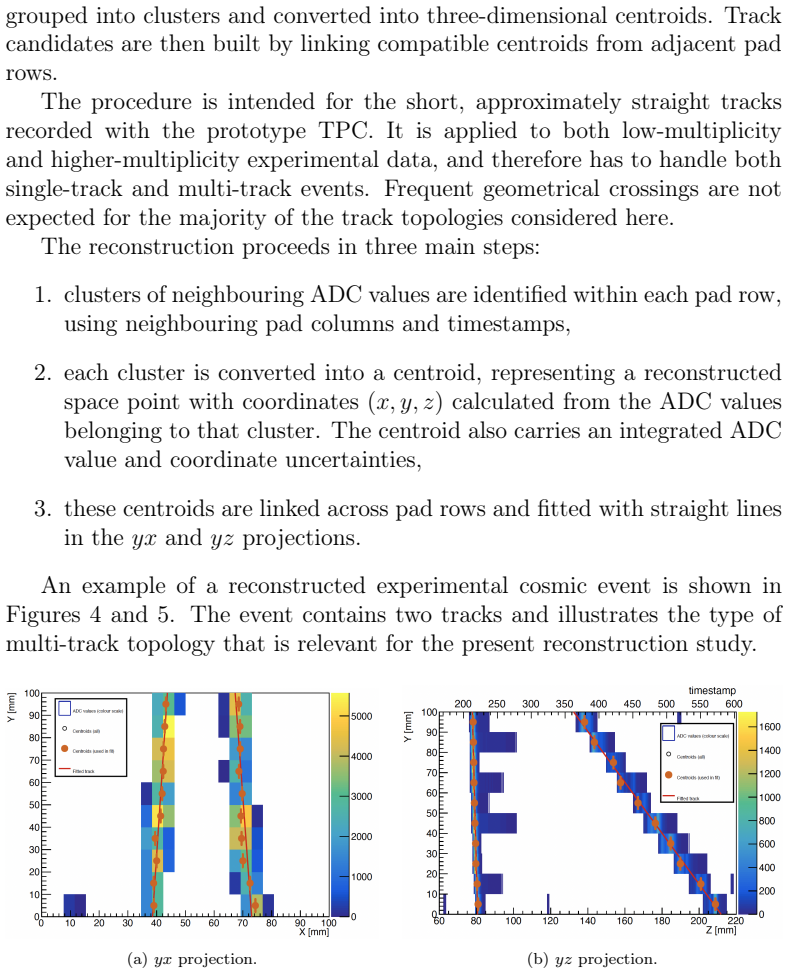
- Reconstructed tracks in experimental cosmic data exhibit sub-millimetre residual widths and uniform dE/dx across the drift volume.
- The algorithm performs reliably on well-separated tracks but shows reduced performance on crossing or overlapping tracks and dense proton-scattering events.
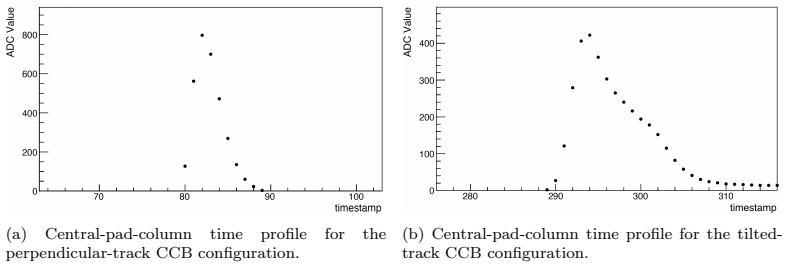
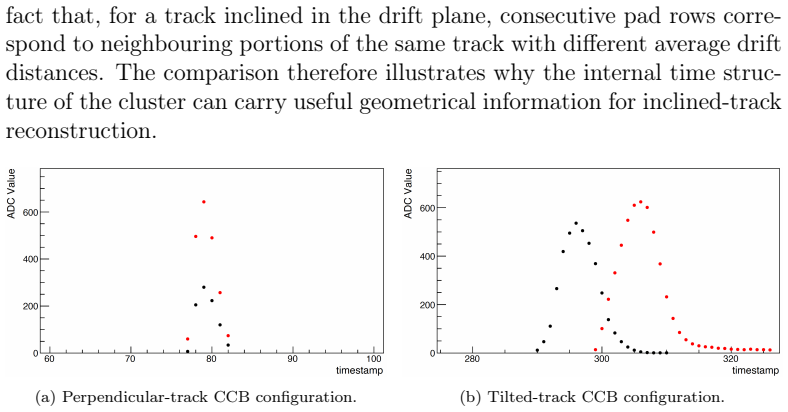
- Tilted proton tracks produce broader yz residuals due to time-extended pad-row signals, which the sub-centroid refit mitigates.
- Energy-loss information extracted via truncated-mean dE/dx can be used for particle identification.
Where Pith is reading between the lines
- If the muon reference accurately models minimum-ionizing pions, the observed dE/dx resolution should translate to the annihilation final states targeted by HIBEAM.
- The sub-centroid refit approach may improve position resolution in other gaseous detectors that record time profiles within readout pads.
- Further algorithm development focused on dense or overlapping topologies would be required before the prototype can handle the full range of expected event complexities.
Load-bearing premise
That cosmic-particle measurements are dominated by atmospheric muons serving as a minimum-ionizing reference for the pionic final states from antineutron annihilation.
What would settle it
A beam test that directly measures the truncated-mean dE/dx distribution for pions of similar momentum and compares its width and peak position to the cosmic-muon distribution would confirm or refute the 16% relative width claim.
Figures


read the original abstract
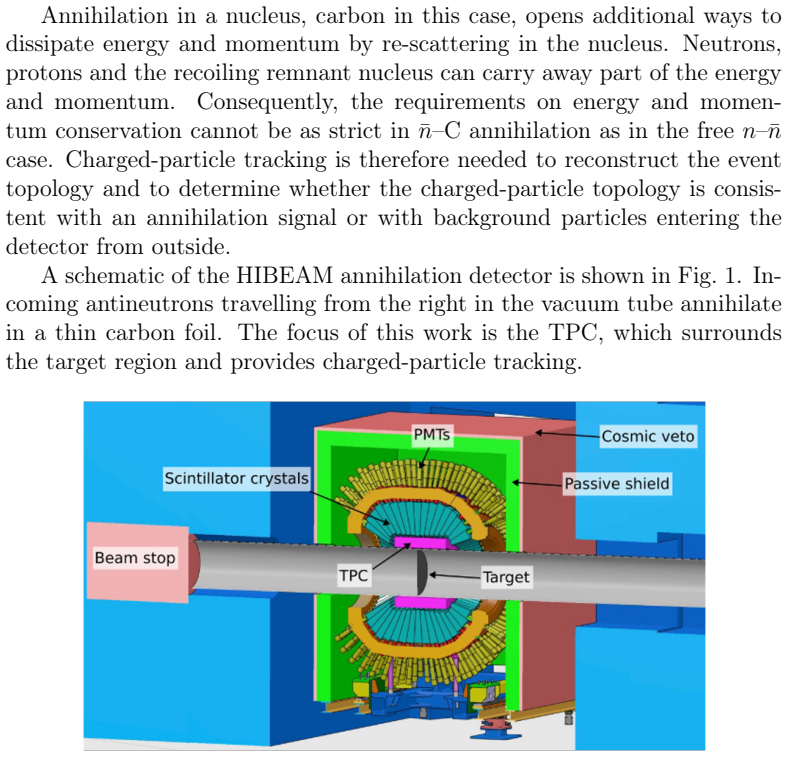
A compact time projection chamber (TPC) prototype was studied for charged-pion tracking in the annihilation detector proposed for the HIBEAM experiment at the European Spallation Source. HIBEAM aims to search for neutron-antineutron oscillations, where a produced antineutron would annihilate on a carbon target and produce a pionic final state. A tracking algorithm was developed and validated using cosmic-particle measurements expected to be dominated by atmospheric cosmic muons, proton elastic-scattering data from the Cyclotron Centre Bronowice, and simulated TPC event data. Cosmic measurements provided a minimum-ionising reference for pion-like tracks, while proton-scattering data tested reconstruction in a more highly ionising environment. Simulated crossing-track events were used as a stress test of complex topologies. The algorithm performed reliably for well-separated tracks, while crossing or overlapping tracks and dense proton-scattering events reduced performance. In experimental data, reconstructed tracks showed sub-millimetre residual widths, robust charge sharing supporting the zigzag-shaped readout, and uniform measured dE/dx across the drift volume. The truncated-mean track-level dE/dx distribution in cosmic data showed an approximately Gaussian peak with a relative width of about 16%, demonstrating how energy-loss information can be used for particle identification. Tilted proton tracks showed broader residuals in yz, because the pad row signal was extended in time. A sub-centroid refit technique was proposed, using the internal ADC time profile within a pad row instead of a single charge-weighted time position. With four equal-y sub-centroids per pad row, the yz residual width was reduced from 1.30 mm to 0.55 mm. These results validate the initial tracking capabilities of the algorithm and prototype, and provide feedback for the next-generation prototype.
Editorial analysis
A structured set of objections, weighed in public.
Referee Report
Summary. The manuscript presents the development and characterization of a compact time projection chamber (TPC) prototype for charged-pion tracking in the annihilation detector proposed for the HIBEAM experiment at the European Spallation Source. The work focuses on a tracking algorithm validated with cosmic-particle data (treated as a minimum-ionizing reference), proton elastic-scattering data from the Cyclotron Centre Bronowice, and simulated TPC events. Reported outcomes include an approximately Gaussian truncated-mean dE/dx distribution with ~16% relative width in cosmic data, sub-millimeter position residuals, and a reduction in yz residual width from 1.30 mm to 0.55 mm via a sub-centroid refit using internal ADC time profiles.
Significance. If the performance metrics hold, the prototype validation provides concrete experimental support for the tracking and dE/dx capabilities required in the HIBEAM n-nbar oscillation search. The sub-centroid refit technique offers a practical method for improving resolution on tilted tracks, and the multi-source validation (cosmic, proton, simulation) adds robustness to the claims of reliable performance for well-separated tracks.
major comments (2)
- [Abstract] Abstract (validation data sources paragraph): Details on data selection criteria, error propagation, and quantitative metrics for the comparison between experimental data and simulated crossing-track events are not provided. These are needed to assess the robustness of the quoted performance figures, including the 16% dE/dx width and the residual improvement from 1.30 mm to 0.55 mm.
- [Abstract] Abstract (paragraph on validation data sources): The assumption that cosmic measurements are dominated by atmospheric muons serving as an MIP reference for the expected pionic final states is stated explicitly but lacks supporting quantitative justification or references within the manuscript; while conventional, this link is relevant to the physics motivation.
minor comments (2)
- [Abstract] The manuscript would benefit from a summary table collating key performance metrics (dE/dx width, residuals) across the three validation datasets for easier comparison.
- [Abstract] Clarify the exact definition and implementation of the 'truncated-mean' dE/dx calculation and the 'sub-centroid refit' (e.g., how the four equal-y sub-centroids are determined and combined).
Simulated Author's Rebuttal
We thank the referee for the constructive comments and positive recommendation. We address the two major comments on the abstract below and will incorporate revisions to strengthen the presentation of validation details.
read point-by-point responses
-
Referee: [Abstract] Abstract (validation data sources paragraph): Details on data selection criteria, error propagation, and quantitative metrics for the comparison between experimental data and simulated crossing-track events are not provided. These are needed to assess the robustness of the quoted performance figures, including the 16% dE/dx width and the residual improvement from 1.30 mm to 0.55 mm.
Authors: The abstract is intentionally concise, with detailed descriptions of data selection, error propagation, and quantitative comparisons (including direct experimental-simulation metrics for crossing tracks) provided in the dedicated analysis and results sections of the manuscript. To improve accessibility, we will revise the abstract paragraph to include one additional sentence summarizing the key selection criteria and the reported residual/dE/dx metrics with their uncertainties, while retaining brevity. revision: yes
-
Referee: [Abstract] Abstract (paragraph on validation data sources): The assumption that cosmic measurements are dominated by atmospheric muons serving as an MIP reference for the expected pionic final states is stated explicitly but lacks supporting quantitative justification or references within the manuscript; while conventional, this link is relevant to the physics motivation.
Authors: We agree that an explicit reference or brief quantitative note would strengthen the justification. We will add a short clause with a standard reference to sea-level cosmic muon flux and composition (e.g., PDG or equivalent) to support the MIP reference assumption in the revised abstract. revision: yes
Circularity Check
No significant circularity; experimental measurements are self-contained
full rationale
The paper reports direct experimental outcomes from cosmic-particle and proton-scattering data, including measured residual widths (1.30 mm to 0.55 mm after refit) and dE/dx relative width (~16%), validated against independent simulations and external data sources. No load-bearing step invokes an equation, fit, or self-citation that reduces the reported quantities to inputs defined from the same dataset; the cosmic-muon reference assumption is stated as a conventional expectation without internal derivation. The work contains no mathematical prediction chain or ansatz smuggling, rendering it self-contained against external benchmarks.
Axiom & Free-Parameter Ledger
Reference graph
Works this paper leans on
-
[1]
Santoro, D
V. Santoro, D. Milstead, P. Fierlinger, W. Snow, J. Amaral, J. Barrow, M. Bartis, P. Bentley, L. Björk, G. Brooijmans, et al., The hibeam instrument at the european spallation source, Journal of Physics G: Nuclear and Particle Physics 52 (4) (2025) 040501
2025
-
[2]
Addazi, K
A. Addazi, K. Anderson, S. Ansell, K. Babu, J. Barrow, D. Baxter, P. Bentley, Z. Berezhiani, R. Bevilacqua, R. Biondi, et al., New high- sensitivity searches for neutrons converting into antineutrons and/or sterile neutrons at the hibeam/nnbar experiment at the european spal- lation source, Journal of Physics G: Nuclear and Particle Physics 48 (7) (2021) 070501
2021
-
[3]
Santoro, et al., HighNESS conceptual design report: Volume II
V. Santoro, et al., HighNESS conceptual design report: Volume II. The NNBAR experiment., J. Neutron Res. 25 (3-4) (2024) 315–406. doi:10.3233/jnr-230951
-
[4]
Garoby, A
R. Garoby, A. Vergara, H. Danared, I. Alonso, E. Bargallo, B. Chey- mol, C. Darve, M. Eshraqi, H. Hassanzadegan, A. Jansson, et al., The european spallation source design, Physica Scripta 93 (1) (2017) 014001
2017
-
[5]
A. D. Sakharov, Violation of CP invariance, C asymmetry, and baryon asymmetry of the Universe, Pisma Zh. Eksp. Teor. Fiz. 5 (1967) 32–35. doi:10.1070/PU1991v034n05ABEH002497
-
[6]
Baldo-Ceolin, P
M. Baldo-Ceolin, P. Benetti, T. Bitter, F. Bobisut, E. Calligarich, R. Dolfini, D. Dubbers, P. El-Muzeini, M. Genoni, D. Gibin, et al., A new experimental limit on neutron-antineutron oscillations, Zeitschrift für Physik C Particles and Fields 63 (3) (1994) 409–416
1994
-
[7]
C. B. Dover, A. Gal, J. M. Richard, Neutron antineu- tron oscillations in nuclei, Phys. Rev. D27 (1983) 1090–1100. doi:10.1103/PhysRevD.27.1090
- [8]
-
[9]
J. N. Marx, D. R. Nygren, The time projection chamber, Physics Today 31 (10) (1978) 46–53
1978
-
[10]
J. Alme, Y. Andres, H. Appelshäuser, S. Bablok, N. Bialas, R. Bolgen, U. Bonnes, R. Bramm, P. Braun-Munzinger, R. Campagnolo, et al., The alice tpc, a large 3-dimensional tracking device with fast readout for ultra-high multiplicity events, Nuclear Instruments and Methods in Physics Research Section A: Accelerators, Spectrometers, Detectors and Associated...
2010
-
[11]
Ivanov, I
M. Ivanov, I. Belikov, P. Hristov, K. Šafařík, Track reconstruction in high density environment, Nuclear Instruments and Methods in Physics Research Section A: Accelerators, Spectrometers, Detectors and Associ- ated Equipment 566 (1) (2006) 70–74
2006
-
[12]
E. S. Golubeva, L. A. Kondratyuk, Annihilation of low energy an- tineutrons on nuclei, Nucl. Phys. B Proc. Suppl. 56 (1997) 103–107. doi:10.1016/S0920-5632(97)00260-0
-
[13]
E. S. Golubeva, J. L. Barrow, C. G. Ladd, Model of¯nannihilation in experimental searches for¯ntransformations, Phys. Rev. D 99 (3) (2019) 035002. arXiv:1804.10270, doi:10.1103/PhysRevD.99.035002
work page internal anchor Pith review Pith/arXiv arXiv doi:10.1103/physrevd.99.035002 2019
-
[14]
J. L. Barrow, E. S. Golubeva, E. Paryev, J.-M. Richard, Progress and simulations for intranuclear neutron-antineutron transformations in 40 18Ar, Phys. Rev. D 101 (3) (2020) 036008. arXiv:1906.02833, doi:10.1103/PhysRevD.101.036008
-
[15]
K. Abe, et al., Search for neutron-antineutron oscillation in super-kamiokande, Physical Review D 91 (7) (2015) 072006. doi:10.1103/PhysRevD.91.072006
-
[16]
M. B. L. Persson, Design of an experiment to search for neutron oscil- lations at the european spallation source (2024)
2024
-
[17]
V. Hehl, Characterization of the hibeam time projection chamber proto- type, bachelor project, Division of Particle and Nuclear Physics (2025). URLhttp://lup.lub.lu.se/student-papers/record/9203174 41
-
[18]
Sauli, Gem: A new concept for electron amplification in gas detectors, Nuclear Instruments and Methods in Physics Research Section A 386 (2–
F. Sauli, Gem: A new concept for electron amplification in gas detectors, Nuclear Instruments and Methods in Physics Research Section A 386 (2–
-
[19]
doi:10.1016/S0168-9002(96)01172-2
(1997) 531–534. doi:10.1016/S0168-9002(96)01172-2
-
[20]
Shoji, Measurement of de/dx resolution of tpc prototype with gating gem exposed to an electron beam, in: Proceedings of the International Workshop on Future Linear Colliders, 2018
A. Shoji, Measurement of de/dx resolution of tpc prototype with gating gem exposed to an electron beam, in: Proceedings of the International Workshop on Future Linear Colliders, 2018
2018
-
[21]
P. Aspell, M. DeGaspari, H. França, E. García, L. Musa, Super-altro 16: A front-end system on chip for dsp based readout of gaseous de- tectors, IEEE Transactions on Nuclear Science 60 (2013) 1289–1295. doi:10.1109/TNS.2013.2250305
-
[22]
M. D. Gaspari, Systems-on-Chip (SoC) for applications in High-Energy Physics, Doctoral dissertation, Ruprecht-Karls-Universität Heidelberg (2012). doi:10.11588/heidok.00013806
-
[23]
S. Martoiu, H. Muller, A. Tarazona, J. Toledo, Development of the scalable readout system for micro-pattern gas detectors and other applications, Journal of Instrumentation 8 (03) (2013) C03015. doi:10.1088/1748-0221/8/03/C03015
-
[24]
R. L. Workman, et al., Review of particle physics, Progress of Theoretical and Experimental Physics 2022 (8) (2022) 083C01. doi:10.1093/ptep/ptac097
-
[25]
Tanabashi, et al., Passage of particles through matter, in: Review of Particle Physics, Vol
M. Tanabashi, et al., Passage of particles through matter, in: Review of Particle Physics, Vol. 98, 2018, p. 030001, updated in subsequent editions of the PDG Review
2018
-
[26]
H. W. Kuhn, The hungarian method for the assignment prob- lem, Naval Research Logistics Quarterly 2 (1-2) (1955) 83–97. doi:10.1002/nav.3800020109. 42
discussion (0)
Sign in with ORCID, Apple, or X to comment. Anyone can read and Pith papers without signing in.