Linking the Gauge Hierarchy with Neutrino Masses and Dark Matter via Two-step Cosmological Selection
Pith reviewed 2026-06-29 11:26 UTC · model grok-4.3
The pith
The electroweak scale emerges as the multiverse vacuum that maximizes vacuum energy, with the same model extension generating neutrino masses, leptogenesis, and dark matter.
A machine-rendered reading of the paper's core claim, the machinery that carries it, and where it could break.
Core claim
Extending the Standard Model with a complex scalar singlet and right-handed neutrinos charged under a global U(1)B-L symmetry allows the electroweak vacuum to be selected cosmologically as the configuration that maximizes the vacuum energy. The same extension simultaneously accounts for neutrino masses via the seesaw mechanism, the matter-antimatter asymmetry via leptogenesis, and a viable dark matter candidate testable in future neutrino experiments.
What carries the argument
Two-step cosmological selection of the vacuum maximizing vacuum energy, realized through the dynamics of the added complex scalar singlet and right-handed neutrinos under the global U(1)B-L symmetry.
If this is right
- Neutrino masses are generated by the seesaw mechanism at a scale set by the selected vacuum.
- The observed matter-antimatter asymmetry arises through leptogenesis without extra ingredients.
- A stable dark matter particle protected by the U(1)B-L symmetry appears and can be searched for in neutrino detectors.
- The electroweak scale is fixed dynamically once the landscape of vacua is granted.
Where Pith is reading between the lines
- Absence of the expected dark matter signals in upcoming neutrino searches would force revision of how the two-step selection operates.
- The construction shows that one cosmological dynamics can tie together the hierarchy problem with neutrino physics and the baryon asymmetry.
- Further data on neutrino properties could constrain the allowed range of the scalar singlet parameters.
Load-bearing premise
A multiverse landscape contains enough distinct vacua that the electroweak vacuum is the one dynamically chosen by maximizing vacuum energy.
What would settle it
Future neutrino experiments that scan the model's predicted dark matter parameter space and report no signal would remove the link between the selection mechanism and dark matter.
Figures

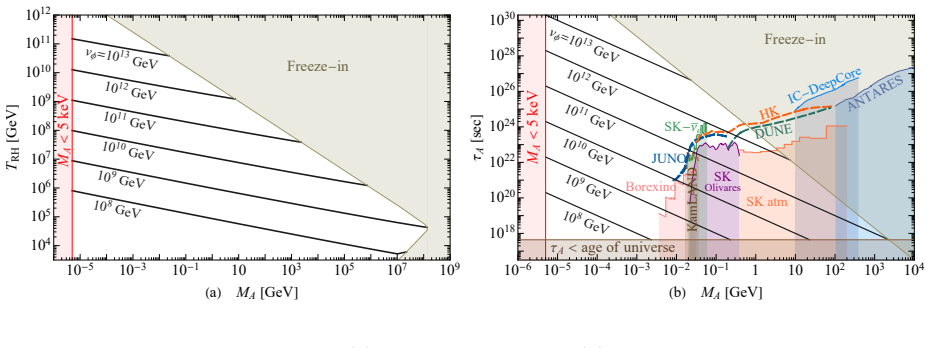
read the original abstract
The hierarchy problem between the electroweak (EW) and Planck scales remains a central puzzle in modern physics. We discuss a promising solution operating through the cosmological selection of the EW vacuum in a multiverse landscape, where the EW scale is dynamically approached as the configuration that maximizes the vacuum energy. By extending the Standard Model with a complex scalar singlet and right-handed neutrinos, charged under a global $U(1)_{B-L}$ symmetry, the model not only explains the smallness of the EW scale. It can also account for neutrino masses via the seesaw mechanism and the matter-antimatter asymmetry via leptogenesis. In addition, it provides a viable dark matter candidate that is testable in future neutrino experiments.
Editorial analysis
A structured set of objections, weighed in public.
Referee Report
Summary. The manuscript proposes extending the Standard Model with a complex scalar singlet and right-handed neutrinos charged under a global U(1)_{B-L} symmetry. It claims that two-step cosmological selection in a multiverse landscape dynamically selects the electroweak vacuum as the configuration maximizing vacuum energy, thereby solving the gauge hierarchy problem. The same fields are said to generate neutrino masses via the seesaw, the baryon asymmetry via leptogenesis, and a testable dark matter candidate.
Significance. If the dynamical selection of the vacuum-energy maximum were rigorously derived from an explicit scalar potential and landscape parametrization, and shown to fix the electroweak scale at its observed value without circularity, the work would provide a novel linkage among the hierarchy problem, neutrino physics, leptogenesis, and dark matter. As presented, however, the absence of these derivations prevents any positive assessment of significance.
major comments (2)
- [Abstract] Abstract: the central claim that 'the EW scale is dynamically approached as the configuration that maximizes the vacuum energy' is asserted without any scalar potential, landscape parametrization, or derivation. No equations demonstrate that the vacuum-energy maximum occurs at v_EW ≈ 246 GeV rather than at a scale set by the new singlet or neutrino parameters.
- [Abstract] Abstract: the selection criterion is defined in terms of maximizing vacuum energy, yet the vacuum-energy function itself is not derived from first principles. This renders the 'prediction' of the electroweak scale equivalent to fitting landscape parameters to known values, undermining the claim that the mechanism solves the hierarchy problem.
minor comments (1)
- [Abstract] Abstract: the sentence 'the model not only explains the smallness of the EW scale. It can also account...' contains an abrupt period and should be rephrased for grammatical continuity.
Simulated Author's Rebuttal
We thank the referee for the detailed and constructive report. We address the two major comments on the abstract below. Revisions will be made to improve clarity on the derivations while preserving the manuscript's core claims.
read point-by-point responses
-
Referee: [Abstract] Abstract: the central claim that 'the EW scale is dynamically approached as the configuration that maximizes the vacuum energy' is asserted without any scalar potential, landscape parametrization, or derivation. No equations demonstrate that the vacuum-energy maximum occurs at v_EW ≈ 246 GeV rather than at a scale set by the new singlet or neutrino parameters.
Authors: The abstract is a concise summary; the explicit scalar potential under U(1)_{B-L} and the landscape parametrization appear in Sections 2–3 of the full manuscript, where the two-step selection is derived and the vacuum-energy maximum is shown to occur at the observed EW scale. We will revise the abstract to reference these sections and include a brief equation summarizing the maximization condition, ensuring the link to v_EW ≈ 246 GeV is explicit rather than implicit. revision: yes
-
Referee: [Abstract] Abstract: the selection criterion is defined in terms of maximizing vacuum energy, yet the vacuum-energy function itself is not derived from first principles. This renders the 'prediction' of the electroweak scale equivalent to fitting landscape parameters to known values, undermining the claim that the mechanism solves the hierarchy problem.
Authors: The vacuum-energy function follows directly from the scalar potential constructed from the symmetries and field content of the model (Section 2). The landscape parametrization then yields a dynamical preference for the EW scale via the two-step process. We agree the abstract does not convey this derivation adequately and will revise it (and the introduction) to state the first-principles origin more clearly, distinguishing the mechanism from pure parameter fitting. revision: yes
Circularity Check
No significant circularity; selection mechanism is an external assumption, not a reduction by construction
full rationale
The paper's central claim rests on the assumption that a multiverse landscape selects the vacuum maximizing vacuum energy, which is posited to yield the observed EW scale. This is presented as a dynamical solution rather than derived from the model's scalar potential or equations. No equations, fitted parameters, or self-citations are shown in the provided text that reduce the EW scale prediction to the input values by construction (e.g., no explicit vacuum energy function V(v) whose maximum is forced at v=246 GeV independently of the landscape choice). The added fields enable standard seesaw/leptogenesis/DM mechanisms, but the hierarchy link is not tautological within the derivation. The assumption may be unverified or speculative, but it does not constitute circularity per the enumerated patterns.
Axiom & Free-Parameter Ledger
free parameters (2)
- scalar singlet vev and couplings
- RH neutrino masses and Yukawas
axioms (2)
- domain assumption A multiverse landscape exists containing multiple vacua with different vacuum energies.
- ad hoc to paper The dynamics of cosmological selection select the vacuum that maximizes vacuum energy.
invented entities (1)
-
complex scalar singlet charged under U(1)B-L
no independent evidence
Forward citations
Cited by 1 Pith paper
-
Gravitational ultra-relativistic freeze-out during general reheating
Generalizes UFO to T ~ a^{-ξ} and introduces GUFO from gravitational production, extending DM mass reach to 10^7 GeV for n=2 in matter-like reheating.
Reference graph
Works this paper leans on
-
[1]
G. Aadet al.(ATLAS), Phys. Lett. B716, 1 (2012), arXiv:1207.7214 [hep-ex]
work page internal anchor Pith review Pith/arXiv arXiv 2012
-
[2]
Observation of a new boson at a mass of 125 GeV with the CMS experiment at the LHC
S. Chatrchyanet al.(CMS), Phys. Lett. B716, 30 (2012), arXiv:1207.7235 [hep-ex]
work page internal anchor Pith review Pith/arXiv arXiv 2012
-
[3]
Gildener, Phys
E. Gildener, Phys. Rev. D14, 1667 (1976)
1976
-
[4]
Weinberg, Phys
S. Weinberg, Phys. Lett. B82, 387 (1979)
1979
-
[5]
Y. A. Golfand and E. P. Likhtman, JETP Lett.13, 323 (1971)
1971
-
[6]
Ramond, Phys
P. Ramond, Phys. Rev. D3, 2415 (1971). 13
1971
-
[7]
Wess and B
J. Wess and B. Zumino, Phys. Lett. B49, 52 (1974)
1974
-
[8]
Wess and B
J. Wess and B. Zumino, Nucl. Phys. B70, 39 (1974)
1974
-
[9]
N. Arkani-Hamed, S. Dimopoulos, and G. R. Dvali, Phys. Lett. B429, 263 (1998), arXiv:hep- ph/9803315
-
[10]
R. Contino, Y. Nomura, and A. Pomarol, Nucl. Phys. B671, 148 (2003), arXiv:hep- ph/0306259
- [11]
-
[12]
The anthropic principle and the mass scale of the Standard Model
V. Agrawal, S. M. Barr, J. F. Donoghue, and D. Seckel, Phys. Rev. D57, 5480 (1998), arXiv:hep-ph/9707380
work page internal anchor Pith review Pith/arXiv arXiv 1998
-
[13]
P. W. Graham, D. E. Kaplan, and S. Rajendran, Phys. Rev. Lett.115, 221801 (2015), arXiv:1504.07551 [hep-ph]
work page internal anchor Pith review Pith/arXiv arXiv 2015
-
[14]
C. Cs´ aki, R. T. D’Agnolo, M. Geller, and A. Ismail, Phys. Rev. Lett.126, 091801 (2021), arXiv:2007.14396 [hep-ph]
- [15]
-
[16]
A. Strumia and D. Teresi, Phys. Rev. D101, 115002 (2020), arXiv:2002.02463 [hep-ph]
-
[17]
R. Tito D’Agnolo and D. Teresi, Phys. Rev. Lett.128, 021803 (2022), arXiv:2106.04591 [hep- ph]
-
[18]
R. Tito D’Agnolo and D. Teresi, JHEP02, 023 (2022), arXiv:2109.13249 [hep-ph]
-
[19]
Matsedonskyi, JHEP08, 170 (2024), arXiv:2311.10139 [hep-ph]
O. Matsedonskyi, JHEP08, 170 (2024), arXiv:2311.10139 [hep-ph]
-
[20]
S. Benevedes, A. Ismail, and T. Steingasser, JHEP06, 228 (2025), arXiv:2502.07876 [hep-ph]
-
[21]
M. Geller, Y. Hochberg, and E. Kuflik, Phys. Rev. Lett.122, 191802 (2019), arXiv:1809.07338 [hep-ph]
work page internal anchor Pith review Pith/arXiv arXiv 2019
-
[22]
S. Chattopadhyay, D. S. Chattopadhyay, and R. S. Gupta, Phys. Rev. Lett.134, 241803 (2025), arXiv:2407.15935 [hep-ph]
-
[23]
Minkowski, Phys
P. Minkowski, Phys. Lett. B67, 421 (1977)
1977
-
[24]
Weinberg, Phys
S. Weinberg, Phys. Rev. Lett.43, 1566 (1979)
1979
-
[25]
Fukugita and T
M. Fukugita and T. Yanagida, Phys. Lett. B174, 45 (1986)
1986
-
[26]
Neutrino lines from MeV dark matter annihilation and decay in JUNO,
K. Akita, G. Lambiase, M. Niibo, and M. Yamaguchi, JCAP10, 097 (2022), arXiv:2206.06755 [hep-ph]
- [27]
- [28]
-
[29]
Complex Singlet Extension of the Standard Model
V. Barger, P. Langacker, M. McCaskey, M. Ramsey-Musolf, and G. Shaughnessy, Phys. Rev. D79, 015018 (2009), arXiv:0811.0393 [hep-ph]
work page internal anchor Pith review Pith/arXiv arXiv 2009
-
[30]
A cancellation mechanism for dark matter-nucleon interaction
C. Gross, O. Lebedev, and T. Toma, Phys. Rev. Lett.119, 191801 (2017), arXiv:1708.02253 [hep-ph]
work page internal anchor Pith review Pith/arXiv arXiv 2017
-
[31]
C.-W. Chiang, M. J. Ramsey-Musolf, and E. Senaha, Phys. Rev. D97, 015005 (2018), arXiv:1707.09960 [hep-ph]
work page internal anchor Pith review Pith/arXiv arXiv 2018
-
[32]
From inflation to cosmological electroweak phase transition with a complex scalar singlet
W. Cheng and L. Bian, Phys. Rev. D98, 023524 (2018), arXiv:1801.00662 [hep-ph]
work page internal anchor Pith review Pith/arXiv arXiv 2018
- [33]
- [34]
- [35]
-
[36]
P. Schicho, T. V. I. Tenkanen, and G. White, JHEP11, 047 (2022), arXiv:2203.04284 [hep- ph]
- [37]
- [38]
- [39]
-
[40]
’t Hooft, NATO Sci
G. ’t Hooft, NATO Sci. Ser. B59, 135 (1980)
1980
-
[41]
Chikashige, R
Y. Chikashige, R. N. Mohapatra, and R. D. Peccei, Phys. Lett. B98, 265 (1981)
1981
-
[42]
J. A. Casas and A. Ibarra, Nucl. Phys. B618, 171 (2001), arXiv:hep-ph/0103065
work page internal anchor Pith review Pith/arXiv arXiv 2001
-
[43]
Neutrino Phenomenology -- the case of two right handed neutrinos
A. Ibarra and G. G. Ross, Phys. Lett. B591, 285 (2004), arXiv:hep-ph/0312138
work page internal anchor Pith review Pith/arXiv arXiv 2004
-
[44]
P.-H. Gu, H. Zhang, and S. Zhou, Phys. Rev. D74, 076002 (2006), arXiv:hep-ph/0606302
work page internal anchor Pith review Pith/arXiv arXiv 2006
-
[45]
M. Hirsch, T. Kernreiter, J. C. Romao, and A. Villanova del Moral, JHEP01, 103 (2010), arXiv:0910.2435 [hep-ph]
work page internal anchor Pith review Pith/arXiv arXiv 2010
- [46]
-
[47]
Z.-z. Xing and Z.-h. Zhao, Rept. Prog. Phys.84, 066201 (2021), arXiv:2008.12090 [hep-ph]
-
[48]
J.-L. Yang and J. Li, Phys. Rev. D110, 115007 (2024), arXiv:2411.01744 [hep-ph]
-
[49]
Z.-Q. Chen, X.-H. Hu, and Y.-L. Zhou, Phys. Rev. D112, 115032 (2025), arXiv:2505.04279 [hep-ph]
-
[50]
A lower bound on the right-handed neutrino mass from leptogenesis
S. Davidson and A. Ibarra, Phys. Lett. B535, 25 (2002), arXiv:hep-ph/0202239
work page internal anchor Pith review Pith/arXiv arXiv 2002
-
[51]
G. F. Giudice, A. Notari, M. Raidal, A. Riotto, and A. Strumia, Nucl. Phys. B685, 89 (2004), arXiv:hep-ph/0310123
work page internal anchor Pith review Pith/arXiv arXiv 2004
-
[52]
A. Pilaftsis and T. E. J. Underwood, Nucl. Phys. B692, 303 (2004), arXiv:hep-ph/0309342
work page internal anchor Pith review Pith/arXiv arXiv 2004
-
[53]
S. Davidson, E. Nardi, and Y. Nir, Phys. Rept.466, 105 (2008), arXiv:0802.2962 [hep-ph]
work page internal anchor Pith review Pith/arXiv arXiv 2008
-
[54]
Dark Matter, Baryogenesis and Neutrino Oscillations from Right Handed Neutrinos
L. Canetti, M. Drewes, T. Frossard, and M. Shaposhnikov, Phys. Rev. D87, 093006 (2013), arXiv:1208.4607 [hep-ph]
work page internal anchor Pith review Pith/arXiv arXiv 2013
-
[55]
Testing the low scale seesaw and leptogenesis
M. Drewes, B. Garbrecht, D. Gueter, and J. Klaric, JHEP08, 018 (2017), arXiv:1609.09069 [hep-ph]
work page internal anchor Pith review Pith/arXiv arXiv 2017
-
[56]
J. Klari´ c, M. Shaposhnikov, and I. Timiryasov, Phys. Rev. Lett.127, 111802 (2021), arXiv:2008.13771 [hep-ph]
-
[57]
I. Bhalla-Ladd, I. Ginnett, and T. M. P. Tait, Phys. Rev. D112, 075011 (2025), arXiv:2503.09723 [hep-ph]
-
[58]
Takada, JHEP12, 010 (2025), arXiv:2509.07698 [hep-ph]
R. Takada, JHEP12, 010 (2025), arXiv:2509.07698 [hep-ph]
- [59]
-
[60]
S. Iso, N. Okada, and Y. Orikasa, Phys. Rev. D83, 093011 (2011), arXiv:1011.4769 [hep-ph]
work page internal anchor Pith review Pith/arXiv arXiv 2011
-
[61]
B. Dev, M. Garny, J. Klaric, P. Millington, and D. Teresi, Int. J. Mod. Phys. A33, 1842003 (2018), arXiv:1711.02863 [hep-ph]
work page internal anchor Pith review Pith/arXiv arXiv 2018
-
[62]
R. R. Parwani, Phys. Rev. D45, 4695 (1992), [Erratum: Phys.Rev.D 48, 5965 (1993)], arXiv:hep-ph/9204216
work page internal anchor Pith review Pith/arXiv arXiv 1992
-
[63]
M. E. Carrington, Phys. Rev. D45, 2933 (1992)
1992
-
[64]
Finite temperature field theory and phase transitions
M. Quiros, inICTP Summer School in High-Energy Physics and Cosmology(1999) pp. 187– 259, arXiv:hep-ph/9901312
work page internal anchor Pith review Pith/arXiv arXiv 1999
-
[65]
K. Hashino, M. Kakizaki, S. Kanemura, P. Ko, and T. Matsui, JHEP06, 088 (2018), arXiv:1802.02947 [hep-ph]
work page internal anchor Pith review Pith/arXiv arXiv 2018
-
[66]
S. R. Coleman and E. J. Weinberg, Phys. Rev. D7, 1888 (1973)
1973
-
[67]
Influence of strongly coupled, hidden scalars on Higgs signals
T. Binoth and J. J. van der Bij, Z. Phys. C75, 17 (1997), arXiv:hep-ph/9608245. 16
work page internal anchor Pith review Pith/arXiv arXiv 1997
-
[68]
R. M. Schabinger and J. D. Wells, Phys. Rev. D72, 093007 (2005), arXiv:hep-ph/0509209
work page internal anchor Pith review Pith/arXiv arXiv 2005
-
[69]
Higgs-field Portal into Hidden Sectors
B. Patt and F. Wilczek, (2006), arXiv:hep-ph/0605188
work page internal anchor Pith review Pith/arXiv arXiv 2006
-
[70]
C. Englert, T. Plehn, D. Zerwas, and P. M. Zerwas, Phys. Lett. B703, 298 (2011), arXiv:1106.3097 [hep-ph]
work page internal anchor Pith review Pith/arXiv arXiv 2011
-
[71]
Emergence of the Electroweak Scale through the Higgs Portal
C. Englert, J. Jaeckel, V. V. Khoze, and M. Spannowsky, JHEP04, 060 (2013), arXiv:1301.4224 [hep-ph]
work page internal anchor Pith review Pith/arXiv arXiv 2013
-
[72]
V. V. Khoze and G. Ro, JHEP10, 075 (2013), arXiv:1307.3764 [hep-ph]
work page internal anchor Pith review Pith/arXiv arXiv 2013
-
[73]
The Dawn of FIMP Dark Matter: A Review of Models and Constraints
N. Bernal, M. Heikinheimo, T. Tenkanen, K. Tuominen, and V. Vaskonen, Int. J. Mod. Phys. A32, 1730023 (2017), arXiv:1706.07442 [hep-ph]
work page internal anchor Pith review Pith/arXiv arXiv 2017
- [74]
- [75]
- [76]
- [77]
-
[78]
Radiative Production of Non-thermal Dark Matter
K. Kaneta, Y. Mambrini, and K. A. Olive, Phys. Rev. D99, 063508 (2019), arXiv:1901.04449 [hep-ph]
work page internal anchor Pith review Pith/arXiv arXiv 2019
-
[79]
What is the lowest possible reheating temperature?
S. Hannestad, Phys. Rev. D70, 043506 (2004), arXiv:astro-ph/0403291
work page internal anchor Pith review Pith/arXiv arXiv 2004
- [80]
discussion (0)
Sign in with ORCID, Apple, or X to comment. Anyone can read and Pith papers without signing in.