Energy-energy correlators inside single inclusive jets in heavy-ion collisions with CoLBT-hydro model
Pith reviewed 2026-06-29 11:16 UTC · model grok-4.3
The pith
An updated CoLBT-hydro model with a 2 GeV medium scale reproduces CMS measurements of energy-energy correlators inside jets in heavy-ion collisions.
A machine-rendered reading of the paper's core claim, the machinery that carries it, and where it could break.
Core claim
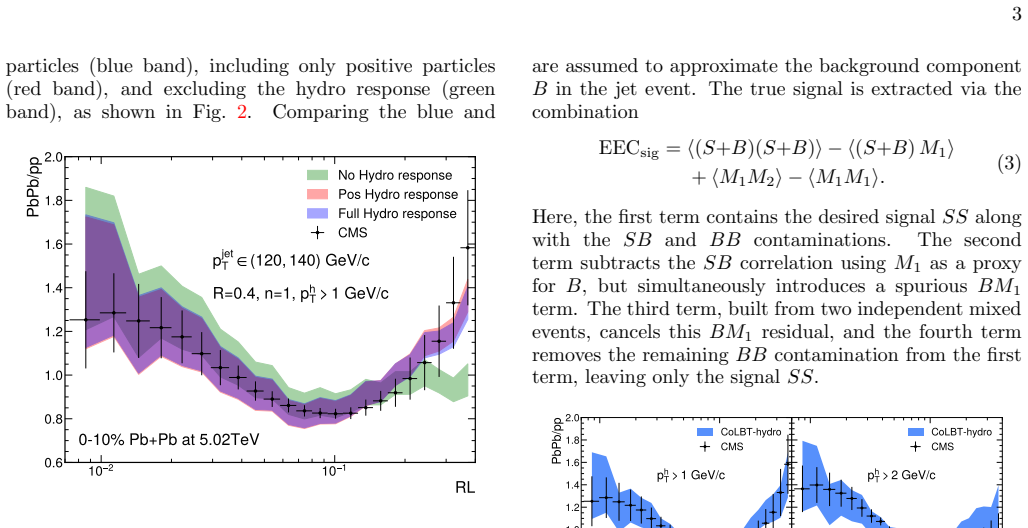
The updated CoLBT-hydro framework with Q_M = 2.0 GeV reproduces the recent CMS measurement of the in-jet energy-energy correlator. Decomposition of different contributions highlights the impact of medium modification. Results obtained with a theoretical background subtraction inside the model are consistent with those from the CMS mixed-event method. Using p_T-ranked jets, the energy-energy correlator differs between leading and sub-leading jets, reflecting dependence on in-medium path length. Its dependence on the dijet rapidity gap serves as a signal of the jet-induced diffusion wake.
What carries the argument
The medium scale Q_M = 2.0 GeV that separates vacuum and in-medium stages of the parton shower, enabling self-consistent jet evolution and background subtraction in the CoLBT-hydro model.
If this is right
- The energy-energy correlator inside jets can probe medium-induced modifications in the quark-gluon plasma.
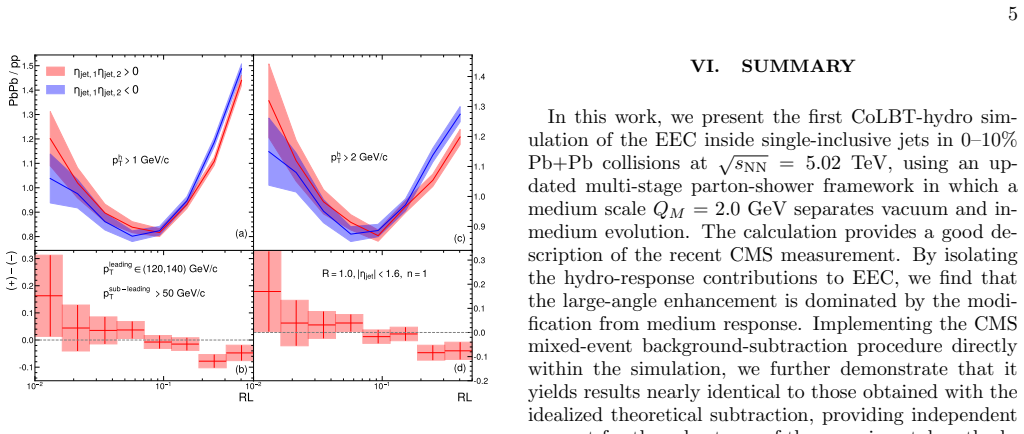
- Different energy-energy correlators for leading versus sub-leading jets reflect the effect of varying in-medium path length.
- Dependence of the leading-jet energy-energy correlator on dijet rapidity gap indicates the jet-induced diffusion wake.
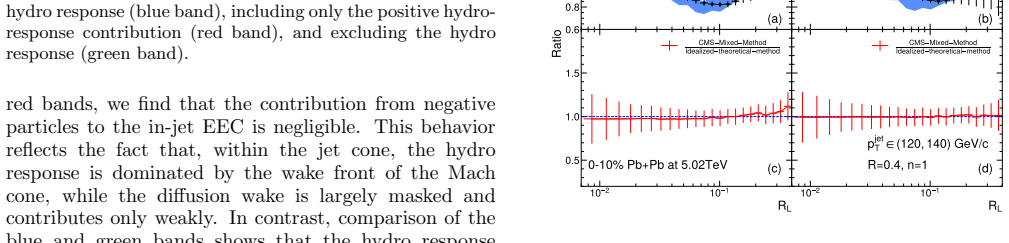
- Theoretical and CMS-style mixed-event background subtractions produce consistent results, validating the experimental procedure.
Where Pith is reading between the lines
- The same scale choice may improve modeling of other jet substructure observables in heavy-ion collisions.
- Path-length dependence could be tested further by comparing results across different collision centralities.
- The diffusion-wake signature may connect to collective-flow patterns induced by jets in the medium.
Load-bearing premise
A fixed medium scale of 2.0 GeV cleanly divides the vacuum and in-medium parts of the parton shower without missing important physics in the jet evolution.
What would settle it
A clear mismatch between the model's predicted in-jet energy-energy correlator and CMS data after identical background subtraction would show that the chosen scale fails to capture the medium effects.
Figures


read the original abstract
The energy-energy correlator (EEC) inside jets is a sensitive observable for studying jet modification in the quark-gluon plasma (QGP). However, its interpretation in heavy-ion collisions remains challenging, requiring a consistent understanding of jet evolution across multiple dynamical scales together with a proper treatment of the background subtraction. In this work, we employ an updated CoLBT-hydro framework in which a medium scale $Q_M$ = 2.0 GeV is introduced to separate the vacuum and in-medium stages of the parton shower, enabling a more self-consistent treatment of jet evolution. Using a theoretical background subtraction within the model, the resulting simulation reproduces the recent CMS measurement of the in-jet EEC, and through a decomposition of different contributions, highlights the impact of medium modification on the observable. To further validate the experimental procedure, we also implement the CMS mixed-event background-subtraction method directly in the simulation and find the results are consistent with that obtained with the theoretical background subtraction. Using $p_T$-ranked jets in each event, we further investigate the dependence of medium modification on the in-medium path length, reflected in the different EECs of leading and sub-leading jets. Finally, we explore the dependence of the leading-jet EEC on the dijet rapidity gap as a signal of the jet-induced diffusion wake.
Editorial analysis
A structured set of objections, weighed in public.
Referee Report
Summary. The manuscript updates the CoLBT-hydro framework by introducing a fixed medium scale Q_M = 2.0 GeV to separate vacuum and in-medium stages of the parton shower. It claims that this enables a self-consistent treatment that reproduces the recent CMS measurement of the in-jet energy-energy correlator (EEC) via theoretical background subtraction, yields consistent results when the CMS mixed-event method is implemented in the simulation, and allows decomposition to highlight medium modifications. Additional studies examine path-length dependence via leading versus sub-leading jets and the effect of dijet rapidity gap on the leading-jet EEC as a probe of the diffusion wake.
Significance. If the EEC reproduction holds independently of the specific Q_M choice and the background-subtraction consistency is robust, the work would supply a practical phenomenological framework for interpreting jet substructure modifications in heavy-ion collisions. The decomposition into medium contributions and the path-length/rapidity-gap explorations could aid in connecting EEC observables to QGP properties and wake effects.
major comments (2)
- [Abstract / model description] Abstract and model description: Q_M = 2.0 GeV is introduced as the scale that 'separates the vacuum and in-medium stages' and 'enables a more self-consistent treatment,' yet no derivation, first-principles motivation, or variation study is referenced. Because the central claim is that the framework 'reproduces' the CMS EEC data, the absence of evidence that this scale was not chosen to match the target distribution makes it impossible to determine whether the reproduction and the subsequent decomposition are independent predictions.
- [Results section on EEC and background methods] Results on EEC reproduction and background subtraction: The abstract states that the simulation reproduces CMS data and that the two background methods are consistent, but supplies no quantitative measures (e.g., χ^{2}, point-by-point ratios, or error-band comparisons). Without such metrics or the corresponding figures/tables, the load-bearing claim of successful reproduction cannot be evaluated.
minor comments (1)
- The abstract would be strengthened by including at least one quantitative statement on the level of agreement with CMS data (e.g., typical deviation or χ^{2} value).
Simulated Author's Rebuttal
We thank the referee for the careful reading of our manuscript and the constructive comments. We address each major comment below.
read point-by-point responses
-
Referee: [Abstract / model description] Abstract and model description: Q_M = 2.0 GeV is introduced as the scale that 'separates the vacuum and in-medium stages' and 'enables a more self-consistent treatment,' yet no derivation, first-principles motivation, or variation study is referenced. Because the central claim is that the framework 'reproduces' the CMS EEC data, the absence of evidence that this scale was not chosen to match the target distribution makes it impossible to determine whether the reproduction and the subsequent decomposition are independent predictions.
Authors: The scale Q_M = 2.0 GeV is introduced in the updated CoLBT-hydro framework to demarcate the transition between vacuum-like shower evolution at high virtuality and medium-modified evolution at lower scales, consistent with the typical virtuality where medium-induced gluon radiation becomes dominant. We acknowledge that the current manuscript provides limited explicit motivation and no variation study. In the revised version we will expand the model section with a brief physical rationale for this choice (drawing on the model's parton-medium interaction thresholds) and add a sensitivity study varying Q_M around 2.0 GeV to demonstrate robustness of the EEC reproduction and decomposition. revision: yes
-
Referee: [Results section on EEC and background methods] Results on EEC reproduction and background subtraction: The abstract states that the simulation reproduces CMS data and that the two background methods are consistent, but supplies no quantitative measures (e.g., χ^{2}, point-by-point ratios, or error-band comparisons). Without such metrics or the corresponding figures/tables, the load-bearing claim of successful reproduction cannot be evaluated.
Authors: We agree that quantitative metrics are necessary to substantiate the reproduction claim. The revised manuscript will include χ²/dof values for the comparison of simulated EEC distributions to CMS data, together with tables or figure annotations showing point-by-point ratios and explicit discussion of error-band overlap for both the theoretical background subtraction and the CMS mixed-event method. revision: yes
Circularity Check
No circularity; Q_M introduction and data reproduction do not reduce to input by construction
full rationale
The provided abstract and excerpts introduce Q_M = 2.0 GeV as a scale 'introduced to separate the vacuum and in-medium stages' and state that the simulation 'reproduces the recent CMS measurement' with decomposition. No equation, section, or quote exhibits a reduction where the EEC result is equivalent to the choice of Q_M by construction, where a fitted parameter is renamed as a prediction, or where a central premise rests solely on a self-citation chain that itself lacks independent verification. The model implementation and background-subtraction consistency checks retain independent content relative to the stated inputs. No load-bearing self-citation or ansatz smuggling is quoted. This is the default honest outcome when no explicit circular step can be exhibited from the text.
Axiom & Free-Parameter Ledger
free parameters (1)
- Q_M =
2.0 GeV
Reference graph
Works this paper leans on
-
[1]
J. D. Bjorken, (1982), reportNumber = FERMILAB- PUB-82-059-THY, FERMILAB-PUB-82-059-T
1982
-
[2]
M. H. Thoma and M. Gyulassy, Nucl. Phys. B351, 491 (1991)
1991
-
[3]
Braaten and M
E. Braaten and M. H. Thoma, Phys. Rev. D44, R2625 (1991)
1991
-
[4]
Multiple Collisions and Induced Gluon Bremsstrahlung in QCD
M. Gyulassy and X.-N. Wang, Nucl. Phys. B420, 583 (1994), arXiv:nucl-th/9306003
work page internal anchor Pith review Pith/arXiv arXiv 1994
- [5]
- [6]
-
[7]
Jet Quenching in Thin Quark-Gluon Plasmas I: Formalism
M. Gyulassy, P. Levai, and I. Vitev, Nucl. Phys. B571, 197 (2000), arXiv:hep-ph/9907461
work page internal anchor Pith review Pith/arXiv arXiv 2000
-
[8]
U. A. Wiedemann, Nucl. Phys. B588, 303 (2000), arXiv:hep-ph/0005129
work page internal anchor Pith review Pith/arXiv arXiv 2000
-
[9]
Multiple Parton Scattering in Nuclei: Parton Energy Loss
X.-N. Wang and X.-F. Guo, Nucl. Phys. A696, 788 (2001), arXiv:hep-ph/0102230
work page internal anchor Pith review Pith/arXiv arXiv 2001
-
[10]
P. B. Arnold, G. D. Moore, and L. G. Yaffe, JHEP06, 030 (2002), arXiv:hep-ph/0204343
work page internal anchor Pith review Pith/arXiv arXiv 2002
-
[11]
Collisional Energy Loss in a Finite Size QCD Matter
M. Djordjevic, Phys. Rev. C74, 064907 (2006), arXiv:nucl-th/0603066
work page internal anchor Pith review Pith/arXiv arXiv 2006
-
[12]
G.-Y. Qin, J. Ruppert, C. Gale, S. Jeon, G. D. Moore, and M. G. Mustafa, Phys. Rev. Lett.100, 072301 (2008), arXiv:0710.0605 [hep-ph]
work page internal anchor Pith review Pith/arXiv arXiv 2008
- [13]
-
[14]
K. Adcoxet al.(PHENIX), Phys. Rev. Lett.88, 022301 (2002), arXiv:nucl-ex/0109003
work page internal anchor Pith review Pith/arXiv arXiv 2002
-
[15]
Centrality dependence of high pT hadron suppression in Au+Au collisions at sqrt(sNN)=130 GeV
C. Adleret al.(STAR), Phys. Rev. Lett.89, 202301 (2002), arXiv:nucl-ex/0206011
work page internal anchor Pith review Pith/arXiv arXiv 2002
-
[16]
New Forms of QCD Matter Discovered at RHIC
M. Gyulassy and L. McLerran, Nucl. Phys. A750, 30 (2005), arXiv:nucl-th/0405013
work page internal anchor Pith review Pith/arXiv arXiv 2005
- [17]
-
[18]
K. Aamodtet al.(ALICE), Phys. Lett. B696, 30 (2011), arXiv:1012.1004 [nucl-ex]
work page internal anchor Pith review Pith/arXiv arXiv 2011
-
[19]
G. Aadet al.(ATLAS), Phys. Rev. Lett.105, 252303 (2010), arXiv:1011.6182 [hep-ex]
work page internal anchor Pith review Pith/arXiv arXiv 2010
-
[20]
The theory and phenomenology of perturbative QCD based jet quenching
A. Majumder and M. Van Leeuwen, Prog. Part. Nucl. Phys.66, 41 (2011), arXiv:1002.2206 [hep-ph]
work page internal anchor Pith review Pith/arXiv arXiv 2011
-
[21]
S. Chatrchyanet al.(CMS), Phys. Rev. C84, 024906 (2011), arXiv:1102.1957 [nucl-ex]
work page internal anchor Pith review Pith/arXiv arXiv 2011
-
[22]
Jet quenching in high-energy heavy-ion collisions
G.-Y. Qin and X.-N. Wang, “Quark–Gluon Plasma 5”, p. 309, edited by X. N. Wang (World Scien- tific, 2016), Int. J. Mod. Phys. E24, 1530014 (2015), arXiv:1511.00790 [hep-ph]
work page internal anchor Pith review Pith/arXiv arXiv 2016
-
[23]
Apolin´ ario, Y.-T
L. Apolin´ ario, Y.-T. Chien, and L. Cunqueiro Mendez, Int. J. Mod. Phys. E33, 2430003 (2024)
2024
-
[24]
C. L. Basham, L. S. Brown, S. D. Ellis, and S. T. Love, Phys. Rev. D17, 2298 (1978)
1978
-
[25]
C. L. Basham, L. S. Brown, S. D. Ellis, and S. T. Love, Phys. Rev. Lett.41, 1585 (1978)
1978
-
[26]
C. L. Basham, L. S. Brown, S. D. Ellis, and S. T. Love, Phys. Rev. D19, 2018 (1979)
2018
- [27]
- [28]
- [29]
- [30]
- [31]
- [32]
- [33]
-
[34]
J. Barata, Z.-B. Kang, X. Mayo L´ opez, and J. Penttala, Phys. Rev. Lett.134, 251903 (2025), arXiv:2411.11782 [hep-ph]
- [35]
- [36]
- [37]
-
[38]
B. Singh and V. Vaidya, JHEP06, 071 (2025), arXiv:2408.02753 [hep-ph]
- [39]
- [40]
- [41]
- [42]
- [43]
- [44]
- [45]
-
[46]
A. Budhraja and B. Singh, Phys. Lett. B872, 140079 (2026), arXiv:2503.20019 [hep-ph]
- [47]
- [48]
-
[49]
L. Apolin´ ario, R. Kunnawalkam Elayavalli, N. O. Madureira, J.-X. Sheng, X.-N. Wang, and Z. Yang, Phys. Rev. D112, 054018 (2025), arXiv:2502.11406 [hep-ph]
- [50]
-
[51]
Acharyaet al.(ALICE), (2024), arXiv:2409.12687 [hep-ex]
S. Acharyaet al.(ALICE), (2024), arXiv:2409.12687 [hep-ex]
-
[52]
A. Hayrapetyanet al.(CMS), Phys. Rev. Lett.133, 071903 (2024), arXiv:2402.13864 [hep-ex]
- [53]
-
[54]
Acharyaet al.(ALICE), (2025), arXiv:2504.03431 [hep-ex]
S. Acharyaet al.(ALICE), (2025), arXiv:2504.03431 [hep-ex]
-
[55]
V. Chekhovskyet al.(CMS), Phys. Lett. B866, 139556 (2025), arXiv:2503.19993 [nucl-ex]
-
[56]
Energy-energy correlation in Z boson tagged PbPb and pp collisions at √sN N = 5.02 TeV,
CMS, “Energy-energy correlation in Z boson tagged PbPb and pp collisions at √sN N = 5.02 TeV,” (2025), cMS-PAS-HIN-24-019
2025
-
[57]
Nambrath, EPJ Web Conf.339, 02001 (2025), arXiv:2510.16195 [nucl-ex]
A. Nambrath, EPJ Web Conf.339, 02001 (2025), arXiv:2510.16195 [nucl-ex]
- [58]
-
[59]
J. Barata and S. Mukherjee, Phys. Rev. D111, L031901 (2025), arXiv:2409.13816 [hep-ph]
- [60]
-
[61]
M. Jaarsma, Y. Li, I. Moult, W. J. Waalewijn, and H. X. Zhu, (2025), arXiv:2512.11950 [hep-ph]. 7
- [62]
- [63]
- [64]
-
[65]
H. Bossi, Y.-C. Chen, Y. Chen, J. Zhang, G. M. In- nocenti, A. Badea, A. Baty, M. Maggi, C. McGinn, and Y.-J. Lee (Electron-Positron Alliance), (2025), arXiv:2505.11828 [hep-ex]
-
[66]
S. Alipour-fard and W. J. Waalewijn, JHEP07, 043 (2025), arXiv:2501.17218 [hep-ph]
-
[67]
A. Budhraja, I. Pels, and W. J. Waalewijn, (2026), arXiv:2603.16996 [hep-ph]
- [68]
-
[69]
Medium Modification of \gamma-jets in High-energy Heavy-ion Collisions
X.-N. Wang and Y. Zhu, Phys. Rev. Lett.111, 062301 (2013), arXiv:1302.5874 [hep-ph]
work page internal anchor Pith review Pith/arXiv arXiv 2013
-
[70]
Y. He, T. Luo, X.-N. Wang, and Y. Zhu, Phys. Rev. C91, 054908 (2015), [Erratum: Phys.Rev.C 97, 019902 (2018)], arXiv:1503.03313 [nucl-th]
work page internal anchor Pith review Pith/arXiv arXiv 2015
-
[71]
S. Cao, T. Luo, G.-Y. Qin, and X.-N. Wang, Phys. Rev. C94, 014909 (2016), arXiv:1605.06447 [nucl-th]
work page internal anchor Pith review Pith/arXiv arXiv 2016
-
[72]
S. Cao, T. Luo, G.-Y. Qin, and X.-N. Wang, Phys. Lett. B777, 255 (2018), arXiv:1703.00822 [nucl-th]
work page internal anchor Pith review Pith/arXiv arXiv 2018
- [73]
- [74]
-
[75]
L. Pang, Q. Wang, and X.-N. Wang, Phys. Rev. C86, 024911 (2012), arXiv:1205.5019 [nucl-th]
work page internal anchor Pith review Pith/arXiv arXiv 2012
-
[76]
L.-G. Pang, Y. Hatta, X.-N. Wang, and B.-W. Xiao, Phys. Rev. D91, 074027 (2015), arXiv:1411.7767 [hep- ph]
work page internal anchor Pith review Pith/arXiv arXiv 2015
-
[77]
L.-G. Pang, H. Petersen, and X.-N. Wang, Phys. Rev. C97, 064918 (2018), arXiv:1802.04449 [nucl-th]
work page internal anchor Pith review Pith/arXiv arXiv 2018
- [78]
-
[79]
W. Chen, S. Cao, T. Luo, L.-G. Pang, and X.-N. Wang, Phys. Lett. B777, 86 (2018), arXiv:1704.03648 [nucl- th]
work page internal anchor Pith review Pith/arXiv arXiv 2018
- [80]
discussion (0)
Sign in with ORCID, Apple, or X to comment. Anyone can read and Pith papers without signing in.