Subsidizing Sequential Search
Pith reviewed 2026-06-29 08:55 UTC · model grok-4.3
The pith
Higher-quality firms offer larger subsidies for consumer inspection, leading to search in descending subsidy order.
A machine-rendered reading of the paper's core claim, the machinery that carries it, and where it could break.
Core claim
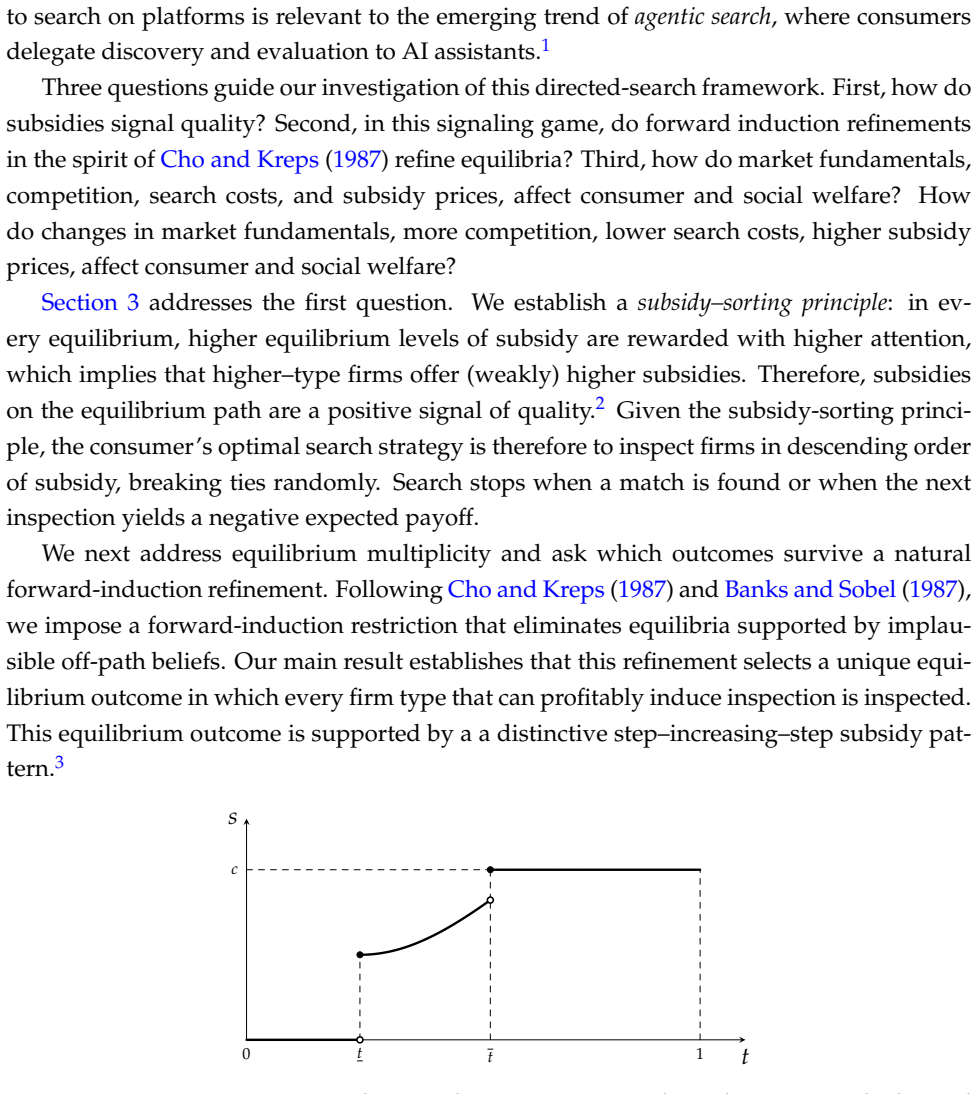
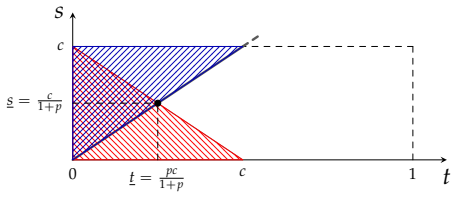
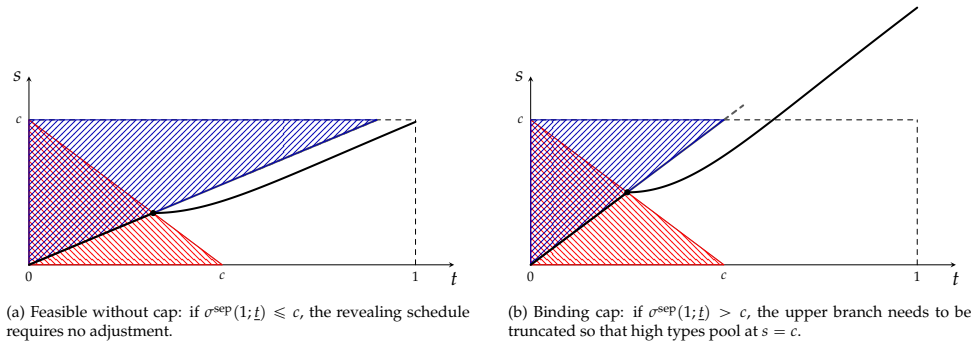
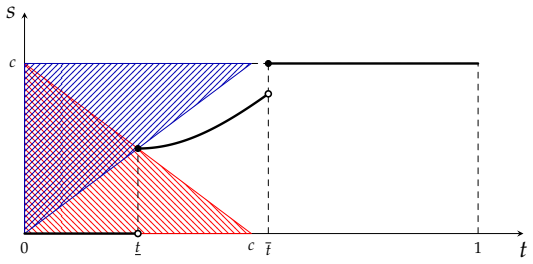
In markets where firms subsidize the cost of product inspection to attract consumer attention, the subsidy-sorting principle holds: higher-quality firms give weakly larger subsidies in any equilibrium. Consumers therefore search in descending order of subsidies. The unique equilibrium that survives the Intuitive Criterion refinement has low-quality firms never inspected, intermediate-quality firms separating via strictly increasing subsidies, and high-quality firms pooling at the maximum subsidy level. This equilibrium maximizes information revelation and achieves efficient inspection. On AI platforms that price inspection tokens linearly, the optimum induces more inspection than socially op
What carries the argument
The subsidy-sorting principle, which links higher firm quality to weakly larger subsidies and thereby determines the consumer search order.
Load-bearing premise
Firms and consumers share common knowledge of the quality distribution and refine equilibria according to the Intuitive Criterion.
What would settle it
An observation that consumers inspect a low-quality firm while higher-quality firms offer equal or smaller subsidies would contradict the subsidy-sorting principle.
Figures
read the original abstract
We study markets where firms compete for consumer attention by subsidizing costly product inspection. These subsidies do not change product quality, but they alter the order in which consumers search by lowering inspection costs. We establish a subsidy-sorting principle: in any equilibrium, higher-quality firms provide weakly larger subsidies, leading consumers to search in descending subsidy order. A unique equilibrium survives forward-induction reasoning in the spirit of the Intuitive Criterion: low-quality firms are never inspected, intermediate-quality firms separate with strictly increasing subsidies, and high-quality firms pool at the full subsidy. This equilibrium maximizes information revelation among all possible outcomes and ensures efficient inspection. We then extend the analysis to AI-mediated platforms that can create and price inspection tokens. The platform's optimal linear pricing leads to excessive inspection relative to the social optimum. While this distortion does not reduce consumer welfare, it reallocates surplus from sellers to the platform and consumers.
Editorial analysis
A structured set of objections, weighed in public.
Referee Report
Summary. The manuscript analyzes markets in which firms compete for consumer attention by offering subsidies that reduce the cost of product inspection. It establishes a subsidy-sorting principle that holds in any equilibrium: higher-quality firms provide weakly larger subsidies, inducing consumers to search in descending order of subsidies. A unique equilibrium is selected by forward-induction reasoning in the spirit of the Intuitive Criterion, in which low-quality firms are never inspected, intermediate-quality firms separate with strictly increasing subsidies, and high-quality firms pool at the full subsidy. This equilibrium maximizes information revelation and ensures efficient inspection. The analysis is extended to AI-mediated platforms that create and price inspection tokens, where the platform's optimal linear pricing results in excessive inspection relative to the social optimum without reducing consumer welfare, but reallocating surplus from sellers to the platform and consumers.
Significance. The subsidy-sorting principle and the characterization of the unique equilibrium under the Intuitive Criterion represent a novel contribution to the theory of sequential search with endogenous inspection costs. The result that the equilibrium is informationally efficient is noteworthy. The extension to platform pricing provides a clear welfare analysis showing no consumer harm despite distortion. These findings could influence models of attention markets and platform regulation if the derivations are robust.
minor comments (2)
- The abstract and introduction should explicitly state the precise definition of the Intuitive Criterion refinement employed and how it differs from standard applications in signaling games, to allow readers to verify the uniqueness claim.
- In the platform extension, the statement that excessive inspection 'does not reduce consumer welfare' requires an explicit comparison of consumer surplus under platform pricing versus the social optimum; this calculation should be highlighted in the main text or appendix.
Simulated Author's Rebuttal
We thank the referee for the thorough and positive assessment of our manuscript. The recommendation for minor revision is noted, and we are pleased that the subsidy-sorting principle, equilibrium selection via forward induction, informational efficiency, and platform extension were viewed as novel contributions.
Circularity Check
No significant circularity; derivation self-contained from primitives
full rationale
The paper derives a subsidy-sorting principle and equilibrium selection via the Intuitive Criterion directly from standard sequential-search game primitives (common-knowledge quality distribution, inspection costs, forward-induction refinement). No fitted parameters are relabeled as predictions, no self-citations supply load-bearing uniqueness theorems, and no ansatz or renaming reduces the central claims to inputs by construction. The equilibrium configuration (low-quality firms uninspected, intermediate separation, high-quality pooling) follows from the refinement applied to the strategy space; the platform extension likewise follows from the same primitives without internal reduction. This is the normal case of a self-contained theoretical derivation.
Axiom & Free-Parameter Ledger
axioms (3)
- domain assumption Consumers are rational Bayesian updaters who choose search order and stopping rules to maximize expected utility net of inspection costs.
- domain assumption Firms simultaneously choose subsidies knowing that consumers will search in subsidy order.
- domain assumption The Intuitive Criterion (forward-induction refinement) selects among multiple equilibria.
Reference graph
Works this paper leans on
-
[1]
Advertising Content.American Economic Review96, 1 (March 2006), 93–113.https://doi.org/10.1257/000282806776157632 Susan Athey and Glenn Ellison
-
[2]
Position Auctions with Consumer Search.The Quarterly Journal of Economics126, 3 (2011), 1213–1270.https://doi.org/10.1093/qje/qjr028 Pak Hung Au and Mark Whitmeyer
-
[3]
Attraction versus Persuasion: Information Provision in Search Markets.Journal of Political Economy131, 1 (2023), 202–245.https://doi.org/10.1086/ 720984 Jeffrey S Banks and Joel Sobel
2023
-
[4]
Simon Board and Jay Lu
Equilibrium selection in signaling games.Econometrica55, 3 (1987), 647–661. Simon Board and Jay Lu
1987
-
[5]
1965–2010.https://www.jstor.org/stable/26550518 Hector Chade and Lones Smith
Competitive Information Disclosure in Search Markets.Journal of Political Economy126, 5 (2018), pp. 1965–2010.https://www.jstor.org/stable/26550518 Hector Chade and Lones Smith
-
[6]
Yongmin Chen and Chuan He
Simultaneous search.Econometrica74, 5 (2006), 1293–1307. Yongmin Chen and Chuan He
2006
-
[7]
In-Koo Cho and David M Kreps
Paid Placement: Advertising and Search on the Internet.The Economic Journal121, 556 (2011), F309–F328. In-Koo Cho and David M Kreps
2011
-
[8]
Peter A Diamond
Signaling Games and Stable Equilibria.The Quarterly Journal of Economics102, 2 (1987), 179–221. Peter A Diamond
1987
-
[9]
A model of price adjustment.Journal of Economic Theory3 (1971), 156–168. https://doi.org/10.1016/0022-0531(71)90013-5 Bolin Ding, Yiding Feng, Chien-Ju Ho, Wei Tang, and Haifeng Xu
-
[10]
Competitive Information Design for Pandora’s Box. arXiv:2103.03769 [cs.GT]https://arxiv.org/abs/2103.03769 Benjamin Edelman, Michael Ostrovsky, and Michael Schwarz
-
[11]
Internet Advertising and the 26 Generalized Second-Price Auction: Selling Billions of Dollars Worth of Keywords.American Eco- nomic Review97, 1 (2007), 242–259.https://doi.org/10.1257/aer.97.1.242 Glenn Ellison and Alexander Wolitzky
-
[12]
Maarten Janssen, Thomas Jungbauer, Marcel Preuss, and Cole Williams
A search cost model of obfuscation.The RAND Journal of Economics43, 3 (2012), 417–441. Maarten Janssen, Thomas Jungbauer, Marcel Preuss, and Cole Williams
2012
-
[13]
J J McCall
Sequential equilibria.Econometrica(1982), 863–894. J J McCall
1982
-
[14]
Teddy Mekonnen, Zeky Murra-Anton, and Bobak Pakzad-Hurson
Economics of Information and Job Search.The Quarterly Journal of Economics84, 1 (1970), 113–126. Teddy Mekonnen, Zeky Murra-Anton, and Bobak Pakzad-Hurson
1970
-
[15]
Persuaded Search.Journal of Political Economy133, 10 (2025), 3167–3207.https://doi.org/10.1086/736765 Paul Milgrom and Chris Shannon
-
[16]
Monotone Comparative Statics.Econometrica62, 1 (1994), 157–180.https://doi.org/10.2307/2951479 Volker Nocke and Patrick Rey
-
[17]
Consumer Search, Steering, and Choice Overload.Journal of Political Economy132, 5 (May 2024), 1684–1739.https://doi.org/10.1086/728108 Jean-Charles Rochet and Jean Tirole
-
[18]
Rothschild, Markus Mobius, Jake M
Platform Competition in Two-Sided Markets.Jour- nal of the European Economic Association1, 4 (2003), 990–1029.https://doi.org/10.1162/ 154247603322493212 David M. Rothschild, Markus Mobius, Jake M. Hofman, Eleanor W. Dillon, Daniel G. Goldstein, Nicole Immorlica, Sonia Jaffe, Brendan Lucier, Aleksandrs Slivkins, and Matthew Vogel
2003
-
[19]
arXiv:2505.15799 [cs.CY]https://arxiv.org/abs/2505.15799 George J
The Agentic Economy. arXiv:2505.15799 [cs.CY]https://arxiv.org/abs/2505.15799 George J. Stigler
-
[20]
The Economics of Information.Journal of Political Economy69, 3 (1961), 213–
1961
-
[21]
https://doi.org/10.2307/1910412 E Glen Weyl
Optimal Search for the Best Alternative.Econometrica47, 3 (1979), 641–654. https://doi.org/10.2307/1910412 E Glen Weyl
-
[22]
27 A Omitted proofs for Section 3 A.1 Proof of Lemma 1 First, we establish that the attention function is weakly increasing on path
A price theory of multi-sided platforms.American Economic Review100, 4 (2010), 1642–1672. 27 A Omitted proofs for Section 3 A.1 Proof of Lemma 1 First, we establish that the attention function is weakly increasing on path. Claim 1.For s,s 1 PImpσq, if s 1 ěs, then q σ,ιps1q ěq σ,ιpsq. Proof.Assume towards a contradiction that this is not the case, thenq σ...
2010
discussion (0)
Sign in with ORCID, Apple, or X to comment. Anyone can read and Pith papers without signing in.