Reinterpreting Memory Effects in Nonequilibrium Systems: From Temporal Dynamics to Steady-State Signatures via NEGF
Pith reviewed 2026-06-29 10:03 UTC · model grok-4.3
The pith
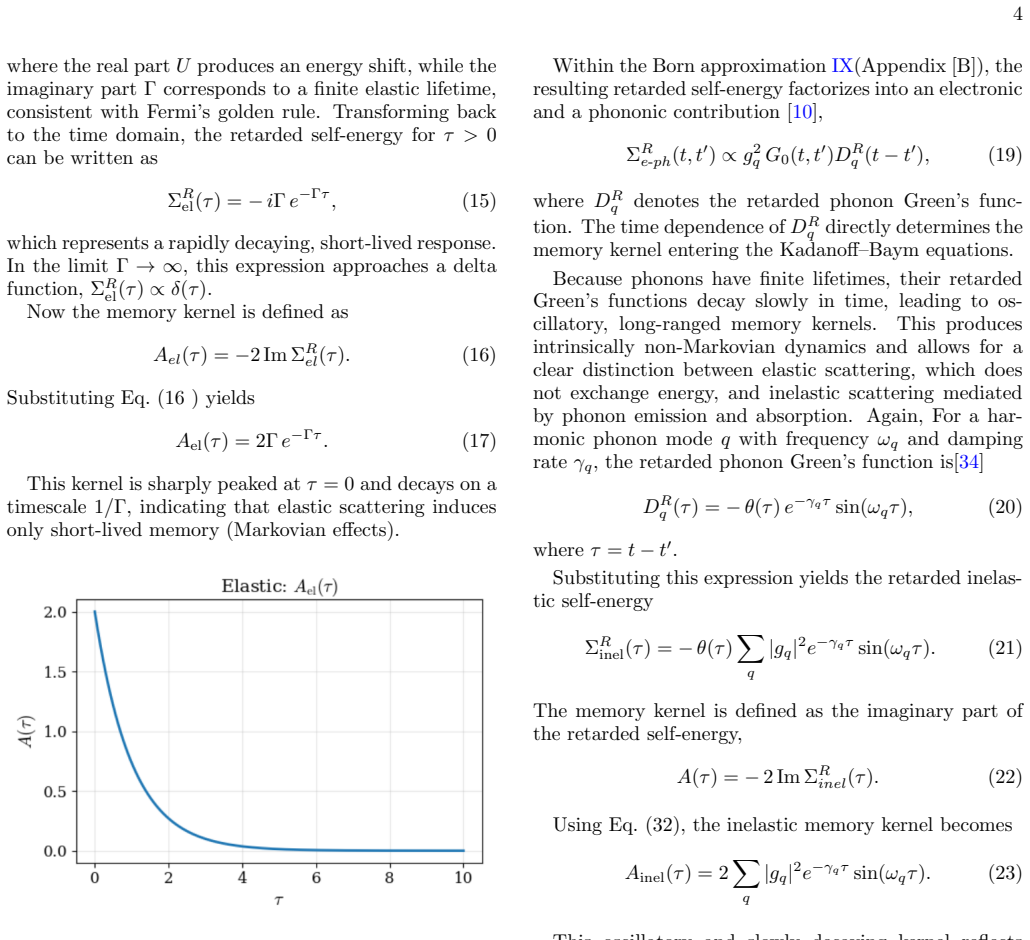
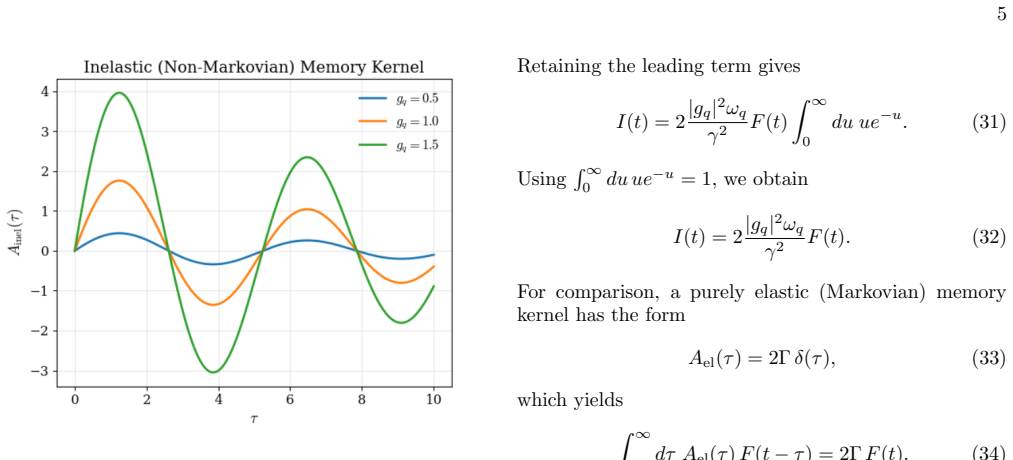
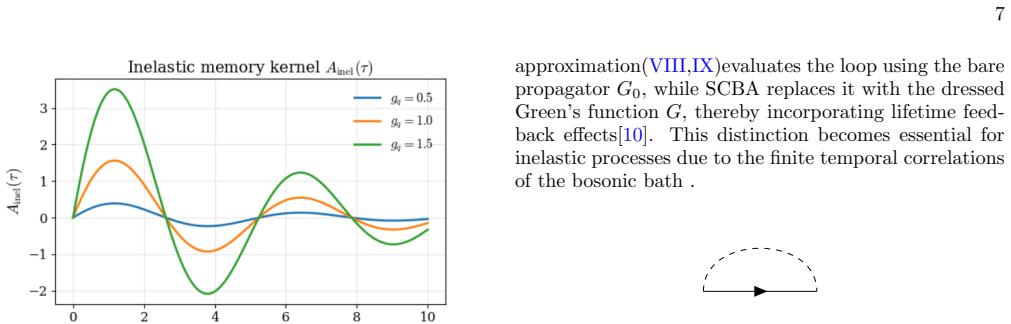
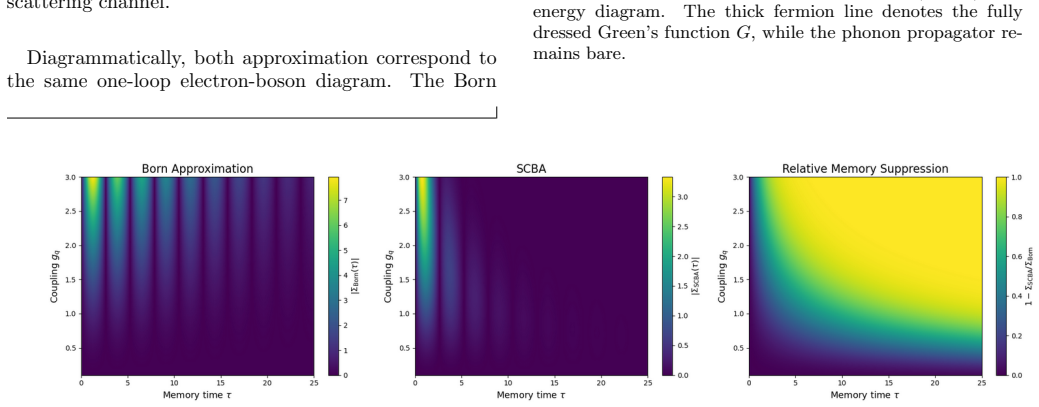
Static disorder produces local self-energies and Markovian memory kernels while electron-phonon coupling produces nonlocal self-energies and non-Markovian behavior in nonequilibrium 2D systems.
A machine-rendered reading of the paper's core claim, the machinery that carries it, and where it could break.
Core claim
Within the Schwinger-Keldysh NEGF formalism, the self-energy arising from static disorder is spatially local and generates a memory kernel that decays on short time scales, corresponding to Markovian dynamics, whereas the self-energy arising from electron-phonon coupling is temporally nonlocal and sustains non-Markovian memory; both signatures are encoded in the spectral function.
What carries the argument
The electronic self-energy obtained from the Dyson equation on the Keldysh contour under Born approximations, which directly determines the form and decay of the memory kernel.
If this is right
- The spectral function supplies a practical, steady-state observable for distinguishing Markovian from non-Markovian memory effects without requiring explicit time-resolved measurements.
- Application of the same NEGF treatment to the Hofstadter model and to RKKY-coupled systems shows that the choice of microscopic Hamiltonian controls whether the resulting dynamics remain Markovian or become non-Markovian.
- Examination of 1PI and 2PI effective actions reveals how coarse-graining alters the memory content of the theory.
Where Pith is reading between the lines
- If the spectral-function distinction survives beyond the Born level, it could be used to identify dominant scattering mechanisms in mesoscopic devices from equilibrium or steady-state spectroscopy alone.
- The separation between local and nonlocal self-energies suggests that hybrid disorder-plus-phonon models would produce memory kernels whose long-time tail is controlled by the phonon component.
Load-bearing premise
The second-order Born and self-consistent Born approximations are sufficient to reveal the qualitative difference between Markovian and non-Markovian memory kernels for the elastic and inelastic mechanisms examined.
What would settle it
A numerical or experimental spectral function computed or measured for a 2D lattice with static disorder that fails to differ from the corresponding function obtained with electron-phonon coupling under the same Born approximations would falsify the claimed distinction.
Figures
read the original abstract
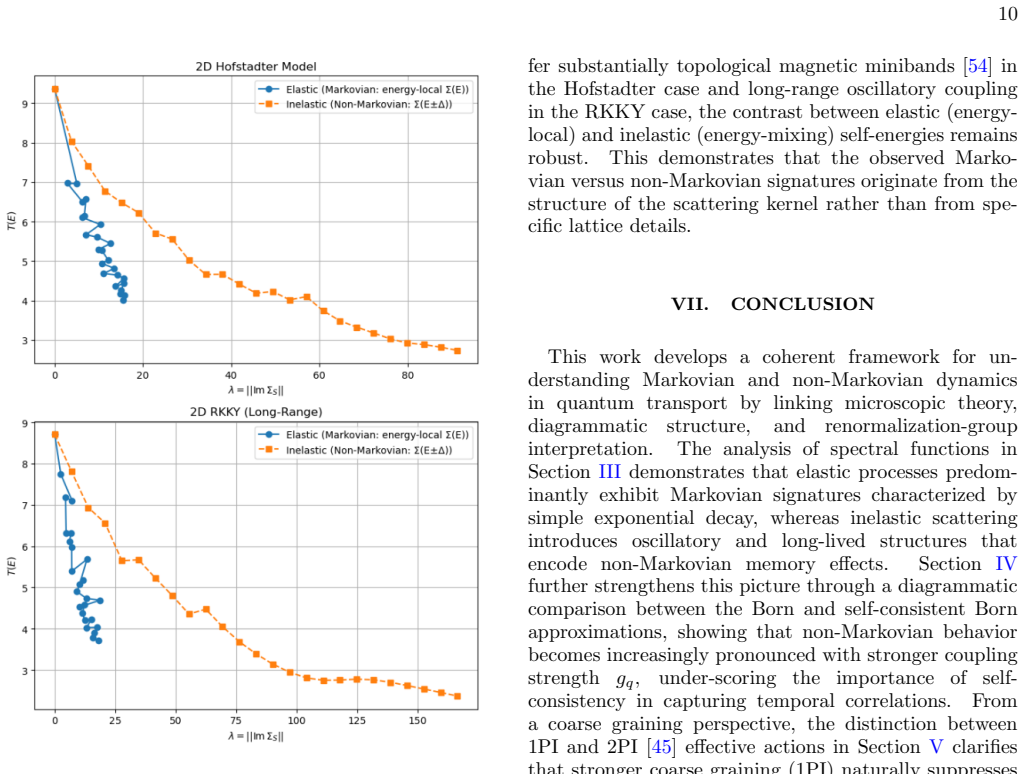
We investigate memory effects and quantum transport in two-dimensional lattice systems within the framework of non-equilibrium Green's functions and Schwinger-Keldysh non-equilibrium quantum field theory. Starting from a 2D tight-binding Hamiltonian, we employ the Dyson expansion on the Keldysh contour and the second-order Born and self-consistent Born Approximation to derive the electronic self-energies associated with elastic and inelastic scattering mechanisms.Static disorder produces a local self-energy and a rapidly decaying memory kernel, characteristic of Markovian dynamics, whereas electron-phonon coupling generates temporally nonlocal self-energies and genuine Non-Markovian behavior. We demonstrate that these distinct memory signatures are directly reflected in the spectral function, which we propose as a diagnostic probe of non-equilibrium memory effects. Further we explore 1PI and 2PI effective actions to see their memory perspectives studying their coarse-graining behavior. Building on this theoretical framework, we further apply the conventional NEGF formalism to two paradigmatic two-dimensional models-the Hofstadter and an RKKY-coupled system to explore how different microscopic Hamiltonians influence Markovian and Non-Markovian nature. Our results provide a unified connection between scattering mechanisms, memory effects, and quantum transport in low-dimensional systems.
Editorial analysis
A structured set of objections, weighed in public.
Referee Report
Summary. The manuscript uses the NEGF formalism on the Schwinger-Keldysh contour, starting from a 2D tight-binding Hamiltonian, to derive electronic self-energies via Dyson expansion and second-order Born/self-consistent Born approximations. It claims that static disorder yields a local self-energy with rapidly decaying memory kernel (Markovian), while electron-phonon coupling produces temporally nonlocal self-energies (non-Markovian); these signatures appear in the steady-state spectral function, proposed as a diagnostic for nonequilibrium memory effects. The work further examines 1PI and 2PI effective actions, their coarse-graining, and applies the framework to Hofstadter and RKKY-coupled models to illustrate how microscopic Hamiltonians affect Markovian versus non-Markovian character.
Significance. If the claimed qualitative separation of memory kernels survives beyond the chosen truncation, the spectral-function diagnostic would provide a concrete, experimentally accessible link between scattering mechanisms and non-Markovian dynamics in low-dimensional nonequilibrium transport. The explicit application to Hofstadter and RKKY models supplies falsifiable predictions for specific Hamiltonians, which strengthens the framework's utility if the underlying approximations are shown to be robust.
major comments (2)
- [Abstract and Dyson expansion/Born approximations paragraph] Abstract and paragraph on Dyson expansion/Born approximations: the central claim that static disorder produces a strictly local, rapidly decaying kernel while electron-phonon coupling remains temporally nonlocal rests on the second-order Born and self-consistent Born truncations. No comparisons to numerically exact solvers (e.g., hierarchical equations of motion or exact diagonalization on small clusters) or higher-order diagrammatic resummations are reported; higher-order scattering or vertex corrections could generate effective time-nonlocality even for elastic disorder, undermining the proposed spectral-function diagnostic.
- [Spectral function discussion] Section discussing the spectral function as diagnostic: the assertion that memory-kernel signatures are 'directly reflected' in the steady-state spectral function is presented without an explicit mapping (e.g., relating kernel decay time to linewidth or sideband structure) that is independent of the same self-energy expressions used to define the memory; this leaves open the possibility of circularity between the definition of 'memory' and the calculated observable.
minor comments (1)
- [Methods section] Notation for the Keldysh contour components and the precise definition of the memory kernel (e.g., whether it is the full lesser/greater component or a projected quantity) should be stated explicitly in the methods section to allow direct reproduction.
Simulated Author's Rebuttal
We thank the referee for the careful reading and constructive comments. We address each major comment below, indicating planned revisions where appropriate.
read point-by-point responses
-
Referee: Abstract and paragraph on Dyson expansion/Born approximations: the central claim that static disorder produces a strictly local, rapidly decaying kernel while electron-phonon coupling remains temporally nonlocal rests on the second-order Born and self-consistent Born truncations. No comparisons to numerically exact solvers (e.g., hierarchical equations of motion or exact diagonalization on small clusters) or higher-order diagrammatic resummations are reported; higher-order scattering or vertex corrections could generate effective time-nonlocality even for elastic disorder, undermining the proposed spectral-function diagnostic.
Authors: We agree that the reported distinction is obtained within the second-order Born and SCBA approximations. These truncations are standard for weak-to-intermediate scattering strengths in NEGF and correctly capture the instantaneous nature of elastic disorder versus the retarded phonon-mediated interaction. We acknowledge that higher-order diagrams or vertex corrections could in principle introduce effective nonlocality for disorder scattering. We will add a new paragraph in the methods and discussion sections explicitly stating the approximation level, its validity regime, and the possibility that non-perturbative effects might alter the Markovian character, thereby qualifying the proposed diagnostic. revision: partial
-
Referee: Section discussing the spectral function as diagnostic: the assertion that memory-kernel signatures are 'directly reflected' in the steady-state spectral function is presented without an explicit mapping (e.g., relating kernel decay time to linewidth or sideband structure) that is independent of the same self-energy expressions used to define the memory; this leaves open the possibility of circularity between the definition of 'memory' and the calculated observable.
Authors: The memory kernel is the time-domain self-energy Σ(t,t′) obtained from the Born diagrams; its Fourier transform enters the Dyson equation that yields the retarded Green’s function and hence the spectral function A(ω). Rapid temporal decay produces a nearly frequency-independent imaginary part of Σ^R(ω) (uniform broadening), while slow or oscillatory decay produces frequency-dependent structure (sidebands). This is the standard NEGF relation between time and frequency domains and is not circular. To remove any ambiguity we will insert an explicit subsection that derives the mapping analytically for model kernels (exponential decay versus damped oscillation) and shows the resulting linewidth versus sideband signatures. revision: yes
- We do not perform comparisons against numerically exact solvers (HEOM, exact diagonalization) in the present work; providing such benchmarks would require new, extensive calculations outside the scope of the manuscript.
Circularity Check
Memory kernel locality and spectral signatures reduce to the same NEGF self-energy definitions by construction
specific steps
-
self definitional
[Abstract]
"Static disorder produces a local self-energy and a rapidly decaying memory kernel, characteristic of Markovian dynamics, whereas electron-phonon coupling generates temporally nonlocal self-energies and genuine Non-Markovian behavior. We demonstrate that these distinct memory signatures are directly reflected in the spectral function, which we propose as a diagnostic probe of non-equilibrium memory effects."
The memory kernel is identified with the time dependence of the self-energy Σ(t,t'); locality in time is therefore the definition of Markovian dynamics. The spectral function A(ω) = −(1/π)Im G^R(ω) is computed from the retarded Green's function that solves the Dyson equation with precisely that Σ. The claimed reflection therefore follows identically from the input expressions rather than constituting an independent result.
full rationale
The central claim equates the time-locality of the self-energy (derived under Born approximations) with Markovian vs non-Markovian memory and then states that these signatures appear in the spectral function. Because the spectral function is obtained directly from the Green's function via the Dyson equation that incorporates the identical self-energy, the demonstration is tautological within the chosen framework. No external benchmark or independent observable is invoked to break the definitional loop. No self-citations, fitted predictions, or ansatz smuggling appear in the abstract or described chain.
Axiom & Free-Parameter Ledger
axioms (2)
- domain assumption Second-order Born and self-consistent Born approximations suffice to derive self-energies for elastic and inelastic scattering
- standard math Schwinger-Keldysh contour and Dyson expansion on that contour correctly describe the non-equilibrium dynamics
Reference graph
Works this paper leans on
-
[1]
World Scientific, 2009
Felix A Buot.Nonequilibrium quantum transport physics in nanosystems: foundation of computational nonequilib- rium physics in nanoscience and nanotechnology. World Scientific, 2009. 11
2009
-
[2]
Cambridge University Press, 2005
Supriyo Datta.Quantum Transport: Atom to Transistor. Cambridge University Press, 2005
2005
-
[3]
Dynamics of open quantum systems ii, markovian approximation.Quantum, 6:616, 2022
Marco Merkli. Dynamics of open quantum systems ii, markovian approximation.Quantum, 6:616, 2022
2022
-
[5]
Quantum non- markovianity: Overview and recent developments.Fron- tiers in Quantum Science and Technology, 2:1134583, 2023
U Shrikant and Prabha Mandayam. Quantum non- markovianity: Overview and recent developments.Fron- tiers in Quantum Science and Technology, 2:1134583, 2023
2023
-
[6]
Introduction to nonequilibrium quantum field theory
J¨ urgen Berges. Introduction to nonequilibrium quantum field theory. InAIP Conference Proceedings, volume 739, page 3–62. AIP, 2004. URL:http://dx.doi.org/10. 1063/1.1843591,doi:10.1063/1.1843591
-
[7]
Dicke model and the theory of driven and spontaneous emission.La Rivista del Nuovo Cimento (1978-1999), 9(4):1–85, 1986
C Leonardi, Franco Persico, and G Vetri. Dicke model and the theory of driven and spontaneous emission.La Rivista del Nuovo Cimento (1978-1999), 9(4):1–85, 1986
1978
-
[8]
Cambridge University Press, 2023
Alex Kamenev.Field theory of non-equilibrium systems. Cambridge University Press, 2023
2023
-
[9]
Keldysh field theory for driven open quantum systems.Reports on Progress in Physics, 79(9):096001, 2016
Lukas M Sieberer, Michael Buchhold, and Sebastian Diehl. Keldysh field theory for driven open quantum systems.Reports on Progress in Physics, 79(9):096001, 2016
2016
-
[10]
H. Haug and Antti-Pekka Jauho. Quantum kinetics in transport & optics of semiconductors.Quantum Kinet- ics in Transport and Optics of Semiconductors: , Solid- State Sciences, Volume 123. ISBN 978-3-540-73561-8. Springer-Verlag Berlin Heidelberg, 2008, 123, 01 2008. doi:10.1007/978-3-540-73564-9
-
[11]
Brownian motion of a quantum os- cillator.Journal of Mathematical Physics, 2(3):407–432, 1961
Julian Schwinger. Brownian motion of a quantum os- cillator.Journal of Mathematical Physics, 2(3):407–432, 1961
1961
-
[12]
Diagram technique for nonequilib- rium processes
Leonid V Keldysh. Diagram technique for nonequilib- rium processes. InSelected Papers of Leonid V Keldysh, pages 47–55. World Scientific, 2024
2024
-
[13]
CRC Press, 2018
Leo P Kadanoff.Quantum statistical mechanics. CRC Press, 2018
2018
-
[14]
Non-markovian electron-phonon relax- ation.Condens
VG Morozov. Non-markovian electron-phonon relax- ation.Condens. Matter Phys, 3:577–595, 2000
2000
-
[15]
P. Kaer, T. R. Nielsen, P. Lodahl, A.-P. Jauho, and J. Mørk. Non-markovian model of photon-assisted dephasing by electron-phonon interactions in a cou- pled quantum-dot–cavity system.Phys. Rev. Lett., 104:157401, Apr 2010. URL:https://link.aps.org/ doi/10.1103/PhysRevLett.104.157401,doi:10.1103/ PhysRevLett.104.157401
-
[16]
Energy dissipa- tion and decoherence in solid-state quantum devices: Markovian versus non-markovian treatments.Entropy, 22(4):489, 2020
Rita Claudia Iotti and Fausto Rossi. Energy dissipa- tion and decoherence in solid-state quantum devices: Markovian versus non-markovian treatments.Entropy, 22(4):489, 2020
2020
-
[17]
Maicol A Ochoa. A semiclassical nonequilibrium green’s function approach to electron transport in systems exhibiting electron-phonon couplings.arXiv preprint arXiv:2503.23620, 2025
-
[18]
Dy- namical emergence of markovianity in local time scheme
J Jekni´ c-Dugi´ c, Momir Arsenijevi´ c, and M Dugi´ c. Dy- namical emergence of markovianity in local time scheme. Proceedings of the Royal Society A: Mathematical, Phys- ical and Engineering Sciences, 472(2190), 2016
2016
-
[19]
01 2015.doi:10.1007/978-3-319-24121-0
Michael Bonitz.Quantum kinetic theory, second edition. 01 2015.doi:10.1007/978-3-319-24121-0
-
[20]
Cambridge University Press, 2013
Gianluca Stefanucci and Robert Van Leeuwen.Nonequi- librium many-body theory of quantum systems: a modern introduction. Cambridge University Press, 2013
2013
-
[21]
General non- markovian dynamics of open quantum systems.Phys
Wei-Min Zhang, Ping-Yuan Lo, Heng-Na Xiong, Ma- tisse Wei-Yuan Tu, and Franco Nori. General non- markovian dynamics of open quantum systems.Phys. Rev. Lett., 109:170402, Oct 2012. URL:https://link. aps.org/doi/10.1103/PhysRevLett.109.170402,doi: 10.1103/PhysRevLett.109.170402
-
[22]
Colloquium: Non-markovian dynam- ics in open quantum systems.Reviews of Modern Physics, 88(2):021002, 2016
Heinz-Peter Breuer, Elsi-Mari Laine, Jyrki Piilo, and Bassano Vacchini. Colloquium: Non-markovian dynam- ics in open quantum systems.Reviews of Modern Physics, 88(2):021002, 2016
2016
-
[23]
Dynamics of non- markovian open quantum systems.Reviews of Modern Physics, 89(1):015001, 2017
In´ es De Vega and Daniel Alonso. Dynamics of non- markovian open quantum systems.Reviews of Modern Physics, 89(1):015001, 2017
2017
-
[24]
Generalized quan- tum master equation from memory kernel coupling the- ory.Journal of Chemical Theory and Computation, 2026
Rui-Hao Bi, Wei Liu, and Wenjie Dou. Generalized quan- tum master equation from memory kernel coupling the- ory.Journal of Chemical Theory and Computation, 2026
2026
-
[25]
Mark Hirsbrunner, Timothy Philicelli, Bora Basa, Youngseok Kim, Moon Park, and Matthew Gilbert. A review of modeling interacting transient phenomena with non-equilibrium green functions.Reports on Progress in Physics, 82, 03 2019.doi:10.1088/1361-6633/aafe5f
-
[26]
Non-markovian dynam- ics of a two-level system in a bosonic bath and a gaus- sian fluctuating environment with finite correlation time
VA Mikhailov and NV Troshkin. Non-markovian dynam- ics of a two-level system in a bosonic bath and a gaus- sian fluctuating environment with finite correlation time. Physical Review A, 103(1):012208, 2021
2021
-
[27]
Uni- fied framework for open quantum dynamics with mem- ory.Nature Communications, 15(1):8087, 2024
Felix Ivander, Lachlan P Lindoy, and Joonho Lee. Uni- fied framework for open quantum dynamics with mem- ory.Nature Communications, 15(1):8087, 2024
2024
-
[28]
Spectral signatures of the markovian to non-markovian transition in open quantum systems.APL quantum, 2(2), 2025
Zeng-Zhao Li, Chi-Hang Lam, Cho-Tung Yip, and Bo Li. Spectral signatures of the markovian to non-markovian transition in open quantum systems.APL quantum, 2(2), 2025
2025
-
[29]
Quantifying spectral signatures of non-markovianity be- yond the born-redfield master equation.Quantum, 9:1863, 2025
Andrew Keefe, Nishant Agarwal, and Archana Kamal. Quantifying spectral signatures of non-markovianity be- yond the born-redfield master equation.Quantum, 9:1863, 2025
2025
-
[30]
Time- dependent markovian quantum master equation.Physi- cal Review A, 98(5):052129, 2018
Roie Dann, Amikam Levy, and Ronnie Kosloff. Time- dependent markovian quantum master equation.Physi- cal Review A, 98(5):052129, 2018
2018
-
[31]
Non-markovian decoherence dynamics of strong-coupling hybrid quan- tum systems: A master equation approach.Physical Re- view A, 103(1):013714, 2021
Kai-Ting Chiang and Wei-Min Zhang. Non-markovian decoherence dynamics of strong-coupling hybrid quan- tum systems: A master equation approach.Physical Re- view A, 103(1):013714, 2021
2021
-
[32]
Spectral theory of non-markovian dissipative phase tran- sitions.Physical Review A, 110(4):042201, 2024
Baptiste Debecker, John Martin, and Fran¸ cois Damanet. Spectral theory of non-markovian dissipative phase tran- sitions.Physical Review A, 110(4):042201, 2024
2024
-
[33]
Non-markovian theories based on a decomposition of the spectral density.The Journal of chemical physics, 121(6):2505–2514, 2004
Ulrich Kleinekath¨ ofer. Non-markovian theories based on a decomposition of the spectral density.The Journal of chemical physics, 121(6):2505–2514, 2004
2004
-
[34]
Springer Sci- ence & Business Media, 2013
Gerald D Mahan.Many-particle physics. Springer Sci- ence & Business Media, 2013
2013
-
[35]
Quantum field theory of non- equilibrium states, cambridge university press.New York, 2007
Jørgen Rammer. Quantum field theory of non- equilibrium states, cambridge university press.New York, 2007
2007
-
[36]
OUP Oxford, 2002
Heinz-Peter Breuer and Francesco Petruccione.The the- ory of open quantum systems. OUP Oxford, 2002
2002
-
[37]
Ultrafast dynamics of strongly correlated fermions—nonequilibrium green functions and selfenergy approximations.Journal of Physics: Condensed Matter, 32(10):103001, 2020
Niclas Schl¨ unzen, Sebastian Hermanns, Miriam Scharnke, and Michael Bonitz. Ultrafast dynamics of strongly correlated fermions—nonequilibrium green functions and selfenergy approximations.Journal of Physics: Condensed Matter, 32(10):103001, 2020
2020
-
[38]
Exam- ining electron-boson coupling using time-resolved spec- troscopy.Physical Review X, 12 2012.doi:10.1103/ PhysRevX.3.041033
Michael Sentef, Alexander Kemper, Brian Moritz, James 12 Freericks, Zhi-Xun Shen, and Thomas Devereaux. Exam- ining electron-boson coupling using time-resolved spec- troscopy.Physical Review X, 12 2012.doi:10.1103/ PhysRevX.3.041033
2012
-
[39]
Martin Eckstein and Philipp Werner. Nonequilibrium dy- namical mean-field calculations based on the noncrossing approximation and its generalizations.Physical Review B, 82(11), September 2010. URL:http://dx.doi.org/ 10.1103/PhysRevB.82.115115,doi:10.1103/physrevb. 82.115115
-
[40]
Wingreen
Yigal Meir and Ned S. Wingreen. Landauer for- mula for the current through an interacting elec- tron region.Phys. Rev. Lett., 68:2512–2515, Apr
-
[41]
URL:https://link.aps.org/doi/10.1103/ PhysRevLett.68.2512,doi:10.1103/PhysRevLett.68. 2512
-
[42]
The non-equilibrium green function (negf) method
Kerem C ¸ amsarı, Shuvro Chowdhury, and Supriyo Datta. The non-equilibrium green function (negf) method. 08 2020.doi:10.48550/arXiv.2008.01275
-
[43]
Control of noisy quantum systems: Field theory approach to error mitigation
Rafael Hipolito and Paul Goldbart. Control of noisy quantum systems: Field theory approach to error mit- igation, 12 2015.doi:10.48550/arXiv.1512.05477
work page internal anchor Pith review Pith/arXiv arXiv doi:10.48550/arxiv.1512.05477 2015
-
[44]
Quantum theory of nonequilib- rium processes, i.Annals of Physics, 152(2):239– 304, 1984
P Danielewicz. Quantum theory of nonequilib- rium processes, i.Annals of Physics, 152(2):239– 304, 1984. URL:https://www.sciencedirect. com/science/article/pii/0003491684900927,doi:10. 1016/0003-4916(84)90092-7
-
[45]
Arend G. Dijkstra and Yoshitaka Tanimura. Non- markovian entanglement dynamics in the presence of system-bath coherence.Phys. Rev. Lett., 104:250401, Jun 2010. URL:https://link.aps.org/doi/10.1103/ PhysRevLett.104.250401,doi:10.1103/PhysRevLett. 104.250401
-
[46]
Adaptive numerical solution of kadanoff-baym equations.SciPost Physics Core, 5(2):030, 2022
Francisco Meirinhos, Michael Kajan, Johann Kroha, and Tim Bode. Adaptive numerical solution of kadanoff-baym equations.SciPost Physics Core, 5(2):030, 2022
2022
-
[47]
An Introduction to the Nonperturbative Renormalization Group
Bertrand Delamotte. An Introduction to the nonper- turbative renormalization group.Lect. Notes Phys., 852:49–132, 2012.arXiv:cond-mat/0702365,doi:10. 1007/978-3-642-27320-9_2
work page internal anchor Pith review Pith/arXiv arXiv 2012
-
[48]
Non-markovian out-of-equilibrium dynamics: A general numerical procedure to construct time-dependent memory kernels for coarse-grained observables,
Hugues Meyer, Philipp Pelagejcev, and Tanja Schilling. Non-markovian out-of-equilibrium dynamics: A general numerical procedure to construct time-dependent memory kernels for coarse-grained observables,
-
[49]
URL:https://arxiv.org/abs/1905.11753, arXiv:1905.11753
work page internal anchor Pith review Pith/arXiv arXiv 1905
-
[50]
Akansha Thakur and Niladri Sarkar. A tutorial on the negf method for electron transport in devices and defec- tive materials.The European Physical Journal B, 96, 08 2023.doi:10.1140/epjb/s10051-023-00580-5
-
[51]
Cambridge Studies in Semiconductor Physics and Microelectronic Engineering
Supriyo Datta.Electronic Transport in Mesoscopic Sys- tems. Cambridge Studies in Semiconductor Physics and Microelectronic Engineering. Cambridge University Press, 1995
1995
-
[52]
Quantum transport with spin dephasing: A nonequlibrium green’s function approach.Phys
Ahmet Ali Yanik, Gerhard Klimeck, and Supriyo Datta. Quantum transport with spin dephasing: A nonequlibrium green’s function approach.Phys. Rev. B, 76:045213, Jul 2007. URL:https://link.aps.org/doi/ 10.1103/PhysRevB.76.045213,doi:10.1103/PhysRevB. 76.045213
-
[53]
Chaudhary Pragya and Sarkar Niladri. Deciphering or- bital and spin-resolved transmission spectra via the negf formalism.EPJ Web Conf., 356:01007, 2026.doi: 10.1051/epjconf/202635601007
-
[54]
Quantum simu- lation of hofstadter butterfly with synthetic gauge fields on two-dimensional superconducting-qubit lattices.Fron- tiers of Physics, 18(6):61302, 2023
Wei Feng, Dexi Shao, Guo-Qiang Zhang, Qi-Ping Su, Jun-Xiang Zhang, and Chui-Ping Yang. Quantum simu- lation of hofstadter butterfly with synthetic gauge fields on two-dimensional superconducting-qubit lattices.Fron- tiers of Physics, 18(6):61302, 2023
2023
-
[55]
Rkky in half-filled bipartite lattices: Graphene as an example.Phys
Saeed Saremi. Rkky in half-filled bipartite lattices: Graphene as an example.Phys. Rev. B, 76:184430, Nov 2007. URL:https://link.aps.org/doi/10. 1103/PhysRevB.76.184430,doi:10.1103/PhysRevB.76. 184430
-
[56]
Douglas R. Hofstadter. Energy levels and wave func- tions of bloch electrons in rational and irrational mag- netic fields.Phys. Rev. B, 14:2239–2249, 1976.doi: 10.1103/PhysRevB.14.2239
-
[57]
Functional renormalization group and 2pi effective action formalism.Annals of Physics, 431:168549, 2021
Jean-Paul Blaizot, Jan M Pawlowski, and Urko Reinosa. Functional renormalization group and 2pi effective action formalism.Annals of Physics, 431:168549, 2021
2021
-
[58]
Generic transport formula for a system driven by marko- vian reservoirs.Phys
Tony Jin, Michele Filippone, and Thierry Giamarchi. Generic transport formula for a system driven by marko- vian reservoirs.Phys. Rev. B, 102:205131, Nov 2020. URL:https://link.aps.org/doi/10.1103/PhysRevB. 102.205131,doi:10.1103/PhysRevB.102.205131
-
[59]
Vaclav Spicka, Bedˇ rich Velick´ y, and A. Kalvov´ a. Re- lation between full negf, non-markovian and marko- vian transport equations.The European Physical Jour- nal Special Topics, 230, 04 2021.doi:10.1140/epjs/ s11734-021-00109-w. VIII. APPENDIX (A) A. construction of Kadanoff-Baym equation Begin from the exact operator identity on the Keldysh contour[5...
-
[60]
Second-Order Expansion The lowest non-vanishing contribution from the inter- action arises at second order ing q (Born approximation), exp −i Z C dt Hinel(t) ≈1− 1 2 Z C dt3dt4 TCHinel(t3)Hinel(t4).(86) Substituting this into the definition ofG(1,2) yields the second-order correction δG(1,2) = (−i) 2 Z C dt3dt4 D TC ψ(1)ψ †(2) Hinel(t3)Hinel(t4) E conn ,(...
-
[61]
Insertion of the Interaction Hamiltonian Inserting the explicit form ofH inel gives δG(1,2) = X q |gq|2 Z C dt3dt4 D TC ψ(1)ψ †(2) ψ†ψ(bq +b † q) t3 ψ†ψ(bq +b † q) t4 E .(88)
-
[62]
The phonon contraction yields the phonon Green’s function TC (bq +b † q)t3(bq +b † q)t4 =−i D q(3,4),(89) whereD q is the contour-ordered phonon propagator
Wick Contractions Since the phonons are harmonic and the initial den- sity matrix factorizes into electronic and phononic parts, 14 Wick’s theorem applies separately to electrons and phonons. The phonon contraction yields the phonon Green’s function TC (bq +b † q)t3(bq +b † q)t4 =−i D q(3,4),(89) whereD q is the contour-ordered phonon propagator. The conn...
-
[63]
APPENDIX C A
Identification of the Self-Energy Collecting all contributions, the second-order correc- tion to the Green’s function takes the form δG(1,2) = Z C d3d4G(1,3) Σ(3,4)G(4,2),(91) which allows us to identify the electron–phonon self- energy as Σ(3,4) =i X q |gq|2 G(3,4)D q(3,4).(92) X. APPENDIX C A. Coarse-graining and effective theories The renormalization g...
discussion (0)
Sign in with ORCID, Apple, or X to comment. Anyone can read and Pith papers without signing in.