Next-generation Exo-REM atmospheric models: application to VHS 1256 b to emulate patchy clouds
Pith reviewed 2026-06-29 09:28 UTC · model grok-4.3
The pith
A 60-40 mix of thick and thin clouds reproduces the JWST spectrum of VHS 1256 b, including its strong 10 μm silicate feature.
A machine-rendered reading of the paper's core claim, the machinery that carries it, and where it could break.
Core claim
New Exo-REM k26 grids add a sedimentation efficiency parameter f_sed that controls cloud opacity, updated molecular line lists, and strict convergence to avoid unstable solutions. When these grids are used in a two-column setup for VHS 1256 b, a 60-40 weighting of thick-cloud and thin-cloud columns produces a superior fit to the full spectrum and specifically recovers the depth of the 10 μm silicate band seen in JWST data.
What carries the argument
The two-column framework that weights pre-computed 1D models with different f_sed values to emulate heterogeneous cloud cover.
If this is right
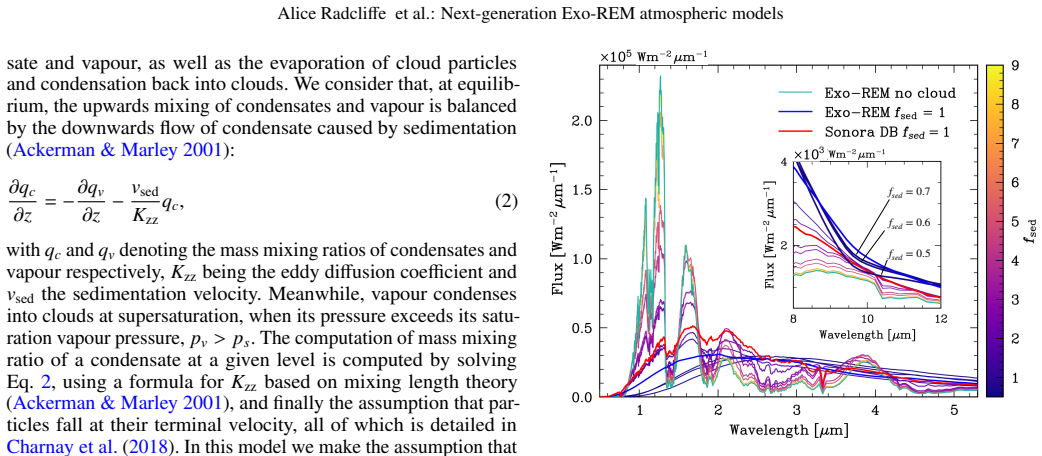
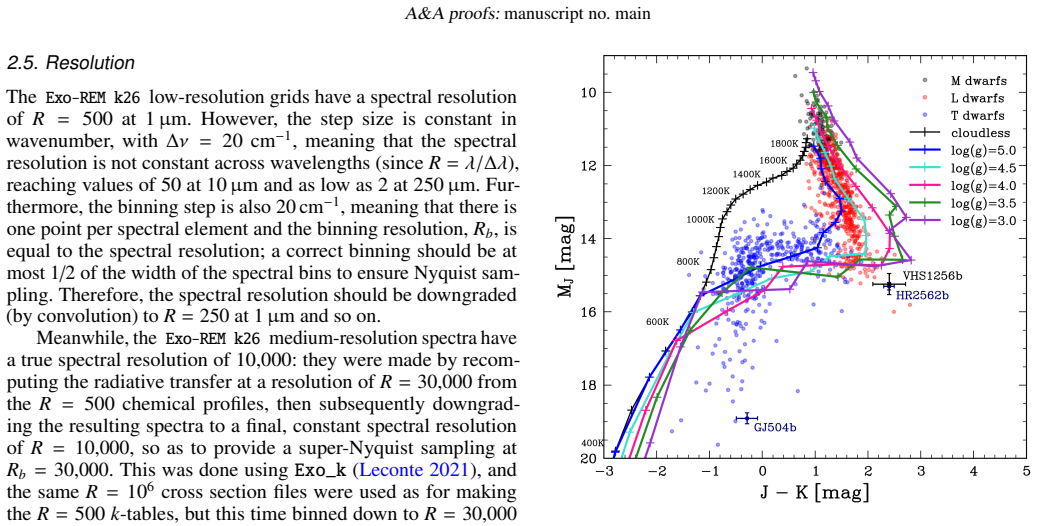
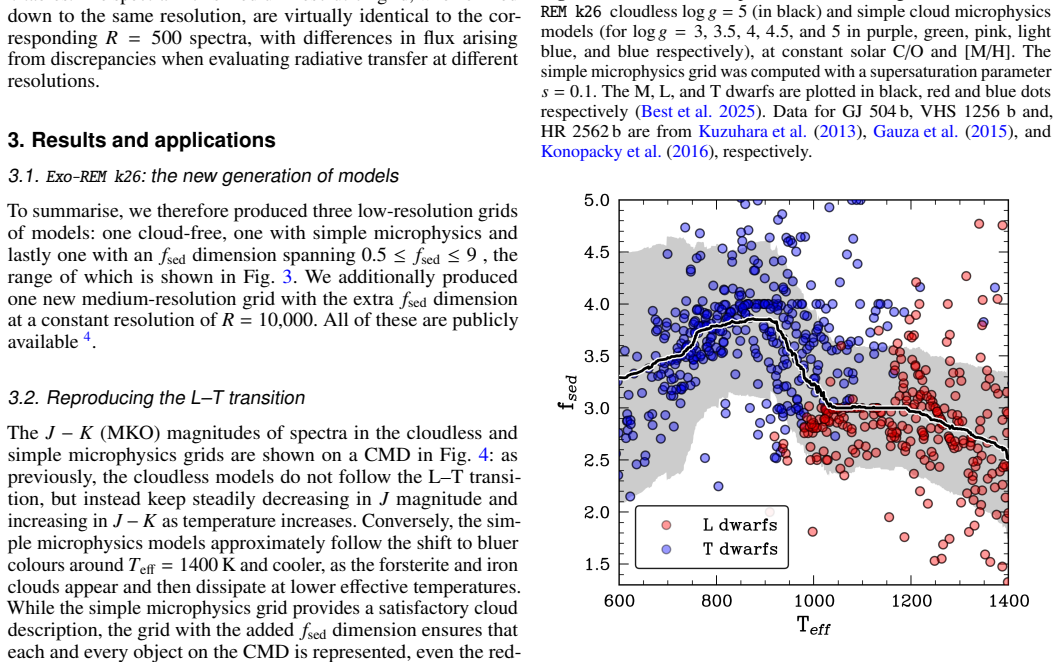
- Varying f_sed across the grid reaches the reddest objects on the color-magnitude diagram and reveals a systematic drop in f_sed from L to T spectral types.
- The same two-column method applied to GJ 504 b revises its effective temperature to 473 K and surface gravity to log g = 4.0.
- The framework supplies a practical way to model rotational variability in other cloudy substellar objects using existing 1D grids.
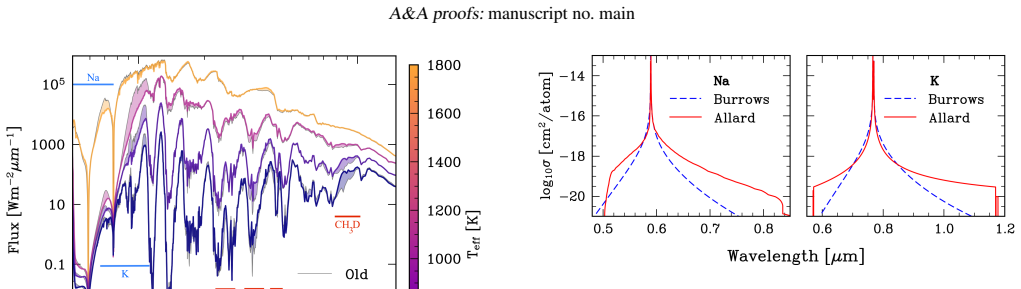
- Updated alkali opacities and corrected CH3D abundances change the predicted spectra of the coolest objects.
Where Pith is reading between the lines
- The same weighting technique could be tested on other JWST targets to see whether 60-40 splits are common or object-specific.
- If the two-column approximation holds across many objects, observers might infer typical cloud patch sizes from the required column fractions alone.
- Future work could check whether the best-fit fractions change with viewing angle or time, providing a low-cost proxy for cloud evolution.
- The approach leaves open whether full 3D models would still be needed for objects with more extreme temperature or composition contrasts.
Load-bearing premise
A linear combination of two separate 1D calculations can capture the radiative effects of real three-dimensional cloud patches.
What would settle it
New phase-resolved spectra that show the 10 μm silicate depth changing independently of the 60-40 weighting, or requiring a third distinct cloud column to fit, would falsify the claim.
Figures

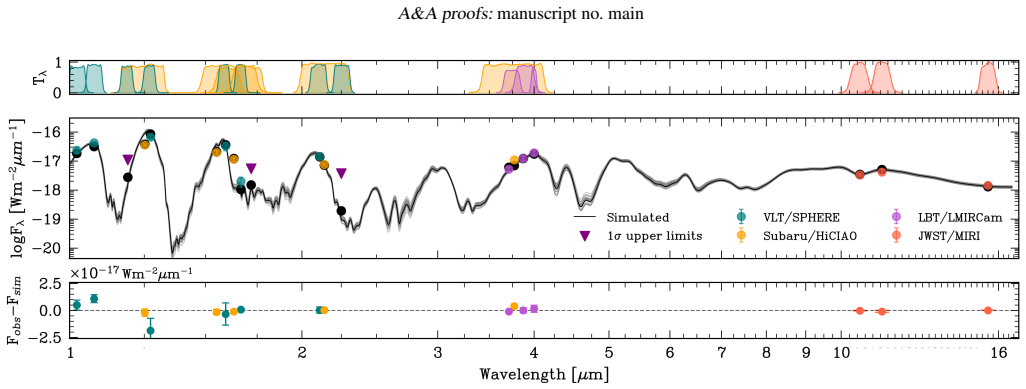
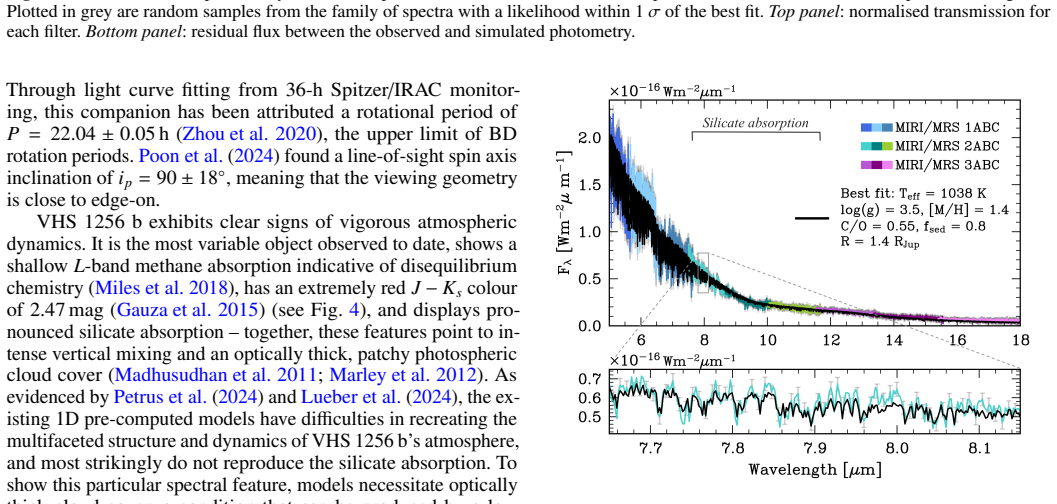
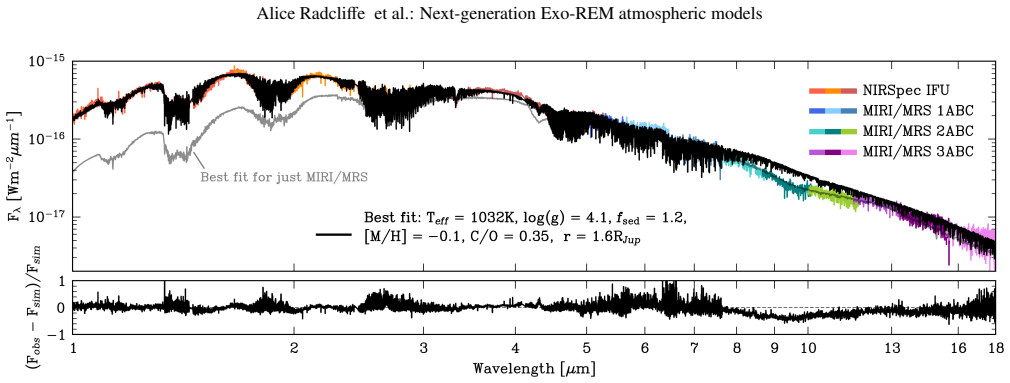
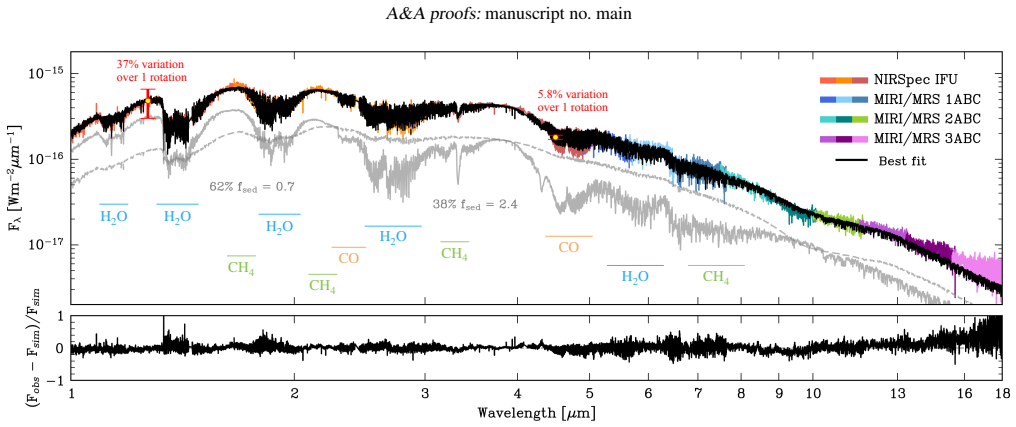


read the original abstract
Condensate clouds are a defining feature of brown dwarf and exoplanet atmospheres, producing a broad range of colours on the CMD and giving rise to spectral features such as the distinct $\sim 10 \mu$m spectral imprint. Cloud cover is likely to be heterogeneous in many objects, with observed rotational variability providing evidence for the presence of thick and thin cloud regions rotating in and out of view. Yet current 1D atmosphere models often fail to reproduce the spectra of highly cloudy substellar objects, especially those with complex cloud structures. We address these limitations by upgrading the Exo-REM atmosphere model, and by devising a more nuanced approach to describe heterogeneous cloud cover with pre-computed 1D grids. We present new Exo-REM grids, hereafter Exo-REM k26, featuring critical updates: (1) the incorporation of a cloud sedimentation parameter, $f_{sed}$, to govern cloud opacity, thereby enabling even the reddest of objects to be accessed on a CMD, revealing a trend of decreasing $f_{sed}$ along the L--T transition (2) the substantial update of molecular opacities and abundances used, including new experimentally validated alkali line lists, and (3) the implementation of strict convergence criteria that entirely avoid unstable model solutions. Correcting an erroneous $\text{CH}_3\text{D}$ abundance leads to spectral changes for low-$T_{eff}$ objects. Applying Exo-REM k26 to the cool GJ 504 b thus leads to a revision of its parameters ($T_{eff} = 473^{+14}_{-12}$ K, $\log g = 4.0 \pm 0.1$ dex). For the variable VHS 1256 b, a two-column framework that emulates cloud heterogeneities achieves an improved global fit over a single 1D model. A ~60-40% split of thick and thin clouds best describes its atmosphere, further confirming the presence of patchy clouds. This reproduces the strong $10 \mu$m silicate absorption in the JWST data of VHS 1256 b.
Editorial analysis
A structured set of objections, weighed in public.
Referee Report
Summary. The paper presents updates to the Exo-REM atmosphere model (k26 grids) incorporating a cloud sedimentation efficiency parameter f_sed, revised molecular opacities and abundances (including new alkali line lists), and strict convergence criteria to eliminate unstable solutions. It applies the new grids to revise parameters for GJ 504 b and, for VHS 1256 b, implements a two-column framework that linearly combines pre-computed thick- and thin-cloud 1D spectra in a ~60-40% ratio to emulate patchy clouds, claiming an improved global fit that reproduces the strong 10 μm silicate absorption in JWST observations.
Significance. If the central results hold, the work supplies a computationally efficient method for modeling heterogeneous cloud cover in substellar objects using existing 1D grids, which could be adopted for interpreting JWST spectra of variable brown dwarfs and directly imaged exoplanets. The reported trend of decreasing f_sed along the L-T transition from the new grids provides a concrete, testable prediction for cloud evolution. The reproduction of the silicate feature with the patchy-cloud model adds to the observational case for cloud heterogeneity.
major comments (1)
- [Application section] Application section (two-column framework for VHS 1256 b): the central claim that a 60-40% thick/thin split 'best describes' the atmosphere and reproduces the 10 μm silicate feature rests on a flux-weighted average of two independent pre-computed 1D Exo-REM k26 spectra. This construction assumes negligible horizontal radiative exchange and no thermal readjustment between columns. Neither assumption is tested against 3D radiative-transfer calculations or a self-consistent multi-column solution with shared T-P structure; if either fails, the inferred patch fraction and the reported improvement over single-column models become non-unique.
minor comments (1)
- The abstract states that the two-column model 'achieves an improved global fit' but supplies no quantitative metrics (e.g., χ² values, residual statistics, or degrees of freedom) to support this claim; adding such numbers in the main text would improve clarity.
Simulated Author's Rebuttal
We thank the referee for their constructive review and for recognizing the potential utility of the Exo-REM k26 grids and the two-column emulation approach. We address the single major comment below.
read point-by-point responses
-
Referee: [Application section] Application section (two-column framework for VHS 1256 b): the central claim that a 60-40% thick/thin split 'best describes' the atmosphere and reproduces the 10 μm silicate feature rests on a flux-weighted average of two independent pre-computed 1D Exo-REM k26 spectra. This construction assumes negligible horizontal radiative exchange and no thermal readjustment between columns. Neither assumption is tested against 3D radiative-transfer calculations or a self-consistent multi-column solution with shared T-P structure; if either fails, the inferred patch fraction and the reported improvement over single-column models become non-unique.
Authors: We appreciate the referee’s emphasis on the underlying assumptions. The two-column framework is presented in the manuscript as a computationally efficient emulation that linearly combines pre-computed 1D spectra to capture the net effect of thick and thin cloud regions; it is not claimed to be a fully self-consistent multi-column or 3D solution. This style of approximation is already used in the literature to interpret rotational variability and spectral features in brown dwarfs and directly imaged planets. The 60-40% combination demonstrably improves the global fit to VHS 1256 b and reproduces the 10 μm silicate feature, lending empirical support to its practical utility. We agree, however, that the neglect of horizontal radiative transfer and thermal readjustment constitutes a limitation whose impact is not quantified here. In the revised manuscript we will add an explicit paragraph in Section 4.2 stating these assumptions, noting that the derived patch fraction should be regarded as an effective rather than literal value, and outlining why a full 3D treatment lies beyond the present scope. revision: partial
Circularity Check
Fitted cloud fractions in two-column model presented as atmospheric description
specific steps
-
fitted input called prediction
[Abstract]
"A ~60-40% split of thick and thin clouds best describes its atmosphere, further confirming the presence of patchy clouds. This reproduces the strong 10 μm silicate absorption in the JWST data of VHS 1256 b."
The 60-40% fractions are the free parameters optimized to minimize the difference between the flux-weighted average of two fixed 1D models and the observed spectrum. The statement that this split 'best describes' the atmosphere is therefore the definition of the best-fit solution rather than an independent result or prediction from the model physics.
full rationale
The paper's central application result for VHS 1256 b is the ~60-40% thick/thin cloud split obtained by optimizing weights in a linear combination of two pre-computed 1D Exo-REM k26 models to match the JWST spectrum. This directly matches the 'fitted input called prediction' pattern: the split is the output of the fit, yet is stated as what 'best describes' the atmosphere and 'further confirming' patchy clouds. The model updates themselves (f_sed, opacities, convergence) show no circularity and are independent. No self-citation load-bearing steps or other patterns are present in the provided text.
Axiom & Free-Parameter Ledger
free parameters (2)
- f_sed
- cloud_cover_fraction =
60-40
axioms (2)
- domain assumption Pre-computed 1D model grids can be linearly combined to emulate spatial heterogeneities in cloud cover
- domain assumption Updated molecular opacities and abundances (including new alkali line lists) are accurate for the relevant temperature range
Reference graph
Works this paper leans on
-
[1]
, " * write output.state after.block = add.period write newline
ENTRY address archiveprefix author booktitle chapter edition editor howpublished institution eprint journal key month note number organization pages publisher school series title type volume year label extra.label sort.label short.list INTEGERS output.state before.all mid.sentence after.sentence after.block FUNCTION init.state.consts #0 'before.all := #1 ...
-
[2]
write newline
" write newline "" before.all 'output.state := FUNCTION n.dashify 't := "" t empty not t #1 #1 substring "-" = t #1 #2 substring "--" = not "--" * t #2 global.max substring 't := t #1 #1 substring "-" = "-" * t #2 global.max substring 't := while if t #1 #1 substring * t #2 global.max substring 't := if while FUNCTION word.in bbl.in " " * FUNCTION format....
-
[3]
, " * write output.state after.block = add.period write newline
ENTRY address archiveprefix author booktitle chapter edition editor howpublished institution eprint doi url journal key month note number organization pages publisher school series title type volume year adsurl label extra.label sort.label short.list INTEGERS output.state before.all mid.sentence after.sentence after.block FUNCTION init.state.consts #0 'be...
-
[4]
write newline
" write newline "" before.all 'output.state := FUNCTION n.dashify 't := "" t empty not t #1 #1 substring "-" = t #1 #2 substring "--" = not "--" * t #2 global.max substring 't := t #1 #1 substring "-" = "-" * t #2 global.max substring 't := while if t #1 #1 substring * t #2 global.max substring 't := if while FUNCTION word.in bbl.in " " * FUNCTION format....
-
[5]
Ackerman, A. S. & Marley, M. S. 2001, http://dx.doi.org/10.1086/321540 magenta ApJ , 556, 872
-
[6]
D., Zhou, Y., Marleau, G.-D., et al
Adams, A. D., Zhou, Y., Marleau, G.-D., et al. 2025, http://dx.doi.org/10.3847/1538-3881/ae07d2 magenta AJ , 170, 289
-
[7]
Allard, F., Homeier, D., & Freytag, B. 2012, http://dx.doi.org/10.1098/rsta.2011.0269 magenta Phil. Trans. R. Soc. A , 370, 2765
-
[8]
Allard, N. F., Allard, F., Hauschildt, P. H., Kielkopf, J. F., & Machin, L. 2003, http://dx.doi.org/10.1051/0004-6361:20031299 magenta A&A , 411, L473
-
[9]
Allard, N. F. & Kielkopf, J. F. 2025, http://dx.doi.org/10.1051/0004-6361/202556933 magenta A&A , 703, A71
-
[10]
F., Spiegelman, F., & Kielkopf, J
Allard, N. F., Spiegelman, F., & Kielkopf, J. F. 2016, http://dx.doi.org/10.1051/0004-6361/201628270 magenta A&A , 589, A21
-
[11]
F., Spiegelman, F., Leininger, T., & Mollière, P
Allard, N. F., Spiegelman, F., Leininger, T., & Mollière, P. 2019, http://dx.doi.org/10.1051/0004-6361/201935593 magenta A&A , 628, A120
-
[12]
2013, http://dx.doi.org/10.1088/0004-637X/768/2/121 magenta ApJ , 768, 121
Apai, D., Radigan, J., Buenzli, E., et al. 2013, http://dx.doi.org/10.1088/0004-637X/768/2/121 magenta ApJ , 768, 121
-
[13]
2009, http://dx.doi.org/10.1088/0004-637X/701/2/1534 magenta ApJ , 701, 1534
Artigau, E., Bouchard, S., Doyon, R., & Lafrenière, D. 2009, http://dx.doi.org/10.1088/0004-637X/701/2/1534 magenta ApJ , 701, 1534
-
[14]
Asplund, M., Amarsi, A. M., & Grevesse, N. 2021, http://dx.doi.org/10.1051/0004-6361/202140445 magenta A&A , 653, A141
work page internal anchor Pith review doi:10.1051/0004-6361/202140445 2021
-
[15]
Asplund, M., Grevesse, N., Sauval, A. J., & Scott, P. 2009, http://dx.doi.org/10.1146/annurev.astro.46.060407.145222 magenta ARA&A , 47, 481
-
[16]
Baraffe, I., Chabrier, G., Allard, F., & Hauschildt, P. H. 2002, http://dx.doi.org/10.1051/0004-6361:20011638 magenta A&A , 382, 563
-
[17]
, archivePrefix = "arXiv", eprint =
Baraffe, I., Homeier, D., Allard, F., & Chabrier, G. 2015, http://dx.doi.org/10.1051/0004-6361/201425481 magenta Astronomy & Astrophysics , 577, A42
work page internal anchor Pith review doi:10.1051/0004-6361/201425481 2015
-
[18]
2015, http://dx.doi.org/10.1051/0004-6361/201526332 magenta A&A , 582, A83
Baudino, J.-L., Bézard, B., Boccaletti, A., et al. 2015, http://dx.doi.org/10.1051/0004-6361/201526332 magenta A&A , 582, A83
-
[19]
Bernath, P. F. 2020, http://dx.doi.org/10.1016/j.jqsrt.2019.106687 magenta Journal of Quant. Spect. and Rad. Trans. , 240, 106687
- [20]
-
[21]
Biller, B. A., Vos, J. M., Zhou, Y., et al. 2024, http://dx.doi.org/10.1093/mnras/stae1602 magenta MNRAS , 532, 2207
-
[22]
2021, http://dx.doi.org/10.1051/0004-6361/202039072 magenta A&A , 646, A15
Blain, D., Charnay, B., & Bézard, B. 2021, http://dx.doi.org/10.1051/0004-6361/202039072 magenta A&A , 646, A15
-
[23]
2018, http://dx.doi.org/10.1051/0004-6361/201832942 magenta A&A , 618, A63
Bonnefoy, M., Perraut, K., Lagrange, A.-M., et al. 2018, http://dx.doi.org/10.1051/0004-6361/201832942 magenta A&A , 618, A63
-
[24]
Bowler, B. P., Zhou, Y., Morley, C. V., et al. 2020, http://dx.doi.org/10.3847/2041-8213/ab8197 magenta ApJ , 893, L30
-
[25]
Buenzli, E., Saumon, D., Marley, M. S., et al. 2015, http://dx.doi.org/10.1088/0004-637X/798/2/127 magenta ApJ , 798, 127
-
[26]
Burrows, A., Burgasser, A. J., Kirkpatrick, J. D., et al. 2002, http://dx.doi.org/10.1086/340584 magenta ApJ , 573, 394
-
[27]
Burrows, A., Hubbard, W. B., Lunine, J. I., & Liebert, J. 2001, http://dx.doi.org/10.1103/RevModPhys.73.719 magenta RMP , 73, 719
-
[28]
Burrows, A. & Sharp, C. M. 1999, http://dx.doi.org/10.1086/306811 magenta ApJ , 512, 843
-
[29]
Burrows, A. & Volobuyev, M. 2003, http://dx.doi.org/10.1086/345412 magenta ApJ , 583, 985
-
[30]
2011, http://dx.doi.org/10.1007/s11207-010-9541-4 magenta Sol
Caffau, E., Ludwig, H.-G., Steffen, M., Freytag, B., & Bonifacio, P. 2011, http://dx.doi.org/10.1007/s11207-010-9541-4 magenta Sol. Phys. , 268, 255
-
[31]
2018, http://dx.doi.org/10.3847/1538-4357/aaac7d magenta ApJ , 854, 172
Charnay, B., Bézard, B., Baudino, J.-L., et al. 2018, http://dx.doi.org/10.3847/1538-4357/aaac7d magenta ApJ , 854, 172
-
[32]
Coles, P. A., Yurchenko, S. N., & Tennyson, J. 2019, http://dx.doi.org/10.1093/mnras/stz2778 magenta MNRAS , 490, 4638
-
[33]
Cooper, C. S., Sudarsky, D., Milsom, J. A., Lunine, J. I., & Burrows, A. 2003, http://dx.doi.org/10.1086/367763 magenta ApJ , 586, 1320
-
[34]
2008, http://dx.doi.org/10.1086/526489 magenta ApJ , 678, 1372
Cushing, M., Marley, M., Saumon, D., et al. 2008, http://dx.doi.org/10.1086/526489 magenta ApJ , 678, 1372
-
[35]
Dupuy, T. J., Liu, M. C., Evans, E. L., et al. 2023, http://dx.doi.org/10.1093/mnras/stac3557 magenta MNRAS , 519, 1688
-
[36]
J., Liu, M
Dupuy, T. J., Liu, M. C., Magnier, E. A., et al. 2020, RNAAS, 4, 54
2020
-
[37]
D’Orazi, V., Desidera, S., Gratton, R. G., et al. 2017, http://dx.doi.org/10.1051/0004-6361/201629283 magenta A&A , 598, A19
-
[38]
C., Janson, M., & Calissendorff, P
Eriksson, S. C., Janson, M., & Calissendorff, P. 2019, http://dx.doi.org/10.1051/0004-6361/201935671 magenta A&A , 629, A145
-
[39]
Fuhrmann, K. & Chini, R. 2015, http://dx.doi.org/10.1088/0004-637X/806/2/163 magenta ApJ , 806, 163
-
[40]
Füri, E. & Marty, B. 2015, http://dx.doi.org/10.1038/ngeo2451 magenta Nat. Geo , 8, 515
-
[41]
Gauza, B., Béjar, V. J. S., Pérez-Garrido, A., et al. 2015, http://dx.doi.org/10.1088/0004-637X/804/2/96 magenta ApJ , 804, 96
-
[42]
Gibson, N. P., Merritt, S., Nugroho, S. K., et al. 2020, http://dx.doi.org/10.1093/mnras/staa228 magenta MNRAS , 493, 2215
-
[43]
Journal of Quantitative Spectroscopy and Radiative Transfer , author =
Gordon, I., Rothman, L., Hargreaves, R., et al. 2022, http://dx.doi.org/10.1016/j.jqsrt.2021.107949 magenta Journal of Quant. Spect. and Rad. Trans. , 277, 107949
-
[44]
Hargreaves, R. J., Gordon, I. E., Rey, M., et al. 2020, http://dx.doi.org/10.3847/1538-4365/ab7a1a magenta ApJ , 247, 55
-
[45]
Harris, G. J., Tennyson, J., Kaminsky, B. M., Pavlenko, Y. V., & Jones, H. R. A. 2006, http://dx.doi.org/10.1111/j.1365-2966.2005.09960.x magenta MNRAS , 367, 400
-
[46]
Helling, C., Dehn, M., Woitke, P., & Hauschildt, P. H. 2008, http://dx.doi.org/10.1086/533462 magenta ApJ , 675, L105
-
[47]
Hinkley, S., Carter, A. L., Ray, S., et al. 2022, http://dx.doi.org/10.1088/1538-3873/ac77bd magenta PASP , 134, 095003
-
[48]
Hoch, K. K. W., Rowland, M., Petrus, S., et al. 2025, http://dx.doi.org/10.1038/s41586-025-09174-w magenta Nature , 643, 938
-
[49]
Janson, M., Brandt, T. D., Kuzuhara, M., et al. 2013, http://dx.doi.org/10.1088/2041-8205/778/1/L4 magenta ApJ , 778, L4
-
[50]
Karalidi, T., Marley, M., Fortney, J. J., et al. 2021, http://dx.doi.org/10.3847/1538-4357/ac3140 magenta ApJ , 923, 269
-
[51]
Karman, T., Gordon, I. E., van der Avoird, A., et al. 2019, http://dx.doi.org/10.1016/j.icarus.2019.02.034 magenta Icarus , 328, 160
-
[52]
Kirkpatrick, J. D. 2005, http://dx.doi.org/10.1146/annurev.astro.42.053102.134017 magenta ARA&A , 43, 195
-
[53]
M., Rameau, J., Duchêne, G., et al
Konopacky, Q. M., Rameau, J., Duchêne, G., et al. 2016, http://dx.doi.org/10.3847/2041-8205/829/1/L4 magenta ApJ , 829, L4
-
[54]
2013, http://dx.doi.org/10.1088/0004-637X/774/1/11 magenta ApJ , 774, 11
Kuzuhara, M., Tamura, M., Kudo, T., et al. 2013, http://dx.doi.org/10.1088/0004-637X/774/1/11 magenta ApJ , 774, 11
-
[55]
Lacis, A. A. & Oinas, V. 1991, http://dx.doi.org/10.1029/90JD01945 magenta JGR: Atmospheres , 96, 9027
-
[56]
Lacy, B. & Burrows, A. 2023, http://dx.doi.org/10.3847/1538-4357/acc8cb magenta AJ , 950, 8
-
[57]
2018, http://dx.doi.org/10.3847/2041-8213/aaaa61 magenta ApJ , 853, L30
Leconte, J. 2018, http://dx.doi.org/10.3847/2041-8213/aaaa61 magenta ApJ , 853, L30
-
[58]
2021, http://dx.doi.org/10.1051/0004-6361/202039040 magenta A&A , 618, A63
Leconte, J. 2021, http://dx.doi.org/10.1051/0004-6361/202039040 magenta A&A , 618, A63
-
[59]
Leggett, S. K., Tremblin, P., Phillips, M. W., et al. 2021, http://dx.doi.org/10.3847/1538-4357/ac0cfe magenta AJ , 918, 11
-
[60]
2010, Solar System Abundances of the Elements, 379--417
Lodders, K. 2010, Solar System Abundances of the Elements, 379--417
2010
-
[61]
Lueber, A., Heng, K., Bowler, B. P., et al. 2024, http://dx.doi.org/10.1051/0004-6361/202451301 magenta A&A , 690, A357
-
[62]
2019, http://dx.doi.org/10.1146/annurev-astro-081817-051846 magenta ARA&A , 57, 617
Madhusudhan, N. 2019, http://dx.doi.org/10.1146/annurev-astro-081817-051846 magenta ARA&A , 57, 617
-
[63]
2011, http://dx.doi.org/10.1088/0004-637X/737/1/34 magenta ApJ , 737, 34
Madhusudhan, N., Burrows, A., & Currie, T. 2011, http://dx.doi.org/10.1088/0004-637X/737/1/34 magenta ApJ , 737, 34
-
[64]
2025, A&A, 693, 9
M \^a lin, M., Boccaletti, A., Perrot, C., et al. 2025, A&A, 693, 9
2025
-
[65]
Marley, M. & Robinson, T. 2015, http://dx.doi.org/10.1146/annurev-astro-082214-122522 magenta ARA&A , 53, 279
-
[66]
S., Saumon, D., Cushing, M., et al
Marley, M. S., Saumon, D., Cushing, M., et al. 2012, http://dx.doi.org/10.1088/0004-637X/754/2/135 magenta ApJ , 754, 135
-
[67]
The Astrophysical Journal , author =
Marley, M. S., Saumon, D., & Goldblatt, C. 2010, http://dx.doi.org/10.1088/2041-8205/723/1/L117 magenta ApJ , 723, L117
-
[68]
arXiv , author =:2107.07434 , journal =
Marley, M. S., Saumon, D., Visscher, C., et al. 2021, http://dx.doi.org/10.3847/1538-4357/ac141d magenta ApJ , 920, 85
-
[69]
McCarthy, A. M., Vos, J. M., Muirhead, P. S., et al. 2025, http://dx.doi.org/10.3847/2041-8213/ad9eaf magenta The Astrophysical Journal Letters , 981, L22
-
[70]
K., Masseron, T., Hoeijmakers, H
McKemmish, L. K., Masseron, T., Hoeijmakers, H. J., et al. 2019, http://dx.doi.org/10.1093/mnras/stz1818 magenta MNRAS , 488, 2836
-
[71]
McKemmish, L. K., Yurchenko, S. N., & Tennyson, J. 2016, http://dx.doi.org/10.1093/mnras/stw1969 magenta MNRAS , 463, 771
-
[72]
A., Heinze, A., Apai, D., et al
Metchev, S. A., Heinze, A., Apai, D., et al. 2015, http://dx.doi.org/10.1088/0004-637X/799/2/154 magenta ApJ , 799, 154
-
[73]
Miles, B. E., Biller, B. A., Patapis, P., et al. 2023, http://dx.doi.org/10.3847/2041-8213/acb04a magenta ApJ , 946, L6
-
[74]
Miles, B. E., Skemer, A. J., Barman, T. S., Allers, K. N., & Stone, J. M. 2018, http://dx.doi.org/10.3847/1538-4357/aae6cd magenta ApJ , 869, 18
-
[75]
Mollière, P., Kühnle, H., Matthews, E. C., et al. 2025, http://dx.doi.org/10.1051/0004-6361/202555732 magenta A&A , 703, A79
-
[76]
Mollière, P., Wardenier, J. P., van Boekel, R., et al. 2019, http://dx.doi.org/10.1051/0004-6361/201935470 magenta A&A , 627, A67
-
[77]
Morley, C. V., Fortney, J. J., Marley, M. S., et al. 2012, http://dx.doi.org/10.1088/0004-637X/756/2/172 magenta ApJ , 756, 172
-
[78]
Morley, C. V., Marley, M. S., Fortney, J. J., & Lupu, R. 2014 a , http://dx.doi.org/10.1088/2041-8205/789/1/L14 magenta ApJ , 789, L14
-
[79]
Morley, C. V., Marley, M. S., Fortney, J. J., et al. 2014 b , http://dx.doi.org/10.1088/0004-637X/787/1/78 magenta ApJ , 787, 78
-
[80]
Morley, C. V., Mukherjee, S., Marley, M. S., et al. 2024, http://dx.doi.org/10.3847/1538-4357/ad71d5 magenta ApJ , 975, 59
discussion (0)
Sign in with ORCID, Apple, or X to comment. Anyone can read and Pith papers without signing in.