Low-Complexity Tensor-Based Monostatic Sensing for IRS-Assisted Communication Systems
Pith reviewed 2026-06-29 10:03 UTC · model grok-4.3
The pith
Tensor decomposition enables low-complexity estimation of target delay, Doppler, and angle in IRS-assisted sensing.
A machine-rendered reading of the paper's core claim, the machinery that carries it, and where it could break.
Core claim
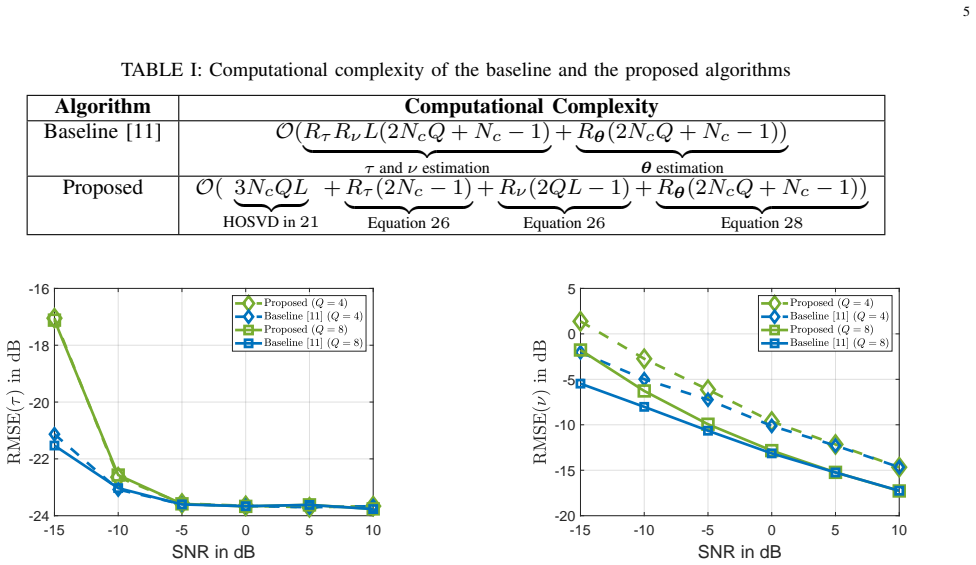
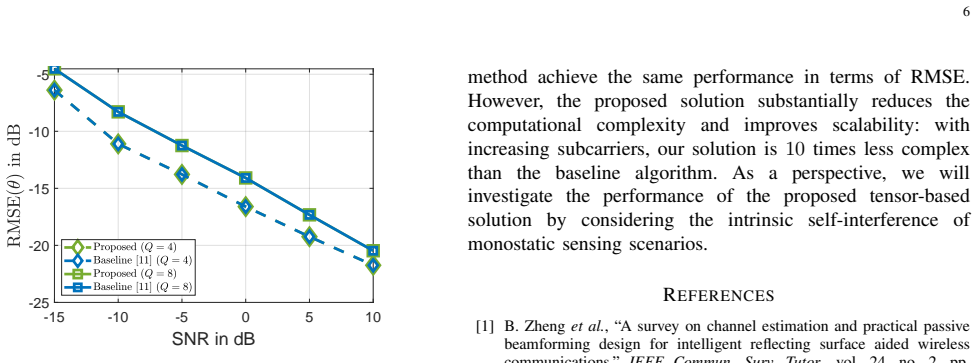
The paper claims that modeling the echo signal as a higher-order tensor allows HOSVD to jointly estimate delay, Doppler, and angular parameters by decomposing the multilinear structure, yielding the same performance as a baseline method but with substantially lower complexity due to individual parameter estimation and parallel processing.
What carries the argument
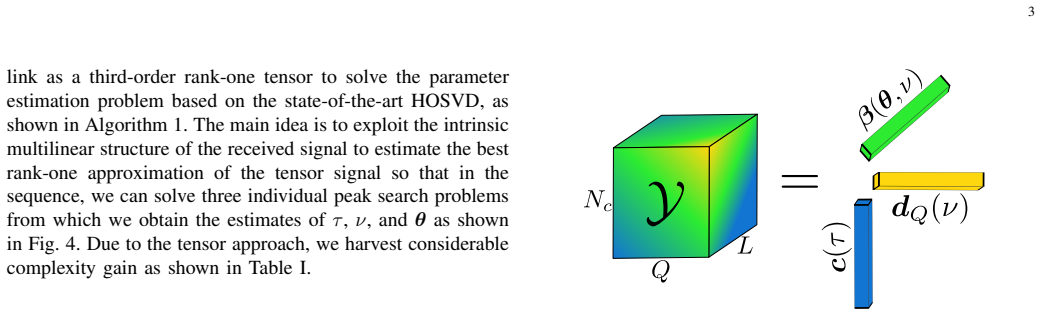
Higher-order singular value decomposition (HOSVD) applied to the multilinear tensor structure of the echo signal, which separates delay, Doppler, and angular factors for independent low-complexity estimation.
If this is right
- Parameters are estimated individually, enabling parallel computation.
- Computational complexity drops sharply relative to non-tensor baselines.
- Estimation accuracy remains equivalent to the reference method in simulations.
- The approach applies directly to monostatic sensing within IRS-assisted communication links.
Where Pith is reading between the lines
- This structure-exploiting method could scale to multi-target scenarios by extending the tensor rank assumptions.
- It may reduce power consumption in edge devices performing integrated sensing and communication.
- The separation of parameters suggests easier fusion with communication channel estimates in the same IRS setup.
Load-bearing premise
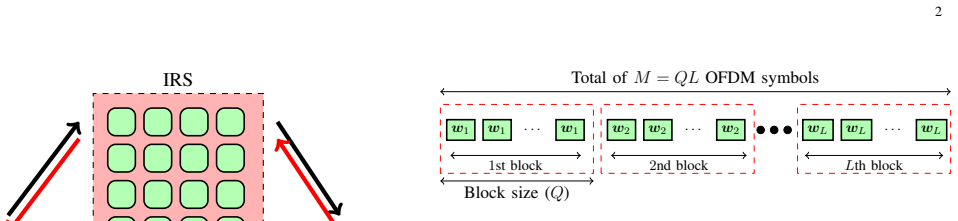
The received echo signal must possess an exploitable multilinear tensor structure that permits HOSVD to separate delay, Doppler, and angular information without significant loss of estimation accuracy.
What would settle it
If the tensor-based estimates show substantially higher root-mean-square error than the reference method on identical simulated echo signals with realistic noise and IRS phase configurations, the performance-equivalence claim would be falsified.
Figures



read the original abstract
This paper proposes a tensor-based parameter estimation algorithm for sensing in an intelligent reflecting surface-assisted system. We present a higher-order singular value decomposition-based solution that exploits the tensor structure of the received echo signal to jointly estimate the target's delay, Doppler, and angular information. Our tensor-based solution can estimate the parameters individually at low complexity, benefiting from parallel computation. Complexity analysis is carried out in comparison with a baseline scheme that does not exploit the intrinsic multilinear structure of the sensed signal. Simulation results show that our proposed tensor-based method can achieve the same performance as the reference method while drastically reducing the computational complexity.
Editorial analysis
A structured set of objections, weighed in public.
Referee Report
Summary. The manuscript proposes a higher-order singular value decomposition (HOSVD)-based tensor method for jointly estimating target delay, Doppler, and angular parameters in an IRS-assisted monostatic sensing system. It claims that exploiting the multilinear tensor structure of the received echo signal allows individual parameter estimation at low complexity via parallel computation, with complexity analysis versus a non-tensor baseline and simulations showing equal performance at drastically reduced complexity.
Significance. If the tensor separability holds and the performance claim is validated with detailed evidence, the approach could offer a practical low-complexity sensing solution for IRS-assisted systems, leveraging standard tensor tools for parallelization benefits in real-time applications. The explicit baseline comparison is a positive element.
major comments (2)
- [Abstract] Abstract: The central claim that the received echo signal admits an exploitable multilinear tensor structure permitting HOSVD to separate delay/Doppler/angle parameters without significant accuracy loss is load-bearing for the low-complexity result, yet the abstract supplies no explicit tensor model, factorization, or proof that IRS-induced factors (reflection matrix, round-trip geometry) preserve subspace orthogonality.
- [Abstract] Abstract: The statement that 'simulation results show that our proposed tensor-based method can achieve the same performance as the reference method' provides no equations, data details, error bars, or exclusion criteria, preventing assessment of whether the equal-performance claim is supported or whether the multilinear assumption introduces coupling that degrades accuracy.
Simulated Author's Rebuttal
We thank the referee for the constructive comments. We address each major comment below and agree that the abstract can be improved for clarity while the supporting details remain in the manuscript body.
read point-by-point responses
-
Referee: [Abstract] Abstract: The central claim that the received echo signal admits an exploitable multilinear tensor structure permitting HOSVD to separate delay/Doppler/angle parameters without significant accuracy loss is load-bearing for the low-complexity result, yet the abstract supplies no explicit tensor model, factorization, or proof that IRS-induced factors (reflection matrix, round-trip geometry) preserve subspace orthogonality.
Authors: The abstract is a concise summary. The explicit tensor model of the received echo signal (expressed as a 3-way tensor with delay, Doppler, and angle factors), the HOSVD factorization, and the proof that the IRS reflection matrix together with round-trip geometry preserve the required subspace orthogonality for separable estimation are derived in Section II and Section III (with supporting analysis in the appendix). We will revise the abstract to include a brief reference to the multilinear tensor structure and separability property. revision: yes
-
Referee: [Abstract] Abstract: The statement that 'simulation results show that our proposed tensor-based method can achieve the same performance as the reference method' provides no equations, data details, error bars, or exclusion criteria, preventing assessment of whether the equal-performance claim is supported or whether the multilinear assumption introduces coupling that degrades accuracy.
Authors: The abstract summarizes the outcome. Full simulation parameters, the reference (non-tensor) baseline, performance metrics (RMSE for each parameter), figures with error bars across SNR and scenarios, and confirmation that the multilinear structure introduces no degrading coupling are provided in Section IV. We will revise the abstract to specify that equivalence is shown via RMSE curves. revision: partial
Circularity Check
No circularity; tensor method and performance claims rest on explicit signal model assumption plus external simulation validation.
full rationale
The paper presents a HOSVD-based estimator that exploits an assumed multilinear structure in the received echo signal to separate delay/Doppler/angle parameters. Complexity reduction and performance equivalence are demonstrated via direct comparison to a non-tensor baseline and Monte-Carlo simulations; no equations, fitted parameters, or self-citations are shown that would make the claimed gains tautological by construction. The multilinear separability is stated as a modeling premise rather than derived from the method itself, satisfying the criteria for a self-contained derivation.
Axiom & Free-Parameter Ledger
Reference graph
Works this paper leans on
-
[1]
A survey on channel estimation and practical passive beamforming design for intelligent reflecting surface aided wireless communications,
B. Zhenget al., “A survey on channel estimation and practical passive beamforming design for intelligent reflecting surface aided wireless communications,”IEEE Commun. Surv. Tutor ., vol. 24, no. 2, pp. 1035–1071, 2022
2022
-
[2]
An overview of signal processing techniques for RIS/IRS-aided wireless systems,
C. Panet al., “An overview of signal processing techniques for RIS/IRS-aided wireless systems,”IEEE J. Sel. Topics Signal Processing, vol. 16, no. 5, pp. 883–917, 2022
2022
-
[3]
RIS in cellular networks-challenges and issues,
M. ˚Astr¨omet al., “Ris in cellular networks–challenges and issues,”arXiv preprint arXiv:2404.04753, 2024
-
[4]
Intelligent reflecting surface-aided wireless communications: A tutorial,
Q. Wuet al., “Intelligent reflecting surface-aided wireless communications: A tutorial,”IEEE transactions on communications, vol. 69, no. 5, pp. 3313–3351, 2021
2021
-
[5]
Integrated sensing and communications: Toward dual-functional wireless networks for 6G and beyond,
F. Liuet al., “Integrated sensing and communications: Toward dual-functional wireless networks for 6G and beyond,”IEEE Journal on Selected areas in Comms., vol. 40, no. 6, pp. 1728–1767, 2022
2022
-
[6]
Integrated sensing and communications with reconfigurable intelligent surfaces: From signal modeling to processing,
S. P. Chepuriet al., “Integrated sensing and communications with reconfigurable intelligent surfaces: From signal modeling to processing,” IEEE Signal Processing Magazine, vol. 40, no. 6, pp. 41–62, 2023
2023
-
[7]
MetaRadar: Multi-target detection for reconfigurable intelligent surface aided radar systems,
H. Zhanget al., “MetaRadar: Multi-target detection for reconfigurable intelligent surface aided radar systems,”IEEE Transactions on Wireless Communications, vol. 21, no. 9, pp. 6994–7010, 2022
2022
-
[8]
Spatial diversity in radar detection via active reconfigurable intelligent surfaces,
M. Rihanet al., “Spatial diversity in radar detection via active reconfigurable intelligent surfaces,”IEEE Signal Processing Letters, vol. 29, pp. 1242–1246, 2022
2022
-
[9]
Intelligent reflecting surface enabled sensing: Cram´er-Rao bound optimization,
X. Songet al., “Intelligent reflecting surface enabled sensing: Cram´er-Rao bound optimization,”IEEE Transactions on Signal Processing, 2023
2023
-
[10]
Target-mounted intelligent reflecting surface for secure wireless sensing,
X. Shaoet al., “Target-mounted intelligent reflecting surface for secure wireless sensing,”IEEE Transactions on Wireless Communications, 2024
2024
-
[11]
RIS-aided NLoS monostatic sensing under mobility and angle-doppler coupling,
M. Kemal Ercanet al., “RIS-aided NLoS monostatic sensing under mobility and angle-doppler coupling,”IEEE Wireless Communications and Networking Conference 2024, 2024
2024
-
[12]
Two-dimensional channel parameter estimation for millimeter-wave systems using butler matrices,
Fazal-E-Asimet al., “Two-dimensional channel parameter estimation for millimeter-wave systems using butler matrices,”IEEE Transactions on Wireless Communications, vol. 20, no. 4, pp. 2670–2684, 2021
2021
-
[13]
Tensor decompositions, alternating least squares and other tales,
P. Comonet al., “Tensor decompositions, alternating least squares and other tales,”Journal of Chemometrics: A Journal of the Chemometrics Society, vol. 23, no. 7-8, pp. 393–405, 2009
2009
-
[14]
Tensor-based modeling/estimation of static channels in IRS-assisted MIMO systems,
K. Ben ´ıcioet al., “Tensor-based modeling/estimation of static channels in IRS-assisted MIMO systems,”XLI Brazilian Symposium on Telecommunications and Signal Processing - SBrT 2023, 2023
2023
-
[15]
Overview of tensor decompositions with applications to communications,
A. L. F. de Almeidaet al., “Overview of tensor decompositions with applications to communications,” inSignals and Images: Advances and Results in Speech, Estimation, Compression, Recognition, Filtering, and Processing, R. Coelhoet al., Eds. CRC-Press, 1 2016, no. Chapter 12, pp. 325–356
2016
-
[16]
Tensor-based channel estimation and data-aided tracking in IRS-assisted MIMO systems,
K. B. Ben ´ıcioet al., “Tensor-based channel estimation and data-aided tracking in IRS-assisted MIMO systems,”IEEE Wireless Comms. Letters, 2023
2023
-
[17]
Hunger,Floating point operations in matrix-vector calculus
R. Hunger,Floating point operations in matrix-vector calculus. Munich University of Technology, Inst. for Circuit Theory, 2005, vol. 2019
2005
discussion (0)
Sign in with ORCID, Apple, or X to comment. Anyone can read and Pith papers without signing in.