Constraints on the Atmospheric Composition of 2002 XV₉₃ from JWST Spectroscopy
Pith reviewed 2026-06-29 05:57 UTC · model grok-4.3
The pith
JWST spectra of 2002 XV93 yield no methane or carbon monoxide detections, placing partial-pressure upper limits orders of magnitude below the total pressure inferred from occultation data.
A machine-rendered reading of the paper's core claim, the machinery that carries it, and where it could break.
Core claim
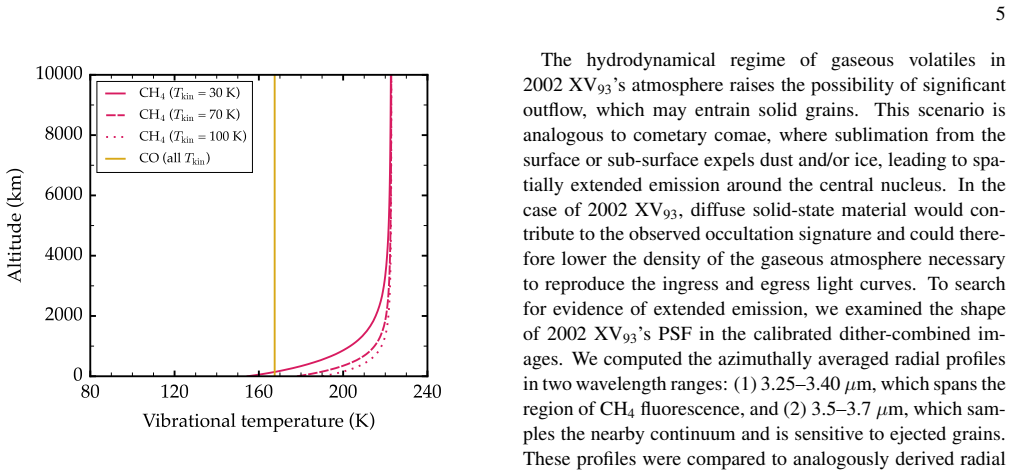
Our results indicate that the atmospheric interpretation of the occultation measurements may require either a composition dominated by volatile species other than methane and carbon monoxide, with nitrogen and argon as possible candidates, or a methane-dominated atmosphere confined near the surface with a steeply decreasing vertical density profile.
What carries the argument
Upper limits on methane and carbon monoxide surface partial pressures obtained by comparing higher-resolution JWST spectra against synthetic fluorescence models.
If this is right
- Methane and carbon monoxide together cannot account for the occultation-derived atmospheric pressure.
- Nitrogen or argon must dominate if the atmosphere is extended and uniform.
- Any methane atmosphere must be restricted to a thin surface layer with rapidly falling density.
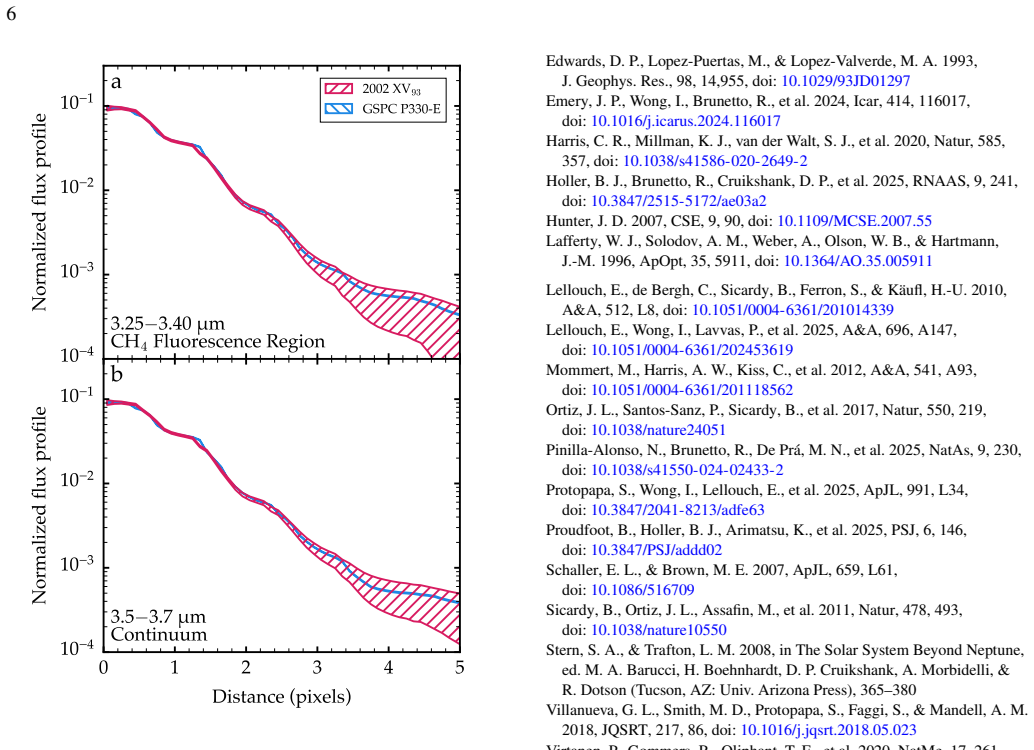
- No extended source of methane gas or refractory dust is present around the object.
Where Pith is reading between the lines
- Atmospheric retention models for small TNOs will need to accommodate either N2/Ar-rich or vertically stratified compositions.
- Repeated JWST observations of other occultation-detected TNOs could test whether the same compositional mismatch appears elsewhere.
- Ground-based or space-based searches for N2 or Ar fluorescence lines would directly test the alternative composition hypothesis.
Load-bearing premise
The synthetic fluorescence models used to turn non-detections into partial-pressure upper limits correctly describe excitation and radiative transfer at 100-200 nbar.
What would settle it
A spectroscopic detection of methane or carbon monoxide emission lines whose strength matches the 100-200 nbar total pressure, or a direct identification of nitrogen or argon as the dominant gas.
Figures

read the original abstract
The recent detection of an atmosphere surrounding the trans-Neptunian object (TNO) 2002 XV$_{93}$ from stellar occultation measurements has challenged the longstanding view that only the largest TNOs can sustain an atmosphere. Atmospheric refraction modeling of the occultation light curves indicated a surface pressure of 100$-$200 nbar, despite 2002 XV$_{93}$'s relatively small size (~510 km in diameter) and weak surface gravity. Together with the detection of methane fluorescence on Makemake, this result suggests that tenuous atmospheres may be more common among TNOs than previously thought. We report JWST/NIRSpec observations acquired before and after the 2024 stellar occultation measurements, obtained with the PRISM and medium-resolution gratings at resolving powers of ~100 and ~1000, respectively. We detect no statistically significant emission features attributed to methane or carbon monoxide gas. By comparing the higher spectral resolution data with synthetic fluorescence models, we report upper limits for the methane and carbon monoxide surface partial pressures of $(3-10)\times10^{-6}$ and $(50-300)\times10^{-6}$ nbar, respectively, substantially below the atmospheric pressure inferred from the occultation measurements. Additionally, we report no evidence of an extended source of either methane gas or refractory material. Our results indicate that the atmospheric interpretation of the occultation measurements may require either a composition dominated by volatile species other than methane and carbon monoxide, with nitrogen and argon as possible candidates, or a methane-dominated atmosphere confined near the surface with a steeply decreasing vertical density profile.
Editorial analysis
A structured set of objections, weighed in public.
Referee Report
Summary. The manuscript reports JWST/NIRSpec PRISM and grating observations of TNO 2002 XV93 acquired around the 2024 stellar occultation epoch. No statistically significant CH4 or CO emission features are detected. Comparison of the R~1000 data to synthetic fluorescence models yields surface partial-pressure upper limits of (3-10)×10^{-6} nbar for CH4 and (50-300)×10^{-6} nbar for CO. These limits lie orders of magnitude below the 100-200 nbar total pressure inferred from the occultation light curves. The authors conclude that the occultation-derived atmosphere is either dominated by other volatiles (N2 or Ar suggested) or that any CH4 component is confined to a thin near-surface layer with a steep vertical density gradient. No evidence for spatially extended CH4 or refractory sources is reported.
Significance. If the reported upper limits are robust, the work supplies the first spectroscopic constraints on the composition of a tenuous atmosphere detected on a sub-600 km TNO. This directly tests whether the occultation signal can be carried by CH4 or CO and thereby narrows the range of plausible volatile inventories and vertical structures for small TNO atmospheres. The result is timely, leverages JWST's sensitivity for faint targets, and provides a clear observational benchmark that future occultation or thermal modeling studies can use.
minor comments (2)
- [§3] §3 (Observations): the text states that both PRISM and grating data were obtained but does not tabulate the exact integration times, number of dithers, or background-subtraction method used for each mode; adding a short table would improve reproducibility.
- [Figure 2] Figure 2 caption: the wavelength range plotted for the medium-resolution grating is not stated; readers must infer it from the text.
Simulated Author's Rebuttal
We thank the referee for their positive assessment of the manuscript and recommendation to accept. The report contains no major comments.
Circularity Check
No significant circularity
full rationale
The paper's central result consists of upper limits on CH4 and CO partial pressures obtained by direct comparison of JWST/NIRSpec non-detections to synthetic fluorescence models. The 100-200 nbar total pressure is taken from independent occultation measurements and functions as an external benchmark rather than an input that is redefined or fitted within the present work. No equation or inference reduces by construction to a parameter fitted from the same JWST data, no self-citation supplies a load-bearing uniqueness theorem, and no ansatz is smuggled in. The derivation chain is therefore self-contained against external observational benchmarks.
Axiom & Free-Parameter Ledger
Reference graph
Works this paper leans on
-
[1]
2026, NatAs, doi: 10.1038/s41550-026-02846-1 Astropy Collaboration, Robitaille, T
Arimatsu, K., Yoshida, F., Hayamizu, T., et al. 2026, NatAs, doi: 10.1038/s41550-026-02846-1 Astropy Collaboration, Robitaille, T. P., Tollerud, E. J., et al. 2013, A&A, 558, A33, doi: 10.1051/0004-6361/201322068 6 10 4 10 3 10 2 10 1 Normalized flux profile 3.25−3.40 m CH4 Fluorescence Region a 2002 XV93 GSPC P330-E 0 1 2 3 4 5 Distance (pixels) 10 4 10 ...
-
[2]
Bohlin, R. C., Gordon, K. D., & Tremblay, P.-E. 2014, PASP, 126, 711, doi: 10.1086/677655
-
[3]
Bushouse, H., Eisenhamer, J., Dencheva, N., et al. 2026, JWST Calibration Pipeline, v2.0.1, Zenodo, doi: 10.5281/zenodo.20058613 de Pater, I., Goldstein, D., & Lellouch, E. 2023, in Astrophysics and Space Science Library, V ol. 468, Io: A New View of Jupiter’s Moon, ed. R. M. C. Lopes, K. de Kleer, & J. T. Keane, 233–290, doi: 10.1007/978-3-031-25670-7_8
-
[4]
P., Lopez-Puertas, M., & Lopez-Valverde, M
Edwards, D. P., Lopez-Puertas, M., & Lopez-Valverde, M. A. 1993, J. Geophys. Res., 98, 14,955, doi: 10.1029/93JD01297
-
[5]
P., Wong, I., Brunetto, R., et al
Emery, J. P., Wong, I., Brunetto, R., et al. 2024, Icar, 414, 116017, doi: 10.1016/j.icarus.2024.116017
-
[6]
Harris, C. R., Millman, K. J., van der Walt, S. J., et al. 2020, Natur, 585, 357, doi: 10.1038/s41586-020-2649-2
-
[7]
J., Brunetto, R., Cruikshank, D
Holler, B. J., Brunetto, R., Cruikshank, D. P., et al. 2025, RNAAS, 9, 241, doi: 10.3847/2515-5172/ae03a2
-
[8]
Hunter, J. D. 2007, CSE, 9, 90, doi: 10.1109/MCSE.2007.55
-
[9]
Lafferty, W. J., Solodov, A. M., Weber, A., Olson, W. B., & Hartmann, J.-M. 1996, ApOpt, 35, 5911, doi: 10.1364/AO.35.005911
-
[10]
2010, A&A, 512, L8, doi: 10.1051/0004-6361/201014339
Lellouch, E., de Bergh, C., Sicardy, B., Ferron, S., & Käufl, H.-U. 2010, A&A, 512, L8, doi: 10.1051/0004-6361/201014339
-
[11]
2025, A&A, 696, A147, doi: 10.1051/0004-6361/202453619
Lellouch, E., Wong, I., Lavvas, P., et al. 2025, A&A, 696, A147, doi: 10.1051/0004-6361/202453619
-
[12]
Mommert, M., Harris, A. W., Kiss, C., et al. 2012, A&A, 541, A93, doi: 10.1051/0004-6361/201118562
-
[13]
Ortiz, J. L., Santos-Sanz, P., Sicardy, B., et al. 2017, Natur, 550, 219, doi: 10.1038/nature24051
-
[14]
Pinilla-Alonso, N., Brunetto, R., De Prá, M. N., et al. 2025, NatAs, 9, 230, doi: 10.1038/s41550-024-02433-2
-
[15]
2025, ApJL, 991, L34, doi: 10.3847/2041-8213/adfe63
Protopapa, S., Wong, I., Lellouch, E., et al. 2025, ApJL, 991, L34, doi: 10.3847/2041-8213/adfe63
-
[16]
Proudfoot, B., Holler, B. J., Arimatsu, K., et al. 2025, PSJ, 6, 146, doi: 10.3847/PSJ/addd02
-
[17]
Schaller, E. L., & Brown, M. E. 2007, ApJL, 659, L61, doi: 10.1086/516709
-
[18]
Sicardy, B., Ortiz, J. L., Assafin, M., et al. 2011, Natur, 478, 493, doi: 10.1038/nature10550
-
[19]
A., & Trafton, L
Stern, S. A., & Trafton, L. M. 2008, in The Solar System Beyond Neptune, ed. M. A. Barucci, H. Boehnhardt, D. P. Cruikshank, A. Morbidelli, & R. Dotson (Tucson, AZ: Univ. Arizona Press), 365–380
2008
-
[20]
doi:10.1016/j.jqsrt.2018.05.023 , eprint =
Villanueva, G. L., Smith, M. D., Protopapa, S., Faggi, S., & Mandell, A. M. 2018, JQSRT, 217, 86, doi: 10.1016/j.jqsrt.2018.05.023
-
[21]
Virtanen, P., Gommers, R., Oliphant, T. E., et al. 2020, NatMe, 17, 261, doi: 10.1038/s41592-019-0686-2 V olkov, A. N., Tucker, O. J., Erwin, J. T., & Johnson, R. E. 2011, PhFl, 23, 066601, doi: 10.1063/1.3592253
-
[22]
2025, jwstspec, v0.9, Zenodo, doi: 10.5281/zenodo.17186394
Wong, I. 2025, jwstspec, v0.9, Zenodo, doi: 10.5281/zenodo.17186394
-
[23]
Wong, I., Brown, M. E., Emery, J. P., et al. 2024, PSJ, 5, 87, doi: 10.3847/PSJ/ad2fc3
-
[24]
Wong, I., Holler, B. J., Protopapa, S., et al. 2025a, PSJ, 6, 281, doi: 10.3847/PSJ/ae1d63
-
[25]
J., Lellouch, E., et al
Wong, I., Holler, B. J., Lellouch, E., et al. 2026, PSJ, in preparation
2026
-
[26]
Young, L. A., Bertrand, T., Trafton, L. M., et al. 2021, in The Pluto System After New Horizons, ed. S. A. Stern, J. M. Moore, W. M. Grundy, L. A. Young, & R. P. Binzel (Tucson, AZ: Univ. Arizona Press), 321–361, doi: 10.2458/azu_uapress_9780816540945-ch014
-
[27]
A., Braga-Ribas, F., & Johnson, R
Young, L. A., Braga-Ribas, F., & Johnson, R. E. 2020, in The Trans-Neptunian Solar System, ed. D. Prialnik, M. A. Barucci, & L. Young (Elsevier), 127–151, doi: 10.1016/B978-0-12-816490-7.00006-0
discussion (0)
Sign in with ORCID, Apple, or X to comment. Anyone can read and Pith papers without signing in.