Statistical study of energy dissipation in magnetic structures during turbulent reconnection in the Earth's magnetotail
Pith reviewed 2026-06-29 00:07 UTC · model grok-4.3
The pith
Electrons moving perpendicular to the magnetic field dominate j·E dissipation in magnetic structures near turbulent reconnection, with energy exchange running mostly bidirectional and only a small net transfer from fields to particles.
A machine-rendered reading of the paper's core claim, the machinery that carries it, and where it could break.
Core claim
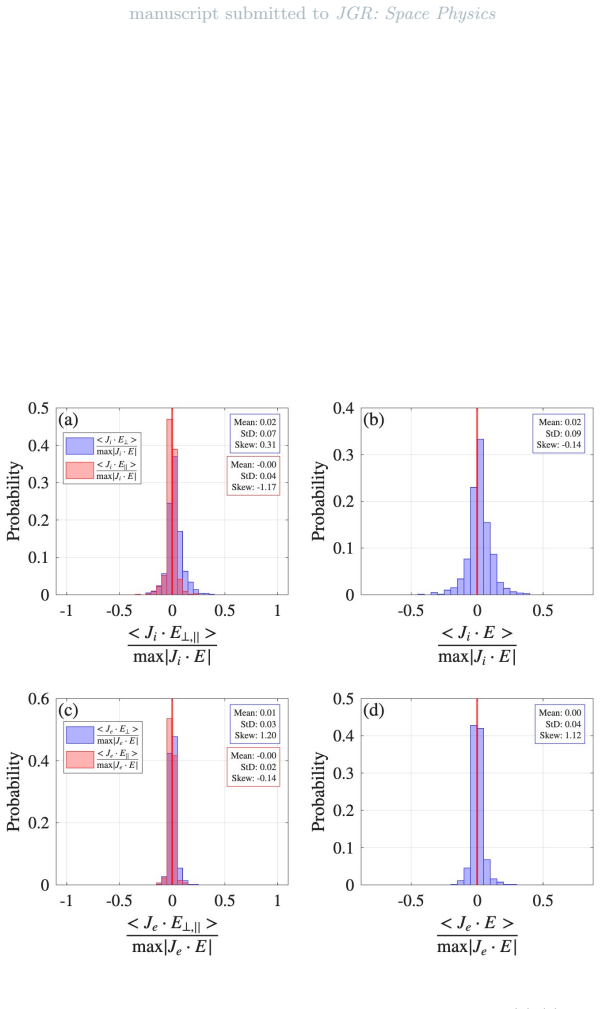
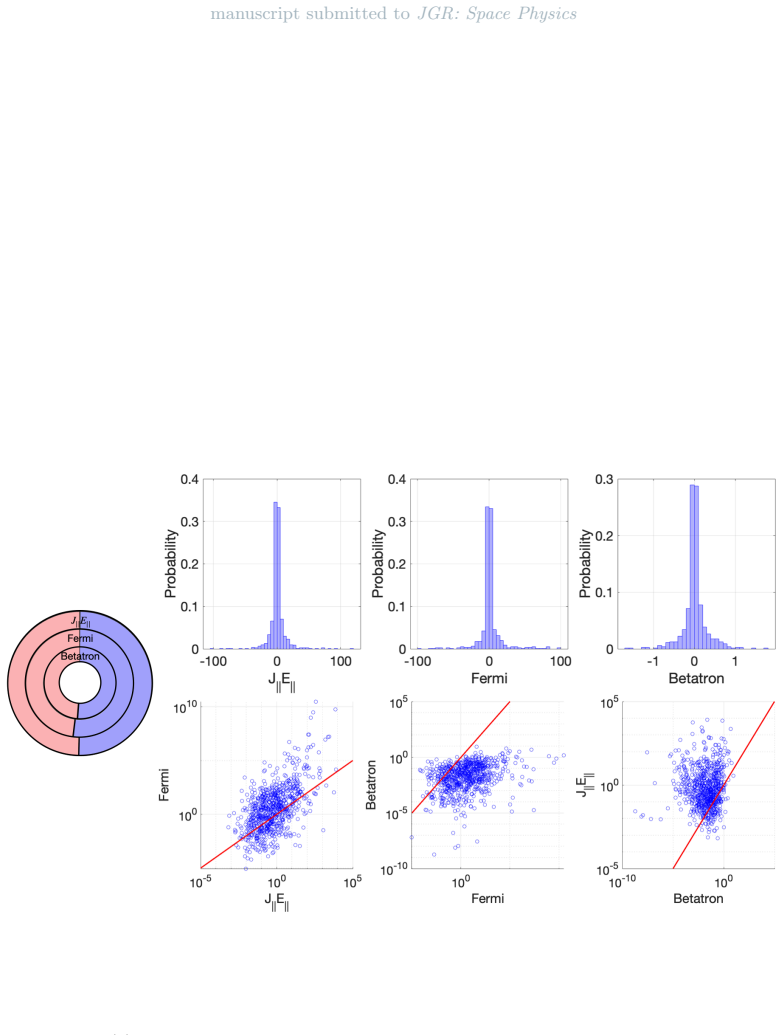
Using Magnetospheric Multiscale mission data, the authors find that electrons with motion perpendicular to the magnetic field dominate the j·E dissipation within magnetic structures near reconnecting regions. In contrast to the conventional picture of unidirectional energy transfer to particles by laminar two-dimensional reconnection, energy exchange within these structures during turbulent reconnection tends to be bidirectional with only a small positive bias from electromagnetic fields to particles. They quantify the contributions of specific electron energization mechanisms due to parallel electric field, Fermi energization from curvature drift, betatron heating from magnetic field inhomo
What carries the argument
Statistical decomposition of j·E dissipation into perpendicular-electron contributions and four named mechanisms (parallel E, curvature-drift Fermi, betatron, polarization drift) inside MMS-identified magnetic structures.
If this is right
- Perpendicular electron motion supplies the dominant share of dissipation inside the observed structures.
- Energy exchange between fields and particles occurs in both directions with only a modest net flow to particles.
- The four mechanisms (parallel electric field, curvature-drift Fermi energization, betatron heating, polarization drift) each contribute measurably to electron energization.
- The bidirectional pattern replaces the unidirectional transfer assumed in laminar two-dimensional reconnection models.
Where Pith is reading between the lines
- Global models of magnetospheric dynamics may need to incorporate fluctuating bidirectional energy exchange when turbulence is present rather than assuming steady net heating.
- Similar statistical patterns could be tested in laboratory reconnection experiments that reach turbulent regimes.
- The modest net bias implies that instantaneous energy fluctuations are larger than the time-averaged transfer, which could affect predictions of nonthermal particle tails.
Load-bearing premise
The selected magnetic structures are representative of those near reconnecting regions without significant selection bias or misidentification that would alter the statistical distribution of energy exchange directions and mechanism contributions.
What would settle it
Repeating the analysis on an independent data set or with a different automated identification algorithm for magnetic structures that produces a substantially different fraction of bidirectional versus unidirectional events or a different ranking of the four mechanisms would falsify the reported statistical results.
Figures



read the original abstract
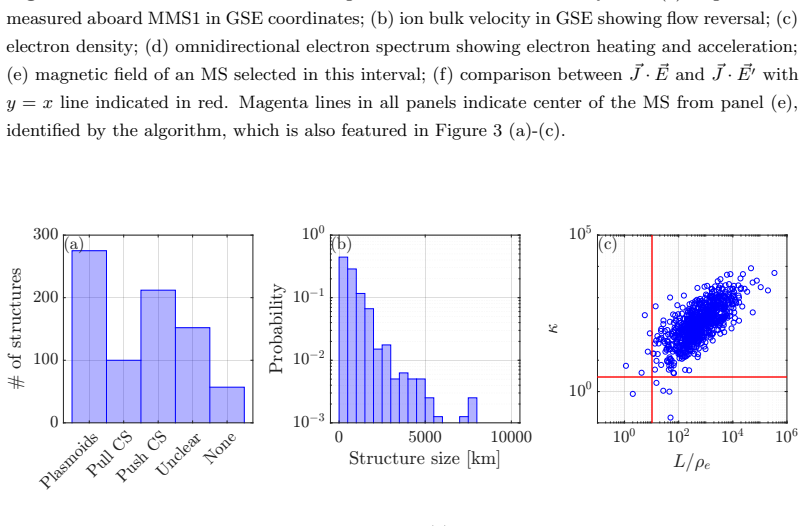
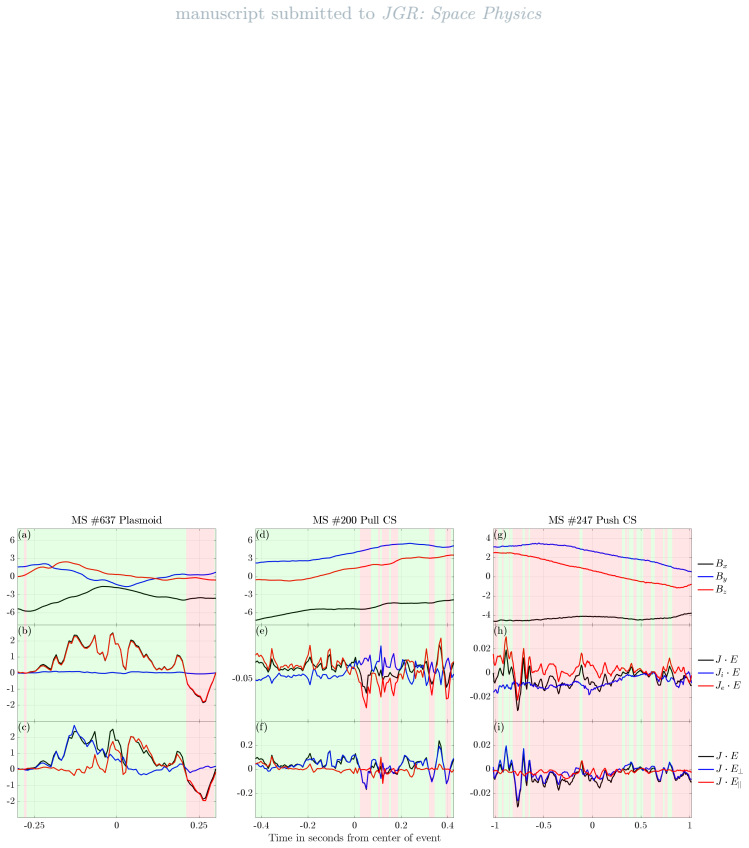
Magnetic reconnection is a ubiquitous plasma phenomenon that plays a critical role in particle heating and energization. During reconnection, the topology of magnetic field rearranges, depositing energy into the surrounding plasma through bulk flow, thermal heating, or non-thermal particle acceleration. While the pathways of this transformation from magnetic energy into kinetic have been studied extensively in recent years through theoretical or case-by-case observations, comprehensive statistical studies remain limited. In this paper, we present a statistical investigation using data from the Magnetospheric Multiscale (MMS) mission, and detail the particle energization mechanisms in magnetic structures found near reconnecting regions in turbulent Earth's magnetotail. We find that electrons with motion perpendicular to the magnetic field dominate $\vec{j}\cdot\vec{E}$ dissipation. In contrast to the conventional picture of unidirectional energy transfer to particles by laminar two-dimensional (2D) reconnection, we find that energy exchange within magnetic structures during turbulent reconnection tends to be bidirectional with only a small positive bias from electromagnetic fields to particles. Specific electron energization mechanisms are quantified, including those due to parallel electric field, Fermi energization from curvature drift, betatron heating from magnetic field inhomogeneity, and polarization drift.
Editorial analysis
A structured set of objections, weighed in public.
Referee Report
Summary. The manuscript presents a statistical investigation using Magnetospheric Multiscale (MMS) mission data on energy dissipation and particle energization mechanisms within magnetic structures near reconnecting regions during turbulent reconnection in the Earth's magnetotail. It reports that electrons with perpendicular motion dominate j·E dissipation, that energy exchange is bidirectional with only a small positive bias from electromagnetic fields to particles (in contrast to unidirectional transfer in laminar 2D reconnection), and that specific mechanisms are quantified including parallel electric field, Fermi energization from curvature drift, betatron heating from magnetic field inhomogeneity, and polarization drift.
Significance. If the central statistical claims hold after addressing selection and robustness issues, the work would provide one of the first comprehensive statistical characterizations of energization pathways in turbulent reconnection, offering quantitative evidence that challenges the conventional unidirectional picture and could inform models of particle heating and acceleration in space plasmas.
major comments (2)
- [Abstract] Abstract: the quantitative claims on dominance of perpendicular electrons in j·E dissipation and on bidirectional energy exchange with small positive bias are stated without error bars, statistical significance tests, data exclusion criteria, or details on mechanism separation, which are required to verify that the finite sample supports the reported distributions and bias.
- [Abstract] Abstract: the headline result on bidirectional exchange and relative mechanism contributions rests on a sample of 'magnetic structures found near reconnecting regions,' yet no explicit selection thresholds, event lists, or null-test results against randomized intervals are described; this leaves the representativeness assumption (and thus the directionality and weighting claims) unsecured against possible identification bias.
minor comments (1)
- [Abstract] Abstract: the number of events analyzed, the time interval covered by the MMS data, and any criteria for identifying 'turbulent' intervals are not stated, which would aid assessment of statistical power.
Simulated Author's Rebuttal
We thank the referee for their constructive comments on the abstract. We address each point below and have revised the abstract to improve self-containment while preserving its brevity. Details supporting the claims remain in the main text.
read point-by-point responses
-
Referee: [Abstract] Abstract: the quantitative claims on dominance of perpendicular electrons in j·E dissipation and on bidirectional energy exchange with small positive bias are stated without error bars, statistical significance tests, data exclusion criteria, or details on mechanism separation, which are required to verify that the finite sample supports the reported distributions and bias.
Authors: We agree the abstract would benefit from additional context on these elements. The main text reports bootstrap-derived uncertainties on the bias (Section 4.1), Kolmogorov-Smirnov tests confirming significance of the perpendicular dominance and net bias (p < 0.01), explicit data exclusion rules (Section 2.3), and the decomposition separating parallel-E, Fermi, betatron, and polarization contributions (Section 3.2). We have revised the abstract to state the sample size (N = 142), note the bias magnitude with uncertainty, and reference the statistical approach. This makes the headline claims more verifiable at a glance. revision: yes
-
Referee: [Abstract] Abstract: the headline result on bidirectional exchange and relative mechanism contributions rests on a sample of 'magnetic structures found near reconnecting regions,' yet no explicit selection thresholds, event lists, or null-test results against randomized intervals are described; this leaves the representativeness assumption (and thus the directionality and weighting claims) unsecured against possible identification bias.
Authors: The referee is correct that the original abstract did not summarize the selection procedure. Section 2.2 details the thresholds (e.g., |B| > 5 nT, |z| < 2 R_E from neutral sheet, minimum-variance identification of structures) and proximity criteria to reconnecting regions. An event list appears in the supplementary material. Section 4.3 presents null tests on randomized intervals confirming the observed bidirectional distribution and small positive bias are statistically distinct from random samples (p = 0.005). We have updated the abstract to include a concise clause on the identification method and robustness checks. revision: yes
Circularity Check
No circularity: observational statistics from MMS data with no fitted predictions or self-referential derivations
full rationale
The paper reports direct statistical measurements of j·E dissipation, energy exchange directionality, and mechanism contributions (parallel E, curvature-drift Fermi, betatron, polarization drift) from identified magnetic structures in MMS magnetotail data. No equations, parameter fits, or self-citations are described that would reduce any reported result to a definition or input by construction. The central claims rest on observational distributions rather than any derivation chain that loops back to its own assumptions or prior author work. Selection of structures is an empirical step whose validity is external to the reported quantities, not a circular reduction.
Axiom & Free-Parameter Ledger
Reference graph
Works this paper leans on
-
[1]
akhavan18 APACrefauthors Akhavan-Tafti, M. , Slavin, J A. , Le, G. , Eastwood, J P. , Strangeway, R J. , Russell, C T. Burch, J L. APACrefauthors \ 2018 . MMS Examination of FTEs at the Earth's Subsolar Magnetopause Mms examination of ftes at the earth's subsolar magnetopause . Journal of Geophysical Research: Space Physics 123 2 1224-1241 . APACrefDOI do...
-
[2]
Bandyopadhyay2020 APACrefauthors Bandyopadhyay , R. , Matthaeus , W H. , Parashar , T N. , Yang , Y. , Chasapis , A. , Giles , B L. Burch , J L. APACrefauthors \ 2020 06 . Statistics of Kinetic Dissipation in the Earth's Magnetosheath: MMS Observations Statistics of Kinetic Dissipation in the Earth's Magnetosheath: MMS Observations . Phys. Rev. Lett. 124 ...
-
[3]
bergstedt24 APACrefauthors Bergstedt , K. \ Ji , H. APACrefauthors \ 2024 . A Novel Method to Train Classification Models for Structure Detection in In-situ Spacecraft Data A Novel Method to Train Classification Models for Structure Detection in In-situ Spacecraft Data . Earth Space Sci. 11 e2023EA002965 . APACrefDOI doi:10.1029/2023EA002965 APACrefDOI
-
[4]
bergstedt20 APACrefauthors Bergstedt , K. , Ji , H. , Jara-Almonte , J. , Yoo , J. , Ergun , R E. \ Chen , L J. APACrefauthors \ 2020 10 . Statistical Properties of Magnetic Structures and Energy Dissipation during Turbulent Reconnection in the Earth's Magnetotail Statistical Properties of Magnetic Structures and Energy Dissipation during Turbulent Reconn...
-
[5]
bose2024 APACrefauthors Bose , S. , Fox , W. , Ji , H. , Yoo , J. , Goodman , A. , Alt , A. \ Yamada , M. APACrefauthors \ 2024 05 . Conversion of Magnetic Energy to Plasma Kinetic Energy During Guide Field Magnetic Reconnection in the Laboratory Conversion of Magnetic Energy to Plasma Kinetic Energy During Guide Field Magnetic Reconnection in the Laborat...
-
[6]
buechner89 APACrefauthors Buechner , J. \ Zelenyi , L M. APACrefauthors \ 1989 09 . Regular and chaotic charged particle motion in magnetotaillike field reversals. 1. Basic theory of trapped motion Regular and chaotic charged particle motion in magnetotaillike field reversals. 1. Basic theory of trapped motion . Journal of Geophysical Research: Space Phys...
-
[7]
burch16 APACrefauthors Burch , J L. , Torbert , R B. , Phan , T D. , Chen , L J. , Moore , T E. , Ergun , R E. Chandler , M. APACrefauthors \ 2016 06 . Electron-scale measurements of magnetic reconnection in space Electron-scale measurements of magnetic reconnection in space . Science 352 aaf2939 . APACrefDOI doi:10.1126/science.aaf2939 APACrefDOI
-
[8]
Cerri2021 APACrefauthors Cerri , S S. , Arzamasskiy , L. \ Kunz , M W. APACrefauthors \ 2021 08 . On Stochastic Heating and Its Phase-space Signatures in Low-beta Kinetic Turbulence On Stochastic Heating and Its Phase-space Signatures in Low-beta Kinetic Turbulence . Astrophys. J. 916 2 120 . APACrefDOI doi:10.3847/1538-4357/abfbde APACrefDOI
-
[9]
chen19 APACrefauthors Chen , L J. , Wang , S. , Hesse , M. , Ergun , R E. , Moore , T. , Giles , B. Lindqvist , P A. APACrefauthors \ 2019 06 . Electron Diffusion Regions in Magnetotail Reconnection Under Varying Guide Fields Electron Diffusion Regions in Magnetotail Reconnection Under Varying Guide Fields . Geophys. Res. Lett. 46 12 6230-6238 . APACrefDO...
-
[10]
dahlin14 APACrefauthors Dahlin , J T. , Drake , J F. \ Swisdak , M. APACrefauthors \ 2014 09 . The mechanisms of electron heating and acceleration during magnetic reconnection The mechanisms of electron heating and acceleration during magnetic reconnection . Physics of Plasmas 21 9 092304 . APACrefDOI doi:10.1063/1.4894484 APACrefDOI
-
[11]
dahlin17 APACrefauthors Dahlin , J T. , Drake , J F. \ Swisdak , M. APACrefauthors \ 2017 09 . The role of three-dimensional transport in driving enhanced electron acceleration during magnetic reconnection The role of three-dimensional transport in driving enhanced electron acceleration during magnetic reconnection . Physics of Plasmas 24 9 092110 . APACr...
-
[12]
drake06 APACrefauthors Drake , J F. , Swisdak , M. , Che , H. \ Shay , M A. APACrefauthors \ 2006 10 . Electron acceleration from contracting magnetic islands during reconnection Electron acceleration from contracting magnetic islands during reconnection . Nature 443 553-556 . APACrefDOI doi:10.1038/nature05116 APACrefDOI
-
[13]
ergun20 APACrefauthors Ergun , R E. , Ahmadi , N. , Kromyda , L. , Schwartz , S J. , Chasapis , A. , Hoilijoki , S. Giles , B L. APACrefauthors \ 2020 08 . Observations of Particle Acceleration in Magnetic Reconnection-driven Turbulence Observations of Particle Acceleration in Magnetic Reconnection-driven Turbulence . Astrophys. J. 898 2 154 . APACrefDOI ...
-
[14]
Eriksson2024E APACrefauthors Eriksson , S. , Ahmadi , N. , Burch , J L. , Genestreti , K J. , Swisdak , M. , Argall , M R. \ Newman , D L. APACrefauthors \ 2024 06 . MMS Observations of Oscillating Energy Conversion and Electron Vorticity in an Electron-Scale Layer Within a Southward Magnetopause Reconnection Exhaust MMS Observations of Oscillating Energy...
-
[15]
, Drake , J F
fermo10 APACrefauthors Fermo , R L. , Drake , J F. \ Swisdak , M. APACrefauthors \ 2010 01 . A statistical model of magnetic islands in a current layer A statistical model of magnetic islands in a current layer . Phys. Plasmas 17 1 010702
2010
-
[16]
fermo11 APACrefauthors Fermo , R L. , Drake , J F. , Swisdak , M. \ Hwang , K J. APACrefauthors \ 2011 09 . Comparison of a statistical model for magnetic islands in large current layers with Hall MHD simulations and Cluster FTE observations Comparison of a statistical model for magnetic islands in large current layers with Hall MHD simulations and Cluste...
-
[17]
ji22 APACrefauthors Ji , H. , Daughton , W. , Jara-Almonte , J. , Le , A. , Stanier , A. \ Yoo , J. APACrefauthors \ 2022 02 . Magnetic reconnection in the era of exascale computing and multiscale experiments Magnetic reconnection in the era of exascale computing and multiscale experiments . Nature Reviews Physics 4 4 263-282 . APACrefDOI doi:10.1038/s422...
-
[18]
jiang21 APACrefauthors Jiang , K. , Huang , S Y. , Yuan , Z G. , Deng , X H. , Wei , Y Y. , Xiong , Q Y. Yu , L. APACrefauthors \ 2021 06 . Statistical Properties of Current, Energy Conversion, and Electron Acceleration in Flux Ropes in the Terrestrial Magnetotail Statistical Properties of Current, Energy Conversion, and Electron Acceleration in Flux Rope...
-
[19]
lemoine22 APACrefauthors Lemoine , M. APACrefauthors \ 2022 11 . First-Principles Fermi Acceleration in Magnetized Turbulence First-Principles Fermi Acceleration in Magnetized Turbulence . Phys. Rev. Lett. 129 21 215101 . APACrefDOI doi:10.1103/PhysRevLett.129.215101 APACrefDOI
-
[20]
2015, ApJL, 811, L24, doi: 10.1088/2041-8205/811/2/L24 —
Li2015 APACrefauthors Li , X. , Guo , F. , Li , H. \ Li , G. APACrefauthors \ 2015 10 . Nonthermally Dominated Electron Acceleration during Magnetic Reconnection in a Low- Plasma Nonthermally Dominated Electron Acceleration during Magnetic Reconnection in a Low- Plasma . Astrophys. J. Lett 811 2 L24 . APACrefDOI doi:10.1088/2041-8205/811/2/L24 APACrefDOI
-
[21]
Li2017 APACrefauthors Li , X. , Guo , F. , Li , H. \ Li , G. APACrefauthors \ 2017 07 . Particle Acceleration during Magnetic Reconnection in a Low-beta Plasma Particle Acceleration during Magnetic Reconnection in a Low-beta Plasma . Astrophys. J. 843 1 21 . APACrefDOI doi:10.3847/1538-4357/aa745e APACrefDOI
-
[22]
ma22 APACrefauthors Ma , W. , Zhou , M. , Zhong , Z. \ Deng , X. APACrefauthors \ 2022 06 . Contrasting the Mechanisms of Reconnection-driven Electron Acceleration with In Situ Observations from MMS in the Terrestrial Magnetotail Contrasting the Mechanisms of Reconnection-driven Electron Acceleration with In Situ Observations from MMS in the Terrestrial M...
-
[23]
Montag2017 APACrefauthors Montag , P. , Egedal , J. , Lichko , E. \ Wetherton , B. APACrefauthors \ 2017 06 . Impact of compressibility and a guide field on Fermi acceleration during magnetic island coalescence Impact of compressibility and a guide field on Fermi acceleration during magnetic island coalescence . Physics of Plasmas 24 6 062906 . APACrefDOI...
-
[24]
APACrefauthors \ 1963
northrop63 APACrefauthors Northrop, T. APACrefauthors \ 1963 . Adiabatic Charged-Particle Motion Adiabatic charged-particle motion . Reviews of Geophysics 1 283
1963
-
[25]
Pyakurel2025 APACrefauthors Pyakurel , P S. , Phan , T D. , ieroset , M. , Drake , J F. , Shay , M A. , Mallet , A. Strangeway , R J. APACrefauthors \ 2025 03 . Detection of Large Guide Field Electron-Only Reconnection in a Filamentary Current Sheet Immersed in a Large-Scale Magnetopause Reconnection Exhaust Detection of Large Guide Field Electron-Only Re...
-
[26]
shi06 APACrefauthors Shi , Q Q. , Shen , C. , Dunlop , M W. , Pu , Z Y. , Zong , Q G. , Liu , Z X. Balogh , A. APACrefauthors \ 2006 04 . Motion of observed structures calculated from multi-point magnetic field measurements: Application to Cluster Motion of observed structures calculated from multi-point magnetic field measurements: Application to Cluster...
-
[27]
smith24 APACrefauthors Smith, A W. , Sun, W. , Slavin, J A. \ Rae, I J. APACrefauthors \ 2024 3 . Ion-Scale Magnetic Flux Ropes and Loops in Earth's Magnetotail: An Automated, Comprehensive Survey of MMS Data Between 2017 and 2022 Ion-scale magnetic flux ropes and loops in earth's magnetotail: An automated, comprehensive survey of mms data between 2017 an...
-
[28]
steinvall2025 APACrefauthors Steinvall , K. , Richard , L. , F \"u l \"o p , T. , Hanebring , L. \ Pusztai , I. APACrefauthors \ 2025 06 . Eulerian and Lagrangian electron energisation during magnetic reconnection Eulerian and Lagrangian electron energisation during magnetic reconnection . Journal of Plasma Physics 91 3 E90 . APACrefDOI doi:10.1017/S00223...
-
[29]
sun22 APACrefauthors Sun , W. , Turner , D L. , Zhang , Q. , Wang , S. , Egedal , J. , Leonard , T. Burch , J L. APACrefauthors \ 2022 12 . Properties and Acceleration Mechanisms of Electrons Up To 200 keV Associated With a Flux Rope Pair and Reconnection X-Lines Around It in Earth's Plasma Sheet Properties and Acceleration Mechanisms of Electrons Up To 2...
-
[30]
torbert18 APACrefauthors Torbert , R B. , Burch , J L. , Phan , T D. , Hesse , M. , Argall , M R. , Shuster , J. Saito , Y. APACrefauthors \ 2018 12 . Electron-scale dynamics of the diffusion region during symmetric magnetic reconnection in space Electron-scale dynamics of the diffusion region during symmetric magnetic reconnection in space . Science 362 ...
-
[31]
Wan2015 APACrefauthors Wan , M. , Matthaeus , W H. , Roytershteyn , V. , Karimabadi , H. , Parashar , T. , Wu , P. \ Shay , M. APACrefauthors \ 2015 05 . Intermittent Dissipation and Heating in 3D Kinetic Plasma Turbulence Intermittent Dissipation and Heating in 3D Kinetic Plasma Turbulence . Phys. Rev. Lett. 114 17 175002 . APACrefDOI doi:10.1103/PhysRev...
-
[32]
wilder18 APACrefauthors Wilder , F D. , Ergun , R E. , Burch , J L. , Ahmadi , N. , Eriksson , S. , Phan , T D. Khotyaintsev , Y V. APACrefauthors \ 2018 08 . The Role of the Parallel Electric Field in Electron-Scale Dissipation at Reconnecting Currents in the Magnetosheath The Role of the Parallel Electric Field in Electron-Scale Dissipation at Reconnect...
-
[33]
xu23 APACrefauthors Xu , Q. , Zhou , M. , Ma , W. , He , J. , Huang , S. , Zhong , Z. Deng , X. APACrefauthors \ 2023 03 . Electron Heating in Magnetosheath Turbulence: Dominant Role of the Parallel Electric Field Within Coherent Structures Electron Heating in Magnetosheath Turbulence: Dominant Role of the Parallel Electric Field Within Coherent Structure...
-
[34]
yamada10 APACrefauthors Yamada , M. , Kulsrud , R. \ Ji , H. APACrefauthors \ 2010 01 . Magnetic reconnection Magnetic reconnection . Reviews of Modern Physics 82 1 603-664 . APACrefDOI doi:10.1103/RevModPhys.82.603 APACrefDOI
-
[35]
Zenitani2011 APACrefauthors Zenitani , S. , Hesse , M. , Klimas , A. , Black , C. \ Kuznetsova , M. APACrefauthors \ 2011 12 . The inner structure of collisionless magnetic reconnection: The electron-frame dissipation measure and Hall fields The inner structure of collisionless magnetic reconnection: The electron-frame dissipation measure and Hall fields ...
discussion (0)
Sign in with ORCID, Apple, or X to comment. Anyone can read and Pith papers without signing in.