Ground-state estimation of the Heisenberg model on frustrated lattices with Sample-based Krylov Quantum Diagonalization
Pith reviewed 2026-06-29 07:16 UTC · model grok-4.3
The pith
Modified SKQD estimates ground states of the antiferromagnetic XXZ Heisenberg model on Kagome and other lattices to sub-percent accuracy up to 24 spins without any variational optimization.
A machine-rendered reading of the paper's core claim, the machinery that carries it, and where it could break.
Core claim
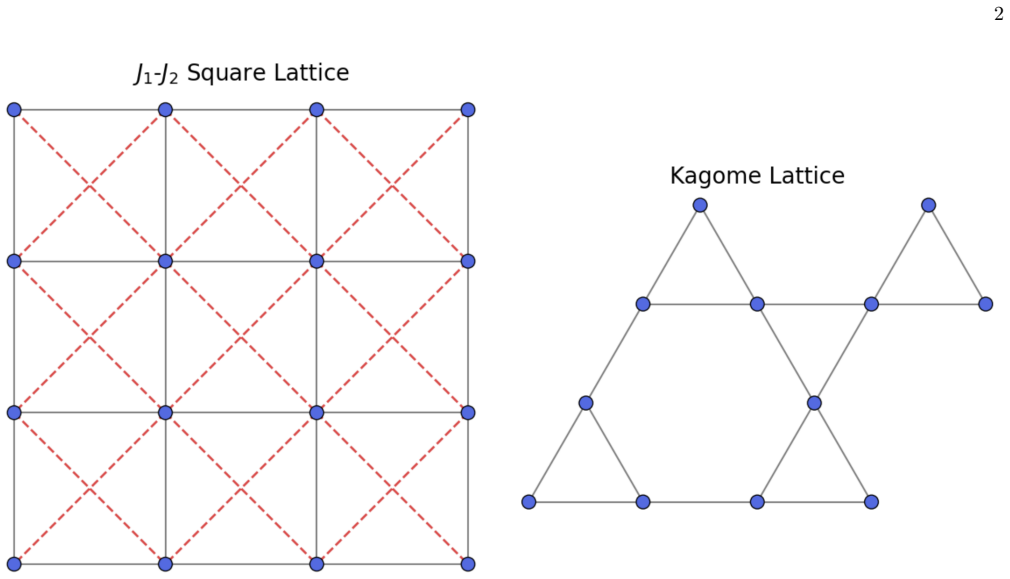
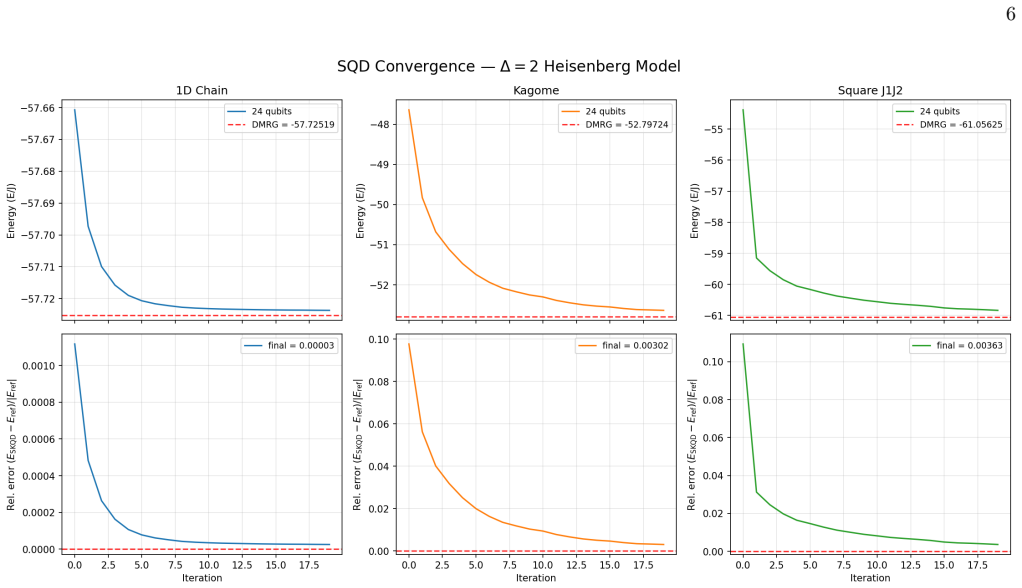
By applying SKQD to the antiferromagnetic XXZ Heisenberg model on the J1-J2 square lattice, Kagome lattice, and 1D chain, the method achieves sub-percent ground-state energy errors at system sizes up to 24 spins, including a relative error of 0.002% on the 12-site Kagome lattice that surpasses the best prior VQE result of 0.01% on the same system, while requiring no variational optimization. SKQD further extends to system sizes of 72 spins across all three geometries.
What carries the argument
Sample-based Krylov Quantum Diagonalization (SKQD) with a ZZ deformation at Δ=2 that creates a sparse Hamiltonian and a canonical bitstring compression scheme that preserves configuration recovery under spin-flip degeneracy, plus the use of multiple Krylov subspaces.
If this is right
- SKQD reaches system sizes of 72 spins on all three lattices, well beyond prior quantum algorithm studies for these models.
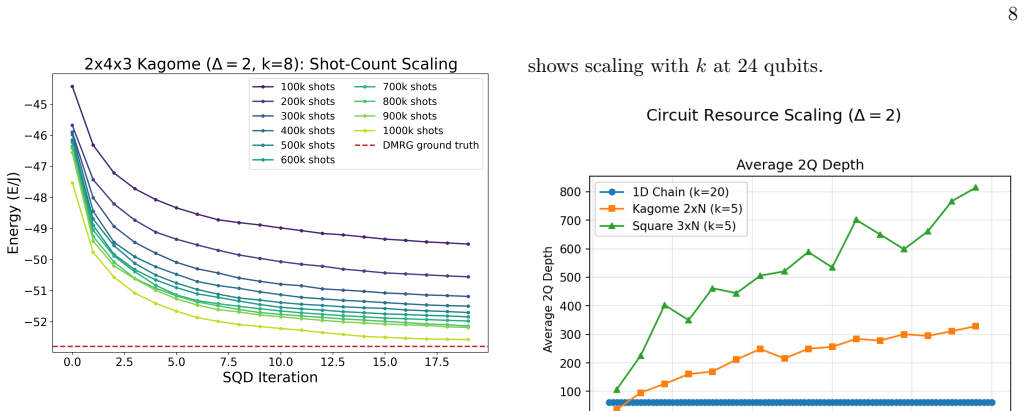
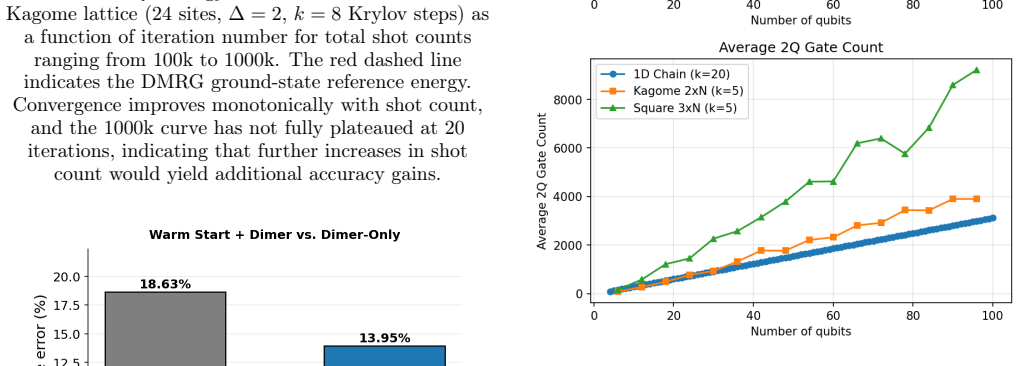
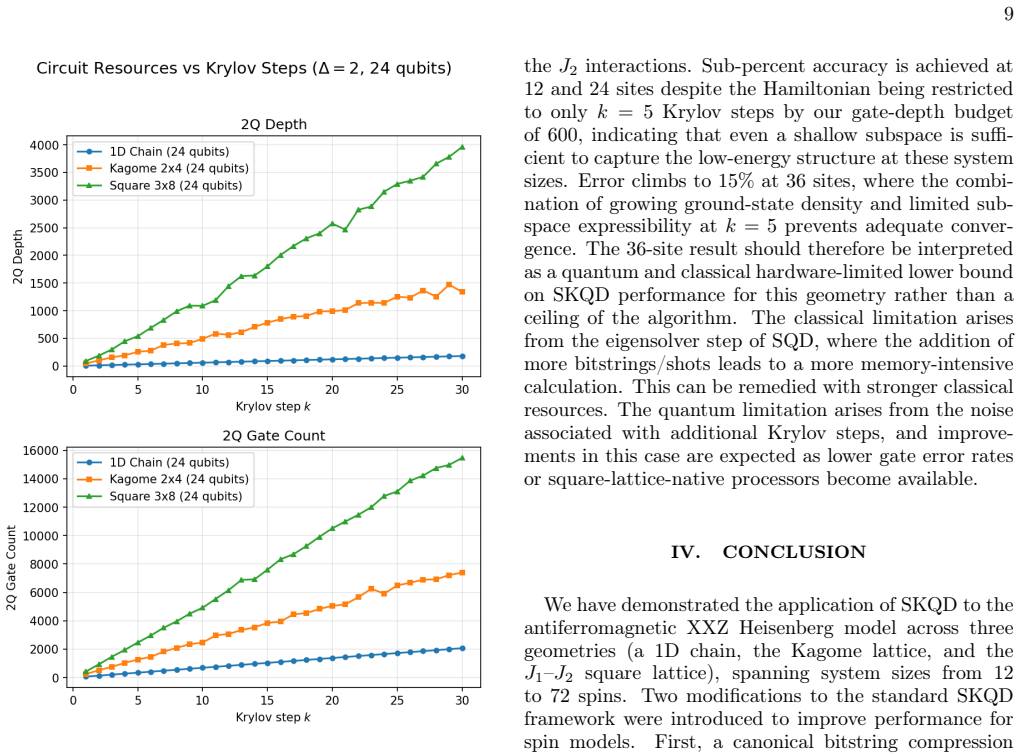
- Ground-state energy errors degrade gradually from sub-percent at 24 spins to 19-36% at 72 spins, indicating the limits arise from shot budgets and circuit depth rather than the algorithm.
- Multiple Krylov subspaces improve ground-state coverage without any increase in quantum resources.
- The method supplies a new quantum benchmark for the frustrated Heisenberg model even though classical tensor networks remain more accurate.
Where Pith is reading between the lines
- The ZZ deformation and compression steps could be tested on other spin Hamiltonians where degeneracy hinders sampling-based methods.
- Pairing SKQD with classical post-processing might reduce the shot requirements for intermediate system sizes.
- The absence of a variational loop could lower the total quantum runtime compared with VQE when the same accuracy target is acceptable.
- The gradual error scaling with size suggests that modest increases in available circuit depth would extend the high-accuracy regime beyond 24 spins.
Load-bearing premise
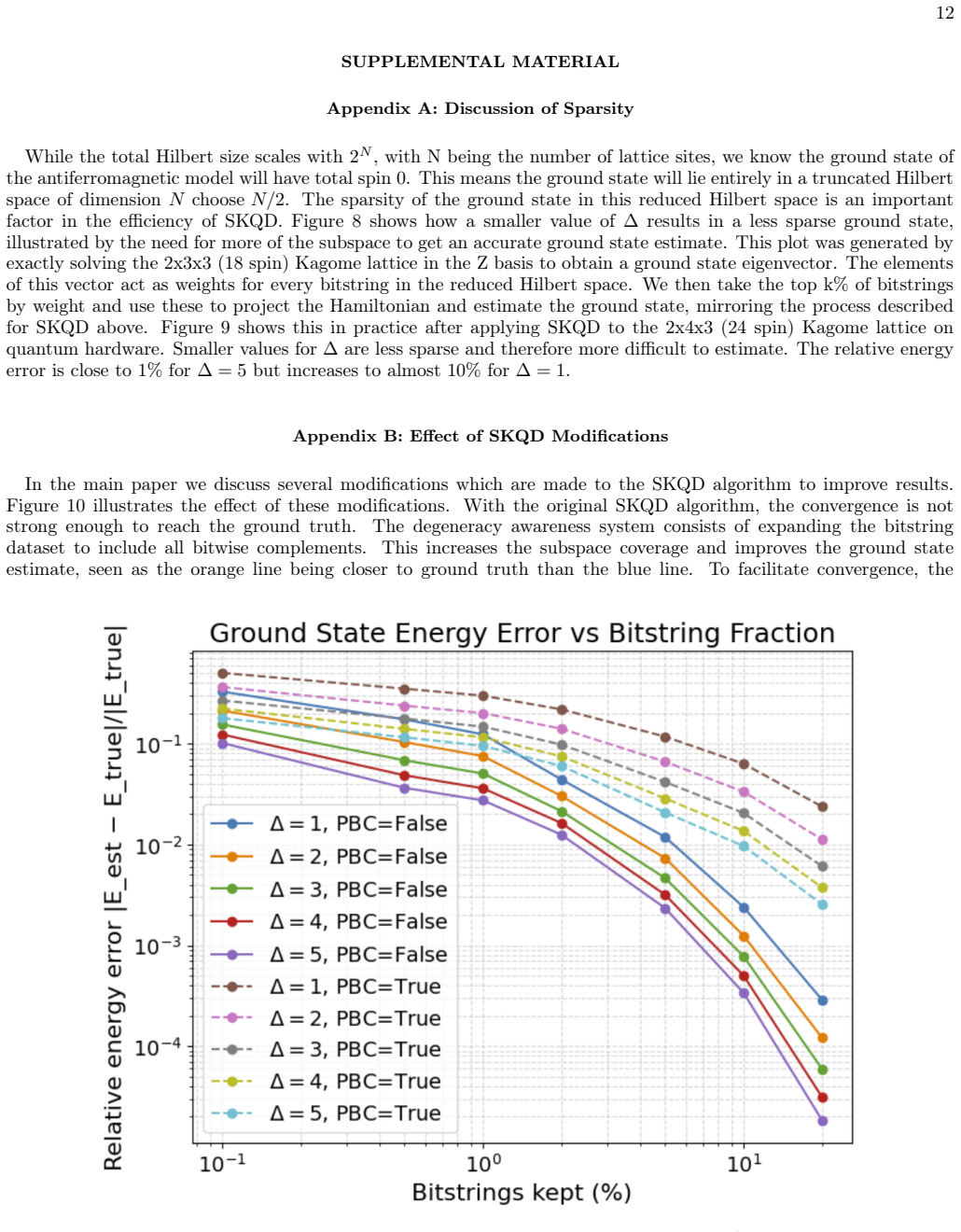
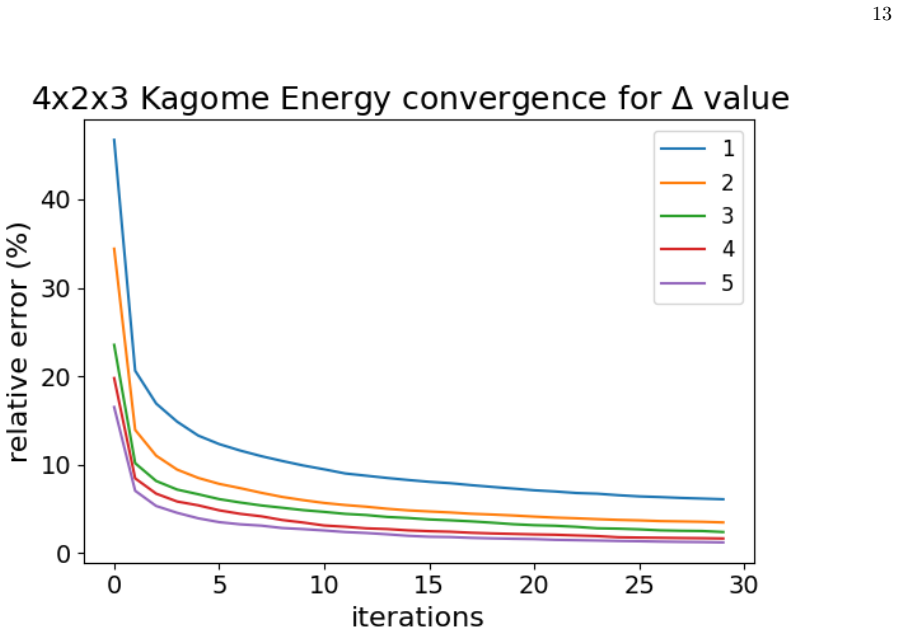
The ZZ deformation with Δ=2 produces a sufficiently sparse Hamiltonian that preserves the essential low-energy physics of the original antiferromagnetic XXZ model.
What would settle it
Running SKQD on the 12-site Kagome lattice with the original XXZ Hamiltonian instead of the Δ=2 deformation and obtaining a relative error larger than 0.002% would show that the deformation is required for the claimed accuracy.
Figures

read the original abstract
Quantum spin simulations of frustrated lattices remain challenging for both classical and quantum algorithms, particularly in parameter regimes relevant to quantum spin liquid (QSL) phases. In this work, we apply Sample-based Krylov Quantum Diagonalization (SKQD) to estimate the ground state of the antiferromagnetic XXZ Heisenberg model on the $J_1$--$J_2$ square lattice, the Kagome lattice, and a 1D chain, studying system sizes from 12 to 72 spins. In our application of SKQD, we identify a ZZ deformation of $\Delta=2$ as a sufficiently sparse Hamiltonian and introduce two modifications to the SKQD framework tailored to spin models: a canonical bitstring compression scheme that preserves the effectiveness of configuration recovery under spin-flip degeneracy, and the use of multiple Krylov subspaces to improve ground state coverage without any increase in quantum resources. For the 1D chain and Kagome lattice, SKQD achieves sub-percent ground-state energy errors at system sizes up to 24 spins, including a relative error of $0.002\%$ on the 12-site Kagome lattice, surpassing the best prior VQE result of $0.01\%$ on the same system while requiring no variational optimization. SKQD further extends to system sizes well beyond the reach of prior quantum algorithm studies, reaching 72 spins across all three geometries. Beyond 24 spins, accuracy degrades to relative errors of $19\%$--$36\%$ at 72 sites, but the gradual scaling of error with system size suggests these limits are set by available shot budgets and circuit depth rather than fundamental algorithmic constraints. Although classical tensor network methods remain state-of-the-art for these models, this work establishes a new benchmark for quantum simulation of the frustrated Heisenberg model and demonstrates SKQD as a scalable, hardware-compatible approach for studying strongly correlated spin systems.
Editorial analysis
A structured set of objections, weighed in public.
Referee Report
Summary. The manuscript applies Sample-based Krylov Quantum Diagonalization (SKQD) to the antiferromagnetic XXZ Heisenberg model on the J1-J2 square lattice, Kagome lattice, and 1D chain for system sizes 12-72 spins. It introduces a ZZ deformation at Δ=2 for sparsity, a canonical bitstring compression scheme, and multiple Krylov subspaces. It reports sub-percent ground-state energy errors up to 24 spins (including 0.002% relative error on the 12-site Kagome lattice, surpassing prior VQE), with degradation to 19-36% at 72 spins attributed to shot budgets rather than algorithmic limits.
Significance. If the central assumption holds, the work establishes a new benchmark for quantum simulation of frustrated Heisenberg models on hardware, demonstrating scalability beyond prior quantum studies without variational optimization and with explicit modifications for spin models.
major comments (1)
- [Abstract] Abstract: The headline accuracies (sub-percent errors up to 24 spins, 0.002% relative error on 12-site Kagome) are stated for the original XXZ model, yet the method relies on the ZZ-deformed Hamiltonian at Δ=2. No direct comparison, bound, or numerical check is provided showing that the ground-state energy of the deformed operator matches the undeformed XXZ model to within the target precision (~0.002% relative), which is load-bearing for the central performance claims.
minor comments (2)
- [Abstract] Abstract: Concrete error figures are reported without error bars, raw data tables, or verification details on how the deformation's effect on low-energy physics was quantified.
- The manuscript should add a dedicated section or table for small-system benchmarks (e.g., 12-site Kagome) explicitly comparing ground-state energies of the original XXZ and Δ=2 deformed Hamiltonians.
Simulated Author's Rebuttal
We thank the referee for their careful reading of the manuscript and for identifying this important point regarding the abstract claims and the ZZ deformation. We respond to the major comment below.
read point-by-point responses
-
Referee: [Abstract] Abstract: The headline accuracies (sub-percent errors up to 24 spins, 0.002% relative error on 12-site Kagome) are stated for the original XXZ model, yet the method relies on the ZZ-deformed Hamiltonian at Δ=2. No direct comparison, bound, or numerical check is provided showing that the ground-state energy of the deformed operator matches the undeformed XXZ model to within the target precision (~0.002% relative), which is load-bearing for the central performance claims.
Authors: We agree that the abstract should more precisely distinguish between the target XXZ model and the deformed Hamiltonian used in the computations. The ZZ deformation at Δ=2 was chosen specifically to ensure sufficient sparsity for the SKQD sampling procedure while preserving the antiferromagnetic character of the model; the manuscript states this motivation in the methods section. However, the referee is correct that no explicit numerical comparison, perturbative bound, or error estimate is provided demonstrating that the ground-state energy of the Δ=2 operator approximates the Δ=0 (original) energy to within the reported 0.002% relative precision on the 12-site Kagome lattice (or to sub-percent level on larger systems). This is a substantive gap for the headline claims. In the revised manuscript we will add a dedicated paragraph (or short appendix) containing direct numerical comparisons of the ground-state energies for the smallest systems (12-site Kagome, 12-site J1-J2 square, and 1D chain) at Δ=0 versus Δ=2, obtained via exact diagonalization. We will also report the relative energy difference and discuss its scaling with system size to justify the approximation quality. These additions will be included in the next version. revision: yes
Circularity Check
No significant circularity; derivation is self-contained
full rationale
The paper selects Δ=2 as a fixed empirical choice for sparsity and bitstring compression, then directly computes SKQD energies on the resulting deformed Hamiltonian. Reported relative errors (e.g., 0.002% on 12-site Kagome) are outputs of the algorithm compared against external references, not quantities that reduce by construction to fitted parameters or self-referential definitions. No equations equate the target XXZ ground-state energy to the deformed one; the preservation claim is an external modeling assumption rather than a tautological step. The central results therefore remain independent of the input data and do not match any enumerated circularity pattern.
Axiom & Free-Parameter Ledger
free parameters (1)
- ZZ deformation strength Δ
axioms (2)
- domain assumption The deformed Hamiltonian with Δ=2 has the same ground-state energy (within target precision) as the original XXZ antiferromagnet.
- standard math Standard quantum mechanics and the definition of the Heisenberg XXZ Hamiltonian on the cited lattices.
Reference graph
Works this paper leans on
-
[1]
Broholm, R
C. Broholm, R. J. Cava, S. A. Kivelson, D. G. Nocera, M. R. Norman, and T. Senthil, Science367, eaay0668 (2020)
2020
-
[2]
Wen, S.-L
J. Wen, S.-L. Yu, S. Li, W. Yu, and J.-X. Li, npj Quan- tum Materials4, 12 (2019)
2019
-
[3]
X. Cai, Z. Han, Z.-X. Li, S. A. Kivelson, and H. Yao, Proceedings of the National Academy of Sciences122, e2426111122 (2025)
2025
-
[4]
W.Zhu, S.-S.Gong,andD.N.Sheng,QuantumFrontiers 4, 11 (2025)
2025
-
[5]
Jiang, H
H.-C. Jiang, H. Yao, and L. Balents, Phys. Rev. B86, 024424 (2012)
2012
-
[6]
Liu, S.-S
W.-Y. Liu, S.-S. Gong, Y.-B. Li, D. Poilblanc, W.-Q. Chen, and Z.-C. Gu, Science Bulletin67, 1034 (2022)
2022
-
[7]
Qian and M
X. Qian and M. Qin, Phys. Rev. B109, L161103 (2024)
2024
-
[8]
Zheng, M
Y. Zheng, M. Wu, D.-X. Yao, and H.-Q. Wu, Phys. Rev. B111, 195145 (2025)
2025
-
[9]
Zhu and S
Z. Zhu and S. R. White, Phys. Rev. B92, 041105 (2015)
2015
-
[10]
R.HaghshenasandD.N.Sheng,Phys.Rev.B97,174408 (2018)
2018
-
[11]
E. M. Stoudenmire and S. R. White, Phys. Rev. B87, 155137 (2013)
2013
-
[12]
S. Dong, C. Wang, H. Zhang, M. Zhang, and L. He, Phys. Rev. Lett.135, 026501 (2025)
2025
-
[13]
T. Weaving, A. Ralli, V. Wimalaweera, P. J. Love, and P. V. Coveney, Simulating the antiferromagnetic heisen- berg model on a spin-frustrated kagome lattice with the contextual subspace variational quantum eigensolver (2025), arXiv:2506.12391 [quant-ph]
-
[14]
Tilly, H
J. Tilly, H. Chen, S. Cao, D. Picozzi, K. Setia, Y. Li, E. Grant, L. Wossnig, I. Rungger, G. H. Booth, and J. Tennyson, Physics Reports986, 1 (2022)
2022
-
[15]
D. Sheils and T. D. Rhone, Near-term quantum spin sim- ulation of the spin- 1 2 squarej 1 −j 2 heisenberg model (2024), arXiv:2406.18474 [quant-ph]
-
[16]
J. Yu, J. R. Moreno, J. T. Iosue, L. Bertels, D. Claudino, B. Fuller, P. Groszkowski, T. S. Humble, P. Jurce- vic, W. Kirby, T. A. Maier, M. Motta, B. Pokharel, A. Seif, A. Shehata, K. J. Sung, M. C. Tran, V. Tripathi, A. Mezzacapo, and K. Sharma, Quantum-centric algo- rithm for sample-based krylov diagonalization (2025), arXiv:2501.09702 [quant-ph]
-
[17]
N. Misciasci, R. Firt, J. E. Mueller, T. Friedhoff, C. Onah, A. Schulze, and S. Mostame, Entropy28, 10.3390/e28040367 (2026)
-
[18]
J. Robledo-Moreno, M. Motta, H. Haas, A. Javadi- Abhari, P. Jurcevic, W. Kirby, S. Martiel, K. Sharma, S. Sharma, T. Shirakawa, I. Sitdikov, R.-Y. Sun, K. J. Sung, M. Takita, M. C. Tran, S. Yunoki, and A. Mez- zacapo, Science Advances11, 10.1126/sciadv.adu9991 (2025)
-
[19]
Qiskit Development Team, Qiskit addon: Sample-based quantum diagonalization,https://github.com/Qiskit/ qiskit-addon-sqd(2024), accessed: 2025
2024
-
[20]
Yoshioka, M
N. Yoshioka, M. Amico, W. Kirby, P. Jurcevic, A. Dutt, B. Fuller, S. Garion, H. Haas, I. Hamamura, A. Ivrii, R. Majumdar, Z. Minev, M. Motta, B. Pokharel, P. Rivero, K. Sharma, C. J. Wood, A. Javadi-Abhari, and A. Mezzacapo, Nature Communications16, 5014 (2025)
2025
- [21]
-
[22]
S. R. White, Physical Review Letters69, 2863 (1992)
1992
-
[23]
S. R. White, Physical Review B48, 10345 (1993)
1993
-
[24]
E. M. Stoudenmire and S. R. White, Annual Review of Condensed Matter Physics3, 111 (2012). 11
2012
-
[25]
Gray, Journal of Open Source Software3, 819 (2018)
J. Gray, Journal of Open Source Software3, 819 (2018)
2018
-
[26]
carry-over
Y. Kim, A. Eddins, S. Anand, K. X. Wei, E. van den Berg, S. Rosenblatt, H. Nayfeh, Y. Wu, M. Zaletel, K. Temme, and A. Kandala, Nature618, 500 (2023). 12 SUPPLEMENTAL MATERIAL Appendix A: Discussion of Sparsity While the total Hilbert size scales with2N, with N being the number of lattice sites, we know the ground state of the antiferromagnetic model will...
2023
discussion (0)
Sign in with ORCID, Apple, or X to comment. Anyone can read and Pith papers without signing in.