Discrete and Continuous Wigner Functions in Open Quantum Systems: Non-Markovian and Thermodynamic Effects
Pith reviewed 2026-06-29 06:49 UTC · model grok-4.3
The pith
Negative quantum states from phase-space operators resist non-Markovian noise better than Bell states.
A machine-rendered reading of the paper's core claim, the machinery that carries it, and where it could break.
Core claim
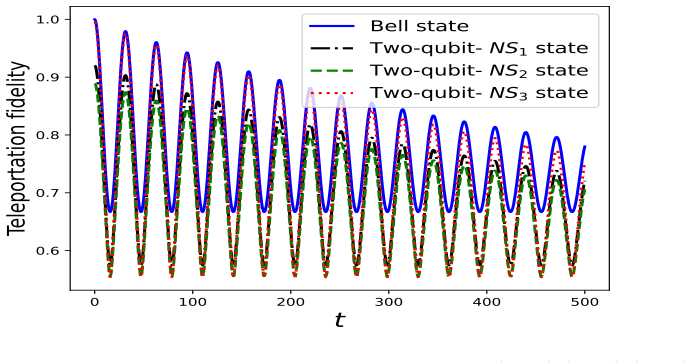
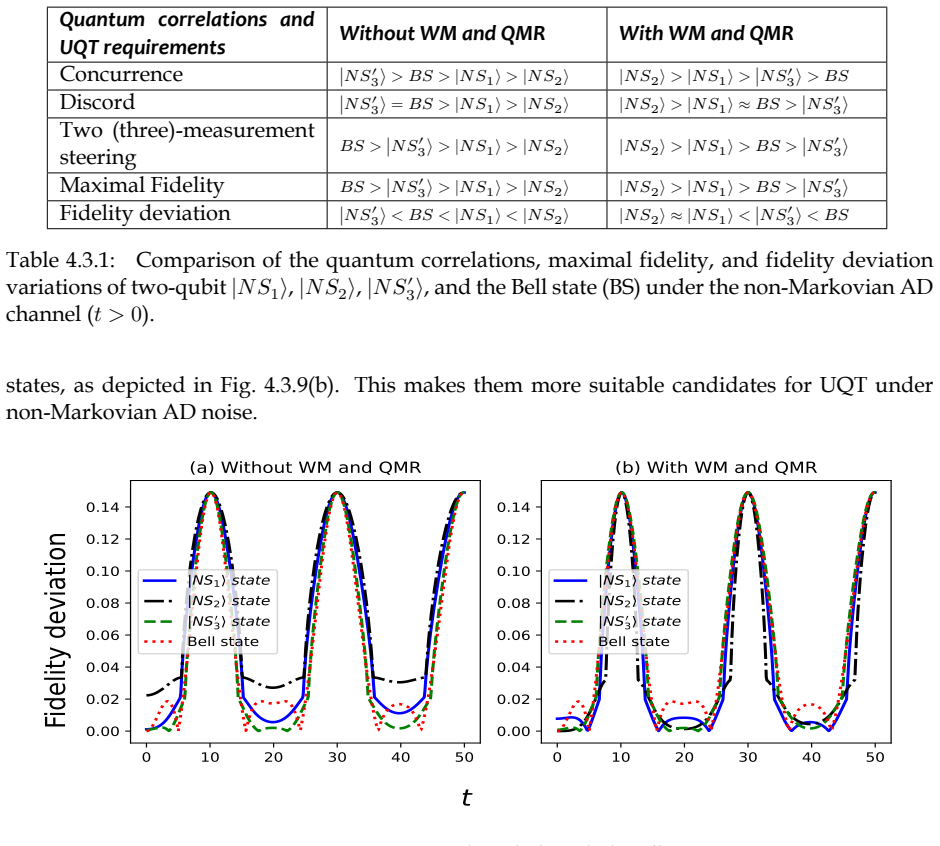
The thesis establishes that certain negative quantum states generated from phase-space point operators in the discrete Wigner function framework exhibit greater resilience than Bell states under non-Markovian noise, preserving higher entanglement, achieving stronger maximal CHSH violation, and delivering better Fisher information, while also supporting improved teleportation performance when protected by weak measurement and reversal; these states are realized experimentally on IBM superconducting devices with high-fidelity state tomography.
What carries the argument
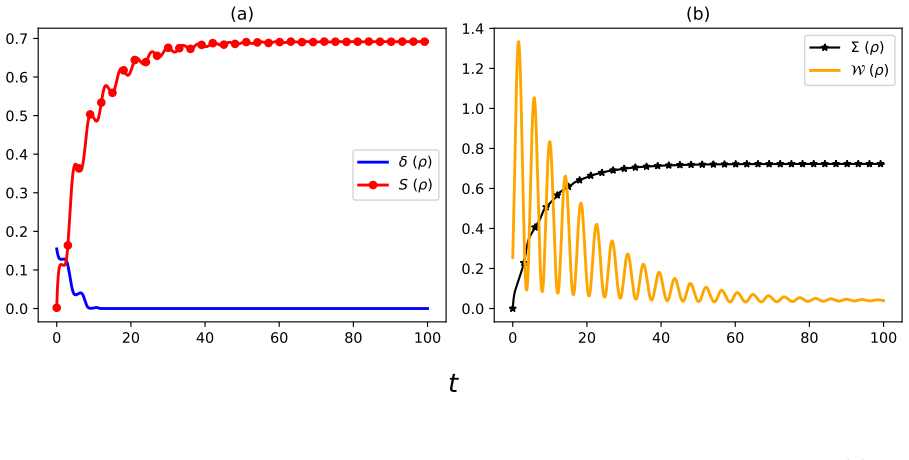
Discrete Wigner functions that define negative quantum states from phase-space point operators, which characterize non-classicality and track its evolution under open-system channels.
If this is right
- These negative states can function as improved resources for quantum teleportation in environments with memory-bearing noise.
- Weak measurement and reversal strategies increase their quantum correlations and reduce fidelity loss compared to unprotected evolution.
- They enable higher maximal CHSH violation and Fisher information than Bell states under the same non-Markovian channels.
- Preparation on superconducting hardware demonstrates that the states remain usable for quantum information tasks after realistic noise exposure.
Where Pith is reading between the lines
- If the advantage holds across other non-Markovian models, the states could serve as drop-in replacements for Bell pairs in quantum networks exposed to memory effects.
- The thermodynamic aspects noted in the title suggest possible links between Wigner negativity and heat dissipation that could be tested in continuous-variable extensions.
- Verification on additional hardware platforms would clarify whether the observed resilience is device-specific or general to the state construction.
Load-bearing premise
The random-telegraph and amplitude-damping models accurately represent the dominant noise processes in the IBM superconducting device.
What would settle it
An experiment on the IBM device in which the negative states fail to show higher entanglement preservation or CHSH values than Bell states under the device's actual noise would falsify the resilience claim.
Figures









read the original abstract
The central aim of the thesis is to examine how non-classical resources in finite-dimensional quantum systems can be identified, characterized, and protected for practical use in the presence of realistic noise. Using the discrete Wigner functions (DWFs) framework, we introduce negative quantum states and examine how their Wigner negativity, mana, coherence, and teleportation fidelity evolve under unital and non-unital channels, with particular attention to non-Markovian random-telegraph and amplitude-damping dynamics. We also analyze protection strategies based on weak measurement and quantum measurement reversal, showing that these methods can enhance quantum correlations, reduce fidelity deviation, and improve teleportation performance for two-qubit negative states in memory-bearing environments. Moreover, we demonstrate that certain negative states, derived from phase-space point operators, exhibit greater resilience than Bell states in measures of entanglement under non-Markovian noise. Further, this thesis focuses on developing and implementing quantum circuits for generating these states on superconducting hardware and realizing them for the first time on IBM's ibm-Brisbane device. Their preparation is verified using quantum state tomography, demonstrating high fidelity under realistic noise conditions. We propose a teleportation scheme that leverages one of the two-qubit negative quantum states as a resource. Moreover, these two-qubit negative quantum states are also found to perform better than the Bell states for maximal CHSH violation and Fisher information in noisy conditions. We believe that these negative quantum states have the potential to be used in place of the traditional Bell states in scenarios where non-Markovian errors are prevalent. (continued in the PDF)
Editorial analysis
A structured set of objections, weighed in public.
Referee Report
Summary. The manuscript examines negative quantum states defined through discrete Wigner functions in open quantum systems. It analyzes their Wigner negativity, mana, coherence, and teleportation fidelity under unital and non-unital channels, with emphasis on non-Markovian random-telegraph and amplitude-damping dynamics. Protection via weak measurement and reversal is studied. The central claims are that certain phase-space-point-operator-derived negative states exhibit greater entanglement resilience than Bell states under these channels, superior maximal CHSH violation and Fisher information in noise, and that they were prepared and tomographically verified on ibm-Brisbane hardware, with a proposed teleportation scheme using one such state.
Significance. If the resilience advantage and hardware results hold after proper model calibration, the work would identify concrete alternatives to Bell states for non-Markovian environments in superconducting platforms, with potential impact on entanglement distribution and metrology tasks. The explicit hardware implementation and tomography verification constitute a concrete strength.
major comments (1)
- [Abstract; hardware implementation and simulation sections] The load-bearing claim that negative states derived from phase-space point operators exhibit greater resilience than Bell states (and superior CHSH/Fisher performance) under non-Markovian noise rests on simulations with random-telegraph and amplitude-damping channels. No section describes calibration of the model parameters (switching rate, correlation time, damping strength) to measured ibm-Brisbane quantities such as T1/T2 spectra, cross-talk, or non-Markovian signatures. Without this mapping, the reported advantage does not demonstrably transfer to the hardware regime invoked in the abstract and conclusion.
Simulated Author's Rebuttal
We thank the referee for the constructive feedback. We address the single major comment below and will revise the manuscript accordingly to clarify the distinction between phenomenological simulations and hardware results.
read point-by-point responses
-
Referee: [Abstract; hardware implementation and simulation sections] The load-bearing claim that negative states derived from phase-space point operators exhibit greater resilience than Bell states (and superior CHSH/Fisher performance) under non-Markovian noise rests on simulations with random-telegraph and amplitude-damping channels. No section describes calibration of the model parameters (switching rate, correlation time, damping strength) to measured ibm-Brisbane quantities such as T1/T2 spectra, cross-talk, or non-Markovian signatures. Without this mapping, the reported advantage does not demonstrably transfer to the hardware regime invoked in the abstract and conclusion.
Authors: We agree that the manuscript does not provide explicit calibration of the random-telegraph switching rates or amplitude-damping strengths to ibm-Brisbane T1/T2 spectra, cross-talk, or measured non-Markovian signatures. The simulations use standard phenomenological models with parameters selected to illustrate non-Markovian memory effects in general, while the hardware section reports only state preparation and tomography on ibm-Brisbane, independent of the dynamical evolution. In the revised version we will add a dedicated paragraph in the simulation section (and a clarifying sentence in the abstract) stating that the reported resilience advantage applies to the chosen model channels and that quantitative mapping to the specific device would require additional calibration experiments, which lie outside the present scope. This revision will remove any implication that the advantage has been directly verified on the hardware. revision: yes
Circularity Check
No circularity in derivation chain
full rationale
The provided abstract and thesis summary describe introduction of negative states via discrete Wigner functions, their evolution under chosen non-Markovian channel models, and hardware verification on ibm-Brisbane via tomography. No equations, fitting procedures, or self-citations are exhibited that would reduce any resilience, CHSH, or Fisher-information claims to the inputs by construction. The channel simulations and experimental preparation are presented as separate steps, with the former used to compute metrics and the latter to confirm realizability; this structure remains self-contained against external benchmarks without load-bearing circular reductions.
Axiom & Free-Parameter Ledger
Reference graph
Works this paper leans on
-
[1]
Operational meaning of discord in terms of teleportation fidelity
Adhikari, S. and Banerjee, S., “Operational meaning of discord in terms of teleportation fidelity”, Physical Review A , vol. 86, 062313 2012, URL https://api.semanticscholar.org/CorpusID: 118416180
2012
-
[2]
Agarwal, G. S., “Relation between atomic coherent-state representation, state multipoles, and generalized phase-space distributions”, Phys. Rev. A, vol. 24, 2889–2896 Dec 1981, URL https: //link.aps.org/doi/10.1103/PhysRevA.24.2889
-
[3]
State reconstruction for a collection of two-level systems
Agarwal, G. S., “State reconstruction for a collection of two-level systems”, Phys. Rev. A , vol. 57, 671–673 Jan 1998, URL https://link.aps.org/doi/10.1103/PhysRevA.57.671
-
[4]
Aharonov, Y., Albert, D. Z., and Vaidman, L., “How the result of a measurement of a component of the spin of a spin-1/2 particle can turn out to be 100”, Phys. Rev. Lett., vol. 60, 1351–1354 Apr 1988, URL https://link.aps.org/doi/10.1103/PhysRevLett.60.1351
-
[5]
and Lendi, K., Quantum dynamical semigroups and applications , vol
Alicki, R. and Lendi, K., Quantum dynamical semigroups and applications , vol. 717, Springer 2007
2007
-
[6]
Maximal work extraction from finite quantum systems
Allahverdyan, A. E., Balian, R., and Nieuwenhuizen, T. M., “Maximal work extraction from finite quantum systems”, Europhysics Letters, vol. 67, no. 4, 565 aug 2004, URL https://dx.doi.org/ 10.1209/epl/i2004-10101-2 Arısoy, O., Campbell, S., and Müstecaplıoğlu, Ö. E., “Thermalization of finite many-body systems by a collision model”, Entropy, vol. 21, no. ...
-
[7]
Local environment can enhance fidelity of quantum teleportation
Badziag, P., Horodecki, M., Horodecki, P., and Horodecki, R., “Local environment can enhance fidelity of quantum teleportation”, Phys. Rev. A , vol. 62, 012311 Jun 2000, URL https://link. aps.org/doi/10.1103/PhysRevA.62.012311
-
[8]
A new proof for the existence of mutually unbiased bases
Bandyopadhyay, Boykin, Roychowdhury, and Vatan, “A new proof for the existence of mutually unbiased bases”, Algorithmica, vol. 34, 512–528 2002, URL https://rdcu.be/dde4t
2002
-
[9]
Banerjee, S., Open Quantum Systems: Dynamics of Nonclassical Evolution , Springer Singapore 2018, URL http://dx.doi.org/10.1007/978-981-13-3182-4
-
[10]
Thermalization in quenched open quantum cosmology
Banerjee, S., Choudhury, S., Chowdhury, S., Knaute, J., Panda, S., and Shirish, K., “Thermalization in quenched open quantum cosmology”, Nuclear Physics B , vol. 996, 116368 2023, URL https: //www.sciencedirect.com/science/article/pii/S0550321323002973
2023
-
[11]
Fidelity deviation in quantum teleportation
Bang, J., Ryu, J., and Kaszlikowski, D., “Fidelity deviation in quantum teleportation”, Journal of Physics A: Mathematical and Theoretical , vol. 51, no. 13, 135302 feb 2018, URL https://dx.doi. org/10.1088/1751-8121/aaac35 129
-
[12]
Ergotropy from coherences in an open quantum system
Baris, C., “Ergotropy from coherences in an open quantum system”, Phys. Rev. E, vol. 102, 042111 Oct 2020, URL https://link.aps.org/doi/10.1103/PhysRevE.102.042111
-
[13]
Baumgratz, T., Cramer, M., and Plenio, M. B., “Quantifying Coherence”, Phys. Rev. Lett., vol. 113, 140401 Sep 2014, URL https://link.aps.org/doi/10.1103/PhysRevLett.113.140401
-
[14]
Bekenstein, J. D., “Black Holes and Entropy”,Phys. Rev. D, vol. 7, 2333–2346 Apr 1973, URLhttps: //link.aps.org/doi/10.1103/PhysRevD.7.2333
-
[18]
Quantum nonlocality without entanglement
Wootters, W. K., “Quantum nonlocality without entanglement”, Phys. Rev. A, vol. 59, 1070–1091 Feb 1999, URL https://link.aps.org/doi/10.1103/PhysRevA.59.1070
-
[19]
Optimal frequency measure- ments with maximally correlated states
Bollinger, J. J. ., Itano, W. M., Wineland, D. J., and Heinzen, D. J., “Optimal frequency measure- ments with maximally correlated states”, Phys. Rev. A , vol. 54, R4649–R4652 Dec 1996, URL https://link.aps.org/doi/10.1103/PhysRevA.54.R4649
-
[20]
Experimental Realization of Teleporting an Unknown Pure Quantum State via Dual Classical and Einstein-Podolsky-Rosen Channels
Boschi, D., Branca, S., De Martini, F., Hardy, L., and Popescu, S., “Experimental Realization of Teleporting an Unknown Pure Quantum State via Dual Classical and Einstein-Podolsky-Rosen Channels”, Phys. Rev. Lett., vol. 80, 1121–1125 Feb 1998, URL https://link.aps.org/doi/10. 1103/PhysRevLett.80.1121
1998
-
[21]
Experimental quantum teleportation
Bouwmeester, D., Pan, J.-W., Mattle, K., Eibl, M., Weinfurter, H., and Zeilinger, A., “Experimental quantum teleportation”, Nature, vol. 390, no. 6660, 575–579 1997
1997
-
[22]
Quantum-enhanced measurements without entanglement
Braun, D., Adesso, G., Benatti, F., Floreanini, R., Marzolino, U., Mitchell, M. W., and Pirandola, S., “Quantum-enhanced measurements without entanglement”, Rev. Mod. Phys. , vol. 90, no. 3 Sep 2018, URL https://link.aps.org/licenses/aps-default-license 130
2018
-
[23]
and Petruccione, F., The Theory of Open Quantum Systems, Oxford University Press 2002, URL https://books.google.co.in/books?id=0Yx5VzaMYm8C
Breuer, H. and Petruccione, F., The Theory of Open Quantum Systems, Oxford University Press 2002, URL https://books.google.co.in/books?id=0Yx5VzaMYm8C
2002
-
[24]
Atomic, Molecular and Optical Physics , vol. 45, no. 15, 154001 jul 2012, URL https://dx.doi. org/10.1088/0953-4075/45/15/154001
-
[25]
Breuer, H.-P. and Petruccione, F., The Theory of Open Quantum Systems , Oxford University Pres- sOxford Jan 2007, URL http://dx.doi.org/10.1093/acprof:oso/9780199213900.001.0001
work page doi:10.1093/acprof:oso/9780199213900.001.0001 2007
-
[26]
Stochastic wave-function method for non- Markovian quantum master equations
Breuer, H.-P., Kappler, B., and Petruccione, F., “Stochastic wave-function method for non- Markovian quantum master equations”, Phys. Rev. A, vol. 59, 1633–1643 Feb 1999, URL https: //link.aps.org/doi/10.1103/PhysRevA.59.1633
-
[27]
Non-Markovian dynamics in a spin star sys- tem: Exact solution and approximation techniques
Breuer, H.-P., Burgarth, D., and Petruccione, F., “Non-Markovian dynamics in a spin star sys- tem: Exact solution and approximation techniques”, Phys. Rev. B, vol. 70, 045323 Jul 2004, URL https://link.aps.org/doi/10.1103/PhysRevB.70.045323
-
[28]
Measure for the Degree of Non-Markovian Behavior of Quantum Processes in Open Systems
Breuer, H.-P., Laine, E.-M., and Piilo, J., “Measure for the Degree of Non-Markovian Behavior of Quantum Processes in Open Systems”, Phys. Rev. Lett., vol. 103, 210401 Nov 2009, URL https: //link.aps.org/doi/10.1103/PhysRevLett.103.210401
-
[29]
Colloquium: Non-Markovian dynamics in open quantum systems
Breuer, H.-P., Laine, E.-M., Piilo, J., and Vacchini, B., “Colloquium: Non-Markovian dynamics in open quantum systems”, Rev. Mod. Phys. , vol. 88, 021002 Apr 2016, URL https://link.aps. org/doi/10.1103/RevModPhys.88.021002
-
[30]
All Mutually Unbiased Bases in Dimensions Two to Five
Brierley, S., Weigert, S., and Bengtsson, I., “All mutually unbiased bases in dimensions two to five”, arXiv preprint arXiv:0907.4097 2009, URL https://dl.acm.org/doi/10.5555/2011464. 2011470
work page internal anchor Pith review Pith/arXiv arXiv doi:10.5555/2011464 2009
-
[31]
Brunner, N., Cavalcanti, D., Pironio, S., Scarani, V., and Wehner, S., “Bell nonlocality”, Rev. Mod. Phys., vol. 86, 419–478 Apr 2014, URL https://link.aps.org/doi/10.1103/RevModPhys.86. 419
-
[32]
Kochen-Specker contex- tuality
Budroni, C., Cabello, A., Gühne, O., Kleinmann, M., and Larsson, J.-A., “Kochen-Specker contex- tuality”, Rev. Mod. Phys., vol. 94, 045007 Dec 2022, URL https://link.aps.org/doi/10.1103/ RevModPhys.94.045007
2022
-
[33]
Collision models in open system dynamics: A versatile tool for deeper insights?
Campbell, S. and Vacchini, B., “Collision models in open system dynamics: A versatile tool for deeper insights?”, Europhysics Letters , vol. 133, no. 6, 60001 may 2021, URL https://dx.doi. org/10.1209/0295-5075/133/60001
-
[34]
System-environment correlations and Markovian embedding of quantum non-Markovian dynamics
Campbell, S., Ciccarello, F., Palma, G. M., and Vacchini, B., “System-environment correlations and Markovian embedding of quantum non-Markovian dynamics”, Phys. Rev. A, vol. 98, 012142 Jul 2018, URL https://link.aps.org/doi/10.1103/PhysRevA.98.012142
-
[35]
Extrema of discrete Wigner functions and appli- cations
Casaccino, A., Galvão, E. F., and Severini, S., “Extrema of discrete Wigner functions and appli- cations”, Phys. Rev. A , vol. 78, 022310 Aug 2008, URL https://link.aps.org/doi/10.1103/ PhysRevA.78.022310
2008
-
[36]
Wigner functions and Weyl transforms for pedestrians
Case, W. B., “Wigner functions and Weyl transforms for pedestrians”, American Journal of Physics, vol. 76, no. 10, 937–946 2008, URL https://doi.org/10.1119/1.2957889 131
-
[37]
Collision Models Can Efficiently Simulate Any Multipartite Markovian Quantum Dynamics
Cattaneo, M., De Chiara, G., Maniscalco, S., Zambrini, R., and Giorgi, G. L., “Collision Models Can Efficiently Simulate Any Multipartite Markovian Quantum Dynamics”, Phys. Rev. Lett. , vol. 126, 130403 Apr 2021, URL https://link.aps.org/doi/10.1103/PhysRevLett.126.130403
-
[38]
A Brief Journey through Colli- sion Models for Multipartite Open Quantum Dynamics
Cattaneo, M., Giorgi, G. L., Zambrini, R., and Maniscalco, S., “A Brief Journey through Colli- sion Models for Multipartite Open Quantum Dynamics”, Open Systems & Information Dynamics, vol. 29, no. 03, 2250015 2022, URL https://doi.org/10.1142/S1230161222500159
-
[39]
A study of quantum correlations in open quantum systems
Chakrabarty, I., Banerjee, S., and Siddharth, N., “A study of quantum correlations in open quantum systems”, Quantum Inf. Comput. , vol. 11, 541–562 2010, URL https://api. semanticscholar.org/CorpusID:15930121
2010
-
[41]
Wigner dis- tributions for finite-dimensional quantum systems: An algebraic approach
Chaturvedi, S., Ercolessi, E., Marmo, G., Morandi, G., Mukunda, N., and Simon, R., “Wigner dis- tributions for finite-dimensional quantum systems: An algebraic approach”, Pramana, vol. 65, 981–993 2005, URL https://doi.org/10.1007/BF02705275
-
[42]
Collision-model-based approach to non- Markovian quantum dynamics
Ciccarello, F., Palma, G. M., and Giovannetti, V., “Collision-model-based approach to non- Markovian quantum dynamics”, Phys. Rev. A , vol. 87, 040103 Apr 2013, URL https://link. aps.org/doi/10.1103/PhysRevA.87.040103
-
[43]
Quantum collision models: Open system dynamics from repeated interactions
Ciccarello, F., Lorenzo, S., Giovannetti, V., and Palma, G. M., “Quantum collision models: Open system dynamics from repeated interactions”, Physics Reports , vol. 954, 1–70, quantum col- lision models: Open system dynamics from repeated interactions 2022, URL https://www. sciencedirect.com/science/article/pii/S0370157322000035
2022
-
[44]
Joint Wigner distribution for spin-1/2 particles
Cohen, L. and Scully, M. O., “Joint Wigner distribution for spin-1/2 particles”, Foundations of physics, vol. 16, no. 4, 295–310 1986, URL https://doi.org/10.1007/BF01882690
-
[45]
Classicality in discrete Wigner functions
Cormick, C., Galvão, E. F., Gottesman, D., Paz, J. P., and Pittenger, A. O., “Classicality in discrete Wigner functions”, Phys. Rev. A , vol. 73, 012301 Jan 2006, URL https://link.aps.org/doi/ 10.1103/PhysRevA.73.012301
-
[46]
Quantification of Einstein-Podolsky-Rosen steering for two- qubit states
Costa, A. C. S. and Angelo, R. M., “Quantification of Einstein-Podolsky-Rosen steering for two- qubit states”, Phys. Rev. A , vol. 93, 020103 Feb 2016, URL https://link.aps.org/doi/10. 1103/PhysRevA.93.020103
2016
-
[47]
Dynamics of open quantum systems—Markovian semigroups and beyond
Czerwinski, A., “Dynamics of open quantum systems—Markovian semigroups and beyond”, Symmetry, vol. 14, no. 8, 1752 2022, URL https://doi.org/10.3390/sym14081752
-
[48]
Depolarizing channel as a completely positive map with memory
Daffer, S., Wódkiewicz, K., Cresser, J. D., and McIver, J. K., “Depolarizing channel as a completely positive map with memory”, Phys. Rev. A , vol. 70, 010304 Jul 2004, URL https://link.aps. org/doi/10.1103/PhysRevA.70.010304 De Chiara, G., Landi, G., Hewgill, A., Reid, B., Ferraro, A., Roncaglia, A. J., and Antezza, M., “Rec- onciliation of quantum local...
-
[49]
Quantum error correction for beginners
Devitt, S. J., Munro, W. J., and Nemoto, K., “Quantum error correction for beginners”, Reports on Progress in Physics , vol. 76, no. 7, 076001 jun 2013, URL https://dx.doi.org/10.1088/ 0034-4885/76/7/076001
2013
-
[50]
Quantum technology: the second quantum revolution
Dowling, J. P. and Milburn, G. J., “Quantum technology: the second quantum revolution”, Philo- sophical Transactions of the Royal Society of London. Series A: Mathematical, Physical and Engineering Sciences, vol. 361, no. 1809, 1655–1674 2003, URL https://doi.org/10.1098/rsta.2003.1227
-
[51]
Colloquium: Understanding quantum weak values: Basics and applications
Dressel, J., Malik, M., Miatto, F. M., Jordan, A. N., and Boyd, R. W., “Colloquium: Understanding quantum weak values: Basics and applications”, Rev. Mod. Phys. , vol. 86, 307–316 Mar 2014, URL https://link.aps.org/doi/10.1103/RevModPhys.86.307
-
[52]
On mutually unbiased bases
Durt, T., Englert, B.-G., Bengtsson, I., and Życzkowski, K., “On mutually unbiased bases”, Inter- national journal of quantum information , vol. 8, no. 04, 535–640 2010
2010
-
[53]
Entanglement criteria for noise resistance of two-qudit states
Dutta, A., Ryu, J., Laskowski, W., and Żukowski, M., “Entanglement criteria for noise resistance of two-qudit states”, Physics Letters A , vol. 380, no. 27-28, 2191–2199 2016, URL https://doi. org/10.1016/j.physleta.2016.04.043
-
[54]
Quantum cryptography based on Bell’s theorem
Ekert, A. K., “Quantum cryptography based on Bell’s theorem”, Phys. Rev. Lett. , vol. 67, 661–663 Aug 1991, URL https://link.aps.org/doi/10.1103/PhysRevLett.67.661
-
[55]
Three faces of the second law. I. Master equation for- mulation
Esposito, M. and Van den Broeck, C., “Three faces of the second law. I. Master equation for- mulation”, Phys. Rev. E , vol. 82, 011143 Jul 2010, URL https://link.aps.org/doi/10.1103/ PhysRevE.82.011143
2010
-
[56]
Quantum steering as resource of quantum teleportation
Fan, Y., Jia, C., and Qiu, L., “Quantum steering as resource of quantum teleportation”, Phys. Rev. A, vol. 106, 012433 Jul 2022, URL https://link.aps.org/doi/10.1103/PhysRevA.106.012433
-
[57]
Charger-mediated energy transfer for quantum batteries: An open-system approach
Farina, D., Andolina, G. M., Mari, A., Polini, M., and Giovannetti, V., “Charger-mediated energy transfer for quantum batteries: An open-system approach”, Phys. Rev. B , vol. 99, 035421 Jan 2019, URL https://link.aps.org/doi/10.1103/PhysRevB.99.035421
-
[59]
Quantum Coherence and Ergotropy
Francica, G., Binder, F. C., Guarnieri, G., Mitchison, M. T., Goold, J., and Plastina, F., “Quantum Coherence and Ergotropy”, Phys. Rev. Lett. , vol. 125, 180603 Oct 2020b, URL https://link. aps.org/doi/10.1103/PhysRevLett.125.180603
-
[60]
An extended Weyl-Wigner transformation for special finite spaces
Galetti, D. and de Toledo Piza, A., “An extended Weyl-Wigner transformation for special finite spaces”, Physica A: Statistical Mechanics and its Applications , vol. 149, no. 1, 267–282 1988, URL https://www.sciencedirect.com/science/article/pii/0378437188902191 Galvão, E. F., “Discrete Wigner functions and quantum computational speedup”, Phys. Rev. A , vo...
-
[61]
Decay of an atom coupled strongly to a reservoir
Garraway, B. M., “Decay of an atom coupled strongly to a reservoir”, Phys. Rev. A , vol. 55, 4636– 4639 Jun 1997, URL https://link.aps.org/doi/10.1103/PhysRevA.55.4636
-
[62]
Optimal two-qubit states for quantum teleportation vis-à-vis state properties
Ghosal, A., Das, D., Roy, S., and Bandyopadhyay, S., “Optimal two-qubit states for quantum teleportation vis-à-vis state properties”, Phys. Rev. A , vol. 101, 012304 Jan 2020, URL https: //link.aps.org/doi/10.1103/PhysRevA.101.012304
-
[63]
Characterizing qubit channels in the context of quantum teleportation
Ghosal, A., Das, D., and Banerjee, S., “Characterizing qubit channels in the context of quantum teleportation”, Phys. Rev. A , vol. 103, 052422 May 2021, URL https://link.aps.org/doi/10. 1103/PhysRevA.103.052422
2021
-
[65]
Quantum-Enhanced Measurements: Beating the Standard Quantum Limit
Giovannetti, V., Lloyd, S., and Maccone, L., “Quantum-Enhanced Measurements: Beating the Standard Quantum Limit”, Science, vol. 306, no. 5700, 1330–1336 2004, URL https://www. science.org/doi/abs/10.1126/science.1104149
-
[66]
Giovannetti, V., Lloyd, S., and Maccone, L., “Advances in quantum metrology”, Nature photonics, vol. 5, no. 4, 222–229 2011, URL https://doi.org/10.1038/nphoton.2011.35
-
[68]
Gisin, N. and Thew, R., “Quantum communication”, Nature photonics, vol. 1, no. 3, 165–171 2007, URL https://doi.org/10.1038/nphoton.2007.22
-
[69]
Journal of Mathematical Physics17(5), 821–825 (1976) https://doi.org/10.1063/1.522979
Gorini, V., Kossakowski, A., and Sudarshan, E. C. G., “Completely positive dynamical semi- groups of N-level systems”, Journal of Mathematical Physics , vol. 17, no. 5, 821–825 1976, URL https://doi.org/10.1063/1.522979
-
[70]
Geometry of the generalized Bloch sphere for qutrits
Goyal, S. K., Simon, B. N., Singh, R., and Simon, S., “Geometry of the generalized Bloch sphere for qutrits”, Journal of Physics A: Mathematical and Theoretical , vol. 49, no. 16, 165203 2016, URL https://doi.org/10.1088/1751-8113/49/16/165203
-
[71]
Canonical form of master equations and characterization of non-Markovianity
Hall, M. J. W., Cresser, J. D., Li, L., and Andersson, E., “Canonical form of master equations and characterization of non-Markovianity”, Phys. Rev. A , vol. 89, 042120 Apr 2014, URL https: //link.aps.org/doi/10.1103/PhysRevA.89.042120
-
[72]
Exact quantum dynamics of XXZ central spin problems
He, W.-B., Chesi, S., Lin, H.-Q., and Guan, X.-W., “Exact quantum dynamics of XXZ central spin problems”, Phys. Rev. B, vol. 99, 174308 May 2019, URL https://link.aps.org/doi/10.1103/ PhysRevB.99.174308
2019
-
[73]
He, Z. and Zeng, H.-S., “Enhancing entanglement of assistance using weak measurement and quantum measurement reversal in correlated amplitude damping channel”, Quantum Informa- tion Processing, vol. 19, 1–13 2020, URL https://doi.org/10.1007/s11128-020-02791-6
-
[74]
Quantum detection and estimation theory
Helstrom, C. W., “Quantum detection and estimation theory”, Journal of Statistical Physics , vol. 1, 231–252 1969 134
1969
-
[75]
Classical, quantum and total correlations
Henderson, L. and Vedral, V., “Classical, quantum and total correlations”, Journal of Physics A: Mathematical and General , vol. 34, no. 35, 6899 aug 2001, URL https://dx.doi.org/10.1088/ 0305-4470/34/35/315
2001
-
[76]
Distribution functions in physics: Fundamentals
Hillery, M., O’Connell, R. F., Scully, M. O., and Wigner, E. P., “Distribution functions in physics: Fundamentals”, Physics reports, vol. 106, no. 3, 121–167 1984, URL https://doi.org/10.1016/ 0370-1573(84)90160-1
1984
-
[77]
General teleportation channel, singlet fraction, and quasidistillation
Horodecki, M., Horodecki, P., and Horodecki, R., “General teleportation channel, singlet fraction, and quasidistillation”, Phys. Rev. A, vol. 60, 1888–1898 Sep 1999, URL https://link.aps.org/ doi/10.1103/PhysRevA.60.1888
-
[79]
Teleportation, Bell’s inequalities and insepa- rability
Horodecki, R., Horodecki, M., and Horodecki, P., “Teleportation, Bell’s inequalities and insepa- rability”, Physics Letters A, vol. 222, no. 1, 21–25 1996, URL https://www.sciencedirect.com/ science/article/pii/0375960196006391
-
[80]
Contextuality supplies the ‘magic’for quantum computation
Howard, M., Wallman, J., Veitch, V., and Emerson, J., “Contextuality supplies the ‘magic’for quantum computation”, Nature, vol. 510, no. 7505, 351–355 2014, URL https://doi.org/10. 1038/nature13460
2014
-
[81]
Quantum coherence and ge- ometric quantum discord
Hu, M.-L., Hu, X., Wang, J., Peng, Y., Zhang, Y.-R., and Fan, H., “Quantum coherence and ge- ometric quantum discord”, Physics Reports , vol. 762, 1–100 2018, URL https://doi.org/10. 1016/j.physrep.2018.07.004
2018
-
[82]
When is the Wigner quasi-probability density non-negative?
Hudson, R. L., “When is the Wigner quasi-probability density non-negative?”, Reports on Mathe- matical Physics, vol. 6, no. 2, 249–252 1974
1974
-
[83]
Fisher information and multiparticle entanglement
Hyllus, P., Laskowski, W., Krischek, R., Schwemmer, C., Wieczorek, W., Weinfurter, H., Pezzé, L., and Smerzi, A., “Fisher information and multiparticle entanglement”, Phys. Rev. A , vol. 85, 022321 Feb 2012, URL https://link.aps.org/doi/10.1103/PhysRevA.85.022321
-
[84]
Qutrit and ququint magic states
Jain, A. and Prakash, S., “Qutrit and ququint magic states”, Phys. Rev. A, vol. 102, 042409 Oct 2020, URL https://link.aps.org/doi/10.1103/PhysRevA.102.042409
-
[85]
Javadi-Abhari, A., Treinish, M., Krsulich, K., Wood, C. J., Lishman, J., Gacon, J., Martiel, S., Na- tion, P. D., Bishop, L. S., Cross, A. W., Johnson, B. R., and Gambetta, J. M., “Quantum computing with Qiskit”, 2024, 2405.08810 135
work page internal anchor Pith review Pith/arXiv arXiv 2024
-
[86]
Comparison of quantum and semiclassical radiation theories with application to the beam maser
Jaynes, E. and Cummings, F., “Comparison of quantum and semiclassical radiation theories with application to the beam maser”, Proceedings of the IEEE , vol. 51, no. 1, 89–109 1963
1963
-
[87]
Probing the quantum speed limit and entanglement in flavor oscillations of neutrino-antineutrino system in curved spacetime
Jha, A. K., Dutta, M., Pathak, M., Banerjee, S., and Mukhopadhyay, B., “Probing the quantum speed limit and entanglement in flavor oscillations of neutrino-antineutrino system in curved spacetime”, Phys. Rev. D , vol. 112, 043045 Aug 2025, URL https://link.aps.org/doi/10. 1103/w9gw-j8zv
2025
-
[88]
Experimental free-space quantum teleportation
Jiang, S. et al., “Experimental free-space quantum teleportation”, Nature photonics, vol. 4, no. 6, 376–381 2010, URL http://dx.doi.org/10.1038/nphoton.2010.87
discussion (0)
Sign in with ORCID, Apple, or X to comment. Anyone can read and Pith papers without signing in.