REVIEW 2 major objections 1 minor 2 references
Improving Adversarial Robustness of Attribution via Implicit Regularization
T0 review · 2 major / 1 minor · reviewed 2026-06-29 · grok-4.3
Pith's one-line read Attribution robustness arises implicitly from standard SGD training through curvature connections between parameters and inputs.
desk verdict SGD training gives attribution robustness for free in many cases, but the curvature theory is the soft spot while the softmax attention entropy limit is the clearer contribution. read the letter →
The pith
A machine-rendered reading of the paper's core claim, the machinery that carries it, and where it could break.
The reading
What carries the argument
connections between parameter-space curvature and input-space curvature during SGD training that produce implicit regularization of attributions
What would settle it
Train models while using an optimizer or schedule that decouples parameter curvature from input curvature and check whether attribution robustness gains disappear.
Extended reading notes
Core claim
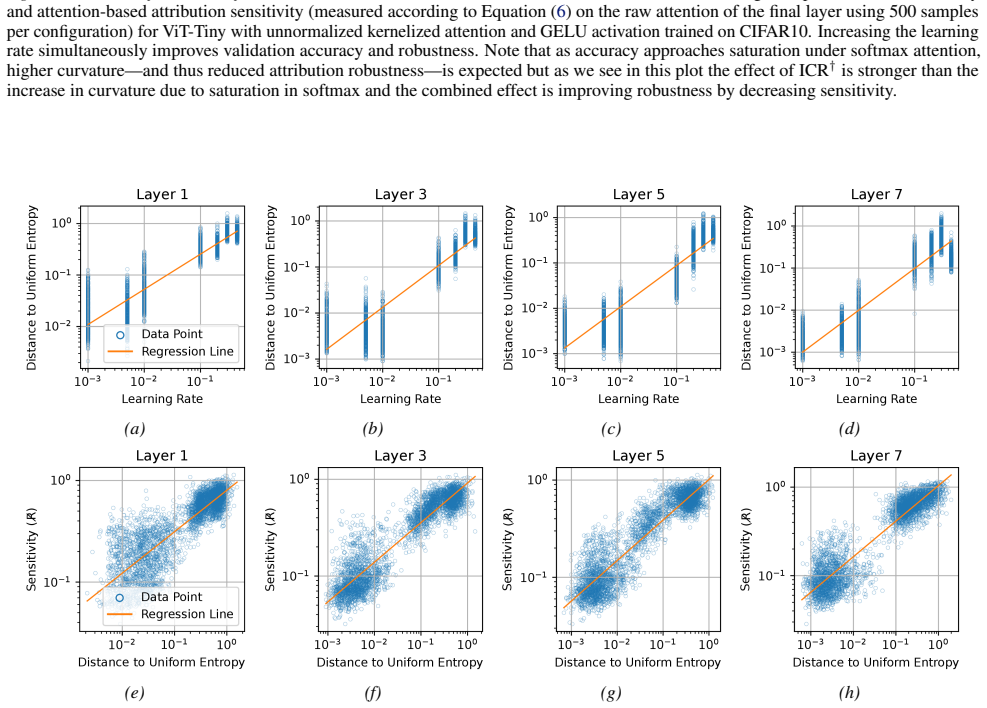
Attribution robustness can arise implicitly from the learning dynamics of standard stochastic gradient descent. This is motivated theoretically by connections between parameter-space and input-space curvature. The effect is validated across architectures, datasets, and attribution methods with negligible computational overhead. Such robustness gains do not transfer to attention-based attribution under softmax normalization due to inherent entropy constraints, but replacing softmax attention with kernel-based attention restores the robustness gains in transformer models.
Load-bearing premise
The curvature relationship between parameter space and input space during SGD training generates attribution robustness without needing explicit regularization terms.
Editorial extensions
If this is right
- Attribution methods obtain robustness gains automatically from standard training without dedicated regularization.
- The robustness effect applies across varied architectures, datasets, and attribution techniques at near-zero extra cost.
- Softmax attention prevents the robustness transfer in transformers because of entropy constraints.
- Kernel attention allows the implicit robustness to appear in transformer models.
Reading between the lines
- Optimizers or training schedules that deliberately shape curvature may amplify or suppress the robustness effect.
- Entropy constraints could limit robustness in other normalized components of neural networks beyond attention layers.
- Model designers prioritizing attribution robustness may prefer kernel attention over softmax in transformers.
Editorial analysis
A structured set of objections, weighed in public.
Referee Report
Summary. The paper claims that adversarial robustness of model attributions arises implicitly from the learning dynamics of standard SGD, motivated theoretically by connections between parameter-space and input-space curvature. It reports empirical validation across architectures, datasets, and attribution methods with negligible overhead, proves that the gains fail to transfer to softmax-normalized attention due to entropy constraints, and shows that kernel-based attention restores the robustness in transformers.
Significance. If the curvature-based theoretical link and the reported validations hold without hidden assumptions, the work would provide a practical, zero-overhead mechanism for robust explainability and identify a fundamental architectural limitation in attention mechanisms. This would be a notable contribution to the intersection of optimization dynamics and interpretability.
major comments (2)
- [Abstract / Theoretical Motivation] Abstract and theoretical motivation section: the asserted connection between SGD-induced parameter-space curvature and input-space curvature relevant to attribution robustness (e.g., for Integrated Gradients or Saliency) is presented without an explicit derivation or mapping (via chain rule, Hessian-vector products, or attribution-specific sensitivity). If this link only holds under additional assumptions on the loss landscape or gradient bounds not guaranteed in standard training, the implicit-regularization explanation is not load-bearing.
- [Proof on attention limitation] Proof regarding softmax attention: the claim that robustness gains 'often does not transfer' due to entropy constraints requires the specific proof to be checked for whether it applies to all common attention-based attribution formulations or only under particular normalization choices; the experimental contrast should quantify the entropy effect directly.
minor comments (1)
- [Abstract] The abstract states 'we prove that such robustness gains often does not transfer'; the grammar should be corrected to 'do not transfer'.
Simulated Author's Rebuttal
We thank the referee for the constructive comments on our manuscript. We address each major point below and are prepared to revise the paper to strengthen the presentation where needed.
read point-by-point responses
-
Referee: [Abstract / Theoretical Motivation] Abstract and theoretical motivation section: the asserted connection between SGD-induced parameter-space curvature and input-space curvature relevant to attribution robustness (e.g., for Integrated Gradients or Saliency) is presented without an explicit derivation or mapping (via chain rule, Hessian-vector products, or attribution-specific sensitivity). If this link only holds under additional assumptions on the loss landscape or gradient bounds not guaranteed in standard training, the implicit-regularization explanation is not load-bearing.
Authors: We agree that the abstract and motivation section would benefit from a more explicit derivation of the parameter-to-input curvature link. While the full theoretical development in the paper connects SGD dynamics to input-space sensitivity via the chain rule on the loss gradient (with Hessian-vector products implicit in the curvature analysis), we will add a concise derivation paragraph in the motivation section that explicitly maps parameter-space curvature to attribution robustness measures. This will also state the mild assumptions (standard bounded gradients and Lipschitz continuity of the network, which hold in our empirical regimes) to make the implicit-regularization argument load-bearing. revision: yes
-
Referee: [Proof on attention limitation] Proof regarding softmax attention: the claim that robustness gains 'often does not transfer' due to entropy constraints requires the specific proof to be checked for whether it applies to all common attention-based attribution formulations or only under particular normalization choices; the experimental contrast should quantify the entropy effect directly.
Authors: The proof targets the standard softmax attention used in common transformer attribution pipelines (e.g., those based on attention weights or gradients through softmax). We will revise the proof statement to explicitly delineate its scope to normalized softmax formulations and note that it does not cover non-normalized or alternative attention variants. Additionally, we will augment the experimental section with direct quantification of the entropy effect by reporting attention entropy values across training and their correlation with attribution robustness scores, providing empirical support for the constraint. revision: partial
Circularity Check
No significant circularity; derivation self-contained via independent curvature motivation and experimental validation
full rationale
The paper's central claim is that attribution robustness emerges implicitly from standard SGD learning dynamics, motivated by a theoretical connection between parameter-space and input-space curvature, with experimental validation across architectures and methods. No load-bearing steps reduce by construction to fitted inputs, self-definitions, or self-citation chains; the abstract and described claims present the curvature link as an external theoretical motivation rather than a renaming or ansatz smuggled from prior self-work. The result is framed as arising from plain training dynamics with negligible overhead, independent of its own outputs.
Assumptions & free parameters
assumptions (1)
- domain assumption Connections between parameter-space curvature and input-space curvature during SGD training confer attribution robustness
Cite this review
Pith. "Pith review of Improving Adversarial Robustness of Attribution via Implicit Regularization." pith.science (2026). https://pith.science/paper/7VMGK4GA
@misc{pith2026260529983,
  author       = {Pith},
  title        = {Pith review of: Improving Adversarial Robustness of Attribution via Implicit Regularization},
  year         = {2026},
  howpublished = {\url{https://pith.science/paper/7VMGK4GA}},
  note         = {Machine review of arXiv:2605.29983}
}
read the original abstract
The adversarial robustness of attributions is a fundamental requirement for reliable explainability in deep learning, yet existing approaches typically rely on computationally expensive explicit regularization. In this work, we show that attribution robustness can arise implicitly from the learning dynamics of standard stochastic gradient descent. We theoretically motivate this effect through connections between parameter-space and input-space curvature, and validate it across architectures, datasets, and attribution methods, with negligible computational overhead. In contrast, we prove that such robustness gains often does not transfer to attention-based attribution under softmax normalization, due to inherent entropy constraints, and we validate this limitation experimentally. Finally, we show that replacing softmax attention with kernel-based attention restores the robustness gains in transformer models. Our results highlight learning dynamics as a principled and practical mechanism for robust explainability, and reveal fundamental limitations of attention-based attribution under normalization.
Figures


Figures from the paper (19 more)




Reference graph
Works this paper leans on
-
[1]
Li, X., Du, M., Chen, J., Chai, Y ., Lakkaraju, H., and Xiong, H
URL https://proceedings.mlr.press/ v202/lee23q.html. Li, X., Du, M., Chen, J., Chai, Y ., Lakkaraju, H., and Xiong, H. M4: A unified xai benchmark for faithfulness evalua- tion of feature attribution methods across metrics, modal- ities, and models. 2023. Li, X., Xu, Z.-Q. J., and Zhang, Z. Loss Spike in Training Neural Networks.Journal of Computational M...
-
[2]
arXiv:2305.05392 [cs]. Wu, B., Xu, C., Dai, X., Wan, A., Zhang, P., Yan, Z., Tomizuka, M., Gonzalez, J., Keutzer, K., and Vajda, P. Visual Transformers: Token-based Image Representa- tion and Processing for Computer Vision.arXiv preprint arXiv:2006.03677, 2020. Wu, L. and Su, W. J. The Implicit Regularization of Dynam- ical Stability in Stochastic Gradien...
Reviewed June 29, 2026 · model on record in the stance chip above.
Discussion (0). Continue with ORCID to comment.