An archival summary: 15 years of ALMA observations on disks and planet formation
Pith reviewed 2026-06-29 00:26 UTC · model grok-4.3
The pith
ALMA has observed 3933 independent coordinates in the disks and planet formation category as of early 2026.
A machine-rendered reading of the paper's core claim, the machinery that carries it, and where it could break.
Core claim
As of the beginning of February 2026, ALMA had observed 3933 independent coordinates in the Disks and planet formation scientific category. These observations are analyzed according to their location in the sky, frequency coverage, exposure time, spectral line coverage, and angular resolution.
What carries the argument
The archival compilation and parameter breakdown of all ALMA pointings assigned to the 'Disks and planet formation' category.
If this is right
- New studies of disk evolution and planet formation can draw on the full existing ALMA archive rather than requiring fresh observations.
- The tabulated properties allow efficient selection of data subsets with required frequency coverage or angular resolution.
- Emphasis on nearby star-forming regions focuses attention on the best-resolved disks for detailed planet-formation research.
Where Pith is reading between the lines
- Observing proposals could use the summary to avoid redundant coverage of already-observed fields.
- Cross-matching the 3933 coordinates with optical or infrared catalogs could identify which disks have multi-wavelength follow-up already available.
Load-bearing premise
The 3933 count accurately captures all independent observations assigned to the 'Disks and planet formation' scientific category without omissions, double-counting, or misclassification of targets.
What would settle it
A complete re-examination of ALMA proposal and execution data showing that the true number of unique coordinates in this category differs by more than a few percent from 3933.
Figures

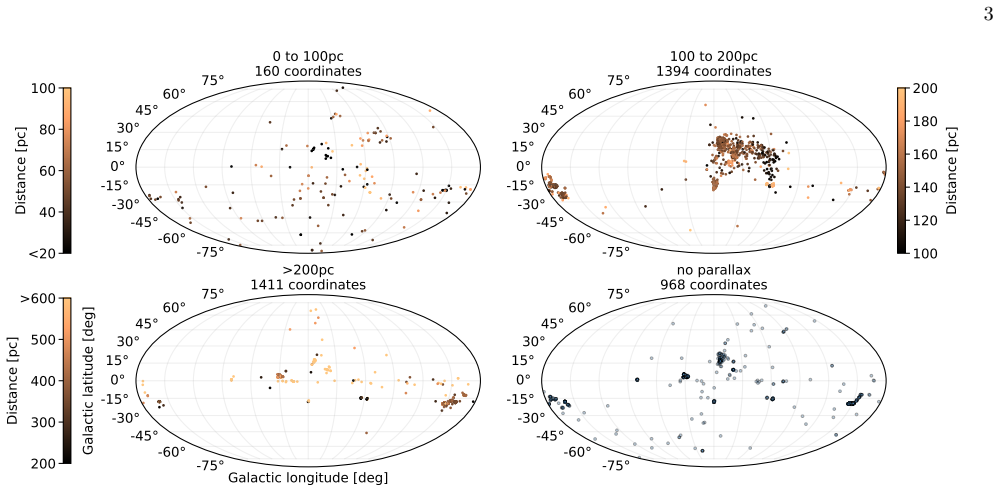
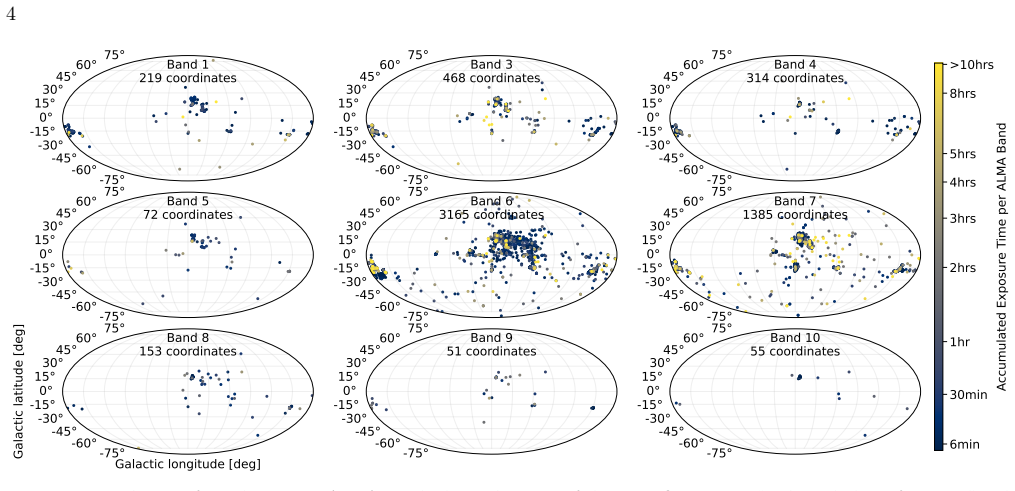
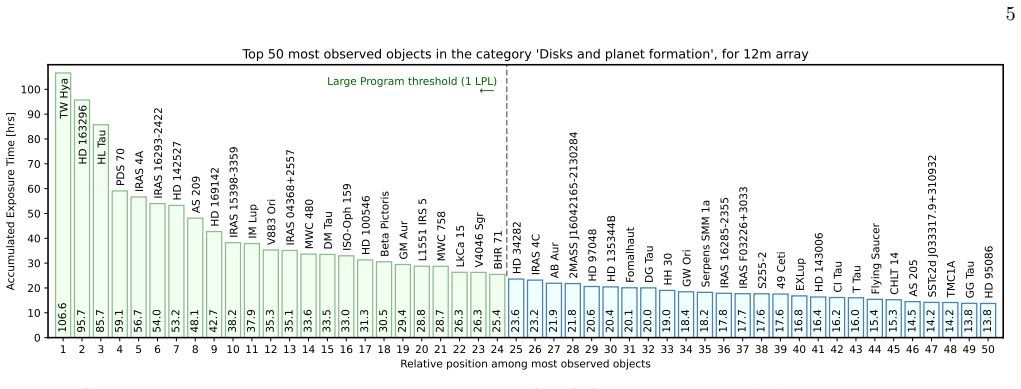


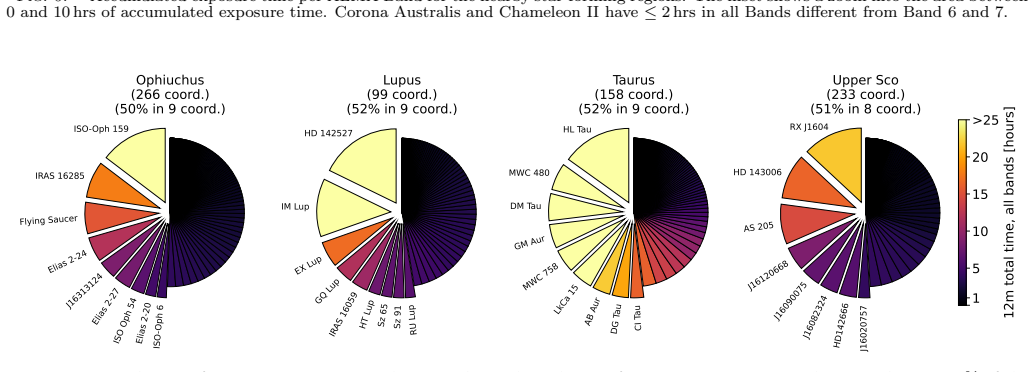


read the original abstract
The Atacama Large (sub-)millimeter Array (ALMA) has been in scientific operations for almost 15 years. We celebrate this achievement by providing a summary of the ``Disks and planet formation'' scientific category, with an emphasis on the disks located in the nearby star-forming regions. As of the beginning of February 2026, ALMA had observed 3933 independent coordinates, which we analyzed by their location in the sky, frequency coverage, exposure time, spectral line coverage, and angular resolution. We encourage the community to explore new scientific questions that are made possible through the archival datasets.
Editorial analysis
A structured set of objections, weighed in public.
Referee Report
Summary. The manuscript is an archival summary of ALMA observations in the 'Disks and planet formation' scientific category over nearly 15 years of operations. It reports that as of the beginning of February 2026, ALMA had observed 3933 independent coordinates in this category. These are analyzed by sky location, frequency coverage, exposure time, spectral line coverage, and angular resolution, with emphasis on disks in nearby star-forming regions, and the authors encourage community use of the archival data for new questions.
Significance. If the reported count and derived statistics are accurate, the paper provides a useful reference resource that can help researchers identify and explore existing ALMA datasets in this field. Its value is primarily practical rather than theoretical, as it contains no new physical models, predictions, or statistical inferences.
major comments (1)
- [Abstract and data selection section] Abstract and § on data selection (implied by the count claim): the central factual claim of exactly 3933 independent coordinates depends on the archive query, category assignment, deduplication of coordinates, and exclusion criteria. Without an explicit description of the query parameters, date range, handling of multiple executions on the same target, or verification steps, the number cannot be independently reproduced or checked for omissions or misclassifications.
minor comments (2)
- [Results section] The manuscript should include at least one table or figure summarizing the breakdown by frequency band or spectral line to make the 'spectral line coverage' analysis concrete.
- [Methods] Clarify the definition of 'independent coordinates' early in the text (e.g., unique (RA, Dec) pairs after merging overlapping pointings).
Simulated Author's Rebuttal
We thank the referee for their review and recommendation of minor revision. The manuscript aims to serve as a practical archival reference, and we agree that improving the transparency of the data selection process will strengthen its utility. We address the single major comment below.
read point-by-point responses
-
Referee: [Abstract and data selection section] Abstract and § on data selection (implied by the count claim): the central factual claim of exactly 3933 independent coordinates depends on the archive query, category assignment, deduplication of coordinates, and exclusion criteria. Without an explicit description of the query parameters, date range, handling of multiple executions on the same target, or verification steps, the number cannot be independently reproduced or checked for omissions or misclassifications.
Authors: We agree that the central count of 3933 requires explicit documentation for reproducibility. The revised manuscript will add a dedicated subsection under Data Selection that specifies: (1) the precise ALMA Science Archive query parameters (including scientific category filter for 'Disks and planet formation', sky coordinates, and date range up to the beginning of February 2026); (2) the method for assigning and filtering by category; (3) the deduplication algorithm for independent coordinates (including angular separation threshold); (4) handling of multiple executions, projects, or scheduling blocks on the same target; and (5) any verification steps or cross-checks performed against the archive. This addition will allow independent reproduction of the reported statistics. revision: yes
Circularity Check
No significant circularity; purely descriptive archival summary
full rationale
The paper is an archival data summary whose central claim is a factual count (3933 independent coordinates) of ALMA observations in one science category, plus descriptive statistics on sky position, frequency coverage, exposure time, spectral lines, and resolution. No derivations, predictions, fitted parameters, or theoretical models are present. The work contains no equations, no self-citation chains, and no load-bearing steps that reduce to inputs by construction. The only potential failure mode is the accuracy of the external archive query itself, which is independent of any internal circularity. This is a standard honest non-finding for a descriptive catalog paper.
Axiom & Free-Parameter Ledger
Reference graph
Works this paper leans on
-
[1]
Agurto-Gangas, C., P´ erez, L. M., Sierra, A., et al. 2025, ApJ, 989, 4, doi:10.3847/1538-4357/adc7ab
-
[2]
Akeson, R. L., & Jensen, E. L. N. 2014, ApJ, 784, 62, doi:10.1088/0004-637X/784/1/62
-
[3]
Akeson, R. L., Jensen, E. L. N., Carpenter, J., et al. 2019, ApJ, 872, 158, doi:10.3847/1538-4357/aaff6a ALMA Partnership, Brogan, C. L., P´ erez, L. M., et al. 2015, ApJ, 808, L3, doi:10.1088/2041-8205/808/1/L3
-
[4]
Alves, F. O., Cleeves, L. I., Girart, J. M., et al. 2020, ApJ, 904, L6, doi:10.3847/2041-8213/abc550
-
[5]
Andrews, S. M. 2020, ARA&A, 58, 483, doi:10.1146/annurev-astro-031220-010302
-
[6]
Andrews, S. M., Rosenfeld, K. A., Kraus, A. L., & Wilner, D. J. 2013, ApJ, 771, 129, doi:10.1088/0004-637X/771/2/129
-
[7]
22 Demographics of planet-forming disks Antonio Garufi et al
Andrews, S. M., Wilner, D. J., Zhu, Z., et al. 2016, ApJ, 820, L40, doi:10.3847/2041-8205/820/2/L40
-
[8]
Andrews, S. M., Huang, J., P´ erez, L. M., et al. 2018, ApJ, 869, L41, doi:10.3847/2041-8213/aaf741
work page internal anchor Pith review doi:10.3847/2041-8213/aaf741 2018
-
[9]
Anglada, G., Amado, P. J., Ortiz, J. L., et al. 2017, ApJ, 850, L6, doi:10.3847/2041-8213/aa978b
-
[10]
Ansdell, M., Williams, J. P., van der Marel, N., et al. 2016, ApJ, 828, 46, doi:10.3847/0004-637X/828/1/46
-
[11]
Ansdell, M., Williams, J. P., Trapman, L., et al. 2018, ApJ, 859, 21, doi:10.3847/1538-4357/aab890
-
[12]
Apai, D., Lagerstrom, J., Reid, I. N., et al. 2010, PASP, 122, 808, doi:10.1086/654851
-
[13]
Protostars and Planets VII , year = 2023, editor =
Bae, J., Isella, A., Zhu, Z., et al. 2023, in Astronomical Society of the Pacific Conference Series, Vol. 534, Protostars and Planets VII, ed. S. Inutsuka, Y. Aikawa, T. Muto, K. Tomida, & M. Tamura, 423, doi:10.48550/arXiv.2210.13314
-
[14]
Bae, J., Teague, R., Andrews, S. M., et al. 2022, ApJ, 934, L20, doi:10.3847/2041-8213/ac7fa3
-
[15]
Barenfeld, S. A., Carpenter, J. M., Ricci, L., & Isella, A. 2016, ApJ, 827, 142, doi:10.3847/0004-637X/827/2/142
-
[16]
2021, ApJ, 916, L2, doi:10.3847/2041-8213/ac0f83
Benisty, M., Bae, J., Facchini, S., et al. 2021, ApJ, 916, L2, doi:10.3847/2041-8213/ac0f83
-
[17]
Bergez-Casalou, C., Bitsch, B., Kurtovic, N. T., & Pinilla, P. 2022, A&A, 659, A6, doi:10.1051/0004-6361/202142490
-
[18]
Mulders, G. D. 2026, A&A, 708, A143, doi:10.1051/0004-6361/202556059
-
[19]
Burton, K., MacGregor, M. A., Osten, R. A., et al. 2025, ApJ, 982, 43, doi:10.3847/1538-4357/ada5f2
-
[20]
Carpenter, J. M., Corvill´ on, A., Meyer, J. D., et al. 2022, PASP, 134, 045001, doi:10.1088/1538-3873/ac5b89
-
[21]
M., Corvill´ on, A., & Shah, N
Carpenter, J. M., Corvill´ on, A., & Shah, N. B. 2025a, PASP, 137, 034501, doi:10.1088/1538-3873/adb5c1
-
[22]
Carpenter, J. M., Esplin, T. L., Luhman, K. L., Mamajek, E. E., & Andrews, S. M. 2025b, ApJ, 978, 117, doi:10.3847/1538-4357/ad8ebc
-
[23]
Carpenter, J. M., Ricci, L., & Isella, A. 2014, ApJ, 787, 42, doi:10.1088/0004-637X/787/1/42 Carrasco-Gonz´ alez, C., Sierra, A., Flock, M., et al. 2019, ApJ, 883, 71, doi:10.3847/1538-4357/ab3d33
-
[24]
The Astrophysical Journal Letters , abstract =
Casassus, S., C´ arcamo, M., Hales, A., Weber, P., & Dent, B. 2022, ApJ, 933, L4, doi:10.3847/2041-8213/ac75e8
-
[25]
2019, ApJ, 883, L41, doi:10.3847/2041-8213/ab4425
Casassus, S., & P´ erez, S. 2019, ApJ, 883, L41, doi:10.3847/2041-8213/ab4425
-
[26]
, archivePrefix = "arXiv", eprint =
Casassus, S., van der Plas, G. M., Perez, S., et al. 2013, Nature, 493, 191, doi:10.1038/nature11769
-
[27]
2021, MNRAS, 507, 3789, doi:10.1093/mnras/stab2359
Casassus, S., Christiaens, V., C´ arcamo, M., et al. 2021, MNRAS, 507, 3789, doi:10.1093/mnras/stab2359
-
[28]
Cazzoletti, P., Manara, C. F., Liu, H. B., et al. 2019, A&A, 626, A11, doi:10.1051/0004-6361/201935273
-
[29]
Cieza, L. A., Ru´ ız-Rodr´ ıguez, D., Hales, A., et al. 2019, MNRAS, 482, 698, doi:10.1093/mnras/sty2653
-
[30]
doi:10.1093/mnras/staa3787 , eprint =
Cieza, L. A., Gonz´ alez-Ruilova, C., Hales, A. S., et al. 2021, MNRAS, 501, 2934, doi:10.1093/mnras/staa3787
-
[31]
Cleeves, L. I., ¨Oberg, K. I., Wilner, D. J., et al. 2018, ApJ, 865, 155, doi:10.3847/1538-4357/aade96
-
[32]
C., Asaki, Y., Cerrigone, L., et al
Cortes, P. C., Asaki, Y., Cerrigone, L., et al. 2026, ALMA Technical Handbook
2026
-
[33]
Curone, P., Facchini, S., Andrews, S. M., et al. 2025, ApJ, 984, L9, doi:10.3847/2041-8213/adc438
-
[34]
Das, S., Kurtovic, N. T., & Flock, M. 2024, A&A, 689, A104, doi:10.1051/0004-6361/202450278
-
[35]
A., Gonz´ alez-Ruilova, C., et al
Dasgupta, A., Cieza, L. A., Gonz´ alez-Ruilova, C., et al. 2025, ApJ, 981, L4, doi:10.3847/2041-8213/adb03c
-
[36]
2025, ApJ, 989, 3, doi:10.3847/1538-4357/add43a
Deng, D., Vioque, M., Pascucci, I., et al. 2025, ApJ, 989, 3, doi:10.3847/1538-4357/add43a
-
[37]
2024, A&A, 688, A149, doi:10.1051/0004-6361/202348555
Derkink, A., Ginski, C., Pinilla, P., et al. 2024, A&A, 688, A149, doi:10.1051/0004-6361/202348555
-
[38]
2018, ApJ, 860, 124, doi:10.3847/1538-4357/aac6cb Donovan Meyer, J., Corvill´ on, A., Carpenter, J
Dong, R., Liu, S.-y., Eisner, J., et al. 2018, ApJ, 860, 124, doi:10.3847/1538-4357/aac6cb Donovan Meyer, J., Corvill´ on, A., Carpenter, J. M., et al. 2022, in Bulletin of the American Astronomical Society, Vol. 54, 043, doi:10.3847/25c2cfeb.4ece85d4
-
[39]
Escoffier, R. P., Comoretto, G., Webber, J. C., et al. 2007, A&A, 462, 801, doi:10.1051/0004-6361:20054519 ESO. 2025, ESO Annual Report 2024, Tech. rep., European Southern Observatory.https: //www.eso.org/public/products/annualreports/ar_2024/
-
[40]
2026, ApJ, 998, L16, doi:10.3847/2041-8213/ae3c0a
Facchini, S., Curone, P., Benisty, M., et al. 2026, ApJ, 998, L16, doi:10.3847/2041-8213/ae3c0a
-
[41]
Facchini, S., van Dishoeck, E. F., Manara, C. F., et al. 2019, A&A, 626, L2, doi:10.1051/0004-6361/201935496
-
[42]
Facchini, S., Benisty, M., Bae, J., et al. 2020, A&A, 639, A121, doi:10.1051/0004-6361/202038027
-
[43]
2018, A&A, 610, A24, doi:10.1051/0004-6361/201731978
Fedele, D., Tazzari, M., Booth, R., et al. 2018, A&A, 610, A24, doi:10.1051/0004-6361/201731978
-
[44]
Gas dynamics around dust asymmetries in turbulent disks
Flores-Rivera, L., Manger, N., Lambrechts, M., et al. 2026, arXiv e-prints, arXiv:2603.24184, doi:10.48550/arXiv.2603.24184
work page internal anchor Pith review Pith/arXiv arXiv doi:10.48550/arxiv.2603.24184 2026
-
[45]
2020, ApJ, 892, 111, doi:10.3847/1538-4357/ab7b63
Francis, L., & van der Marel, N. 2020, ApJ, 892, 111, doi:10.3847/1538-4357/ab7b63
-
[46]
Gasman, D., Temmink, M., van Dishoeck, E. F., et al. 2025, A&A, 694, A147, doi:10.1051/0004-6361/202452152 Gonz´ alez-Ruilova, C., Cieza, L. A., Hales, A. S., et al. 2020, ApJ, 902, L33, doi:10.3847/2041-8213/abbcce
-
[47]
M., van der Marel, N., Williams, J
Guerra-Alvarado, O. M., van der Marel, N., Williams, J. P., et al. 2025, A&A, 696, A232, doi:10.1051/0004-6361/202453338 Guzm´ an, V. V., Huang, J., Andrews, S. M., et al. 2018, ApJ, 869, L48, doi:10.3847/2041-8213/aaedae
-
[48]
Hammond, I., Christiaens, V., Price, D. J., et al. 2023, MNRAS, 522, L51, doi:10.1093/mnrasl/slad027
-
[49]
2026, A&A, 705, A196, doi:10.1051/0004-6361/202556450
Han, Y., Mansell, E., Jennings, J., et al. 2026, A&A, 705, A196, doi:10.1051/0004-6361/202556450
-
[50]
Harsono, D., Long, F., Pinilla, P., et al. 2024, ApJ, 961, 28, doi:10.3847/1538-4357/ad0835
-
[51]
2021a, AJ, 161, 264, doi:10.3847/1538-3881/abf431
Hashimoto, J., Dong, R., & Muto, T. 2021a, AJ, 161, 264, doi:10.3847/1538-3881/abf431
-
[52]
The Astrophysical Journal , keywords =
Hashimoto, J., Muto, T., Dong, R., et al. 2021b, ApJ, 911, 5, doi:10.3847/1538-4357/abe59f
-
[53]
P., Pinilla, P., Pascucci, I., et al
Hendler, N. P., Pinilla, P., Pascucci, I., et al. 2018, MNRAS, 475, L62, doi:10.1093/mnrasl/slx184
-
[54]
2024, ApJ, 976, 132, doi:10.3847/1538-4357/ad84df
Huang, J., Ansdell, M., Birnstiel, T., et al. 2024, ApJ, 976, 132, doi:10.3847/1538-4357/ad84df
-
[55]
arXiv , author =:1812.04041 , journal =
Huang, J., Andrews, S. M., Dullemond, C. P., et al. 2018a, ApJ, 869, L42, doi:10.3847/2041-8213/aaf740
-
[56]
Huang, J., Andrews, S. M., P´ erez, L. M., et al. 2018b, ApJ, 869, L43, doi:10.3847/2041-8213/aaf7a0
-
[57]
Huang, J., Andrews, S. M., Cleeves, L. I., et al. 2018c, ApJ, 852, 122, doi:10.3847/1538-4357/aaa1e7
-
[58]
arXiv , author =:2001.11040 , journal =
Huang, J., Andrews, S. M., Dullemond, C. P., et al. 2020, ApJ, 891, 48, doi:10.3847/1538-4357/ab711e
-
[59]
2025, ApJ, 988, 106, doi:10.3847/1538-4357/ade1d8
Huang, J., Aizawa, M., Bae, J., et al. 2025, ApJ, 988, 106, doi:10.3847/1538-4357/ade1d8
-
[60]
Hughes, A. G., Boley, A. C., Osten, R. A., & White, J. A. 2019, ApJ, 881, 33, doi:10.3847/1538-4357/ab2be7
-
[61]
D., Walsh, C., Jennings, J., et al
Ilee, J. D., Walsh, C., Jennings, J., et al. 2022, MNRAS, 515, L23, doi:10.1093/mnrasl/slac048
-
[62]
Isella, A., Guidi, G., Testi, L., et al. 2016, Phys. Rev. Lett., 117, 251101, doi:10.1103/PhysRevLett.117.251101
-
[63]
Isella, A., Huang, J., Andrews, S. M., et al. 2018, ApJ, 869, L49, doi:10.3847/2041-8213/aaf747
-
[64]
Izquierdo, A. F., Facchini, S., Rosotti, G. P., van Dishoeck, E. F., & Testi, L. 2022, ApJ, 928, 2, doi:10.3847/1538-4357/ac474d
-
[65]
D., Huang, J., Czekala, I., et al
Jiang, S. D., Huang, J., Czekala, I., et al. 2026, ApJ, 1000, 35, doi:10.3847/1538-4357/ae3e8c 25
-
[66]
Jorquera, S., Bonnefoy, M., P´ erez, L. M., et al. 2024, ApJ, 976, 42, doi:10.3847/1538-4357/ad6e84
-
[67]
D., Hashimoto, J., Muto, T., et al
Kanagawa, K. D., Hashimoto, J., Muto, T., et al. 2021, ApJ, 909, 212, doi:10.3847/1538-4357/abdfc5
-
[68]
H., Qi, C., Dickson-Vandervelde, D
Kastner, J. H., Qi, C., Dickson-Vandervelde, D. A., et al. 2018, ApJ, 863, 106, doi:10.3847/1538-4357/aacff7
-
[69]
2017, ApJ, 844, L5, doi:10.3847/2041-8213/aa7e33
Kataoka, A., Tsukagoshi, T., Pohl, A., et al. 2017, ApJ, 844, L5, doi:10.3847/2041-8213/aa7e33
-
[70]
M., Matr` a, L., Facchini, S., et al
Kennedy, G. M., Matr` a, L., Facchini, S., et al. 2019, Nature Astronomy, 3, 230, doi:10.1038/s41550-018-0667-x
-
[71]
2018, A&A, 617, A44, doi:10.1051/0004-6361/201832957
Keppler, M., Benisty, M., M¨ uller, A., et al. 2018, A&A, 617, A44, doi:10.1051/0004-6361/201832957
-
[72]
2019, A&A, 625, A118, doi:10.1051/0004-6361/201935034
Keppler, M., Teague, R., Bae, J., et al. 2019, A&A, 625, A118, doi:10.1051/0004-6361/201935034
-
[73]
2020, ApJ, 888, 72, doi:10.3847/1538-4357/ab5d2b
Kim, S., Takahashi, S., Nomura, H., et al. 2020, ApJ, 888, 72, doi:10.3847/1538-4357/ab5d2b
-
[74]
2024, The Journal of Open Source Software, 9, 4942, doi:10.21105/joss.04942
Kurtovic, N. 2024, The Journal of Open Source Software, 9, 4942, doi:10.21105/joss.04942
-
[75]
Kurtovic, N. T., P´ erez, L. M., Benisty, M., et al. 2018, ApJ, 869, L44, doi:10.3847/2041-8213/aaf746
-
[76]
T., Pinilla, P., Long, F., et al
Kurtovic, N. T., Pinilla, P., Long, F., et al. 2021, A&A, 645, A139, doi:10.1051/0004-6361/202038983
-
[77]
Kurtovic, N. T., Pinilla, P., Penzlin, A. B. T., et al. 2022, A&A, 664, A151, doi:10.1051/0004-6361/202243505
-
[78]
T., Facchini, S., Benisty, M., et al
Kurtovic, N. T., Facchini, S., Benisty, M., et al. 2024, A&A, 692, A155, doi:10.1051/0004-6361/202347583
-
[79]
Law, C. J., Loomis, R. A., Teague, R., et al. 2021, ApJS, 257, 3, doi:10.3847/1538-4365/ac1434
-
[80]
Li, J., Close, L. M., Long, F., et al. 2025, ApJ, 990, L70, doi:10.3847/2041-8213/adfcbd
discussion (0)
Sign in with ORCID, Apple, or X to comment. Anyone can read and Pith papers without signing in.