The Shape of (486958) Arrokoth
Pith reviewed 2026-06-29 00:23 UTC · model grok-4.3
The pith
A new shape model of Arrokoth finds it thicker overall, with the larger lobe flattened and smaller lobe spherical at a 2:1 volume ratio.
A machine-rendered reading of the paper's core claim, the machinery that carries it, and where it could break.
Core claim
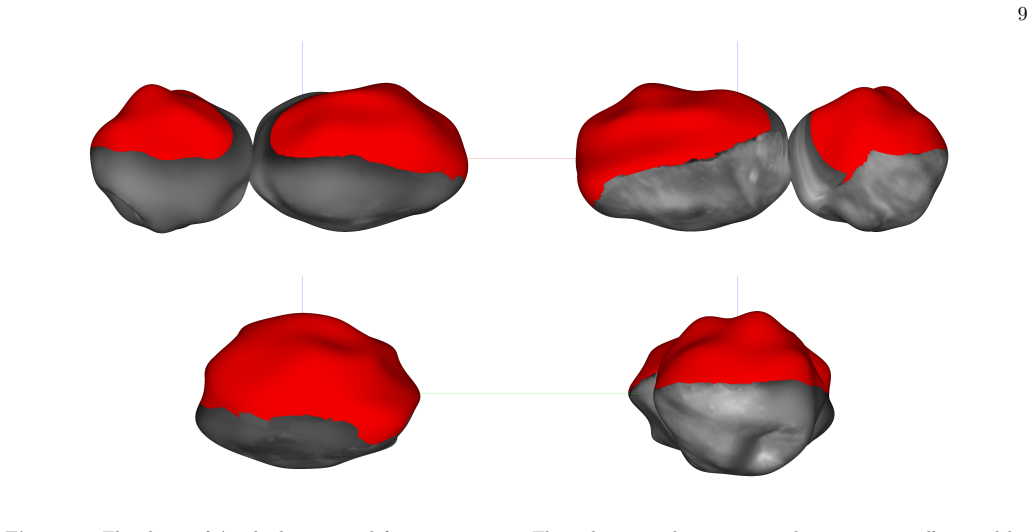
The updated shape model of (486958) Arrokoth, obtained by fitting the full set of resolved LORRI images with a GPU-accelerated algorithm, is significantly thicker and larger in volume than the prior model. The smaller lobe Weeyo is roughly spherical, the larger lobe Wenu is more flattened, and their volume ratio is approximately 2:1.
What carries the argument
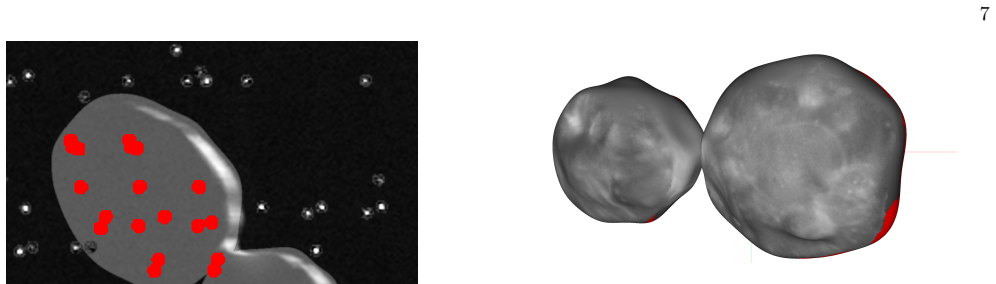
GPU-accelerated shape modeling algorithm that simultaneously fits the contact binary shape and rotational pole to the complete LORRI image set.
If this is right
- Arrokoth's rotational lightcurve would show significantly lower mean reflectance when viewed from subobserver latitudes that produce lightcurve variation.
- This revised shape may change estimates of how frequently contact binaries occur among Kuiper Belt objects.
- The shape details provide new constraints on Arrokoth's formation, especially in relation to the Streaming Instability mechanism.
Where Pith is reading between the lines
- If the new thickness holds, it could imply that similar objects formed with more material or experienced less compaction than previously modeled.
- Independent verification using different image processing or additional flyby data would strengthen or refute the volume ratio.
- The altered lightcurve prediction might require re-examination of ground-based observations of other candidate contact binaries.
Load-bearing premise
The GPU-accelerated algorithm accurately recovers the true shape and pole without systematic errors from the image data or fitting process.
What would settle it
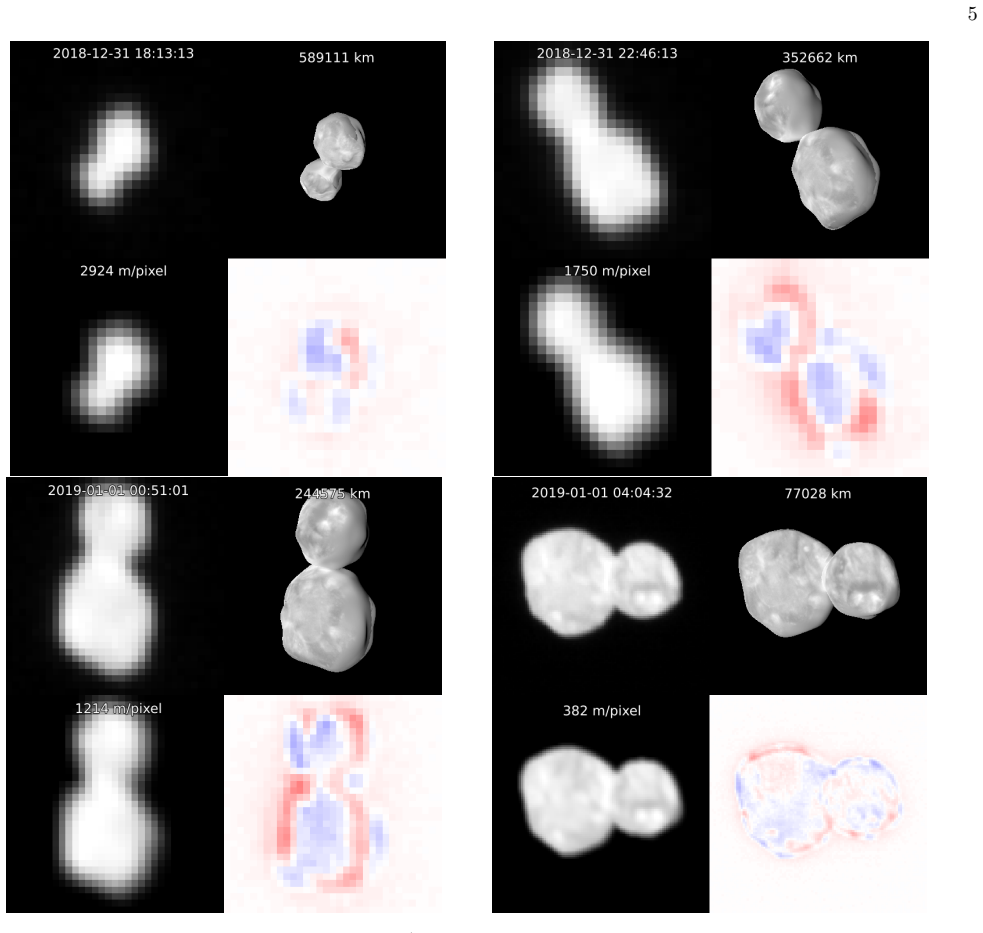
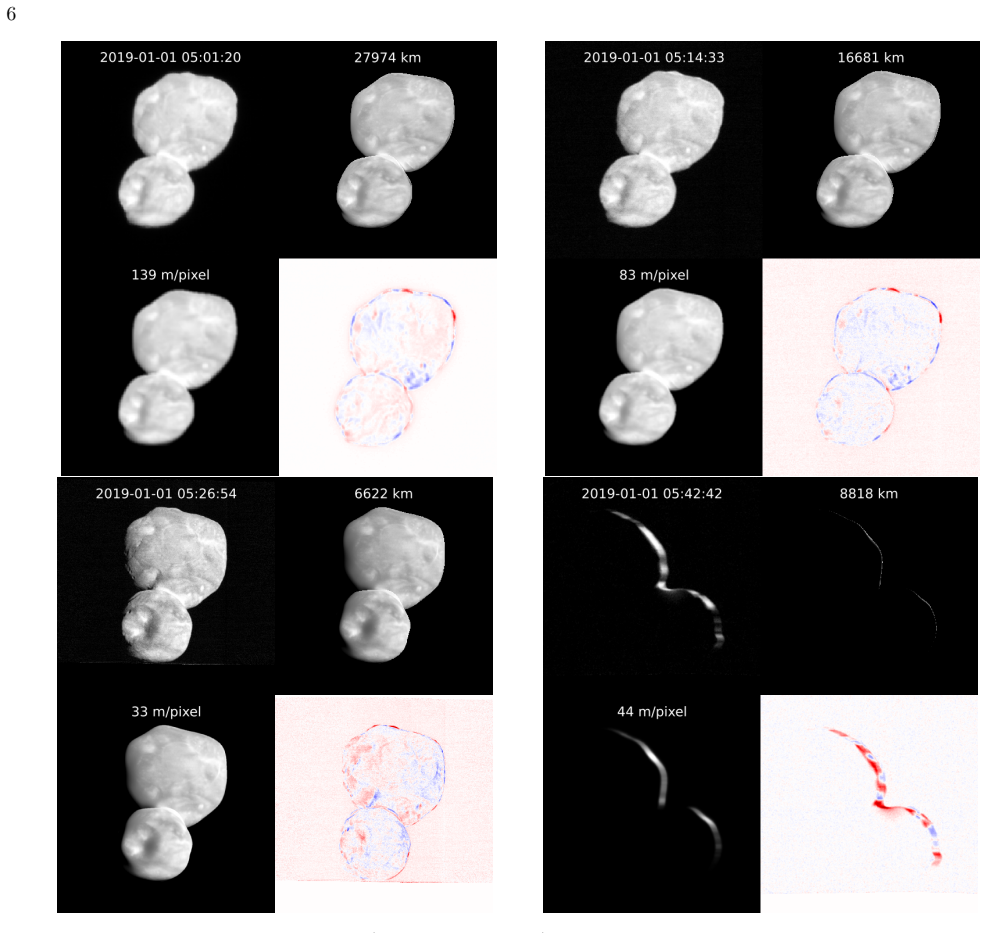
A comparison showing that the new model's rendered images match the observed LORRI data better than the old model, or a measurement of Arrokoth's actual volume from an independent technique such as occultation timing.
Figures


read the original abstract
Here we present an updated shape model of (486958) Arrokoth, the bilobate Kuiper Belt Object (KBO) which the NASA New Horizons spacecraft flew past in 2019. This updated shape model uses all of the resolved images of Arrokoth obtained by the New Horizons LOng Range Reconnaissance Imager (LORRI). We developed an updated shape modeling algorithm which allowed the shape and rotational pole of Arrokoth to be fit to much better quality with an efficient use of GPU-accelerated features. The resulting model of Arrokoth's contact binary shape is significantly thicker and of larger volume than the one previously published immediately after the flyby by Spencer et al (2020). We show that Arrokoth's smaller lobe Weeyo is roughly spherical in shape, while the larger lobe Wenu is more flattened, with the volume ratio between the lobes being roughly 2:1. Owing to Wenu's oblate shape, Arrokoth's rotational lightcurve would have significantly lower mean reflectance when viewed from subobserver latitudes that would have shown lightcurve variation. We discuss the impact this may have on estimates of the frequency of contact binaries in the Kuiper Belt. We also discuss the implications of this shape for the formation of Arrokoth, particularly in the context of the Streaming Instability.
Editorial analysis
A structured set of objections, weighed in public.
Referee Report
Summary. The paper presents an updated shape model of the bilobate KBO Arrokoth derived from all resolved LORRI images obtained during the New Horizons flyby. A new GPU-accelerated algorithm is used to simultaneously fit the contact-binary shape and rotational pole, yielding a model that is significantly thicker and larger in volume than the Spencer et al. (2020) model. The smaller lobe Weeyo is described as roughly spherical, the larger lobe Wenu as more oblate, and the lobe volume ratio as approximately 2:1. Implications are discussed for rotational lightcurves, the observed frequency of contact binaries, and formation via streaming instability.
Significance. If the revised dimensions hold, the result would alter interpretations of Arrokoth's formation and the prevalence of contact binaries in the Kuiper Belt, while the GPU-accelerated fitting method constitutes a reusable technical advance for spacecraft image analysis. The use of the complete LORRI dataset is a clear strength relative to prior work.
major comments (1)
- [Methods] Methods section (shape-modeling algorithm): the central claim of increased thickness and a 2:1 volume ratio rests on the new GPU-accelerated fitting procedure. The manuscript must supply validation tests (recovery of synthetic shapes, residual maps against the full LORRI dataset, or direct comparison with the Spencer et al. solution on identical data) to demonstrate that the reported geometry is not an artifact of regularization choices, priors, or convergence behavior.
minor comments (1)
- The abstract states that the new model fits 'to much better quality' but does not quantify the improvement (e.g., rms residuals or reduced chi-squared); these metrics should appear in the results section alongside the shape parameters.
Simulated Author's Rebuttal
We thank the referee for their constructive review and recommendation. We address the single major comment below and will revise the manuscript to incorporate the requested validation tests.
read point-by-point responses
-
Referee: [Methods] Methods section (shape-modeling algorithm): the central claim of increased thickness and a 2:1 volume ratio rests on the new GPU-accelerated fitting procedure. The manuscript must supply validation tests (recovery of synthetic shapes, residual maps against the full LORRI dataset, or direct comparison with the Spencer et al. solution on identical data) to demonstrate that the reported geometry is not an artifact of regularization choices, priors, or convergence behavior.
Authors: We agree that the central claims require explicit validation of the GPU-accelerated algorithm. The revised manuscript will add a new subsection to the Methods section that includes: (1) recovery tests using synthetic contact-binary shapes rendered into simulated LORRI images, (2) residual maps comparing the best-fit model to the complete LORRI dataset, and (3) a direct side-by-side comparison of our solution against the Spencer et al. (2020) model when both are fitted to identical data. These tests will quantify any effects from regularization, priors, or convergence and confirm that the reported increase in thickness and 2:1 volume ratio are robust. revision: yes
Circularity Check
No significant circularity in derivation chain
full rationale
The paper derives an updated shape model by fitting a new GPU-accelerated algorithm directly to the full set of resolved LORRI images, producing outputs (increased thickness, larger volume, ~2:1 lobe volume ratio, spherical Weeyo vs. flattened Wenu) that are compared against the independent prior result of Spencer et al. (2020). No self-definitional steps, fitted inputs renamed as predictions, load-bearing self-citations, or ansatzes smuggled via citation are present; the central claim rests on external image data and an independent baseline rather than reducing to its own inputs by construction.
Axiom & Free-Parameter Ledger
Reference graph
Works this paper leans on
-
[1]
Abod, C. P., Simon, J. B., Li, R., et al. 2019, ApJ, 883, 192, doi: 10.3847/1538-4357/ab40a3
-
[2]
Annex, A., Pearson, B., Seignovert, B., et al. 2021, AndrewAnnex/SpiceyPy: SpiceyPy 4.0.1, v4.0.1, Zenodo, doi: 10.5281/zenodo.4883901 Astropy Collaboration, Price-Whelan, A. M., Lim, P. L., et al. 2022, ApJ, 935, 167, doi: 10.3847/1538-4357/ac7c74
-
[3]
Benecchi, S. D., Noll, K. S., Grundy, W. M., et al. 2009, Icarus, 200, 292, doi: 10.1016/j.icarus.2008.10.025
-
[4]
Benecchi, S. D., Noll, K. S., Grundy, W. M., & Levison, H. F. 2010, Icarus, 207, 978, doi: 10.1016/j.icarus.2009.12.017
-
[5]
Benecchi, S. D., Noll, K. S., Stephens, D. C., Grundy, W. M., & Rawlins, J. 2011, Icarus, 213, 693, doi: 10.1016/j.icarus.2011.03.005
-
[6]
Benecchi, S. D., Porter, S. B., Buie, M. W., et al. 2019, Icarus, 334, 11, doi: 10.1016/j.icarus.2019.01.023
-
[7]
Buie, M. W., Porter, S. B., Tamblyn, P., et al. 2020, AJ, 159, 130, doi: 10.3847/1538-3881/ab6ced
-
[8]
Buie, M. W., Spencer, J. R., Porter, S. B., et al. 2024, PSJ, 5, 196, doi: 10.3847/PSJ/ad676d
-
[9]
2022, vispy/vispy: Version 0.11.0, v0.11.0, Zenodo, doi: 10.5281/zenodo.6795163
Campagnola, L., Larson, E., Klein, A., et al. 2022, vispy/vispy: Version 0.11.0, v0.11.0, Zenodo, doi: 10.5281/zenodo.6795163
-
[10]
Campbell, H. M., Anderson, K. E., & Kaib, N. A. 2025, Nature Astronomy, 9, 75, doi: 10.1038/s41550-024-02388-4
-
[11]
Carrera, D., Gorti, U., Johansen, A., & Davies, M. B. 2017, ApJ, 839, 16, doi: 10.3847/1538-4357/aa6932
-
[12]
Cheng, A. F., Weaver, H. A., Conard, S. J., et al. 2008, SSRv, 140, 189, doi: 10.1007/s11214-007-9271-6
-
[13]
Edgeworth, K. E. 1949, MNRAS, 109, 600, doi: 10.1093/mnras/109.5.600
-
[14]
Elliot, J. L., Kern, S. D., Clancy, K. B., et al. 2005, AJ, 129, 1117, doi: 10.1086/427395
-
[15]
Fountain, G. H., Kusnierkiewicz, D. Y., Hersman, C. B., et al. 2008, SSRv, 140, 23, doi: 10.1007/s11214-008-9374-8
-
[16]
Fraser, W. C., Bannister, M. T., Pike, R. E., et al. 2017, Nature Astronomy, 1, 0088, doi: 10.1038/s41550-017-0088
-
[17]
Fraser, W. C., Porter, S. B., Peltier, L., et al. 2024, PSJ, 5, 227, doi: 10.3847/PSJ/ad6f9e Gaia Collaboration, Brown, A. G. A., Vallenari, A., et al. 2018, A&A, 616, A1, doi: 10.1051/0004-6361/201833051 Gaia Collaboration, Vallenari, A., Brown, A. G. A., et al. 2023, A&A, 674, A1, doi: 10.1051/0004-6361/202243940
-
[18]
2002, Nature, 420, 643, doi: 10.1038/nature01227
Goldreich, P., Lithwick, Y., & Sari, R. 2002, Nature, 420, 643, doi: 10.1038/nature01227
-
[19]
Greenstreet, S., Gladman, B., McKinnon, W. B., Kavelaars, J. J., & Singer, K. N. 2019, ApJL, 872, L5, doi: 10.3847/2041-8213/ab01db
-
[20]
Grundy, W. M., Noll, K. S., Roe, H. G., et al. 2019, Icarus, 334, 62, doi: 10.1016/j.icarus.2019.03.035
-
[21]
Hapke, B. 1981, J. Geophys. Res., 86, 3039, doi: 10.1029/JB086iB04p03039 —. 1993, Theory of reflectance and emittance spectroscopy (Cambridge UP) —. 2012, Theory of Reflectance and Emittance Spectroscopy (Cambridge UP), doi: 10.1017/CBO9781139025683 14
-
[22]
Hofgartner, J. D., Buratti, B. J., Benecchi, S. D., et al. 2021, Icarus, 356, 113723, doi: 10.1016/j.icarus.2020.113723
-
[23]
Jewitt, D., & Luu, J. 1993, Nature, 362, 730, doi: 10.1038/362730a0
-
[24]
2012, A&A, 543, A97, doi: 10.1051/0004-6361/201219267
Kaasalainen, M., & Viikinkoski, M. 2012, A&A, 543, A97, doi: 10.1051/0004-6361/201219267
-
[25]
PyCUDA and PyOpenCL: A Scripting-Based Approach to GPU Run-Time Code Generation
Keane, J. T., Porter, S. B., Beyer, R. A., et al. 2022, Journal of Geophysical Research (Planets), 127, e07068, doi: 10.1029/2021JE007068 Kl¨ ockner, A., Pinto, N., Lee, Y., et al. 2009, arXiv e-prints, arXiv:0911.3456, doi: 10.48550/arXiv.0911.3456
work page internal anchor Pith review Pith/arXiv arXiv doi:10.1029/2021je007068 2022
-
[26]
Kuiper, G. P. 1974, Celestial Mechanics, 9, 321, doi: 10.1007/BF01228575
-
[27]
Lam, S. K., Pitrou, A., & Seibert, S. 2015, in Proc. Second Workshop on the LLVM Compiler Infrastructure in HPC, 1–6, doi: 10.1145/2833157.2833162
-
[28]
Leiva, R., Buie, M. W., Keller, J. M., et al. 2020, PSJ, 1, 48, doi: 10.3847/PSJ/abb23d
-
[29]
https://doi.org/10.1086/300408
Ma, C., Arias, E. F., Eubanks, T. M., et al. 1998, AJ, 116, 516, doi: 10.1086/300408
-
[30]
McGuire, A. F., & Hapke, B. W. 1995, Icarus, 113, 134, doi: 10.1006/icar.1995.1012
-
[31]
McKinnon, W. B., Richardson, D. C., Marohnic, J. C., et al. 2020, Science, 367, aay6620, doi: 10.1126/science.aay6620
-
[32]
Nelder, J. A., & Mead, R. 1965, The computer journal, 7, 308, doi: 10.1093/comjnl/7.4.308
-
[33]
A., Ragozzine, D., Proudfoot, B
Nelsen, M. A., Ragozzine, D., Proudfoot, B. C. N., Giforos, W. G., & Grundy, W. 2025, PSJ, 6, 53, doi: 10.3847/PSJ/ad864d
-
[34]
Nelson, D. S., Pelletier, F. J., Buie, M. W., et al. 2022, SSRv, 218, 11, doi: 10.1007/s11214-022-00877-4 Nesvorn´ y, D., Li, R., Youdin, A. N., Simon, J. B., &
-
[35]
Grundy, W. M. 2019, Nature Astronomy, 3, 808, doi: 10.1038/s41550-019-0806-z
-
[36]
Porter, S. B., Benecchi, S. D., Verbiscer, A. J., et al. 2024, PSJ, 5, 143, doi: 10.3847/PSJ/ad3f19
-
[37]
Porter, S. B., & Grundy, W. M. 2012, Icarus, 220, 947, doi: 10.1016/j.icarus.2012.06.034
-
[38]
Porter, S. B., Verbiscer, A. J., Weaver, H. A., Cook, J. C., & Grundy, W. M. 2021, in The Pluto System After New Horizons, ed. S. A. Stern, J. M. Moore, W. M. Grundy, L. A. Young, & R. P. Binzel (Arizona UP), 457–472, doi: 10.2458/azu uapress 9780816540945-ch020
work page doi:10.2458/azu 2021
-
[39]
Porter, S. B., Buie, M. W., Parker, A. H., et al. 2018, AJ, 156, 20, doi: 10.3847/1538-3881/aac2e1
-
[40]
Porter, S. B., Spencer, J. R., Verbiscer, A., et al. 2022, PSJ, 3, 23, doi: 10.3847/PSJ/ac3491
-
[41]
Powell, M. J. 1964, The computer journal, 7, 155, doi: 10.1093/comjnl/7.2.155
-
[42]
Schwamb, M. E., Jones, R. L., Yoachim, P., et al. 2023, ApJS, 266, 22, doi: 10.3847/1538-4365/acc173
-
[43]
Showalter, M. R., Benecchi, S. D., Buie, M. W., et al. 2021, Icarus, 356, 114098, doi: 10.1016/j.icarus.2020.114098
-
[44]
Souza-Feliciano, A. C., Holler, B. J., Pinilla-Alonso, N., et al. 2024, A&A, 681, L17, doi: 10.1051/0004-6361/202348222
-
[45]
Spencer, J. R., Stern, S. A., Moore, J. M., et al. 2020, Science, 367, aay3999, doi: 10.1126/science.aay3999
-
[46]
Stern, S. A. 2025, New Horizons Encounter with (486958) Arrokoth: Derived Shape Models and Surface Maps, NASA Planetary Data System, doi: 10.26007/VZ79-9862
-
[47]
Stern, S. A., Weaver, H. A., Spencer, J. R., et al. 2019, Science, 364, aaw9771, doi: 10.1126/science.aaw9771
-
[48]
Stern, S. A., White, O. L., Grundy, W. M., et al. 2023, PSJ, 4, 176, doi: 10.3847/PSJ/acf317
-
[49]
Thirouin, A., & Sheppard, S. S. 2019, AJ, 157, 228, doi: 10.3847/1538-3881/ab18a9
-
[50]
Tsiganis, K., Gomes, R., Morbidelli, A., & Levison, H. F. 2005, Nature, 435, 459, doi: 10.1038/nature03539
-
[51]
Virtanen, P., Gommers, R., Oliphant, T. E., et al. 2020, Nature Methods, 17, 261, doi: 10.1038/s41592-019-0686-2
-
[52]
Weaver, H. A., Porter, S. B., Spencer, J. R., & The New Horizons Science Team. 2022, PSJ, 3, 46, doi: 10.3847/PSJ/ac4cb7
-
[53]
Weaver, H. A., Buie, M. W., Buratti, B. J., et al. 2016, Science, 351, aae0030, doi: 10.1126/science.aae0030
-
[54]
Weaver, H. A., Cheng, A. F., Morgan, F., et al. 2020, PASP, 132, 035003, doi: 10.1088/1538-3873/ab67ec
-
[55]
2007, ApJ, 662, 613, doi: 10.1086/516729
Youdin, A., & Johansen, A. 2007, ApJ, 662, 613, doi: 10.1086/516729
discussion (0)
Sign in with ORCID, Apple, or X to comment. Anyone can read and Pith papers without signing in.