Alternative adiabatic quantum dynamics with algorithmic applications
Pith reviewed 2026-06-29 06:30 UTC · model grok-4.3
The pith
Alternative processes achieve adiabatic tracking on gate-based quantum computers without Hamiltonian simulation.
A machine-rendered reading of the paper's core claim, the machinery that carries it, and where it could break.
Core claim
Several alternative processes achieve the same goal as adiabatic evolution but are directly implementable on gate-based quantum computers without the overhead of simulating time-dependent Hamiltonian evolution. A general framework derives adiabatic theorems for these processes. The framework yields various algorithms for the Quantum Linear Systems Problem with optimal scaling in the condition number, one of which is a randomised version of the discrete adiabatic algorithm, and it also reproduces Trotterisation results in a randomised setting with asymptotically better fidelity-based error bounds.
What carries the argument
General framework for deriving adiabatic theorems for alternative discrete processes that replace time-dependent Hamiltonian evolution while preserving eigenstate tracking.
If this is right
- QLSP algorithms achieve optimal scaling with the condition number.
- A randomised version of the discrete adiabatic algorithm solves QLSP.
- Trotterisation can be performed inside the framework in a randomised setting.
- Trotter error bounds measured in fidelity are asymptotically tighter than conventional bounds.
Where Pith is reading between the lines
- The discrete processes may reduce the resources needed to run adiabatic-style algorithms on near-term gate hardware.
- The framework could be used to analyse other gate-based quantum algorithms that currently rely on adiabatic theorems.
- Randomised variants might tolerate certain forms of noise better than their deterministic counterparts.
Load-bearing premise
The alternative discrete processes preserve the required eigenstate tracking property through the new framework when realized with standard gates.
What would settle it
A direct simulation or hardware run of one proposed process on a small QLSP instance that shows the final state fidelity falls below the bound predicted by the framework's adiabatic theorem.
Figures
read the original abstract
In adiabatic quantum computing the aim is to track an eigenstate as the Hamiltonian changes. In the usual setup this is achieved using the natural time-dependent Hamiltonian evolution of the system and the main technical tool is the adiabatic theorem. We propose several alternative processes that achieve the same goal, but can easily be implemented on a gate-based quantum computer without the overhead of simulating time-dependent Hamiltonian evolution. We give a general framework for deriving `adiabatic' theorems for these processes. As an application, we give various algorithms for solving the Quantum Linear Systems Problem (QLSP) with optimal scaling in the condition number. One of these algorithms was previously developed in [Cunningham, Roland 2024] and another can be seen as a randomised version of the discrete adiabatic algorithm of [Costa et al. 2022]. We also describe versions of Trotterisation in our framework, which allows several results from [An et al. 2025] to be reproduced in a randomised setting. In particular, bounds on the Trotter error in terms of the fidelity are obtained that are asymptotically better than the standard bounds.
Editorial analysis
A structured set of objections, weighed in public.
Referee Report
Summary. The manuscript proposes several alternative dynamical processes to standard adiabatic quantum computing that track eigenstates without requiring simulation of continuous time-dependent Hamiltonians, enabling direct implementation on gate-based quantum computers. It develops a general framework for deriving adiabatic theorems applicable to these processes. As an application, the framework yields QLSP algorithms with optimal scaling in the condition number, including a randomized version of the discrete adiabatic algorithm from Costa et al. (2022) and a reproduction of results from Cunningham and Roland (2024). The paper also presents randomized Trotterization variants that reproduce results from An et al. (2025) with asymptotically improved fidelity-based error bounds.
Significance. If the central claims hold, the work offers a useful generalization of adiabatic methods to discrete gate-based settings, removing simulation overhead while preserving tracking guarantees. The explicit reproduction of prior QLSP and Trotter results in a randomized context, together with improved error bounds, strengthens the contribution by providing both algorithmic alternatives and tighter analyses. The absence of free parameters or circular definitions in the high-level claims, as noted in the abstract, supports the framework's potential utility for future algorithm design.
minor comments (1)
- The abstract references results from An et al. (2025); ensure the reference list includes the full citation details and that the manuscript clarifies the precise overlap with the reproduced bounds.
Simulated Author's Rebuttal
We thank the referee for their thorough and positive review, which accurately captures the manuscript's contributions to alternative adiabatic processes, QLSP algorithms, and randomized Trotterization. We are pleased by the recommendation to accept.
Circularity Check
No significant circularity identified
full rationale
The paper presents a new general framework for alternative adiabatic processes implementable via standard gates, with applications to QLSP algorithms of optimal scaling. The self-reference to the authors' prior 2024 QLSP result is an acknowledgment that one listed algorithm was previously developed elsewhere; it does not serve as a load-bearing premise for the framework itself or force any new derivation by construction. No self-definitional equations, fitted inputs renamed as predictions, uniqueness theorems imported from the same authors, or ansatzes smuggled via citation are present. The derivation chain remains independent of the cited prior work.
Axiom & Free-Parameter Ledger
axioms (1)
- domain assumption Alternative discrete processes can track an eigenstate of a changing Hamiltonian in a manner analogous to the standard adiabatic theorem.
Reference graph
Works this paper leans on
-
[1]
Eigenpath Traversal by Poisson-Distributed Phase Ran- domisation
Joseph Cunningham and J´ er´ emie Roland. “Eigenpath Traversal by Poisson-Distributed Phase Ran- domisation”. In:19th Conference on the Theory of Quantum Computation, Communication and Cryptography (TQC 2024). Ed. by Fr´ ed´ eric Magniez and Alex Bredariol Grilo. Vol. 310. Leibniz International Proceedings in Informatics (LIPIcs). Dagstuhl, Germany: Schlo...
-
[2]
Optimal Scaling Quantum Linear-Systems Solver via Discrete Adiabatic Theorem
Pedro C.S. Costa et al. “Optimal Scaling Quantum Linear-Systems Solver via Discrete Adiabatic Theorem”. In:PRX Quantum3 (4 Oct. 2022), p. 040303.doi:10.1103/PRXQuantum.3.040303
- [3]
-
[4]
Tameem Albash and Daniel A. Lidar. “Adiabatic quantum computation”. In:Reviews of Modern Physics90.1 (Jan. 2018).doi:10.1103/revmodphys.90.015002
-
[5]
Cost of emulating a small quantum annealing problem in the circuit model
Javier Gonzalez-Conde et al. “Cost of emulating a small quantum annealing problem in the circuit model”. In:Physical Review A111.6 (June 2025).doi:10.1103/physreva.111.062606
-
[6]
Edward Farhi et al.Quantum Computation by Adiabatic Evolution. 2000. arXiv:quant-ph/0001106 [quant-ph]
work page internal anchor Pith review Pith/arXiv arXiv 2000
-
[7]
Quantum search by local adiabatic evolution
J´ er´ emie Roland and Nicolas J. Cerf. “Quantum search by local adiabatic evolution”. In:Physical Review A65.4 (Mar. 2002).doi:10.1103/physreva.65.042308
-
[8]
How powerful is adiabatic quantum compu- tation?
Wim van Dam, Michele Mosca, and Umesh Vazirani. “How powerful is adiabatic quantum compu- tation?” In:Proceedings 42nd IEEE Symposium on Foundations of Computer Science. IEEE, 2001. doi:10.1109/sfcs.2001.959902
-
[9]
Unstructured Adiabatic Quantum Optimization: Optimality with Limita- tions
Arthur Braida et al. “Unstructured Adiabatic Quantum Optimization: Optimality with Limita- tions”. In:Quantum9 (July 2025), p. 1790.doi:10.22331/q-2025-07-11-1790
-
[10]
Quantum Algorithms for Systems of Linear Equations Inspired by Adiabatic Quantum Computing
Yi˘ git Suba¸ sı, Rolando D. Somma, and Davide Orsucci. “Quantum Algorithms for Systems of Linear Equations Inspired by Adiabatic Quantum Computing”. In:Physical Review Letters122.6 (Feb. 2019).doi:10.1103/physrevlett.122.060504
-
[11]
Dong An and Lin Lin. “Quantum Linear System Solver Based on Time-optimal Adiabatic Quan- tum Computing and Quantum Approximate Optimization Algorithm”. In:ACM Transactions on Quantum Computing3.2 (Mar. 2022), pp. 1–28.doi:10.1145/3498331
-
[12]
Bounds for the adiabatic approximation with applications to quantum computation
Sabine Jansen, Mary-Beth Ruskai, and Ruedi Seiler. “Bounds for the adiabatic approximation with applications to quantum computation”. In:Journal of Mathematical Physics48.10 (Oct. 2007). doi:10.1063/1.2798382
-
[13]
Adiabatic Theorems for Generators of Contracting Evolutions
Joseph E. Avron et al. “Adiabatic Theorems for Generators of Contracting Evolutions”. In:Com- munications in Mathematical Physics314.1 (May 2012), pp. 163–191.doi:10.1007/s00220-012- 1504-1
-
[14]
Discrete time adiabatic theorems for quantum mechanical systems
Alexander Dranov, Johannes Kellendonk, and Ruedi Seiler. “Discrete time adiabatic theorems for quantum mechanical systems”. In:Journal of Mathematical Physics39.3 (Mar. 1998), pp. 1340– 1349.doi:10.1063/1.532382
-
[15]
Hamiltonian Simulation by Qubitization
Guang Hao Low and Isaac L. Chuang. “Hamiltonian Simulation by Qubitization”. In:Quantum3 (July 2019), p. 163.doi:10.22331/q-2019-07-12-163
-
[16]
Masuo Suzuki. “Decomposition formulas of exponential operators and Lie exponentials with some applications to quantum mechanics and statistical physics”. en. In:Journal of Mathematical Physics 26.4 (Apr. 1985), pp. 601–612.doi:10.1063/1.526596
-
[17]
Eigenpath traversal by phase randomization
Sergio Boixo, Emanuel Knill, and Rolando Somma. “Eigenpath traversal by phase randomization”. In:Quantum Information and Computation9.9&10 (Sept. 2009), pp. 833–855.doi:10 . 26421 / QIC9.9-10-7
2009
- [18]
-
[19]
Quantum-circuit model of Hamiltonian search algorithms
J´ er´ emie Roland and Nicolas J. Cerf. “Quantum-circuit model of Hamiltonian search algorithms”. In:Physical Review A68.6 (Dec. 2003).doi:10.1103/physreva.68.062311
-
[20]
Quantum Algorithm for Linear Systems of Equations
Aram W. Harrow, Avinatan Hassidim, and Seth Lloyd. “Quantum Algorithm for Linear Systems of Equations”. In:Physical Review Letters103.15 (Oct. 2009).doi:10.1103/physrevlett.103. 150502. 16
-
[21]
Adiabatic theorems and applications to the quantum hall effect
Joseph E. Avron, Ruedi Seiler, and Laurence G. Yaffe. “Adiabatic theorems and applications to the quantum hall effect”. In:Communications in Mathematical Physics110.1 (Mar. 1987), pp. 33–49. doi:10.1007/bf01209015
-
[22]
Pierre Del Moral and Angele Niclas.A Taylor expansion of the square root matrix functional. 2018. arXiv:1705.08561 [math.NA]
work page internal anchor Pith review Pith/arXiv arXiv 2018
-
[23]
Springer, 1997.doi:10.1007/978-1-4612-0653-8
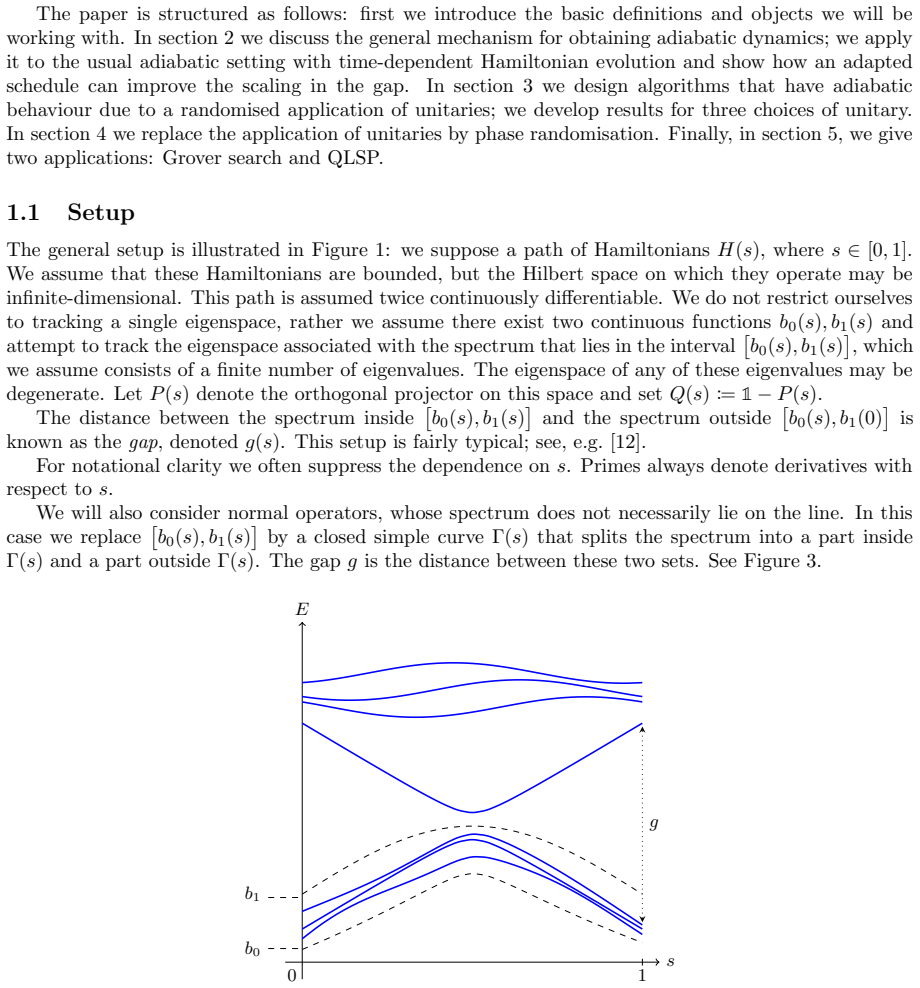
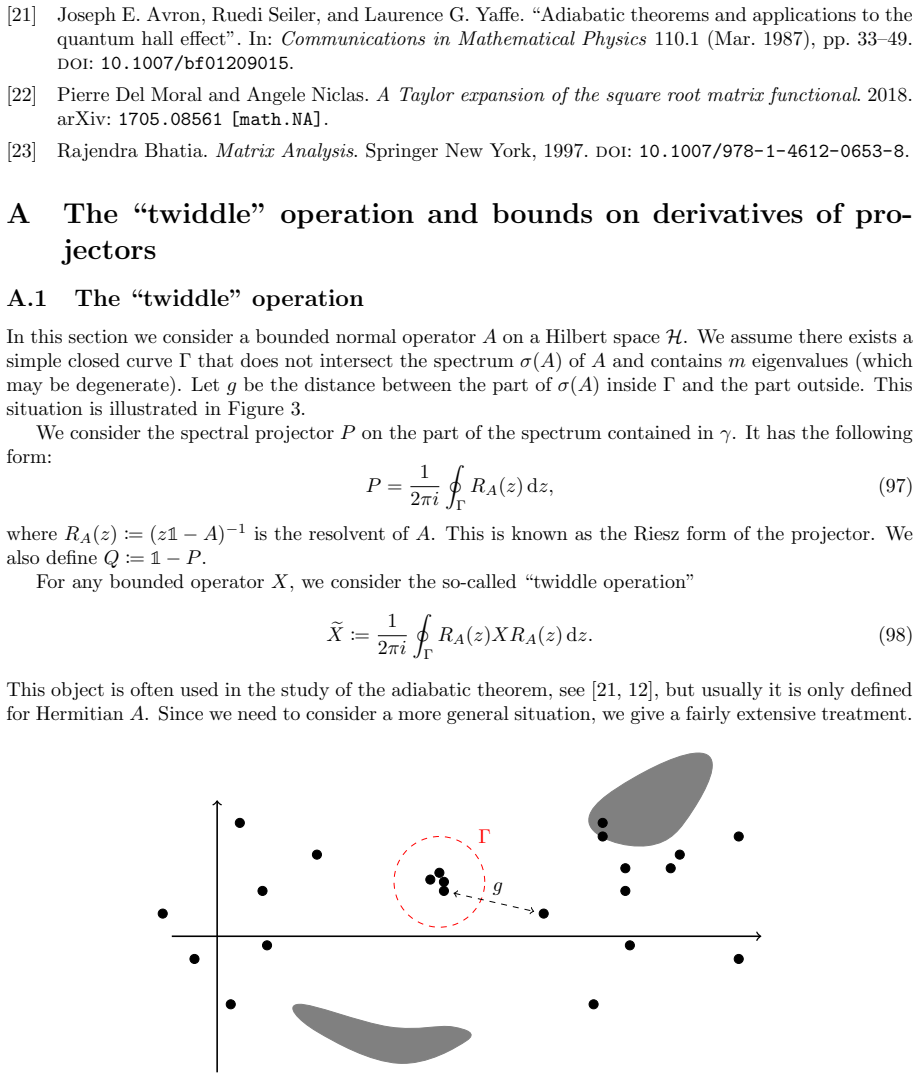
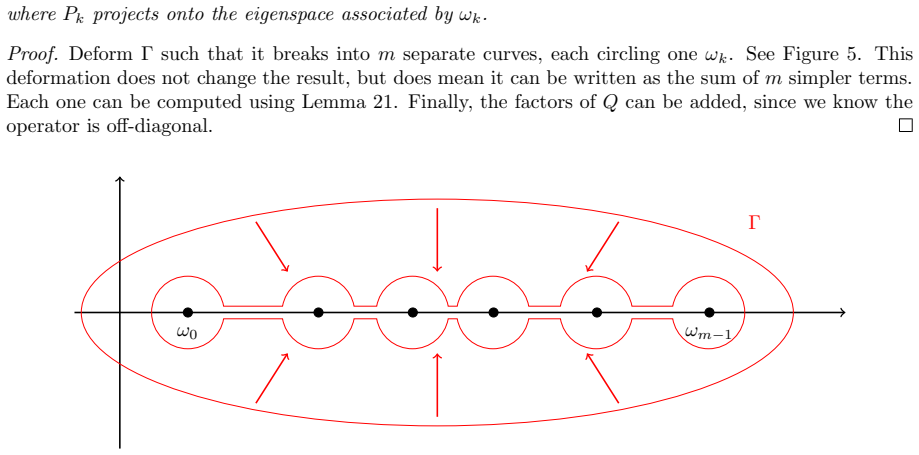
Rajendra Bhatia.Matrix Analysis. Springer New York, 1997.doi:10.1007/978-1-4612-0653-8. A The “twiddle” operation and bounds on derivatives of pro- jectors A.1 The “twiddle” operation In this section we consider a bounded normal operatorAon a Hilbert spaceH. We assume there exists a simple closed curve Γ that does not intersect the spectrumσ(A) ofAand con...
-
[24]
off-diagonal
eX=P eXQ+Q eXP. We can express property (2) by saying that eXis “off-diagonal”. Proof.(1) The proof is a straightforward verification of the proposed solution: [A, eX] = 1 2πi I Γ A, RA(z)XR A(z) dz(99) = 1 2πi I Γ RA(z)XR A(z), z1−A dz(100) = 1 2πi I Γ RA(z)X−XR A(z) dz(101) = 1 2πi I Γ RA(z) dz X−X 1 2πi I Γ RA(z) dz (102) =P X−XP= [P, X].(103) (2) Sinc...
-
[25]
fP ′[P ′, P] +fP ′′ = fP ′′ + (Q−P) ^[A′,fP ′] +QP ′fP ′Q−P P ′fP ′P; 2.P ′′ = fA′′ + (Q−P) 2(P ′)2 + ^[A′, P ′]
-
[26]
fP ′′ = ffA′′ + (Q−P) ^^[A′, P ′]. Proof.(1) Proposition 25 gives the expansion fP ′′ = fP ′′ + (Q−P) P ′fP ′ +fP ′P ′ + ^[A′,fP ′] (148) = fP ′′ + (Q−P) ^[A′,fP ′] +Q P ′fP ′ +fP ′P ′ Q−P P ′fP ′ +fP ′P ′ P,(149) which can be added to fP ′[P ′, P] =P fP ′P ′P−Q fP ′P ′Q.(150) to get the result. (2) SinceP ′′ =fH ′′ , the result follows from Proposition 2...
-
[27]
IfX 0,1 = 0 =X 1,0, then ∥X∥ ≤max{∥X 0,0∥,∥X 1,1∥}.(157)
-
[28]
IfX 0,0 = 0 =X 1,1, then ∥X∥ ≤max{∥X 0,1∥,∥X 0,1∥}.(158)
-
[29]
IfX 0,0 = 0 =X 1,0, then ∥X∥ ≤ q ∥X0,1∥2 +∥X 1,1∥2.(159)
-
[30]
If∥X 0,1∥=∥X 1,0∥, then ∥X∥ ≤ ∥X0,0∥+∥X 1,1∥ 2 + 1 2 q ∥X0,0∥ − ∥X1,1∥ 2 + 4∥X0,1∥2.(160)
-
[31]
SupposeAis differentiable,Γ(s)is continuous and the part ofσ(A)insideΓconsists ofm eigenvalues
IfX 0,0 = 0and∥X 0,1∥=∥X 1,0∥, then ∥X∥ ≤ ∥X1,1∥ 2 + r ∥X1,1∥2 4 +∥X 0,1∥2.(161) Proposition 29.LetHbe a Hilbert space,A(s)a bounded normal operator onH,X(s)a bounded operator onHandΓ(s)a closed simple curve that does not intersect the spectrum ofA(s), for all s∈[0,1]. SupposeAis differentiable,Γ(s)is continuous and the part ofσ(A)insideΓconsists ofm eige...
discussion (0)
Sign in with ORCID, Apple, or X to comment. Anyone can read and Pith papers without signing in.