HyperPrecision: A Mathematica package for High-Precision Numerical Evaluation of Multivariate Hypergeometric Functions
Pith reviewed 2026-06-29 06:28 UTC · model grok-4.3
The pith
HyperPrecision package evaluates general multivariate hypergeometric functions at high precision by reducing their Pfaffian PDE systems to solvable ODEs along contours.
A machine-rendered reading of the paper's core claim, the machinery that carries it, and where it could break.
Core claim
The central claim is that any general Horn-type multivariate hypergeometric function admits an automatically constructible Pfaffian system whose restriction to a suitable one-dimensional contour yields an ordinary differential equation that the Frobenius method can integrate numerically to arbitrary precision once the boundary conditions are fixed analytically by the defining series.
What carries the argument
The Pfaffian system of partial differential equations for the hypergeometric function, restricted to a one-dimensional contour in variable space and integrated by the Frobenius method with series-supplied initial conditions.
If this is right
- High-precision numerical values become available for the Appell F1, F2, F3, and F4 functions at arbitrary points in their domains.
- The same procedure supplies values for the Horn G- and H-series and the Lauricella FA, FB, FC, and FD functions.
- Laurent expansions in a small parameter ε can be obtained simultaneously with the function values themselves.
- Angular integrals, Feynman integrals, and cosmological or holographic correlators that reduce to these hypergeometric functions can be evaluated numerically to high precision.
Where Pith is reading between the lines
- The automatic Pfaffian construction could be reused as a building block for numerical continuation of other systems of linear PDEs that arise in physics but lack closed-form continuations.
- Integration of the package into existing Feynman-integral toolchains would allow direct high-precision checks against sector-decomposition or other numerical methods without intermediate analytic steps.
- The contour-reduction technique suggests that similar one-dimensional paths might be identified for multivariate functions outside the Horn class when their differential equations are known.
Load-bearing premise
A suitable one-dimensional contour can always be chosen so that the reduced ordinary differential equation encounters neither prohibitive singularities nor insurmountable numerical instabilities.
What would settle it
A concrete counterexample would be any specific Horn-type function together with a target point for which the package either fails to construct the Pfaffian system or produces an ODE whose numerical integration diverges or becomes unstable on every possible contour.
Figures


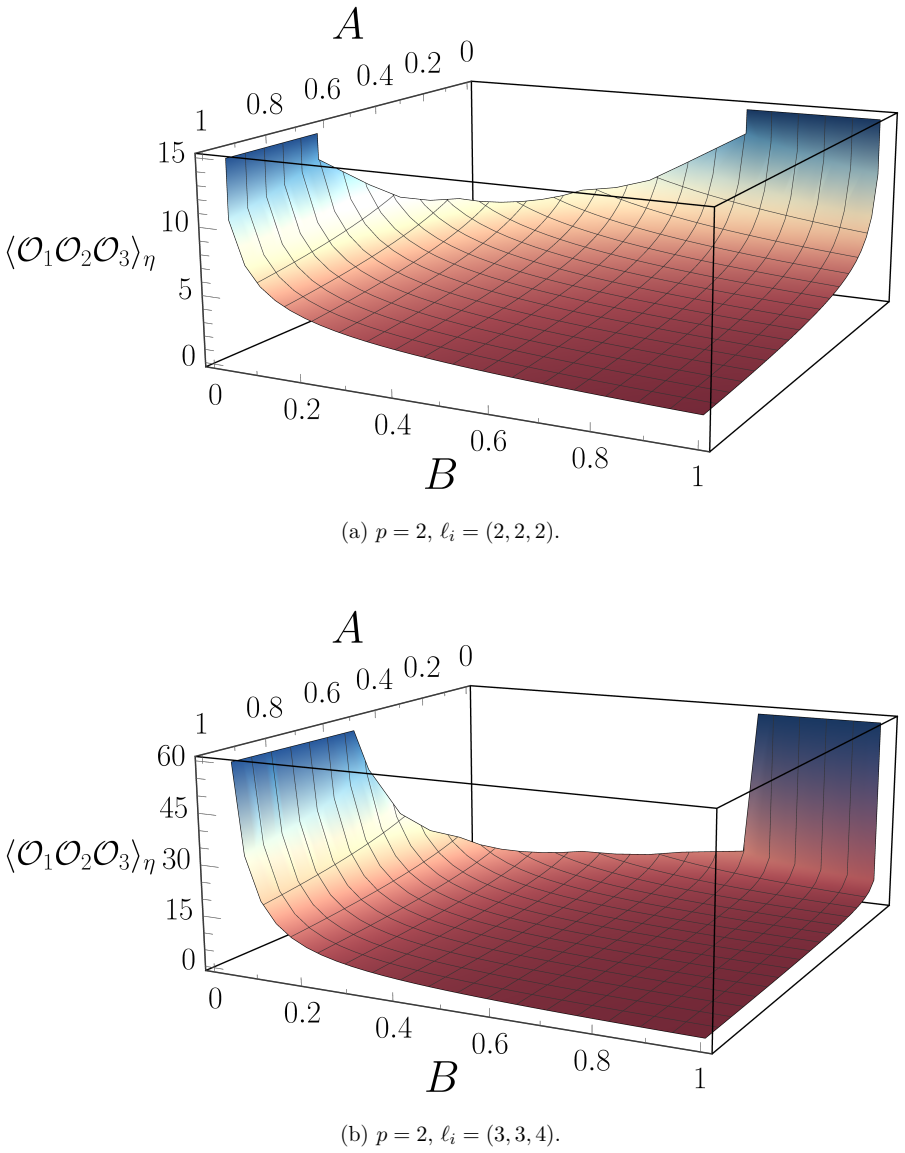
read the original abstract
In this paper, we present HyperPrecision, a Mathematica package for high-precision numerical evaluation of general Horn-type multivariate hypergeometric functions and their Laurent expansions in a small parameter $\epsilon$. Such functions appear widely in physics and mathematics, with applications ranging from quantum field theory and string theory to number theory and statistics. Their high-precision numerical evaluation, however, remains challenging, since their defining series converge only in restricted domains and analytic continuation beyond these domains is, in general, non-trivial. HyperPrecision addresses this problem by automatically constructing the Pfaffian system of partial differential equations for a given hypergeometric function and restricting it to a one-dimensional contour in the space of variables connecting the starting to the target point. The resulting ordinary differential equation is then solved by the Frobenius method, with boundary conditions fixed analytically by the defining series. We illustrate the use of the package by evaluating commonly occurring multivariate hypergeometric functions, including the Appell $F_1$, $F_2$, $F_3$, and $F_4$ functions, the Horn $G$- and $H$-series, and the Lauricella $F_A$, $F_B$, $F_C$, and $F_D$ functions, as well as by considering applications to angular integrals, Feynman integrals, and cosmological and holographic correlators.
Editorial analysis
A structured set of objections, weighed in public.
Referee Report
Summary. The paper presents HyperPrecision, a Mathematica package for high-precision numerical evaluation of general Horn-type multivariate hypergeometric functions and their Laurent expansions in a small parameter ε. The approach automatically constructs the Pfaffian system of partial differential equations for a given function, restricts it to a one-dimensional contour connecting starting and target points, solves the resulting ODE via the Frobenius method, and fixes boundary conditions analytically from the defining series. Illustrations cover Appell F1–F4, Horn G- and H-series, Lauricella FA–FD functions, plus applications to angular integrals, Feynman integrals, and cosmological/holographic correlators.
Significance. If the automated Pfaffian construction and contour selection prove reliable beyond the listed families, the package would provide a valuable general-purpose tool for high-precision computations in quantum field theory, string theory, and related fields where multivariate hypergeometrics arise. Shipping a Mathematica package with code for the described pipeline is a concrete strength that supports reproducibility.
major comments (2)
- [Abstract and algorithmic description] Abstract (and algorithmic sections): the claim that a Pfaffian system can be constructed automatically for arbitrary Horn-type functions, and that a suitable one-dimensional contour can always be chosen so the restricted ODE has only regular, avoidable singularities, lacks a general existence proof or systematic failure-mode analysis for functions outside the standard Appell/Horn/Lauricella families; this is load-bearing because the entire numerical pipeline collapses if either step fails for a non-standard series.
- [Validation and benchmarks] Validation sections: no detailed benchmarks, error analysis, or singularity-handling tests are supplied that would confirm the claimed high-precision results hold across the full scope of Horn-type functions; without these the soundness of the high-precision claim cannot be verified.
minor comments (1)
- Notation for the Frobenius-method implementation and contour parametrization could be made more explicit to aid readers implementing or extending the package.
Simulated Author's Rebuttal
We thank the referee for the careful review and constructive comments on our manuscript. We address each major comment below and have revised the manuscript to strengthen the presentation of the algorithmic scope and to include additional validation material.
read point-by-point responses
-
Referee: Abstract (and algorithmic sections): the claim that a Pfaffian system can be constructed automatically for arbitrary Horn-type functions, and that a suitable one-dimensional contour can always be chosen so the restricted ODE has only regular, avoidable singularities, lacks a general existence proof or systematic failure-mode analysis for functions outside the standard Appell/Horn/Lauricella families; this is load-bearing because the entire numerical pipeline collapses if either step fails for a non-standard series.
Authors: We agree that the manuscript does not contain a general existence theorem covering every conceivable Horn-type series. The Pfaffian construction implemented in HyperPrecision follows the standard algorithmic procedure based on the coefficient recurrence relations of a given Horn series (as described in the cited literature on multivariate hypergeometric systems). The package therefore applies to any series for which such a Pfaffian system exists and can be computed symbolically; it does not claim to handle pathological cases outside this class. In the revised version we have added an explicit subsection (Section 3.2) that states the working assumptions, lists the families for which the construction has been verified, and describes the failure modes we have encountered (e.g., when the recurrence relations do not close into a finite Pfaffian system or when all admissible contours encounter unavoidable irregular singularities). We have also inserted a short paragraph in the abstract clarifying that the method is constructive for the class of Horn-type functions admitting a Pfaffian representation. revision: yes
-
Referee: Validation sections: no detailed benchmarks, error analysis, or singularity-handling tests are supplied that would confirm the claimed high-precision results hold across the full scope of Horn-type functions; without these the soundness of the high-precision claim cannot be verified.
Authors: We accept that the original validation material was limited to illustrative examples. In the revised manuscript we have added a dedicated numerical-validation section (Section 5) containing: (i) systematic high-precision comparisons against known reference values for Appell F1–F4, Horn G/H, and Lauricella FA–FD functions over a grid of kinematic points, (ii) an error analysis that reports absolute and relative errors as functions of working precision and contour length, and (iii) explicit singularity-handling tests that approach regular singular points along several contours while monitoring the achieved precision. All benchmarks were performed with Mathematica’s arbitrary-precision arithmetic and are accompanied by the corresponding notebook files that will be deposited with the package. revision: yes
Circularity Check
No circularity: method derives ODEs directly from series definitions
full rationale
The paper describes an algorithmic pipeline that starts from the defining multivariate series of Horn-type hypergeometric functions, constructs the associated Pfaffian system of PDEs, restricts it to a contour, and solves the resulting ODE via the Frobenius method with series-derived boundary conditions. This chain is self-contained and does not reduce any claimed output to a fitted parameter, self-citation, or renamed input; the construction steps are presented as operating on the function definitions themselves. No load-bearing uniqueness theorem, ansatz, or prediction is invoked that collapses to the inputs by construction. The approach therefore qualifies as an independent implementation rather than a circular re-derivation.
Axiom & Free-Parameter Ledger
axioms (2)
- standard math Pfaffian systems exist and can be constructed for general Horn-type multivariate hypergeometric functions.
- standard math The Frobenius method can be applied to the reduced ODE along a chosen contour with boundary conditions from the defining series.
Reference graph
Works this paper leans on
-
[1]
Slater.Generalized Hypergeometric Functions
L. Slater.Generalized Hypergeometric Functions. 1966
1966
-
[2]
Bateman and A
H. Bateman and A. Erdélyi.Higher Transcendental Functions. Higher Transcen- dental Functions v. 1. Dover Publications, 2006
2006
-
[3]
Exton.Multiple Hypergeometric Functions and Applications
H. Exton.Multiple Hypergeometric Functions and Applications. Chichester: Ellis Horwood, 1976
1976
-
[4]
H. M. Srivastava and P. W. Karlsson.Multiple gaussian hypergeometric series. 1985. 40
1985
-
[5]
Bailey.Generalized Hypergeometric Series
W. Bailey.Generalized Hypergeometric Series. Cambridge tracts in mathematics and mathematical physics. The University Press, 1935
1935
-
[6]
Multiple hypergeometric series: Appell series and beyond
M. J. Schlosser. “Multiple hypergeometric series: Appell series and beyond”. In: Computer algebra in quantum field theory: integration, summation and special functions(2013), pp. 305–324
2013
-
[7]
Aomoto, M
K. Aomoto, M. Kita, T. Kohno, and K. Iohara.Theory of Hypergeometric Func- tions. Springer Monographs in Mathematics. Springer Japan, 2011
2011
-
[8]
M.Yoshida.Hypergeometric Functions, My Love: Modular Interpretations of Con- figuration Spaces. Vol. E32. Aspects of Mathematics. Braunschweig/Wiesbaden: Vieweg, 1997
1997
-
[9]
Disquisitionesgeneralescircaserieminfinitam1+ αβ 1·γx+α(α+1)β(β+1) 1·2·γ(γ+1)x2+ etc
C.F.Gauss.“Disquisitionesgeneralescircaserieminfinitam1+ αβ 1·γx+α(α+1)β(β+1) 1·2·γ(γ+1)x2+ etc.”. In:Commentationes Societatis Regiae Scientiarum Gottingensis Recentiores 2 (1813), pp. 3–46
-
[10]
Paris: Gauthier-Villars, 1926
P.AppellandJ.KampédeFériet.Fonctions hypergéométriques et hypersphériques: Polynômes d’Hermite. Paris: Gauthier-Villars, 1926
1926
-
[11]
Hypergeometrische Funktionen zweier Veränderlichen
J. Horn. “Hypergeometrische Funktionen zweier Veränderlichen”. In:Math. Ann. 105 (1931), pp. 381–407
1931
-
[12]
Kampé de Fériet.La fonction hypergéométrique
J. Kampé de Fériet.La fonction hypergéométrique. Mémorial des Sciences Math- ématiques 85. Paris: Gauthier-Villars, 1937
1937
-
[13]
Sulle funzioni ipergeometriche a più variabili
G. Lauricella. “Sulle funzioni ipergeometriche a più variabili”. In:Rend. Circ. Mat. Palermo7 (1893), pp. 111–158
-
[14]
Transformations of certain hypergeometric functions of three vari- ables
S. Saran. “Transformations of certain hypergeometric functions of three vari- ables”. In:Acta Mathematica93 (1955), pp. 293–312
1955
-
[15]
General theory of hypergeometric functions
I. M. Gel’fand. “General theory of hypergeometric functions”. In:Soviet Math. Dokl.33 (1986), pp. 573–577
1986
-
[16]
Discriminants, Resultants, and Multidimensional Determinants
I. Gelfand, M. M. Kapranov, and A. V. Zelevinsky. “Discriminants, Resultants, and Multidimensional Determinants”. In: 1994
1994
-
[17]
Hypergeometricfunctions and toric varieties
I.M.Gel’fand,M.M.Kapranov,andA.V.Zelevinsky.“Hypergeometricfunctions and toric varieties”. In:Funct. Anal. Appl.23.2 (1989), pp. 94–106
1989
-
[18]
Generalized Euler inte- grals andA-hypergeometric functions
I. M. Gel’fand, M. M. Kapranov, and A. V. Zelevinsky. “Generalized Euler inte- grals andA-hypergeometric functions”. In:Adv. Math.84 (1990), pp. 255–271
1990
-
[19]
Feynman integrals as A-hypergeometric functions
L. de la Cruz. “Feynman integrals as A-hypergeometric functions”. In:JHEP12 (2019), p. 123. arXiv:1907.00507 [math-ph]
-
[20]
Hypergeometric Series Representations of Feynman Integrals by GKZ Hypergeometric Systems
R. P. Klausen. “Hypergeometric Series Representations of Feynman Integrals by GKZ Hypergeometric Systems”. In:JHEP04 (2020), p. 121. arXiv:1910.08651 [hep-th]
-
[21]
FeynGKZ: A Mathematica package for solving Feynman integrals using GKZ hypergeometric systems
B. Ananthanarayan, S. Banik, S. Bera, and S. Datta. “FeynGKZ: A Mathematica package for solving Feynman integrals using GKZ hypergeometric systems”. In: Comput. Phys. Commun.287 (2023), p. 108699. arXiv:2211.01285 [hep-th]
-
[22]
Macaulay matrix for Feynman integrals: linear relations and intersection numbers
V. Chestnov, F. Gasparotto, M. K. Mandal, P. Mastrolia, S. J. Matsubara-Heo, H. J. Munch, and N. Takayama. “Macaulay matrix for Feynman integrals: linear relations and intersection numbers”. In:JHEP09 (2022), p. 187. arXiv:2204. 12983 [hep-th]. 41
2022
-
[23]
GKZ-hypergeometric systems for Feynman integrals
T.-F. Feng, C.-H. Chang, J.-B. Chen, and H.-B. Zhang. “GKZ-hypergeometric systems for Feynman integrals”. In:Nucl. Phys. B953 (2020), p. 114952. arXiv: 1912.01726 [hep-th]
-
[24]
On convergent series representations of Mellin-Barnes integrals
S. Friot and D. Greynat. “On convergent series representations of Mellin-Barnes integrals”. In:J. Math. Phys.53 (2012), p. 023508. arXiv:1107.0328 [math-ph]
work page internal anchor Pith review Pith/arXiv arXiv 2012
-
[25]
Multiple Series Repre- sentations of N-fold Mellin-Barnes Integrals
B. Ananthanarayan, S. Banik, S. Friot, and S. Ghosh. “Multiple Series Repre- sentations of N-fold Mellin-Barnes Integrals”. In:Phys. Rev. Lett.127.15 (2021), p. 151601. arXiv:2012.15108 [hep-th]
-
[26]
Multiple polylogarithms, cyclotomy and modular complexes
A. B. Goncharov. “Multiple polylogarithms, cyclotomy and modular complexes”. In:Math. Res. Lett.5 (1998), pp. 497–516. arXiv:1105.2076 [math.AG]
work page internal anchor Pith review Pith/arXiv arXiv 1998
-
[27]
Analytic Evaluation of Multiple Mellin-Barnes Integrals
S. Banik and S. Friot. “Analytic Evaluation of Multiple Mellin-Barnes Integrals”. In:PoSLL2024 (2024), p. 039. arXiv:2407.20120 [hep-th]
-
[28]
V. A. Smirnov.Analytic tools for Feynman integrals. Vol. 250. 2012
2012
-
[29]
Symbolic Expansion of Transcendental Functions
S.Weinzierl.“Symbolicexpansionoftranscendentalfunctions”.In:Comput. Phys. Commun.145 (2002), pp. 357–370. arXiv:math-ph/0201011
work page internal anchor Pith review Pith/arXiv arXiv 2002
-
[30]
A Mellin Space Approach to Cosmological Correlators
C. Sleight. “A Mellin Space Approach to Cosmological Correlators”. In:JHEP01 (2020), p. 090. arXiv:1906.12302 [hep-th]
-
[31]
J. Chen, B. Feng, and Y.-X. Tao. “Multivariate hypergeometric solutions of cos- mological (dS) correlators by d log-form differential equations”. In:JHEP03 (2025), p. 075. arXiv:2411.03088 [hep-th]
-
[32]
Selected topics in analytic conformal bootstrap: A guided journey
A. Bissi, A. Sinha, and X. Zhou. “Selected topics in analytic conformal bootstrap: A guided journey”. In:Phys. Rept.991 (2022), pp. 1–89. arXiv:2202 . 08475 [hep-th]
2022
-
[33]
Correlationfunctionsfornon-conformal Dp-braneholography
N.Bobev,G.MeraÁlvarez,andH.Paul.“Correlationfunctionsfornon-conformal Dp-braneholography”.In:JHEP07(2025),p.137.arXiv:2503.18770 [hep-th]
-
[34]
Angular integrals in d dimensions
G. Somogyi. “Angular integrals in d dimensions”. In:J. Math. Phys.52 (2011), p. 083501. arXiv:1101.3557 [hep-ph]
work page internal anchor Pith review Pith/arXiv arXiv 2011
-
[35]
Integration of the partial differential equations for the hyper- geometric functionsF 1 andF D of two and more variables
P. O. M. Olsson. “Integration of the partial differential equations for the hyper- geometric functionsF 1 andF D of two and more variables”. In:J. Math. Phys.5 (1964), pp. 420–430
1964
-
[36]
B. Ananthanarayan, S. Bera, S. Friot, and T. Pathak. “Olsson.wl & ROC2.wl: Mathematica packages for transformations of multivariable hypergeometric func- tions & regions of convergence for their series representations in the two variables case”. In:Comput. Phys. Commun.300 (2024), p. 109162. arXiv:2201.01189 [cs.MS]
-
[37]
Multiple Mellin-Barnes integrals and triangulations of point configurations
S. Banik and S. Friot. “Multiple Mellin-Barnes integrals and triangulations of point configurations”. In:Phys. Rev. D110.3 (2024), p. 036002. arXiv:2309 . 00409 [hep-th]
2024
-
[38]
M. Y. Kalmykov. “Gauss hypergeometric function: Reduction, epsilon-expansion for integer/half-integer parameters and Feynman diagrams”. In:JHEP04 (2006), p. 056. arXiv:hep-th/0602028
work page internal anchor Pith review Pith/arXiv arXiv 2006
-
[39]
M. Y. Kalmykov, B. F. L. Ward, and S. A. Yost. “On the all-order epsilon- expansion of generalized hypergeometric functions with integer values of param- eters”. In:JHEP11 (2007), p. 009. arXiv:0708.0803 [hep-th]. 42
work page internal anchor Pith review Pith/arXiv arXiv 2007
-
[40]
M. Y. Kalmykov and B. A. Kniehl. “Towards all-order Laurent expansion of generalized hypergeometric functions around rational values of parameters”. In: Nucl. Phys. B809 (2009), pp. 365–405. arXiv:0807.0567 [hep-th]
work page internal anchor Pith review Pith/arXiv arXiv 2009
-
[41]
A new approach to the epsilon expansion of generalized hypergeometric functions
D.GreynatandJ.Sesma.“Anewapproachtotheepsilonexpansionofgeneralized hypergeometric functions”. In:Comput. Phys. Commun.185 (2014), pp. 472–478. arXiv:1302.2423 [math-ph]
work page internal anchor Pith review Pith/arXiv arXiv 2014
-
[42]
Epsilon expansion of Appell and Kamp\'e de F\'eriet functions
D. Greynat, J. Sesma, and G. Vulvert. “Epsilon expansion of Appell and Kampé de Fériet functions”. In: (2013). arXiv:1310.7700 [math-ph]
work page internal anchor Pith review Pith/arXiv arXiv 2013
-
[43]
Derivatives of the Pochhammer and reciprocal Pochhammer symbols and their use in epsilon-expansions of Appell and Kampé de Fériet functions
D. Greynat, J. Sesma, and G. Vulvert. “Derivatives of the Pochhammer and reciprocal Pochhammer symbols and their use in epsilon-expansions of Appell and Kampé de Fériet functions”. In:J. Math. Phys.55 (2014), p. 043501
2014
-
[44]
Nested Sums, Expansion of Transcendental Functions and Multi-Scale Multi-Loop Integrals
S. Moch, P. Uwer, and S. Weinzierl. “Nested sums, expansion of transcenden- tal functions and multiscale multiloop integrals”. In:J. Math. Phys.43 (2002), pp. 3363–3386. arXiv:hep-ph/0110083
work page internal anchor Pith review Pith/arXiv arXiv 2002
-
[45]
Expansion around half integer values, binomial sums and inverse binomial sums
S. Weinzierl. “Expansion around half integer values, binomial sums and inverse binomial sums”. In:J. Math. Phys.45 (2004), pp. 2656–2673. arXiv:hep- ph/ 0402131
2004
-
[46]
The Epsilon Expansion of Feynman Diagrams via Hypergeometric Functions and Differential Reduction
S. A. Yost, V. V. Bytev, M. Y. Kalmykov, B. A. Kniehl, and B. F. L. Ward. “The Epsilon Expansion of Feynman Diagrams via Hypergeometric Functions and Differential Reduction”. In: (2011). arXiv:1110.0210 [math-ph]
work page internal anchor Pith review Pith/arXiv arXiv 2011
-
[47]
V. V. Bytev, M. Y. Kalmykov, and B. A. Kniehl. “When epsilon-expansion of hypergeometric functions is expressible in terms of multiple polylogarithms: the two-variables examples”. In:PoSLL2012 (2012). Ed. by T. Riemann, p. 029. arXiv:1212.4719 [hep-th]
work page internal anchor Pith review Pith/arXiv arXiv 2012
-
[48]
Hypergeometric Functions and Feynman Diagrams
M. Kalmykov, V. Bytev, B. A. Kniehl, S.-O. Moch, B. F. L. Ward, and S. A. Yost. “Hypergeometric Functions and Feynman Diagrams”. In:Antidifferentiation and the Calculation of Feynman Amplitudes. 2020. arXiv:2012.14492 [hep-th]
-
[49]
Difference Equations in Massive Higher Order Calculations
I. Bierenbaum, J. Blumlein, S. Klein, and C. Schneider. “Difference Equations in Massive Higher Order Calculations”. In:PoSACAT (2007), p. 082. arXiv: 0707.4659 [math-ph]
work page internal anchor Pith review Pith/arXiv arXiv 2007
-
[50]
A Symbolic Summation Ap- proach to Feynman Integral Calculus
J. Blumlein, S. Klein, C. Schneider, and F. Stan. “A Symbolic Summation Ap- proach to Feynman Integral Calculus”. In:J. Symb. Comput.47 (2012), pp. 1267–
2012
-
[51]
arXiv:1011.2656 [cs.SC]
work page internal anchor Pith review Pith/arXiv arXiv
-
[52]
Evaluation of Multi-Sums for Large Scale Problems
J. Blumlein, A. Hasselhuhn, and C. Schneider. “Evaluation of Multi-Sums for Large Scale Problems”. In:PoSRADCOR2011 (2011), p. 032. arXiv:1202.4303 [math-ph]
work page internal anchor Pith review Pith/arXiv arXiv 2011
-
[53]
Advanced Computer Algebra Algorithms for the Expansion of Feynman Integrals
J. Ablinger, J. Blumlein, M. Round, and C. Schneider. “Advanced Computer Algebra Algorithms for the Expansion of Feynman Integrals”. In:PoSLL2012 (2012). Ed. by T. Riemann, p. 050. arXiv:1210.1685 [cs.SC]
work page internal anchor Pith review Pith/arXiv arXiv 2012
-
[54]
Modern Summation Methods for Loop Integrals in Quantum Field Theory: The Packages Sigma, EvaluateMultiSums and SumProduction
C. Schneider. “Modern Summation Methods for Loop Integrals in Quantum Field Theory: The Packages Sigma, EvaluateMultiSums and SumProduction”. In:J. Phys. Conf. Ser.523 (2014). Ed. by J. Wang, p. 012037. arXiv:1310 . 0160 [cs.SC]. 43
2014
-
[55]
HypergeometricstructuresinFeyn- man integrals
J.Blümlein,M. Saragnese, andC. Schneider. “HypergeometricstructuresinFeyn- man integrals”. In:Ann. Math. Artif. Intell.91.5 (2023), pp. 591–649. arXiv: 2111.15501 [math-ph]
-
[56]
T. Huber and D. Maitre. “HypExp, a Mathematica package for expanding hyper- geometric functions around integer-valued parameters”. In:Comput. Phys. Com- mun.175 (2006), pp. 122–144. arXiv:hep-ph/0507094
work page internal anchor Pith review Pith/arXiv arXiv 2006
-
[57]
HypExp 2, Expanding Hypergeometric Functions about Half-Integer Parameters
T. Huber and D. Maitre. “HypExp 2, Expanding hypergeometric functions about half-integer parameters”. In:Comput. Phys. Commun.178 (2008), pp. 755–776. arXiv:0708.2443 [hep-ph]
work page internal anchor Pith review Pith/arXiv arXiv 2008
-
[58]
- XSummer - Transcendental Functions and Symbolic Summation in Form
S. Moch and P. Uwer. “XSummer: Transcendental functions and symbolic sum- mation in form”. In:Comput. Phys. Commun.174 (2006), pp. 759–770. arXiv: math-ph/0508008
work page internal anchor Pith review Pith/arXiv arXiv 2006
-
[59]
Analytic and Algorithmic Aspects of Generalized Harmonic Sums and Polylogarithms
J. Ablinger, J. Blümlein, and C. Schneider. “Analytic and Algorithmic Aspects of Generalized Harmonic Sums and Polylogarithms”. In:J. Math. Phys.54 (2013), p. 082301. arXiv:1302.0378 [math-ph]
work page internal anchor Pith review Pith/arXiv arXiv 2013
-
[60]
ϵ-expansion of multivariable hypergeometric functions appearing in Feynman integral calculus
S. Bera. “ϵ-expansion of multivariable hypergeometric functions appearing in Feynman integral calculus”. In:Nucl. Phys. B989 (2023), p. 116145. arXiv: 2208.01000 [math-ph]
-
[61]
S. Bera. “MultiHypExp: A Mathematica package for expanding multivariate hy- pergeometric functions in terms of multiple polylogarithms”. In:Comput. Phys. Commun.297 (2024), p. 109060. arXiv:2306.11718 [hep-th]
-
[62]
NumExp: Numerical epsilon expansion of hypergeometric functions
Z.-W. Huang and J. Liu. “NumExp: Numerical epsilon expansion of hypergeo- metric functions”. In:Comput. Phys. Commun.184 (2013), pp. 1973–1980. arXiv: 1209.3971 [physics.comp-ph]
work page internal anchor Pith review Pith/arXiv arXiv 2013
-
[63]
High- precision numerical evaluation of Lauricella functions
M. A. Bezuglov, B. A. Kniehl, A. I. Onishchenko, and O. L. Veretin. “High- precision numerical evaluation of Lauricella functions”. In:Nucl. Phys. B1018 (2025), p. 116994. arXiv:2502.03276 [hep-th]
-
[64]
M. A. Bezuglov, B. A. Kniehl, A. I. Onishchenko, and O. L. Veretin. “Precision- Lauricella: Package for numerical computation of Lauricella functions depending on a parameter”. In:Comput. Phys. Commun.316 (2025), p. 109812. arXiv: 2502.07935 [cs.MS]
-
[65]
Differential equations method: New technique for massive Feyn- man diagrams calculation
A. V. Kotikov. “Differential equations method: New technique for massive Feyn- man diagrams calculation”. In:Phys. Lett. B254 (1991), pp. 158–164
1991
-
[66]
Differential Equations for Two-Loop Four-Point Functions
T. Gehrmann and E. Remiddi. “Differential equations for two-loop four-point functions”. In:Nucl. Phys. B580 (2000), pp. 485–518. arXiv:hep-ph/9912329
work page internal anchor Pith review Pith/arXiv arXiv 2000
-
[67]
Multiloop integrals in dimensional regularization made simple
J. M. Henn. “Multiloop integrals in dimensional regularization made simple”. In: Phys. Rev. Lett.110 (2013), p. 251601. arXiv:1304.1806 [hep-th]
work page internal anchor Pith review Pith/arXiv arXiv 2013
-
[68]
M. Hidding. “DiffExp, a Mathematica package for computing Feynman integrals in terms of one-dimensional series expansions”. In:Comput. Phys. Commun.269 (2021), p. 108125. arXiv:2006.05510 [hep-ph]
-
[69]
AMFlow: A Mathematica package for Feynman integrals computation via auxiliary mass flow
X. Liu and Y.-Q. Ma. “AMFlow: A Mathematica package for Feynman integrals computation via auxiliary mass flow”. In:Comput. Phys. Commun.283 (2023), p. 108565. arXiv:2201.11669 [hep-ph]. 44
-
[70]
Evaluation of Feynman integrals with arbitrary complex masses via series expansions
T. Armadillo, R. Bonciani, S. Devoto, N. Rana, and A. Vicini. “Evaluation of Feynman integrals with arbitrary complex masses via series expansions”. In:Com- put. Phys. Commun.282 (2023), p. 108545. arXiv:2205.03345 [hep-ph]
-
[71]
LINE: Loop Integrals Numerical Evaluation
R. M. Prisco, J. Ronca, and F. Tramontano. “LINE: Loop Integrals Numerical Evaluation”. In:JHEP07 (2025), p. 219. arXiv:2501.01943 [hep-ph]
-
[72]
M. A. Bezuglov and A. I. Onishchenko. “Expansion of hypergeometric functions in terms of polylogarithms with a nontrivial change of variables”. In:Theor. Math. Phys.219.3 (2024), pp. 871–896. arXiv:2312.06242 [hep-th]
-
[73]
Cosmological correla- tors with double massive exchanges: bootstrap equation and phenomenology
S. Aoki, L. Pinol, F. Sano, M. Yamaguchi, and Y. Zhu. “Cosmological correla- tors with double massive exchanges: bootstrap equation and phenomenology”. In: JHEP09 (2024), p. 176. arXiv:2404.09547 [hep-th]
-
[74]
New ideas for handling of loop and angular integrals in D-dimensions in QCD
V. E. Lyubovitskij, F. Wunder, and A. S. Zhevlakov. “New ideas for handling of loop and angular integrals in D-dimensions in QCD”. In:JHEP06 (2021), p. 066. arXiv:2102.08943 [hep-ph]
-
[75]
Phase-space integrals through Mellin-Barnes representation
T. Ahmed, S. M. Hasan, and A. Rapakoulias. “Phase-space integrals through Mellin-Barnes representation”. In:Phys. Rev. D112.5 (2025), p. L051903. arXiv: 2410.18886 [hep-ph]
-
[76]
Closed expressions for specific massive multiloop selfenergy integrals
F. A. Berends, M. Buza, M. Bohm, and R. Scharf. “Closed expressions for specific massive multiloop selfenergy integrals”. In:Z. Phys. C63 (1994), pp. 227–234
1994
-
[77]
W. R. Inc.Mathematica, Version 14.3. Champaign, IL, 2025
2025
-
[78]
Scattering amplitudes over finite fields and multivariate functional reconstruction
T. Peraro. “Scattering amplitudes over finite fields and multivariate functional reconstruction”. In:JHEP12 (2016), p. 030. arXiv:1608.01902 [hep-ph]
work page internal anchor Pith review Pith/arXiv arXiv 2016
-
[79]
FiniteFlow: multivariate functional reconstruction using finite fields and dataflow graphs
T. Peraro. “FiniteFlow: multivariate functional reconstruction using finite fields and dataflow graphs”. In:JHEP07 (2019), p. 031. arXiv:1905.08019 [hep-ph]
work page internal anchor Pith review Pith/arXiv arXiv 2019
-
[80]
Erdélyi, W
A. Erdélyi, W. Magnus, F. Oberhettinger, and F. G. Tricomi.Higher Transcen- dental Functions, Vol. I. Ed. by A. Erdélyi. Bateman Manuscript Project. New York: McGraw-Hill, 1953
1953
discussion (0)
Sign in with ORCID, Apple, or X to comment. Anyone can read and Pith papers without signing in.