Late-time Quantum Vacuum Decay and its Cosmological Implications
Pith reviewed 2026-06-29 05:37 UTC · model grok-4.3
The pith
Cosmological distance and CMB data still permit a 50 percent drop in vacuum energy from late-time quantum tunneling at redshift below 1.
A machine-rendered reading of the paper's core claim, the machinery that carries it, and where it could break.
Core claim
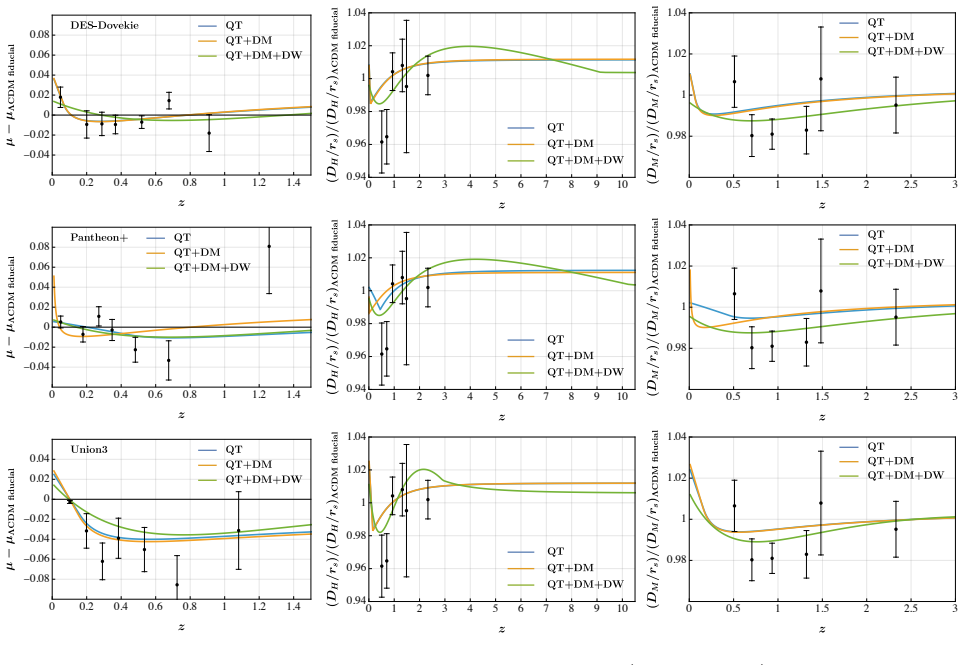
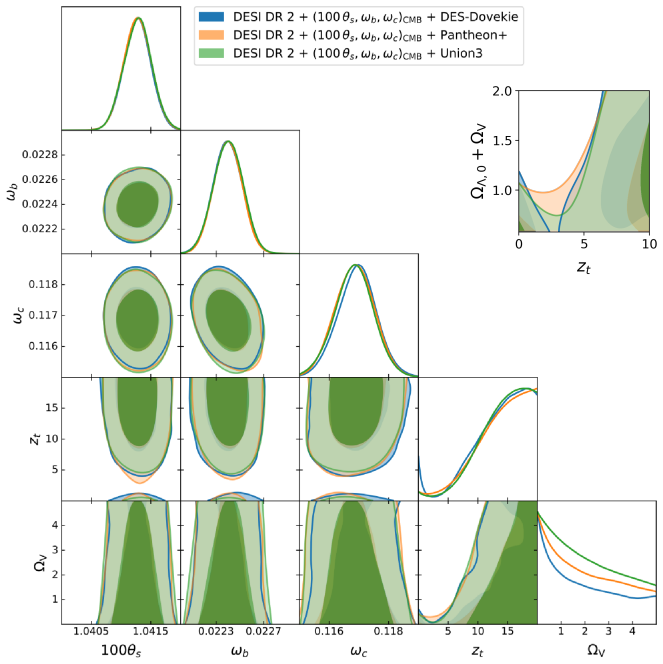
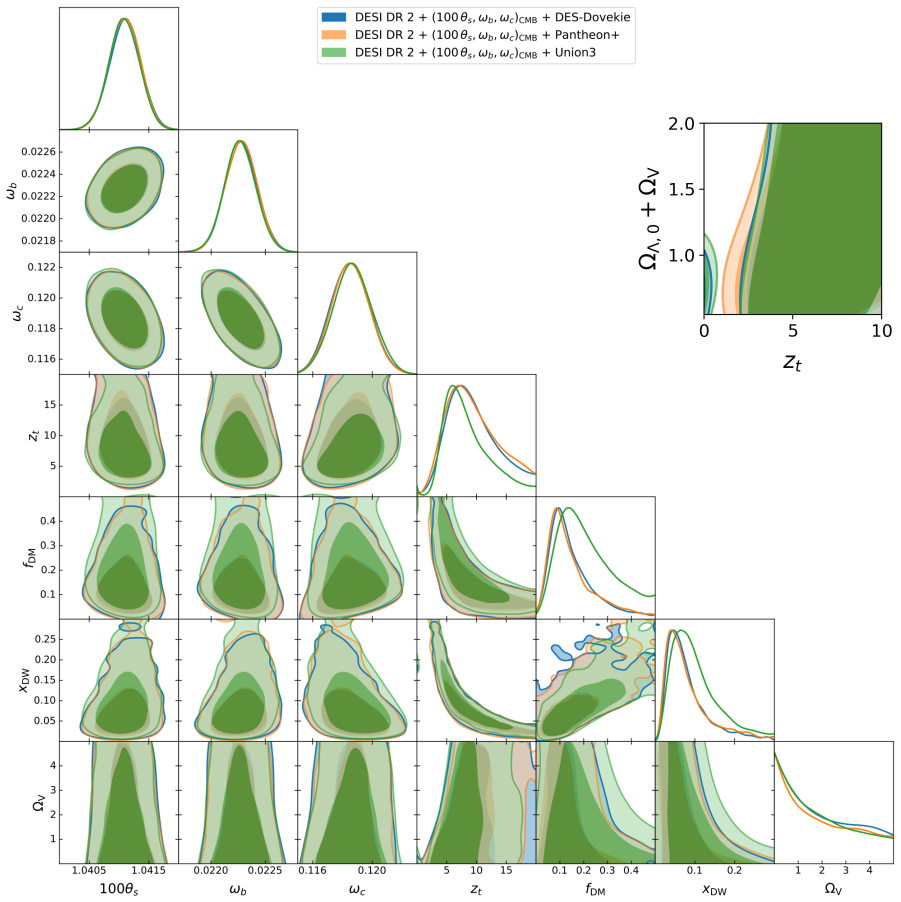
Late-time quantum vacuum decay remains compatible with existing cosmological data. For minimal tunneling models a 50 percent drop in total vacuum energy is still allowed at transition redshifts below 1. The model that adds dark-matter conversion and domain-wall production yields a good fit that eases tensions with Lambda-CDM, preferring a transition redshift near 7 and participation of about 10 percent of the dark matter. CMB constraints from bubble nucleation and the resulting domain-wall network limit slow or sparse transitions to an O(10 percent) vacuum-energy change at order-unity redshift, while nonminimal models with dark-matter-density-dependent tunneling rates can evade these limits.
What carries the argument
Phenomenological parametrization of a vacuum-energy drop at transition redshift z_t together with a dark-matter conversion fraction and an accompanying domain-wall network.
If this is right
- Current distance measurements still allow a 50 percent decrease in total vacuum energy for any transition redshift below 1.
- The dark-matter conversion plus domain-wall model resolves cosmological tensions with a preferred transition at z_t approximately 7 and 10 percent dark-matter participation.
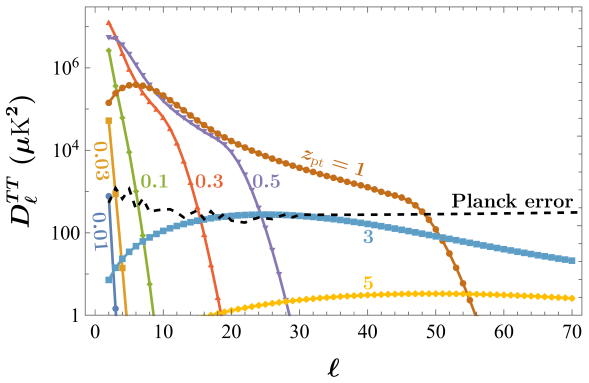
- CMB anisotropy limits from bubble nucleation restrict slow or sparse late transitions to an O(10 percent) vacuum-energy change at order-unity redshift.
- Dark-matter-density-dependent tunneling can proceed rapidly enough to evade the CMB bounds that apply to slower transitions.
Where Pith is reading between the lines
- More precise future distance surveys could detect or exclude the specific expansion-history features predicted by the favored transition parameters.
- The same framework offers a direct observational test of metastable-vacuum scenarios motivated by landscape constructions.
- Similar phenomenological modeling could be applied to other late-time phase transitions that alter dark-sector energy densities.
Load-bearing premise
The chosen parametrization of the vacuum-energy drop, dark-matter conversion fraction, and domain-wall network accurately captures the late-time tunneling process without a full quantum-field-theory calculation of the tunneling rate or bubble dynamics.
What would settle it
A future measurement of the expansion history at redshift around 7 that shows no deviation from Lambda-CDM and no sign of the 10 percent dark-matter conversion would rule out the parameters preferred by the best-fit model.
Figures

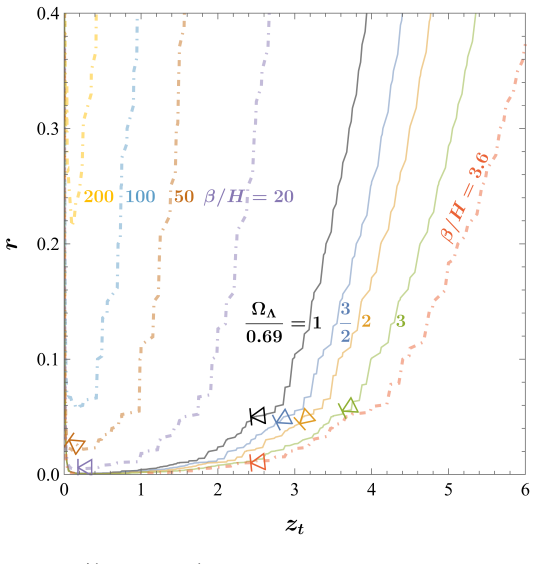
read the original abstract
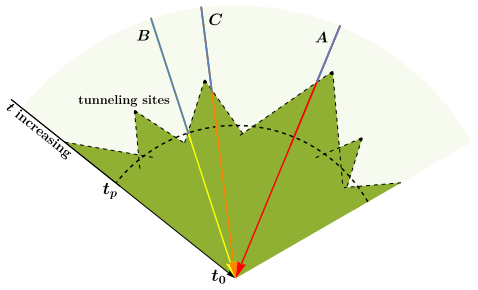
The existence of a landscape of metastable vacua raises the possibility that our Universe may have undergone quantum vacuum decay at late times. This work explores how such a transition can be tested with cosmological observables, focusing on precision distance measurements and cosmic microwave background (CMB) anisotropies. A set of phenomenological models is constructed in which late-time quantum tunneling changes the vacuum energy and may convert a subcomponent of dark matter into dark radiation, possibly accompanied by domain-wall production. The resulting expansion histories are compared with DESI DR2 baryon acoustic oscillation data; supernova distance measurements from DES-Dovekie, Pantheon+, and Union3; and a compressed CMB likelihood. For quantum-tunneling models, current cosmological distance measurements still allow a 50% decrease in the total vacuum energy for a transition redshift $z_t<1$. The model with dark-matter conversion and domain-wall production provides a good fit to resolve the tension between cosmological observables and the $\Lambda$CDM model, with a preferred transition around $z_t \sim 7$ and about 10% of dark matter participating in the transition. Additionally, CMB anisotropy constraints from bubble nucleation and the associated domain-wall network are derived and shown to strongly restrict slow or sparse late transitions. Applied to the minimal quantum-tunneling model, these constraints allow an $\mathcal{O}(10\%)$ decrease in the total vacuum energy for a transition redshift $z_t$ of order unity. For nonminimal models, dark-matter-density-dependent tunneling can proceed rapidly enough to evade such bounds. These results demonstrate that late-time quantum vacuum decay is a testable cosmological phenomenon and provide a concrete observational handle on metastable-vacuum physics motivated by landscape scenarios.
Editorial analysis
A structured set of objections, weighed in public.
Referee Report
Summary. The paper explores late-time quantum vacuum decay in metastable vacua motivated by landscape scenarios. It introduces phenomenological models in which tunneling alters vacuum energy (possibly by up to 50%), converts a fraction of dark matter to dark radiation, and produces domain walls. Expansion histories are inserted into the Friedmann equation and compared to DESI DR2 BAO, DES-Dovekie/Pantheon+/Union3 supernovae, and compressed CMB data. The abstract reports that current data still permit a 50% vacuum-energy drop for z_t < 1, while a non-minimal model with ~10% DM conversion at z_t ~ 7 yields a good fit that resolves cosmological tensions; CMB anisotropy bounds from nucleation and domain walls are also derived and shown to restrict slow transitions.
Significance. If the parametrizations can be justified microphysically, the work supplies a concrete observational test of landscape-motivated vacuum decay and shows that existing distance and CMB data already constrain the allowed parameter space. The approach is novel in combining vacuum-energy drop, DM conversion, and domain-wall production, but its significance is limited by the absence of first-principles derivations of the tunneling rate or bubble dynamics.
major comments (3)
- [Abstract / Model Construction] Abstract and model-construction paragraphs: the expansion histories are inserted directly into the Friedmann equation without a derivation of the nucleation rate Γ from an instanton or Coleman–De Luccia calculation for a potential that would produce transitions at z ~ O(1) or z ~ 7. This is load-bearing for the claim that the models are motivated by landscape physics rather than chosen to fit data.
- [Abstract] Abstract: the statements that the model 'provides a good fit' with 'preferred' z_t ~ 7 and 10% DM conversion are obtained by fitting the free parameters (z_t, vacuum-energy drop fraction, DM conversion fraction) to the same DESI + supernova + CMB datasets used to claim tension resolution. This circularity undermines the interpretation of these values as independent predictions or resolutions.
- [CMB Constraints] CMB anisotropy constraints paragraph: bounds on bubble nucleation and domain-wall networks are computed within the same phenomenological parametrization rather than from first-principles wall velocity, percolation, or early-universe stability requirements. If the microphysical rate cannot reach the required values without violating other constraints, the allowed O(10%) vacuum-energy drop for z_t ~ 1 collapses.
minor comments (2)
- [Model Construction] Notation for the domain-wall tension and its time dependence should be defined explicitly when first introduced.
- [Abstract] The abstract refers to 'compressed CMB likelihood' without specifying which likelihood or compression method is used.
Simulated Author's Rebuttal
We thank the referee for the constructive report. Below we address each major comment directly, clarifying the scope and intent of our phenomenological analysis while acknowledging its limitations.
read point-by-point responses
-
Referee: [Abstract / Model Construction] Abstract and model-construction paragraphs: the expansion histories are inserted directly into the Friedmann equation without a derivation of the nucleation rate Γ from an instanton or Coleman–De Luccia calculation for a potential that would produce transitions at z ~ O(1) or z ~ 7. This is load-bearing for the claim that the models are motivated by landscape physics rather than chosen to fit data.
Authors: The manuscript is explicitly phenomenological, as stated in the introduction and model sections. Landscape scenarios supply the general motivation that metastable vacua can exist and decay at late times, but we do not derive a specific instanton or Coleman–De Luccia rate. The parametrization of z_t, vacuum-energy drop, and DM conversion fraction is chosen to explore observable consequences within current data. This approach tests whether such transitions remain viable, without claiming a first-principles derivation of the rate. We will add an explicit sentence in the model-construction paragraph reiterating that the work does not provide a microphysical potential. revision: partial
-
Referee: [Abstract] Abstract: the statements that the model 'provides a good fit' with 'preferred' z_t ~ 7 and 10% DM conversion are obtained by fitting the free parameters (z_t, vacuum-energy drop fraction, DM conversion fraction) to the same DESI + supernova + CMB datasets used to claim tension resolution. This circularity undermines the interpretation of these values as independent predictions or resolutions.
Authors: The quoted phrasing reports the best-fit values obtained from the joint likelihood analysis. These values illustrate that parameter choices exist within the model that improve the fit relative to ΛCDM and reduce certain tensions. The exercise is not presented as an independent prediction but as a demonstration of consistency and possible tension alleviation. Any fitted model necessarily uses the same data for both fitting and comparison; the scientific content lies in mapping the allowed parameter space and its implications for observables. revision: no
-
Referee: [CMB Constraints] CMB anisotropy constraints paragraph: bounds on bubble nucleation and domain-wall networks are computed within the same phenomenological parametrization rather than from first-principles wall velocity, percolation, or early-universe stability requirements. If the microphysical rate cannot reach the required values without violating other constraints, the allowed O(10%) vacuum-energy drop for z_t ~ 1 collapses.
Authors: The CMB bounds are derived from the phenomenological parameters (transition redshift, participating DM fraction, and implied nucleation rate) and are therefore model-dependent. We present them as indicative constraints within this framework rather than absolute limits. The text already notes that density-dependent tunneling in non-minimal models can produce sufficiently rapid transitions to evade the bounds. A full first-principles calculation would require a specific potential, which lies outside the scope of the present work; the current bounds serve to restrict the slow-transition regime of the phenomenological models. revision: no
Circularity Check
No circularity: phenomenological parametrization fitted directly to external data
full rationale
The paper constructs explicit phenomenological models for vacuum-energy drop, DM conversion, and domain walls, then compares the resulting Friedmann-equation expansion histories to independent datasets (DESI DR2 BAO, DES-Dovekie/Pantheon+/Union3 supernovae, compressed CMB). The reported allowances (50% vacuum-energy drop for z_t<1) and best-fit values (z_t~7, ~10% DM conversion) are outputs of this data comparison, not inputs redefined as predictions. No equation or section reduces a claimed first-principles result to a fitted parameter or self-citation; the text labels the models as phenomenological and derives CMB bubble-nucleation bounds within the same parametrization without claiming microphysical derivation from instantons. The analysis is therefore self-contained against external benchmarks.
Axiom & Free-Parameter Ledger
free parameters (3)
- transition redshift z_t
- vacuum-energy drop fraction
- dark-matter conversion fraction
axioms (2)
- domain assumption Late-time quantum tunneling can be modeled by a sudden change in vacuum energy at a single redshift without back-reaction on the metric or particle content beyond the stated conversion.
- standard math Standard ΛCDM background plus linear perturbations remain valid when domain walls are produced.
invented entities (1)
-
late-time domain-wall network
no independent evidence
Forward citations
Cited by 1 Pith paper
-
A New Origin of the Big Bang from Dark-Sector-Induced Vacuum Decay and Its Gravitational-Wave Signal
A model in which inflaton energy goes exclusively to a dark sector, delaying SM thermalization until a false-vacuum decay produces a GW background with present-day Omega_GW up to 3e-8.
Reference graph
Works this paper leans on
-
[1]
Quantization of Four-form Fluxes and Dynamical Neutralization of the Cosmological Constant
R. Bousso and J. Polchinski,Quantization of four form fluxes and dynamical neutralization of the cosmological constant,JHEP06(2000) 006, [hep-th/0004134]
work page internal anchor Pith review Pith/arXiv arXiv 2000
-
[2]
S. B. Giddings, S. Kachru, and J. Polchinski,Hierarchies from fluxes in string compactifications,Phys. Rev. D66(2002) 106006, [hep-th/0105097]
work page internal anchor Pith review Pith/arXiv arXiv 2002
-
[3]
de Sitter Vacua in String Theory
S. Kachru, R. Kallosh, A. D. Linde, and S. P. Trivedi,De Sitter vacua in string theory, Phys. Rev. D68(2003) 046005, [hep-th/0301240]
work page internal anchor Pith review Pith/arXiv arXiv 2003
-
[4]
The Anthropic Landscape of String Theory
L. Susskind,The Anthropic landscape of string theory,hep-th/0302219
work page internal anchor Pith review Pith/arXiv arXiv
-
[5]
Weinberg,Anthropic Bound on the Cosmological Constant,Phys
S. Weinberg,Anthropic Bound on the Cosmological Constant,Phys. Rev. Lett.59(1987) 2607
1987
-
[6]
The Cosmological Constant and the String Landscape
J. Polchinski,The Cosmological Constant and the String Landscape, in23rd Solvay Conference in Physics: The Quantum Structure of Space and Time, pp. 216–236, 3, 2006.hep-th/0603249
work page internal anchor Pith review Pith/arXiv arXiv 2006
-
[7]
T. D. Brennan, F. Carta, and C. Vafa,The String Landscape, the Swampland, and the Missing Corner,PoSTASI2017(2017) 015, [arXiv:1711.00864]
work page internal anchor Pith review Pith/arXiv arXiv 2017
- [8]
-
[9]
F. Denef and M. R. Douglas,Distributions of flux vacua,JHEP05(2004) 072, [hep-th/0404116]
work page internal anchor Pith review Pith/arXiv arXiv 2004
-
[10]
Predictive Landscapes and New Physics at a TeV
N. Arkani-Hamed, S. Dimopoulos, and S. Kachru,Predictive landscapes and new physics at a TeV,hep-th/0501082
work page internal anchor Pith review Pith/arXiv arXiv
-
[11]
Quantum Horizons of the Standard Model Landscape
N. Arkani-Hamed, S. Dubovsky, A. Nicolis, and G. Villadoro,Quantum Horizons of the Standard Model Landscape,JHEP06(2007) 078, [hep-th/0703067]
work page internal anchor Pith review Pith/arXiv arXiv 2007
-
[12]
On the metastability of the Standard Model vacuum
G. Isidori, G. Ridolfi, and A. Strumia,On the metastability of the standard model vacuum,Nucl. Phys. B609(2001) 387–409, [hep-ph/0104016]
work page internal anchor Pith review Pith/arXiv arXiv 2001
-
[13]
Tumbling through a landscape: Evidence of instabilities in high-dimensional moduli spaces
B. Greene, D. Kagan, A. Masoumi, D. Mehta, E. J. Weinberg, and X. Xiao,Tumbling through a landscape: Evidence of instabilities in high-dimensional moduli spaces,Phys. Rev. D88(2013), no. 2 026005, [arXiv:1303.4428]
work page internal anchor Pith review Pith/arXiv arXiv 2013
-
[14]
Vacuum Selection on Axionic Landscapes
G. Wang and T. Battefeld,Vacuum Selection on Axionic Landscapes,JCAP04(2016) 025, [arXiv:1512.04224]
work page internal anchor Pith review Pith/arXiv arXiv 2016
-
[15]
N. Gendler, N. MacFadden, L. McAllister, J. Moritz, R. Nally, A. Schachner, and M. Stillman,Counting Calabi-Yau Threefolds,arXiv:2310.06820. 37
-
[16]
L. McAllister, J. Moritz, R. Nally, and A. Schachner,Candidate de Sitter vacua,Phys. Rev. D111(2025), no. 8 086015, [arXiv:2406.13751]
- [17]
- [18]
- [19]
-
[20]
N. Gendler and D. J. E. Marsh,Possible Implications of QCD Axion Dark Matter Constraints from Helioscopes and Haloscopes for the String Theory Landscape,Phys. Rev. Lett.134(2025), no. 8 081602, [arXiv:2407.07143]
-
[21]
Tunneling in Theories with Many Fields
M. Dine and S. Paban,Tunneling in Theories with Many Fields,JHEP10(2015) 088, [arXiv:1506.06428]
work page internal anchor Pith review Pith/arXiv arXiv 2015
-
[22]
Vacuum statistics and stability in axionic landscapes
A. Masoumi and A. Vilenkin,Vacuum statistics and stability in axionic landscapes, JCAP03(2016) 054, [arXiv:1601.01662]
work page internal anchor Pith review Pith/arXiv arXiv 2016
-
[23]
Gravitational Radiation from First-Order Phase Transitions
M. Kamionkowski, A. Kosowsky, and M. S. Turner,Gravitational radiation from first order phase transitions,Phys. Rev. D49(1994) 2837–2851, [astro-ph/9310044]
work page internal anchor Pith review Pith/arXiv arXiv 1994
-
[24]
C. Caprini et al.,Science with the space-based interferometer eLISA. II: Gravitational waves from cosmological phase transitions,JCAP04(2016) 001, [arXiv:1512.06239]
work page internal anchor Pith review Pith/arXiv arXiv 2016
-
[25]
T. Bringmann, P. F. Depta, T. Konstandin, K. Schmidt-Hoberg, and C. Tasillo,Does NANOGrav observe a dark sector phase transition?,JCAP11(2023) 053, [arXiv:2306.09411]
- [26]
-
[27]
A. Salvio,Supercooling in Radiative Symmetry Breaking: Theory Extensions, Gravitational Wave Detection and Primordial Black Holes,JCAP12(2023) 046, [arXiv:2307.04694]
-
[28]
M. W. Winkler and K. Freese,Origin of the stochastic gravitational wave background: First-order phase transition versus black hole mergers,Phys. Rev. D111(2025), no. 8 083509, [arXiv:2401.13729]. [29]LISA Cosmology Working GroupCollaboration, P. Auclair et al.,Cosmology with the Laser Interferometer Space Antenna,Living Rev. Rel.26(2023), no. 1 5, [arXiv:...
-
[29]
Fundamental Physics and Cosmology with TianQin
J. Luo et al.,Fundamental physics and cosmology with TianQin,Living Rev. Rel.29 (2026), no. 1 1, [arXiv:2502.20138]
work page internal anchor Pith review Pith/arXiv arXiv 2026
-
[30]
The NANOGrav 15-year Data Set: Evidence for a Gravitational-Wave Background
W.-R. Hu and Y.-L. Wu,The Taiji Program in Space for gravitational wave physics and the nature of gravity,Natl. Sci. Rev.4(2017), no. 5 685–686. 38 [32]NANOGravCollaboration, G. Agazie et al.,The NANOGrav 15 yr Data Set: Evidence for a Gravitational-wave Background,Astrophys. J. Lett.951(2023), no. 1 L8, [arXiv:2306.16213]
work page internal anchor Pith review Pith/arXiv arXiv 2017
-
[31]
A. V. Patwardhan and G. M. Fuller,Late-time vacuum phase transitions: Connecting sub-eV scale physics with cosmological structure formation,Phys. Rev. D90(2014), no. 6 063009, [arXiv:1401.1923]
work page internal anchor Pith review Pith/arXiv arXiv 2014
-
[32]
L. M. Krauss and J. Dent,The Late time behavior of false vacuum decay: Possible implications for cosmology and metastable inflating states,Phys. Rev. Lett.100(2008) 171301, [arXiv:0711.1821]
work page internal anchor Pith review Pith/arXiv arXiv 2008
-
[33]
M. Lewicki, P. Toczek, and V. Vaskonen,Black Holes and Gravitational Waves from Slow First-Order Phase Transitions,Phys. Rev. Lett.133(2024), no. 22 221003, [arXiv:2402.04158]
- [34]
-
[35]
S. Kanemura, M. Tanaka, and K.-P. Xie,Primordial black holes from slow phase transitions: a model-building perspective,JHEP06(2024) 036, [arXiv:2404.00646]
-
[36]
E. W. Kolb and Y. Wang,Domain wall formation in late time phase transitions,Phys. Rev. D45(1992) 4421–4427
1992
- [37]
- [38]
- [39]
-
[40]
X.-R. Wong and K.-P. Xie,Freeze-in of WIMP dark matter,Phys. Rev. D108(2023), no. 5 055035, [arXiv:2304.00908]
- [41]
-
[42]
H. An, T. Li, and C. Yang,Gravitational Waves and Primordial Black Holes produced by Dark Meta Stable Vacuum Decay,arXiv:2601.14366. [45]DESICollaboration, M. Abdul Karim et al.,DESI DR2 results. II. Measurements of baryon acoustic oscillations and cosmological constraints,Phys. Rev. D112(2025), no. 8 083515, [arXiv:2503.14738]. [46]DESCollaboration, B. P...
-
[43]
The Pantheon+ Analysis: The Full Dataset and Light-Curve Release
D. Scolnic et al.,The Pantheon+ Analysis: The Full Data Set and Light-curve Release, Astrophys. J.938(2022), no. 2 113, [arXiv:2112.03863]
work page internal anchor Pith review Pith/arXiv arXiv 2022
-
[44]
The Pantheon+ Analysis: Cosmological Constraints
D. Brout et al.,The Pantheon+ Analysis: Cosmological Constraints,Astrophys. J.938 (2022), no. 2 110, [arXiv:2202.04077]. 39
work page internal anchor Pith review Pith/arXiv arXiv 2022
-
[45]
Union Through UNITY: Cosmology with 2,000 SNe Using a Unified Bayesian Framework
D. Rubin et al.,Union Through UNITY: Cosmology with 2,000 SNe Using a Unified Bayesian Framework,Astrophys. J.986(2025), no. 2 231, [arXiv:2311.12098]
work page internal anchor Pith review Pith/arXiv arXiv 2025
-
[46]
Accelerating Universes with Scaling Dark Matter
M. Chevallier and D. Polarski,Accelerating universes with scaling dark matter,Int. J. Mod. Phys. D10(2001) 213–224, [gr-qc/0009008]
work page internal anchor Pith review Pith/arXiv arXiv 2001
-
[47]
E. V. Linder,Exploring the expansion history of the universe,Phys. Rev. Lett.90(2003) 091301, [astro-ph/0208512]
work page internal anchor Pith review Pith/arXiv arXiv 2003
-
[48]
M. Braglia, X. Chen, and A. Loeb,Exotic Dark Matter and the DESI Anomaly, arXiv:2507.13925
-
[49]
L. La Penna, A. Notari, and M. Redi,Mimicking Phantom Dark Energy with Evolving Dark Matter Mass,arXiv:2601.05235
- [50]
-
[51]
J. Khoury, M.-X. Lin, and M. Trodden,Apparent w<-1 and a Lower S8 from Dark Axion and Dark Baryons Interactions,Phys. Rev. Lett.135(2025), no. 18 181001, [arXiv:2503.16415]
- [52]
- [53]
- [54]
-
[55]
Realizing the phantom-divide crossing with vector and scalar fields
S. Tsujikawa,Realizing the phantom-divide crossing with vector and scalar fields, arXiv:2601.21274
work page internal anchor Pith review Pith/arXiv arXiv
- [56]
-
[57]
S. S´ anchez L´ opez, A. Karam, and D. K. Hazra,Non-Minimally Coupled Quintessence in Light of DESI,arXiv:2510.14941
- [58]
- [59]
-
[60]
Y. Cai, X. Ren, T. Qiu, M. Li, and X. Zhang,The Quintom theory of dark energy after DESI DR2,arXiv:2505.24732
work page internal anchor Pith review Pith/arXiv arXiv
- [61]
-
[62]
X. Chen and A. Loeb,Evolving dark energy or dark matter with an evolving equation-of-state?,JCAP07(2025) 059, [arXiv:2505.02645]. 40
- [63]
- [64]
-
[65]
G. Franciolini, Y. Gouttenoire, and R. Jinno,Curvature Perturbations from First-Order Phase Transitions: Implications to Black Holes and Gravitational Waves,Phys. Rev. Lett.136(2026), no. 17 171404, [arXiv:2503.01962]
work page internal anchor Pith review Pith/arXiv arXiv 2026
-
[66]
R. K. Sachs and A. M. Wolfe,Perturbations of a cosmological model and angular variations of the microwave background,Astrophys. J.147(1967) 73–90
1967
-
[67]
S. R. Coleman,The Fate of the False Vacuum. 1. Semiclassical Theory,Phys. Rev. D15 (1977) 2929–2936. [Erratum: Phys.Rev.D 16, 1248 (1977)]
1977
-
[68]
C. G. Callan, Jr. and S. R. Coleman,The Fate of the False Vacuum. 2. First Quantum Corrections,Phys. Rev. D16(1977) 1762–1768
1977
-
[69]
V. Guada, A. Maiezza, and M. Nemevˇ sek,Multifield Polygonal Bounces,Phys. Rev. D 99(2019), no. 5 056020, [arXiv:1803.02227]
work page internal anchor Pith review Pith/arXiv arXiv 2019
-
[70]
M. D. Rintoul and S. Torquato,Precise determination of the critical threshold and exponents in a three-dimensional continuum percolation model,Journal of Physics A: Mathematical and General30(aug, 1997) L585
1997
-
[71]
A. H. Guth and E. J. Weinberg,Could the Universe Have Recovered from a Slow First Order Phase Transition?,Nucl. Phys. B212(1983) 321–364
1983
-
[72]
M. S. Turner, E. J. Weinberg, and L. M. Widrow,Bubble nucleation in first order inflation and other cosmological phase transitions,Phys. Rev. D46(1992) 2384–2403
1992
- [73]
-
[74]
Tremaine and J
S. Tremaine and J. E. Gunn,Dynamical Role of Light Neutral Leptons in Cosmology, Phys. Rev. Lett.42(1979) 407–410
1979
-
[75]
Dark matter annihilation and decay from non-spherical dark halos in the Galactic dwarf satellites
K. Hayashi, K. Ichikawa, S. Matsumoto, M. Ibe, M. N. Ishigaki, and H. Sugai,Dark matter annihilation and decay from non-spherical dark halos in galactic dwarf satellites, Mon. Not. Roy. Astron. Soc.461(2016), no. 3 2914–2928, [arXiv:1603.08046]
work page internal anchor Pith review Pith/arXiv arXiv 2016
-
[76]
V. Irˇ siˇ c et al.,New Constraints on the free-streaming of warm dark matter from intermediate and small scale Lyman-αforest data,Phys. Rev. D96(2017), no. 2 023522, [arXiv:1702.01764]
work page internal anchor Pith review Pith/arXiv arXiv 2017
-
[77]
T. W. B. Kibble,Topology of Cosmic Domains and Strings,J. Phys. A9(1976) 1387–1398
1976
-
[78]
W. H. Zurek,Cosmological Experiments in Superfluid Helium?,Nature317(1985) 505–508. [83]PlanckCollaboration, N. Aghanim et al.,Planck 2018 results. VI. Cosmological parameters,Astron. Astrophys.641(2020) A6, [arXiv:1807.06209]. [Erratum: Astron.Astrophys. 652, C4 (2021)]. 41 [84]DESICollaboration, M. Abdul Karim et al.,DESI DR2 results. I. Baryon acoustic...
work page internal anchor Pith review Pith/arXiv arXiv 1985
-
[79]
Cobaya: Code for Bayesian Analysis of hierarchical physical models
J. Torrado and A. Lewis,Cobaya: Code for Bayesian Analysis of hierarchical physical models,JCAP05(2021) 057, [arXiv:2005.05290]
work page internal anchor Pith review Pith/arXiv arXiv 2021
-
[80]
Cobaya: Bayesian analysis in cosmology
J. Torrado and A. Lewis, “Cobaya: Bayesian analysis in cosmology.” Astrophysics Source Code Library, record ascl:1910.019, Oct., 2019
1910
discussion (0)
Sign in with ORCID, Apple, or X to comment. Anyone can read and Pith papers without signing in.