Exploring the Origins of Anti-Ambipolarity in BBL Polymer: Links to Redox Chemistry, Electronic Structure, and Structural Dynamics
Pith reviewed 2026-06-29 06:18 UTC · model grok-4.3
The pith
Bell-shaped conductivity in BBL polymer arises from an odd-even pattern of band-gap narrowing and reopening during redox charging.
A machine-rendered reading of the paper's core claim, the machinery that carries it, and where it could break.
Core claim
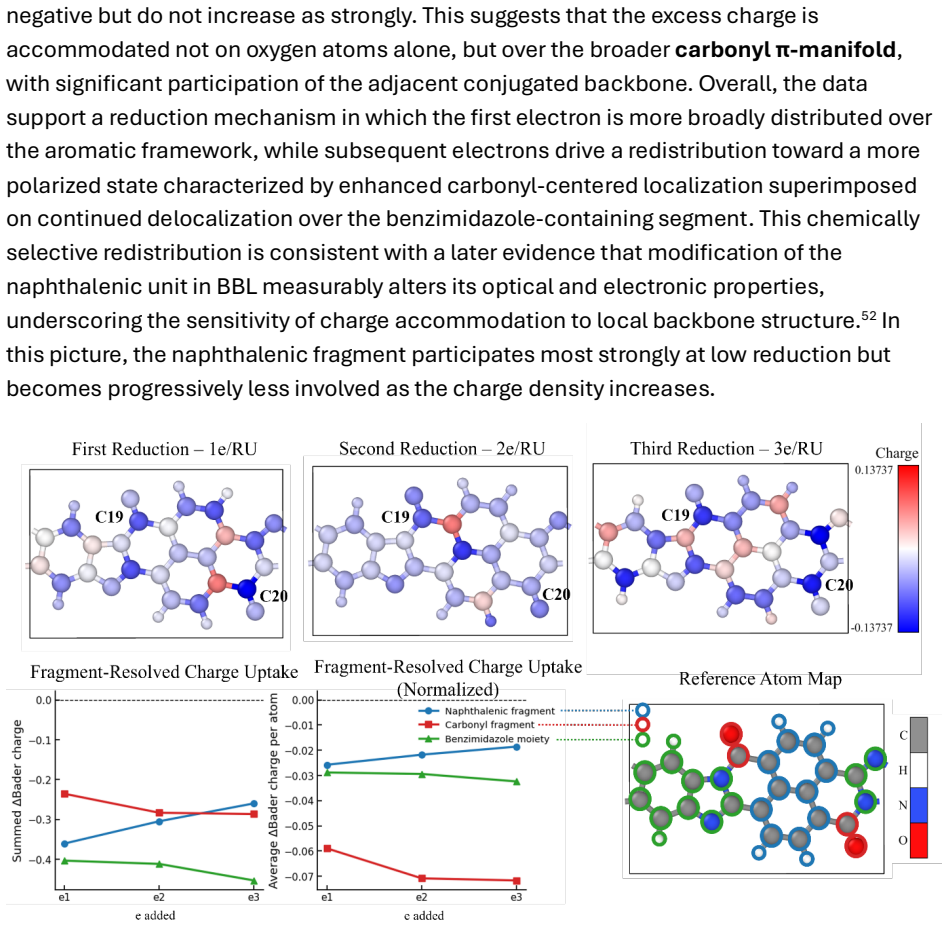
Converging theoretical evidence demonstrates that bell shaped conductivity in BBL originates in its fundamental electronic structure and supramolecular organization. The redox response is not simply monotonic but follows an alternating odd/even pattern in which gap narrowing and reopening occur sequentially before near-gapless behavior emerges at high charging.
What carries the argument
The odd/even alternation in band-gap response to sequential electron addition, produced by the conjugated ladder-type structure and chain packing of BBL.
If this is right
- Anti-ambipolar device response can be tuned by targeting specific intermediate charge states where the gap is narrowest.
- Supramolecular packing directly modulates the position and height of the conductivity peak.
- Electron-transfer rates calculated via Marcus theory vary systematically with the observed gap changes.
- Near-gapless states at high charging imply metallic-like behavior in heavily doped BBL.
- The pattern is expected to appear in other ladder-type conjugated polymers sharing the same electronic symmetry.
Where Pith is reading between the lines
- The same odd-even mechanism may operate in related ladder polymers, offering a design rule for anti-ambipolar materials.
- Morphology control during film processing could shift the charge level at which the conductivity maximum occurs.
- Spectroscopic probes of the gap at successive doping levels would provide a direct test independent of transport measurements.
- Extension to other redox-active conjugated systems could reveal whether the alternation requires the specific BBL backbone symmetry.
Load-bearing premise
The computational models accurately capture the redox response and structural dynamics of BBL without significant artifacts from functional choice, basis set, or periodic boundary conditions.
What would settle it
Experimental measurement of conductivity versus doping level in BBL films that shows a clear bell shape with evidence of gap reopening at even numbers of added electrons rather than steady monotonic closure.
Figures
read the original abstract
We examine the intrinsic physical-chemical properties of the conjugated ladder-type polymer poly(benzimidazobenzophenanthroline) (BBL) in response to electron transfer. We aim at explaining the origin of the anti-ambipolar behavior behind the observed BBL nonlinear response associated with specific device architectures. To elucidate this point, we use theory and computation based on first principles, including density functional theory optimizations, ab initio molecular dynamics, time-dependent DFT, and Marcus-theory analysis. Our results reveal that this redox response is not simply monotonic but follows an alternating odd/even pattern in which gap narrowing and reopening occur sequentially before near-gapless behavior emerges at high charging. Converging theoretical evidence in this work demonstrates that bell shaped conductivity in BBL originates in its fundamental electronic structure and supramolecular organization.
Editorial analysis
A structured set of objections, weighed in public.
Referee Report
Summary. The manuscript investigates the anti-ambipolar behavior of the BBL ladder polymer in response to electron transfer. Using DFT geometry optimizations, AIMD, TDDFT, and Marcus-theory rate calculations, it identifies an alternating odd/even pattern of gap narrowing and reopening that produces bell-shaped conductivity; the authors conclude that this response is intrinsic to the electronic structure and supramolecular organization rather than an extrinsic device effect.
Significance. If the computational results hold, the work supplies a first-principles account of nonlinear conductivity in a conjugated ladder polymer and demonstrates that multiple independent methods (DFT, AIMD, TDDFT, Marcus) converge on the same odd/even gap pattern. The explicit controls over functional choice, finite versus periodic models, and explicit rate calculations constitute a strength.
minor comments (3)
- [§3] §3 (Computational Details): the basis-set and functional convergence tests are mentioned but not tabulated; a short supplementary table listing HOMO-LUMO gaps for B3LYP, PBE0, and HSE06 with 6-31G(d) versus def2-TZVP would strengthen the claim that the odd/even pattern is robust.
- [Figure 4] Figure 4: the Marcus reorganization energies are plotted versus charge state, but the corresponding electronic coupling values (V) are only stated in the text; overlaying V on the same panel would make the rate-limiting step clearer.
- [Abstract] The abstract states 'near-gapless behavior at high charging' without quoting the numerical gap value or the charge per repeat unit at which this occurs; adding these numbers would improve precision.
Simulated Author's Rebuttal
We thank the referee for the thorough and positive assessment of our work on the origins of anti-ambipolarity in BBL. The recommendation for minor revision is noted. No specific major comments were provided in the report, so we have no individual points to address at this stage. We remain available to incorporate any additional feedback.
Circularity Check
No significant circularity detected
full rationale
The paper's derivation relies on standard first-principles computations (DFT optimizations, AIMD, TDDFT, Marcus theory) applied to BBL to reveal an odd/even gap pattern and link it to bell-shaped conductivity. No equations, fitted parameters, or self-citations are presented in the abstract or described claims that reduce any prediction to its inputs by construction. The central claim emerges from independent computational outputs rather than self-definitional loops, renamed empirical patterns, or load-bearing self-citations. The derivation chain is self-contained and does not exhibit any of the enumerated circularity patterns.
Axiom & Free-Parameter Ledger
Reference graph
Works this paper leans on
-
[1]
35 (4) Chicca, E.; Stefanini, F.; Bartolozzi, C.; Indiveri, G
DOI: 10.1109/FG61629.2025.11099243. 35 (4) Chicca, E.; Stefanini, F.; Bartolozzi, C.; Indiveri, G. Neuromorphic Electronic Circuits for Building Autonomous Cognitive Systems. Proceedings of the IEEE 2014, 102 (9), 1367–
-
[2]
(5) Strakosas, X.; Bongo, M.; Owens, R
DOI: 10.1109/JPROC.2014.2313954. (5) Strakosas, X.; Bongo, M.; Owens, R. M. The organic electrochemical transistor for biological applications. Journal of Applied Polymer Science 2015, 132 (15). DOI: https://doi.org/10.1002/app.41735 (accessed 2026/05/17). (6) Indiveri, G.; Linares-Barranco, B.; Hamilton, T. J.; van Schaik, A.; Etienne-Cummings, R.; Delbr...
-
[3]
(22) Karpourazar, N.; Abady, K
DOI: 10.1021/acs.macromol.2c01190. (22) Karpourazar, N.; Abady, K. K.; Rentzepis, P . M. Portable, cost-effective UV–vis-NIR microspectrophotometer for absorption and fluorescence microscopy and spectroscopy. Measurement 2025, 256, 118224. DOI: https://doi.org/10.1016/j.measurement.2025.118224. (23) Fazzi, D.; Negri, F . Addressing the Elusive Polaronic N...
-
[4]
DOI: 10.1134/S1063739723700531
discussion (0)
Sign in with ORCID, Apple, or X to comment. Anyone can read and Pith papers without signing in.