Enhanced Loading of a Molecular Magneto-Optical Trap
Pith reviewed 2026-06-28 23:35 UTC · model grok-4.3
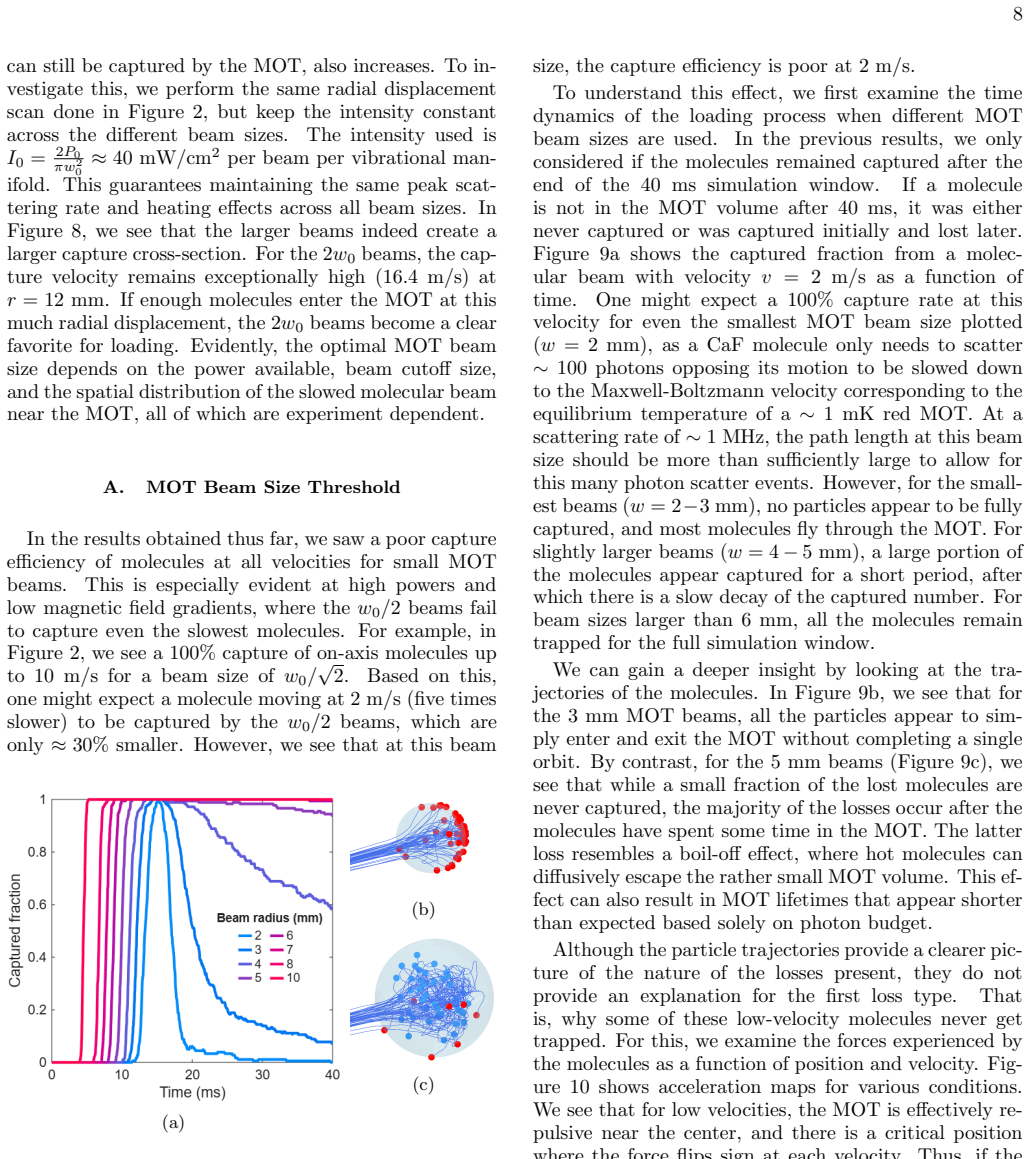
The pith
A CaF molecular MOT traps 1.5 million molecules after Monte Carlo-guided optimization of capture velocity.
A machine-rendered reading of the paper's core claim, the machinery that carries it, and where it could break.
Core claim
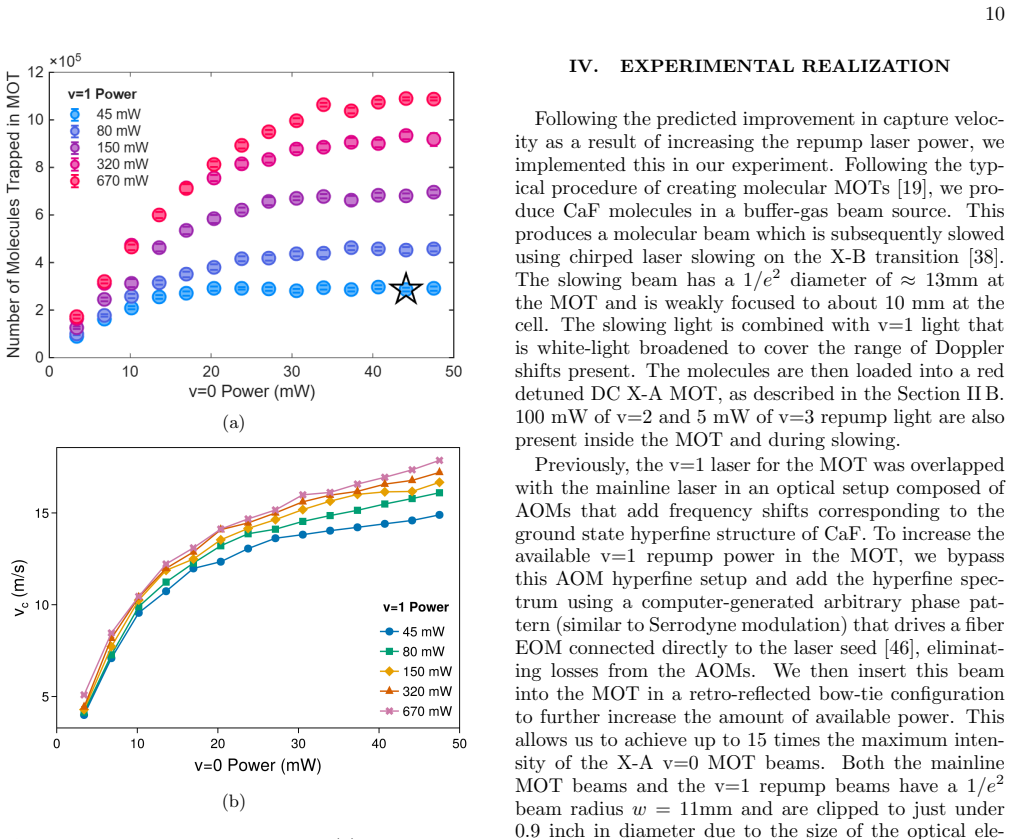
We demonstrate a molecular MOT with 1.5 million trapped molecules. This represents an eight-fold improvement and is an important step toward achieving quantum degeneracy with laser cooled molecules. The gain follows from using a Stochastic Schrödinger Equation Monte Carlo model to map capture-velocity limits, select improved operating parameters, and identify a loss mechanism intrinsic to molecular MOTs that should be avoided.
What carries the argument
Stochastic Schrödinger Equation Monte Carlo model of the CaF DC MOT, used to quantify capture velocity and locate parameter regimes that increase loading while avoiding intrinsic loss.
If this is right
- Molecular MOTs for other species can adopt the same modeling approach to raise capture velocity.
- Avoiding the identified loss regimes reduces background decay rates in any DC molecular MOT.
- Larger trapped samples enable subsequent stages of cooling and compression that were previously statistics-limited.
- The eight-fold gain narrows the particle-number gap between molecular and atomic MOTs.
Where Pith is reading between the lines
- If the same modeling workflow scales to other laser-coolable molecules, the field could move from proof-of-principle trapping to routine production of degenerate molecular gases.
- The intrinsic loss channel may set a practical upper bound on MOT density even after capture velocity is optimized, suggesting a need for new trap geometries or repumping schemes.
- Combining the higher initial number with existing sub-Doppler cooling techniques could shorten the time to reach phase-space densities near quantum degeneracy.
Load-bearing premise
The Monte Carlo model correctly identifies the dominant mechanisms that set capture velocity and the main intrinsic loss channel, so that the parameter changes it recommends produce the observed experimental gain.
What would settle it
Re-running the experiment with the exact parameter set predicted by the model but observing no substantial increase (or an increase much smaller than eight-fold) in the steady-state number of trapped molecules would falsify the claim that the modeled mechanisms control loading.
Figures



read the original abstract
Molecular magneto-optical traps (MOTs) typically capture orders of magnitude fewer particles than their atomic counterparts due in part to their significantly lower capture velocities. Here, we employ a Stochastic Schr\"odinger Equation Monte Carlo approach to model a CaF DC MOT to understand the factors limiting capture velocity. We provide physical intuition into the mechanisms that affect capture velocity and identify important parameters and general strategies to improve it. In addition, we point out a loss mechanism intrinsic to molecular MOTs and determine parameter regimes that should be avoided experimentally. We benchmark our simulations against a CaF DC MOT and experimentally implement the improvements predicted by our model. In doing so, we demonstrate a molecular MOT with 1.5 million trapped molecules. This represents an eight-fold improvement and is an important step toward achieving quantum degeneracy with laser cooled molecules.
Editorial analysis
A structured set of objections, weighed in public.
Referee Report
Summary. The manuscript uses a Stochastic Schrödinger Equation Monte Carlo simulation to model capture-velocity limits and an intrinsic loss channel in a CaF DC MOT, derives general strategies for improvement, benchmarks the model against a prior CaF DC MOT, and implements the predicted parameter changes to experimentally realize a MOT containing 1.5 million molecules—an eight-fold increase.
Significance. The experimental demonstration of 1.5 million trapped molecules constitutes a clear advance for molecular laser cooling. The work supplies both physical intuition from the model and a concrete, reproducible loading improvement that moves the field closer to the particle numbers needed for quantum degeneracy studies. The direct experimental implementation of model-guided changes is a strength.
major comments (1)
- [Benchmarking statement (abstract and methods)] The abstract states that the model was benchmarked against an existing CaF DC MOT before the improvements were implemented, yet no quantitative metrics (capture-velocity agreement, loss-rate discrepancy, or sensitivity to unmodeled effects) are supplied. Because the central claim attributes the observed eight-fold gain to the model-identified parameter changes, the absence of these metrics leaves open the possibility that the gain arose from unpredicted factors.
minor comments (2)
- A short table or paragraph listing the specific parameter values before and after the model-guided changes, together with the measured molecule number and uncertainty, would strengthen the experimental claim.
- The abstract mentions an 'intrinsic loss mechanism' but does not name the dominant channel or the parameter regime to be avoided; a single sentence clarifying this would improve accessibility.
Simulated Author's Rebuttal
We thank the referee for their positive assessment of the work and recommendation for minor revision. We address the major comment below.
read point-by-point responses
-
Referee: [Benchmarking statement (abstract and methods)] The abstract states that the model was benchmarked against an existing CaF DC MOT before the improvements were implemented, yet no quantitative metrics (capture-velocity agreement, loss-rate discrepancy, or sensitivity to unmodeled effects) are supplied. Because the central claim attributes the observed eight-fold gain to the model-identified parameter changes, the absence of these metrics leaves open the possibility that the gain arose from unpredicted factors.
Authors: We agree that the manuscript would be strengthened by the inclusion of explicit quantitative benchmarking metrics. The current text states that benchmarking was performed but does not report specific numbers for capture-velocity agreement or loss-rate comparison with the prior experiment. In the revised manuscript we will add a dedicated paragraph (or table) in the methods or results section that directly compares the simulated capture velocity and loss rates to the values measured in the benchmarked CaF DC MOT, along with any available sensitivity checks. This addition will make the link between the model predictions and the observed eight-fold improvement more transparent. revision: yes
Circularity Check
No significant circularity; experimental result independent of model
full rationale
The paper's central claim is an experimental demonstration of 1.5 million trapped molecules (eight-fold gain) achieved by implementing parameter changes identified via Stochastic Schrödinger Equation Monte Carlo simulations. The simulations are benchmarked against prior experiment before the changes are applied, and the final number is measured directly in the lab. No load-bearing step reduces by construction to a fitted parameter, self-citation chain, or renamed input; the reported improvement is an external measurement rather than a statistical consequence of the model fit itself. This is the normal case of a simulation-guided experiment whose outcome remains falsifiable outside the model's equations.
Axiom & Free-Parameter Ledger
Reference graph
Works this paper leans on
-
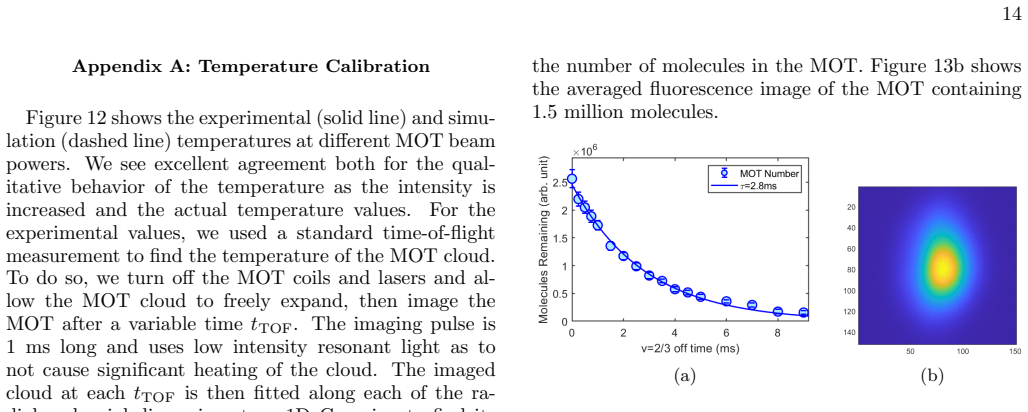
[1]
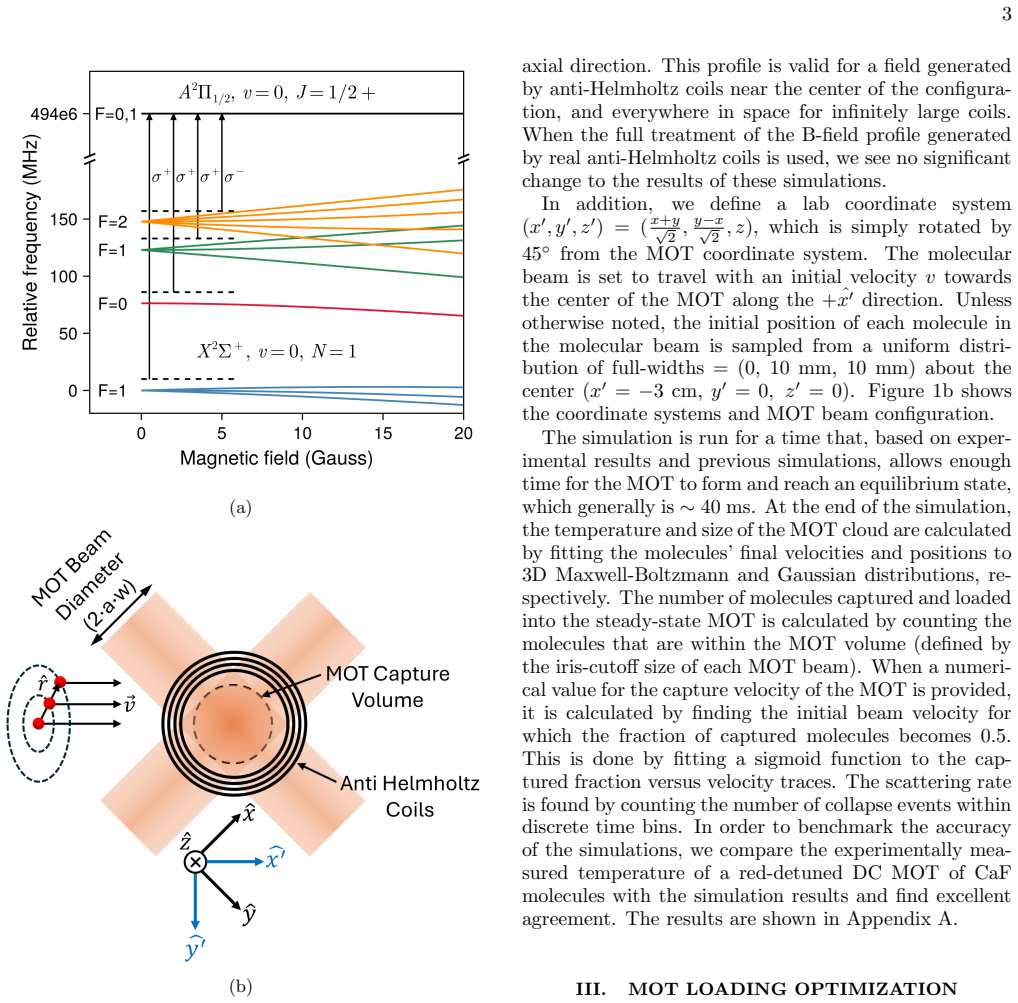
The global v=0 detuning ∆ is set to -10 MHz, which is≈1.2 Γ/(2π)
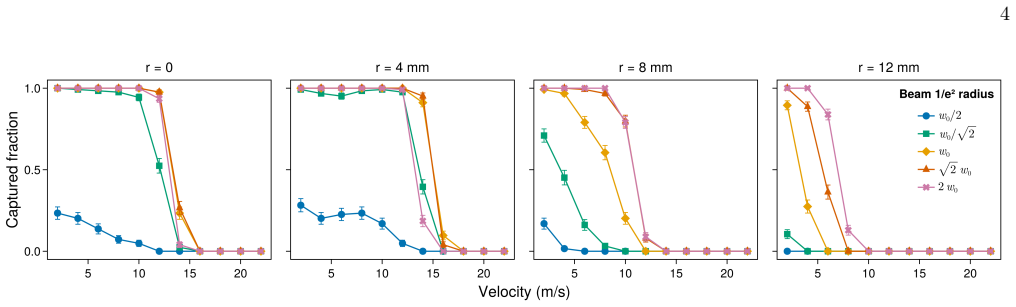
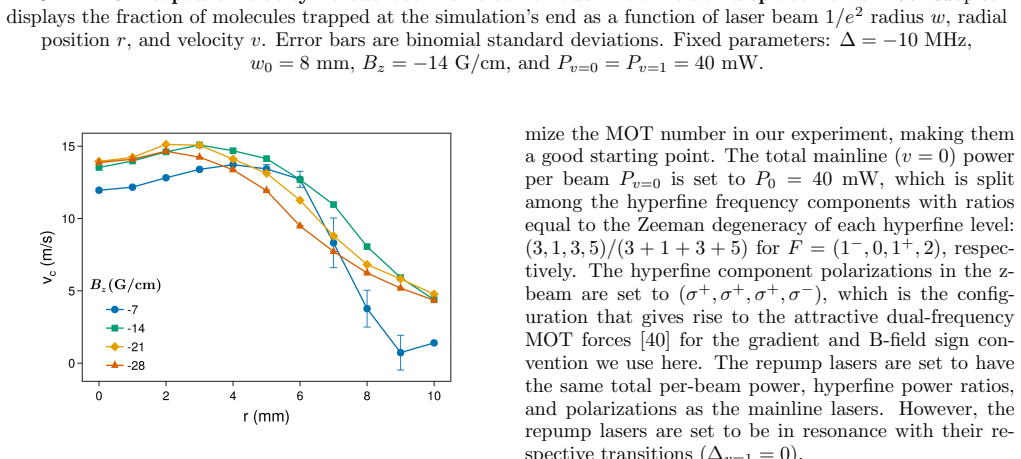
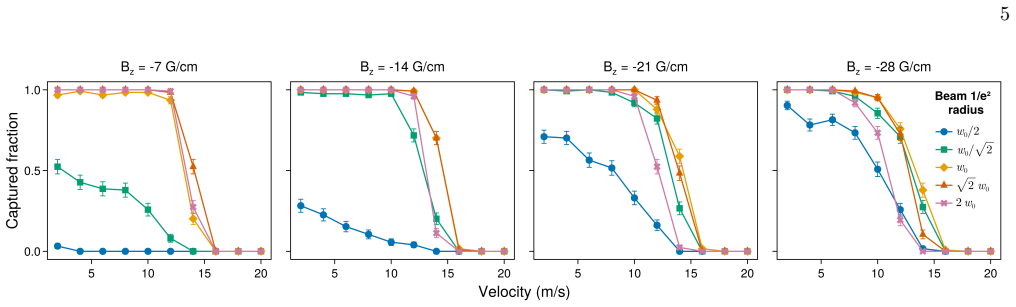
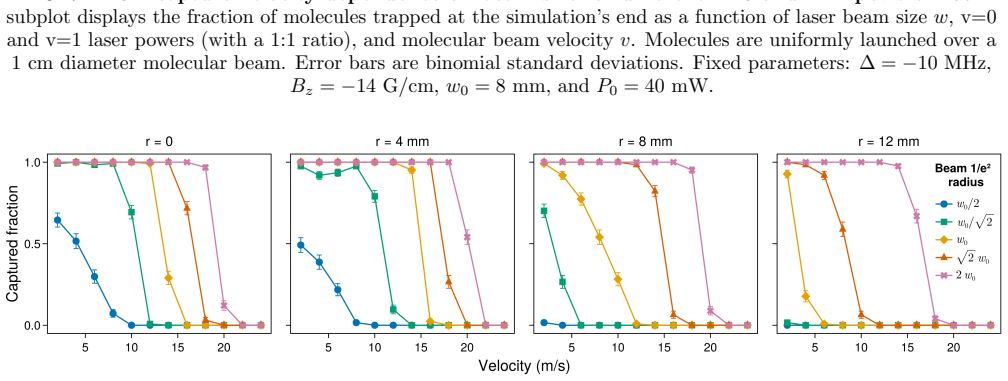
= (−3 cm, r/ √ 2, r/ √ 2), whereris the radial displacement of the molecule from thex ′ axis. The global v=0 detuning ∆ is set to -10 MHz, which is≈1.2 Γ/(2π). The axial magnetic field gradient Bz is set to -14 G/cm. These values of global detuning and magnetic field gradient are ones that roughly maxi- mize the MOT number in our experiment, making them a...
-
[2]
However, we see that at this beam (a) (b) (c) FIG
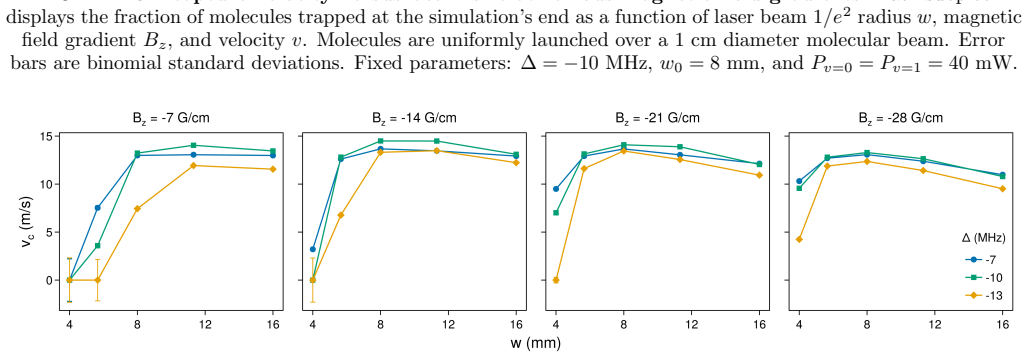
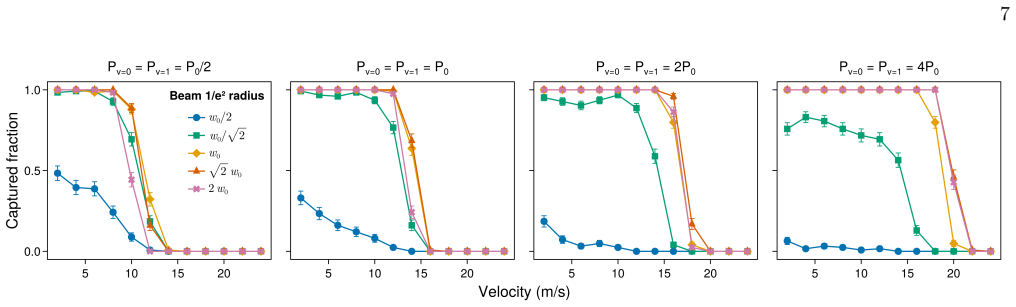
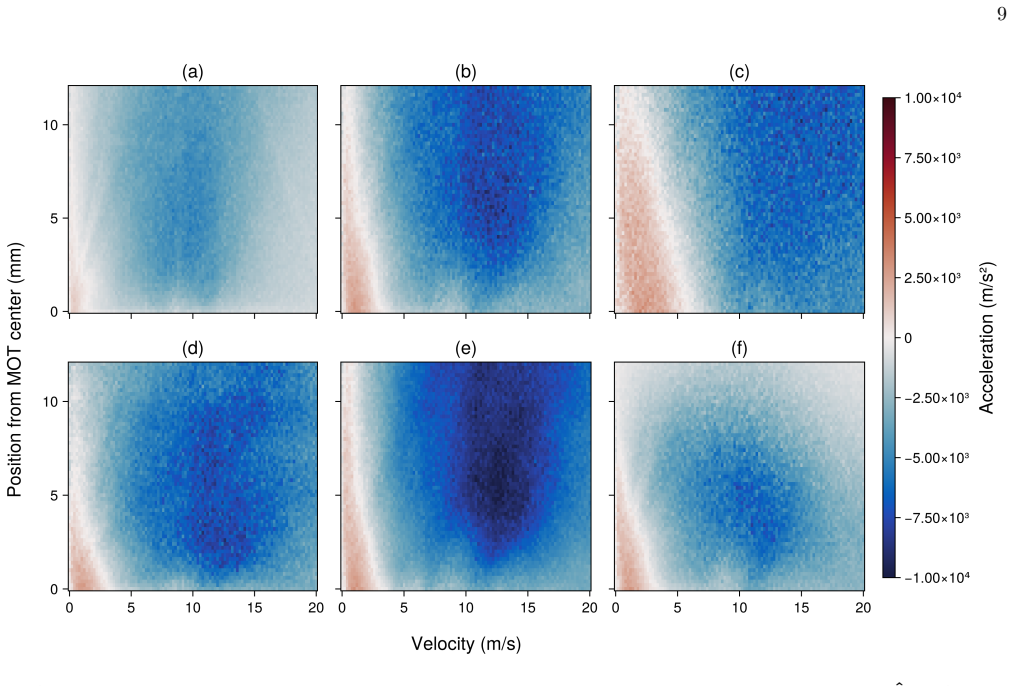
Based on this, one might expect a molecule moving at 2 m/s (five times slower) to be captured by thew 0/2 beams, which are only≈30% smaller. However, we see that at this beam (a) (b) (c) FIG. 9:Beam size threshold and heating losses. (a) Time evolution of the captured fraction of 2 m/s molecules as a function of beam size. We use a beam cutoff factora= 1....
-
[3]
DeMille, Quantum computation with trapped polar molecules, Physical Review Letters88, 067901 (2002)
D. DeMille, Quantum computation with trapped polar molecules, Physical Review Letters88, 067901 (2002)
2002
-
[4]
A. M. Kaufman and K.-K. Ni, Quantum science with optical tweezer arrays of ultracold atoms and molecules, Nature Physics17, 1324 (2021)
2021
-
[5]
Micheli, G
A. Micheli, G. K. Brennen, and P. Zoller, A toolbox for lattice-spin models with polar molecules, Nature Physics 2, 341 (2006)
2006
-
[6]
S. L. Cornish, M. R. Tarbutt, and K. R. Hazzard, Quan- tum simulation with ultracold molecules, Nature Physics 20, 730 (2024)
2024
-
[7]
M. T. Bell and T. P. Softley, Ultracold molecules and ultracold chemistry, Molecular Physics107, 99 (2009)
2009
-
[8]
DeMille, N
D. DeMille, N. R. Hutzler, I. Kozyryev, and C. Ospelkaus, Quantum precision measurement with molecules, Nature Physics20, 741 (2024)
2024
-
[9]
N. R. Hutzler, Polyatomic molecules as quantum sensors for fundamental physics, Quantum Science and Technol- ogy5, 044011 (2020)
2020
-
[10]
J. F. Barry, D. J. McCarron, E. B. Norrgard, M. H. Stei- necker, and D. DeMille, Magneto-optical trapping of a diatomic molecule, Nature512, 286 (2014)
2014
-
[11]
Truppe, H
S. Truppe, H. J. Williams, M. Hambach, L. Caldwell, N. J. Fitch, E. A. Hinds, B. E. Sauer, and M. R. Tarbutt, Molecules cooled below the doppler limit, Nature Physics 13, 1173 (2017)
2017
-
[12]
Anderegg, B
L. Anderegg, B. L. Augenbraun, E. Chae, B. Hemmer- ling, N. R. Hutzler, A. Ravi, A. Collopy, J. Ye, W. Ket- terle, and J. M. Doyle, Radio frequency magneto-optical trapping of caf with high density, Physical Review Let- ters119, 103201 (2017)
2017
-
[13]
A. L. Collopy, S. Ding, Y. Wu, I. A. Finneran, L. An- deregg, B. L. Augenbraun, J. M. Doyle, and J. Ye, 3d magneto-optical trap of yttrium monoxide, Physical Re- view Letters121, 213201 (2018)
2018
-
[14]
L. W. Cheuk, L. Anderegg, B. L. Augenbraun, Y. Bao, S. Burchesky, W. Ketterle, and J. M. Doyle,λ-enhanced imaging of molecules in an optical trap, Physical Review Letters121, 083201 (2018)
2018
-
[15]
Caldwell, J
L. Caldwell, J. Devlin, H. Williams, N. Fitch, E. Hinds, B. Sauer, and M. Tarbutt, Deep laser cooling and efficient magnetic compression of molecules, Physical Review Let- ters123, 033202 (2019)
2019
-
[16]
N. B. Vilas, C. Hallas, L. Anderegg, P. Robichaud, A. Winnicki, D. Mitra, and J. M. Doyle, Magneto- optical trapping and sub-doppler cooling of a polyatomic molecule, Nature606, 70 (2022)
2022
-
[17]
J. J. Burau, P. Aggarwal, K. Mehling, and J. Ye, Blue- detuned magneto-optical trap of molecules, Physical Re- view Letters130, 193401 (2023)
2023
-
[18]
Z. Zeng, S. Deng, S. Yang, and B. Yan, Three- dimensional magneto-optical trapping of barium monofluoride, Physical Review Letters133, 143404 (2024)
2024
-
[19]
J. Padilla-Castillo, J. Cai, P. Agarwal, P. Kukreja, R. Thomas, B. Sartakov, S. Truppe, G. Meijer, and S. Wright, Magneto-optical trapping of alu- minum monofluoride, Physical Review Letters135, 10.1103/ksnd-9fyf (2025)
-
[20]
C. Hallas, G. K. Li, N. B. Vilas, P. Robichaud, L. An- deregg, and J. M. Doyle, High compression blue-detuned magneto-optical trap of polyatomic molecules, Physical Review Letters136, 10.1103/w9qc-rczf (2026)
-
[21]
Fitch and M
N. Fitch and M. Tarbutt, Chapter three - laser-cooled molecules (Academic Press, 2021) pp. 157–262
2021
-
[22]
B. L. Augenbraun, L. Anderegg, C. Hallas, Z. D. Las- ner, N. B. Vilas, and J. M. Doyle, Direct laser cooling of polyatomic molecules, inAdvances in Atomic, Molecu- lar, and Optical Physics, Advances In Atomic, Molecular, and Optical Physics, Vol. 72, edited by L. F. DiMauro, H. Perrin, and S. F. Yelin (Academic Press, 2023) pp. 89–182
2023
-
[23]
Jarvis, J
K. Jarvis, J. Devlin, T. Wall, B. Sauer, and M. Tar- butt, Blue-detuned magneto-optical trap, Physical Re- view Letters120, 083201 (2018)
2018
-
[24]
G. K. Li, C. Hallas, and J. M. Doyle, Conveyor-belt magneto-optical trapping of molecules, New J. Phys.27, 043002 (2025)
2025
-
[25]
Z. Zeng, S. Yang, S. Deng, and B. Yan, Direct loading of baf molecules with a conveyor-belt magneto-optical trap, Physical Review Letters136, 10.1103/pd77-s994 (2026)
-
[26]
S. Yuet al., A conveyor-belt magneto-optical trap of caf, arXiv preprint arXiv:2409.15262 (2024), arXiv:2409.15262
-
[27]
Bigagli, W
N. Bigagli, W. Yuan, S. Zhang, B. Bulatovic, T. Karman, I. Stevenson, and S. Will, Observation of bose–einstein condensation of dipolar molecules, Nature631, 289 (2024)
2024
-
[28]
Gadway and B
B. Gadway and B. Yan, Strongly interacting ultracold polar molecules, Journal of Physics B: Atomic, Molecular and Optical Physics49, 152002 (2016)
2016
-
[29]
Langen, J
T. Langen, J. Boronat, J. S´ anchez-Baena, R. Bomb´ ın, T. Karman, and F. Mazzanti, Dipolar droplets of strongly interacting molecules, Physical Review Letters134, 053001 (2025)
2025
-
[30]
Schindewolf, J
A. Schindewolf, J. Hertkorn, I. Stevenson, M. Ciardi, P. Gross, D. Wang, T. Karman, G. Quemener, S. Will, T. Pohl, and T. Langen, From few- to many-body physics: Strongly dipolar molecular bose-einstein con- densates and quantum fluids (2025)
2025
-
[31]
M. S. Safronova, D. Budker, D. DeMille, D. F. J. Kimball, A. Derevianko, and C. W. Clark, Search for new physics with atoms and molecules, Reviews of Modern Physics 90, 025008 (2018)
2018
-
[32]
Anderegg, L
L. Anderegg, L. W. Cheuk, Y. Bao, S. Burchesky, W. Ketterle, K.-K. Ni, and J. M. Doyle, An optical tweezer array of ultracold molecules, Science365, 1156 (2019)
2019
-
[33]
J. T. Zhang, L. R. B. Picard, W. B. Cairncross, K. Wang, Y. Yu, F. Fang, and K.-K. Ni, An optical tweezer array of ground-state polar molecules, Quantum Science and Technology7, 035006 (2022)
2022
-
[34]
C. M. Holland, Y. Lu, and L. W. Cheuk, On-demand entanglement of molecules in a reconfigurable optical tweezer array, Science382, 1143 (2023)
2023
-
[35]
N. B. Vilas, P. Robichaud, C. Hallas, G. K. Li, L. An- deregg, and J. M. Doyle, An optical tweezer array of ul- tracold polyatomic molecules, Nature628, 282 (2024)
2024
-
[36]
N. R. Hutzler, H.-I. Lu, and J. M. Doyle, The buffer gas beam: An intense, cold, and slow source for atoms and molecules, Chemical Reviews112, 4803 (2012)
2012
-
[37]
S. C. Wright, M. Doppelbauer, S. Hofs¨ ass, H. Chris- 13 tian Schewe, B. Sartakov, G. Meijer, and S. Truppe, Cryogenic buffer gas beams of alf, caf, mgf, ybf, al, ca, yb and no – a comparison, Molecular Physics121, 10.1080/00268976.2022.2146541 (2022)
-
[38]
J. F. Barry, E. S. Shuman, E. B. Norrgard, and D. De- Mille, Laser radiation pressure slowing of a molecular beam, Physical Review Letters108, 103002 (2012)
2012
-
[39]
Hemmerling, E
B. Hemmerling, E. Chae, A. Ravi, L. Anderegg, G. K. Drayna, N. R. Hutzler, A. L. Collopy, J. Ye, W. Ket- terle, and J. M. Doyle, Laser slowing of caf molecules to near the capture velocity of a molecular mot, Journal of Physics B: Atomic, Molecular and Optical Physics49, 174001 (2016)
2016
-
[40]
Truppe, H
S. Truppe, H. J. Williams, N. J. Fitch, M. Hambach, T. E. Wall, E. A. Hinds, B. E. Sauer, and M. R. Tarbutt, An intense, cold, velocity-controlled molecular beam by frequency-chirped laser slowing, New Journal of Physics 19, 022001 (2017)
2017
-
[41]
M. R. Tarbutt, Magneto-optical trapping forces for atoms and molecules with complex level structures, New Jour- nal of Physics17, 015007 (2015)
2015
-
[42]
M. R. Tarbutt and T. C. Steimle, Modeling magneto- optical trapping of caf molecules, Physical Review A92, 053401 (2015)
2015
-
[43]
J. A. Devlin and M. R. Tarbutt, Three-dimensional doppler, polarization-gradient, and magneto-optical forces for atoms and molecules with dark states, New Journal of Physics18, 123017 (2016)
2016
-
[44]
J. A. Devlin and M. R. Tarbutt, Laser cooling and magneto-optical trapping of molecules analyzed using optical bloch equations and the fokker-planck-kramers equation, Physical Review A98, 063415 (2018)
2018
-
[45]
T. K. Langin and D. DeMille, Toward improved loading, cooling, and trapping of molecules in magneto-optical traps, New Journal of Physics25, 043005 (2023)
2023
-
[46]
J. D. Klaus Molmer, Yvan Castin, Monte carlo wave- function method in quantum optics, Journal of the Op- tical Society of America10, 524 (1993)
1993
-
[47]
K. M. Jean Dalibard, Yvan Castin, Wave-function ap- proach to dissipative processes in quantum optics, Phys- ical Review Letters68, 580 (1992)
1992
-
[48]
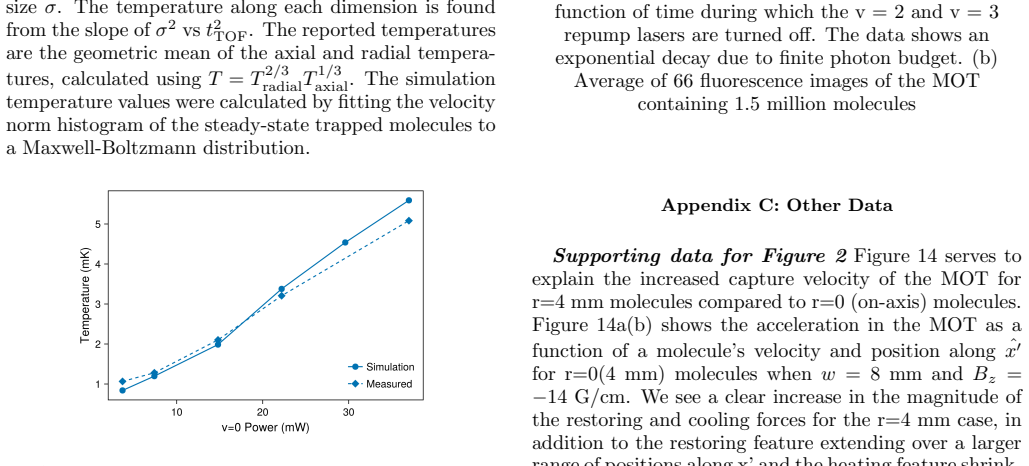
C. M. Holland, Y. Lu, and L. W. Cheuk, Synthesizing op- tical spectra using computer-generated holography tech- niques, New Journal of Physics23, 033028 (2021). 14 Appendix A: T emperature Calibration Figure 12 shows the experimental (solid line) and simu- lation (dashed line) temperatures at different MOT beam powers. We see excellent agreement both for ...
2021
-
[49]
This corresponds to a scattering rate of 480 kHz at the imaging parameters
An exponential fit to the decay timescale yields a lifetime ofτ= 2.8ms, Figure 13a. This corresponds to a scattering rate of 480 kHz at the imaging parameters. The florescence from the MOT is captured onto an EM- CCD camera. We calibrated the imaging system to con- vert camera counts to photons. With this information, and using a 5 ms exposure imaging pul...
discussion (0)
Sign in with ORCID, Apple, or X to comment. Anyone can read and Pith papers without signing in.