Detecting bipartite entanglement with PnCP maps and non-negative polynomials
Pith reviewed 2026-06-29 06:38 UTC · model grok-4.3
The pith
Maps from positive non-sum-of-squares polynomials detect bipartite entangled states missed by most other tests.
A machine-rendered reading of the paper's core claim, the machinery that carries it, and where it could break.
Core claim
The maps generated from the polynomial construction are indecomposable PnCP maps that sit on the boundary of the positive cone and are inequivalent to most known PnCP maps. These maps have sufficient entanglement power to detect PPT entangled states that most other criteria fail to detect.
What carries the argument
PnCP maps obtained by converting positive non-sum-of-squares polynomials into linear maps on density operators, which act as entanglement witnesses when the output fails to be positive.
If this is right
- The maps are indecomposable.
- They lie on the boundary of the positive cone.
- They are inequivalent to most other known PnCP maps.
- They detect PPT entangled states that most criteria fail to detect.
Where Pith is reading between the lines
- Combining several such maps could raise the fraction of detectable PPT states beyond what single-map criteria achieve.
- The same polynomial route might produce witnesses for multipartite or continuous-variable systems if the construction generalizes.
- The numerical robustness of the implementation makes it feasible to scan many random states and measure the fraction of newly detected entanglement.
Load-bearing premise
The algorithm produces actual PnCP maps whose indecomposability, boundary location, and numerical detection performance on PPT states hold as claimed.
What would settle it
An explicit decomposition of any generated map into a sum of a completely positive map and a positive map, or a concrete PPT state on which the map returns a non-negative value despite the numerical tests.
Figures




read the original abstract
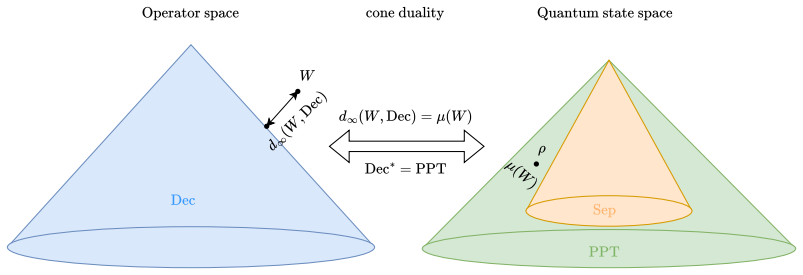
Positive non-Completely Positive (PnCP) maps are an essential tool to detect entanglement since their characterization is a dual aspect of the separability problem. A recent algorithm proposed by Kelp et al. explains how to generate PnCP maps based on the construction of certain positive non-Sum-of-Squares polynomials. We implement this algorithm in a numerically robust way and propose a working version on GitHub. We theoretically demonstrate that the maps produced by the algorithm are indecomposable, localized on the boundary of the positive cone and show that they are inequivalent with most other known PnCP maps. We numerically investigate their entanglement power, demonstrating notably that they are capable of detecting PPT entangled states that most criteria fail to detect.
Editorial analysis
A structured set of objections, weighed in public.
Referee Report
Summary. The paper implements the Kelp et al. algorithm for constructing PnCP maps from positive non-sum-of-squares polynomials in a numerically robust manner, releasing the code on GitHub. It theoretically establishes that the generated maps are indecomposable and lie on the boundary of the positive cone, demonstrates their inequivalence to most known PnCP maps, and provides numerical evidence that these maps detect certain PPT entangled states missed by other criteria.
Significance. If the theoretical demonstrations hold, the work supplies new explicit examples of indecomposable PnCP maps with demonstrated utility for PPT entanglement detection, complementing existing criteria. The open-source code release is a clear strength that supports reproducibility and further investigation in quantum information.
minor comments (2)
- [Abstract] Abstract: the claim of inequivalence 'with most other known PnCP maps' should be made precise by stating the number of maps compared and the criteria used for inequivalence.
- The manuscript should include the exact GitHub repository URL in the main text (not only the abstract) to ensure accessibility.
Simulated Author's Rebuttal
We thank the referee for the positive assessment of our work, the recognition of its significance in providing new explicit indecomposable PnCP maps and the open-source code, and the recommendation for minor revision. No specific major comments were provided in the report.
Circularity Check
No significant circularity in derivation chain
full rationale
The paper's core workflow implements the external Kelp et al. algorithm to construct PnCP maps from positive non-Sum-of-Squares polynomials, then supplies independent theoretical proofs of indecomposability, boundary localization, and inequivalence, plus numerical entanglement-power tests on PPT states. No step reduces a claimed prediction or property to a fitted parameter, self-definition, or load-bearing self-citation; the cited algorithm is treated as an external black box whose outputs are analyzed separately. Open GitHub code further decouples the numerical results from any internal fitting loop. The derivation chain therefore remains self-contained against external benchmarks.
Axiom & Free-Parameter Ledger
axioms (1)
- domain assumption Duality between separability problem and characterization of PnCP maps
Reference graph
Works this paper leans on
-
[1]
There are many more positive maps than completely positive maps
Igor Klep, Scott McCullough, Klemen Šivic, and Aljaž Zalar. “There are many more positive maps than completely positive maps”. International Mathematics Research Notices2019, 3313–3375 (2017)
2017
-
[2]
Quan- tum entanglement
RyszardHorodecki, PawełHorodecki, MichałHorodecki, andKarolHorodecki. “Quan- tum entanglement”. Rev. Mod. Phys.81, 865–942 (2009)
2009
-
[3]
Quantum resource theories
Eric Chitambar and Gilad Gour. “Quantum resource theories”. Rev. Mod. Phys.91, 025001 (2019)
2019
-
[4]
Complete family of separability criteria
Andrew C. Doherty, Pablo A. Parrilo, and Federico M. Spedalieri. “Complete family of separability criteria”. Physical Review A69(2004)
2004
-
[5]
Strong NP-Hardness of the Quantum Separability Problem
Sevag Gharibian. “Strong np-hardness of the quantum separability problem” (2009). arXiv:0810.4507
work page internal anchor Pith review Pith/arXiv arXiv 2009
-
[6]
Hamza Fawzi. “The set of separable states has no finite semidefinite representation except in dimension3×2” (2019). arXiv:1905.02575
work page internal anchor Pith review Pith/arXiv arXiv 2019
-
[8]
Reduction criterion of separability and limits for a class of distillation protocols
Michał Horodecki and Paweł Horodecki. “Reduction criterion of separability and limits for a class of distillation protocols”. Phys. Rev. A59, 4206–4216 (1999)
1999
-
[9]
A matrix realignment method for recognizing entanglement
Kai Chen and Ling-An Wu. “A matrix realignment method for recognizing entangle- ment” (2003). arXiv:quant-ph/0205017
work page internal anchor Pith review Pith/arXiv arXiv 2003
-
[10]
Entanglement detection
Otfried Gühne and Géza Tóth. “Entanglement detection”. Physics Reports474, 1–75 (2009)
2009
-
[11]
A Class of Linear Positive Maps in Matrix Algebras
Andrzej Kossakowski. “A class of linear positive maps in matrix algebras” (2003). arXiv:quant-ph/0307132
work page internal anchor Pith review Pith/arXiv arXiv 2003
-
[12]
A class of atomic positive linear maps in matrix algebras
Kil-Chan Ha. “A class of atomic positive linear maps in matrix algebras”. Linear Algebra and its Applications359, 277–290 (2003)
2003
-
[13]
Optimalentanglementcriterionformixedquantumstates
Heinz-PeterBreuer. “Optimalentanglementcriterionformixedquantumstates”. Phys. Rev. Lett.97, 080501 (2006)
2006
-
[14]
A new criterion for indecomposability of positive maps
William Hall. “A new criterion for indecomposability of positive maps”. Journal of Physics A: Mathematical and General39, 14119 (2006)
2006
-
[15]
Revealing hidden physical nonclassicality with non-negative polynomials
Ties-A. Ohst, Benjamin Yadin, Birte Ostermann, Timo de Wolff, Otfried Gühne, and Hai-Chau Nguyen. “Revealing hidden physical nonclassicality with non-negative polynomials”. Physical Review Letters134(2025)
2025
-
[16]
Bounding the separable rank via poly- nomial optimisation
S. Gribling, M. Laurent, and A. Steenkamp. “Bounding the separable rank via poly- nomial optimisation”. Linear Algebra and its Applications648, 1–55 (2022)
2022
-
[17]
Entanglement and the truncated moment problem
F. Bohnet-Waldraff, D. Braun, and O. Giraud. “Entanglement and the truncated moment problem”. Physical Review A96(2017)
2017
-
[18]
Ueber die darstellung definiter formen als summen von formenquadraten
Hilbert. “Ueber die darstellung definiter formen als summen von formenquadraten”. Mathematische Annalen32, 342–350 (1888)
-
[19]
Global optimization with polynomials and the prob- lem of moments
Jean B. Lasserre. “Global optimization with polynomials and the prob- lem of moments”. SIAM Journal on Optimization11, 796–817 (2001). arXiv:https://doi.org/10.1137/S1052623400366802
-
[20]
Semidefinite optimiza- tion and convex algebraic geometry
Grigoriy Blekherman, Pablo A Parrilo, and Rekha R Thomas. “Semidefinite optimiza- tion and convex algebraic geometry”. Volume 13. SIAM. (2012)
2012
-
[21]
Sums of squares, moment matrices and optimization over polynomials
Monique Laurent. “Sums of squares, moment matrices and optimization over polynomials”. In Emerging applications of algebraic geometry. Pages 157–270. Springer (2008). 36
2008
-
[22]
Bounding the set of quantum correlations
Miguel Navascués, Stefano Pironio, and Antonio Acín. “Bounding the set of quantum correlations”. Phys. Rev. Lett.98, 010401 (2007)
2007
-
[23]
A convergent hierarchy of semidefinite programs characterizing the set of quantum correlations
Miguel Navascués, Stefano Pironio, and Antonio Acín. “A convergent hierarchy of semidefinite programs characterizing the set of quantum correlations”. New Journal of Physics10, 073013 (2008)
2008
-
[24]
Semidefinite programming relaxations for semialgebraic problems
Pablo A. Parrilo. “Semidefinite programming relaxations for semialgebraic problems”. Mathematical Programming96, 293–320 (2003)
2003
-
[25]
The sum-of-squares hierarchy on the sphere and applications in quantum information theory
Kun Fang and Hamza Fawzi. “The sum-of-squares hierarchy on the sphere and applications in quantum information theory”. Mathematical Programming190, 331–360 (2020)
2020
-
[26]
Convergent relaxations of polynomial optimization problems with noncommuting variables
Stefano Pironio, Miguel Navascués, and Antonio Acín. “Convergent relaxations of polynomial optimization problems with noncommuting variables”. SIAM Journal on Optimization20, 2157–2180 (2010)
2010
-
[27]
“Positive
J. William Helton. ““Positive” noncommutative polynomials are sums of squares”. Annals of Mathematics156, 675–694 (2002)
2002
-
[28]
There are significantly more nonegative polynomials than sums of squares
Grigoriy Blekherman. “There are significantly more nonegative polynomials than sums of squares”. Israel Journal of Mathematics153, 355–380 (2006)
2006
-
[29]
A practical approach to SOS relaxations for detecting quan- tum entanglement
Abhishek Bhardwaj. “A practical approach to SOS relaxations for detecting quan- tum entanglement”. Journal of Optimization Theory and Applications198, 869– 891 (2023)
2023
-
[30]
Code for “detecting entanglement with pncp maps from the ksmz algorithm
Gaël Massé, Mounir Rezig, Paul Catala, Santiago Scheiner, Laia Serradesanferm Cór- doba, Enky Oudot, and Damian Markham. “Code for “detecting entanglement with pncp maps from the ksmz algorithm”” (2026). GitHub repository, accessed 2026-05-11
2026
-
[31]
Entanglement witnesses: construction, analysis and classification
Dariusz Chruściński and Gniewomir Sarbicki. “Entanglement witnesses: construction, analysis and classification”. Journal of Physics A: Mathematical and Theoretical47, 483001 (2014)
2014
-
[32]
Completely positive linear maps on complex matrices
Man-Duen Choi. “Completely positive linear maps on complex matrices”. Linear Algebra and its Applications10, 285–290 (1975)
1975
-
[33]
Linear transformations which preserve trace and positive semidef- initeness of operators
A. Jamiołkowski. “Linear transformations which preserve trace and positive semidef- initeness of operators”. Reports on Mathematical Physics3, 275–278 (1972)
1972
-
[34]
Channel-state duality
Min Jiang, Shunlong Luo, and Shuangshuang Fu. “Channel-state duality”. Phys. Rev. A87, 022310 (2013)
2013
-
[35]
Separability of mixed states: necessary and sufficient conditions
Michał Horodecki, Paweł Horodecki, and Ryszard Horodecki. “Separability of mixed states: necessary and sufficient conditions”. Physics Letters A223, 1–8 (1996)
1996
-
[36]
Witnessing entanglement in experiments with correlated noise
Bas Dirkse, Matteo Pompili, Ronald Hanson, Michael Walter, and Stephanie Wehner. “Witnessing entanglement in experiments with correlated noise”. Quantum Science and Technology5, 035007 (2020)
2020
-
[37]
Positive linear maps of operator algebras
Erling Størmer. “Positive linear maps of operator algebras”. Springer. (2013)
2013
-
[38]
Geometry of quantum states: An intro- duction to quantum entanglement
Ingemar Bengtsson and Karol Życzkowski. “Geometry of quantum states: An intro- duction to quantum entanglement”. Cambridge University Press. (2006)
2006
-
[39]
Implementable hybrid entanglement witness
Gaël Massé, Thomas Coudreau, Arne Keller, and Perola Milman. “Implementable hybrid entanglement witness”. Physical Review A102(2020)
2020
-
[40]
Experimental detection of multipartite entanglement using witness operators
Mohamed Bourennane, Manfred Eibl, Christian Kurtsiefer, Sascha Gaertner, Harald Weinfurter, Otfried Gühne, Philipp Hyllus, Dagmar Bruß, Maciej Lewenstein, and Anna Sanpera. “Experimental detection of multipartite entanglement using witness operators”. Phys. Rev. Lett.92, 087902 (2004)
2004
-
[41]
Positive polynomials on compact semi-algebraic sets
Mihai Putinar. “Positive polynomials on compact semi-algebraic sets”. Indiana Uni- versity Mathematics Journal42, 969–984 (1993). 37
1993
-
[42]
A semidefinite approach to the generalized problem of moments
J.-B. Lasserre. “A semidefinite approach to the generalized problem of moments”. Math. Program.112, 65–92 (2008)
2008
-
[43]
Facial structures for various notions of positivity and ap- plications to the theory of entanglement
SEUNG-HYEOK KYE. “Facial structures for various notions of positivity and ap- plications to the theory of entanglement”. Reviews in Mathematical Physics25, 1330002 (2013)
2013
-
[44]
Positive maps of low dimensional matrix algebras
S.L. Woronowicz. “Positive maps of low dimensional matrix algebras”. Reports on Mathematical Physics10, 165–183 (1976)
1976
-
[45]
Some concrete aspects of hilbert’s 17th problem
Bruce Reznick. “Some concrete aspects of hilbert’s 17th problem”. Contemporary Mathematics253, 251–272 (2000)
2000
-
[46]
The arithmetic-geometric inequality
Theodore S. Motzkin. “The arithmetic-geometric inequality”. InequalitiesPages 205– 224 (1967)
1967
-
[47]
Extremal positive semidefinite forms
Man-Duen Choi and Tsit-Yuen Lam. “Extremal positive semidefinite forms”. Mathe- matische Annalen231, 1–18 (1977)
1977
-
[48]
Some definite polynomials which are not sums of squares of real polynomials
R. M. Robinson. “Some definite polynomials which are not sums of squares of real polynomials”. Selected Questions of Algebra and LogicPages 264–282 (1973)
1973
-
[49]
Nonnegative polynomials and sums of squares
Grigoriy Blekherman. “Nonnegative polynomials and sums of squares”. Journal of the American Mathematical Society25, 617–635 (2012)
2012
-
[50]
Algebraic boundaries of sums of squares cones
Grigoriy Blekherman, Kristian Ranestad, and Bernd Sturmfels. “Algebraic boundaries of sums of squares cones”. Compositio Mathematica148, 1049–1076 (2013)
2013
-
[51]
Positive maps, positive polynomials and entanglement witnesses
Lukasz Skowronek and Karol Zyczkowski. “Positive maps, positive polynomials and entanglement witnesses”. Journal of Physics A: Mathematical and Theoretical42, 325302 (2009). arXiv:0903.3042
work page internal anchor Pith review Pith/arXiv arXiv 2009
-
[52]
New examples of extremal positive linear maps
Anita Buckley and Klemen Šivic. “New examples of extremal positive linear maps”. Linear Algebra and its Applications598, 110–144 (2020)
2020
-
[53]
On the real zeros of positive semi-definite biquadratic forms
Ronan Quarez. “On the real zeros of positive semi-definite biquadratic forms”. Com- munications in Algebra43, 1317–1353 (2015)
2015
-
[54]
New examples of entangled states onC 3 ⊗C3
Anita Buckley. “New examples of entangled states onC 3 ⊗C3” (2022). arXiv:2112.12643
-
[55]
Sums of squares: A real projective story
Grigoriy Blekherman, Rainer Sinn, Gregory Smith, and Mauricio Velasco. “Sums of squares: A real projective story”. Notices of the American Mathematical Soci- ety68(2021)
2021
-
[56]
Über positive darstellung von polynomen
G. Pólya. “Über positive darstellung von polynomen”. Vierteljschr Naturforsch. Ges. Zürich73, 141–145 (1928)
1928
-
[57]
Semidefinite programming
L. Vanderberghe and S. Boyd. “Semidefinite programming”. SIAM Review38, 49– 95 (1996)
1996
-
[58]
Yalmip : a toolbox for modeling and optimization in matlab
J. Lofberg. “Yalmip : a toolbox for modeling and optimization in matlab”. In 2004 IEEE International Conference on Robotics and Automation (IEEE Cat. No.04CH37508). Pages 284–289. (2004)
2004
-
[59]
Some applications of Choi polynomials of linear maps
Minh Toan Ho, Thanh Hieu Le, Cong Trinh Le, and Hiroyuki Osaka. “Some applica- tions of choi polynomials of linear maps” (2026). arXiv:2604.27034
work page internal anchor Pith review Pith/arXiv arXiv 2026
-
[60]
Optimization of entanglement witnesses
M. Lewenstein, B. Kraus, J. I. Cirac, and P. Horodecki. “Optimization of entanglement witnesses”. Physical Review A62(2000)
2000
-
[61]
Extremal entanglement witnesses
Leif Ove Hansen, Andreas Hauge, Jan Myrheim, and Per Øyvind Sollid. “Extremal entanglement witnesses” (2015). arXiv:1305.2385
work page internal anchor Pith review Pith/arXiv arXiv 2015
-
[62]
A class of optimal positive maps in mn
Anindita Bera, Gniewomir Sarbicki, and Dariusz Chruściński. “A class of optimal positive maps in mn”. Linear Algebra and its Applications668, 131–148 (2023)
2023
-
[63]
Solution of the truncated complex moment problem for flat data
R. E. Curto and L. A. Fialkow. “Solution of the truncated complex moment problem for flat data”. Memoirs of the AMS119(1996). 38
1996
-
[64]
Separability of mixed states: neces- sary and sufficient conditions
M. Horodecki, P. Horodecki, and R. Horodecki. “Separability of mixed states: neces- sary and sufficient conditions”. Phys. Lett. A223, 1–8 (1996)
1996
-
[65]
Quantifying entanglement with witness operators
Fernando G. S. L. Brandão. “Quantifying entanglement with witness operators”. Phys- ical Review A72(2005)
2005
-
[66]
Schmidt number for density matrices
Barbara M. Terhal and Paweł Horodecki. “Schmidt number for density matrices”. Physical Review A61(2000)
2000
-
[67]
Oneparameterfamilyofindecomposableoptimal entanglement witnesses arising from generalized choi maps
Kil-ChanHaandSeung-HyeokKye. “Oneparameterfamilyofindecomposableoptimal entanglement witnesses arising from generalized choi maps” (2011)
2011
-
[68]
Optimal entanglement criterion for mixed quantum states
H. P. Breuer. “Optimal entanglement criterion for mixed quantum states”. Phys. Rev. Lett.97, 080501 (2006)
2006
-
[69]
Constructions of indecomposable positive maps based on a new criterion for indecomposability
W. Hall. “Constructions of indecomposable positive maps based on a new criterion for indecomposability”. arXiv:quant-ph/0607035 (2006)
work page internal anchor Pith review Pith/arXiv arXiv 2006
-
[70]
QETLAB: A MATLAB toolbox for quantum entanglement, version 1.0
Nathaniel Johnston. “QETLAB: A MATLAB toolbox for quantum entanglement, version 1.0”.https://qetlab.com(2016)
2016
-
[71]
Accuracy and stability of numerical algorithms
Nicholas J. Higham. “Accuracy and stability of numerical algorithms”. SIAM. (2002). 2nd edition
2002
-
[72]
Lapack users’ guide
E. Anderson, Z. Bai, C. Bischof, S. Blackford, J. Demmel, J. Dongarra, J. Du Croz, A. Greenbaum, S. Hammarling, A. McKenney, and D. Sorensen. “Lapack users’ guide”. SIAM. (1999). 3rd edition. url:https://www.netlib.org/lapack/lug/
1999
-
[73]
Dsyevr - compute eigenvalues and eigenvectors of a real symmetric matrix
LAPACK Project. “Dsyevr - compute eigenvalues and eigenvectors of a real symmetric matrix”.https://www.netlib.org/lapack/explore-html/d1/d56/group__heevr_ gaa334ac0c11113576db0fc37b7565e8b5.html(1999)
1999
-
[74]
Separability criterion for density matrices
Asher Peres. “Separability criterion for density matrices”. Phys. Rev. Lett.77, 1413– 1415 (1996)
1996
-
[75]
Operational criterion and constructive checks for the separability of low-rank density matrices
P. Horodecki, M. Lewenstein, G. Vidal, and J. I. Cirac. “Operational criterion and constructive checks for the separability of low-rank density matrices”. Phys. Rev. A 62, 032310 (2000)
2000
-
[76]
A matrix realignment method for recognizing entanglement
K. Chen and L. A. Wu. “A matrix realignment method for recognizing entanglement”. Quantum Inf. Comput.3, 193–202 (2003)
2003
-
[77]
Entanglement detection beyond the cross-norm or realignment criterion
C. J. Zhang, Y. S. Zhang, S. Zhang, and G. C. Guo. “Entanglement detection beyond the cross-norm or realignment criterion”. Phys. Rev. A77, 060301 (2008)
2008
-
[78]
Separability from spectrum for qubit-qudit states
N. Johnston. “Separability from spectrum for qubit-qudit states”. Phys. Rev. A88, 062330 (2013)
2013
-
[79]
Semidefinite descriptions of low-dimensional separable matrix cones
R. Hildebrand. “Semidefinite descriptions of low-dimensional separable matrix cones”. Linear Algebra Appl.429, 901–932 (2008)
2008
-
[80]
Hildebrand, Comparison of the PPT cone and the separable cone for 2-by-n sys- tems, Lecture slides, 2005
R. Hildebrand, Comparison of the PPT cone and the separable cone for 2-by-n sys- tems, Lecture slides, 2005
2005
-
[81]
R. Hildebrand, Comparison of the PPT cone and the separable cone for 2⊗nsystems, Linear Algebra and its Applications, 429(4):901–932, 2008. doi:10.1016/j.laa.2008.05.031
discussion (0)
Sign in with ORCID, Apple, or X to comment. Anyone can read and Pith papers without signing in.