Canonical statistical hadronization with local baryon conservation for higher-order cumulants
Pith reviewed 2026-06-28 22:20 UTC · model grok-4.3
The pith
Local baryon conservation alone can drive κ6/κ2 to small or negative values in restricted acceptance at the LHC.
A machine-rendered reading of the paper's core claim, the machinery that carries it, and where it could break.
Core claim
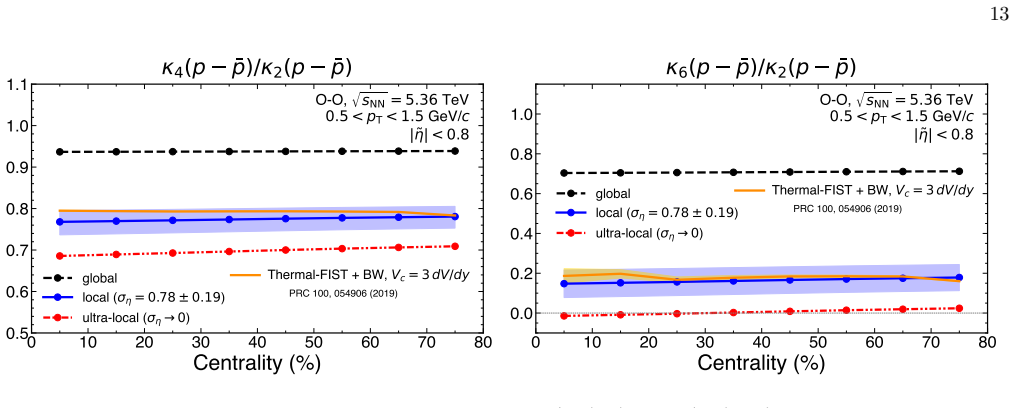
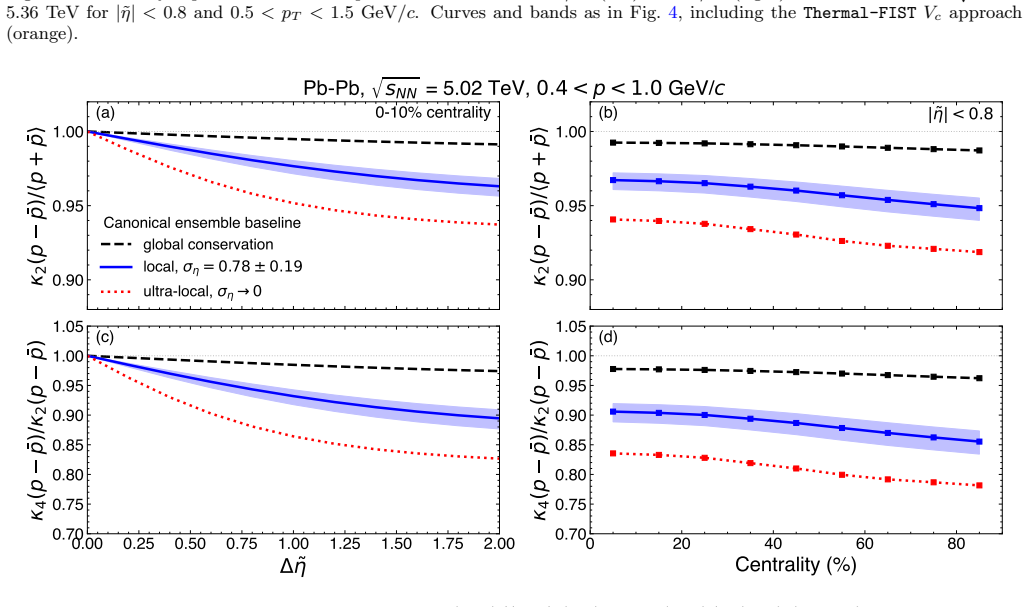
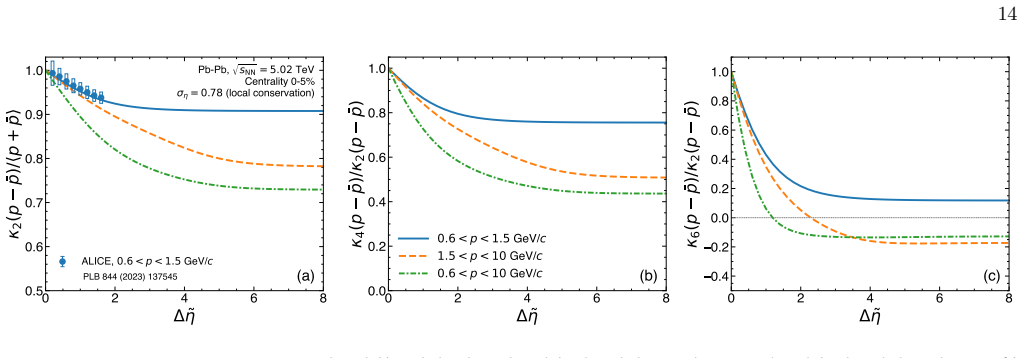
In the canonical ensemble with Gaussian local baryon conservation in spatial rapidity space, the ratio of sixth to second order cumulants of net baryon number can reach small or negative values within limited rapidity acceptances, a behavior often linked to chiral criticality, and this establishes the ideal hadron gas baseline for LHC net-proton measurements in O-O and Pb-Pb collisions.
What carries the argument
The Gaussian local conservation of baryon number in spatial rapidity space, which generalizes the density correlations approach to compute cumulants up to sixth order.
If this is right
- Gaussian local conservation produces predictions comparable to the V_c approach at midrapidity but with marked differences at larger rapidity acceptances.
- Coordinate-space results agree exactly with the diffusion master equation for all cumulant ratios up to κ6/κ2.
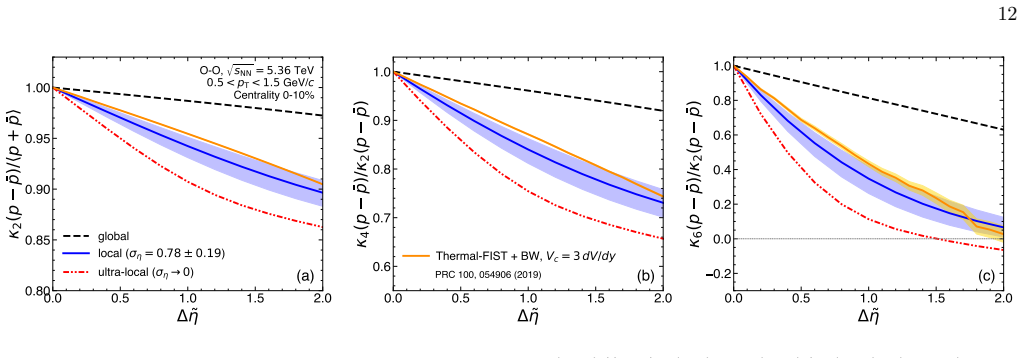
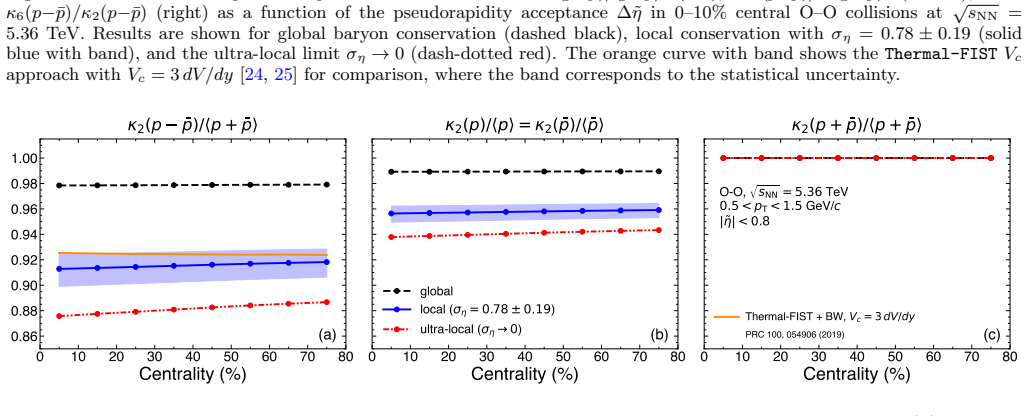
- Blast-wave model predictions provide net-proton cumulant baselines for O-O and Pb-Pb collisions at the LHC.
- The conservation baseline must be accounted for when interpreting upcoming LHC measurements that might signal chiral criticality.
Where Pith is reading between the lines
- Negative cumulant ratios observed in data may arise from conservation laws rather than critical phenomena.
- The Gaussian rapidity model could be tested against full hydrodynamic simulations of the collision evolution.
- Extending the same local conservation treatment to electric charge or strangeness would yield additional baselines for multi-charge cumulants.
Load-bearing premise
Local baryon conservation is modeled as taking a Gaussian form in spatial rapidity space.
What would settle it
An LHC measurement in which net-proton κ6/κ2 stays positive for every acceptance window would contradict the prediction that local conservation drives the ratio negative in restricted acceptances.
Figures

read the original abstract
We study higher-order cumulants of the conserved baryon number at the LHC within the canonical ensemble with local baryon conservation. We generalize the density correlations approach of [Phys. Rev. C 110, L061902 (2024)] to incorporate the effect of Gaussian local conservation in spatial rapidity space in cumulants up to 6th order. Gaussian local conservation improves upon the commonly employed $V_c$ approach, yielding comparable predictions at midrapidity, but marked differences for larger rapidity acceptances. Our coordinate-space results are in exact agreement with the diffusion master equation approach for all cumulant ratios up to $\kappa_6/\kappa_2$. Using the blast-wave model to apply kinematic cuts, we obtain predictions for net-proton cumulants in O--O and Pb--Pb collisions at the LHC that establish an ideal hadron gas baseline. We find that local baryon conservation alone can drive $\kappa_6/\kappa_2$ to small or even negative values in restricted acceptance, a behavior often associated with chiral criticality. The conservation baseline must therefore be carefully accounted for when interpreting upcoming LHC measurements.
Editorial analysis
A structured set of objections, weighed in public.
Referee Report
Summary. The manuscript generalizes the density-correlations method to incorporate Gaussian local baryon conservation in spatial rapidity space, enabling calculation of baryon-number cumulants up to sixth order in the canonical ensemble. It reports exact agreement with the diffusion master equation for all ratios through κ6/κ2, applies blast-wave kinematics to obtain net-proton predictions for O-O and Pb-Pb collisions at the LHC, and concludes that local conservation alone can drive κ6/κ2 to small or negative values in restricted acceptance.
Significance. If the central results hold, the work supplies a necessary baseline for interpreting higher-order cumulant data at the LHC, demonstrating that conservation effects can produce signatures commonly associated with chiral criticality. The exact numerical agreement between two independent formalisms (density correlations and diffusion master equation) is a clear technical strength that increases in the coordinate-space predictions.
major comments (2)
- [Generalization of density correlations approach (abstract and § on local conservation)] The generalization beyond the V_c approximation relies on assuming a Gaussian form for the local baryon conservation correlation in spatial rapidity; this functional choice directly controls the sign and magnitude of κ6/κ2 at larger acceptances. The manuscript should test robustness against other forms (exponential or power-law tails) to establish that the reported negative values are not an artifact of the Gaussian parametrization.
- [Comparison with diffusion master equation] The exact agreement with the diffusion master equation is stated for all cumulant ratios up to κ6/κ2, yet the text does not clarify whether this match is independent of the Gaussian rapidity correlation or whether both methods embed the same functional assumption; this distinction is load-bearing for the claim that the result is method-independent.
minor comments (1)
- [Results section] Explicit numerical values for the Gaussian rapidity width and the blast-wave parameters used for the kinematic cuts should be tabulated to allow direct reproduction of the net-proton predictions.
Simulated Author's Rebuttal
We thank the referee for their careful reading of the manuscript and for the constructive comments, which help clarify key assumptions. We address each major comment below and will make the indicated revisions.
read point-by-point responses
-
Referee: [Generalization of density correlations approach (abstract and § on local conservation)] The generalization beyond the V_c approximation relies on assuming a Gaussian form for the local baryon conservation correlation in spatial rapidity; this functional choice directly controls the sign and magnitude of κ6/κ2 at larger acceptances. The manuscript should test robustness against other forms (exponential or power-law tails) to establish that the reported negative values are not an artifact of the Gaussian parametrization.
Authors: The Gaussian parametrization is physically motivated by the diffusive spreading of baryon number, which produces Gaussian correlations in rapidity. We agree that robustness checks against other forms would strengthen the work. In the revised manuscript we will add calculations using exponential and power-law correlation functions (in a new appendix) and show that, while the precise numerical values of κ6/κ2 change, the qualitative finding that local conservation can drive the ratio to small or negative values in restricted acceptance remains robust. revision: yes
-
Referee: [Comparison with diffusion master equation] The exact agreement with the diffusion master equation is stated for all cumulant ratios up to κ6/κ2, yet the text does not clarify whether this match is independent of the Gaussian rapidity correlation or whether both methods embed the same functional assumption; this distinction is load-bearing for the claim that the result is method-independent.
Authors: The diffusion master equation solves a stochastic diffusion process whose Green's function is Gaussian in the continuum limit; our density-correlations implementation adopts the same Gaussian local-conservation kernel. The exact numerical agreement therefore validates that the two independent mathematical frameworks (density correlations versus master equation) produce identical results when they encode the identical physical assumption of diffusive local conservation. We will add an explicit clarifying paragraph in the revised text to make this distinction clear while preserving the claim of technical consistency across formalisms. revision: yes
Circularity Check
No significant circularity detected
full rationale
The paper's derivation starts from the canonical ensemble with local baryon conservation, explicitly introduces a Gaussian correlation form in spatial rapidity as a modeling generalization of the cited density-correlations method, computes cumulant expressions up to order 6, verifies exact agreement with the independent diffusion master equation, and only then applies blast-wave kinematics for acceptance cuts. None of these steps reduce the target κ6/κ2 predictions to quantities fitted from the same data or to self-referential definitions; the Gaussian ansatz is an input assumption, not derived from or tautological with the output ratios. The central claim is therefore a model consequence rather than a logical loop.
Axiom & Free-Parameter Ledger
free parameters (1)
- Gaussian rapidity width
axioms (2)
- domain assumption Canonical ensemble enforces exact global baryon-number conservation while allowing local fluctuations
- domain assumption Blast-wave model accurately maps coordinate-space results to detector acceptance
Forward citations
Cited by 1 Pith paper
-
Multistage dynamical modeling of heavy-ion collisions
The paper discusses recent progress and open issues in multistage simulations connecting bulk evolution, conserved charges, strangeness, and heavy flavor to constrain QCD matter at finite density.
Reference graph
Works this paper leans on
-
[1]
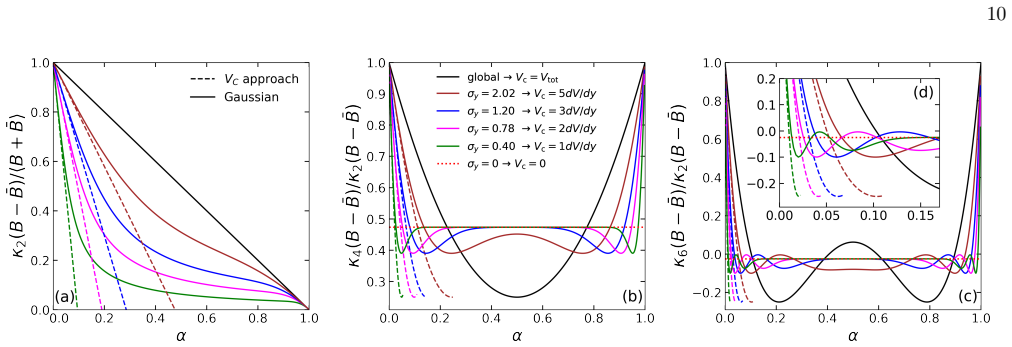
[23, 24, 29], in which exact baryon conservation is imposed within a sharp spatial rapidity windowV c =k dV /dy(dashed lines)
Thermal-FISTV c approach Figure 2 also compares the Gaussian local-conservation approach with theV c approach of Refs. [23, 24, 29], in which exact baryon conservation is imposed within a sharp spatial rapidity windowV c =k dV /dy(dashed lines). The correspondence between the two prescriptions is established by matchingκ 2/Nacc at smallα, yielding ση ≃0.4...
-
[2]
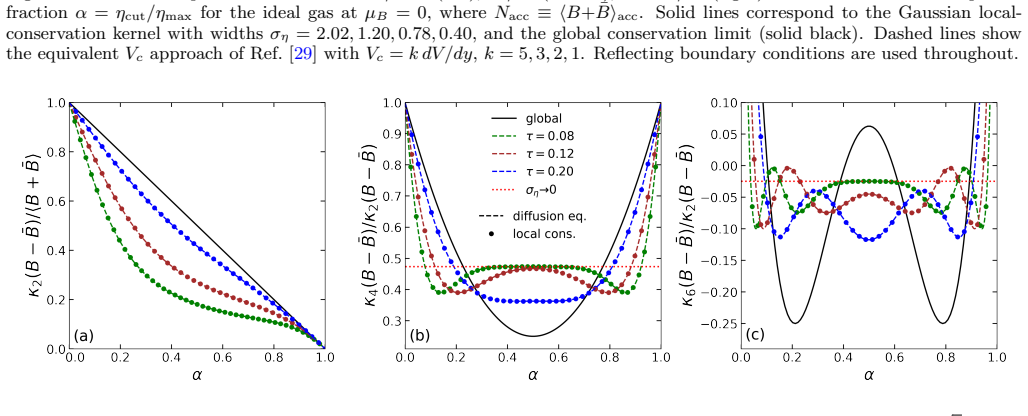
Diffusion master equation As a second benchmark, we compare our static Gaus- sian local-conservation model to the diffusion master equation approach of Ref. [21]. In that framework, the fireball is modeled as a finite interval in spatial rapid- ity with reflecting boundaries, and the time evolution of conserved-charge fluctuations is generated by diffusio...
-
[3]
Correlated sampling model It is also instructive to compare to the correlated sam- pling model of Ref. [22]. In that approach, full-space multiplicities are sampled from a canonical ensemble distribution, while the rapidities of balancing baryon- antibaryon pairs are generated with a finite rapidity- correlation length. A practical advantage of this con- ...
2019
-
[4]
(18) admits a con- venient factorized representation
Common-source representation The Gaussian-cluster ansatz of Eq. (18) admits a con- venient factorized representation. Defining gσ(x) = 1√π ση e−x2/σ2 η ,(C1) one can complete the square in the exponent of Eq. (18) to obtain the infinite-volume identity κn(η1, . . . , ηn) V n−1 = Z ∞ −∞ dX nY i=1 gσ(ηi −X).(C2) Thus thencoordinates can be viewed as indepen...
-
[5]
snapshot
Small-σ η plateau values We now derive the plateau values ofκ 4/κ2 andκ 6/κ2 in the limit of strongly local conservation, ση ≪η cut, σ η ≪η max −η cut,(C9) for the step-function acceptancep(η) = Θ(η cut − |η|). In this regime, the fireball boundaries are parametrically far from the acceptance edges, so the finite-volume kernels reduce locally to their inf...
-
[6]
M. A. Stephanov, K. Rajagopal, and E. V. Shuryak, Phys. Rev. D60, 114028 (1999), arXiv:hep-ph/9903292
Pith/arXiv arXiv 1999
- [7]
-
[8]
A. Bazavovet al.(HotQCD), Phys. Lett. B795, 15 (2019), arXiv:1812.08235 [hep-lat]
arXiv 2019
-
[9]
S. Borsanyi, Z. Fodor, J. N. Guenther, R. Kara, S. D. Katz, P. Parotto, A. Pasztor, C. Ratti, and K. K. Szabo, Phys. Rev. Lett.125, 052001 (2020), arXiv:2002.02821 [hep-lat]
arXiv 2020
-
[10]
R. D. Pisarski and F. Wilczek, Phys. Rev. D29, 338 (1984)
1984
-
[11]
H. T. Dinget al.(HotQCD), Phys. Rev. Lett.123, 062002 (2019), arXiv:1903.04801 [hep-lat]
arXiv 2019
-
[12]
B. Friman, F. Karsch, K. Redlich, and V. Skokov, Eur. Phys. J. C71, 1694 (2011), arXiv:1103.3511 [hep-ph]
Pith/arXiv arXiv 2011
-
[13]
S. Acharyaet al.(ALICE), Eur. Phys. J. C84, 813 (2024), arXiv:2211.04384 [nucl-ex]
arXiv 2024
-
[14]
A. Andronic, P. Braun-Munzinger, K. Redlich, and J. Stachel, Nature561, 321 (2018), arXiv:1710.09425 [nucl-th]
Pith/arXiv arXiv 2018
-
[15]
V. Vovchenko, M. I. Gorenstein, and H. Stoecker, Phys. Rev. C98, 034906 (2018), arXiv:1807.02079 [nucl-th]
Pith/arXiv arXiv 2018
-
[16]
V. V. Begun, M. Gazdzicki, M. I. Gorenstein, and O. S. Zozulya, Phys. Rev. C70, 034901 (2004), arXiv:nucl- th/0404056
arXiv 2004
-
[17]
A. Bzdak, V. Koch, and V. Skokov, Phys. Rev. C87, 014901 (2013), arXiv:1203.4529 [hep-ph]
Pith/arXiv arXiv 2013
-
[18]
P. Braun-Munzinger, B. Friman, K. Redlich, A. Rusta- mov, and J. Stachel, Nucl. Phys. A1008, 122141 (2021), arXiv:2007.02463 [nucl-th]
arXiv 2021
-
[19]
V. Vovchenko, V. Koch, and C. Shen, Phys. Rev. C105, 014904 (2022), arXiv:2107.00163 [hep-ph]
arXiv 2022
-
[20]
V. Vovchenko and V. Koch, Phys. Rev. C103, 044903 (2021), arXiv:2012.09954 [hep-ph]
arXiv 2021
-
[21]
Hadronic Fluctuations and Correlations,
V. Koch, “Hadronic Fluctuations and Correlations,” in Relativistic Heavy Ion Physics, edited by R. Stock (2010) pp. 626–652, arXiv:0810.2520 [nucl-th]
Pith/arXiv arXiv 2010
-
[22]
V. Vovchenko, O. Savchuk, R. V. Poberezhnyuk, M. I. Gorenstein, and V. Koch, Phys. Lett. B811, 135868 (2020), arXiv:2003.13905 [hep-ph]
arXiv 2020
- [23]
-
[24]
P. Castorina and H. Satz, Int. J. Mod. Phys. E23, 1450019 (2014), arXiv:1310.6932 [hep-ph]
Pith/arXiv arXiv 2014
-
[25]
P. Bozek and W. Broniowski, Phys. Rev. Lett.109, 062301 (2012), arXiv:1204.3580 [nucl-th]
Pith/arXiv arXiv 2012
-
[26]
M. Sakaida, M. Asakawa, and M. Kitazawa, Phys. Rev. C90, 064911 (2014), arXiv:1409.6866 [nucl-th]
Pith/arXiv arXiv 2014
-
[27]
P. Braun-Munzinger, K. Redlich, A. Rustamov, and J. Stachel, JHEP08, 113 (2024), arXiv:2312.15534 [nucl- th]
arXiv 2024
-
[28]
V. Vovchenko, B. D¨ onigus, and H. Stoecker, Phys. Lett. B785, 171 (2018), arXiv:1808.05245 [hep-ph]
arXiv 2018
-
[29]
V. Vovchenko, B. D¨ onigus, and H. Stoecker, Phys. Rev. C100, 054906 (2019), arXiv:1906.03145 [hep-ph]
arXiv 2019
-
[30]
V. Vovchenko and H. Stoecker, Comput. Phys. Commun. 20 244, 295 (2019), arXiv:1901.05249 [nucl-th]
arXiv 2019
-
[31]
S. Acharyaet al.(ALICE), Phys. Lett. B844, 137545 (2023), arXiv:2206.03343 [nucl-ex]
arXiv 2023
-
[32]
S. Acharyaet al.(ALICE), Phys. Rev. Lett.131, 041901 (2023), arXiv:2204.10166 [nucl-ex]
arXiv 2023
-
[33]
S. Acharyaet al.(ALICE), Phys. Rev. Lett.134, 022303 (2025), arXiv:2405.19890 [nucl-ex]
arXiv 2025
- [34]
- [35]
-
[36]
T. P. Speed, Australian Journal of Statistics25, 378 (1983)
1983
- [37]
-
[38]
O. Savchuk, V. Vovchenko, V. Koch, J. Steinheimer, and H. Stoecker, Phys. Lett. B827, 136983 (2022), arXiv:2106.08239 [hep-ph]
arXiv 2022
- [39]
-
[40]
M. Arslandok, in31st International Conference on Ultra-relativistic Nucleus-Nucleus Collisions(2025) arXiv:2510.09115 [hep-ex]
arXiv 2025
-
[41]
Fokin, EPJ Web Conf.364, 15003 (2026), arXiv:2510.10847 [nucl-ex]
I. Fokin, EPJ Web Conf.364, 15003 (2026), arXiv:2510.10847 [nucl-ex]
arXiv 2026
-
[42]
ALICE Collaboration, (2022), arXiv:2211.02491 [physics.ins-det]
arXiv 2022
-
[43]
Dainese and A
A. Dainese and A. Di Mauro,Scoping document for the ALICE 3 detector, Tech. Rep. (CERN, Geneva, 2025)
2025
-
[44]
V. Skokov, B. Friman, and K. Redlich, Phys. Rev. C88, 034911 (2013), arXiv:1205.4756 [hep-ph]
Pith/arXiv arXiv 2013
-
[45]
R. V. Poberezhnyuk, O. Savchuk, M. I. Gorenstein, V. Vovchenko, K. Taradiy, V. V. Begun, L. Satarov, J. Steinheimer, and H. Stoecker, Phys. Rev. C102, 024908 (2020), arXiv:2004.14358 [hep-ph]
arXiv 2020
-
[46]
M. S. Pradeep and M. Stephanov, Phys. Rev. Lett.130, 162301 (2023), arXiv:2211.09142 [hep-ph]
arXiv 2023
-
[47]
J. M. Karthein, K. Rajagopal, M. S. Pradeep, M. Stephanov, and Y. Yin, Phys. Rev. D113, 074010 (2026), arXiv:2508.19237 [nucl-th]
arXiv 2026
-
[48]
M. Sakaida, M. Asakawa, H. Fujii, and M. Kitazawa, Phys. Rev. C95, 064905 (2017), arXiv:1703.08008 [nucl- th]
Pith/arXiv arXiv 2017
-
[49]
Gardiner,Stochastic methods, Vol
C. Gardiner,Stochastic methods, Vol. 4 (Springer Berlin Heidelberg, 2009)
2009
discussion (0)
Sign in with ORCID, Apple, or X to comment. Anyone can read and Pith papers without signing in.