Geometric dependence of critical-current variation in Al/AlO{rm _x}/Al Josephson junctions: a model-based analysis
Pith reviewed 2026-06-28 22:16 UTC · model grok-4.3
The pith
Fluctuations in aluminum film thickness dominate critical current variation in Al/AlOx/Al Josephson junctions.
A machine-rendered reading of the paper's core claim, the machinery that carries it, and where it could break.
Core claim
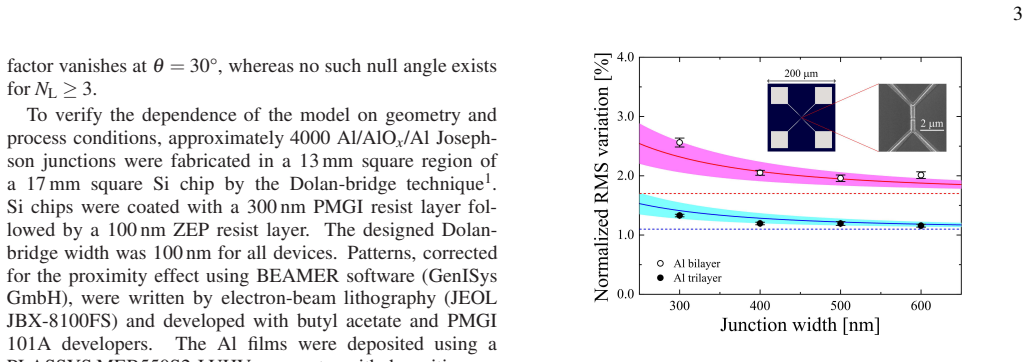
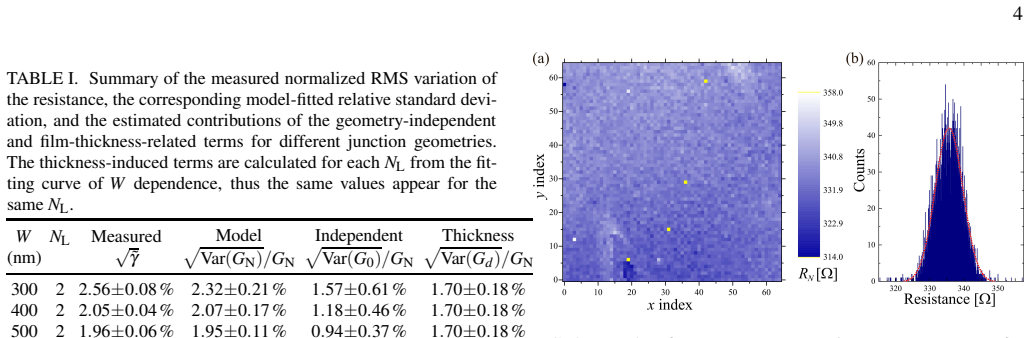
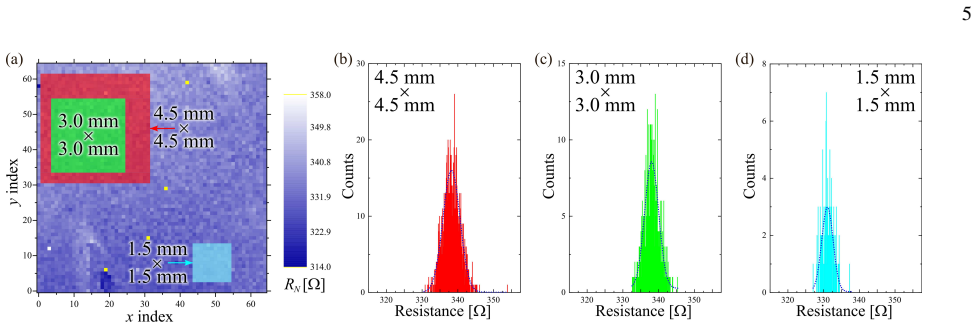
Our model-based analysis reveals that fluctuations in the Al film thickness play the dominant role among the modeled contributing factors. Based on this analysis, we found that, in Dolan-bridge double-angle deposition, adopting a deposition angle of 30-degree for bilayer junctions significantly improves uniformity, yielding a relative standard deviation of 1.2% (0.5%) across a 9.75 mm (1.5 mm) square region.
What carries the argument
Model of variation sources that separates thickness, geometry, and deposition contributions by their distinct dependence on junction layout and evaporation angle, validated against room-temperature tunnel resistance statistics.
If this is right
- A 30-degree deposition angle for bilayer junctions reduces relative standard deviation to 1.2 percent across 9.75 mm regions and 0.5 percent across 1.5 mm regions.
- Geometry and deposition-angle dependence can distinguish thickness fluctuations from other variation sources without direct thickness metrology.
- Room-temperature tunnel resistance statistics serve as a reliable proxy for mapping critical-current uniformity before cryogenic testing.
- Uniformity improvements from the identified angle change directly support scaling of superconducting quantum circuits that require matched junction currents.
Where Pith is reading between the lines
- The same geometry-dependence method could be applied to other junction materials or processes to isolate their own dominant variation sources.
- If thickness fluctuations remain dominant after the angle change, further uniformity gains would require tighter control of aluminum deposition rate or substrate temperature rather than layout adjustments.
- Large-scale quantum processors might achieve higher functional yield by combining the 30-degree process with statistical binning based on the room-temperature resistance maps.
Load-bearing premise
The model correctly captures and separates all dominant sources of variation so that observed geometry and angle dependence can unambiguously identify which source is largest.
What would settle it
Fabricate a set of junctions with deliberately varied aluminum film thicknesses at fixed geometry and deposition angle, then check whether the measured critical-current spread matches the model's quantitative prediction for thickness dominance.
Figures

read the original abstract
Achieving uniform critical current across Josephson junctions is essential for the large-scale integration of superconducting quantum circuits. In this work, we statistically analyzed the variation of the critical current of Al/AlO${\rm _x}$/Al junctions using room-temperature tunnel resistance statistics, and identified the dominant contribution among the modeled sources of the variation based on their dependence on geometry and deposition conditions of junctions. Our model-based analysis reveals that fluctuations in the Al film thickness play the dominant role among the modeled contributing factors. Based on this analysis, we found that, in Dolan-bridge double-angle deposition, adopting a deposition angle of 30-degree for bilayer junctions significantly improves uniformity, yielding a relative standard deviation of 1.2% (0.5%) across a 9.75 mm (1.5 mm) square region.
Editorial analysis
A structured set of objections, weighed in public.
Referee Report
Summary. The paper performs a model-based statistical analysis of critical-current variation in Al/AlO_x/Al Josephson junctions using room-temperature tunnel resistance statistics. It identifies fluctuations in Al film thickness as the dominant source among modeled factors, based on dependence on junction geometry and deposition conditions. The authors recommend a 30-degree deposition angle in Dolan-bridge double-angle deposition for bilayer junctions, claiming this yields relative standard deviations of 1.2% (0.5%) across 9.75 mm (1.5 mm) square regions.
Significance. If the variance decomposition is robust and the model separation holds, the result could guide practical improvements in junction uniformity for large-scale superconducting quantum circuits. The use of room-temperature resistance data as a proxy is efficient, and the concrete recommendation with quantified uniformity metrics would be directly actionable for fabrication if validated.
major comments (2)
- [Abstract] Abstract: the central claim that thickness fluctuations dominate rests on a statistical model that decomposes observed geometry and deposition-angle dependence into independent contributions; however, no equations, functional forms, or fitting procedure for this decomposition (e.g., variance propagation or Monte-Carlo steps) are supplied, preventing assessment of whether unmodeled covariances (such as angle-induced shadowing affecting thickness) are accounted for.
- [Abstract] Abstract: the reported relative standard deviations of 1.2% and 0.5% are given without sample sizes, error bars, or direct comparison to measured data, so it is not possible to evaluate whether these numbers are supported by the underlying statistics or are model outputs only.
minor comments (1)
- [Abstract] Abstract: the phrase 'bilayer junctions' is used without definition in the context of the Dolan-bridge process; a brief clarification would improve readability.
Simulated Author's Rebuttal
We thank the referee for their detailed and constructive comments. We address each major comment below, clarifying the model and statistics while indicating revisions to improve clarity and completeness.
read point-by-point responses
-
Referee: [Abstract] Abstract: the central claim that thickness fluctuations dominate rests on a statistical model that decomposes observed geometry and deposition-angle dependence into independent contributions; however, no equations, functional forms, or fitting procedure for this decomposition (e.g., variance propagation or Monte-Carlo steps) are supplied, preventing assessment of whether unmodeled covariances (such as angle-induced shadowing affecting thickness) are accounted for.
Authors: The decomposition employs analytical variance propagation under the assumption of independent contributions from each source (Al film thickness, junction area, and barrier properties). The relative variance of critical current is obtained by summing the squared relative contributions, with functional forms derived from the exponential dependence of tunnel resistance on Al thickness (from Simmons model) and linear scaling with area. No Monte Carlo simulation is used. The main text details the input statistics and propagation; however, we acknowledge the abstract omits these specifics and will add the explicit equations plus a statement on the independence assumption (including a note that angle-induced shadowing is mitigated at 30 degrees per our geometry analysis) in the revised manuscript. revision: yes
-
Referee: [Abstract] Abstract: the reported relative standard deviations of 1.2% and 0.5% are given without sample sizes, error bars, or direct comparison to measured data, so it is not possible to evaluate whether these numbers are supported by the underlying statistics or are model outputs only.
Authors: These RSD values are model predictions obtained by applying the variance decomposition to the measured geometry parameters and room-temperature resistance statistics. The underlying statistics derive from a large ensemble of junctions (sample size exceeds 1000 devices across multiple chips). We will revise the abstract and main text to explicitly state that these are model outputs, report the input sample size, include error bars obtained by propagating uncertainties from the measured variances, and strengthen the direct comparison to experimentally measured critical-current variation already present in the results section. revision: yes
Circularity Check
No circularity: statistical decomposition of variation sources is independent of the reported dominance conclusion
full rationale
The paper performs a model-based statistical analysis of room-temperature tunnel resistance data to attribute variation sources (thickness fluctuations, geometry, deposition angle) according to their observed dependence on junction geometry and deposition conditions. No equations, fitted parameters, or self-citations are presented that would make the identification of thickness fluctuations as dominant reduce to the input data by construction; the attribution is an output of the variance decomposition rather than a definitional or tautological step. The uniformity predictions (1.2% / 0.5% RSD) are likewise downstream empirical results, not forced by the model structure itself. This is a standard self-contained empirical modeling workflow with no load-bearing circularity.
Axiom & Free-Parameter Ledger
axioms (1)
- domain assumption Room-temperature tunnel resistance statistics are a valid proxy for low-temperature critical current variation
Reference graph
Works this paper leans on
-
[1]
author author G. J. \ Dolan ,\ 10.1063/1.89690 journal journal Applied Physics Letters \ volume 31 ,\ pages 337 ( year 1977 ) NoStop
-
[2]
author author A. Potts , author P. R. \ Routley , author G. J. \ Parker , author J. J. \ Baumberg , \ and\ author P. A. J. \ de Groot ,\ 10.1023/A:1011279908265 journal journal Journal of Materials Science: Materials in Electronics \ volume 12 ,\ pages 289 ( year 2001 ) NoStop
-
[3]
author author M. V. \ Costache , author G. Bridoux , author I. Neumann , \ and\ author S. O. \ Valenzuela ,\ 10.1116/1.4722982 journal journal Journal of Vacuum Science & Technology B \ volume 30 ,\ pages 04E105 ( year 2012 ) NoStop
-
[4]
author author Y. Nakamura , author Y. A. \ Pashkin , \ and\ author J. S. \ Tsai ,\ 10.1038/19718 journal journal Nature \ volume 398 ,\ pages 786 ( year 1999 ) NoStop
-
[5]
Physical Review A76(4), 042319 (2007) https://doi.org/10.1103/PhysRevA.76.042319
author author J. Koch , author T. M. \ Yu , author J. Gambetta , author A. A. \ Houck , author D. I. \ Schuster , author J. Majer , author A. Blais , author M. H. \ Devoret , author S. M. \ Girvin , \ and\ author R. J. \ Schoelkopf ,\ 10.1103/PhysRevA.76.042319 journal journal Phys. Rev. A \ volume 76 ,\ pages 042319 ( year 2007 ) NoStop
-
[6]
Quantum supremacy us- ing a programmable superconducting proces- sor
author author F. Arute , author K. Arya , author R. Babbush , author D. Bacon , author J. C. \ Bardin , author R. Barends , author R. Biswas , author S. Boixo , author F. G. S. L. \ Brandao , author D. A. \ Buell , author B. Burkett , author Y. Chen , author Z. Chen , author B. Chiaro , author R. Collins , author W. Courtney , author A. Dunsworth , author...
-
[7]
author author M. Brink , author J. M. \ Chow , author J. Hertzberg , author E. Magesan , \ and\ author S. Rosenblatt ,\ in\ 10.1109/IEDM.2018.8614500 booktitle 2018 IEEE International Electron Devices Meeting (IEDM) \ ( year 2018 )\ pp.\ pages 6.1.1--6.1.3 NoStop
-
[8]
author author T. C. \ White , author J. Y. \ Mutus , author I.-C. \ Hoi , author R. Barends , author B. Campbell , author Y. Chen , author Z. Chen , author B. Chiaro , author A. Dunsworth , author E. Jeffrey , author J. Kelly , author A. Megrant , author C. Neill , author P. J. J. \ O'Malley , author P. Roushan , author D. Sank , author A. Vainsencher , a...
-
[9]
author author C. Macklin , author K. O’Brien , author D. Hover , author M. E. \ Schwartz , author V. Bolkhovsky , author X. Zhang , author W. D. \ Oliver , \ and\ author I. Siddiqi ,\ 10.1126/science.aaa8525 journal journal Science \ volume 350 ,\ pages 307 ( year 2015 ) NoStop
-
[10]
author author S. \'O Peat\'ain , author T. Dixon , author P. J. \ Meeson , author J. M. \ Williams , author S. Kafanov , \ and\ author Y. A. \ Pashkin ,\ 10.1088/1361-6668/acba4e journal journal Superconductor Science and Technology \ volume 36 ,\ pages 045017 ( year 2023 ) NoStop
-
[11]
author author J. M. \ Kreikebaum , author K. P. \ O’Brien , author A. Morvan , \ and\ author I. Siddiqi ,\ 10.1088/1361-6668/ab8617 journal journal Superconductor Science and Technology \ volume 33 ,\ pages 06LT02 ( year 2020 ) NoStop
-
[12]
author author T. Takahashi , author N. Kouma , author Y. Doi , author S. Sato , author S. Tamate , \ and\ author Y. Nakamura ,\ 10.35848/1347-4065/aca256 journal journal Japanese Journal of Applied Physics \ volume 62 ,\ pages SC1002 ( year 2022 ) NoStop
-
[13]
author author D. O. \ Moskalev , author E. V. \ Zikiy , author A. A. \ Pishchimova , author D. A. \ Ezenkova , author N. S. \ Smirnov , author A. I. \ Ivanov , author N. D. \ Korshakov , \ and\ author I. A. \ Rodionov ,\ 10.1038/s41598-023-31003-1 journal journal Scientific Reports \ volume 13 ,\ pages 4174 ( year 2023 ) NoStop
-
[14]
author author A. A. \ Pishchimova , author N. S. \ Smirnov , author D. A. \ Ezenkova , author E. A. \ Krivko , author E. V. \ Zikiy , author D. O. \ Moskalev , author A. I. \ Ivanov , author N. D. \ Korshakov , \ and\ author I. A. \ Rodionov ,\ 10.1038/s41598-023-34051-9 journal journal Scientific Reports \ volume 13 ,\ pages 6772 ( year 2023 ) NoStop
-
[15]
author author Y. Zheng , author S. Li , author Z. Ding , author K. Xiong , author J. Feng , \ and\ author H. Yang ,\ 10.1038/s41598-023-39052-2 journal journal Scientific Reports \ volume 13 ,\ pages 11874 ( year 2023 ) NoStop
-
[16]
author author V. Ambegaokar \ and\ author A. Baratoff ,\ 10.1103/PhysRevLett.10.486 journal journal Phys. Rev. Lett. \ volume 10 ,\ pages 486 ( year 1963 ) NoStop
discussion (0)
Sign in with ORCID, Apple, or X to comment. Anyone can read and Pith papers without signing in.