High-Dimensional Bayesian Calibration of Expensive Nuclear Models with Differentiable Emulation
Pith reviewed 2026-06-28 20:35 UTC · model grok-4.3
The pith
Reconstructing the nuclear operator via SVD compression supplies exact likelihood gradients for Hamiltonian Monte Carlo sampling in high-dimensional Bayesian calibration.
A machine-rendered reading of the paper's core claim, the machinery that carries it, and where it could break.
Core claim
The parameter-dependent operator is sampled offline by any legacy code, compressed by singular value decomposition, and reconstructed online in a differentiable framework so that automatic differentiation delivers exact likelihood gradients through the full forward solve at the cost of one additional evaluation per Hamiltonian Monte Carlo step. The construction is operator-level and depends only on smooth, compressible parameter dependence; the underlying physics solver is treated as a black box. When applied to a continuum-discretized coupled-channels analysis with eighteen optical-potential parameters, No-U-Turn Sampling converges on a single GPU in under ten minutes from a cold start with
What carries the argument
The online differentiable reconstruction of the SVD-compressed parameter-dependent operator, which enables automatic differentiation to obtain exact likelihood gradients through the complete forward model.
If this is right
- Hamiltonian Monte Carlo sampling of high-dimensional posteriors becomes practical at the cost of one additional forward evaluation per step.
- The posterior is determined by the reaction model rather than the surrogate when emulator error stays below model discrepancy.
- Well-determined parameter combinations are updated by the data while under-determined directions remain at the prior.
- Multi-energy datasets can be incorporated to produce sharpened physics interpretations without custom gradient code.
Where Pith is reading between the lines
- The same offline-sampling plus online-differentiable-reconstruction pattern could be applied to other expensive parameter-dependent simulations that currently rely on gradient-free samplers.
- Models whose parameter dependence is less compressible may require alternative compression techniques before the same gradient cost scaling is achieved.
- The reported separation between emulator error and model discrepancy supplies a concrete numerical target that later work can test across additional reaction channels.
Load-bearing premise
The parameter dependence of the nuclear operator is sufficiently smooth and compressible that the SVD reconstruction keeps mean emulator error more than an order of magnitude below the inferred model discrepancy.
What would settle it
A new application in which the mean emulator error exceeds the inferred model discrepancy or in which the sampler produces divergent transitions despite the claimed one-extra-evaluation cost.
Figures

read the original abstract
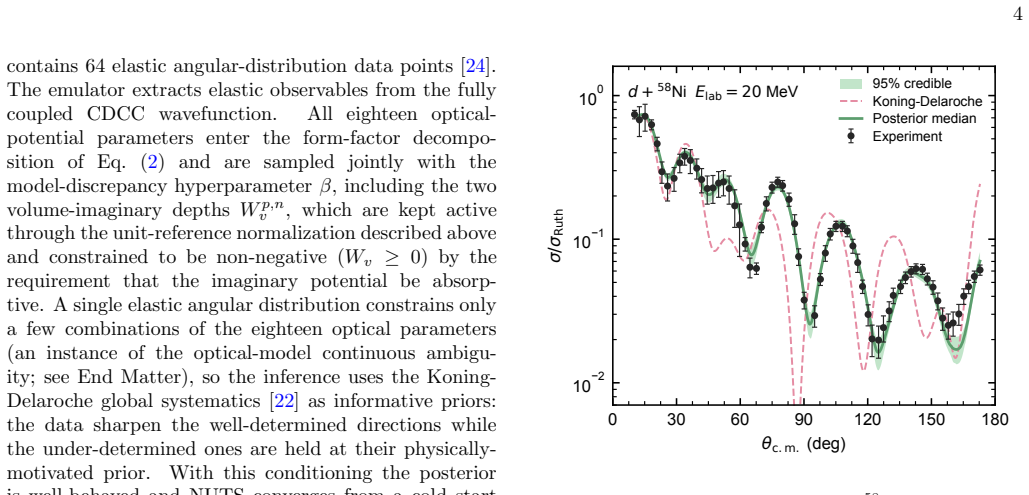
Full Bayesian calibration of expensive nuclear models has been blocked not by the cost of any single solve, but by the absence of exact likelihood gradients in legacy parameter-dependent operators, which forces gradient-free samplers to spend $\mathcal{O}(10^5)$ evaluations exploring high-dimensional correlated posteriors. I introduce DREAM, a differentiable calibration strategy in which the parameter-dependent operator is sampled offline by any legacy code, compressed by singular value decomposition, and reconstructed online in a differentiable framework so that automatic differentiation delivers exact likelihood gradients through the full forward solve at the cost of one additional evaluation per Hamiltonian Monte Carlo step. The construction is operator-level and depends only on smooth, compressible parameter dependence; the underlying physics solver is treated as a black box. As a representative demonstration, DREAM is applied to a continuum-discretized coupled-channels (CDCC) analysis of $d$+$^{58}$Ni elastic scattering at $20$~MeV with eighteen optical-potential parameters, for which No-U-Turn Sampling converges on a single GPU in under ten minutes from a cold start with zero divergent transitions, yielding a full Bayesian posterior for a breakup reaction. The mean emulator error is more than an order of magnitude below the inferred model discrepancy, so the posterior is set by the reaction model rather than the surrogate. Treating the Koning-Delaroche systematics as an informative prior, the data update the well-determined parameter combinations, raising the mean deuteron surface absorption about $36\%$ above the Koning-Delaroche value, while the under-determined directions remain at the prior; this is a representative payoff that the multi-energy datasets DREAM is designed to accommodate can sharpen into a full physics interpretation.
Editorial analysis
A structured set of objections, weighed in public.
Referee Report
Summary. The manuscript introduces DREAM, a workflow for high-dimensional Bayesian calibration of expensive nuclear models. The parameter-dependent operator is sampled offline by legacy code, compressed via singular value decomposition, and reconstructed online in a differentiable framework, allowing automatic differentiation to supply exact likelihood gradients for Hamiltonian Monte Carlo at the cost of one extra evaluation per step. The construction is operator-level and black-box with respect to the underlying solver. As demonstration, DREAM is applied to an 18-parameter continuum-discretized coupled-channels analysis of d+58Ni elastic scattering at 20 MeV; No-U-Turn Sampling converges on a GPU in under ten minutes from a cold start with zero divergences, and the mean emulator error is stated to lie more than an order of magnitude below the inferred model discrepancy.
Significance. If the reported emulator-accuracy condition holds, the approach removes a long-standing barrier to full Bayesian calibration of high-dimensional nuclear reaction models by delivering exact gradients without altering legacy solvers. The demonstration on a breakup reaction and the explicit separation of emulator error from model discrepancy are concrete strengths that, if generalized, would support multi-energy analyses capable of sharpening parameter constraints beyond systematics such as Koning-Delaroche.
major comments (1)
- [Abstract (demonstration paragraph)] Abstract (demonstration paragraph): The central claim that 'the posterior is set by the reaction model rather than the surrogate' rests on the assertion that mean emulator error lies more than an order of magnitude below inferred model discrepancy. No a priori bound on SVD truncation error, no scaling with parameter dimension, and no tests on operators whose parameter dependence may be less smooth or compressible are supplied; the result is shown only for the single 18-parameter CDCC case. This single-instance validation is insufficient to establish that automatic-differentiation gradients through the online reconstruction leave the posterior unaffected.
Simulated Author's Rebuttal
We thank the referee for the careful reading of the manuscript and the positive assessment of its significance. We respond to the major comment below.
read point-by-point responses
-
Referee: [Abstract (demonstration paragraph)] Abstract (demonstration paragraph): The central claim that 'the posterior is set by the reaction model rather than the surrogate' rests on the assertion that mean emulator error lies more than an order of magnitude below inferred model discrepancy. No a priori bound on SVD truncation error, no scaling with parameter dimension, and no tests on operators whose parameter dependence may be less smooth or compressible are supplied; the result is shown only for the single 18-parameter CDCC case. This single-instance validation is insufficient to establish that automatic-differentiation gradients through the online reconstruction leave the posterior unaffected.
Authors: We agree that the validation of the emulator-error condition is performed only for the single 18-parameter CDCC demonstration and that the manuscript supplies neither an a priori bound on SVD truncation error nor scaling studies with parameter dimension or tests on operators with less smooth parameter dependence. The central claim in the abstract is therefore tied to the numerical observation, specific to this case, that the mean emulator error lies more than an order of magnitude below the inferred model discrepancy. We do not claim a general guarantee that the automatic-differentiation gradients leave the posterior unaffected for arbitrary operators. We will revise the abstract to state explicitly that the reported error condition and the resulting conclusion hold for the demonstrated 18-parameter CDCC application. revision: yes
Circularity Check
No circularity: method and error check are independent of fitted outputs
full rationale
The paper introduces an SVD-based differentiable emulator for legacy nuclear operators and verifies empirically that mean emulator error lies more than an order of magnitude below inferred model discrepancy in the single CDCC demonstration. This verification is presented as a post-hoc numerical check on the specific 18-parameter case rather than a derivation that reduces any reported posterior or gradient to a quantity defined by the emulator fit itself. No equations, self-citations, or uniqueness claims are shown that would make the central result equivalent to its inputs by construction. The construction relies on external smoothness/compressibility assumptions and black-box legacy solves, which are independent of the calibration outputs.
Axiom & Free-Parameter Ledger
axioms (1)
- domain assumption The parameter-dependent nuclear operator has smooth, compressible dependence that permits accurate low-rank SVD reconstruction.
invented entities (1)
-
DREAM differentiable emulation workflow
no independent evidence
Reference graph
Works this paper leans on
-
[1]
Beskos, N
A. Beskos, N. Pillai, G. Roberts, J. M. Sanz-Serna, and A. Stuart, Optimal tuning of the hybrid Monte Carlo algorithm, Bernoulli19, 1501 (2013)
2013
-
[2]
Properties of the Affine Invariant Ensemble Sampler in high dimensions
D. Huijser, J. Goodman, and B. J. Brewer, Properties of the affine-invariant ensemble sampler’s ‘stretch move’ in high dimensions, Aust. N. Z. J. Stat.64, 1 (2022), arXiv:1509.02230 [stat.CO]
work page internal anchor Pith review Pith/arXiv arXiv 2022
-
[3]
G. B. King, A. E. Lovell, L. Neufcourt, and F. M. Nunes, Direct comparison between Bayesian and frequentist un- certainty quantification for nuclear reactions, Phys. Rev. Lett.122, 232502 (2019)
2019
-
[4]
C. Drischler, M. Quinonez, P. G. Giuliani, A. E. Lovell, and F. M. Nunes, Toward emulating nuclear reactions us- ing eigenvector continuation, Phys. Lett. B823, 136777 (2021), arXiv:2108.08269 [nucl-th]
- [5]
-
[6]
K. Beyer and F. M. Nunes, The East Lansing Model: a Bayesian uncertainty quantified optical potential for rare isotopes (2026), arXiv:2603.28599 [nucl-th], arXiv:2603.28599 [nucl-th]
-
[7]
empirical interpolation
M. Barrault, Y. Maday, N. C. Nguyen, and A. T. Patera, An “empirical interpolation” method: application to ef- ficient reduced-basis discretization of partial differential equations, C. R. Math.339, 667 (2004)
2004
-
[8]
Eigenvector continuation with subspace learning
D. Frame, R. He, I. Ipsen, D. Lee, D. Lee, and E. Rrapaj, Eigenvector continuation with subspace learning, Phys. Rev. Lett.121, 032501 (2018), arXiv:1711.07090 [nucl- th]
work page internal anchor Pith review Pith/arXiv arXiv 2018
-
[9]
Quarteroni, A
A. Quarteroni, A. Manzoni, and F. Negri,Reduced Basis Methods for Partial Differential Equations, UNITEXT, Vol. 92 (Springer, 2016)
2016
-
[10]
Duane, A
S. Duane, A. D. Kennedy, B. J. Pendleton, and D. Roweth, Hybrid Monte Carlo, Phys. Lett. B195, 216 (1987)
1987
-
[11]
M. D. Hoffman and A. Gelman, The No-U-Turn sam- pler: adaptively setting path lengths in Hamiltonian Monte Carlo, J. Mach. Learn. Res.15, 1593 (2014), arXiv:1111.4246 [stat.CO]
work page internal anchor Pith review Pith/arXiv arXiv 2014
-
[12]
Piras and A
D. Piras and A. Spurio Mancini, CosmoPower-JAX: high- dimensional Bayesian inference with differentiable cos- mological emulators, Open J. Astrophys.6, 20 (2023)
2023
- [13]
-
[14]
M. Catacora-Rios, K. Beyer, P. Giuliani, K. Godbey, R. J. Furnstahl, and F. M. Nunes, Wavefunction-based emulation of coupled-channels scattering with nonaffinely parametrized interactions, Phys. Rev. C113, 044623 (2026), arXiv:2512.08097 [nucl-th]
-
[15]
Exterior complex scaling enables physics-informed neural networks for quantum scattering
J. Lei, Exterior complex scaling enables physics-informed neural networks for quantum scattering, arXiv preprint arXiv:2602.04553 (2026), arXiv:2602.04553 [nucl-th]
work page internal anchor Pith review Pith/arXiv arXiv 2026
-
[16]
Bidirectional Neural Networks for Global Nucleon-Nucleus Optical Model Calculations
J. Lei, Bidirectional neural networks for global nucleon- nucleus optical model calculations, arXiv preprint arXiv:2512.22500 (2025), arXiv:2512.22500 [nucl-th]
work page internal anchor Pith review Pith/arXiv arXiv 2025
-
[17]
Austern, Y
N. Austern, Y. Iseri, M. Kamimura, M. Kawai, G. Raw- itscher, and M. Yahiro, Continuum-discretized coupled- channels calculations for three-body models of deuteron- nucleus reactions, Phys. Rep.154, 125 (1987)
1987
-
[18]
R. J. Furnstahl, A. J. Garcia, P. J. Millican, and 6 X. Zhang, Efficient emulators for scattering using eigen- vector continuation, Phys. Lett. B809, 135719 (2020)
2020
-
[19]
C. Drischler, J. A. Melendez, R. J. Furnstahl, A. J. Gar- cia, and X. Zhang, BUQEYE guide to projection-based emulators in nuclear physics, Front. Phys.10, 1092931 (2023), arXiv:2212.04912 [nucl-th]
-
[20]
J. Lei, Reduced basis emulator for elastic scattering in continuum-discretized coupled-channels calculations, Phys. Rev. C113, 044610 (2026), arXiv:2512.17687 [nucl-th]
- [21]
-
[22]
A. J. Koning and J. P. Delaroche, Local and global nu- cleon optical models from 1 keV to 200 MeV, Nucl. Phys. A713, 231 (2003)
2003
-
[23]
M. C. Kennedy and A. O’Hagan, Bayesian calibration of computer models, J. R. Stat. Soc. B63, 425 (2001)
2001
-
[24]
Ermer, H
M. Ermer, H. Clement, G. Holetzke, W. Kabitzke, G. Graw, R. Hertenberger, H. Kader, F. Merz, and P. Schiemenz, The deuteron optical potential at low ener- gies, Nucl. Phys. A533, 71 (1991),d+ 58Ni elastic angular distribution, EXFOR F0709.024
1991
-
[25]
(2026), see Supplemental Material for the full eighteen- parameter posterior corner plot
2026
-
[26]
A. E. Lovell and F. M. Nunes, Constraining transfer cross sections using Bayes’ theorem, Phys. Rev. C97, 064612 (2018)
2018
-
[27]
Bradbury, R
J. Bradbury, R. Frostig, P. Hawkins, M. J. John- son, C. Leary, D. Maclaurin, G. Necula, A. Paszke, J. VanderPlas, S. Wanderman-Milne, and Q. Zhang, JAX: composable transformations of Python+NumPy programs (2018), software available athttp://github. com/jax-ml/jax
2018
-
[28]
D. Phan, N. Pradhan, and M. Jankowiak, Compos- able effects for flexible and accelerated probabilistic pro- gramming in NumPyro (2019), arXiv:1912.11554 [cs.PL], arXiv:1912.11554 [cs.PL]
work page internal anchor Pith review Pith/arXiv arXiv 2019
-
[29]
Igo, Optical-model potential at the nuclear surface for the elastic scattering of alpha particles, Phys
G. Igo, Optical-model potential at the nuclear surface for the elastic scattering of alpha particles, Phys. Rev. Lett. 1, 72 (1958)
1958
-
[30]
Foreman-Mackey, D
D. Foreman-Mackey, D. W. Hogg, D. Lang, and J. Good- man, emcee: The MCMC hammer, Publ. Astron. Soc. Pac.125, 306 (2013)
2013
-
[31]
Vehtari, A
A. Vehtari, A. Gelman, D. Simpson, B. Carpenter, and P.-C. B¨ urkner, Rank-normalization, folding, and localiza- tion: An improved ˆRfor assessing convergence of MCMC (with discussion), Bayesian Anal.16, 667 (2021)
2021
-
[32]
Lei, companion Fisher-information analysis of the two- body nucleon-nucleus optical potential (to be published)
J. Lei, companion Fisher-information analysis of the two- body nucleon-nucleus optical potential (to be published). End Matter Implementation.—The online calculation is imple- mented in JAX [27] with NUTS sampling provided by NumPyro [28]. The offline SVD database is loaded once at initialization and stored as static JAX arrays. All online operations, inc...
discussion (0)
Sign in with ORCID, Apple, or X to comment. Anyone can read and Pith papers without signing in.