REVIEW 3 major objections 1 minor 111 references
The Galactic Squeeze: How Aggregate and Highly Dynamical Environments Shape Star Formation in the Local Universe
T0 review · 3 major / 1 minor · reviewed 2026-06-28 · grok-4.3
Pith's one-line read Galaxy evolution drivers depend jointly on stellar mass, group halo mass, and location in large-scale structure.
desk verdict Extends prior work to Nexus with radial and PPS splits, but decoupling from halo mass variations is not convincingly demonstrated. read the letter →
The pith
A machine-rendered reading of the paper's core claim, the machinery that carries it, and where it could break.
The reading
What carries the argument
Quenched fraction (f_Q) and specific star formation rate (sSFR) measured versus stellar mass and group halo mass, compared between SGP reference volume and Nexus superstructure using radial zone splits and projected phase-space analysis of Abell 4038.
What would settle it
Observing no difference in quenched fraction or sSFR between the Nexus and SGP regions once stellar mass and halo mass are fixed, or finding that radial zone variations disappear after matching the halo mass function.
Extended reading notes
Core claim
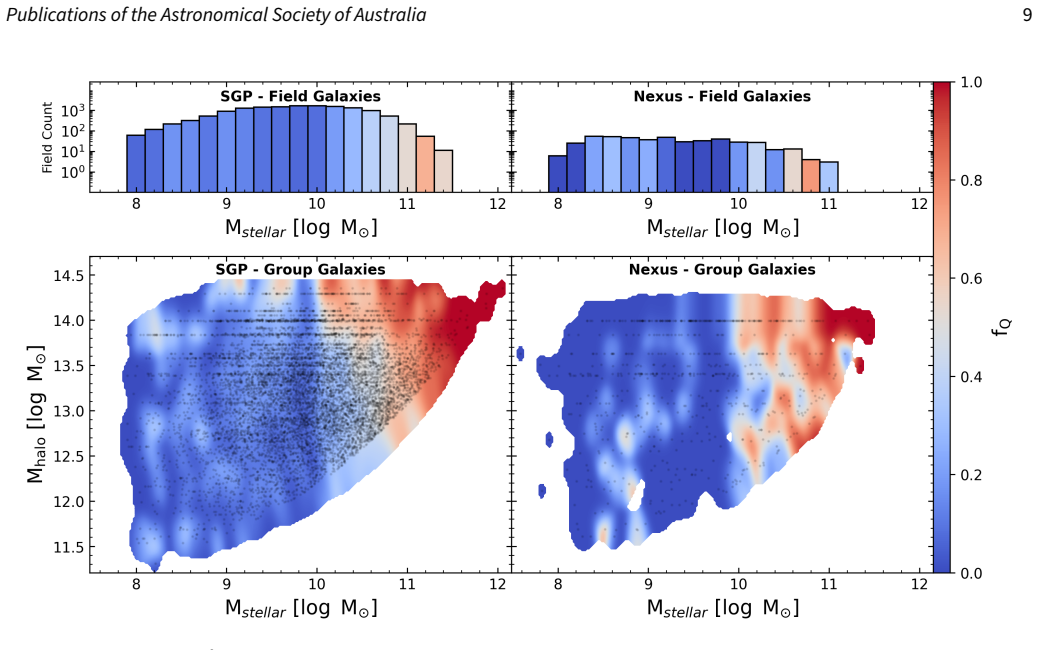
The quenched fraction increases with stellar mass in both field and group environments while groups show additional dependence on halo mass. The Nexus region exhibits systematic differences from the SGP baseline consistent with increased heterogeneity in accretion histories and pre-processing. For star-forming galaxies the mean log(sSFR) declines strongly with stellar mass and shows further suppression in group-scale halos. Radial zone splits around Abell 4038 show that environmental regulation is not spatially uniform and is driven largely by variations in the sampled halo mass function. Projected phase-space analysis links quenching to orbital history within the cluster but this trend is s
Load-bearing premise
The SGP volume provides an unbiased average reference and stellar-halo mass dependence can be cleanly decoupled from environmental signals without significant selection biases or covariances.
Editorial extensions
If this is right
- Quenched fraction gains an extra dependence on halo mass beyond the stellar mass trend in group environments.
- Star-forming galaxies experience additional sSFR suppression inside group-scale halos compared to the field.
- Environmental regulation varies with projected radial position around the central cluster because of differences in the local halo mass function.
- Quenching correlates with orbital history inside the cluster but only for galaxies above log(M_stellar) = 10.
- The overall drivers of evolution require accounting for both local halo mass and position in the surrounding large-scale structure.
Reading between the lines
- The mass threshold in the phase-space result suggests internal processes dominate quenching below log(M_stellar) = 10 while environment matters more above it.
- Repeating the radial and phase-space analysis on other assembling superstructures would test whether the observed patterns are general.
- The need to decouple mass and environment highlights that volume selection like the SGP is critical for isolating environmental signals in future surveys.
Signed reviews
Editorial analysis
A structured set of objections, weighed in public.
Referee Report
Summary. The manuscript claims that the drivers of galaxy evolution in the local universe depend jointly on stellar mass, group-scale halo mass, and location within large-scale structure. This is based on comparing quenched fraction f_Q and mean log(sSFR) between an average SGP reference volume and the dynamically assembling Nexus superstructure around Abell 4038, after decoupling stellar-halo mass relations using data from prior works; radial-zone splits within Nexus and projected phase-space analysis of the cluster are used to show non-uniform environmental effects and mass-dependent orbital quenching.
Significance. If the decoupling procedure robustly isolates additive LSS effects beyond stellar and halo mass, the results would strengthen evidence that galaxy quenching and star-formation regulation respond to multiple nested environmental scales, with the radial-zone and PPS findings highlighting pre-processing and orbital history in superstructures. This would motivate targeted cosmic-web surveys, though the current reliance on self-cited prior measurements limits the independence of the new claims.
major comments (3)
- [Abstract] Abstract (radial zone paragraph): the statement that radial-zone differences 'are driven largely by variations in the sampled halo mass function' directly undermines the central joint-dependence claim, because it indicates the reported LSS signal may be reducible to halo-mass sampling differences between zones rather than an independent location effect; the decoupling must be shown to remove this covariance explicitly before attributing residuals to LSS position.
- [Abstract] Abstract (decoupling sentence): the procedure for decoupling stellar-halo mass dependence is described only at a high level with no details on the matching/regression method, sample selection, error bars, or verification that residuals are uncorrelated with LSS location; this is load-bearing for the claim that group galaxies show 'an additional dependence on halo mass' separate from the radial-zone trends.
- [Abstract] Abstract (PPS analysis): the mass-dependent quenching trend (no significant f_Q change for log(M_stellar) < 10) is presented without quantitative comparison to the SGP baseline or statistical tests for the 'strongly mass-dependent' qualifier, weakening support for the joint stellar-mass + LSS conclusion.
minor comments (1)
- The abstract references measurements from VanKempen2024 and VanKempen2026 but provides no summary of completeness limits or selection functions; adding a short methods paragraph on these would improve clarity without altering the central claims.
Simulated Author's Rebuttal
We thank the referee for the careful and constructive review. We address each major comment point by point below, with revisions indicated where the manuscript will be updated.
read point-by-point responses
-
Referee: [Abstract] Abstract (radial zone paragraph): the statement that radial-zone differences 'are driven largely by variations in the sampled halo mass function' directly undermines the central joint-dependence claim, because it indicates the reported LSS signal may be reducible to halo-mass sampling differences between zones rather than an independent location effect; the decoupling must be shown to remove this covariance explicitly before attributing residuals to LSS position.
Authors: We agree the phrasing is ambiguous and risks implying that LSS effects reduce entirely to halo-mass sampling. The manuscript's decoupling (Section 3) explicitly matches on stellar and halo mass before comparing radial zones, and residuals after this matching retain a position dependence. We will revise the abstract to state that non-uniformity persists after halo-mass matching, thereby clarifying the independent LSS contribution. revision: yes
-
Referee: [Abstract] Abstract (decoupling sentence): the procedure for decoupling stellar-halo mass dependence is described only at a high level with no details on the matching/regression method, sample selection, error bars, or verification that residuals are uncorrelated with LSS location; this is load-bearing for the claim that group galaxies show 'an additional dependence on halo mass' separate from the radial-zone trends.
Authors: The abstract is necessarily concise. Full details of the matching procedure, sample cuts, bootstrap error estimation, and explicit verification that post-decoupling residuals are uncorrelated with radial position appear in Section 3.2 and Appendix B. We will insert a short parenthetical reference to these sections in the revised abstract. revision: partial
-
Referee: [Abstract] Abstract (PPS analysis): the mass-dependent quenching trend (no significant f_Q change for log(M_stellar) < 10) is presented without quantitative comparison to the SGP baseline or statistical tests for the 'strongly mass-dependent' qualifier, weakening support for the joint stellar-mass + LSS conclusion.
Authors: Section 4.3 already contains direct f_Q comparisons to the SGP baseline with uncertainties and Kolmogorov-Smirnov p-values confirming the mass dependence. We will add a concise quantitative clause to the abstract summarizing these tests. revision: yes
Circularity Check
No significant circularity; analysis builds on prior data without reducing claims to self-citation by construction
full rationale
The paper performs new comparisons, radial-zone splits, and phase-space analysis on measurements sourced from VanKempen2024 and VanKempen2026. These steps constitute independent observational work rather than any self-definitional loop, fitted parameter renamed as prediction, or load-bearing premise justified solely by overlapping-author citation. No equations or derivations are shown to collapse to inputs by construction, and the central joint-dependence claim rests on the new splits rather than prior results alone. Self-citation here is limited to data provenance, which is standard and does not trigger the enumerated circularity patterns.
Assumptions & free parameters
free parameters (1)
- group-scale halo mass definitions and bins
assumptions (2)
- domain assumption SGP dataset is an unbiased average reference volume for field environment
- domain assumption Stellar-halo mass dependence can be decoupled from environmental effects without residual biases
Cite this review
Pith. "Pith review of The Galactic Squeeze: How Aggregate and Highly Dynamical Environments Shape Star Formation in the Local Universe." pith.science (2026). https://pith.science/paper/JGM5P4HT
@misc{pith2026260531008,
  author       = {Pith},
  title        = {Pith review of: The Galactic Squeeze: How Aggregate and Highly Dynamical Environments Shape Star Formation in the Local Universe},
  year         = {2026},
  howpublished = {\url{https://pith.science/paper/JGM5P4HT}},
  note         = {Machine review of arXiv:2605.31008}
}
abstract
We investigate how galaxy evolution varies with environment in the nearby Universe by comparing an ``average'' reference volume in the Southern Galactic Pole (SGP) dataset from \citet{VanKempen2024} to the Nexus region, a dynamically assembling superstructure centred on the Abell~4038 galaxy cluster. We quantify environmental effects using the quenched fraction ($f_{\mathrm{Q}}$) and the specific star formation rate ($\mathrm{sSFR}$) for the star-forming population, measured as functions of stellar mass and group-scale halo mass from \citet{VanKempen2026}. We decouple the stellar--halo mass dependence, demonstrating that $f_{\mathrm{Q}}$ increases with stellar mass in both field and group environments, while group galaxies show an additional dependence on halo mass. The Nexus exhibits systematic differences relative to the SGP baseline, consistent with increased heterogeneity in accretion histories and pre-processing within a forming superstructure. For star-forming galaxies, the mean $\log(\mathrm{sSFR})$ declines strongly with stellar mass and shows additional environment-linked suppression in group-scale halos. Within the Nexus, splitting the sample into three projected radial zones around Abell~4038 shows that environmental regulation is not spatially uniform, driven largely by variations in the sampled halo mass function. Finally, a projected phase-space (PPS) analysis of Abell~4038 links quenching to orbital history within the cluster, though this trend is strongly mass-dependent: low-mass galaxies ($\log(M_{\mathrm{stellar}}) < 10$) show no significant change in $f_{\mathrm{Q}}$. These results demonstrate that the drivers of galaxy evolution depend jointly on stellar mass, local group halo mass, and location within the surrounding large-scale structure, motivating future large-scale, multi-wavelength cosmic web surveys.
Figures


Figures from the paper (10 more)


Reference graph
Works this paper leans on
-
[1]
G., Moore, B., & Bower, R
Abadi, M. G., Moore, B., & Bower, R. G. 1999, MNRAS, 308, 947 Astropy Collaboration, Robitaille, T. P., Tollerud, E. J., et al. 2013, A&A, 558, A33 Astropy Collaboration, Price-Whelan, A. M., Sipőcz, B. M., et al. 2018, AJ, 156, 123 Astropy Collaboration, Price-Whelan, A. M., Lim, P. L., et al. 2022, ApJ, 935, 167
1999
-
[2]
2017, ApJ, 844, 25
Bagchi, J., Sankhyayan, S., Sarkar, P., et al. 2017, ApJ, 844, 25
2017
-
[3]
K., Balogh, M
Baldry, I. K., Balogh, M. L., Bower, R. G., et al. 2006, MNRAS, 373, 469
2006
-
[4]
L., Baldry, I
Balogh, M. L., Baldry, I. K., Nichol, R., et al. 2004, ApJ, 615, L101
2004
-
[5]
L., Navarro, J
Balogh, M. L., Navarro, J. F., & Morris, S. L. 2000, ApJ, 540, 113
2000
-
[6]
P., Nichol, R
Bamford, S. P., Nichol, R. C., Baldry, I. K., et al. 2009, MNRAS, 393, 1324
2009
-
[7]
P., Haines, C
Bianconi, M., Smith, G. P., Haines, C. P., et al. 2018, MNRAS, 473, L79
2018
-
[8]
2007, MNRAS, 380, 339
Birnboim, Y., Dekel, A., & Neistein, E. 2007, MNRAS, 380, 339
2007
Show all 111 references
-
[9]
2016, MNRAS, 462, 4240
Blake, C., Amon, A., Childress, M., et al. 2016, MNRAS, 462, 4240
2016
-
[10]
R., & Moustakas, J
Blanton, M. R., & Moustakas, J. 2009, ARA&A, 47, 159
2009
-
[11]
Bluck, A. F. L., Maiolino, R., Sánchez, S. F., et al. 2020, MNRAS, 492, 96
2020
-
[12]
Bluck, A. F. L., Mendel, J. T., Ellison, S. L., et al. 2014, MNRAS, 441, 599 —. 2016, MNRAS, 462, 2559
2014
-
[13]
2022, A&A Rev., 30, 3
Boselli, A., Fossati, M., & Sun, M. 2022, A&A Rev., 30, 3
2022
-
[14]
2006, PASP, 118, 517
Boselli, A., & Gavazzi, G. 2006, PASP, 118, 517
2006
-
[15]
2014, A&A, 570, A69
Boselli, A., V oyer, E., Boissier, S., et al. 2014, A&A, 570, A69
2014
-
[16]
Brunetti, G., & Jones, T. W. 2014, International Journal of Modern Physics D, 23, 1430007
2014
-
[17]
G., Y ee, H
Carlberg, R. G., Y ee, H. K. C., Ellingson, E., et al. 1997, ApJ, 485, L13
1997
-
[18]
2018, MNRAS, 476, 875
Catinella, B., Saintonge, A., Janowiecki, S., et al. 2018, MNRAS, 476, 875
2018
-
[19]
2006, MNRAS, 370, 1651
Cattaneo, A., Dekel, A., Devriendt, J., Guiderdoni, B., & Blaizot, J. 2006, MNRAS, 370, 1651
2006
-
[20]
2003, PASP, 115, 763
Chabrier, G. 2003, PASP, 115, 763
2003
-
[21]
Choi, H., & Yi, S. K. 2017, ApJ, 837, 68
2017
-
[22]
2013, MNRAS, 429, 3272
Chon, G., Böhringer, H., & Nowak, N. 2013, MNRAS, 429, 3272
2013
-
[23]
2015, A&A, 575, L14
Chon, G., Böhringer, H., & Zaroubi, S. 2015, A&A, 575, L14
2015
-
[24]
E., Jarrett, T
Cluver, M. E., Jarrett, T. H., Taylor, E. N., et al. 2020, ApJ, 898, 20
2020
-
[25]
E., Jarrett, T
Cluver, M. E., Jarrett, T. H., Dale, D. A., et al. 2025, ApJ, 979, 18
2025
-
[26]
2001, MNRAS, 328, 1039
Colless, M., Dalton, G., Maddox, S., et al. 2001, MNRAS, 328, 1039
2001
-
[27]
J., Springel, V., White, S
Croton, D. J., Springel, V., White, S. D. M., et al. 2006, MNRAS, 365, 11
2006
-
[28]
J., Stevens, A
Croton, D. J., Stevens, A. R. H., Tonini, C., et al. 2016, ApJS, 222, 22
2016
-
[29]
S., Fazio, G
Cybulski, R., Yun, M. S., Fazio, G. G., & Gutermuth, R. A. 2014, MNRAS, 439, 3564
2014
-
[30]
2016, ApJ, 825, 113
Darvish, B., Mobasher, B., Sobral, D., et al. 2016, ApJ, 825, 113
2016
-
[31]
Davies, L. J. M., Robotham, A. S. G., Lagos, C. d. P., et al. 2019, MNRAS, 483, 5444
2019
-
[32]
S., & White, S
Davis, M., Efstathiou, G., Frenk, C. S., & White, S. D. M. 1985, ApJ, 292, 371 De Lucia, G., Fontanot, F., Xie, L., & Hirschmann, M. 2024, A&A, 687, A68 De Lucia, G., Tornatore, L., Frenk, C. S., et al. 2014, MNRAS, 445, 970 De Lucia, G., Weinmann, S., Poggianti, B. M., Aragón...
1985
-
[33]
2012, MNRAS, 423, 1277
Zaritsky, D. 2012, MNRAS, 423, 1277
2012
-
[34]
2006, MNRAS, 368, 2
Dekel, A., & Birnboim, Y. 2006, MNRAS, 368, 2
2006
-
[35]
1980, ApJ, 236, 351
Dressler, A. 1980, ApJ, 236, 351
1980
-
[36]
P., Norberg, P., Baldry, I
Driver, S. P., Norberg, P., Baldry, I. K., et al. 2009, Astronomy and Geo- physics, 50, 5.12
2009
-
[37]
P., Hill, D
Driver, S. P., Hill, D. T., Kelvin, L. S., et al. 2011, MNRAS, 413, 971
2011
-
[38]
P., Liske, J., Davies, L
Driver, S. P., Liske, J., Davies, L. J. M., et al. 2019, The Messenger, 175, 46
2019
-
[39]
P., Robotham, A
Driver, S. P., Robotham, A. S. G., Obreschkow, D., et al. 2022, MNRAS, 515, 2138
2022
-
[40]
2014, A&A, 562, A87
Einasto, M., Lietzen, H., Tempel, E., et al. 2014, A&A, 562, A87
2014
-
[41]
J., Tago, E., et al
Einasto, M., Liivamägi, L. J., Tago, E., et al. 2011, A&A, 532, A5
2011
-
[42]
R., Baugh, C
Eke, V. R., Baugh, C. M., Cole, S., et al. 2004, MNRAS, 348, 866 Publications of the Astronomical Society of Australia23 Enßlin, T. A., & Gopal-Krishna. 2001, A&A, 366, 26
2004
-
[43]
2012, A&A Rev., 20, 54
Feretti, L., Giovannini, G., Govoni, F., & Murgia, M. 2012, A&A Rev., 20, 54
2012
-
[44]
P., Cooper, M
Fillingham, S. P., Cooper, M. C., Wheeler, C., et al. 2015, MNRAS, 454, 2039
2015
-
[45]
Flesch, E. W. 2021, arXiv e-prints, arXiv:2105.12985
2021
-
[46]
J., Mendel, J
Fossati, M., Wilman, D. J., Mendel, J. T., et al. 2017, ApJ, 835, 153
2017
-
[47]
E., & Gott, J
Gunn, J. E., & Gott, J. Richard, I. 1972, ApJ, 176, 1
1972
-
[48]
P., Busarello, G., Merluzzi, P., et al
Haines, C. P., Busarello, G., Merluzzi, P., et al. 2011, MNRAS, 412, 127
2011
-
[49]
P., Pereira, M
Haines, C. P., Pereira, M. J., Smith, G. P., et al. 2015, ApJ, 806, 101
2015
-
[50]
Hamilton, A. J. S. 1998, in Astrophysics and Space Science Library, V ol. 231, The Evolving Universe, ed. D. Hamilton, 185
1998
-
[51]
2016, MNRAS, 461, 1760
Hirschmann, M., De Lucia, G., & Fontanot, F. 2016, MNRAS, 461, 1760
2016
-
[52]
C., & Harris, W
Hou, A., Parker, L. C., & Harris, W. E. 2014, MNRAS, 442, 406
2014
-
[53]
Hu, W., & Kravtsov, A. V. 2003, ApJ, 584, 702
2003
-
[54]
Hunter, J. D. 2007, Computing in Science and Engineering, 9, 90
2007
-
[55]
Jackson, J. C. 1972, MNRAS, 156, 1P Jaffé, Y. L., Smith, R., Candlish, G. N., et al. 2015, MNRAS, 448, 1715
1972
-
[56]
H., Cluver, M
Jarrett, T. H., Cluver, M. E., Taylor, E. N., et al. 2023, ApJ, 946, 95
2023
-
[57]
H., Saunders, W., Colless, M., et al
Jones, D. H., Saunders, W., Colless, M., et al. 2004, MNRAS, 355, 747
2004
-
[58]
D., Pillepich, A., Nelson, D., et al
Joshi, G. D., Pillepich, A., Nelson, D., et al. 2020, MNRAS, 496, 2673
2020
-
[59]
1987, MNRAS, 227, 1
Kaiser, N. 1987, MNRAS, 227, 1
1987
-
[60]
Kauffmann, G., White, S. D. M., Heckman, T. M., et al. 2004, MNRAS, 353, 713
2004
-
[61]
M., Tremonti, C., et al
Kauffmann, G., Heckman, T. M., Tremonti, C., et al. 2003, MNRAS, 346, 1055
2003
-
[62]
C., & Evans, N
Kennicutt, R. C., & Evans, N. J. 2012, ARA&A, 50, 531
2012
-
[63]
A., Trujillo-Gomez, S., & Primack, J
Klypin, A. A., Trujillo-Gomez, S., & Primack, J. 2011, ApJ, 740, 102
2011
-
[64]
J., W oo, J., & Kovač, K
Knobel, C., Lilly, S. J., W oo, J., & Kovač, K. 2015, ApJ, 800, 24
2015
-
[65]
M., Dunkley, J., et al
Komatsu, E., Smith, K. M., Dunkley, J., et al. 2011, ApJS, 192, 18
2011
-
[66]
Lagos, C. d. P., Tobar, R. J., Robotham, A. S. G., et al. 2018, MNRAS, 481, 3573
2018
-
[67]
Lagos, C. d. P., Bravo, M., Tobar, R., et al. 2024, MNRAS, 531, 3551
2024
-
[68]
S., Kraan-Korteweg, R
Lambert, T. S., Kraan-Korteweg, R. C., Jarrett, T. H., & Macri, L. M. 2020, MNRAS, 497, 2954
2020
-
[69]
B., Tinsley, B
Larson, R. B., Tinsley, B. M., & Caldwell, C. N. 1980, ApJ, 237, 692
1980
-
[70]
H., et al
Luber, N., Müller, A., van Gorkom, J. H., et al. 2022, ApJ, 927, 39
2022
-
[71]
E., Lares, M., Yaryura, C
Luparello, H. E., Lares, M., Yaryura, C. Y., et al. 2013, MNRAS, 432, 1367
2013
-
[72]
M., Kraan-Korteweg, R
Macri, L. M., Kraan-Korteweg, R. C., Lambert, T., et al. 2019, ApJS, 245, 6
2019
-
[73]
2013, MNRAS, 431, L117
Mahajan, S. 2013, MNRAS, 431, L117
2013
-
[74]
A., Biviano, A., & Boué, G
Mamon, G. A., Biviano, A., & Boué, G. 2013, MNRAS, 429, 3079
2013
-
[75]
2009, ApJ, 707, 250
Martig, M., Bournaud, F., Teyssier, R., & Dekel, A. 2009, ApJ, 707, 250
2009
-
[76]
L., Balogh, M
McGee, S. L., Balogh, M. L., Bower, R. G., Font, A. S., & McCarthy, I. G. 2009, MNRAS, 400, 937
2009
-
[77]
2010, in Proceedings of the 9th Python in Science Conference, ed
McKinney, W. 2010, in Proceedings of the 9th Python in Science Conference, ed. Stéfan van der Walt & Jarrod Millman, 56 – 61
2010
-
[78]
McQuinn, K. B. W., Skillman, E. D., Cannon, J. M., et al. 2010, ApJ, 721, 297
2010
-
[79]
1996, Nature, 379, 613
Moore, B., Katz, N., Lake, G., Dressler, A., & Oemler, A. 1996, Nature, 379, 613
1996
-
[80]
P., Somerville, R
Moster, B. P., Somerville, R. S., Maulbetsch, C., et al. 2010, ApJ, 710, 903
2010
-
[81]
F., Frenk, C
Navarro, J. F., Frenk, C. S., & White, S. D. M. 1997, ApJ, 490, 493
1997
-
[82]
G., Weiner, B
Noeske, K. G., Weiner, B. J., Faber, S. M., et al. 2007, ApJ, 660, L43
2007
-
[83]
A., Hudson, M
Oman, K. A., Hudson, M. J., & Behroozi, P. S. 2013, MNRAS, 431, 2307
2013
-
[84]
S., Baldry, I
Owers, M. S., Baldry, I. K., Bauer, A. E., et al. 2013, ApJ, 772, 104
2013
-
[85]
2019, MNRAS, 484, 1702
Pasquali, A., Smith, R., Gallazzi, A., et al. 2019, MNRAS, 484, 1702
2019
-
[86]
2015, Nature, 521, 192
Peng, Y., Maiolino, R., & Cochrane, R. 2015, Nature, 521, 192
2015
-
[87]
J., Renzini, A., & Carollo, M
Peng, Y.-j., Lilly, S. J., Renzini, A., & Carollo, M. 2012, ApJ, 757, 4
2012
-
[88]
J., Kovač, K., et al
Peng, Y.-j., Lilly, S. J., Kovač, K., et al. 2010, ApJ, 721, 193
2010
-
[89]
A., Smail, I., Kodama, T., et al
Pimbblet, K. A., Smail, I., Kodama, T., et al. 2002, MNRAS, 331, 333 Planck Collaboration, Ade, P. A. R., Aghanim, N., et al. 2016, A&A, 594, A24
2002
-
[90]
C., & Raychaudhury, S
Porter, S. C., & Raychaudhury, S. 2007, MNRAS, 375, 1409
2007
-
[91]
C., Raychaudhury, S., Pimbblet, K
Porter, S. C., Raychaudhury, S., Pimbblet, K. A., & Drinkwater, M. J. 2008, MNRAS, 388, 1152
2008
-
[92]
A., & Spergel, D
Reid, B. A., & Spergel, D. N. 2009, ApJ, 698, 143
2009
-
[93]
J., Kurtz, M
Rines, K., Geller, M. J., Kurtz, M. J., & Diaferio, A. 2003, AJ, 126, 2152
2003
-
[94]
Robotham, A. S. G., Norberg, P., Driver, S. P., et al. 2011, MNRAS, 416, 2640
2011
-
[95]
J., et al
Saintonge, A., Catinella, B., Tacconi, L. J., et al. 2017, ApJS, 233, 22
2017
-
[96]
2015, A&A, 575, A74
Schreiber, C., Pannella, M., Elbaz, D., et al. 2015, A&A, 575, A74
2015
-
[97]
B., & Roy, A
Slee, O. B., & Roy, A. L. 1998, MNRAS, 297, L86
1998
-
[98]
J., Hwang, H
Sohn, J., Geller, M. J., Hwang, H. S., et al. 2021, ApJ, 923, 143
2021
-
[99]
S., Steinhardt, C
Speagle, J. S., Steinhardt, C. L., Capak, P. L., & Silverman, J. D. 2014, ApJS, 214, 15
2014
-
[100]
Springel, V., White, S. D. M., Jenkins, A., et al. 2005, Nature, 435, 629
2005
-
[101]
J., Genzel, R., & Sternberg, A
Tacconi, L. J., Genzel, R., & Sternberg, A. 2020, ARA&A, 58, 157
2020
-
[102]
N., Cluver, M., Bell, E., et al
Taylor, E. N., Cluver, M., Bell, E., et al. 2023, The Messenger, 190, 46
2023
-
[103]
A., Bell, E
Terrazas, B. A., Bell, E. F., Henriques, B. M. B., et al. 2016, ApJ, 830, L12 van den Bosch, F. C., Aquino, D., Yang, X., et al. 2008, MNRAS, 387, 79 van der Burg, R. F. J., McGee, S., Aussel, H., et al. 2018, A&A, 618, A140 van der Velden, E. 2020, The Journal of Open Source ...
2016
-
[104]
E., et al
Virtanen, P., Gommers, R., Oliphant, T. E., et al. 2020, Nature Methods, 17, 261
2020
-
[105]
R., Johnson, B
Weisz, D. R., Johnson, B. D., Johnson, L. C., et al. 2012, ApJ, 744, 44
2012
-
[106]
R., Tinker, J
Wetzel, A. R., Tinker, J. L., & Conroy, C. 2012, MNRAS, 424, 232
2012
-
[107]
R., Tinker, J
Wetzel, A. R., Tinker, J. L., Conroy, C., & van den Bosch, F. C. 2013, MNRAS, 432, 336
2013
-
[108]
E., van Dokkum, P
Whitaker, K. E., van Dokkum, P. G., Brammer, G., & Franx, M. 2012, ApJ, 754, L29 W oo, J., Dekel, A., Faber, S. M., et al. 2013, MNRAS, 428, 3306
2012
-
[109]
L., Eisenhardt, P
Wright, E. L., Eisenhardt, P. R. M., Mainzer, A. K., et al. 2010, AJ, 140, 1868
2010
-
[110]
J., van den Bosch, F
Yang, X., Mo, H. J., van den Bosch, F. C., et al. 2007, ApJ, 671, 153
2007
-
[111]
I., & Mulchaey, J
Zabludoff, A. I., & Mulchaey, J. S. 1998, ApJ, 496, 39 Zel’dovich, Y. B. 1970, Astrophysics, 6, 164 Appendix 1. Table Statistics 24 Wesley Van Kempen et al. Table A4.Quenched fractionf Q for 0.4 dex bins of halo mass (top) and 0.2 dex bins of stellar mass (bottom) for the SGP ...
1998
Reviewed June 28, 2026 · model on record in the stance chip above.
Discussion (0). Continue with ORCID to comment.