Radiative Corrections to Elastic Lepton-Proton Scattering with Focus on Two-Photon-Exchange Diagrams
Pith reviewed 2026-06-28 22:06 UTC · model grok-4.3
The pith
Complete next-to-leading-order QED radiative corrections to elastic lepton-proton scattering are calculated with loop-momentum-dependent form factors.
A machine-rendered reading of the paper's core claim, the machinery that carries it, and where it could break.
Core claim
We present a complete calculation of QED radiative corrections to elastic electron-proton and muon-proton scattering at next-to-leading order, taking into account loop-momentum-dependent form factors. In the discussion of their numerical impact on lepton-proton scattering cross sections, we pay special attention to the TPE diagrams and compare them with existing theoretical predictions and lepton-proton scattering data.
What carries the argument
Loop-momentum-dependent form factors incorporated into the two-photon-exchange diagrams at next-to-leading order in QED
Load-bearing premise
The modeling of two-photon-exchange diagrams relies on loop-momentum-dependent form factors whose specific functional form and input values are taken as given.
What would settle it
A precise measurement of the ratio of electron-proton to muon-proton scattering cross sections at kinematics where TPE effects are significant that does not match the calculated corrections would falsify the numerical predictions.
Figures

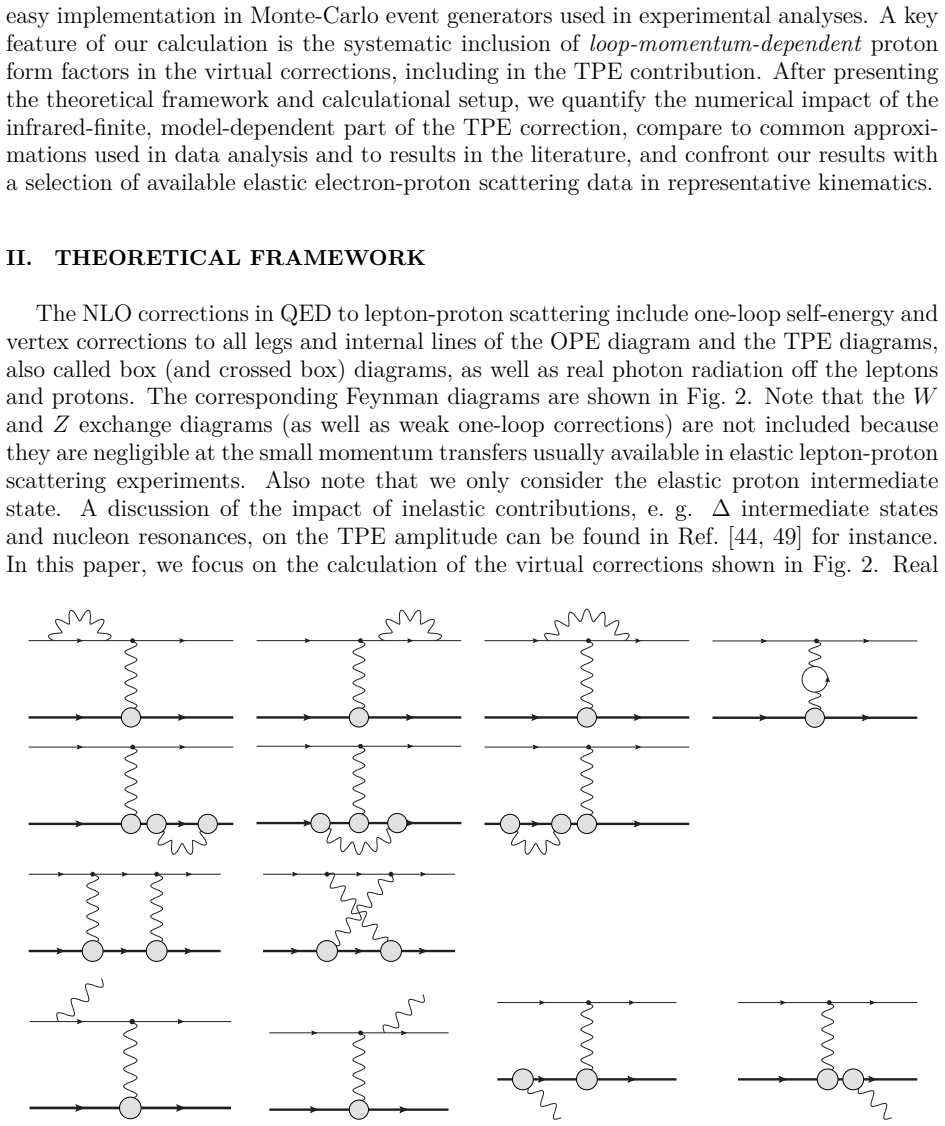




read the original abstract
Lepton (electron and muon) scattering experiments are excellent tools to gain insight into the nucleon structure. Elastic electron-proton scattering probes the spatial distribution of charge and magnetization inside the proton, and comparing electron-proton and muon-proton scattering data tests lepton universality. The availability of a plethora of scattering data with increased precision and observed discrepancies such as the proton form factor puzzle and the proton radius puzzle motivated a renewed effort to improve the theoretical framework. Realizing that the one-photon-exchange approximation (OPE), i.e. the Born approximation, is not sufficient, radiative corrections in QED, especially the two-photon-exchange (TPE) diagrams, are under investigation. The TPE diagrams are of special interest among the radiative corrections, since they depend on the proton structure. In this work, we present a complete calculation of QED radiative corrections to elastic electron-proton and muon-proton scattering at next-to-leading order, taking into account loop-momentum-dependent form factors. In the discussion of their numerical impact on lepton-proton scattering cross sections, we pay special attention to the TPE diagrams and compare them with existing theoretical predictions and lepton-proton scattering data.
Editorial analysis
A structured set of objections, weighed in public.
Referee Report
Summary. The manuscript presents a complete next-to-leading-order QED calculation of radiative corrections to elastic electron-proton and muon-proton scattering. It incorporates loop-momentum-dependent proton form factors into the two-photon-exchange (TPE) diagrams and evaluates the numerical impact of these corrections on cross sections, with comparisons to existing theoretical predictions and experimental data.
Significance. If the derivation holds, the work supplies an explicit NLO framework that improves upon the one-photon-exchange approximation and constant-form-factor treatments of TPE. This is directly relevant to precision extractions of nucleon structure and tests of lepton universality. The explicit dependence on external form-factor inputs is stated, allowing the community to assess sensitivity to proton-structure modeling.
minor comments (2)
- [Abstract] Abstract: the kinematic range (e.g., Q² interval or lepton beam energies) over which the numerical impact is evaluated is not stated; adding this would clarify the domain of applicability.
- The manuscript would benefit from an explicit statement, perhaps in the introduction or results section, of which specific parametrization (e.g., dipole, Kelly, or other) supplies the loop-momentum-dependent form factors used for the numerical results.
Simulated Author's Rebuttal
We thank the referee for the careful reading and positive assessment of our work, including the recommendation for minor revision. The report provides no specific major comments to address point by point.
Circularity Check
No significant circularity; derivation is self-contained perturbative calculation
full rationale
The manuscript presents an explicit NLO QED calculation of radiative corrections to elastic lepton-proton scattering, with loop-momentum-dependent form factors supplied as external inputs rather than fitted or defined within the work itself. No load-bearing step reduces by construction to a self-citation, a fitted parameter renamed as a prediction, or an ansatz smuggled via prior author work; the central results are conditional on those inputs and the derivation chain remains independent of the target observables.
Axiom & Free-Parameter Ledger
axioms (2)
- standard math Standard perturbative expansion of QED to next-to-leading order is valid for the kinematics considered.
- domain assumption Proton structure can be adequately captured by loop-momentum-dependent form factors in the TPE diagrams.
Reference graph
Works this paper leans on
-
[1]
The result for the crossed-box diagram follows from crossing symmetry, X (Mcbox · M∗ 0)(s, u) = − X (Mbox · M∗ 0)(s, t) s→u
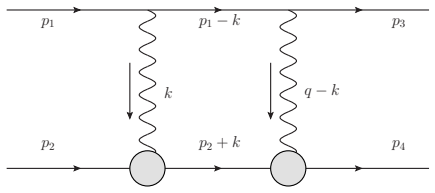
is expressed as a combination of (at most) scalar four-point functions and for n = 2 their first- and second-order derivatives with respect to Λ2. The result for the crossed-box diagram follows from crossing symmetry, X (Mcbox · M∗ 0)(s, u) = − X (Mbox · M∗ 0)(s, t) s→u . (33) 10 Integration-by-Parts (IBP) identities provide an independent and complementa...
2025
-
[2]
02 0 0 . 2 0 . 4 0 . 6 0 . 8 1 n=1,Q2 = 0. 01 GeV2 n=2,Q2 = 0. 01 GeV2 n=1,Q2 = 1 GeV2 n=2,Q2 = 1 GeV2 n=1,Q2 = 5 GeV2 n=2,Q2 = 5 GeV2 n=1,Q2 = 10 GeV2 n=2,Q2 = 10 GeV2 δγγ (M oT) ǫ FIG. 6: Our results for δγγ (M oT) using monopole and dipole form factors. |k2| ∼ Q2 ≪ Λ2, where both parametrizations agree. As Q2 approaches and exceeds Λ2, the loop samples...
-
[3]
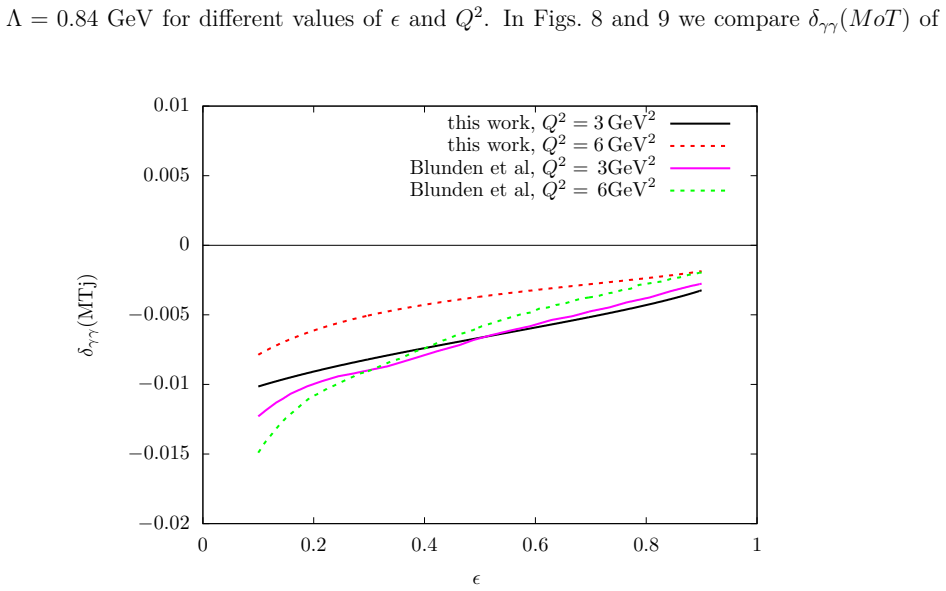
01 0 0 . 2 0 . 4 0 . 6 0 . 8 1 this work, Q2 = 3 GeV2 this work, Q2 = 6 GeV2 Blunden et al, Q2 = 3GeV 2 Blunden et al, Q2 = 6GeV 2 δγγ (MTj) ǫ FIG. 7: Comparison of our results (with n = 1 and Λ = 0 .84 GeV ) for δγγ (M T j) with those presented in Ref. [36] (Fig. 3). Fig. 2.3 of Ref. [47] which is also obtained with n = 1 in Eq. 45, with our results for ...
-
[4]
02 0 0 . 2 0 . 4 0 . 6 0 . 8 1 this work Afanasev et al. Q2 = 1 GeV2 Q2 = 0. 5 GeV2 Q2 = 0. 1 GeV2 Q2 = 0. 01 GeV2 Q2 = 0. 001 GeV2 Q2 = 1 GeV2 Q2 = 0. 5 GeV2 Q2 = 0. 1 GeV2 Q2 = 0. 01 GeV2 Q2 = 0. 001 GeV2 δγγ (MoT) ǫ FIG. 8: Comparison of our results for δγγ (M oT) with those presented in Fig. 2.3 (left) of Ref. [47] for the range of Q2 from 0.001 GeV 2...
-
[5]
Theory Challenges in the Precision Era of the Large Hadron Collider
01 0 0 . 2 0 . 4 0 . 6 0 . 8 1 this work, Q2 = 1 GeV2 this work, Q2 = 2 GeV2 this work, Q2 = 3 GeV2 this work, Q2 = 6 GeV2 Afanasev et al., Q2 = 1 GeV2 Afanasev et al., Q2 = 2 GeV2 Afanasev et al., Q2 = 3 GeV2 Afanasev et al., Q2 = 6 GeV2 δγγ (MoT) ǫ FIG. 9: Comparison of our results for δγγ (M oT) with those presented in Fig. 2.3 (right) of Ref. [47] for...
-
[6]
+ 12) + 4)M 2t + κ(3κ(κ + 1) + 8)t2 ! + β5 ΛL2 2β2κt3 4β2M 2 −6C0,Λ + 6C0 + 6C(1) 0,ΛL − 3C(2) 0,ΛL2 + C(3) 0,ΛL3 + C(3) 0,Λκ2L4 − 2L4t 8β2C(3) 0,Λ(κ(κ(κ + 3) + 12) + 4) M 4 − κ3(6C(1) 0,Λ + L(6C(2) 0,Λ + C(3) 0,ΛL)) + 2κ(κ(7κ + 9) − 8)M 2(3C(2) 0,Λ + C(3) 0,ΛL) + κt2 −16β4M 4 −6C0,Λ + 6C0 + 6C(1) 0,ΛL − 3C(2) 0,ΛL2 + C(3) 0,ΛL3 − 8β2C(3) 0,Λ κ2 − 6 L4M 2...
-
[7]
Derivatives of B0 and C0 functions needed for the TPE contribution The derivatives of the scalar 2-point functions of Eq. B2 read as follows ( L = Λ 2): ∂B (04) 0 ∂Λ2 = 1 m2 − ln √ L m ! + (L − 2m2)√ L √ L − 4m2 ln ( p√ L + 2m + p√ L − 2m)2 4m !! (C1) ∂B (05) 0 ∂Λ2 = 1 M 2 4(L − 2M 2)√ 4M 2 − L arctan p 2M − √ Lp 2M + √ L ! − √ L ln L M 2 ! (C2) ∂B (12) 0...
-
[8]
First derivatives of D(1245) 0 , D(0145) 0 and second derivative of D(0145) 0 For convenience, we introduce L = Λ 2 and write the logarithms appearing in the deriva- tives of the scalar 4-point functions of Eq. B4 as follows ( x = m or M ) Lx = ln L + √∆x 2x √ L , L ∆ = ln m2 + M 2 − s + √ ∆ 2mM ! , L t = ln 2L − t + √∆L 2L , where ∆ = λ(s, m, M), ∆L = λ(...
-
[9]
+ 8) + 16)s) + 512M 8 ! + κ2st3((κ + 4)s + (3κ + 4)t) + 32M 8(16s − (3κ(κ + 2) + 4)t) − 2M 6 −64(κ − 3)st + (κ(κ(45κ + 127) + 104) + 16) t2 + 256s2 ! + M 4t 32(κ(3κ + 2) + 8)s2 + 4(κ(κ(17κ + 35) + 8) + 32) st + (κ(κ(49κ + 160) + 160) + 48) t2 ! − M 2t2 2(κ(κ(5κ +
-
[10]
+ 8) + 16)s2 + 2(κ(κ(16κ + 27) + 8) + 8) st + (κ + 1)(κ(7κ + 16) + 8)t2 ! M 2 2 t − 4m2 !2 c1c(4) = 2 κ3 L − t t − 4m2 Lm2 t − 2 m2 + M 2 − s + t t 2m2 − M 2 + s − 4m4 + κ2 2L2m2 7m4 + m2 6M 2 − 5(2s + t) + 3M 4 − 3M 2(2s + t) + (s + t)(3s + t) + L 16m6t − 2t2 3m4 + m2 4s − 6M 2 + M 2 − s 2 − 16m4 m2 + M 2 − s 2 − M 2t3 + t 16m8 + m6 96M 2 + 32s − 30t + 4...
-
[11]
R. G. Sachs, High-energy behavior of nucleon electromagnetic form factors, Phys. Rev. 126, 2256 (1962)
1962
-
[12]
I. A. Qattan et al. , High precision measurements of the proton elastic electromagnetic form factors and their ratio at Q2 = 0.50, 2.64, 3.20, and 4.10 GeV 2 (2024), arXiv:2411.05201 [nucl-ex]
arXiv 2024
-
[13]
Pohl et al
R. Pohl et al. , The size of the proton, Nature 466, 213 (2010)
2010
- [14]
-
[15]
G. Lee, J. R. Arrington, and R. J. Hill, Extraction of the proton radius from electron-proton scattering data, Phys. Rev. D 92, 013013 (2015), arXiv:1505.01489 [hep-ph]
Pith/arXiv arXiv 2015
-
[16]
J. C. Bernauer et al. (A1), Electric and magnetic form factors of the proton, Phys. Rev. C 90, 015206 (2014), arXiv:1307.6227 [nucl-ex]
Pith/arXiv arXiv 2014
-
[17]
M. Mihovilovič et al. , First measurement of proton’s charge form factor at very low Q2 with initial state radiation, Phys. Lett. B 771, 194 (2017), arXiv:1612.06707 [nucl-ex]
Pith/arXiv arXiv 2017
-
[18]
M. Mihovilovič et al. , The proton charge radius extracted from the initial-state radiation experiment at MAMI, Eur. Phys. J. A 57, 107 (2021), arXiv:1905.11182 [nucl-ex]
Pith/arXiv arXiv 2021
-
[19]
Xiong et al
W. Xiong et al. , A small proton charge radius from an electron–proton scattering experiment, Nature 575, 147 (2019)
2019
-
[20]
D. Androić et al. (Qweak), Precision measurement of the weak charge of the proton, Nature 557, 207 (2018), arXiv:1905.08283 [nucl-ex]
Pith/arXiv arXiv 2018
-
[21]
D. Becker et al. , The P2 experiment, Eur. Phys. J. A 54, 208 (2018), arXiv:1802.04759 [nucl- ex]
Pith/arXiv arXiv 2018
-
[22]
R. Gilman et al. (MUSE), Studying the Proton ”Radius” Puzzle with \mu p Elastic Scattering (2013), arXiv:1303.2160 [nucl-ex]
Pith/arXiv arXiv 2013
-
[23]
R. Gilman et al. (MUSE), Technical Design Report for the Paul Scherrer Institute Exper- iment R-12-01.1: Studying the Proton ”Radius” Puzzle with µp Elastic Scattering (2017), arXiv:1709.09753 [physics.ins-det]
Pith/arXiv arXiv 2017
-
[24]
A. Afanasev et al. , Radiative corrections: from medium to high energy experiments, Eur. Phys. J. A 60, 91 (2024), arXiv:2306.14578 [hep-ph]
arXiv 2024
-
[25]
Tsai, Radiative Corrections to Electron-Proton Scattering, Phys
Y.-S. Tsai, Radiative Corrections to Electron-Proton Scattering, Phys. Rev. 122, 1898 (1961)
1961
-
[26]
L. W. Mo and Y.-S. Tsai, Radiative Corrections to Elastic and Inelastic e p and mu p Scat- tering, Rev. Mod. Phys. 41, 205 (1969)
1969
-
[27]
L. C. Maximon and J. A. Tjon, Radiative corrections to electron-proton scattering, Physical Review C 62, 10.1103/physrevc.62.054320 (2000)
-
[28]
Y. M. Bystritskiy, E. A. Kuraev, and E. Tomasi-Gustafsson, Structure function method ap- plied to polarized and unpolarized electron-proton scattering: A solution of the GE(p)/GM(p) discrepancy, Phys. Rev. C 75, 015207 (2007), arXiv:hep-ph/0603132
Pith/arXiv arXiv 2007
-
[29]
E. A. Kuraev, A. I. Ahmadov, Y. M. Bystritskiy, and E. Tomasi-Gustafsson, Radiative cor- rections for electron proton elastic scattering taking into account high orders and hard photon emission, Phys. Rev. C 89, 065207 (2014), arXiv:1311.0370 [hep-ph]
Pith/arXiv arXiv 2014
-
[30]
R. E. Gerasimov and V. S. Fadin, Analysis of approximations used in calculations of radiative corrections to electron-proton scattering cross section, Phys. Atom. Nucl. 78, 69 (2015)
2015
-
[31]
Akushevich, H
I. Akushevich, H. Gao, A. Ilyichev, and M. Meziane, Radiative corrections beyond the ultra 40 relativistic limit in unpolarized ep elastic and Møller scatterings for the PRad Experiment at Jefferson Laboratory, Eur. Phys. J. A 51, 1 (2015)
2015
-
[32]
J. Isaacson, W. I. Jay, A. Lovato, P. A. N. Machado, and N. Rocco, Introducing a novel event generator for electron-nucleus and neutrino-nucleus scattering, Phys. Rev. D 107, 033007 (2023), arXiv:2205.06378 [hep-ph]
arXiv 2023
-
[33]
R.-D. Bucoveanu and H. Spiesberger, QED radiative corrections for Polarized Lepton-Proton Scattering, PoS SPIN2018, 115 (2019), arXiv:1903.12229 [hep-ph]
Pith/arXiv arXiv 2019
-
[34]
P. Banerjee, T. Engel, A. Signer, and Y. Ulrich, QED at NNLO with McMule, SciPost Phys. 9, 027 (2020), arXiv:2007.01654 [hep-ph]
arXiv 2020
-
[35]
R. Bonciani et al. , Two-Loop Four-Fermion Scattering Amplitude in QED, Phys. Rev. Lett. 128, 022002 (2022), arXiv:2106.13179 [hep-ph]
arXiv 2022
- [36]
-
[37]
D. R. Yennie, S. C. Frautschi, and H. Suura, The infrared divergence phenomena and high- energy processes, Annals Phys. 13, 379 (1961)
1961
-
[38]
R. J. Hill, Effective field theory for large logarithms in radiative corrections to electron proton scattering, Phys. Rev. D 95, 013001 (2017), arXiv:1605.02613 [hep-ph]
Pith/arXiv arXiv 2017
-
[39]
Kivel and M
N. Kivel and M. Vanderhaeghen, Two-photon exchange in elastic electron-proton scattering: A qcd factorization approach, Phys. Rev. Lett. 103, 092004 (2009)
2009
-
[40]
N. Kivel and M. Vanderhaeghen, Two-photon exchange corrections to elastic electron- proton scattering at large momentum transfer within the SCET approach, JHEP 04, 029, arXiv:1212.0683 [hep-ph]
-
[41]
P. Talukdar, V. C. Shastry, U. Raha, and F. Myhrer, Lepton-Proton Two-Photon Exchange in Chiral Perturbation Theory, Phys. Rev. D 101, 013008 (2020), arXiv:1911.06843 [nucl-th]
arXiv 2020
-
[42]
Talukdar, V
P. Talukdar, V. C. Shastry, U. Raha, and F. Myhrer, Radiative and chiral corrections to elastic lepton-proton scattering in chiral perturbation theory, Phys. Rev. D 104, 053001 (2021)
2021
-
[43]
P. Choudhary, R. Goswami, U. Raha, F. Myhrer, and D. Chakrabarti, Analytical evaluation of elastic lepton-proton two-photon exchange in chiral perturbation theory, Eur. Phys. J. A 60, 69 (2024), [Erratum: Eur.Phys.J.A 62, 31 (2026)], arXiv:2306.09454 [hep-ph]
arXiv 2024
-
[44]
S. P. Dye, M. Gonderinger, and G. Paz, Elements of QED-NRQED effective field theory: NLO scattering at leading power, Phys. Rev. D 94, 013006 (2016), arXiv:1602.07770 [hep-ph]
Pith/arXiv arXiv 2016
-
[45]
S. P. Dye, M. Gonderinger, and G. Paz, Elements of QED-NRQED Effective Field Theory: II. Matching of Contact Interactions, Phys. Rev. D 100, 054010 (2019), arXiv:1812.05056 [hep-ph]
arXiv 2019
-
[46]
P. G. Blunden, W. Melnitchouk, and J. A. Tjon, Two photon exchange and elastic electron proton scattering, Phys. Rev. Lett. 91, 142304 (2003), arXiv:nucl-th/0306076
Pith/arXiv arXiv 2003
-
[47]
P. G. Blunden, W. Melnitchouk, and J. A. Tjon, Two-photon exchange in elastic electron- nucleon scattering, Phys. Rev. C 72, 034612 (2005), arXiv:nucl-th/0506039
Pith/arXiv arXiv 2005
-
[48]
D. Borisyuk and A. Kobushkin, Box diagram in the elastic electron-proton scattering, Phys. Rev. C 74, 065203 (2006), arXiv:nucl-th/0606030
Pith/arXiv arXiv 2006
-
[49]
E. A. Kuraev, V. V. Bytev, S. Bakmaev, and E. Tomasi-Gustafsson, Charge asymmetry for electron (positron)-proton elastic scattering at large angles, Phys. Rev. C 78, 015205 (2008)
2008
-
[50]
O. Tomalak and M. Vanderhaeghen, Two-photon exchange correction to elastic lepton-proton scattering at small momentum transfer, Phys. Rev. D 90, 013006 (2014), arXiv:1405.1600
Pith/arXiv arXiv 2014
-
[51]
O. Tomalak, B. Pasquini, and M. Vanderhaeghen, Two-photon exchange corrections to elastic 41 e−-proton scattering: full dispersive treatment of πN states at low momentum transfers, Phys. Rev. D 95, 096001 (2017), arXiv:1612.07726
Pith/arXiv arXiv 2017
-
[52]
O. Tomalak and M. Vanderhaeghen, Two-photon exchange correction to muon-proton elastic scattering at low momentum transfer, Eur. Phys. J. C 76, 125 (2016), arXiv:1512.09113
Pith/arXiv arXiv 2016
-
[53]
P. G. Blunden and W. Melnitchouk, Dispersive approach to two-photon exchange in elastic electron-proton scattering, Phys. Rev. C 95, 065209 (2017), arXiv:1703.06181
Pith/arXiv arXiv 2017
- [54]
-
[55]
Y.-C. Chen, A. Afanasev, S. J. Brodsky, C. E. Carlson, and M. Vanderhaeghen, Partonic calculation of the two-photon exchange contribution to elastic electron-proton scattering at large momentum transfer, Phys. Rev. Lett. 93, 122301 (2004), arXiv:hep-ph/0403058
Pith/arXiv arXiv 2004
-
[56]
A. V. Afanasev, S. J. Brodsky, C. E. Carlson, Y.-C. Chen, and M. Vanderhaeghen, The Two-photon exchange contribution to elastic electron-nucleon scattering at large momentum transfer, Phys. Rev. D 72, 013008 (2005), arXiv:hep-ph/0502013
Pith/arXiv arXiv 2005
-
[57]
Afanasev, P
A. Afanasev, P. Blunden, D. Hasell, and B. Raue, Two-photon exchange in elastic electron– proton scattering, Progress in Particle and Nuclear Physics 95, 245 (2017)
2017
-
[58]
C. E. Carlson and M. Vanderhaeghen, Two-Photon Physics in Hadronic Processes, Ann. Rev. Nucl. Part. Sci. 57, 171 (2007), arXiv:hep-ph/0701272
Pith/arXiv arXiv 2007
-
[59]
Arrington, P
J. Arrington, P. Blunden, and W. Melnitchouk, Review of two-photon exchange in electron scattering, Progress in Particle and Nuclear Physics 66, 782–833 (2011)
2011
-
[60]
’t Hooft and M
G. ’t Hooft and M. J. G. Veltman, Scalar One Loop Integrals, Nucl. Phys. B 153, 365 (1979)
1979
-
[61]
A. Denner, Techniques for calculation of electroweak radiative corrections at the one loop level and results for W physics at LEP-200, Fortsch. Phys. 41, 307 (1993), arXiv:0709.1075 [hep-ph]
Pith/arXiv arXiv 1993
-
[62]
M. Bohm, H. Spiesberger, and W. Hollik, On the One Loop Renormalization of the Elec- troweak Standard Model and Its Application to Leptonic Processes, Fortsch. Phys. 34, 687 (1986)
1986
-
[63]
Passarino and M
G. Passarino and M. J. G. Veltman, One Loop Corrections for e+ e- Annihilation Into mu+ mu- in the Weinberg Model, Nucl. Phys. B 160, 151 (1979)
1979
-
[64]
Jamin and M
M. Jamin and M. E. Lautenbacher, TRACER: Version 1.1: A Mathematica package for gamma algebra in arbitrary dimensions, Comput. Phys. Commun. 74, 265 (1993)
1993
-
[65]
Beenakker and A
W. Beenakker and A. Denner, Infrared Divergent Scalar Box Integrals With Applications in the Electroweak Standard Model, Nucl. Phys. B 338, 349 (1990)
1990
-
[66]
Denner, U
A. Denner, U. Nierste, and R. Scharf, A Compact expression for the scalar one loop four point function, Nucl. Phys. B 367, 637 (1991)
1991
-
[67]
A. Denner and S. Dittmaier, Scalar one-loop 4-point integrals, Nucl. Phys. B 844, 199 (2011), arXiv:1005.2076 [hep-ph]
Pith/arXiv arXiv 2011
-
[68]
Mertig, M
R. Mertig, M. Böhm, and A. Denner, Feyn calc - computer-algebraic calculation of feynman amplitudes, Computer Physics Communications 64, 345 (1991)
1991
-
[69]
Shtabovenko, R
V. Shtabovenko, R. Mertig, and F. Orellana, New developments in feyncalc 9.0, Computer Physics Communications 207, 432–444 (2016)
2016
-
[70]
Shtabovenko, R
V. Shtabovenko, R. Mertig, and F. Orellana, Feyncalc 9.3: New features and improvements, Computer Physics Communications 256, 107478 (2020)
2020
-
[71]
H. H. Patel, Package-X: A Mathematica package for the analytic calculation of one-loop integrals, Comput. Phys. Commun. 197, 276 (2015), arXiv:1503.01469 [hep-ph]. 42
Pith/arXiv arXiv 2015
-
[72]
H. H. Patel, Package-X 2.0: A Mathematica package for the analytic calculation of one-loop integrals, Comput. Phys. Commun. 218, 66 (2017), arXiv:1612.00009 [hep-ph]
Pith/arXiv arXiv 2017
-
[73]
R. N. Lee, LiteRed 1.4: a powerful tool for reduction of multiloop integrals, J. Phys. Conf. Ser. 523, 012059 (2014), arXiv:1310.1145 [hep-ph]
Pith/arXiv arXiv 2014
-
[74]
A. Denner, S. Dittmaier, and L. Hofer, COLLIER - A fortran-library for one-loop integrals, PoS LL2014, 071 (2014), arXiv:1407.0087 [hep-ph]
Pith/arXiv arXiv 2014
-
[75]
A. Denner and S. Dittmaier, Reduction of one loop tensor five point integrals, Nucl. Phys. B 658, 175 (2003), arXiv:hep-ph/0212259
Pith/arXiv arXiv 2003
-
[76]
A. Denner and S. Dittmaier, Reduction schemes for one-loop tensor integrals, Nucl. Phys. B 734, 62 (2006), arXiv:hep-ph/0509141
Pith/arXiv arXiv 2006
-
[77]
Beenakker, S
W. Beenakker, S. C. van der Marck, and W. Hollik, e+ e- annihilation into heavy fermion pairs at high-energy colliders, Nucl. Phys. B 365, 24 (1991)
1991
-
[78]
Dittmaier, Separation of soft and collinear singularities from one loop N point integrals, Nucl
S. Dittmaier, Separation of soft and collinear singularities from one loop N point integrals, Nucl. Phys. B 675, 447 (2003), arXiv:hep-ph/0308246
Pith/arXiv arXiv 2003
-
[79]
Navas et al
S. Navas et al. (Particle Data Group), Review of particle physics, Phys. Rev. D 110, 030001 (2024)
2024
-
[80]
Bloch and A
F. Bloch and A. Nordsieck, Note on the Radiation Field of the electron, Phys. Rev. 52, 54 (1937)
1937
discussion (0)
Sign in with ORCID, Apple, or X to comment. Anyone can read and Pith papers without signing in.