Learning Hyperspherical Time-Frequency Representations for Time-Series Out-of-Distribution Detection
Pith reviewed 2026-06-28 23:40 UTC · model grok-4.3
The pith
Time-series OOD detection improves when representations are learned as hyperspherical embeddings via a von Mises-Fisher objective that fuses time and frequency views.
A machine-rendered reading of the paper's core claim, the machinery that carries it, and where it could break.
Core claim
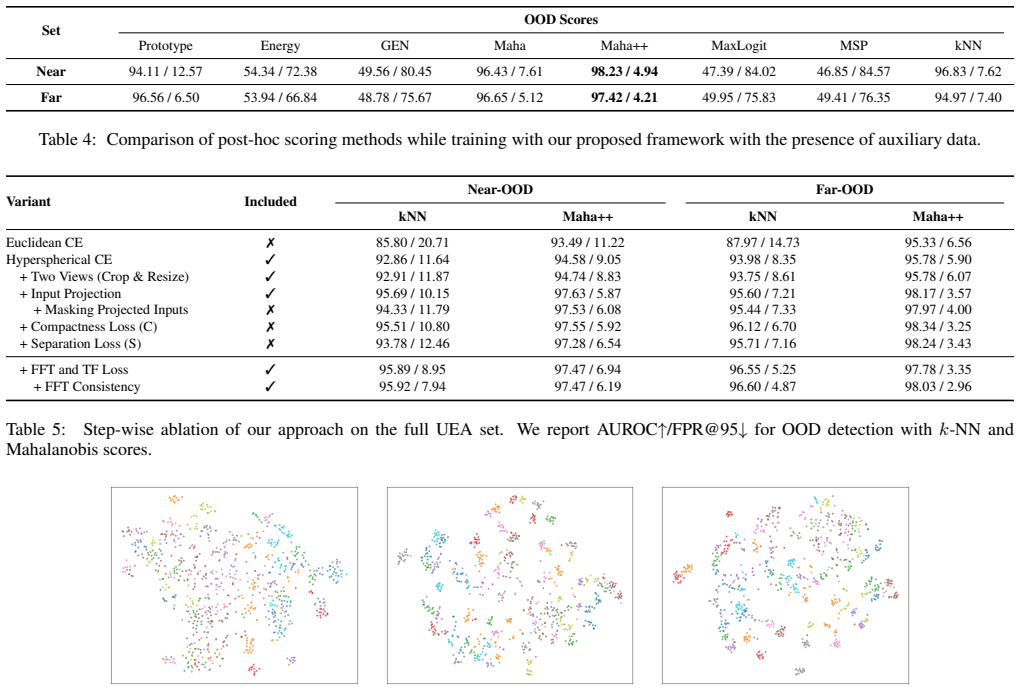
The central claim is that time-series OOD detection is advanced by learning hyperspherical embeddings whose class-conditional densities are modeled with a von Mises-Fisher likelihood; the embeddings are produced by fusing time-domain and frequency-domain encoders into a shared unit-sphere space, after which k-nearest-neighbor and Mahalanobis scores applied to the embeddings yield consistent improvements over strong contrastive-learning and post-hoc baselines when evaluated on the complete UCR and UEA archives under a cross-dataset protocol.
What carries the argument
Hyperspherical embeddings induced by a von Mises-Fisher likelihood objective on the unit sphere that integrates time-domain and frequency-domain encoders into a joint embedding space for distance-based scoring.
If this is right
- k-NN scores computed on the learned embeddings detect OOD samples more accurately than the compared baselines.
- Mahalanobis scores computed on the same embeddings also show consistent gains over the baselines.
- The improvements hold across the entire UCR and UEA collections when training and test sets come from different datasets.
Where Pith is reading between the lines
- The same time-frequency fusion and spherical constraint could be tested on other sequential modalities such as audio or multivariate sensor streams.
- If the vMF objective is the key ingredient, replacing it with a different spherical prior would provide a direct test of whether the hyperspherical geometry itself drives the detection gains.
Load-bearing premise
Inducing class-conditional structure via a von Mises-Fisher likelihood-based objective on hyperspherical embeddings produces representations where distance-based scores reliably detect out-of-distribution samples under distributional shifts.
What would settle it
A dataset from the UCR or UEA archives on which the vMF hyperspherical method fails to improve or underperforms the contrastive-learning baselines under the cross-dataset protocol would falsify the central claim.
Figures

read the original abstract
Out-of-distribution (OOD) detection for time-series data remains comparatively underexplored compared to vision and language, with a limited principled understanding of how supervised time-series representations can be leveraged for reliable detection under distributional shifts. This work formulates time-series OOD detection as representation learning with hyperspherical embeddings, where class-conditional structure is induced by a von Mises-Fisher (vMF) likelihood-based objective on the unit sphere. The learned representation combines time- and frequency-domain views of the input signal via domain-specific encoders, integrating them into a joint embedding space for OOD detection. Detection uses distance-based scores over the learned embeddings, including k-nearest neighbors (k-NN) and Mahalanobis scores. We evaluate the approach at scale on the complete UCR and UEA time-series archives under a cross-dataset protocol. Empirical results show consistent improvements under both k-NN and Mahalanobis scoring over strong contrastive learning and post-hoc baselines in the same setting. Code is available at https://github.com/tiiuae/hypertf-time-series-ood.
Editorial analysis
A structured set of objections, weighed in public.
Referee Report
Summary. The paper formulates time-series OOD detection as representation learning on the unit sphere, inducing class-conditional structure via a von Mises-Fisher likelihood objective applied to joint embeddings produced by domain-specific time- and frequency-domain encoders. OOD scoring is performed with standard distance-based methods (k-NN and Mahalanobis) on the learned hyperspherical embeddings. The approach is evaluated at scale on the complete UCR and UEA archives under a cross-dataset protocol and reports consistent gains over contrastive-learning and post-hoc baselines; code is released.
Significance. If the reported gains hold under the stated protocol, the work supplies a concrete, scalable recipe for leveraging supervised hyperspherical representations in an underexplored domain. The combination of a geometrically motivated objective, dual-domain encoders, and large-scale archive evaluation, together with public code, would constitute a useful empirical reference point for time-series OOD research.
major comments (1)
- [§4] §4 (Evaluation): the cross-dataset protocol is described at a high level in the abstract but the precise train/test split rules, exclusion criteria for datasets, and definition of distributional shift are not stated with sufficient precision to allow independent reproduction or to rule out inadvertent leakage; this directly affects the load-bearing claim of 'consistent improvements under cross-dataset shifts'.
minor comments (2)
- [Abstract] The abstract lists 'strong contrastive learning and post-hoc baselines' without naming the exact methods or citing their original papers; adding the specific baselines and references would improve clarity.
- [§3] Notation for the joint embedding (time + frequency) and the precise form of the vMF concentration parameter are introduced without an explicit equation reference in the early sections; a single numbered equation would aid readability.
Simulated Author's Rebuttal
We thank the referee for the positive assessment and the recommendation for minor revision. We address the single major comment below and will incorporate the requested clarifications.
read point-by-point responses
-
Referee: [§4] §4 (Evaluation): the cross-dataset protocol is described at a high level in the abstract but the precise train/test split rules, exclusion criteria for datasets, and definition of distributional shift are not stated with sufficient precision to allow independent reproduction or to rule out inadvertent leakage; this directly affects the load-bearing claim of 'consistent improvements under cross-dataset shifts'.
Authors: We agree that greater precision is needed for reproducibility. In the revised manuscript we will expand §4 with an explicit subsection detailing: (i) the exact train/test split rules (including how source and target datasets are paired), (ii) the exclusion criteria applied to the UCR/UEA archives, and (iii) the operational definition of distributional shift used in the protocol. These additions will also include concrete checks confirming absence of leakage between training and evaluation sets. revision: yes
Circularity Check
No significant circularity; purely empirical pipeline
full rationale
The paper advances a representation-learning method for time-series OOD detection: domain-specific encoders produce joint hyperspherical embeddings trained under a vMF likelihood objective, followed by standard k-NN and Mahalanobis scoring. The central claim consists of empirical improvements on the full UCR/UEA archives under cross-dataset evaluation. No derivation chain, uniqueness theorem, fitted-parameter prediction, or self-citation load-bearing step is present; the vMF objective and distance scores are independent of the reported test metrics. This is the normal case of a self-contained empirical contribution.
Axiom & Free-Parameter Ledger
Reference graph
Works this paper leans on
-
[1]
Unexplored faces of robustness and out-of- distribution: Covariate shifts in environment and sensor domains
[Baeket al., 2024 ] Eunsu Baek, Keondo Park, Jiyoon Kim, and Hyung-Sin Kim. Unexplored faces of robustness and out-of- distribution: Covariate shifts in environment and sensor domains. InProceedings of the IEEE/CVF Conference on Computer Vision and Pattern Recognition, pages 22294–22303,
2024
-
[2]
Out-of-distribution detection in time-series do- main: A novel seasonal ratio scoring approach.ACM Transac- tions on Intelligent Systems and Technology, 15(1):1–24,
[Belkhoujaet al., 2023 ] Taha Belkhouja, Yan Yan, and Janard- han Rao Doppa. Out-of-distribution detection in time-series do- main: A novel seasonal ratio scoring approach.ACM Transac- tions on Intelligent Systems and Technology, 15(1):1–24,
2023
-
[3]
Your classifier can be secretly a likelihood-based ood detector
[Burapacheep and Li, 2024] Jirayu Burapacheep and Yixuan Li. Your classifier can be secretly a likelihood-based ood detector. Transactions on Machine Learning Research,
2024
-
[4]
A simple framework for con- trastive learning of visual representations
[Chenet al., 2020 ] Ting Chen, Simon Kornblith, Mohammad Norouzi, and Geoffrey Hinton. A simple framework for con- trastive learning of visual representations. InInternational con- ference on machine learning, pages 1597–1607. PmLR,
2020
-
[5]
Atom: Robustifying out-of-distribution detec- tion using outlier mining
[Chenet al., 2021 ] Jiefeng Chen, Yixuan Li, Xi Wu, Yingyu Liang, and Somesh Jha. Atom: Robustifying out-of-distribution detec- tion using outlier mining. InJoint European Conference on Ma- chine Learning and Knowledge Discovery in Databases, pages 430–445. Springer,
2021
-
[6]
Gaia: Delving into gradient-based attribution abnormality for out-of-distribution de- tection.Advances in Neural Information Processing Systems, 36:79946–79958,
[Chenet al., 2023 ] Jinggang Chen, Junjie Li, Xiaoyang Qu, Jian- zong Wang, Jiguang Wan, and Jing Xiao. Gaia: Delving into gradient-based attribution abnormality for out-of-distribution de- tection.Advances in Neural Information Processing Systems, 36:79946–79958,
2023
-
[7]
[Djurisicet al., 2022 ] Andrija Djurisic, Nebojsa Bozanic, Ar- jun Ashok, and Rosanne Liu. Extremely simple activa- tion shaping for out-of-distribution detection.arXiv preprint arXiv:2209.09858,
-
[8]
Siren: Shaping representations for detecting out-of- distribution objects.Advances in neural information processing systems, 35:20434–20449,
[Duet al., 2022 ] Xuefeng Du, Gabriel Gozum, Yifei Ming, and Yixuan Li. Siren: Shaping representations for detecting out-of- distribution objects.Advances in neural information processing systems, 35:20434–20449,
2022
-
[9]
Diffguard: Semantic mismatch-guided out-of- distribution detection using pre-trained diffusion models
[Gaoet al., 2023 ] Ruiyuan Gao, Chenchen Zhao, Lanqing Hong, and Qiang Xu. Diffguard: Semantic mismatch-guided out-of- distribution detection using pre-trained diffusion models. InPro- ceedings of the IEEE/CVF International Conference on Com- puter Vision, pages 1579–1589,
2023
-
[10]
[Gungoret al., 2025 ] Onat Gungor, Amanda Sofie Rios, Nilesh Ahuja, and Tajana Rosing. Ts-ood: Evaluating time-series out- of-distribution detection and prospective directions for progress. arXiv preprint arXiv:2502.15901,
-
[11]
A baseline for detecting misclassified and out-of-distribution ex- amples in neural networks.Proceedings of International Confer- ence on Learning Representations,
[Hendrycks and Gimpel, 2017] Dan Hendrycks and Kevin Gimpel. A baseline for detecting misclassified and out-of-distribution ex- amples in neural networks.Proceedings of International Confer- ence on Learning Representations,
2017
-
[12]
Scaling out-of-distribution de- tection for real-world settings.arXiv preprint arXiv:1911.11132,
[Hendryckset al., 2019a ] Dan Hendrycks, Steven Basart, Mantas Mazeika, Andy Zou, Joe Kwon, Mohammadreza Mostajabi, Ja- cob Steinhardt, and Dawn Song. Scaling out-of-distribution de- tection for real-world settings.arXiv preprint arXiv:1911.11132,
-
[13]
On the importance of gradients for detecting distributional shifts in the wild.Advances in Neural Information Processing Systems, 34:677–689,
[Huanget al., 2021 ] Rui Huang, Andrew Geng, and Yixuan Li. On the importance of gradients for detecting distributional shifts in the wild.Advances in Neural Information Processing Systems, 34:677–689,
2021
-
[14]
Density-driven regular- ization for out-of-distribution detection.Advances in Neural In- formation Processing Systems, 35:887–900,
[Huanget al., 2022 ] Wenjian Huang, Hao Wang, Jiahao Xia, Chengyan Wang, and Jianguo Zhang. Density-driven regular- ization for out-of-distribution detection.Advances in Neural In- formation Processing Systems, 35:887–900,
2022
-
[15]
Inceptiontime: Finding alexnet for time series classification.Data Mining and Knowl- edge Discovery, 34(6):1936–1962,
[Ismail Fawazet al., 2020 ] Hassan Ismail Fawaz, Benjamin Lu- cas, Germain Forestier, Charlotte Pelletier, Daniel F Schmidt, Jonathan Weber, Geoffrey I Webb, Lhassane Idoumghar, Pierre- Alain Muller, and Franc ¸ois Petitjean. Inceptiontime: Finding alexnet for time series classification.Data Mining and Knowl- edge Discovery, 34(6):1936–1962,
2020
-
[16]
Supervised contrastive learning
[Khoslaet al., 2020 ] Prannay Khosla, Piotr Teterwak, Chen Wang, Aaron Sarna, Yonglong Tian, Phillip Isola, Aaron Maschinot, Ce Liu, and Dilip Krishnan. Supervised contrastive learning. Advances in neural information processing systems, 33:18661– 18673,
2020
-
[17]
Out-of-distribution detection with logical reasoning
[Kirchheimet al., 2024 ] Konstantin Kirchheim, Tim Gonschorek, and Frank Ortmeier. Out-of-distribution detection with logical reasoning. InProceedings of the IEEE/CVF Winter Conference on Applications of Computer Vision, pages 2122–2131,
2024
-
[18]
Revisiting time series out- lier detection: Definitions and benchmarks
[Laiet al., 2021 ] Kwei-Herng Lai, Daochen Zha, Junjie Xu, Yue Zhao, Guanchu Wang, and Xia Hu. Revisiting time series out- lier detection: Definitions and benchmarks. InThirty-fifth con- ference on neural information processing systems datasets and benchmarks track (round 1),
2021
-
[19]
A simple unified framework for detecting out-of- distribution samples and adversarial attacks.Advances in neural information processing systems, 31,
[Leeet al., 2018 ] Kimin Lee, Kibok Lee, Honglak Lee, and Jin- woo Shin. A simple unified framework for detecting out-of- distribution samples and adversarial attacks.Advances in neural information processing systems, 31,
2018
-
[20]
[Lianget al., 2017 ] Shiyu Liang, Yixuan Li, and Rayadurgam Srikant. Enhancing the reliability of out-of-distribution image detection in neural networks.arXiv preprint arXiv:1706.02690,
-
[21]
Energy-based out-of-distribution detection.Ad- vances in neural information processing systems, 33:21464– 21475,
[Liuet al., 2020 ] Weitang Liu, Xiaoyun Wang, John Owens, and Yixuan Li. Energy-based out-of-distribution detection.Ad- vances in neural information processing systems, 33:21464– 21475,
2020
-
[22]
Gen: Pushing the limits of softmax-based out-of- distribution detection
[Liuet al., 2023 ] Xixi Liu, Yaroslava Lochman, and Christopher Zach. Gen: Pushing the limits of softmax-based out-of- distribution detection. InProceedings of the IEEE/CVF confer- ence on computer vision and pattern recognition, pages 23946– 23955,
2023
-
[23]
[Luet al., 2024a ] Haodong Lu, Dong Gong, Shuo Wang, Jason Xue, Lina Yao, and Kristen Moore. Learning with mixture of prototypes for out-of-distribution detection.arXiv preprint arXiv:2402.02653,
-
[24]
Lunardi, Abdulrahman Banabila, Dania Herzalla, and Martin Andreoni
[Lunardiet al., 2025 ] Willian T. Lunardi, Abdulrahman Banabila, Dania Herzalla, and Martin Andreoni. Contrastive representa- tion modeling for anomaly detection. InFrontiers in Artificial Intelligence and Applications, Volume 413: ECAI 2025, pages 2594–2601. IOS Press,
2025
-
[25]
Poem: Out-of-distribution detection with posterior sampling
[Minget al., 2022 ] Yifei Ming, Ying Fan, and Yixuan Li. Poem: Out-of-distribution detection with posterior sampling. InInter- national conference on machine learning, pages 15650–15665. PMLR,
2022
-
[26]
How to exploit hyperspherical embeddings for out-of- distribution detection? InThe Eleventh International Conference on Learning Representations,
[Minget al., 2023 ] Yifei Ming, Yiyou Sun, Ousmane Dia, and Yix- uan Li. How to exploit hyperspherical embeddings for out-of- distribution detection? InThe Eleventh International Conference on Learning Representations,
2023
-
[27]
Mahalanobis++: Improving ood detection via feature normaliza- tion.arXiv preprint arXiv:2505.18032,
[Mueller and Hein, 2025] Maximilian Mueller and Matthias Hein. Mahalanobis++: Improving ood detection via feature normaliza- tion.arXiv preprint arXiv:2505.18032,
-
[28]
Nearest neighbor guidance for out-of-distribution detection
[Parket al., 2023 ] Jaewoo Park, Yoon Gyo Jung, and Andrew Beng Jin Teoh. Nearest neighbor guidance for out-of-distribution detection. InProceedings of the IEEE/CVF international confer- ence on computer vision, pages 1686–1695,
2023
-
[29]
ConjNorm: Tractable Density Estimation for Out-of-Distribution Detection
[Penget al., 2024 ] Bo Peng, Yadan Luo, Yonggang Zhang, Yixuan Li, and Zhen Fang. Conjnorm: Tractable density estimation for out-of-distribution detection.arXiv preprint arXiv:2402.17888,
work page internal anchor Pith review Pith/arXiv arXiv 2024
-
[30]
Reweightood: Loss reweighting for distance-based ood detec- tion
[Regmiet al., 2024 ] Sudarshan Regmi, Bibek Panthi, Yifei Ming, Prashnna K Gyawali, Danail Stoyanov, and Binod Bhattarai. Reweightood: Loss reweighting for distance-based ood detec- tion. InProceedings of the IEEE/CVF Conference on Computer Vision and Pattern Recognition, pages 131–141,
2024
-
[31]
Ssd: A unified framework for self-supervised outlier de- tection
[Sehwaget al., 2021 ] Vikash Sehwag, Mung Chiang, and Prateek Mittal. Ssd: A unified framework for self-supervised outlier de- tection. InInternational Conference on Learning Representa- tions,
2021
-
[32]
React: Out-of-distribution detection with rectified activations.Advances in neural information processing systems, 34:144–157,
[Sunet al., 2021 ] Yiyou Sun, Chuan Guo, and Yixuan Li. React: Out-of-distribution detection with rectified activations.Advances in neural information processing systems, 34:144–157,
2021
-
[33]
Out-of-distribution detection with deep nearest neighbors
[Sunet al., 2022 ] Yiyou Sun, Yifei Ming, Xiaojin Zhu, and Yixuan Li. Out-of-distribution detection with deep nearest neighbors. In International Conference on Machine Learning, pages 20827– 20840. PMLR,
2022
-
[34]
Csi: Novelty detection via contrastive learning on distributionally shifted instances.Advances in neural infor- mation processing systems, 33:11839–11852,
[Tacket al., 2020 ] Jihoon Tack, Sangwoo Mo, Jongheon Jeong, and Jinwoo Shin. Csi: Novelty detection via contrastive learning on distributionally shifted instances.Advances in neural infor- mation processing systems, 33:11839–11852,
2020
-
[35]
Vim: Out-of-distribution with virtual-logit match- ing
[Wanget al., 2022 ] Haoqi Wang, Zhizhong Li, Litong Feng, and Wayne Zhang. Vim: Out-of-distribution with virtual-logit match- ing. InProceedings of the IEEE/CVF conference on computer vision and pattern recognition, pages 4921–4930,
2022
-
[36]
Mitigating neural network over- confidence with logit normalization
[Weiet al., 2022 ] Hongxin Wei, Renchunzi Xie, Hao Cheng, Lei Feng, Bo An, and Yixuan Li. Mitigating neural network over- confidence with logit normalization. InInternational conference on machine learning, pages 23631–23644. PMLR,
2022
-
[37]
A discriminative feature learning approach for deep face recognition
[Wenet al., 2016 ] Yandong Wen, Kaipeng Zhang, Zhifeng Li, and Yu Qiao. A discriminative feature learning approach for deep face recognition. In Bastian Leibe, Jiri Matas, Nicu Sebe, and Max Welling, editors,Computer Vision – ECCV 2016, pages 499–515, Cham,
2016
-
[38]
Springer International Publishing. [Winkenset al., 2020 ] Jim Winkens, Rudy Bunel, Abhijit Guha Roy, Robert Stanforth, Vivek Natarajan, Joseph R Ledsam, Pa- tricia MacWilliams, Pushmeet Kohli, Alan Karthikesalingam, Simon Kohl, et al. Contrastive training for improved out-of- distribution detection.arXiv preprint arXiv:2007.05566,
-
[39]
[Wuet al., 2024 ] Yingwen Wu, Ruiji Yu, Xinwen Cheng, Zheng- bao He, and Xiaolin Huang. Pursuing feature separation based on neural collapse for out-of-distribution detection.arXiv preprint arXiv:2405.17816,
-
[40]
Se- mantically coherent out-of-distribution detection
[Yanget al., 2021 ] Jingkang Yang, Haoqi Wang, Litong Feng, Xi- aopeng Yan, Huabin Zheng, Wayne Zhang, and Ziwei Liu. Se- mantically coherent out-of-distribution detection. InProceedings of the IEEE/CVF International Conference on Computer Vision, pages 8301–8309,
2021
-
[41]
Out-of-distribution detec- tion with diversification (provably).Advances in Neural Infor- mation Processing Systems, 37:22690–22719,
[Yaoet al., 2024 ] Haiyun Yao, Zongbo Han, Huazhu Fu, Xi Peng, Qinghua Hu, and Changqing Zhang. Out-of-distribution detec- tion with diversification (provably).Advances in Neural Infor- mation Processing Systems, 37:22690–22719,
2024
-
[42]
Unsuper- vised out-of-distribution detection by maximum classifier dis- crepancy
[Yu and Aizawa, 2019] Qing Yu and Kiyoharu Aizawa. Unsuper- vised out-of-distribution detection by maximum classifier dis- crepancy. InProceedings of the IEEE/CVF international con- ference on computer vision, pages 9518–9526,
2019
-
[43]
Ts2vec: Towards universal representation of time series
[Yueet al., 2022 ] Zhihan Yue, Yujing Wang, Juanyong Duan, Tian- meng Yang, Congrui Huang, Yunhai Tong, and Bixiong Xu. Ts2vec: Towards universal representation of time series. InPro- ceedings of the AAAI conference on artificial intelligence, vol- ume 36, pages 8980–8987,
2022
-
[44]
Decou- pling maxlogit for out-of-distribution detection
[Zhang and Xiang, 2023] Zihan Zhang and Xiang Xiang. Decou- pling maxlogit for out-of-distribution detection. InProceedings of the IEEE/CVF conference on computer vision and pattern recognition, pages 3388–3397,
2023
-
[45]
Openood v1.5: Enhanced benchmark for out-of-distribution detection.arXiv preprint arXiv:2306.09301,
[Zhanget al., 2023b ] Jingyang Zhang, Jingkang Yang, Pengyun Wang, Haoqi Wang, Yueqian Lin, Haoran Zhang, Yiyou Sun, Xuefeng Du, Yixuan Li, Ziwei Liu, et al. Openood v1. 5: Enhanced benchmark for out-of-distribution detection.arXiv preprint arXiv:2306.09301,
-
[46]
Step: Out-of-distribution detection in the presence of limited in-distribution labeled data.Advances in Neural Information Processing Systems, 34:29168–29180,
[Zhouet al., 2021 ] Zhi Zhou, Lan-Zhe Guo, Zhanzhan Cheng, Yu- Feng Li, and Shiliang Pu. Step: Out-of-distribution detection in the presence of limited in-distribution labeled data.Advances in Neural Information Processing Systems, 34:29168–29180,
2021
-
[47]
Diversified out- lier exposure for out-of-distribution detection via informative ex- trapolation.Advances in neural information processing systems, 36:22702–22734,
[Zhuet al., 2023 ] Jianing Zhu, Yu Geng, Jiangchao Yao, Tongliang Liu, Gang Niu, Masashi Sugiyama, and Bo Han. Diversified out- lier exposure for out-of-distribution detection via informative ex- trapolation.Advances in neural information processing systems, 36:22702–22734,
2023
-
[48]
The projection head is implemented as a two-layer multilayer perceptron (MLP) with batch normalization and ReLU activations (except the last one)
A Training Details We use INCEPTIONTIME [Ismail Fawazet al., 2020 ] as the encoder networkf θ, followed by a projection headg ϕ that maps representations to a 128-dimensional hyperspherical embedding space. The projection head is implemented as a two-layer multilayer perceptron (MLP) with batch normalization and ReLU activations (except the last one). All...
2020
-
[49]
The base learning rate is linearly warmed up over the first10%of training steps and subsequently annealed with a cosine schedule
We use SGD with momentum0.9and weight decay3×10 −3. The base learning rate is linearly warmed up over the first10%of training steps and subsequently annealed with a cosine schedule. Training is run for100epochs per ID dataset, with a batch size of8, following [Yueet al., 2022]. For data augmentation, we apply a random crop in[75%,99%]and resize back to th...
2022
-
[50]
This categorization is essential for our benchmark protocol, as it underlies the construction of near- vs
In addition to raw statistics, we also report a datasettypelabel (e.g., human activity recognition (HAR), electroencephalogram (EEG), Audio, etc.). This categorization is essential for our benchmark protocol, as it underlies the construction of near- vs. far-OOD splits: datasets belonging to the same type form natural candidates for near-OOD evaluation, w...
2050
-
[51]
The table reports dataset statistics along with aTypelabel, which is used to define near- and far-OOD splits in our benchmark
Dataset TrainSize TestSize NumDimensions SeriesLength NumClasses Type Ham 109 105 1 431 2 SPECTRO HandOutlines 1000 370 1 2709 2 IMAGE Haptics 155 308 1 1092 5 MOTION Herring 64 64 1 512 2 IMAGE HouseTwenty 40 119 1 2000 2 DEVICE InlineSkate 100 550 1 1882 7 MOTION InsectEPGRegularTrain 62 249 1 601 3 EPG InsectEPGSmallTrain 17 249 1 601 3 EPG ItalyPowerD...
2000
discussion (0)
Sign in with ORCID, Apple, or X to comment. Anyone can read and Pith papers without signing in.