Erasing photons from bright squeezed vacuum light via above-threshold ionization
Pith reviewed 2026-06-28 22:28 UTC · model grok-4.3
The pith
Above-threshold ionization from bright squeezed light generates large Schrödinger cat states by heralding photon subtraction.
A machine-rendered reading of the paper's core claim, the machinery that carries it, and where it could break.
Core claim
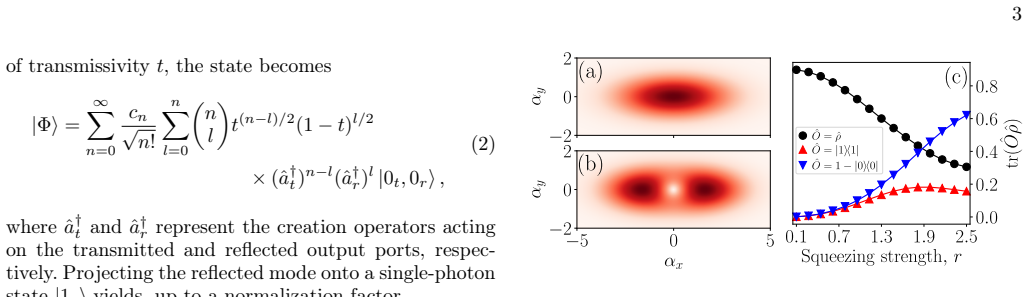
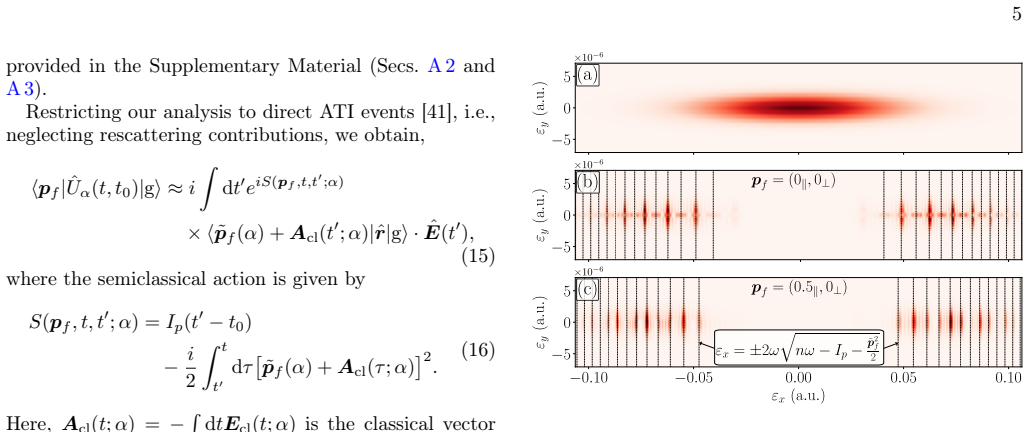
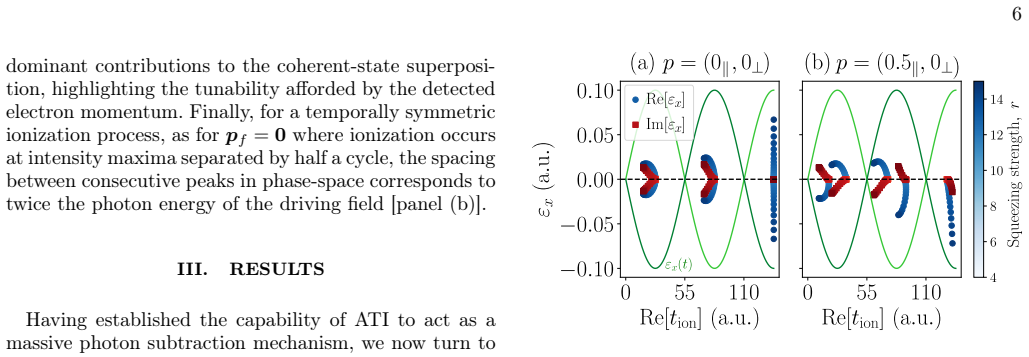
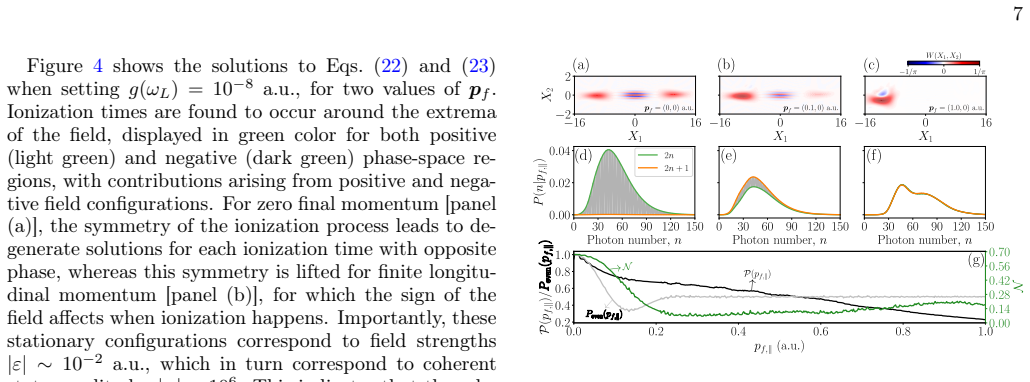
Above-threshold ionization driven by bright squeezed light provides a strong-field analogue of photon subtraction, where photoelectron detection acts as a high-intensity heralding mechanism, enabling the generation of large amplitude optical Schrödinger cat states. The resulting non-Gaussian features can be tuned via the detected photoelectron momentum and remain robust against finite momentum resolution at the heralding step. Despite the noise, the generated states can be manipulated to violate a Bell inequality.
What carries the argument
Above-threshold ionization driven by bright squeezed light acting as an effective photon subtraction via photoelectron detection as the heralding mechanism.
Load-bearing premise
The strong-field ionization dynamics can be treated as an effective photon subtraction operation on the squeezed vacuum without significant additional distortions or multi-electron effects.
What would settle it
An experiment that detects photoelectrons from bright squeezed vacuum but measures no negativity in the Wigner function of the heralded light or no Bell inequality violation beyond standard photon subtraction limits would falsify the claim.
Figures



read the original abstract
While the interface between strong-field physics and quantum optics offers a unique regime for combining extreme nonlinearity with quantum optical resources, its potential for generating non-classical states of light remains largely unexplored. Standard protocols for generating optical Schr\"odinger cat states, such as photon subtraction from squeezed light, are inherently limited in the achievable macroscopicity of the state and its scalability. In this work, we bridge this gap by demonstrating that above-threshold ionization driven by bright squeezed light provides a strong-field analogue of photon subtraction, where photoelectron detection acts as a high-intensity heralding mechanism, enabling the generation of large amplitude optical Schr\"odinger cat states. We characterize the resulting non-Gaussian features and show that they can be tuned via the detected photoelectron momentum, and study their robustness against the experimental imperfections arising from finite momentum resolution at the heralding step. Despite the noise, we show that the generated states can be manipulated to violate a Bell inequality, thereby highlighting their potential for foundational and practical applications. Our results establish strong-field processes as a scalable platform for macroscopic quantum state engineering, opening a route to quantum optics in previously inaccessible regimes.
Editorial analysis
A structured set of objections, weighed in public.
Referee Report
Summary. The manuscript proposes that above-threshold ionization (ATI) driven by bright squeezed vacuum light acts as a strong-field analogue of photon subtraction. Photoelectron detection serves as a high-intensity herald, generating large-amplitude optical Schrödinger cat states. The work derives the conditional optical state via the strong-field approximation, characterizes its non-Gaussian features and Wigner-function interference, shows tunability through detected photoelectron momentum, incorporates finite momentum resolution into the heralding operator, and demonstrates that the resulting states violate a Bell inequality after post-processing under the single-active-electron approximation.
Significance. If the effective mapping from ATI dynamics to photon subtraction holds, the approach offers a scalable route to macroscopic cat states that circumvents the intensity limits of conventional photon-subtraction protocols. Strengths include the explicit folding of experimental momentum resolution into the herald, the demonstration of Bell violation despite noise, and the use of the strong-field approximation to obtain a concrete conditional state whose Wigner function exhibits the expected interference.
minor comments (3)
- The abstract and introduction use the phrase 'erasing photons' without a precise definition; a short clarifying sentence in §2 linking this terminology to the effective subtraction operator would improve readability.
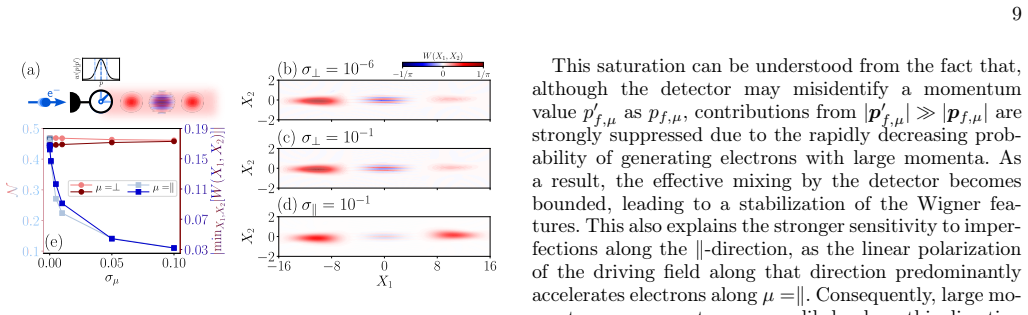
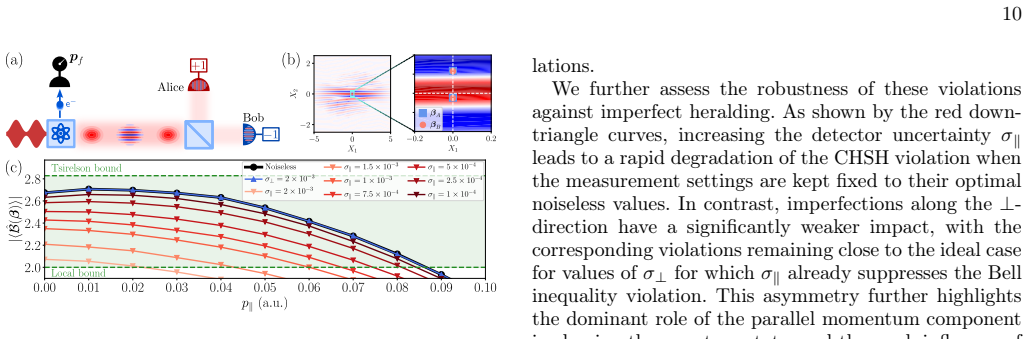
- Figure captions for the Wigner-function plots should explicitly state the momentum bin width used in the heralding operator so that readers can directly compare the plotted interference visibility to the robustness analysis in the text.
- A reference to the original strong-field approximation literature (e.g., the Lewenstein model) is missing in the derivation paragraph of the conditional-state section.
Simulated Author's Rebuttal
We thank the referee for their positive assessment of the manuscript, accurate summary of its contributions, and recommendation for minor revision. We appreciate the recognition of the work's potential as a scalable route to macroscopic cat states.
Circularity Check
No significant circularity detected
full rationale
The paper models above-threshold ionization under the strong-field approximation as an effective photon-subtraction channel on bright squeezed vacuum, deriving the conditional optical state and its Wigner function directly from standard quantum-optical and SFA equations. No predictions reduce to fitted parameters by construction, no self-definitional mappings appear, and no load-bearing self-citations or ansatzes imported from prior author work are required for the central claim. The resulting cat-state features and Bell-inequality violation follow from the heralding operator and post-processing without circular reduction to the input squeezed state. The derivation remains self-contained against external benchmarks in strong-field and quantum optics.
Axiom & Free-Parameter Ledger
Forward citations
Cited by 1 Pith paper
-
Emergence of Gaussian entanglement and non-Gaussianity in high-harmonic generation driven by bright squeezed light
Bichromatic HHG with coherent drive at ω and perturbative BSV at 2ω yields multimode Gaussian entanglement in even harmonics, modeled as a collective squeezed mode over the harmonic manifold.
Reference graph
Works this paper leans on
-
[1]
Georgescu, S
I. Georgescu, S. Ashhab, and F. Nori, Quantum simu- lation, Reviews of Modern Physics86, 153 (2014)
2014
-
[2]
Degen, F
C. Degen, F. Reinhard, and P. Cappellaro, Quantum sensing, Reviews of Modern Physics89, 035002 (2017)
2017
-
[3]
Portmann and R
C. Portmann and R. Renner, Security in quantum cryptography, Reviews of Modern Physics94, 025008 (2022)
2022
-
[4]
Horodecki, P
R. Horodecki, P. Horodecki, M. Horodecki, and K. Horodecki, Quantum entanglement, Reviews of Mod- ern Physics81, 865 (2009)
2009
-
[5]
A. Acín, I. Bloch, H. Buhrman, T. Calarco, C. Eichler, J. Eisert, D. Esteve, N. Gisin, S. J. Glaser, F. Jelezko, S. Kuhr, M. Lewenstein, M. F. Riedel, P. O. Schmidt, R. Thew, A. Wallraff, I. Walmsley, and F. K. Wilhelm, The quantum technologies roadmap: a European com- munity view, New Journal of Physics20, 080201 (2018)
2018
-
[6]
Gisin and R
N. Gisin and R. Thew, Quantum communication, Na- ture Photonics1, 165 (2007)
2007
-
[7]
P. Kok, W. J. Munro, K. Nemoto, T. C. Ralph, J. P. Dowling, and G. J. Milburn, Linear optical quantum computing with photonic qubits, Reviews of Modern Physics79, 135 (2007)
2007
-
[8]
Giovannetti, S
V. Giovannetti, S. Lloyd, and L. Maccone, Advances in quantum metrology, Nature Photonics5, 222 (2011)
2011
-
[9]
Aspuru-Guzik and P
A. Aspuru-Guzik and P. Walther, Photonic quantum simulators, Nature Physics8, 285 (2012)
2012
-
[10]
Pirandola, B
S. Pirandola, B. R. Bardhan, T. Gehring, C. Weed- brook, and S. Lloyd, Advances in photonic quantum sensing, Nature Photonics12, 724 (2018)
2018
-
[11]
V. C. Usenko, A. Acín, R. Alléaume, U. L. Andersen, E.Diamanti, T.Gehring, A.A.Hajomer, F.Kanitschar, C. Pacher, S. Pirandola, and V. Pruneri, Continuous- variable quantum communication, Reviews of Modern Physics98, 015003 (2026)
2026
-
[12]
van Loock, Optical hybrid approaches to quantum information, Laser & Photonics Reviews5, 167 (2011)
P. van Loock, Optical hybrid approaches to quantum information, Laser & Photonics Reviews5, 167 (2011)
2011
-
[13]
U. L. Andersen, J. S. Neergaard-Nielsen, P. van Loock, and A. Furusawa, Hybrid discrete- and continuous- variable quantum information, Nature Physics11, 713 (2015)
2015
-
[14]
D. C. Burnham and D. L. Weinberg, Observation of Si- multaneity in Parametric Production of Optical Photon Pairs, Physical Review Letters25, 84 (1970)
1970
-
[15]
C. K. Hong, Z. Y. Ou, and L. Mandel, Measurement of subpicosecond time intervals between two photons by interference, Physical Review Letters59, 2044 (1987)
2044
-
[16]
R. E. Slusher, L. W. Hollberg, B. Yurke, J. C. Mertz, and J. F. Valley, Observation of Squeezed States Gener- ated by Four-Wave Mixing in an Optical Cavity, Phys- ical Review Letters55, 2409 (1985)
1985
-
[17]
L.-A. Wu, M. Xiao, and H. J. Kimble, Squeezed states of light from an optical parametric oscillator, JOSA B 4, 1465 (1987)
1987
-
[18]
Schneider, M
K. Schneider, M. Lang, J. Mlynek, and S. Schiller, Gen- eration of strongly squeezed continuous-wave light at 1064 nm, Optics Express2, 59 (1998)
1998
-
[19]
P. K. Lam, T. C. Ralph, B. C. Buchler, D. E. Mc- Clelland, H.-A. Bachor, and J. Gao, Optimization and transfer of vacuum squeezing from an optical parametric oscillator, Journal of Optics B: Quantum and Semiclas- sical Optics1, 469 (1999)
1999
-
[20]
D. F. Walls, Squeezed states of light, Nature306, 141 (1983)
1983
-
[21]
Xiao, L.-A
M. Xiao, L.-A. Wu, and H. J. Kimble, Precision mea- surement beyond the shot-noise limit, Physical Review Letters59, 278 (1987)
1987
-
[22]
The LIGO Scientific Collaboration, A gravitational wave observatory operating beyond the quantum shot- noise limit, Nature Physics7, 962 (2011)
2011
-
[23]
Dakna, T
M. Dakna, T. Anhut, T. Opatrný, L. Knöll, and D.-G. Welsch, Generating Schödinger-cat-like states by means of conditional measurements on a beam splitter, Physi- cal Review A55, 3184 (1997)
1997
-
[24]
Ourjoumtsev, R
A. Ourjoumtsev, R. Tualle-Brouri, J. Laurat, and P. Grangier, Generating Optical Schrödinger Kittens for Quantum Information Processing, Science312, 83 (2006)
2006
-
[25]
J. S. Neergaard-Nielsen, B. M. Nielsen, C. Hettich, K. Mølmer, and E. S. Polzik, Generation of a Superposi- tion of Odd Photon Number States for Quantum Infor- mation Networks, Physical Review Letters97, 083604 (2006)
2006
-
[26]
Ourjoumtsev, H
A. Ourjoumtsev, H. Jeong, R. Tualle-Brouri, and P. Grangier, Generation of optical ‘Schrödinger cats’ from photon number states, Nature448, 784 (2007), number: 7155. 13
2007
-
[27]
Hacker, S
B. Hacker, S. Welte, S. Daiss, A. Shaukat, S. Ritter, L. Li, and G. Rempe, Deterministic creation of entan- gled atom–light Schrödinger-cat states, Nature Photon- ics13, 110 (2019)
2019
-
[28]
S. J. van Enk and O. Hirota, Entangled coherent states: Teleportation and decoherence, Physical Review A64, 022313 (2001)
2001
-
[29]
Gilchrist, K
A. Gilchrist, K. Nemoto, W. J. Munro, T. C. Ralph, S. Glancy, S. L. Braunstein, and G. J. Milburn, Schrödinger cats and their power for quantum infor- mation processing, Journal of Optics B: Quantum and Semiclassical Optics6, S828 (2004)
2004
-
[30]
A. P. Lund, T. C. Ralph, and H. L. Haselgrove, Fault- Tolerant Linear Optical Quantum Computing with Small-Amplitude Coherent States, Physical Review Let- ters100, 030503 (2008)
2008
-
[31]
N. Lee, H. Benichi, Y. Takeno, S. Takeda, J. Webb, E. Huntington, and A. Furusawa, Teleportation of Non- classicalWavePacketsofLight,Science332,330(2011)
2011
-
[32]
Zavatta, S
A. Zavatta, S. Viciani, and M. Bellini, Quantum-to- Classical Transition with Single-Photon-Added Coher- ent States of Light, Science306, 660 (2004)
2004
-
[33]
Paavola, M
J. Paavola, M. J. W. Hall, M. G. A. Paris, and S. Man- iscalco, Finite-time quantum-to-classical transition for a Schrödinger-cat state, Physical Review A84, 012121 (2011)
2011
-
[34]
Einstein, B
A. Einstein, B. Podolsky, and N. Rosen, Can Quantum- Mechanical Description of Physical Reality Be Consid- ered Complete?, Physical Review47, 777 (1935)
1935
-
[35]
J. S. Bell, On the Einstein Podolsky Rosen paradox, Physics Physique Fizika1, 195 (1964)
1964
-
[36]
Brunner, D
N. Brunner, D. Cavalcanti, S. Pironio, V. Scarani, and S. Wehner, Bell nonlocality, Reviews of Modern Physics 86, 419 (2014)
2014
-
[37]
Laghaout, J
A. Laghaout, J. S. Neergaard-Nielsen, I. Rigas, C. Kragh, A. Tipsmark, and U. L. Andersen, Ampli- fication of realistic Schrödinger-cat-state-like states by homodyne heralding, Physical Review A87, 043826 (2013)
2013
-
[38]
D. V. Sychev, A. E. Ulanov, A. A. Pushkina, M. W. Richards, I. A. Fedorov, and A. I. Lvovsky, Enlargement ofopticalSchrödinger’scatstates,NaturePhotonics11, 379 (2017)
2017
-
[39]
L. V. Keldysh, Ionization of atoms in an alternating electric field, Sov. Phys. JETP20, 1307 (1965)
1965
-
[40]
DiMauro, M
L. DiMauro, M. Frolov, K. L. Ishikawa, and M. Ivanov, 50 years of optical tunneling, Journal of Physics B: Atomic, Molecular and Optical Physics47, 200301 (2014)
2014
-
[41]
Amini, J
K. Amini, J. Biegert, F. Calegari, A. Chacón, M. F. Ciappina, A. Dauphin, D. K. Efimov, C. F. d. M. Faria, K. Giergiel, P. Gniewek, A. S. Landsman, M. Lesiuk, M. Mandrysz, A. S. Maxwell, R. Moszyński, L. Ort- mann, J. A. Pérez-Hernández, A. Picón, E. Pisanty, J. Prauzner-Bechcicki, K. Sacha, N. Suárez, A. Zaïr, J. Zakrzewski, and M. Lewenstein, Symphony o...
2019
-
[42]
Antoine, A
P. Antoine, A. L’Huillier, and M. Lewenstein, Attosec- ond Pulse Trains Using High–Order Harmonics, Physi- cal Review Letters77, 1234 (1996)
1996
-
[43]
Drescher, M
M. Drescher, M. Hentschel, R. Kienberger, G. Tem- pea, C. Spielmann, G. A. Reider, P. B. Corkum, and F. Krausz, X-ray Pulses Approaching the Attosecond Frontier, Science291, 1923 (2001)
1923
-
[44]
P. M. Paul, E. S. Toma, P. Breger, G. Mullot, F. Augé, P. Balcou, H. G. Muller, and P. Agostini, Observation of a Train of Attosecond Pulses from High Harmonic Generation, Science292, 1689 (2001)
2001
-
[45]
P. B. Corkum and F. Krausz, Attosecond science, Na- ture Physics3, 381 (2007)
2007
-
[46]
Krausz and M
F. Krausz and M. Ivanov, Attosecond physics, Reviews of Modern Physics81, 163 (2009)
2009
-
[47]
Cruz-Rodriguez, D
L. Cruz-Rodriguez, D. Dey, A. Freibert, and P. Stam- mer, Quantum phenomena in attosecond science, Na- ture Reviews Physics6, 691 (2024)
2024
-
[48]
P. Stammer, J. Rivera-Dean, P. Tzallas, M. F. Ciappina, and M. Lewenstein, Colloquium: Quantum optics of in- tense light–matter interaction (2025), arXiv:2510.19045 [quant-ph]
-
[49]
Stammer, T
P. Stammer, T. F. Martos, M. Lewenstein, and G. Rajchel-Mieldzioć, Metrological robustness of high photon number optical cat states, Quantum Science and Technology9, 045047 (2024)
2024
-
[50]
Sennary, J
M. Sennary, J. Rivera-Dean, M. ElKabbash, V. Pervak, M. Lewenstein, and M. T. Hassan, Attosecond quantum uncertainty dynamics and ultrafast squeezed light for quantumcommunication,Light: Science&Applications 14, 350 (2025)
2025
-
[51]
M. Sennary, J. Rivera-Dean, Y. Wange, M. Lewenstein, and M. T. Hassan, Attosecond quantum optics (2026), arXiv:2601.08671 [physics]
-
[52]
K. Y. Spasibko, D. A. Kopylov, V. L. Krutyanskiy, T. V. Murzina, G. Leuchs, and M. V. Chekhova, Mul- tiphoton Effects Enhanced due to Ultrafast Photon- Number Fluctuations, Physical Review Letters119, 223603 (2017)
2017
-
[53]
Manceau, K
M. Manceau, K. Y. Spasibko, G. Leuchs, R. Filip, and M. V. Chekhova, Indefinite-Mean Pareto Photon Distri- bution from Amplified Quantum Noise, Physical Review Letters123, 123606 (2019)
2019
-
[54]
A. Rasputnyi, Z. Chen, M. Birk, O. Cohen, I. Kaminer, M. Krüger, D. Seletskiy, M. Chekhova, and F. Tani, High-harmonic generation by a bright squeezed vacuum, Nature Physics 10.1038/s41567-024-02659-x (2024)
-
[55]
Heimerl, A
J. Heimerl, A. Mikhaylov, S. Meier, H. Höllerer, I. Kaminer, M. Chekhova, and P. Hommelhoff, Multi- photon electron emission with non-classical light, Na- ture Physics20, 945 (2024)
2024
-
[56]
Heimerl, A
J. Heimerl, A. Rasputnyi, J. Pölloth, S. Meier, M. Chekhova, and P. Hommelhoff, Quantum light drives electrons strongly at metal needle tips, Nature Physics 21, 1899 (2025)
2025
-
[57]
Lemieux, S
S. Lemieux, S. A. Jalil, D. N. Purschke, N. Boroumand, T. J. Hammond, D. Villeneuve, A. Naumov, T. Brabec, andG.Vampa,Photonbunchinginhigh-harmonicemis- sion controlled by quantum light, Nature Photonics19, 767 (2025)
2025
- [58]
-
[59]
Y. Kern, I. Nisim, M. Birk, A. Rasputnyi, D. Behar, Z. Chen, I. Kaminer, P. Sidorenko, O. Cohen, and M. Krüger, Single-shot pulse retrieval of femtosecond bright squeezed vacuum, Optica13, 395 (2026)
2026
-
[60]
Z. Lyu, F. Sun, S. Yi, J. Li, H. Liu, Q. He, Q. Gong, 14 M. Ivanov, and Y. Liu, Attosecond quantum spec- troscopy with entangled photon pairs (2026)
2026
-
[61]
Gorlach, M
A. Gorlach, M. E. Tzur, M. Birk, M. Krüger, N. Rivera, O. Cohen, and I. Kaminer, High-harmonic generation driven by quantum light, Nature Physics , 1 (2023)
2023
-
[62]
Even Tzur, M
M. Even Tzur, M. Birk, A. Gorlach, M. Krüger, I. Kaminer, and O. Cohen, Photon-statistics force in ultrafast electron dynamics, Nature Photonics17, 501 (2023)
2023
-
[63]
Wang and X
S. Wang and X. Lai, High-order above-threshold ion- ization of an atom in intense quantum light, Physical Review A108, 063101 (2023)
2023
-
[64]
Z. Lyu, F. Sun, Y. Fang, Q. He, and Y. Liu, Ef- fect of photon quantum statistics on electrons in above-threshold ionization, Physical Review Research 7, L012072 (2025)
2025
-
[65]
H.Liu, H.Zhang, X.Wang,andJ.Yuan,AtomicDouble Ionization with Quantum Light, Physical Review Let- ters134, 123202 (2025)
2025
-
[66]
Rivera-Dean, P
J. Rivera-Dean, P. Stammer, M. Ciappina, and M. Lewenstein, Structured Squeezed Light Allows for High-Harmonic Generation in Classical Forbidden Ge- ometries, Physical Review Letters135, 013801 (2025)
2025
-
[67]
P. Stammer, C. Granados, and J. Rivera-Dean, Fluctuation-induced symmetry breaking in high har- monic generation for bicircular quantum light (2026), arXiv:2603.24377 [quant-ph]
-
[68]
Rivera-Dean, L
J. Rivera-Dean, L. Petrovic, M. Lewenstein, and P. Stammer, Attosecond quantum optical interferom- etry, Reports on Progress in Physics89, 047901 (2026)
2026
-
[69]
Interferometrically Enhanced Asymmetry in Strong-field Ionization with Bright Squeezed Vacuum
G. Singh, T. Rook, J. Rivera-Dean, and C. F. d. M. Faria, Interferometrically Enhanced Asymmetry in Strong-field Ionization with Bright Squeezed Vacuum (2026), arXiv:2604.12646 [quant-ph]
work page internal anchor Pith review Pith/arXiv arXiv 2026
-
[70]
C. S. Lange, T. Hansen, and L. B. Madsen, Electron- correlation-induced nonclassicality of light from high- order harmonic generation, Physical Review A109, 033110 (2024)
2024
-
[71]
Stammer, J
P. Stammer, J. Rivera-Dean, A. S. Maxwell, T. Lam- prou, J. Argüello-Luengo, P. Tzallas, M. F. Ciappina, and M. Lewenstein, Entanglement and Squeezing of the Optical Field Modes in High Harmonic Generation, Physical Review Letters132, 143603 (2024)
2024
-
[72]
Theidel, V
D. Theidel, V. Cotte, R. Sondenheimer, V. Shiriaeva, M. Froidevaux, V. Severin, A. Merdji-Larue, P. Mosel, S. Fröhlich, K.-A. Weber, U. Morgner, M. Kovacev, J. Biegert, and H. Merdji, Evidence of the Quantum Op- tical Nature of High-Harmonic Generation, PRX Quan- tum5, 040319 (2024)
2024
-
[73]
Theidel, V
D. Theidel, V. Cotte, P. Heinzel, H. Griguer, M. Weis, R. Sondenheimer, and H. Merdji, Observation of a displaced squeezed state in high-harmonic generation, Physical Review Research7, 033223 (2025)
2025
-
[74]
S. Yi, N. D. Klimkin, G. G. Brown, O. Smirnova, S. Patchkovskii, I. Babushkin, and M. Ivanov, Genera- tion of Massively Entangled Bright States of Light dur- ing Harmonic Generation in Resonant Media, Physical Review X15, 011023 (2025)
2025
-
[75]
Lewenstein, M
M. Lewenstein, M. F. Ciappina, E. Pisanty, J. Rivera- Dean, P. Stammer, T. Lamprou, and P. Tzallas, Gen- eration of optical Schrödinger cat states in intense laser–matter interactions, Nature Physics17, 1104 (2021)
2021
-
[76]
Stammer, J
P. Stammer, J. Rivera-Dean, T. Lamprou, E. Pisanty, M. F. Ciappina, P. Tzallas, and M. Lewenstein, High Photon Number Entangled States and Coherent State Superposition from the Extreme Ultraviolet to the Far Infrared, Physical Review Letters128, 123603 (2022)
2022
-
[77]
Stammer, J
P. Stammer, J. Rivera-Dean, A. Maxwell, T. Lam- prou, A. Ordóñez, M. F. Ciappina, P. Tzallas, and M. Lewenstein, Quantum Electrodynamics of Intense Laser-Matter Interactions: A Tool for Quantum State Engineering, PRX Quantum4, 010201 (2023)
2023
-
[78]
P. Stammer, Information-theoretic perspective on en- ergy conservation in high harmonic generation (2026), arXiv:2410.15503 [quant-ph] version: 2
-
[79]
D. Theidel, M. Nahra, I. Karuseichyk, H. Griguer, M. Weis, and H. Merdji, Sub-Poissonian Statistics and Quantum Non-Gaussianity from High-Harmonic Gener- ation (2026), arXiv:2602.10882 [quant-ph]
-
[80]
Rivera-Dean and P
J. Rivera-Dean and P. Stammer, Non-classiality criteria using coherent state expansions (202X)
discussion (0)
Sign in with ORCID, Apple, or X to comment. Anyone can read and Pith papers without signing in.